For the ELCA Division for Higher Education and Schools and the Council of ELCA College and University Presidents, the journal INTERSECTIONS is an important way to stimulate discussion of what it means (and should mean) to a college or university to be related to the ELCA. Another important way is through the conference where most of the papers have been presented that get published in INTERSECTIONS, the annual conference on “The Vocation of a Lutheran College.” We thought the 1998 conference went exceptionally well, and the reactions after the presentations were very positive.
Maybe we should not be surprised then, that the INTERSECTIONS issue preceding this one, where we first drew upon that conference for papers, has been the most popular ever (so far), widely used by the Lutheran colleges and universities. But I do want to praise and congratulate our editor, professor Tom Christenson, since he gave as the keynote address at the conference what became the lead article of that issue. His modesty had not allowed us to draw upon his talents and insights in as prominent a manner until now. This issue continues the publication of the presentations from that conference.
Both the conference and the journal are possible thanks to a generous grant from the Lutheran Brotherhood Foundation. Now LB has come through with another great grant, so this summer we will be able to have the inaugural session of “The Lutheran Academy of Scholars in Higher Education.” This will be a two-week long seminar at Harvard University for a select group of faculty from Lutheran colleges and universities. The theme will be “Finding Our Voice — Christian Faith and Critical Vision,” and the leader will be Dr. Ron Thiemann, the John Lord O’Brian Professor of Divinity and former Dean of Harvard School of Divinity. This will be another way for the Council of Presidents and the Division for Higher Education to stimulate discussion of and publications about the relationship between faith, life and higher education.
I am glad that the institutions of the church and the institutions of higher education have recognized that they need to promote scholarly work on faith related issues in many different disciplines. I am also glad that Lutheran colleges and universities have faculty who respond to the challenge to study, argue, and present in oral and in written form new insights about the important issues college students must face as they try to find clarity in their lives. And I am glad that you have the opportunity to read this journal to stimulate your thoughts about these issues.
Arne Selbyg
Director for Colleges and Universities
ELCA Division for Higher Education and Schools
-
 Editorial
From the Editor
Tom Christenson
Christenson introduces the issue’s contents—papers from the 1998 Vocation conference by Cheryl Ney and Robert Scholz, a response by Jennifer Sacher Wiley, an interview with four Capital University faculty about Cuba, a meditation by St. Olaf senior Erik Haaland, and the journal’s first letter to the editor—and commends the Mount Mary College volume Wagering on Transcendence as a model of a faculty community sustained by Friday-afternoon conversation over a glass of wine.
-
Article
Rooting Science in Empathy: Growing Towards a Sustainable Science Practice for the 21st Century
Cheryl L. Ney
Ney, a DNA biochemist turned feminist science educator at Capital University, traces her own search for the “grounding” of teaching from Ernest Boyer’s scholarship of teaching through Cathleen Loving’s Scientific Theory Profile, Evelyn Fox-Keller’s critiques of science as “truly masculine philosophy” and her biography of Barbara McClintock (“A Feeling for the Organism”), and Arnold Pacey’s definition of science as a web of technical, organizational, and cultural practice. Drawing on the Dutch Science Shops, the Loka Institute’s community-based research, and academic service learning, she calls for “sustainable science practice” rooted in empathy and asks whether Lutheran institutions have the courage to claim an institutional freedom of vision rather than reduce themselves to preparation for the job market.
-
Article
How Can We Keep From Singing?
Robert Scholz
Scholz, professor of music at St. Olaf, responds to Tom Christenson’s “Freedom of a Christian” by walking through his own Nunc dimittis for the St. Olaf Christmas Festival, an Elderhostel choir of singers aged 60 to 95, and the four liberating arts (enablement and change, melioristic, embodying, and critical) as they shape conducting, composition, and music education. He defends the fine arts and folk traditions over “contemporary Christian” soft pop-rock and taped accompaniments, citing Luther’s preface to Georg Rhau’s Symphoniae iucundae and the family of God’s need to interact in song against the virtual community of TV evangelism and the Crystal Cathedrals of the air.
-
Reflection
Some Personal Reflections on the ELCA Vocation of a Lutheran College Conference, 1998
Jennifer Sacher Wiley
Sacher Wiley, a Unitarian Universalist with one Jewish parent and a first-year music faculty member at Susquehanna, reflects on common-ness and other-ness at the 1998 conference—Tom Christenson’s weaver’s warp and Charles Ives’s essay on American music—and proposes four markers of group identity. Against the fear of secularization expressed by some attendees, she suggests that “Christian” might be defined less by belief in Christ as Savior than by living a vocation as Jesus lived, with Cheryl Ney offered as an example of a “working prophet,” or “little Christ,” regardless of specific belief in the Trinity.
-
Article
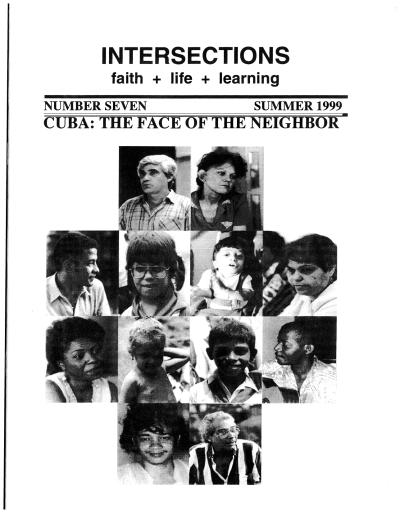
The Face of the Neighbor: An Interview with Four Capital University Faculty About Their Recent Visit to Cuba
Brian Forry Wallace, Michael Yosha, Reg Dyck, Susan Narita
Four Capital University faculty—political scientist Brian Wallace (returning to Cuba a third time after the 1994 boat lift), English professor Reg Dyck, ESL teacher Susan Narita, and political scientist Michael Yosha—recount their summer 1998 trip with Pastors for Peace, describing Cuban priorities of education, health care, and military (in that order), the cultural richness of Havana from sixteenth-century cloisters to Miramar, the Cuban Foreign Service’s vision of a Scandinavian-style democratic socialism, the counter-productive U.S. embargo (including its effect on kidney dialysis machines), Castro’s 1991 reconciliation with religious communities, and a recurrent image of a little girl named Marguerite singing at a school for amputee and terminally ill children. The interview was conducted by Capital senior Jessica Brown and Tom Christenson.
-
Reflection
Meditation—Band Chapel Service, St. Olaf College
Erik Haaland
Haaland, a St. Olaf senior, offers a brief Band Chapel meditation that defines art as “the expression of what is deeply human through the manipulation of the physical world” and defends worship—architecture, stained glass, music, eloquence—as an art form requiring our best and most sincere efforts. When the God we worship and the salvation we proclaim do not seem near, artful worship offers not propositions but something real and tangible to hold on to.
-
Institutional Focus
Letters to the Editor
The journal’s first letter to the editor: Pastor John L. Vaswig of Spokane, a Pacific Lutheran University alumnus and member of the PLU Board of Regents, writes after reading James Tunstead Burtchaell’s The Dying Light: The Disengagement of Colleges and Universities from Their Christian Churches to ask whether church-related institutions, in their effort to be open and tolerant, have abandoned a compelling word of hope and forgiveness in Jesus Christ.
-
 Article
From Alien to Citizen
Arne Selbyg
No. 29 · Spring 2009
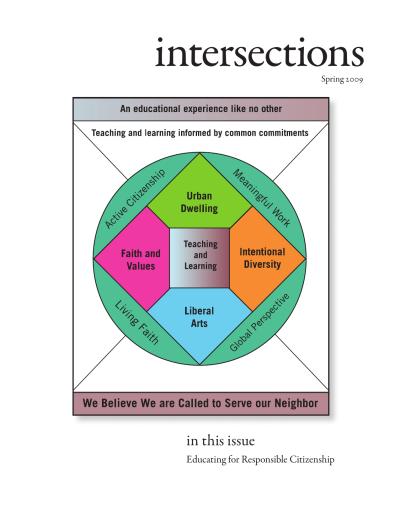
Selbyg reflects on three experiences of being educated for citizenship—growing up in Norway under the legacy of Lutheran pastors and public school teachers who resisted the Nazi occupation, arriving in America as a resident alien, and becoming a naturalized American citizen—and proposes the jazz ensemble as a better metaphor for American society than the melting pot, one in which different citizens learn skills, study other instruments, and dialog with one another in service to the common music.
-
 Editorial
From the Publisher
Arne Selbyg
No. 27 · Spring 2008
Selbyg, retiring this summer as Director for ELCA Colleges and Universities, reflects on his decade serving as spokesperson between the church and its twenty-eight colleges and universities, and argues that the link between the colleges and the church has grown stronger over the last ten years — sustained by supportive church leaders like Presiding Bishop Mark Hanson, the annual Vocation of a Lutheran College conference, and a Lutheran theology of higher education whose principles (questioning authority, returning to the sources, including the excluded, serving the neighbor) remain a strong basis for operating colleges and universities in the twenty-first century.
-
 Editorial
From the Publisher
Arne Selbyg
No. 26 · Fall 2007
Selbyg notes that, while a stated purpose of Intersections over its twelve years and twenty-six issues has been the intersection of faith, learning, and teaching, surprisingly few articles have addressed how Lutheran faculty teach and why — and credits the editor for assembling essays from authors whose teaching has benefited from the ELCA Wittenberg Center, on the eve of the City of Wittenberg’s “Luther Decade” leading up to the 2017 Reformation anniversary.
-
 Editorial
From the Publisher
Arne Selbyg
No. 25 · Spring 2007
Selbyg notes that most papers in this issue grew out of a pan-Lutheran conference organized by the Association of Lutheran College Faculties in fall 2006 rather than the annual Vocation of a Lutheran College conference, and argues that the ELCA’s ecumenical posture—truthful but open to learning from others—is a good foundation for institutions of higher education whose faculty likewise profess while remaining subject to change based on new research and insights.
-
 Editorial
From the Publisher
Arne Selbyg
No. 24 · Fall 2006
Selbyg situates this issue in the ongoing ELCA conversation about education that began with the 2005 conference and is feeding into the second draft of the ELCA Social Statement on Education, previews the 2007 conference (“The Vocation of a Lutheran College — Engaging the World”) at Augustana College, Rock Island, and lifts up Luther’s insistence that the church and its members contribute to their wider communities rather than retreat into self-centered enclaves.
-
 Editorial
From the Publisher
Arne Selbyg
No. 23 · Summer 2006
Selbyg features articles based on presentations at the 2005 Vocation of a Lutheran College conference focused on the upcoming ELCA Social Statement on Education, and urges members of the ELCA higher-education community to download the first draft (“Our Calling in Education”) from the ELCA website and submit feedback to the Task Force on Education before the October 15 deadline. He worries that the sexuality social statement on a 2009 timeline will draw more attention than the education statement, but reminds readers that, for Martin Luther and for those who work in Lutheran higher education, education is as important as sex.
-
Article
Lutheran Education in the None Zone
Samuel Torvend
No. 23 · Summer 2006
Torvend, Associate Professor of Religion at Pacific Lutheran University, argues that any ELCA social statement on education must speak not only to those raised within the cultural and theological traditions of ELCA Lutheranism but also to the diverse communities of the “none zone” — the Pacific Northwest and other regions where religious affiliation is increasingly unaffiliated. The statement must therefore equip Lutheran colleges, congregations, and schools for engagement with religious pluralism and cultural diversity rather than presuming a Lutheran cultural baseline.
-
 Article
Women in Leadership: Obstacles, Opportunities, and Entry Points
Susan Hasseler
No. 41 · Spring 2015
Drawing on two focus-group conversations with female faculty and academic administrators at Augustana College (Sioux Falls), Hasseler traces four obstacle/opportunity themes for women in academic leadership — valuing the intellectual work of leadership, religious and cultural interpretations of gender roles, caregiving realities, and embracing a strong voice — and proposes deliberate next steps for cultivating inclusive excellence on ELCA campuses.
-
 Editorial
From the Editor
Jason A. Mahn
No. 37 · Spring 2013
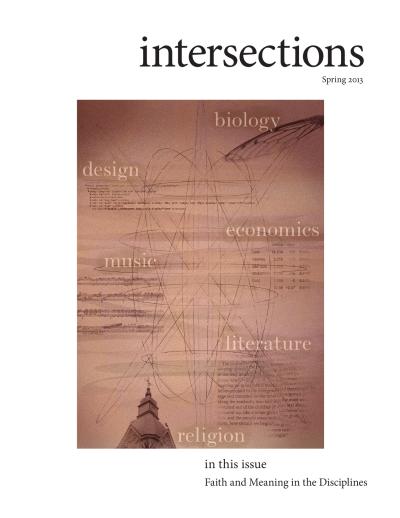
Mahn introduces the issue’s six essays as parallel attempts—from poetry, economics, choral music, biology, religion, and Lutheran higher education—to resist our culture’s fact-value split, and uses Augustana’s Fritiof Fryxell, a 1922 biology and English graduate who began teaching just as the Scopes Trial ignited, to illustrate how church-related colleges have long held faith and disciplinary inquiry together.
-
 Article
Radical Hospitality on Haunted Grounds: Anti-Racism in Lutheran Higher Education
Krista E. Hughes
No. 52 · Fall 2020
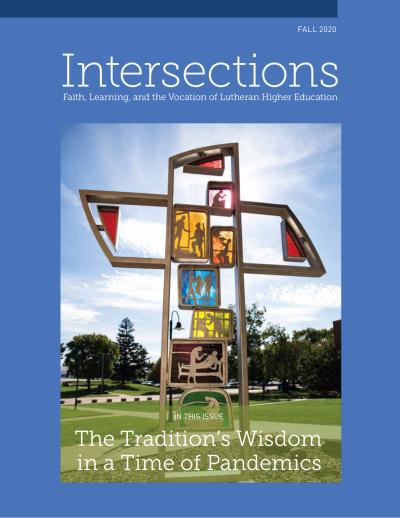
Writing from Newberry College’s campus on land once home to the Cherokee and within a day’s drive of Mother Emanuel A.M.E., Hughes argues that NECU’s call to “practice radical hospitality” demands that predominately white institutions open themselves to the hauntings of racism — pursuing belonging rather than mere welcome, and risking kenotic transformation of institutional identity itself.
-
 Reflection
Shelter in Place: Reflections from March 22, 2020
Jason A. Mahn
No. 53 · Spring 2021
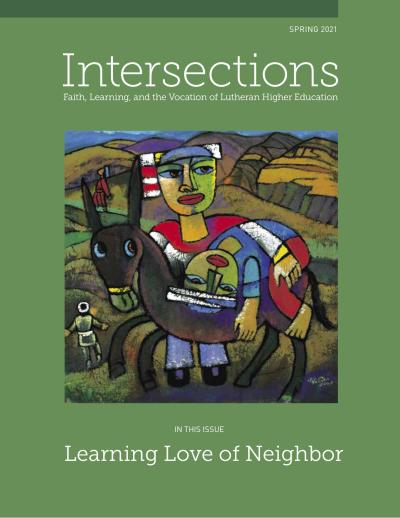
On the fourth Sunday of Lent in 2020, Mahn meditates on the etymology of “shelter” (from shield) and on an email from a former student in Boston whose mutual-aid organizing models a Lutheran understanding of vocation: the upending of ego by divine love that frees us, finally, to see and serve the neighbor.
-
 Editorial
Guest Editorial
Lynn Hunnicutt
No. 47 · Spring 2018
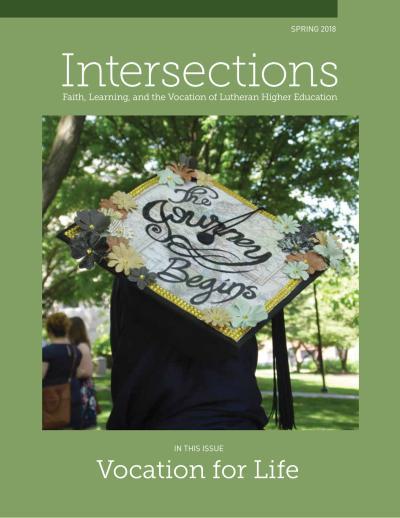
Hunnicutt traces the etymology of vocation through its cognates — evoke, provoke, convocation — to argue that vocation presumes a relationship between caller and called, that callings are often grounded in ordinary words and humble lives, and that recognizing vocation as plural and lifelong relieves colleges of the pressure to help students find a single calling while on campus.