Characters:
Maggie — age 22, senior in college
Chris — age 22, senior in college
Herr Kopp — a peasant of the 16th century
As the play begins, Maggie is in the college library stacks. She is at a desk that sits perpendicular to the audience. There is a chair on the other side and another desk behind her. There are bookshelves extending towards the back of the stage, perpendicular to the audience, disappearing into darkness, or a wall. This is where people will enter or exit, through these rows of books. There are books on her desk as she studies. She does not love her studies and is tired. She has a laptop with her. She types…
MAGGIE: Oh drat, where was that quote… it’s here somewhere. (Looking through her books.) Here? No, maybe here. There we go. No wonder I couldn’t find it. Anything this boring you’d want to forget. Apology of Augsburg. They should apologize for this, for the drudgery, the punishment… Jeesh, what were these guys thinking? And to think wars were fought over this stuff. (Returning to her work) Oh, I’m so tired… (Lays her head down on her desk)
Chris enters and begins sneaking up on her.
MAGGIE: Hello Chris.
CHRIS: How did you know?
MAGGIE: I can smell you.
CHRIS: What?
MAGGIE: You still use that same soap.
CHRIS: What’s wrong with it?
MAGGIE: Nothing’s wrong with. I have just been a friend with you long enough to know it, and I have a sensitive nose.
CHRIS: Is it, well, a bad smell?
MAGGIE: It’s a fine smell, if you have to smell.
CHRIS: Everyone has a smell.
MAGGIE: No, they don’t.
CHRIS: Yes, everyone does.
MAGGIE: What’s my smell?
CHRIS: I don’t know.
MAGGIE: See?
CHRIS: Just because I don’t know it doesn’t mean you don’t have one. If I have a smell, you have a smell.
MAGGIE: I don’t use some super-duper, extra deodorant plus, fragrant soap bar, that’s all.
CHRIS: Maybe you should.
MAGGIE: What’s that supposed to mean?
CHRIS: Just kidding, just kidding; I’m flattered, actually.
MAGGIE: Don’t be.
CHRIS: She knows my smell. She knows my smell.
MAGGIE: Will you be quiet?
CHRIS: It means you care.
MAGGIE: It means we have spent enough time together around this campus, studying, talking…
CHRIS: And other things.
MAGGIE: But none of “those things” which would warrant you hollering through the college library that I care.
CHRIS: Of course, I’m surprised you smell anything since you keep your nose so much in those books.
MAGGIE: Do not.
CHRIS: Oh, but you do. What’s this?
MAGGIE: Reformation history. Dr. Schmidt.
CHRIS: Oh, gag.
MAGGIE: It’s not that bad.
CHRIS: Apology of Augsburg. Smallcald articles. We Lutherans are so tedious.
MAGGIE: Yeah, I know.
CHRIS: But sometimes it’s good. When Luther deals with the common stuff, the everyday. When he talks of the guy in the gutter, the farmer shoveling manure, the lady just trying to feed the kids. Beer! He brewed beer! As a college student, you know I like that! Does he talk about sex in there anywhere?
MAGGIE: Look, I have to finish this thing. I have a lot of work to do. This is my senior year, and a lot is riding on it.
CHRIS: What? I forgot, is there something higher than Magna Summa, super double duper Cum Laude? Is there a ranking higher than the first?
MAGGIE: Don’t be so sarcastic.
CHRIS: Eat, drink, be merry the good book says, for this life is futile, my dear friend. A vanity of vanities, a chasing after wind. When we have shuffled off, this mortal coil must give us pause. What dreams may come? Ah, there’s the rub!
MAGGIE: Look, pick. Ecclesiates or Shakespeare, not both, and don’t butcher the bard so horribly.
CHRIS: Is it vanity that you chase?
MAGGIE: It is simply my future that I concern myself with.
CHRIS: Oh as if you have to worry. Look, Maggie, you are one of the top students at this school. You have graduate schools begging for you, not to mention me begging you to…
MAGGIE: Groveling doesn’t become you.
CHRIS: Oh, but we are all beggars.
MAGGIE: Now you quote Luther? I think he was referring to our status before God. Not men pleading for a date.
CHRIS: It still applies. And you are a goddess.
MAGGIE: And you are a devil. Get off your knees. And don’t go talking about me. You don’t do so badly yourself, but you, aren’t you filled with anxiety? Aren’t you worried?
CHRIS: About what?
MAGGIE: About the future. About what you’re going to do when you shuffle off this mortal coil we call school.
CHRIS: I’ll figure out what I’m going to do eventually. It’ll come to me.
MAGGIE: What are you thinking about doing come June?
CHRIS: I don’t know. I might bike across the country.
MAGGIE: Come on.
CHRIS: Really. I think when I graduate I am going to bike across the country. I have a friend in Durham in an environmental energy firm who might have something for me.
MAGGIE: You’re so lucky.
CHRIS: Huh?
MAGGIE: You can do almost anything you want. What about med school?
CHRIS: I’m not so sure I’ll get in. I think I need to work first anyway. I have to make sure why I’m doing it, you know, that I want to do it. Not just because I liked ER, or that it’s a family tradition.
MAGGIE: I sort of wish I had a family tradition.
CHRIS: Don’t be so sure.
MAGGIE: Really. Something. Someone to say: Here, look at this! You need to do this.
CHRIS: I think you already know what it is.
MAGGIE: Don’t start on that.
CHRIS: You just want to ignore all the obvious trail markings.
MAGGIE: I don’t need to hear it from you too.
CHRIS: Why not? After all, if you know my smell…
MAGGIE: That doesn’t give you the right to tell me what direction my life should take.
CHRIS: I’m not. I’m just saying, you tend to ignore the obvious. Maybe that’s why you are so anxious.
MAGGIE: Don’t analyze me. One intro to psych course and everyone’s a counselor.
CHRIS: I’m just saying, if you get good grades you have more options open to you, but if you choose a path, well, you might not need to be so perfect.
MAGGIE: And you think you know my path?
CHRIS: I think there’s been something biting at you for some time.
MAGGIE: The ministry.
CHRIS: There. She said it. The dirty word is on the table.
MAGGIE: Ordained ministry.
CHRIS: Oooooouuuu… even dirtier, stinkier! We’ve talked about it.
MAGGIE: And I’m not sure I want to talk about it again. I have a paper to finish.
CHRIS: I mean, if I could do it, I would.
MAGGIE: What?
CHRIS: Be a preacher.
MAGGIE: You?
CHRIS: Yeah, but I’m not cut out for it.
MAGGIE: I’m scared to ask; why not?
CHRIS: I hate meetings. And all the sucking up you have to do. Yes, Miss Tilly, I do think your bunyons are tragic, and we can certainly include them in the congregation’s prayers today. We’ll list them with Mister Smith’s hemorrhoids.
MAGGIE: That is a down side.
CHRIS: And people. I basically can’t stand people.
MAGGIE: You don’t hate people.
CHRIS: I don’t have the patience.
MAGGIE: And I do?
CHRIS: I think so. The issue is, so you have the call? I think you do.
MAGGIE: How can you be so sure?
CHRIS: I had my doubts, until that letter.
MAGGIE: I should have never shown you that thing.
CHRIS: It was great. Your dad meant every word of it.
MAGGIE: I know he did.
CHRIS: And he’s no pastor, or theologian. He’s just an honest guy, making a living, and he sees in you the gifts for ordained ministry. That’s cool. He’s not pressuring you.
MAGGIE: Felt like it.
CHRIS: He was just telling you he’d be proud, and you have the gifts.
MAGGIE: What gifts? Tell me?
CHRIS: All of them! People skills, speaking, smart; you’d be great. And you obviously believe it.
MAGGIE: Obviously?
CHRIS: Apparently so.
MAGGIE: Like you don’t?
CHRIS: Yeah, but I have too much fun playing around with the backside of the picture.
MAGGIE: Huh?
CHRIS: When I look at a painting, like the Last Supper, I wonder, what’s going on behind them? What’s on the backside? What’s on the backside of the gospel? Of Jesus? What don’t we know? That’s a fun question. People in the pews don’t want to look at the backside of Jesus… so to speak.
MAGGIE: You put it so delicately.
CHRIS: I’ve seen you in chapel. And that time you preached…
MAGGIE: So I preached. Who says I enjoyed it?
CHRIS: But you were good.
MAGGIE: So? What does Campbell talk about? Follow your bliss. What is your passion!? I don’t know if my passion is THE passion, if you know what I mean.
CHRIS: Then what is your passion?
MAGGIE: You know it.
CHRIS: Still?
MAGGIE: Still love it.
CHRIS: Digging up old bones and pottery?
MAGGIE: I love archeology.
CHRIS: It’s just a phase. You took what, two courses?
MAGGIE: Here.
CHRIS: What’s this?
MAGGIE: A grad school application. For the school of archeology.
CHRIS: You’re kidding, right?
MAGGIE: No, I’m not. Shouldn’t I at least find out?
CHRIS: How do you make a living digging up old stuff?
MAGGIE: Listen to you… oh, live life! Be happy! I’ll bike across America. You of all people should be encouraging me.
CHRIS: It’s just that when we’re married, someone has to have a stable career. You know, for the health benefits.
MAGGIE: We’re not getting married.
CHRIS: Not if you’re going into archeology. That’s the last straw. I won’t follow you all around the world chasing dinosaur remnants.
MAGGIE: You know where some of the best artifacts are found?
CHRIS: Where?
MAGGIE: Outhouses!
CHRIS: Oh great, you really want to dig around in dead people’s ancient…
MAGGIE: Shhhh… be quiet.
CHRIS: Look at it. The holy call to word and sacrament, lifting the bread and wine, or lifting up old bones, cracked pots, maybe you’ll be lucky and find a piece of dinosaur poop! Oh boy! Talk about your odors!
MAGGIE: Yes. Oh boy. Maybe it would be the find of the century.
CHRIS: But maybe you’re just running away, from the ministry.
MAGGIE: Maybe, maybe not. Maybe it IS ministry.
CHRIS: Now you’re stretching it.
MAGGIE: Maybe I will be the one to discover, I don’t know, the bones of King David. And we find out that he wasn’t as gorgeous as Michelangelo thought, that he was a dwarf. What about that?
CHRIS: Don’t be ridiculous.
MAGGIE: An archaeologist has just discovered evidence of a great flood, that created the Black Sea, some 7000 years ago, and on the bottom of the sea, buildings. Could this be evidence of Noah’s flood? Isn’t that important? Or isn’t it just as important if I discovered relics of a lost tribe of native Americans who traveled here hundreds of years earlier from another land? And suddenly, suddenly we wonder, how could they have done that? How did our planet change? What made them die out? All of that can shed light on our present, and our future.
CHRIS: But is it ministry?
MAGGIE: Why not?
CHRIS: I think you’re called to do something more. Look at me. For once, I am serious, as your friend. You must consider this. Of all things to regret not doing. You say you are not certain? Was Paul certain, or Peter, or Luther?
MAGGIE: Maybe you’re right, maybe I am just avoiding the call.
CHRIS: How many people have told you that? Not just in passing, but really told you? Lots, I bet.
MAGGIE: Sometimes I think I am like Luther, studying here.
CHRIS: How so?
MAGGIE: The way he was fleeing the call, pursuing law, until his encounter with the storm and his prayer to St. Anne. I guess I need more lightning to convince me, scare me. I don’t know.
CHRIS: Well, get through this paper. Think about it.
MAGGIE: I really appreciate you coming in here and totally messing me up.
CHRIS: I did not.
MAGGIE: I was studying perfectly well, now… Now I’ll be back to being consumed with this question.
CHRIS: Sorry.
MAGGIE: Let me work.
CHRIS: Or sleep.
MAGGIE: Look, you owe me one. Come back here in about twenty minutes or so, and wake me up. I’m going to take a little nap.
CHRIS: A reformation power nap.
MAGGIE: Just come wake me.
CHRIS: Here I am Lord… is it I Lord… I have heard you calling… (as he leaves)
MAGGIE: Shhhh… Why must everyone know better? Lord, we have to straighten this out sometime soon.
She lays her head down on her desk for a nap. She is restless. A man enters. He is dressed in 16th century peasant attire. He looks at her books. They seem strange to him. He pulls up a chair and sits.
KOPP: Ask me.
MAGGIE: (waking) What?! (She jumps from her seat)
KOPP: Ask me about this… this reformation.
MAGGIE: Who are you? You get away from me.
KOPP: Calm down Maggie.
MAGGIE: How do you know my name?
KOPP: Shhh. We are in a library, aren’t we?
MAGGIE: Look, just leave me alone.
KOPP: I just thought I’d give you a hand.
MAGGIE: Who are you? Is this some kind of joke? Did Chris put you up to this? You’re from the theater department, aren’t you?
KOPP: Theater?
MAGGIE: Then you’re one of those guys off the street. You smell like one.
KOPP: I beg your pardon.
MAGGIE: Get lost, or I’ll scream.
KOPP: They won’t hear you.
MAGGIE: Huh?
KOPP: They won’t hear you I said.
MAGGIE: This has got to be some sort of a bad dream. I’ll just lay my head back down and it’ll all go away.
Pause.
KOPP: Dreams are funny things, I heard Luther say. Didn’t God use dreams with Joseph, with prophets, with Ezekiel, dreams and more dreams? Nothing wrong with dreams.
MAGGIE: Okay, I’ll just enjoy it then. Yes, that’s it, enjoy it, and hope it is a dream.
KOPP: What is all this? Books on the Reformation? They really wrote this much about everything that happened?
MAGGIE: Who are you?
KOPP: You don’t know? I must be in a lot of these books.
MAGGIE: Luther? Martin Luther. Of course… I was reading that book, Conversations with Luther. Where is it… here it is… that makes perfect sense.
KOPP: Conversations with Luther? Let me tell you, it was tough to have a conversation with Luther, with him always preaching at you. Why must it always be Luther?
MAGGIE: You’re not Luther?
KOPP: What did you expect?
MAGGIE: Doctor Amsdorf?
KOPP: That bore?
MAGGIE: Melancthon?
KOPP: Please!
MAGGIE: Duke Frederick?
KOPP: Do I look like a Duke? Come now, I must be in there somewhere.
MAGGIE: You smell like… like…
KOPP: Yes?
MAGGIE: Of dead fish!
KOPP: What’s wrong with fish?
MAGGIE: Nothing, I guess…
KOPP: The disciples fished. Jesus caught fish. He cooked and ate fish. He did miracles with fish. What’s wrong with people who deal in fish?
MAGGIE: Yes, but you smell so…
KOPP: You mean to tell me, you are studying the Reformation, and all the changes that took place, the world upside down, and you don’t know me?
MAGGIE: Forgive me. I’m at a loss.
KOPP: Why, without me, the Reformation, would have been totally different. Luther would have certainly been different without me. Luther may have stayed in his ivory tower, his pedestal, with priests high above us, but I helped him get his hand into the real world.
MAGGIE: I don’t understand.
KOPP: What changes did Luther bring to the ministry?
MAGGIE: He broke with the church. He talked of the ministry of all people.
KOPP: Yes, yes… what else? Practical changes? CONJUGAL changes?
MAGGIE: Marriage. Ministers could marry.
KOPP: Yes.
MAGGIE: You performed Luther’s wedding?
KOPP: Do I look like a priest? Why, after risking my neck, after going to all the trouble to haul them all out of that convent, don’t I get remembered? It’s the little guy who does the real work, but gets no notice. I am Herr Kopp.
MAGGIE: Yes?
KOPP: Leonard Kopp.
MAGGIE: I’m sorry, I still…
KOPP: I am the pickled herring merchant who helped Katherine Von Bora and eight other nuns escape the convent, right under the nose of Duke George, which by the way, was no easy task and not to be taken lightly. It was punishable by death. They caught Phillip the barber sneaking Luther’s writings into the choir, and now he is the prison barber.
MAGGIE: Katherine Von Bora. Yes, Luther’s wife. She escaped when she got on board a wagon.
KOPP: My wagon.
MAGGIE: Yes, your wagon, and got into the empty pickled herring barrels.
KOPP: That is what everyone says. That isn’t exactly so.
MAGGIE: What?
KOPP: They were to get in the barrels, but at the last minute, they refused. They were afraid that they would end up smelling like pickled herring, like me actually, and how could they get husbands in Wittenberg smelling like that? So we put them on board, and I covered them up as if they were pickled herring barrels.
MAGGIE: Very clever.
KOPP: Very risky. We must have been quite a sight rolling into Wittenberg. One student wrote, “Nine women have arrived in town more eager for marriage than for life. May God find them husbands, lest worse befall.” But it was I who brought them to town, and brought Luther his wife, the mother of his children, the queen of his house, the partner in his bed. But do I get any credit? Am I more than a footnote in all these books? Why, where would he be without me? I brought him the greatest gift of his entire life. Well, maybe not.
MAGGIE: How so?
KOPP: Well, Katie gave him his children. How Luther loved those children. Katie gave him those children, but I brought him Katie, so I should at least be remembered.
MAGGIE: I am sure I won’t forget you.
KOPP: And well you shouldn’t! Can you imagine Luther without, without changing diapers! Without sex! Without love? Without the chores of a home? That is the stuff of life, and Luther loved life, all of the life, the dirty little parts of it.
MAGGIE: But why me? Why are you talking to me? Why am I dreaming you?
KOPP: Well, there was Chris…
MAGGIE: So this is all Chris’ doing… and you had me believing I was dreaming…
KOPP: No, you are dreaming. Because of what Chris was saying, I had to speak up.
MAGGIE: Why?
KOPP: It’s about your call.
MAGGIE: Of course. You are the lightning I wanted!
KOPP: But what kind of lightning? If God was telling you to pursue the ordained ministry, don’t you think you would be speaking with Luther? Do you think you would dream up Herr Kopp?
MAGGIE: Then what?
KOPP: I said it was about your call. You assumed your call into the ordained ministry. Look at me. I am called.
MAGGIE: You?
KOPP: You seem surprised.
MAGGIE: You deliver pickled herring. Though, I guess, when you rescued Katie.
KOPP: No. I am called now, every day.
MAGGIE: It does not seem like a choice many people would make.
KOPP: Look, in my day, pickled herring was a staple. It was important. We didn’t have canned goods, or refrigerators. People needed pickled herring. So why wasn’t I called to deliver it? I take pride in what I do.
MAGGIE: Yes, but how is it benefitting God’s kingdom?
KOPP: Look at Katie. What did she do?
MAGGIE: I don’t know.
KOPP: She did everything, to take care of Luther, to run the home, to earn an income. She had an apple orchard, a fish farm; she even brewed beer, all to keep ministry going. Is delivering pickled herring any different?
MAGGIE: It’s just that some things are so much more obvious.
KOPP: You mean?
MAGGIE: For instance, a doctor. Or a nurse. A teacher, a public servant of some sort.
KOPP: Are they somehow better? Tell me, who scrubs the floors of doctors’ offices and the hospitals? Without the janitor, germs go crazy, disease spreads, the doctor can’t work. So tell me, is the janitor less called?
MAGGIE: It’s hard to see it that way.
KOPP: That’s called sin.
MAGGIE: Sin?
KOPP: Sin. And the disciples said, let me sit at your right hand and your left in the kingdom of Jesus. We all want to reign. What do you really want to do? To be? I could teach you all about pickled herring.
MAGGIE: I love archeology.
KOPP: What?
MAGGIE: Digging up old bones and things, to find out about the past. Did you know dinosaurs ruled the earth millions of years ago?
KOPP: Dinosaurs? What’s that?
MAGGIE: Never mind, but we can learn so much, by exploring the past. Why animals, why peoples, died out. What happened to the earth? How did people live? It excites me.
KOPP: Then maybe you are called to that.
MAGGIE: To dig up old bones? Old pottery? Do you know where they find some of the best discoveries?
KOPP: No.
MAGGIE: Outhouses. Toilets. Privies. People used to throw everything down them. They didn’t have garbage service. They dumped everything down the hole out back. How could digging around in THAT be a sacred calling? It stinks.
KOPP: So does herring. Is it honest?
MAGGIE: Yes.
KOPP: Does it challenge you?
MAGGIE: Yes.
KOPP: Can you provide for yourself and others, and not be a burden on your family?
MAGGIE: I think so.
KOPP: Could it help?
MAGGIE: Help?
KOPP: Help someone, or society? Help, in some way? Pickled herring helps those who enjoy it.
MAGGIE: Most certainly. I think all knowledge helps.
KOPP: And you enjoy it?
MAGGIE: So far, yes. I’m not sure.
KOPP: Join the rest of us. But back in my day, we didn’t have many choices. You did what your father did, unless you were fortunate enough to go to school. And women, they worked, but only in the home.
MAGGIE: We have many choices.
KOPP: Then make one.
MAGGIE: But maybe I’m called to the ministry, to be a pastor.
KOPP: And maybe I’m here to help you escape the convent.
MAGGIE: Convent?
KOPP: Sure. Katie and others were often in convents, in the ordained ministry, for the wrong reasons. For security? Because their families put them there. Or, like Luther himself, to please God somehow. But Luther found out it does not work. He went into the ministry because of a vow he made in fear, but it was in that ministry that he discovered the ministry of life, life as ministry. He even taught me that.
MAGGIE: He did?
KOPP: Certainly. He liked me, most of the time. After all, I had brought him his Katie. And depending on how he felt about married life that day—the feelings which can rise and fall like the tide, mind you—well, he would either love me or hate me. Usually, he was glad to see me, and would say, sit. Let’s talk a moment.
MAGGIE: He must have talked a great deal.
KOPP: There was so much to talk about. But we didn’t talk of such heady things as in these books. No, not with this fish merchant. I recall, one time, he talked of smells. I guess I bring up the topic. I recall, he began with an insult. He said: “Herr Kopp, you stink to high heaven.” At first I was offended and would have left, but he laughed and told me to sit, to sit beside him. I told him the smell was a hazard of my trade, and he laughed his deep laugh and said: “Yes, yes, I know that. It is one of the things I like most about you, Herr Kopp. You have a trade. What is my trade? Do we trade in God’s word? Sometimes I wish my hands smelled like yours, that I was called to sell pickled herring, or even to practice law, as my parents wanted.” I said, “But Dr. Luther, you bring us sacraments. You have translated God’s word to us. You preach to us, daily.” “Yes, yes,” he said. “But you are called to live God’s word, daily, even in the grind and ordinariness of your day. As you break in all the odors of the day. Do you know what the church does with those orders?” he asked.
MAGGIE: What did he say?
KOPP: He said, “We burn incense, and wave it before our priests to insulate them, to protect them lest they inhale and smell the everyday smells of life. Don’t you know, Herr Kopp, that those are holy odors?” He laughed. Holy odors? I didn’t understand. “Holy odors,” he said again, “Not Holy ORDERS, but Holy ODORS.” “Oh,” I said, and chuckled. He thought it was very funny. “Don’t you know, Herr Kopp,” he continued, “that we all end up rotting flesh, that if we were to dig up the bones of kings or of ministers, or peasant, or the pope himself, we would all smell as rancid. Except…”
MAGGIE: Except?
KOPP: “Except for the sweet smell of God’s breath saying peace, peace I give you.” And with that, he got up and left me. I shall never forget. Why not dig up old bones, and call it ministry?
MAGGIE: But why, why do we still hear in scripture of disciples called to ministry, to put down their nets?
KOPP: Oh, but wasn’t Paul still a tent maker? Can you imagine the smell of the tanning hides? And Amos, a dresser of sycamore trees. What did they smell like in the spring?
MAGGIE: I went to a friend’s ordination the other day.
KOPP: Yes?
MAGGIE: And the scripture, they read so many, endorsing that call. And I wondered what they could read for me?
KOPP: We could certainly write a service for you! We will begin with Ezekiel! The spirit of the Lord was upon me, and took me to a valley of… what?
MAGGIE: Dry bones.
KOPP: And what about Adam’s rib? God dug that one up to discover Eve. And didn’t Samson slay the Philistines with the jawbone of an ass? I don’t know. Maybe it was really different in my day, maybe not. But when I wonder about what I’m doing, delivering fish, I just think about all the fish in the Bible, and I am consoled.
MAGGIE: But what if there are, I don’t know, no stockbrokers, or no consultants, or no architects in the scripture. What then?
KOPP: But there are people. Lots and lots of people, living out their faith, fetching water from the well, being carpenters, and soldiers, and tax collectors, and even priests. You are not Lot’s wife.
MAGGIE: You lost me.
KOPP: What did she get in trouble for?
MAGGIE: For looking back.
KOPP: She turned to stone, when she did not heed God’s call, God’s word. Oh. If I had a coin for everyone I knew who turned to stone, who stood motionless in life, because they did not follow God’s call, God’s voice.
MAGGIE: Sometimes I am afraid.
KOPP: Of what? So were the Israelites, when they fled Egypt. But would it have been better to stay bound in slavery? Go ahead. Dig up old bones. It’s as holy a call as the one called to say words as we lay them in the ground.
MAGGIE: Maybe we should have a religious rite for digging up the bones too?
KOPP: Oh, but then the priests would claim that job for themselves. No, you can do it, if you so choose.
MAGGIE: If I choose.
KOPP: Where is God calling you to go?
MAGGIE: I’m not sure.
KOPP: That’s okay. Just don’t think one road is holier than the other. But, I have a fish to deliver. Funny thing about those fish, lying in that water, staying soaked.
MAGGIE: What about them?
KOPP: Sort of like baptized. Sometimes we just forget that we’re always lying in, walking in, sleeping in, working in, and living in those baptismal waters, each and every day. Soaking in it. But I need to get going. All these books make me nervous.
MAGGIE: I love them.
KOPP: To each their own. Goodbye.
MAGGIE: Wait. Stay a moment. I’d like to ask you a few things, for my paper.
KOPP: And when the professor asks you for your source, what will you say? When he asks where you dreamed this up, will you simply say, “yes”? I don’t think so. Goodbye. Sweet dreams. (He exits)
MAGGIE: I guess you’re right. Who would have believed a dream? Herr Kopp… where was he listed? He must be here somewhere. Here? No, here. This is so tiresome. Maybe, maybe, a quick nap. (She lays her head down)
CHRIS: (Entering, singing) Hey, wake up, Maggie, I think I got something to say to you. Wake up, the stacks are closing.
MAGGIE: Hey, what’s going on… How long have I been asleep? You were supposed to wake me.
CHRIS: Yeah, well, I ran into a certain young lady, and well, you know.
MAGGIE: But I… oh my… Chris, do you smell something?
CHRIS: Like what?
MAGGIE: Like pickled herring.
CHRIS: You’ve lost it. Let’s get out of here.
MAGGIE: No, no, I think I may have discovered something.
CHRIS: You’ve been studying too hard.
MAGGIE: No, come one, let’s get some coffee.
CHRIS: But it’s late.
MAGGIE: Come on, come on. I’ve got a bone to pick with you. (They exit)
-
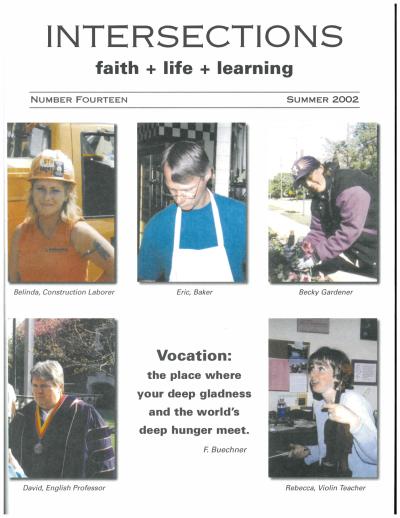 Editorial
From the Publisher
Arne Selbyg
Writing on behalf of the publisher, Sue Edison-Swift names vocation as one of the precious gifts Lutheran theology offers education, reflects on her first ELCA Vocation of a Lutheran College conference, and asks readers to gift future issues of Intersections with feedback—notes on what they read and skipped, and how they ended up with a copy.
-
Editorial
From the Editor
Tom Christenson
Christenson argues that whether or not the conversation is funded by the “Lilly lottery,” vocation should just be part of who we are and what we do at ELCA colleges, and proposes three low-cost conversations—among faculty (twenty dollars of wine, in vino veritas), with students throughout their four years, and with alumni—explaining why this issue is deliberately “fatter” than usual and inviting feedback on other single-topic issues.
-
Article
Vocational Discernment: A Comprehensive College Program
Darrell Jodock
Jodock, whose Gustavus Adolphus was one of twenty colleges to receive a Lilly “Theological Exploration of Vocation” grant in 2000, defines vocation not as occupation but as a self-understanding that nests the self in community. Reading Robert Putnam’s Bowling Alone on the collapse of secondary communities alongside Luther’s ethic of community benefit and five Lutheran principles (graciousness, Christian freedom, community, God active in the world, the theology of the cross), he walks through Gustavus’s three-level design—a definition of vocation open to other faith traditions, “middle principles” drawn from Sharon Parks’s Common Fire, and a long menu of programs coordinated by a new Center for Vocational Reflection—hoping that, in the language of Holocaust studies, graduates will be “resisters” and “rescuers” rather than bystanders.
-
Article
Renewing a Sense of Vocation at Lutheran Colleges and Universities: Insights from a Project at Valparaiso University
Marcia Bunge
Bunge, director of the process for writing Valparaiso’s nearly two-million-dollar Lilly grant on the Theological Exploration of Vocation, argues that contemporary culture’s reduction of vocation to either paid work or self-fulfillment requires Lutheran institutions to renew attention to a rich theological concept rooted in Luther’s expansion of vocation beyond the priesthood. She outlines eight low-cost “doorways”—caring adults, prayer, worship leadership, music and the arts, service, cross-cultural experience, church camps and wilderness, study and reflection—and describes Valparaiso’s two-program structure: a Campus-Wide Program weaving vocation into Freshman Core Courses and chapel life, and a Church Vocations Program for students considering full-time ministry. She closes with four troubling questions for any institution carrying out such a grant: what faith traditions can learn from one another, how to involve parents, whether faculty and staff have space to reflect on their own vocations, and whether daily institutional practices—family policies, treatment of low-paid staff, environmental responsibility, obligations to the wider community—actually reflect a commitment to love of neighbor.
-
Article
Martin Luther, Vocation, and Church Colleges: Nurturing Future Leaders for Faith and Community
Richard W. Rouse
Rouse, citing Arne Selbyg’s statistic that thirteen of sixteen newly elected ELCA bishops graduated from a Lutheran college (and 49 of 65 in the new Conference of Bishops), argues that ELCA colleges are training grounds for future church and community leaders because of Luther’s doctrine of the priesthood of all believers and his distinction between vocation and station—the basis of PLU’s motto “educating for lives of service, inquiry, leadership, and care.” He describes “Paths Unknown: Where is God Leading Me?” a Western Mission Cluster collaboration of California Lutheran, Luther Seminary, Pacific Lutheran Theological Seminary, PLU, and Trinity Lutheran College that used a dedicated web site (godleading.com), a January-February 2001 online virtual forum reaching over 300 participants in 40 states and Canada and Mexico, and one-day interactive video workshops featuring Trump’s play “Holy Odors,” and reports LECNA’s Reclaiming Lutheran Student Project findings on teaching, community, and faith integration at Lutheran schools.
-
Article
Of Fathers and Feminism: How One Lutheran Woman Came to a Vocation
Karla G. Bohmbach
Bohmbach, a recently tenured Susquehanna University feminist biblical scholar one month shy of forty, traces her vocation back through a Vacation Bible School injury, an LCMS upbringing in which only men could preach or preside, her father’s contradictory message that she could do anything while modeling a church that limited women, St. Olaf’s revelation of a Lutheran female face, and a Duke graduate seminar on the History of Feminist Thought with Carol Meyers. Her published feminist work on biblical daughters and on the concubine of Judges 19 is read alongside Kathleen Norris’s account of word-bombardment in church, Michel Tournier on childhood as “ardent confusion,” and her own recent participation as both student and teacher in an Authorized Lay Worship Leaders Program.
-
Reflection
Discerning Vocation: Personal Recollections
Tom Christenson
Christenson recalls growing up two blocks from Concordia College, Moorhead, where his father—known to students as “Doc”—was the steam engineer, and afternoon wanderings past walrus-moustached biologists, Harpo-Marx-haired theologians, and a math professor who wrote proofs with one hand and erased them with the other. He came to see the campus as “an asylum for child-like minds building towers of intellectual blocks and then knocking them down,” and traces his philosophical bent back to a high school physics teacher who, asked why Bernoulli’s principle was true, finally growled, “Christenson, you’re nothing but a damn philosopher.”
-
Book Review
Alister McGrath: Glimpsing the Divine: The Search for Meaning in the Universe
Don Braxton
Braxton reviews Alister McGrath’s Glimpsing the Divine (Eerdmans, 2002), commending its twelve articulate, lavishly photographed meditations as a fine introduction to Western spirituality but criticizing its conservative neo-Barthian confessionalism, its Eurocentric treatment of non-Western traditions as “taillights” to Christianity’s “headlights,” its one-sided host-guest engagement with the natural sciences, and its metaphysical dualism. In a section added for ministerial readers, he contrasts McGrath’s self-contained confessionalism with H. Richard Niebuhr’s call to respond to all things as if to God’s actions upon us, and argues that in an era of rival fundamentalisms exclusivity must become a thing of the past.
-
 Article
A Lutheran Learning Paradigm
Paul J. Dovre
No. 34 · Fall 2011
Drawing on Hughes and Adrian’s Models of Christian Higher Education and on Ernest Simmons, Darrell Jodock, Tom Christenson, Robert Benne, and Richard Hughes, Dovre sketches a Lutheran learning paradigm shaped by four deep narratives—the biblical, the confessional, the theological, and the vocational—and traces their implications for curriculum (the study of scripture, theology, and vocation), for the religion faculty’s college-wide responsibility, and for pedagogy (moral deliberation, dialectic, paradox, the engagement of faith and the secular disciplines).
-
 Article
Committed to Paradox
Caryn Riswold
No. 60 · Fall 2024
Riswold lifts up paradox — saint and sinner, lord and servant, Rooted and Open — as a distinctive Lutheran root that lets institutions honor the complicated truth of who their students are and embrace the messy, ever-reforming work of access and accessibility as a theology of the cross.
-
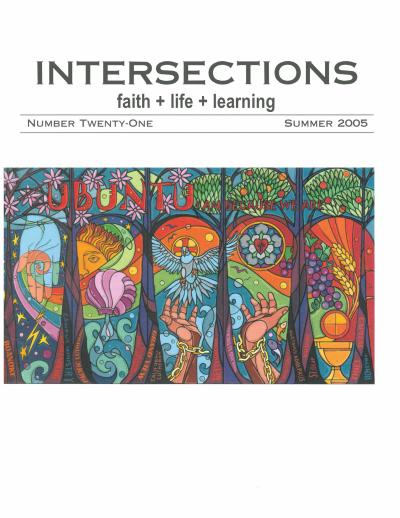 Reflection
Finding Words That Matter (Proverbs 1:20-21; 4:10-13)
Harvard Stevens Jr.
No. 21 · Summer 2005
In a brief homiletic reflection on Proverbs, Stevens addresses Lutheran educators as “merchants of wisdom” competing with a crowded contemporary marketplace of internet, cable TV, and rap music alongside “Hedonism 101,” “Advanced Voyeurism,” and “Pure Escapism.” Recounting an evening with a Carthage student poetry club, he shares the poem wisdom whispered to him there and offers thanks for the high calling to teach “words that matter.”
-
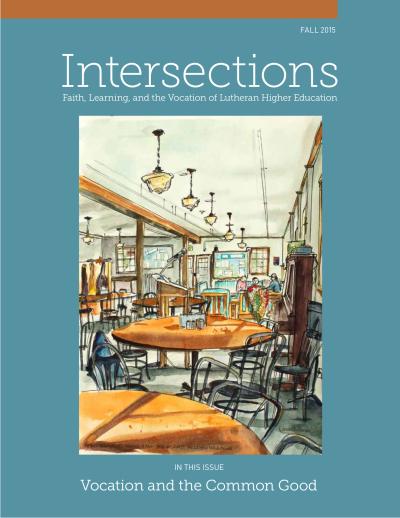 Article
Say Something Theological: A Meditation on the Vocation of Lutheran Colleges and Universities to Serve the Common Good
Paul C. Pribbenow
No. 42 · Fall 2015
Pribbenow expands Luther’s “priesthood of all believers” into a meditation on doing theology with the Bible in one hand and the New York Times in the other — reading Luke 14 alongside walls, immigration, and hunger in his Minneapolis neighborhood — and argues that the leadership of Lutheran colleges demands a willingness to engage the theological issues at the heart of their public vocation.
-
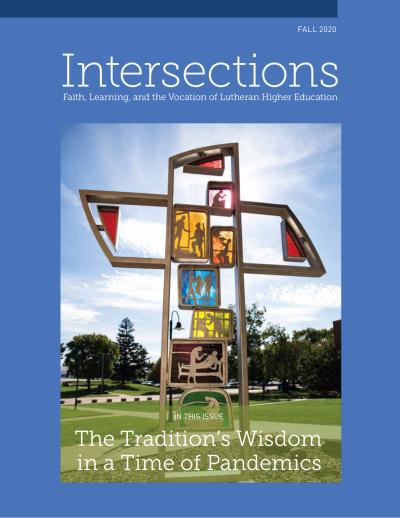 Article
Leadership in Lutheran Key at a Time of Pandemics
Deanna Thompson
No. 52 · Fall 2020
Thompson draws on Luther’s theology of the cross and Shelly Rambo’s theology of trauma to sketch a Lutheran model of leadership for a season of pandemics — one that is attentive to pain, responsive to need, and intentionally nourished by food, friends, and deep conversation.
-
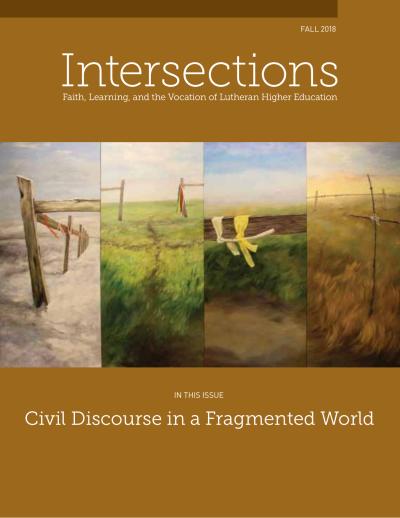 Poem
Poem
Original Song Lyrics: "Just a Little"
Mike Blair
No. 48 · Fall 2018
Lyrics for an original song inspired by biblical images and stories, by Emma Lazarus’ “The New Colossus,” and by the faith, hope, love, and courage of immigrant friends and neighbors — led as a devotion during the 2018 Vocation of a Lutheran College conference.