Conciliatory and Queer: The Radical Love of Lutheran Higher Education
Intersections No. 50 · Fall 2019
Daniel Erlander, in the classic Baptized We Live: Lutheranism as a Way of Life, notes the necessity of ELCA Lutherans to take on the “task of living as a reforming movement—constantly letting the Holy Spirit show us where our personal and corporate lives must change” (21). Samuel Torvend adds that such transformation depends on the courage to ask “disruptive questions,” including questions about who does and does not yet fully benefit from Lutheran higher education (6-9). After three years (Kiki) and twenty-one years (Sharon) at Augustana College, we both have found that the College mission has acted upon us. It has changed us and what we think of ourselves, our students, our neighbors, and the possibilities for radical love. We are part of Augustana, so of course, our own transformations, when we have boldly claimed them (and have sometimes asked disruptive questions), have worked iteratively to change the College in (re)turn.
Individual and Institutional Commitments
We here write from a first-person narrative position about experiences that we hope are true of many ELCA colleges. Augustana College has enabled many activist-educators to sync their own callings with the institutional vocation of the school. In the process, each challenges and keeps the other accountable, deepening commitments both personal and professional. Through many individual activist-educators, the College now has connections to the imprisoned, the immigrant, the refugee, the non-binary, the struggling, the stranger. We think that these connections are necessary to our ELCA institutional identity. Our mission speaks of moving toward equity and inclusion even and especially in an uncertain time.
As the landscape of higher education has been shifting rapidly, many American institutions have revisited their missions, sometimes frantically. Indeed, Gustavus Adolphus College emeritus professor Florence D. Amamoto writes that “support for the [ELCA] college’s church-related identity is fragile” (19). While we agree, we also have found deep support as our professional and personal commitments and callings develop with that of the institutional vocation of this Lutheran school.
We have found deep support as our professional and personal commitments and callings develop with that of the institutional vocation of this Lutheran school.
At the outset of our employment at Augustana, neither of us identified as ELCA Lutheran, nor did we deeply understand what teaching at a Lutheran college meant. Yet Augustana’s mission and culture has encouraged each of us to trust not only ourselves but also this shared community as we take action that aligns with our values. That shared set of values and institutional calling is captured in our college’s mission statement:
Augustana College, rooted in the liberal arts and sciences and a Lutheran expression of the Christian faith, is committed to offering a challenging education that develops qualities of mind, spirit and body necessary for a rewarding life of leadership and service in a diverse and changing world.
Increasingly over the past decade, Augustana’s “Five Faith Commitments” have helped steer the ways we live out our mission. Augustana’s commitments are to:
- Interfaith Engagement: Augustana College celebrates God’s regard for the worth and dignity of all persons.
- Social Justice: Augustana College encourages the development of a campus community that seeks justice, loves kindness, and acts with love and humility.
- Spiritual Exploration: Augustana College provides a context in which every student might ask meaningful questions about life, morality and spiritual practice.
- Reasoned Examination: Augustana College encourages our campus community to wrestle with ways in which faith and reason challenge and enrich each other.
- Vocational Discernment: Augustana College affirms that work and career—indeed, all human effort—are aspects of an understanding of vocation, a concept the Lutheran tradition in higher education helps illuminate.
Over many conversations, it has become clear to us that this mission and these commitments are the center of the web of our diverse connections, work, and spirit as activist-educators in multiple realms. Indeed, with gentle persistence that in our case has been remarkably empowering, Augustana Chaplain Richard Priggie explains to new faculty that the ecumenical spirit that keeps the college rooted in openness and acceptance can be traced back to the conciliatory approach of the Augsburg Confession. (“Augustana” derives from the Latin title of the Augsburg Confession.) Priggie makes it abundantly clear that Augustana is welcoming not despite the fact that we are Lutheran, but because of it.
Reflections in Conversation
To illustrate this reciprocal re-formation, each of us will reflect in turn on some of the ways that we have become attuned to the mission of our school. Our diverse experiences, backgrounds, and identities—especially when put in conversation—both reflect and strengthen our commitments to Lutheran higher education.
KIKI:
It has long been a cornerstone of my teaching philosophy to establish and sustain learning environments in which students feel encouraged to lead lives of kindness and authenticity while leveraging their unique gifts to contribute to social justice work. An understanding of vocational discernment (one of Augustana’s Five Faith Commitments) gives me renewed language for this approach. It anchors my moral compass to institutional practices that provide structure and the strength of shared core values. As a first-generation college student, I’ve often felt out of place in academia. And as a non-Christian queer person, I was, at best, cautiously optimistic about what life might be like as a faculty member at a church-related institution. Now beginning my third year at Augustana College, I feel wholly embraced in ways that have left me eager to contribute to advancing our mission.
SHARON:
As a 21-year faculty veteran, I admit to worrying that Augustana’s ELCA affiliation would be misunderstood or maligned by newcomers to the College. Many of us, as newcomers, have been at least concerned initially because, if history is our teacher, then we can likely cite numerous betrayals of a nominally Christian ethic. That reality can weigh deeply on our sense of the possible.
Over the years I have been part of a culture that encouraged me to live in these very questions in a way that made my teaching better and my activism stronger.
And yet, over the years I have been part of a culture that encouraged me to live in these very questions in a way that made my teaching better and my activism stronger, a culture that wasn’t afraid to critique itself. But newcomers to and skeptics of Lutheranism, as I was once, sometimes ask if it is even possible that Augustana could have a Christian ethos and not in some fundamental way be repressive or oppressive. When Kiki believed it possible and immediately acted on that belief—in their classroom work, in their travel to Taizé, in their friendships across faith communities, in their joyful absence of fear—their willingness to embody the mission was thrilling to me, too. I treasure Kiki’s fearlessness. I think we have made each other more brave and more mission-activist.
KIKI:
At Augustana, I quickly realized that the “evangelical” of ELCA does not mean that anyone wants me to be different. At this point in my life and in my career, I am rewriting the narrative I have long known to be true that Christians are trying to convert me. Coming out as a lesbian during adolescence in a rural area where church on Sunday was the norm had taught me, like many LGBTQ+ persons, that people often use religion to endorse personal phobias and to justify social inequities. Never was I exposed to a “reasoned examination of faith,” to borrow again from the Five Faith Commitments. In my hometown, and for many years after I left there, my interactions with people of faith were characterized by hate speech, damaged relationships, and the overwhelming observation that I did not belong.
At Augustana, clergy, colleagues, and administration have affirmed my queerness as I’ve negotiated my identity as a non-binary person. They have also introduced me to the faith-based activisms of organizations like ReconcilingWorks. This is a testament to the transformative potential of our College’s commitments to interfaith engagement and social justice.
What is more, as someone with a long history of LGBTQ+ community engagement and activism, I have experienced at Augustana genuine and multidimensional support for projects and curricula aimed at increasing inclusivity for marginalized students, faculty, and staff. This has led me to reflect on what historically divisive queer communities could stand to learn from the conciliatory approach enacted through Augustana’s ecumenical spirit. In turn, I ask how Augustana and institutions who share our values might continue to leverage and activate our inherently inclusionary traditions in ways that align with the quickly evolving landscape of educational priorities for an increasingly diverse student body.
Clergy, colleagues, and administration have affirmed my queerness as I’ve negotiated my identity as a non-binary person.
SHARON:
Reading and listening to Kiki’s experience is both painful and illuminating, reinforcing the need I have (and we all have as educators) to continually clarify our commitments. They are not self-evident in religious labels and they are certainly not a “given.” It is painful knowing that this beautiful person who the world needs to be fully in their power has been treated as less than, in the name of Christianity. Pastor Priggie and others—including those who have acted as stewards of the Augustana mission—have, intentionally or not, reinforced the need I feel to reclaim that radical love is at the center of our mission as educators.
Our mission necessitates interdependence and it is deeply my responsibility to believe and act in solidarity to the extent of my own power. The empowerment of the Five Faith Commitments, in concert with our college-wide learning outcomes, have given me the “street cred” (as Kiki puts it) to act on principle, to prioritize radical love both inside and outside the classroom in ways that I pray serve to embolden our students also to act in love and not fear. My upcoming sabbatical work involves working within the carceral system. One of Kiki’s ongoing projects is the development of French-language pedagogical materials to include non-binary pronouns as possibilities. In this ELCA institution, we strive to enact a pedagogy that will connect with and empower students to bridge to communities that are typically outside of conventional higher ed spaces.
Radical Love
In the twentieth anniversary issue of Intersections, Haak, Mahn, and Christenson noted the possibility that ELCA colleges and universities might help students and faculty to develop a predisposition toward interdependence rather than individualism. We believe radical love is the sum of the combination of the Augustana College Five Faith Commitments. And we believe that radical love builds bridges.
The radical love we both espouse is not a straightforward notion, not a “status quo” kind of exigency, but one that compels us to put ourselves into the places that most people simply and conveniently overlook. It is an epistemology of queerness that obliges us to engage in struggles that are not directly our own. It requires us to question and subvert the lines we so readily draw, and to re-envision configurations of connections both through and across differences. With a supportive academic environment for those who practice radical love in their pedagogy, we can give our academic and personal lives a deep purpose. And we can build and sustain—and be sustained by—communities that are inherently Lutheran, both conciliatory and queer.
Works Cited
Amamoto, Florence D. “Diversity and Dialogue: Twenty Years and Counting.” Intersections 43 (Spring 2016): 19-23.
Augustana College. “Five Faith Commitments.” Accessed 1 Oct. 2019, https://www.augustana.edu/about-us/president/commitments.
———. “Mission Statement.” Accessed 1 Oct. 2019, https://www.augustana.edu/academics/catalog/overview.
Erlander, Daniel. Baptized, We Live: Lutheranism as a Way of Life. Holden Village, 1981.
Haak, Bob and Jason Mahn, with Tom Christenson. “The Vocation of Intersections on its Twentieth Birthday.” Intersections 43 (Spring 2016): 6-13.
“ReconcilingWorks: Lutherans for Full Participation.” ReconcilingWorks. Accessed 1 Oct. 2019, https://www.reconcilingworks.org/.
Torvend, Samuel. “Critical Engagement in Public Life: Listening to Luther’s Troubling Questions.” Intersections 35 (Spring 2012): 5-9.
-
 Editorial
From the Publisher
Mark Wilhelm
Wilhelm frames the issue by noting that a federal court’s vindication of Harvard’s race-conscious admissions process is a win for higher education’s commitments to diversity, equity, and inclusion — and argues that for Lutheran higher education, the commitment to diversity is an old and foundational claim, rooted in Christianity’s openness to all and reflected in the four diverse gospels of the New Testament.
-
Editorial
From the Editor
Jason A. Mahn
Mahn opens with Lenny Duncan’s observation that the ELCA is 96 percent white — the whitest denomination in the U.S. — and asks how teachers and administrators at historically, predominantly, and persistently white institutions can turn from white privilege and white supremacy toward spaces where people of color thrive and white people are re-formed into antiracist allies.
-
Article
Making Diversity Matter: Inclusion is the Key
Monica Smith
Smith, Augustana’s inaugural Vice President for Diversity, Equity and Inclusion, frames the work of a Chief Diversity Officer as that of a disrupter and argues that while diversity in higher education is already happening, inclusion is a choice — one requiring a fundamental institutional transformation that diversifies faculty and staff, infuses diversity into the curriculum, invests in professional development, and draws on senior leadership to dismantle barriers.
-
Article
The Perils and Promise of Privilege
Guy Nave
Nave argues that privilege is always used in one of two ways — to preserve privilege by promoting inequity, or to challenge privilege by promoting diversity, inclusion, and equity — and uses examples from Indianapolis Catholic schools, Martin Luther, and equity-mindedness research to call Lutheran institutions to address the racist practices and policies that reproduce whiteness on their campuses.
-
Article
The Vocation of White People in a Racist Society
Caryn Riswold
Riswold proposes that whiteness is a weakness borne of apathy, atrophy, and ignorance — an atrophied muscle of race-consciousness — and offers concrete practices (reading, adjusting one’s gaze, consuming media differently, drawing on ELCA social statements like the repudiation of the Doctrine of Discovery) for exercising that muscle and naming the vocation of white people in a racist and white supremacist culture.
-
Article
Learning the Language of Inclusive Pedagogy
David Thompson
Thompson frames inclusive pedagogy as a foreign language with its own vocabulary, grammar, and cultural values, and reflects on a year of immersing himself in readings, conversations, and workshops — arguing that proficiency grows when instructors study and practice these languages repeatedly and atrophies when ignored.
-
Article
The "V" Word: Different Dimensions of Vocation in a Religiously Diverse Classroom
Martha E. Stortz
Stortz responds to a sea of blank stares when she used the word “vocation” in a religiously diverse required course by offering five metaphors — place, path, relationships, lens, and story — that point to different dimensions of vocation across the world’s religions and help students articulate their callings on their own terms.
-
Book Review
The American Myth of White Supremacy: A Review of Myths America Lives By
Susan VanZanten
VanZanten reviews Richard T. Hughes’s Myths America Lives By: White Supremacy and the Stories that Give Us Meaning, which argues that the United States grounds its identity in five myths — Chosen Nation, Nature’s Nation, Christian Nation, Millennial Nation, and Innocent Nation — all informed by the primal myth of white supremacy, and considers what Lutheran theological values can offer for resisting that myth.
-
Reflection
Seeing in a New Way: A Meditation
Kara Baylor
Baylor, the only Black campus pastor in the NECU, weaves Psalm 25, the parable of the Good Samaritan as re-read through Lenny Duncan, and the “crimson thread of divine justice” from Allen Dwight Callahan into a meditation that closes with the invitation she offered at the 2019 conference — to tie a crimson thread around the wrist as a symbol of collective commitment to moving beyond privilege toward inclusion and equity.
-
 Article
What's in a Name?
Matthew J. Marohl
No. 40 · Fall 2014
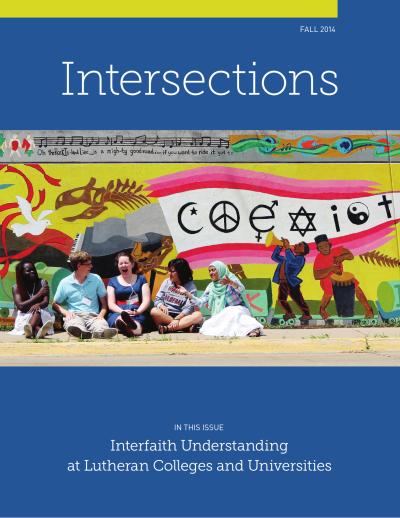
St. Olaf College Pastor Matt Marohl tells the story of designing The Undercroft’s prayer and meditation room with a campus meditation group whose members began as “Matt” and ended — as their mutual respect grew — calling him “Pastor Matt,” a counterintuitive movement toward a more formal address that signals what intentional Lutheran-Christian hospitality looks like in practice.
-
 Editorial
From the Publisher: Introduction and Invitation
Lamont Anthony Wells
No. 57 · Spring 2023
Wells introduces himself as the new Executive Director of NECU, succeeding Rev. Dr. Mark Wilhelm, and frames this Spring issue as a passionate response to the crises facing higher education amid threats to academic freedom and the well-being of educators.
-
Reflection
Annie Schone
Annie Schone
No. 40 · Fall 2014
Schone, raised in a small conservative Central Illinois congregation, recounts how Augustana’s Interfaith Understanding group and Interfaith Youth Core gave her the first chance to befriend Muslim, Unitarian Universalist, and atheist peers, and how she hopes to bring the joy of those friendships back to her home church through the power of storytelling.
-
 Response
"Whose Future?" or "Social Justice and the Lutheran Academy?"
Marsha Heck
No. 1 · Summer 1996
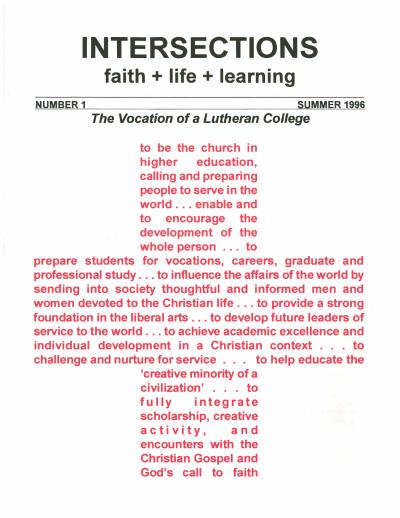
Heck argues that the future of Lutheran higher education lies less in defining Lutheran distinctiveness than in moral action grounded in face-to-face relationships with others. Drawing on David Lotz’s two-kingdoms theology of citizenship, Ernest Simmons’s relational reading of Luther, Arthur Preisinger’s indictment of the German Lutheran misreading of two kingdoms during the Third Reich, Starla Stensaas of Dana College, and Paulo Freire’s dialectic of empowerment, she calls Lutheran colleges to integrate moral reflection with moral action—to move students’ muscles against what is not true as well as to feel truths in their bones.
-
 Article
Why All This Talk About Understanding the Mission of NECU Member Institutions as a Vocation?
Mark Wilhelm
No. 56 · Fall 2022
In his valedictory keynote, retiring NECU Executive Director Mark Wilhelm argues that Lutheran higher education is, properly understood, vocation-based education — outlining four core practices recovered over the past fifty years and naming the constructive and corrective work still to be done, including a fuller embrace of DEIJ and of the diverse vocations of NECU’s 27 institutions.
-
 Editorial
From the Editor
Jason A. Mahn
No. 54 · Fall 2021
Mahn introduces the “Called to Place” theme of the 2021 VLHE Conference, arguing that Lutheran higher education’s emphasis on vocation must be grounded in particular geographies and embodied communities — for, as Wallace Stegner put it, “If you don’t know where you are, you don’t know who you are.”