"Annoying the Student With Her Rights:" Human Life Coram Hominibus; Reflections on Vocation, Hope, and Politics
Intersections No. 32 · Spring 2010
The author of Col. 3:8 was writing to a divided community that needed to “get rid of all such things—anger, wrath, malice, slander, and abusive language,” and was trying to give an account of hope to unify them. The various ways that our civic and political community is divided today are numerous. Is there hope, harmony, or any kind of unity in an age of ideological partisanship? Having survived the interminably long 2008 presidential election, pausing for a breath before the start of the 2010 midterm Congressional election, while already hearing speculation about the 2012 slate of presidential hopefuls, we are asked to think about the reasons for hope amidst the anxiety bred by a political climate that seems to be based on fear and mistrust. Our shared Lutheran tradition and our shared vocation as educators provide a context from which to speak and work, and they are reasons and resources for hope.
The 2008 election had a pretty significant presence on college campuses around the country, and data shows that 66% of 18-29 year olds voted for Barack Obama (CNN Election Center). That two major themes of his campaign were hope and change are obviously relevant to the theme of this conference. I want to share one curious encounter I had with a student last fall to provide entrée into some reflections on hope and politics in the context of our vocation and the Lutheran tradition.
Students in my political science colleague’s “Parties and Elections” class had been deputized to register people to vote on campus, so there was a community effort on campus to encourage students to participate in the election. The deputy registrars came to classes with forms, sat in the student center during lunchtime, and set up tables outside of events on campus to catch the crowds and register new voters. For a couple of class periods before one such registrar was to come to my class, I was reminding my students that they needed to bring their drivers license and student identification the following week if they were going to register to vote. I talked about how exciting and memorable your first presidential election can be, shared stories about my first voting experiences, and emphasized why it is important to vote.
Finally, on about the second or third day of these promotional announcements, a young woman said with great exasperation, “I don’t WANT to register to vote.” I stopped in my tracks, a bit shocked amidst all the general election-fever, and said politely, “Who would like to tell Ashley [not the student’s real name] why its important to register to vote?” The other students in the class immediately piped up with all the proper responses: We are the ones fighting these wars. Our generation has to pay off these debts. We have to deal with the fallout from this economic crisis. We are the leaders of the future, and so forth. Ashley said, “Oh, I know about all of that. My boyfriend is about to deploy to Iraq.” I kindly said, “Well, then don’t you think you should have a say in how that goes?” She said, “I don’t understand it all and I don’t want to vote for the wrong thing and I just don’t want to be a part of it. If I register, then I have to vote, and then, I’m a part of the whole mess.” I gently reminded her that she already was.
That was about the end of the discussion that day as we moved on to the lecture topic at hand. The interchange came up, though, one more time on my course evaluations at the end of the semester over two months later. Here was the anonymous comment: “Also, voting is your own personal right a right to participate and not participate so it was very unprofessional when you were annoying the student with her rights.” Annoying the student with her rights. That is a great description of my job, and our vocation.
By starting with the story of Ashley, I want to look first at some of the sources of anxiety and fear in the political arena, and some of the more disturbing consequences of those fears. Then, I will engage some of the resources of our Lutheran tradition in a way that might speak to these collective anxieties. Finally, I will reflect on how our vocation as undergraduate educators, and the vocation of a Lutheran college in general, provides a unique reason for hope in the midst of all of this anxiety and fear.
Our sources of anxiety: Fear of change, mistrust of difference
Back to Ashley: What was she worried about? Actually, it is kind of refreshing that she actually knew that she didn’t know enough to make a good decision, and in resisting the responsibility that comes with voting, she gets it in a fundamental way. There is a lot at stake in our political arena and with our voting decisions. You should know about all of the issues and candidates in depth before you step into the voting booth. Ashley was perhaps subconsciously aware of the change of her own responsibilities that came with being of legal age to vote, and she resisted because she was afraid. Rather than just view Ashley as an immature nineteen-year old shirking her democratic duties, I think we can also see her as properly humbled by the power of the democratic process and understandably afraid of change.
Of course, in our jobs as educators, we would like to see our students seizing the opportunity to participate in a democratic election. Everyone should read every candidate’s position statements, learn about and research issues that they care about, and understand the historical context for every decision that they make. This is much of what we do in our professional lives, and these are some of the skills we would like to impart to our students: the ability to think well, to read well, to write and communicate well. But we should not forget about how overwhelming all of that is, and how “annoying” it can be. Like me, a large number of my students are first-generation college students. For these young people especially, all that comes with a college education is simultaneously empowering and shattering. It is empowering insofar as it opens up the world in a way that their parents may not have experienced. It is shattering because it makes it hard to go home again, because home has changed and so have they. We should not forget that this is a source of anxiety for the particular people with whom we spend our days and lives. The fear of change that comes with a college education and with grown-up responsibilities which we encounter in students like Ashley is natural, and to a degree it is understandable.
Fear of change is one thing that breeds anxiety in the political arena. This is especially true for anyone who has become comfortable with the status quo, or anyone who benefits from the way things currently are. This fear becomes sinister when coupled with another source of anxiety: mistrust of difference. The very thing that Barack Obama embraced to catapult him into the history books as the first African American president, change, is a source of hope for many while it remains a foundational source of anxiety for many of his opponents and detractors. One feared change, though, is very specific. In many ways he is similar to many other presidents: an Ivy league educated lawyer with humble family roots, a strong work ethic, a sharp mind, and a charismatic personality. We have seen all of these things in other presidents. What we have not seen before, literally, is the color of his skin on a president. This is a specific source of anxiety for many of his critics and it gets cloaked in other issues and language: the prejudicial mistrust of black men by the white establishment is the dirty secret of American racism that still pervades our culture and our history. Add to this a generalized Islamophobia and Obama’s Indonesian-schooled youth with a Muslim stepfather, and we end up with legal complaints that he is not a U.S. citizen (despite the release of his birth-certificate in 2008, something never demanded of any another president or candidate), blog and talk-radio rhetoric that refers to him as an “Islamofascist nazi” or “Islamofascist monkey,” campaign rallies last year where enraged audience members shouted “terrorist” and “kill him,” and the widespread use of socialist as a dirty word. All of this is meant to engender fear and hatred among an already anxious population. Fear of change naturally accompanies a young person into college, and often throughout the maturation process, but here in politics when fear of change is coupled with mistrust of difference, it takes on a sinister and destructive form.
Anticipated results of this fear of change and mistrust of difference led to the Department of Homeland Security’s April 7, 2009, report warning about a likely uptick in right-wing extremist violence: “…rightwing extremists may be gaining new recruits by playing on their fears about several emergent issues. The economic downturn and the election of the first African American president present unique drivers for rightwing radicalization and recruitment.” The report indicates that rightwing extremist organizations are stockpiling weapons and using the financial crisis as a specific tool for anti-Semitic extremist recruitment. It reminds the public of “white supremacists’ longstanding exploitation of social issues such as abortion, inter-racial crimes, and same-sex marriage.” (Office of Intelligence and Analysis). One example cited in the report itself is the April 4, 2009, murders of three Pittsburgh police officers by Richard Poplawski, a white supremacist who talked about the influence of “the Zionists” and spread rumors about a coming gun ban under President Obama. (Anti-Defamation League). The release of the DHS report was roundly slammed, mocked, and chastised by conservative media personalities as ideologically motivated and inaccurate.1 Within two months, the murders of Dr. George Tiller and Holocaust Museum guard Stephen Johns at the hands of right-wing extremists provided further sobering confirmation of the accuracy of that assessment.
The key motivator identified by the DHS is fear. I want to be very specific and talk about how race- and gender-based fear and hatred play a unique role in these two cases. Racism and sexism are at one level a mistrust of difference along with an insecurity about one’s own identity in relationship to that difference. Racism clearly motivated James Von Brunn to enter the Holocaust Museum in Washington, DC, with the stated intent to kill as many Jews as possible. He is an outspoken white supremacist and anti-Semite who is also on record as part of the “birther movement” insisting that Barack Obama is not a U.S. citizen (Stein). Racial hatred and fear was also echoed by Poplawski in Pittsburgh who wrote about promoting a new “racial awareness” among the young white population (Anti-Defamation League).
Sexism motivated Scott Roeder insofar as he bought into and repeated the rhetoric that Tiller’s Women’s Health Care Services clinic in Kansas City was a “death camp” rather than a medical services provider for women in extremely dire circumstances with no good options left to them (Fitzpatrick). At one level, the anti-choice movement capitalizes on a fundamental mistrust of women’s moral discernment and agency. The belief carried to a violent extreme by Roeder and others is that women, along with their families, doctors, and spiritual advisors, cannot be trusted to make difficult decisions, and that they need to be protected from doctors like Tiller. To that end, it is easy to find several websites that show detailed pictures of Tiller’s now-closed clinic from every angle to show its location and entrances, with its address and phone number, photographs of employees’ vehicles and their home addresses, and most importantly, chilling photographs of “churches that defend and comfort Tiller,” one of which is Reformation Lutheran Church in Kansas City where he was finally gunned down while ushering on a Sunday morning.
These cases of extremist violence occur when a fear of change coupled with a mistrust of difference take root in unstable and mentally ill people. While they are relatively rare, they are the red flags that signal something gone very wrong in our culture, with our political discourse, demanding our attention. Poplawski, Von Brunn, and Roeder are terrifying examples of some of the consequences of fear-based divisions that infect our political arena. The confirmation hearings for Supreme Court Justice Sonia Sotomayor made plain the ways that racism and sexism infect political discourse in a less extreme but equally infuriating way. The line of questioning for those senators who opposed her nomination focused primarily not on her seventeen years of cases, written opinions, and summary judgments. The questions focused on identity politics, especially race and gender, highlighting the implications of the first Latina Supreme Court nominee. Eugene Robinson wrote in The Washington Post that “Republicans’ outrage, both real and feigned, at Sotomayor’s musings about how her identity as a ‘wise Latina’ might affect her judicial decisions is based on a flawed assumption: that whiteness and maleness are not themselves facets of a distinct identity.” One senator in particular repeatedly used terms like “classic American” and “objective view” of the law to describe what Sotomayor did not have. In context, these terms are coded references to the presumed white male neutrality that Robinson names.
What the players in all of these examples (my student Ashley, rightwing extremist violence, and the Sotomayor hearings) share is a fear of change and a real sense that there is a lot at stake in our public and political discourse. I would like to suggest that we have before us a tradition and a vocation that helps us respond to young people like Ashley, and delegitimize divisive racist and sexist rhetoric that serves in part to justify violence and hatred that fuels extremists like Poplawski, Von Brunn, and Roeder.
Our Lutheran tradition
Engaging the Lutheran tradition is one way to begin crawling out of the morass of anxiety and fear that affects us all in this age of ideological partisanship. It was not an accident that Barack Obama’s “hope” theme resonated widely across the country last fall, as we watched the markets collapse, saw the foreclosure signs in our neighborhoods, and heard family members’ stories of losing their jobs. Anxiety and fear were pervasive, and hope was an essential antidote. “Anger, wrath, malice, slander, and abusive* language” existed for the Colossians, and they exist for Americans engaging in politics. Martin Luther understood that anxiety and fear were characteristic of the human condition, and he experienced those things himself very keenly. The hope which brings people out of this morass had one clear source for both of these authors: God.
A major source of Luther’s anxiety was uncertainty about salvation, a fear that was calmed with his renewed look at justification by grace through faith, something also claimed in the Colossians text. Luther knew deeply and personally that he was not good enough and could not do enough to earn God’s favor. He was therefore liberated in his reading of Romans in particular and Paul’s discussion in chapter three of
the righteousness of God through faith in Jesus Christ for all who believe. For there is no distinction, since all have sinned and fall short of the glory of God; they are now justified by his grace as a gift, through the redemption that is in Christ Jesus, whom God put forward as a sacrifice of atonement by his blood, effective through faith. (Rom. 3:22-25).
All have sinned. All fall short. Grace is a gift. I can almost hear Luther breathing a sigh of relief at really and finally understanding this.
With justification by grace through faith in Christ as a core concept, Luther discussed throughout his life’s work the various ways in which the human person is therefore in relationship. Gerhard Ebeling, a Lutheran theologian writing in the 1950s, described four key ways that the human being is in relationship, using Luther’s Latin term coram. I like the use of this term because it suggests an intimate relationality that extends in many directions. It is a Latin adverb (typically translated into German as “vor,” and English as “before”) that can be translated in several ways: in the presence of, before the eyes of, in the face of, openly, face to face, present, in person, personally. Those things which are before my face are things with which I am in relation.
“... it suggest an intimate relationality that extends in many directions.”
For Luther, Ebeling pointed out, human beings live first and always in relationship to God, coram Deo. This was the foundational source of hope for all of Luther’s theology. While this relationship is most important and pervasive, Luther also took seriously the fact that human beings live coram mundo (in relationship to the world.) Many scholars and theologians have discussed at length his development of a “two kingdoms” theology, wherein human beings have dual citizenship in the kingdom of God and the kingdom of this world. The kingdom of this world as created and ordained by God is a key location for carrying out God’s work. Human beings come to know what this work is because they live coram meipso (in relationship to myself). This is a more subtle discussion of personal existence, what Ebeling calls “existence in my own sight … before myself” (199). Finally, Luther explores human life coram hominibus (in relationship to other people) as a particular locus of relation and responsibility. I have explored two aspects of this relationality elsewhere, so here I want to mine his ideas about human life coram hominibus as a particular source of hope for our age of anxiety and fear (see Riswold, Coram Deo and “Coram Mundo”).
We first gain a little more insight into Luther’s understanding of anxiety and fear when hearing his consideration of human life before the fall. In his commentary on Gen. 1:26, he says:
Therefore the image of God, according to which Adam was created, was something far more distinguished and excellent … Both his inner and outer sensations were all of the purest kind. His intellect was the clearest, his memory was the best, and his will was the most straightforward—all in the most beautiful tranquillity of mind, without any fear of death and without any anxiety. (62)
Beautiful tranquility, without fear and anxiety. Whether or not this is the most adequate reading of the Genesis text, this is what Luther understands as human life coram Deo without the stain of sin and consequences of the fall: it is “freedom from fear.” He clearly notes that we have no real experience of this now, and in fact “we continually experience the opposite” (63). For Luther, the fall brought us the fear of danger and death with which we all live. Perhaps this is the ultimate fear of change.
When Luther talked about human beings coram hominibus, in relationship to other people, some of the more significant statements came in his 1520 treatise on “The Freedom of a Christian.” It is here where he expands on how a Christian is freed from working to earn salvation, therefore freed to serve the neighbor as a manifestation of Christ in the world. Thus, mutual service and care ideally characterize the relationships of Christian people in community. Ebeling describes “the freedom which a Christian has through faith is freedom to render the service of love. And it is only the service of love if it is carried out in freedom.” (212) Additionally, he quotes Luther’s reflections on Matt. 5:38, that the Christian is “bound in his life to another person, whom he has below or above him, or even beside him, as lord, lady, wife, child, neighbour, etc., such that one has the obligation to defend, protect and guard the other when one can.” (206) This is what an obligation to mutual service looks like in this world, where each person has a role to play and a duty to carry out in relationship to other people.
A Lutheran ethic has therefore often been described as “faith active in love,” despite Luther’s well-known criticisms of the Epistle of James and its claim in the second chapter that “faith by itself, if it has no works, is dead.” (Jas. 2:17). Understanding that human life is both coram Deo and coram hominibus is the key to maintaining justification by faith (not works) as well as a robust ethic of servant love. Brian Gerrish uses the twofold relationality to situate the proper place of human work in the world: “before God moral attainment, being always tainted with the disease of self-will, counts for nothing. Here a man is justified only by the righteousness of Christ, appropriated through faith, and the works of the law have no place.” (119). He restates the foundational nature of justification by faith: coram Deo, works have no merit or meaning. And he goes on:
In the Earthly Kingdom, on the other hand, as we face our neighbour, we do stand under the imperative of the law. For our faith does not benefit our neighbour; he needs our works of love. Indeed Luther is quite willing to assert that, before our fellow men, we should seek to be justified by our works … (119).
He thus claims the place of service and work: coram hominibus, we are obliged to incarnate the love of God and live out of the righteousness made possible through Christ.
Alister McGrath similarly uses these two relationships to help his exposition of Luther’s ideas on righteousness and the value of faith: “viewed coram hominibus, it [faith] cannot [have value], as the inherent value of faith is so little; viewed coram Deo, however, it has a much greater contracted value.” (118) In relationship to God, what matters is faith because of the covenantal and sacramental relationship between God and human beings. In relationship to other people, what matters is what we do with and for them. Both are important. One gift of Luther’s idea about human life coram hominibus is the way in which it insists that we speak of an obligation to serve the other, and a humility in which we grasp that are all equally wretched coram Deo.
This manifold relationality, with its mutual accountability and communal humility are resources from the Lutheran tradition which we can use to respond to and understand fear of change and a mistrust of difference. Rather than be captive to fear and mistrust, we are all freed by the relationships that characterize our lives. Grounded in human life coram Deo which properly humbles all persons in relationship to a transcendent source of truth, justice, and compassion, we are called to live human life coram hominibus in which we are called to serve each other in proclaiming that truth, seeking out justice, and living with compassion.
Our vocation: Annoying students with their rights
Our final task is to consider more concretely how our vocation as educators in this tradition is a source of hope in an ideologically divided and dangerous time. This is how Luther’s discussion of the role of our work in the world is most relevant. We have already seen how he understands our work in this world as morally significant and important coram hominibus. Gustaf Wingren spends a good amount of time in his discussion of Luther’s thoughts on vocation describing “co-operation” and how “Luther conceives of man as a ‘fellow-worker’ with God.” Specifically, Wingren says that “co-operation takes place in vocation, which belongs on earth, not in heaven; it is pointed toward one’s neighbor, not toward God. Man’s deeds and work have a real function to fill in civil and social relationships.” (124) Again, having sorted out the difference of human life coram Deo and coram hominibus, we see how the work and service that we do pointed toward our neighbor matters. A more modern construction of this idea is Lutheran pastor and theologian Philip Hefner’s idea of human beings as created co-creators. Hefner preserves a robust understanding of our fundamental created nature, while detailing how we work throughout our lives to bring about a world which God envisions (27-39). Human life coram hominibus is where we live our lives, do our work, and enact that which God purposes.
“We want people to be awake.”
Our work in this world is undergraduate education, so it is perhaps clear how this calling provides hope for the reality that my student Ashley voiced. When the overwhelming responsibility of civic participation and adulthood seizes young people, we respond by guiding, teaching, and empowering them to think carefully and decide well. Wingren even states in a footnote that “when the work of vocation is carried out, the neighbor is profited.” (125n) If we do our work well, our neighbors will benefit. In this vocation, our neighbor is our student. Mary Rose O’Reilley makes a key connection in her reflections on the power of education: “finding voice—let’s be clear—is a political act. It defines a moment of presence, of being awake; and it involves not only self-understanding, but the ability to transmit that self-understanding to others.” (58) Isn’t this what we want for our students? Isn’t this at the heart of institutional mission statements’ language about mind and character, leadership and service? We want people to be awake. We want them to have a self-understanding and we want them to be able to communicate and act on that self-understanding. We want to annoy students with their right to a voice.
But we also do that within a tradition that properly limits and guides our work. Because James Von Brunn was awake, and he had a voice that we all have now heard. O’Reilley also describes this “finding voice” process as necessarily “a socially-responsible political act.” (62) Luther reminds us that our lives coram hominibus are simultaneously coram Deo, and that perhaps what it means to be socially responsible is to be accountable both to the neighbor and to God. Because of this, I as a professor have to remember that shattering assumptions and challenging claims made by students can be threatening. I have to do it with compassion and attention. Because of the context of the Lutheran tradition, we can understand that our work in the world should benefit our neighbor, not destroy her. The relationship with God serves as a foundational context for our actions and our institutions. This is one thing that holds our actions in check, and holds us accountable not only to one another but to a transcendent source of truth, justice, and compassion.
If violent extremism is the red-flag that something is wrong with our culture and our politically charged public arena, then our vocation to educate the mind and form the heart and character is one part of the antidote of hope that we need. By serving our students as responsible and effective educators, we serve the world into which they are called to live their own vocations. In 2007, Bishop Mark Hanson described two purposes of the colleges and universities of the ELCA: to “model moral deliberation” and “prepare students for engagement in the world.” If we do this well, we will in fact help Ashley figure out how to responsibly participate in the democratic process that governs her life, and we will contribute to delegitimizing radical extremism and violence by educating activists, leaders, and educators of the future.
The reason for our hope in the face of such despair and tragedy is the understanding that human life is lived both coram Deo and coram hominibus. We have a source for our vocation, and a neighbor to whom we are accountable. The vocation that we share takes place at the intersections of many relationships, and the tradition that informs us frames our responses to the world.
I conclude with the words of bell hooks, who describes the complexity of our work today:
The academy is not paradise. But learning is a place where paradise can be created. The classroom, with all its limitations, remains a location of possibility. In that field of possibility we have the opportunity to labor for freedom, to demand of ourselves and our comrades, an openness of mind and heart that allows us to face reality even as we collectively imagine ways to move beyond boundaries, to transgress. This is education as the practice of freedom. (207)
Endnote
1. It was also pointed out that the Department released a report on left-wing extremists on January 26, 2009. This report spoke of animal rights and environmental activists expanding cyber-attacks and computer system hacking to disrupt the operations and economic viability of specific industries. The unfurling of a banner by Greenpeace Activists on Mount Rushmore in July 2009 is an example of this kind of activity. See: “Leftwing Extremists Likely to Increase Use of Cyber Attacks over the Coming Decade.” Online: <http://www.docstoc.com/docs/5601713/Leftwing-Extremist-Threat>
Works Cited
Anti-Defamation League. “Richard Poplawski: The Making of a Lone Wolf.” April 8, 2009. Online: <http://www.adl.org/learn/extremism_in_the_news/White_Supremacy/poplawski+report.htm?LEARN_Cat=Extremism&LEARN_SubCat=Extremism_in_the_News>
CNN Election Center. Online: <http://www.cnn.com/ELECTION/2008/results/president/>
Ebeling, Gerhard. Luther: An Introduction to His Thought. Minneapolis: Fortress, 1970, 2007.
Fitzpatrick, Laura. “Scott Roeder: The Tiller Murder Suspect.” Time.com, June 2, 2009. Online: <http://www.time.com/time/nation/article/o,8599,1902189,00.html>
Gerrish, Brian. Grace and Reason: A Study in the Theology of Luther. Chicago: U of Chicago, 1962, 1979.
Hanson, Mark. “Colleges Lead Way.” Intersections 28 (Fall 2008): 5.
Hefner, Philip J. The Human Factor: Evolution, Culture, and Religion. Minneapolis: Fortress, 1993.
hooks, bell. Teaching to Transgress: Education as the Practice of Freedom. New York: Routledge, 1994.
Luther, Martin. “Genesis 1:26.” Luther’s Works, American Education, volume 1. Ed. J. Pelikan. Saint Louis: Concordia, 1958. 55-68.
McGrath, Alister E. Luther’s Theology of the Cross: Martin Luther’s Theological Breakthrough. Grand Rapids: Baker, 1985, 1994.
Office of Intelligence and Analysis, Department of Homeland Security. “Rightwing Extremism.” April 7, 2009. Online: <http://images.salon.com/politics/war_room/2009/04/14/dhs_report/hsa-rightwing-extremism-09-04-07.pdf>
O’Reilley, Mary Rose. The Peaceable Classroom. Portsmouth: Boynton/Cook, 1993.
Riswold, Caryn D. Coram Deo: Human Life in the Vision of God. Eugene: Pickwick, 2007.
———. “Coram Mundo: A Lutheran Feminist Anthropology of Hope.” Dialog: A Journal of Theology 48.2 (Summer 2009): 132—39.
Robinson, Eugene. “Whose Identity Politics?” The Washington Post, July 14, 2009. Online: <http://www.washingtonpost.com/wp-dyn/content/article/2009/07/13/AR2009071302605.html>
Stein, Sam. “James Von Brunn Apparently Part of Obama ‘Birther’ Movement.” The Huffington Post, June 10, 2009. Online: <http://www.huffingtonpost.com/2009/06/10/james-von-brunn-apparentl_n_214006.html>
Wingren, Gustaf. Luther on Vocation. Trans. C. C. Rasmussen. Philadelphia: Muhlenberg, 1957.
-
 Editorial
From the Publisher
Mark Wilhelm
Wilhelm invites readers to enjoy or revisit the presentations from the 2009 Vocation of a Lutheran College Conference, then reflects on the Higher Learning Commission’s denial of Dana College’s request to transfer accreditation to a for-profit purchaser—an event that effectively ended Dana’s sale and prompted ELCA colleges and universities to welcome Dana students and faculty—and argues that the irreversible entry of for-profit operators into liberal arts education gives the Lutheran community further reason to continue the conversation about the vocation of a Lutheran college.
-
Article
Living at the Intersection of Fear and Hope
Mark S. Hanson
Hanson draws on his January 2009 ELCA/ELCIC visit to Jordan, Israel, and Palestine—a Hebron Quran that did not burn, fifth graders dancing at the Hope School, a conversation with King Abdullah II—to frame the vocation of Lutheran higher education at the intersection of fear and hope. Engaging Brueggemann, Sittler, Buechner, Auden, Strandjord, Douglas John Hall, W. Robert Connor, Lewis Mudge, and Cynthia Moe-Lobeda, he argues that Lutheran colleges are called to critical inquiry that does not collapse into a hermeneutic of suspicion, to a “thinking faith” that resists religious fundamentalism, and to communities of discernment that work for the common good.
-
Article
Practicing Hope: The Charisms of Lutheran Higher Education
Martha E. Stortz
Stortz names four charisms—theological gifts of identity rather than commodities—that Lutheran higher education brings to a culture of fear: semper reformanda as flexible, responsive institutions; the freedom of a Christian as simul justus et peccator critical inquiry that holds opposites in creative tension; regard for the other as “neighbor” rather than friend or alien; and the priesthood of all believers as a public, civic calling to know the poor. Drawing on Augustine, George Lindbeck, Patricia Killen, James Clifford, Earl Shorris, Carter Lindberg, and Augsburg’s Center for Global Education, she argues that immersion trips, neighbor-regard, and welfare reform witness that the gift Lutherans bring is hope grounded in Christ in you, the hope of glory.
-
Article
Hope in the Face of Ecological Decline
Jason Peters
Peters reads our ecological crisis—a campus “Birth Control Tree,” feminized fish, population, climate, water, and soil—through Alexander Pope, William Blake, Søren Kierkegaard, and C. S. Lewis’s The Abolition of Man, and argues that the modern project of mastering nature has made despair (the unconscious form Kierkegaard named) our condition. He calls for three reorientations: practical (assigning value to domestic arts and place over disciplinary specialization), philosophical (dismantling the Baconian/Machiavellian/Cartesian project of control), and theological (recovering the Church’s rejection of Gnosticism so that grace comes to us by means of nature, not in contempt of it).
-
Article
Hope in a Period of Economic Decline
Rebecca Judge
Judge reads the 2008-2009 recession against the panic-free 1982 downturn and argues that this panic comes from the genuine surprise of a generation that had been told—by George Will and others—that business cycles had been tamed by deregulation, globalization, and Greenspan. Drawing on Luther’s “Trade and Usury” and Large Catechism, Paul Tillich, Stephen Marglin, Karl Polanyi, and Larry Summers, she critiques the “crude utilitarianism” of Homo economicus and benefit-cost analysis, finding hope in the possibility that this recession will renew a national conversation about moral obligation to neighbor in a market whose “raging bull” has broken out of its squeeze chute.
-
Article
An Apostolate of Hope
David L. Tiede
Tiede argues that the vocation of a Lutheran college is to be “an apostolate of hope” oriented by three metrics of our time: 12,000 (the Dow), 350 (parts per million of CO2), and $1.25 (the daily income of 1.4 billion people in extreme poverty). Drawing on Darrell Jodock’s “third path” for church-related colleges, Larry Rasmussen’s Batalden lectures, Mark Tranvik, Douglas John Hall, Bill McKibben, Stephen Privett, Peter Singer, and Augsburg’s Center for Global Education, he proposes that justification by faith, critical pluralism, stewardship of God’s earth, and love and justice for our students together prepare wise leaders to renew the future.
-
Reflection
The Neglected Miracle of Pentecost
Susan M. O'Shaughnessy
O’Shaughnessy, in a homily delivered at Concordia College in 2008, reads the Pentecost narrative of Acts 2 through Maria Lugones and Elizabeth Spelman’s 1983 critique of white feminism’s cultural imperialism. She argues that the miracle is not the disciples’ speaking but the immigrant Jews’ hearing—and that the writer of Acts withholds the content of what was said precisely to teach disciples that people of privilege know less than the foreigner, the immigrant, the oppressed, the woman, the child, and must learn to listen in new languages before they can speak.
-
 Institutional Focus
So That All May Belong: Lutheran Roots for Diversity, Equity, Inclusion, and Justice
Altheia Richardson, Angie Hambrick, Caryn Riswold, Colleen Windham-Hughes, Deanna Thompson, Marcia Bunge, Robert Clay
No. 61 · Spring 2025
22 min audio
The full NECU statement grounds DEIJ work in Luther’s 16th-century reforms and Lutheran theological claims about the image of God, equal dignity, and the limits of human knowing — offering definitions, Lutheran roots, and calls to action for diversity, equity, inclusion, and justice, with belonging as the outcome of DEIJ at work.
-
Institutional Focus
Scriptures That Inspire Work for Diversity, Equity, Inclusion, and Justice
Altheia Richardson, Angie Hambrick, Caryn Riswold, Colleen Windham-Hughes, Deanna Thompson, Marcia Bunge, Robert Clay
No. 61 · Spring 2025
9 min audio
A companion list of biblical verses — from Genesis 1:27 and Galatians 3:28 to Micah 6:8 and Luke 4:18-19 — that grounded NECU’s drafting of So That All May Belong, organized by the four DEIJ commitments and offered as an invitation to share other texts that ground and sustain the work.
-
Institutional Focus
So That All May Belong: Lutheran Roots for Diversity, Equity, Inclusion, and Justice [abridged]
Altheia Richardson, Angie Hambrick, Caryn Riswold, Colleen Windham-Hughes, Deanna Thompson, Marcia Bunge, Robert Clay
No. 61 · Spring 2025
8 min audio
A condensed version of the NECU statement that consolidates Lutheran theological grounding for DEIJ and a single combined call to action for Lutheran colleges and universities — offered as a shareable summary alongside the complete document.
-
 Article
Committed to Paradox
Caryn Riswold
No. 60 · Fall 2024
Riswold lifts up paradox — saint and sinner, lord and servant, Rooted and Open — as a distinctive Lutheran root that lets institutions honor the complicated truth of who their students are and embrace the messy, ever-reforming work of access and accessibility as a theology of the cross.
-
 Article
Views on Flourishing After the Age of Roe
Caryn Riswold, Mary J. Streufert
No. 57 · Spring 2023
Riswold and Streufert reflect on the Radcliffe Institute’s January 2023 conference “The Age of Roe” and argue that the ELCA’s 1991 Social Statement on Abortion and its 2019 statement Faith, Sexism, and Justice offer Lutheran higher education a third way to approach reproductive justice grounded in serving the neighbor so that all may flourish.
-
 Article
A New Image for an Ancient Call: Lutheran Higher Education Amidst Pandemics Today
Caryn Riswold
No. 52 · Fall 2020
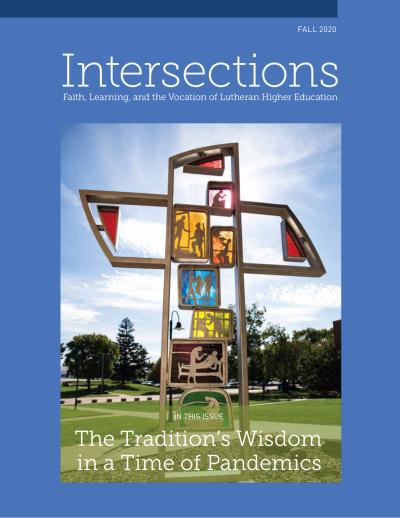
Pairing Wartburg’s Lebenskreuz sculpture with the Matthew 25 acts of mercy and the commitments of Rooted and Open, Riswold reads the calls to feed the hungry, welcome the stranger, and care for the sick as urgent summons for Lutheran higher education in a year of overlapping pandemics — and as a call to dismantle the structures that produced them.
-
 Editorial
Guest Editor
Madeleine Forell Marshall
No. 25 · Spring 2007
Marshall introduces the four papers in this issue from the 70th annual meeting of the Association of Lutheran College Faculties, held at California Lutheran University in October 2006 on the theme “Identity and Diversity in the Lutheran College.” She notes a geographic pattern—the two East Coast contributors (Balmer and Bailey) defend Christian liberal arts against perceived suspicion, while the two Westerners (Marichal and Brubaker) treat Lutheran identity as advantage and diversity as a Lutheran given—and announces the 2007 ALCF meeting at Newberry College on “Beyond ‘Whatever’: Values Based Learning in Lutheran Higher Education.”
-
 Article
Assessing Self-Assessment Instruments at Finlandia University
René Johnson
No. 55 · Spring 2022
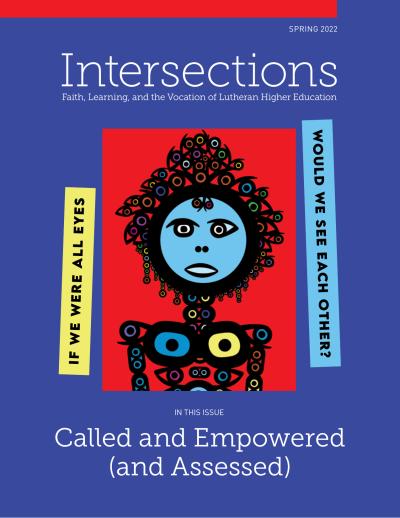
Johnson surveys three self-assessment instruments presented at the NetVUE conference — PathwayU at Colorado State, the Intercultural Development Inventory at Friends University, and Mark Savickas’s Career Construction Counseling Manual at Union College — and describes Finlandia’s use of the CliftonStrengths© assessment to link students’ personhood to “behaviors that benefit the community.”
-
 Editorial
From the Publisher
Mark Wilhelm
No. 28 · Fall 2008
Wilhelm introduces himself as the new Director for Colleges and Universities and publisher of Intersections, thanks his predecessor Arne Selbyg, and previews an issue devoted to the aims and purposes of Lutheran higher education—reflections from Presiding Bishop Mark Hanson, two pieces from Wartburg College’s fall 2008 campus conversation about being a college of the church (his own essay and the Benne/Christenson dialogue), and a sermon by Lake Lambert III preached in the Castle Church in Wittenberg.
-
 Article
What Does Ethical Leadership in a Changing World Require?
Kristina Frugé
No. 62 · Fall 2025
5 min audio
Frugé argues that ethical leadership in a changing — perhaps ending — world means cultivating trustworthy communities through patient, co-created relationship work, drawing on her experience stewarding the writing community behind Hungry for Hope: Letters to the Church from Young Adults.
-
 Article
The Face of the Neighbor: An Interview with Four Capital University Faculty About Their Recent Visit to Cuba
Brian Forry Wallace, Michael Yosha, Reg Dyck, Susan Narita
No. 7 · Summer 1999
Four Capital University faculty—political scientist Brian Wallace (returning to Cuba a third time after the 1994 boat lift), English professor Reg Dyck, ESL teacher Susan Narita, and political scientist Michael Yosha—recount their summer 1998 trip with Pastors for Peace, describing Cuban priorities of education, health care, and military (in that order), the cultural richness of Havana from sixteenth-century cloisters to Miramar, the Cuban Foreign Service’s vision of a Scandinavian-style democratic socialism, the counter-productive U.S. embargo (including its effect on kidney dialysis machines), Castro’s 1991 reconciliation with religious communities, and a recurrent image of a little girl named Marguerite singing at a school for amputee and terminally ill children. The interview was conducted by Capital senior Jessica Brown and Tom Christenson.
-
 Editorial
From the Publisher
Mark Wilhelm
No. 39 · Spring 2014
Wilhelm interrogates the widely used phrase “the model is broken,” arguing that it blames the victim, masks the demographic and public-funding pressures actually facing ELCA higher education, and distracts from the work of modifying—rather than discarding—a model of educating the whole person that has successfully adjusted across the centuries.