This essay focuses on the first of Mark Schwehn’s arguments, that we ought to conceive of Lutheran colleges/universities not as ends unto themselves but as voices among many within the conversation over Christ and culture. That is a worthy goal for church-related colleges. But ultimately, I will suggest, Lutheran colleges face a predicament: the American academic culture from which we seek respect is not much interested in such a conversation. Schwehn’s sage advice is of much use in my personal vocation as an academic. The issue I will address is that of the vocation of the institution we call the college.
I have been deeply influenced by Lutheran educators: a Missouri Synod Lutheran undergraduate advisor, an LCA/ELCA Lutheran master’s thesis director, and a Lutheran-turned-Episcopalian dissertation director. Their training in intellectual history rooted me in the traditions upon which Schwehn skillfully draws. References to Niebuhr and MacIntyre, to Haskell and Putnam, not to mention Augustine and Luther, are comfortable and comforting.
But colleges are about more than traditions. They are dynamic communities whose members change yearly. The student body changes at a rate of about 25% every year, while the faculty changes at a rate of about 25% every eight years. By the time the ink is dry on any report, the special community around the report has changed—mission statements reflect yesterday’s consensus. Change is the great constant, and we would do well to ask how the transforming trends of our age have affected the affinity between the purposes of the church and those of the academy.
… the trend among mainline Protestant colleges has been first to play down and then to abandon their religious identities, a process in which many Lutheran colleges are only behind, not headed in a different direction.
When Lutheran colleges were founded, the commonalities between higher education and church were great, and not simply because the church often started the college. The pursuit of “academic excellence” corresponded well to the educational needs of churchly people in the nineteenth century. One did not need to choose between academics and spirituality. But that was then. Nowadays, we are hard-pressed to defend “Lutheran higher education.” We now face choices; the question haunting church-related colleges is whether the academy and the faith have anything left in common. Ecumenism, secularization, and the decline of liberal education have combined to shift the ground on which Lutheran higher education stands.
1. Ecumenism, and the Changing Face of Christianity.
This is an age of the collapse of the differences between the old-line Protestant groups. Schwehn rightly notes that good Lutherans always should ask why they are not Catholics—a fair question, one rooted in tradition. But an equally good question is why I am not Presbyterian or Episcopalian or Baptist or Methodist or what-have-you. The common sense of the laity, to which Schwehn refers, is that the differences do not matter very much. This may reflect their deep devotion to core doctrines, or it may signal a kind of homogenization based on the unimportance of all doctrine. Probably it signals both, but judging from the sociological literature, among the mainliners this movement says more about the un-theological leanings of the laity. The ELCA is serious about dialogue with Roman Catholics, and it is moving toward formal relations with Episcopalians and Presbyterians—even at the top, our distinctive qualities are less important than our points of commonality. The appearance of the ELCA—the fourth largest religious body in the U.S.—comes at surely the most peculiar time in history for Lutherans to attempt to define themselves as Lutherans: We have joined together as Lutherans when being Lutheran per se matters less and less even to Lutherans.
The most astute observer of the trends in American religion, Princeton sociologist Robert Wuthnow, has noted that the old differences do not matter much anymore, that the defining line in American Christianity lies between liberalism and evangelicalism. And liberal Christianity is weakening: Methodists, Presbyterians, and Episcopalians have been hemorrhaging members for years now, and it is not clear that the ELCA won’t do the same. But the conservative groups, whether evangelical or fundamentalist, are growing enough to maintain their share of the total population. On the whole, the academy is uncomfortable with evangelical Christianity.
2. The Secularization of Higher Education.
There is much debate about whether or not the U.S. truly has experienced the kind of secularization that sociologists often describe. Religion and religious faith have proven remarkably resilient in this culture. (For example, the current percentage of the population attending church or synagogue in a given week corresponds to that before World War II). And yet few would argue that America’s public institutions—the media and the government come to mind—are not much more secular in orientation than they were.
As the research of George Marsden and others has demonstrated, American higher education certainly has experienced this process of secularization. This is especially true of the most prestigious graduate programs, both private and public. The reasons are complicated and many are positive. But a result—unintended by many but no less real—is that the dominant strands of the academic profession now have little, if anything, to do with religion. There are religious people in academia (though sociological research indicates that they are less plentiful there than in other professions), but the dominant values in graduate or professional training are frequently hostile, if usually just indifferent, toward religious faith.
Marsden argues that there is a natural evolution in colleges toward less and less identification with their roots and greater and greater identification with the dominant aspects of broader academic culture, and that this has meant for hundreds of colleges, both public and private, the de-Christianization of higher education. According to the Marsden model, Lutheran colleges like mine are no different. They enter into a phase in which they hope to embrace the accouterments that go with status in the academy without sacrificing the values of a churchly past, but that phase is merely transitory and self-delusional.
3. The Decline of Liberal Arts Colleges.
Higher education at the undergraduate level has experienced a massive expansion and restructuring since the end of World War II. Both the high school graduation rate and the percentage of high schoolers going to college have risen steadily, and one result was an enormous expansion of state university systems, at the same time that court decisions were making public education more secular, or at least less avowedly religious.
With increases in students came dramatically increased needs for faculty in a wider variety of fields than before. American undergraduate education remains less specialized than that in Europe, but it nonetheless is more job-focused now than half a century ago. This has two consequences for us. There is now less overlap between the agenda of the church and that of the academy than at any time in the history of higher education. And liberal arts colleges—those institutions whose curricula are dominated by the traditional fields of the arts and sciences—have been under greater pressure and have declined in number in recent decades (even while the Arts & Sciences Colleges within state universities have increased in number and size). Some liberal arts colleges responded with more “professional programs,” such as in Education or Business. All but the most elite find it more necessary than ever to explain to prospective students and their families the value of a “liberal education.” Most observers agree that private liberal arts colleges will face greater economic pressures in coming decades.
Lutheran Colleges.
These forces create one whale of a predicament for Lutheran colleges. Those who wish to preserve the “faith dimension” in those colleges find it awkward to defend “Lutheran colleges” when “Lutheranness” matters less and less even to Lutherans. How does one defend particularity in our ecumenical age? Most of our colleges have adopted equal opportunity guidelines for employment. Though it is officially a part of their missions, religion (of any sort) often plays but a small part in admissions and is irrelevant to the hiring of faculty.
As our colleges have steadily improved the quality of their faculties, those faculties come more and more to reflect the values of the academic mainstream. Many of these faculty members find strong church ties a frank embarrassment, a remnant of an age of narrow-minded sectarians, racial exclusion, and gender inequalities. Efforts to fortify the church relationship—to defend the particular—face strong suspicion from faculty and often from administrators. And such faculties find “Christian college” an even more frightening appellation than “Lutheran college”, because Lutheran can be taken to mean respect for the old tie—whereas Christian sounds like we might actually mean something.
Most Lutheran colleges are liberal arts colleges, though several have strong programs in areas like education, business, and nursing. In marketing terms, therefore, they are under the gun and cannot afford to do that which might cost them students. They compete not only with other private colleges, but also with public colleges and universities. They cannot afford—and the church should not want—to weaken their academic programs or profiles. And yet undergraduate education entering the twentieth century has less and less to do with the work of the church.
Tough Choices.
If this analysis is correct, there are few options here. While many American colleges choose to emphasize their religious orientation—think of the Coalition of Christian Colleges and Universities—the trend among mainline Protestant colleges has been first to play down and then to abandon their religious identities, a process in which many Lutheran colleges are only behind, not headed in a different direction. When push comes to shove, our colleges and perhaps even our church would rather identify with the liberal wing of American Protestantism than with the evangelical wing. The result, for now, is an in-between stage, in which there are enough vestiges of church influence with which to assuage those who care about such things, but not enough real presence to make anybody—even the most avowed secularist—wary.
This description will sound extreme to many. But then it would, especially for Lutherans. These trends move very slowly and are not discernible in year-to-year snapshots. It is something of a truism that the rhetoric of a certain kind of culture will survive in the culture even after the substantive source of the rhetoric has passed. (Remember that the rhetoric of pre-Revolutionary America was monarchical even though the culture was not, as became painfully clear in 1776). The rhetoric of a church relationship easily lasts longer than the substance, especially if it is useful for a time in order to placate Board members or to solicit contributions.
It is especially tough for Lutherans to come to grips with such questions. Lutheranism has been culturally conditioned by hundreds of years of state sponsorship to be more passive about such things than might other groups. Following Richard Niebuhr, it often is said that Lutherans, unlike other groups, are particularly prone to see the relationship between Christ and Culture as one of paradox—not exactly at odds with one another but not in harmony either. Such a notion fits our current situation—temporarily at least—very well. I tell myself, my college is not in league with the church against a hostile secular culture. We like much of that culture, its financial rewards, and its academic and professional status. We could never throw in with those “other colleges” who identify themselves so religiously! My ambivalence, I can claim, is rooted in paradox, in traditional Lutheran theology! How comforting. And how naive.
The eventual result, of course, is that we are no different from other private colleges, and are distinguishable from state universities only by higher tuition and lower class sizes. My religious vocation as an academic becomes purely personal. Matters of faith appear here and there in the classroom, but they do not significantly enter the intellectual climate. The campus church becomes, if it is fortunate, a campus ministry program. We might as well be public.
And that observation reminds me that my three Lutheran mentors taught me at UNC at Greensboro and at the University of Illinois. Both were and are terrific state universities, with strong religious influences on their origins, numerous people of faith on faculty and among the student body to this day—and are secular to the core.
And this is the point: All four of Mark Schwehn’s arguments—each of which I more or less endorse—apply to any Christian (or person of faith) teaching on any campus. But the key question is, are distinctively Lutheran or Christian colleges necessary for the advancement of those arguments? If so, why? What are the implications for ELCA affiliated colleges? And are we willing to address them?
Religious communities rely as much on institutional affiliation as on unity in the spirit. As Father Neuhaus has observed, “While conviction is more important than affiliation, affiliation can help sustain conviction. Convictions are sustained by communities of conviction…. All institutions are prone to losing their way, and therefore must be held accountable to a community that can recall them to their constituting purpose.” (p. 20–22) The institution to which Lutheran colleges can be affiliated will remain the Lutheran church. Defending such a particular connection in the present age is difficult for lay people and anathema for academics. And yet, an institution cannot be related to religion in general, and Lutheran colleges cannot be institutionally connected to the entire church yet. So if they are to remain in any sense Christian, their institutional affiliations must remain, for a time at least, actively Lutheran. Embracing such a choice rubs against both the academic and the church grains. But is such friction worse than where we are headed?
Works Cited
George Marsden, The Soul of the University. New York: Oxford University Press, and Marsden and Bradley J. Longfield. eds., The Secularization of the Academy. New: Oxford University Press, 1992.
Richard John Neuhaus, “Eleven Theses,” First Things 59. January 1996.
Robert Wuthnow, The Restructuring of American Religion: Society and Faith since World War II. Princeton: Princeton University Press, 1988, and The Struggle for America’s Soul: Evangelicals, Liberals, and Secularism. (Grand Rapids, Mich.: Eerdmans, 1989).
-
 Editorial
From the Publisher
James M. Unglaube
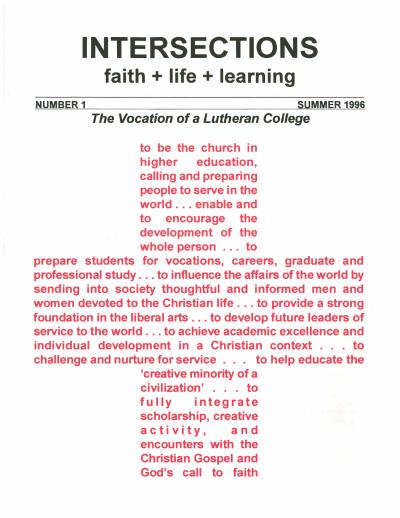
Unglaube welcomes readers to the inaugural issue of Intersections, crediting Editor Tom Christenson and Capital University, and announces the new annual Vocation of a Lutheran College Conference whose continuing dialogue the journal exists to enhance. He gives thanks to the Lilly Endowment for a sizable grant supporting the 1996 conference, campus dialogues, and the birth of the publication.
-
Editorial
From the Editor
Tom Christenson
Christenson, feeling like a proud parent, welcomes readers to the inaugural issue and acknowledges three people without whom the publication would still be just an idea: Naomi Linnel of the ELCA office for Higher Education and Schools, publisher Jim Unglaube, and Capital University president Josiah Blackmore. He invites readers’ reactions, suggestions, and active involvement as editors, reviewers, authors, artists, and critics in shaping the dialogue across the ELCA college and university family.
-
Article
The Future of Lutheran Higher Education
Mark Schwehn
Schwehn’s keynote, framed against Otto Paul Kretzmann’s October 1940 inaugural at Valparaiso, organizes itself around four topics: the idea of a Christian University (Lutheran schools as a tributary of the Christian intellectual tradition, voices in a conversation in the spirit of H. Richard Niebuhr and Alasdair MacIntyre rather than phases of James Burtchaell’s devolutionary scheme); the pursuit of truth (against Foucauldian reduction of truth to power, with Hilary Putnam, toward a cruciform discipleship that discovers truth ambulando); the critique of knowledge (developing Christian theories of knowing in conversation with Benne, Lotz, Wolterstorff, LeClerc, and Augustine); and Christianity and liberal learning (objectivity refurbished as Thomas Haskell’s ascetic self-discipline, and the recovery of texts that have claims upon us).
-
Response
"Whose Future?" or "Social Justice and the Lutheran Academy?"
Marsha Heck
Heck argues that the future of Lutheran higher education lies less in defining Lutheran distinctiveness than in moral action grounded in face-to-face relationships with others. Drawing on David Lotz’s two-kingdoms theology of citizenship, Ernest Simmons’s relational reading of Luther, Arthur Preisinger’s indictment of the German Lutheran misreading of two kingdoms during the Third Reich, Starla Stensaas of Dana College, and Paulo Freire’s dialectic of empowerment, she calls Lutheran colleges to integrate moral reflection with moral action—to move students’ muscles against what is not true as well as to feel truths in their bones.
-
Response
Knowing and a Tradition to be Known
Kurt Keljo
Keljo, University Pastor at Capital, embraces Schwehn’s vocational call but challenges his epistemological framing. We are called to bear witness to the Truth more than to pursue it; truth and power need not be dissociated when power is understood cruciform-ly as love and service; alongside objectivity, a case can be made from the tradition for connected knowing (image of God, idolatry, repentance, Incarnation). Christians offer not a particular epistemology but a foundation for epistemology—a tradition to be known. He closes with James Fowler’s four marks of the “public church”: particularly Christian, prepared for pluralism, balancing intimacy with public engagement, and unafraid of ideological pluralism in confident, nondefensive civility.
-
Response
Renewing Our Journey: Some Thoughts on Pursuing the Truth
John Rehl
Rehl, a Capital University graduate pursuing doctorates in theology at Chicago and in economics at Wisconsin, takes up Schwehn’s invitation to think again on the nature of truth. He sets aside truth as information, as object, and as mere words; recasts the church-related college’s task as a renewed emphasis on classroom teaching (Kierkegaard’s teacher as midwife) and on brave, articulate professors. He calls for moral education in courage, discipline, patience, and love, illustrates the costs of the fact-value split with examples from economics, and argues that we honor Lutheran heritage not by preserving it as a museum piece but by testing it—Luther’s theology of the cross over a theology of glory—and by preparing students for a world of Untruth, strengthened (with Julian of Norwich) by the promise that they will not be overwhelmed.
-
Institutional Focus
Diversity and Dialogue: Gustavus Adolphus College
Florence D. Amamoto
Amamoto, a third-generation Japanese-American Buddhist who teaches American literature at Gustavus Adolphus and regularly attends daily chapel, writes as an “inside outsider.” Engaging Schwehn’s closing call to refurbish the Lutheran college, she argues that church-related colleges are vitally important to society, that “refurbishing” must take up diversity, and describes how Lutheranism is manifest at Gustavus: Christ Chapel as the highest point on campus, the ecumenical chapel program led for thirty years by Chaplain Richard Elvee, the Nobel Conferences that pair scientists with philosophers and theologians, the First-term Seminar and Tuesday Conversations, the India study-abroad program organized by Deane Curtin, and the Sponberg Chair in Ethics. She names the pressures of money, secularization, and the publications-driven push for “excellence” that threaten this creative tension.
-
Institutional Focus
Continuing the Dialogue: Augustana College
Sandra C. Looney
Looney describes Augustana College, Sioux Falls, debating and renaming its values—Christian, Liberal Arts, Community, Excellence, Service—under the leadership of religion professor Dr. Arthur Olsen and the T’N’T (“Through Thick and Thin”) committee, in the wake of ELCA Region III’s “What Does It Mean to be a College of the Church?” conversations. She describes Augustana’s 56% Lutheran student body, daily 10 a.m. chapel, dual Christmas Vespers in Our Savior’s Lutheran Church and St. Joseph’s Cathedral, the Capstone classes on moral and aesthetic issues, and the ongoing work of enlarging Augustana’s conversation to include Native American, Jewish, and Islamic voices.
-
 Editorial
From the Editor
Robert D. Haak
No. 29 · Spring 2009
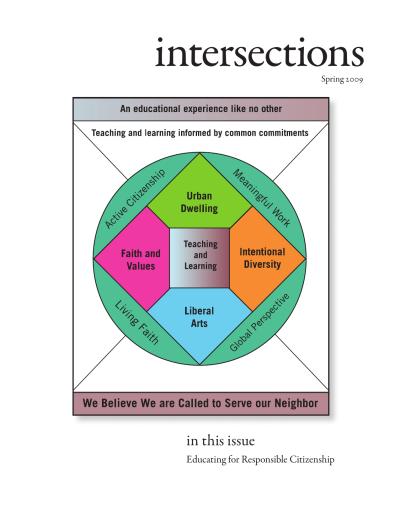
Haak frames the issue’s essays around the question of Lutheran colleges and the role of citizen, noting H. Richard Niebuhr’s typology in Christ and Culture and Luther’s own complex understanding of Christian and state, and offers a fitting farewell to Arne Selbyg with Mike Blair’s tribute song “A Fine Norwegian.”
-
 Article
Where Your Feet are Standing: Institutional Engagement and Place
Melissa Maxwell-Doherty
No. 54 · Fall 2021
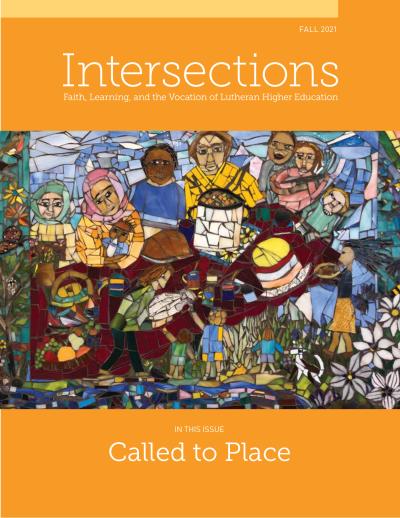
Maxwell-Doherty draws on Cal Lutheran’s Hispanic-Serving Institution designation and its location on Chumash, Fernandino Tataviam, and Ohlone lands to ask how the university’s mission might shift if it depended on where its students are standing — not just where the institution sits.
-
 Article
Gift and Calling: A Lutheran Perspective on Higher Education
Darrell Jodock
No. 34 · Fall 2011
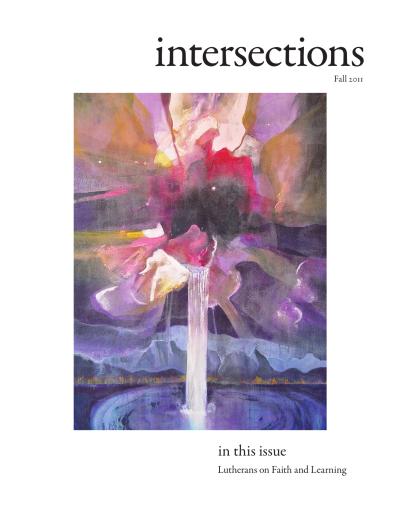
Jodock argues that a Lutheran perspective on higher education rests on three underlying ideas—that we are gifted (a giftedness that calls forth wonder, awe, gratitude, a sense of humor, and vocation as response to neighbor); that the Lutheran tradition affirms a particular kind of God who is down-to-earth and at work in the world for justice and human wholeness; and that a Lutheran “third path” can be both rooted in the tradition and inclusive of others. He draws out ten implications for higher education, from wonder as the heart of religion through liberal learning oriented toward the freedom of its members.
-
 Article
Low-Hanging Fruit, Moonshots, and Coffee: Dreaming Big Within and Beyond Our Limitations
Jeremy Myers
No. 59 · Spring 2024
Myers shares the process used by Augsburg’s Christensen Center for Vocation to help teams move from a shared experience to next steps — an Ignatian-rooted Awareness Examen followed by naming low-hanging fruit, moonshots, and the coffee conversations that build the coalition to make it all happen.
-
 Reflection
Keeping Close from a Distance: Pandemic Reflections of a Library Coordinator
Carla Flengeris
No. 53 · Spring 2021
Flengeris reflects on a year of running Luther College’s library at the University of Regina from her basement and mourns the loss of the hourly walks through the stacks—the “roving reference” that, she realizes, were never disruptions to her work but were the work itself.
-
 Book Review
Alister McGrath: Glimpsing the Divine: The Search for Meaning in the Universe
Don Braxton
No. 14 · Summer 2002
Braxton reviews Alister McGrath’s Glimpsing the Divine (Eerdmans, 2002), commending its twelve articulate, lavishly photographed meditations as a fine introduction to Western spirituality but criticizing its conservative neo-Barthian confessionalism, its Eurocentric treatment of non-Western traditions as “taillights” to Christianity’s “headlights,” its one-sided host-guest engagement with the natural sciences, and its metaphysical dualism. In a section added for ministerial readers, he contrasts McGrath’s self-contained confessionalism with H. Richard Niebuhr’s call to respond to all things as if to God’s actions upon us, and argues that in an era of rival fundamentalisms exclusivity must become a thing of the past.