Some Personal Reflections on the ELCA Vocation of a Lutheran College Conference, 1998
Intersections No. 7 · Summer 1999
Common-ness and Otherness
As a first time attendee of the ELCA Conference, it struck me that one of the main themes of the workshop was evaluating the relative strength of the Lutheran college identity. I offer the following observations about group identity and the evolution of that identity, as seemed relevant to our sessions at the conference.
Is there a distinctive identity to ELCA colleges? What group members contribute to that identity?
In his keynote address at the 1998 ELCA Vocation of a Lutheran College Conference, “The Freedom of a Christian,” Dr. Tom Christenson described an inclusive view of group membership in likening Lutheran colleges to woven fabric:
In weaving, it’s usually what weavers call the woof or weft of the weaving that carries the color, the texture and the distinctive pattern of the weaving … But it’s the warp that holds the whole thing together, that makes it a weaving at all. The ‘for whom,’ the ‘by whom,’ the ‘where,’ and the ‘ethnic roots’ of our institutions make them different weavings. We should celebrate those differences. But I think there’s a common warp to all of us … We should celebrate that commonality.
Composer Charles Ives offers an even more inclusive view of group identity as he describes characteristics of American music in Essays Before a Sonata:
A true love of country is likely to be so big that it will embrace the virtue one sees in other countries … A composer born in America … may be so interested in “negro melodies” that he writes a symphony over them. He is conscious … that he wishes it to be ‘American music.’ He tries to forget that the paternal Negro came from Africa. Is his music American or as African? … If he had been born in Africa, his music might have been just as American, for there is good authority that an African soul under an X-ray looks identically like an American soul.
While Christenson points to a commonality of place as uniting a diverse group of people, Ives suggests that the commonality of human-ness serves the same function, blurring the distinction between sub-groups such as American or African music. However, Ives does suggest that commonality of purpose (“spirit”) between individuals helps to distinguish a larger group:
“There is a futility in selecting a certain type to represent a ‘whole,’ unless the … spirit of the type coincides with that of the whole.”
At the 1998 ELCA conference, I became part of a group seeking to define its Lutheran-ness. As we heard presentations and engaged in discussion, I was intrigued by the wide range of possibilities for inclusiveness in establishing the ELCA identity, as suggested by Ives and Christenson above. To simplify matters for myself, I thought about some general markers that might be used to determine the distinctiveness of a perceivable group.
- The group has generated printed works.
- There are people who consider themselves group members.
- Group membership generates activity.
- People outside of the group perceive the group as such, especially because of their own recognition of themselves as outside of the group.
These markers were recognizable and evident at the 1998 ELCA conference. Ernest Simmons’ book Lutheran Higher Education: An Introduction for Faculty served as a document of historical and visionary definition for the ELCA higher education community. Activity was generated as outstanding speakers, helpful staff, and committed administrators and faculty from ELCA colleges attended, engaging in discussion, thought, devotional services, and recreation for four days in Springfield.
Marker #4, the reactions of “others,” is a multi-faceted concept that I feel compelled to address. To the “other” groups on Wittenberg’s campus (marching bands, soccer camps, etc.), the ELCA conference was a group with an identity, to which they reacted, either consciously or subconsciously. To the “other” faculty, staff, and administrators from the ELCA colleges who didn’t attend the conference, those of us in Springfield were a “group” to which they may have reacted when the beginning of the academic year invited discourse about the conference activities and discoveries.
But, among those who did attend the ELCA conference, there were other “others”: those who may have felt, somehow, “outside” the conference even after having been given a room key and a name tag. In fact, each conference attendee may have felt “other” for a multitude of reasons: “I’m the only administrator in my discussion group.” “I’m the only Baptist.” “I’m the only athlete.” “I’m the only homosexual.” But, perhaps, more significant is a kind of “other” used by Dr. Simmons in his text. In his affirmation of the richness of diversity found at Lutheran colleges, he writes:
“We need denominational diversity on campus not only to enrich our own understanding of the Christian tradition but also to keep Lutherans honest. We need reflective Presbyterians, Roman Catholics, Baptists, Methodists, and others, for they may do more for the effecting of Lutheran identity on campus than a non-reflective Lutheran would.”
As a Unitarian Universalist with one Jewish parent, I certainly fall into the category “other” as designated by Simmons. Also, I am in the “other” category because I attended the ELCA conference after having served only one year as a faculty member at Susquehanna University. My educational background also contributed to my “other-ness”: a secular liberal arts college (Oberlin), a conservatory (New England Conservatory), and a state school (University of Minnesota).
The concept of “other-ness” was discussed directly on several occasions at the ELCA conference itself. Dr. Robert Scholz, in his paper “How Can We Keep From Singing” used “other” in a positive sense, referring to music that would more meaningfully contribute to a “Christian worship service”:
“I really object to the terminology ‘contemporary Christian’ to describe a narrowly conceived soft pop-rock genre to the exclusion of all other contemporary musical styles — folk, jazz, or classical.”
Still, there was the “other-ness” of institutions that, clearly (to those presiding) belonged in groups other than the ELCA. Calvin College, Wheaton, and Pepperdine were identified by California Lutheran College’s Vice President for Academic Affairs Dr. Pamela Jolicoer as institutions “who use education to ‘Christianize’ or transform [culture]” — not a vision articulated by the Lutheran educators at the 1998 conference. On the other end of the institutional spectrum, Dr. Ryan LaHurd cited author George Marsden who, “offers a stern warning for colleges like ours, which he sees on the slippery slope sliding toward secularization in the historical tradition of Harvard and Yale.” Other earnest warnings were issued by Dr. Christenson: “ … when I taught in Minnesota, the temptation was to be another Carleton or Macalister. In Ohio, we yearn to be another Kenyon or Oberlin … But let me tell you, this is not the direction we should go.”
From the perspective of a secular humanist, it might surprise Lutherans to learn that they may be seen as part of a group of colleges that call themselves “Christian” — Wheaton, Calvin, Southern Methodist University, and Bob Jones University included. All of these institutions are grounded in the belief of redemption through Christ. “Other” to some “unenlightened” people might mean any college that is “church affiliated.” At any rate, from my vantage point, the group identity of the ELCA colleges seemed intact at the 1998 conference. Although I understand the frustration expressed at forming group identity on the basis of what the group is not, I believe that many groups face similar frustrations, Unitarian Universalists in particular. Thus, I was not surprised by Dr. Christenson’s description of the “other” Protestant church schools looking to the Lutheran colleges for lessons in forming identity.
Shepherding the ELCA Identity
If it is acknowledged that ELCA colleges hold an identity, illuminated by documentation, people and their actions, and the reactions of “others” to them, the question that seemed to be urgent to many at the conference was what the future of that identity would be. I observed two positions (sometimes held by the same persons) in Springfield: the position of identity spoke of the importance of having people on their campuses who could “tell the story” (presumably of Lutheranism) to those new to the college community. On the other hand, one professor described an imaginary scene in which Martin Luther returned to the world to chastise Lutherans for preserving Lutheranism to the extent that it prohibited the development of their faith. One effective way of preservation is through historical documentation. The 1998 ELCA conference provided an exciting array of position papers documenting Lutheran points of view. Although the presenters of those papers will naturally experience changes in their perspectives in the years to come, the documents stand as testaments of their commitment to Lutheran higher education. The essence of Lutheranism will be preserved so long as those historical representations of ELCA higher education are made available to all members of the ELCA community.
However, I humbly suggest that my remaining three markers of the Lutheran group identity: its people (members, if you will), their actions, and, naturally, the reactions of “others” be allowed to evolve. If preservation of a group identity manifests itself in seeking to recruit members who mirror the views already shared by the group, it will stagnate. Rather, complimenting and even contrasting persons (students, faculty, and staff) should be sought. I was aware of several fears expressed by those who voiced their colleges’ needs for Lutheran personnel preservation. These fears were for loss of “worship” (number of services required, number in congregation), loss of the liturgical, theological Lutheran story, and loss of Christianity overall, which contributes, ultimately, they felt, to the loss of community on their campuses.
To that fear I offer my particular reaction to thinking about Christianity and community: if Christianity means the teaching of the gospel, the belief in Christ’s power of grace and redemption, and the belief in the two Kingdoms of God, then, yes, those manifestations of Christianity could be superseded by other academic activities if the percentage of Lutherans on campuses declines. However, if one can accept the notion that Christianity means living the life of the redeemer, adopting the work ethic of Jesus, and his passion of vocation, then those persons selected to compliment and even contrast those members of the Lutheran community will not “dilute” the Lutheranism of the institution, but give it continued energy and growth.
“Little Christ”
From the presentations at the 1998 ELCU conference one heard expressed repeatedly a fear of “secularization.” I interpreted that term, (in the context of the symposium established by the tone of Simmons’ book) to mean a life without spirituality. I am not convinced, after my exposure to the inclusive nature of these Lutheran institutions that “secularization” means a life without belief in Jesus as Savior. Repeatedly, I heard professors claim the thankfulness with which they called Jews, Buddhists, Muslims, and their colleagues. Surely, the presence of these “non-Christians” strengthened their institutions, the conference attendees claimed. But how many “non-Lutherans” or “non-Christians” can an ELCA college have? Simmons writes, “According to Luther, the Christian relates to God through faith alone, which is then expressed in loving service to one’s neighbor. Such is the freedom of a Christian when one is called upon to be a ‘little Christ’ to one’s neighbor by continuing in limited human fashion the incarnation of God’s love in Christ.”
A Unitarian Universalist might read those sentences like this: “According to one of the great religious reformers, Martin Luther, the human maintains faith in the notion of an affirming Creator, rejoicing in that faith through service to others. In that sense, the human may be called to serve as a ‘Working Prophet’ to her neighbor by living as Jesus lived, accepting his mission of human service as her own.”
In my opinion, anyone who displays the qualities of engaged, committed, and passionate vocation and can share that passion for vocation with students and colleagues is not only a valuable member of the Lutheran higher education community, but even acts as a prophet in that community.
Therefore, I saw no need for Dr. Cheryl Ney (professor of chemistry at Capital University) to specifically address “Christianity,” in her vibrant description of her community-grounded scientific vocation. She was clearly an example of the incarnation of “Working Prophet” (or “Little Christ”), regardless of her specific beliefs in the trinity.
I wonder if a more inclusive definition of “Christianity” is what Dr. Christenson had in mind when, in his summary comments, he asserted that “Lutherans and other Christians” held the particular discerning ability to identify, recruit, and embrace engaged teachers from diverse backgrounds. Again, he was supporting the value of diversity of Lutheran campuses. But “Christians” were identified as the sole stewards of that diversity. To what extent would a more inclusive, working definition of “Christian” alleviate the fears I heard expressed at the ELCA conference about Lutheran reservation? Would the future of Lutheranism be secure if one were to accept Ives’ charge to recruit individuals with the same “spirit” rather than concerning oneself with the “religious” beliefs of the individual?
It is a challenging position to consider one’s “Christianity” by the way one is immersed in a vocation as Jesus lived, rather than in one’s belief of Christ as Savior. I certainly am in no position to propose that challenge to the ELCA Lutherans. I am, after all, an “other.”
-
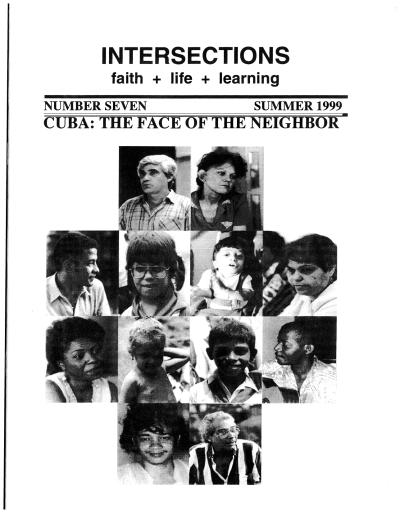 Editorial
From the Publisher
Arne Selbyg
Selbyg celebrates the popularity of the previous issue—the first to draw on papers from the annual “Vocation of a Lutheran College” conference—and announces a new Lutheran Brotherhood Foundation grant that will fund the inaugural Lutheran Academy of Scholars in Higher Education, a two-week seminar at Harvard led by Ronald Thiemann on “Finding Our Voice: Christian Faith and Critical Vision.”
-
Editorial
From the Editor
Tom Christenson
Christenson introduces the issue’s contents—papers from the 1998 Vocation conference by Cheryl Ney and Robert Scholz, a response by Jennifer Sacher Wiley, an interview with four Capital University faculty about Cuba, a meditation by St. Olaf senior Erik Haaland, and the journal’s first letter to the editor—and commends the Mount Mary College volume Wagering on Transcendence as a model of a faculty community sustained by Friday-afternoon conversation over a glass of wine.
-
Article
Rooting Science in Empathy: Growing Towards a Sustainable Science Practice for the 21st Century
Cheryl L. Ney
Ney, a DNA biochemist turned feminist science educator at Capital University, traces her own search for the “grounding” of teaching from Ernest Boyer’s scholarship of teaching through Cathleen Loving’s Scientific Theory Profile, Evelyn Fox-Keller’s critiques of science as “truly masculine philosophy” and her biography of Barbara McClintock (“A Feeling for the Organism”), and Arnold Pacey’s definition of science as a web of technical, organizational, and cultural practice. Drawing on the Dutch Science Shops, the Loka Institute’s community-based research, and academic service learning, she calls for “sustainable science practice” rooted in empathy and asks whether Lutheran institutions have the courage to claim an institutional freedom of vision rather than reduce themselves to preparation for the job market.
-
Article
How Can We Keep From Singing?
Robert Scholz
Scholz, professor of music at St. Olaf, responds to Tom Christenson’s “Freedom of a Christian” by walking through his own Nunc dimittis for the St. Olaf Christmas Festival, an Elderhostel choir of singers aged 60 to 95, and the four liberating arts (enablement and change, melioristic, embodying, and critical) as they shape conducting, composition, and music education. He defends the fine arts and folk traditions over “contemporary Christian” soft pop-rock and taped accompaniments, citing Luther’s preface to Georg Rhau’s Symphoniae iucundae and the family of God’s need to interact in song against the virtual community of TV evangelism and the Crystal Cathedrals of the air.
-
Article
The Face of the Neighbor: An Interview with Four Capital University Faculty About Their Recent Visit to Cuba
Brian Forry Wallace, Michael Yosha, Reg Dyck, Susan Narita
Four Capital University faculty—political scientist Brian Wallace (returning to Cuba a third time after the 1994 boat lift), English professor Reg Dyck, ESL teacher Susan Narita, and political scientist Michael Yosha—recount their summer 1998 trip with Pastors for Peace, describing Cuban priorities of education, health care, and military (in that order), the cultural richness of Havana from sixteenth-century cloisters to Miramar, the Cuban Foreign Service’s vision of a Scandinavian-style democratic socialism, the counter-productive U.S. embargo (including its effect on kidney dialysis machines), Castro’s 1991 reconciliation with religious communities, and a recurrent image of a little girl named Marguerite singing at a school for amputee and terminally ill children. The interview was conducted by Capital senior Jessica Brown and Tom Christenson.
-
Reflection
Meditation—Band Chapel Service, St. Olaf College
Erik Haaland
Haaland, a St. Olaf senior, offers a brief Band Chapel meditation that defines art as “the expression of what is deeply human through the manipulation of the physical world” and defends worship—architecture, stained glass, music, eloquence—as an art form requiring our best and most sincere efforts. When the God we worship and the salvation we proclaim do not seem near, artful worship offers not propositions but something real and tangible to hold on to.
-
Institutional Focus
Letters to the Editor
The journal’s first letter to the editor: Pastor John L. Vaswig of Spokane, a Pacific Lutheran University alumnus and member of the PLU Board of Regents, writes after reading James Tunstead Burtchaell’s The Dying Light: The Disengagement of Colleges and Universities from Their Christian Churches to ask whether church-related institutions, in their effort to be open and tolerant, have abandoned a compelling word of hope and forgiveness in Jesus Christ.
-
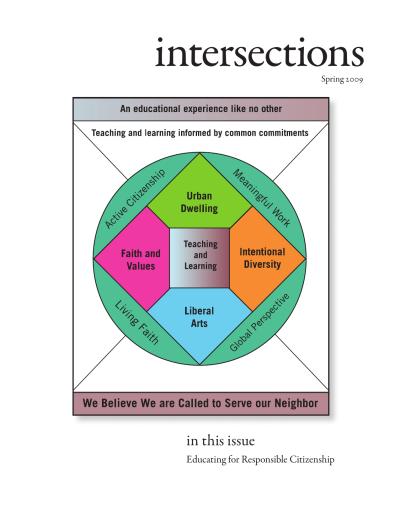 Editorial
From the Editor
Robert D. Haak
No. 29 · Spring 2009
Haak frames the issue’s essays around the question of Lutheran colleges and the role of citizen, noting H. Richard Niebuhr’s typology in Christ and Culture and Luther’s own complex understanding of Christian and state, and offers a fitting farewell to Arne Selbyg with Mike Blair’s tribute song “A Fine Norwegian.”
-
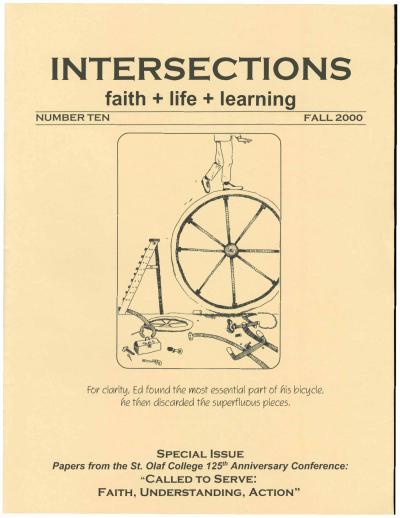 Article
Education for Peace and Justice
David J. O'Brien
No. 10 · Fall 2000
O’Brien surveys justice and peace education in Catholic higher education from Vatican II through the 1980s pastoral letters on nuclear weapons and the American economy, contrasting evangelical radicals (“what would Jesus do?”) with comfortable accomodationists, and argues that Catholic social teaching remains the church’s “best-kept secret.” Drawing on Bryan Hehir, David Hollenbach, Pope John XXIII, Patricia Hample’s “placing ourselves in the world to be of use,” and Martin Luther King’s last book on the “world house,” he develops pastoral care, solidarity (rooted in the mystical Body of Christ), and a realistic vocation-and-citizenship as the three needed responses for Catholic and Lutheran colleges alike.
-
 Article
Making Dry Bones Stand: Lutheran Higher Education at Century's End
Diane Scholl
No. 17 · Summer 2003
Scholl reads John Winthrop’s “A Model of Christian Charity,” the banishment of Anne Hutchinson, de Crevecoeur’s American farmer, Olaudah Equiano, Phyllis Wheatley, and Hawthorne’s The Scarlet Letter alongside Ezekiel’s vision of the dry bones to ask how a Lutheran college can be a community that holds difference and commonality together. Drawing on Ernest Simmons’s warning against collapsing into either dogmatic absolutism or thoroughgoing relativism and Bruce Reichenbach’s companion essay in this issue, she identifies five features of shared life at a Lutheran college—the liberal arts, political process, the arts, the community of caring, and the recognition of difference and the right to dissent—and argues that the necessary tension between individualism and corporate identity, framed by theological vision, is “our best legacy and our best hope for the future.”
-
 Institutional Focus
Pivoting to Imaginative Programming in the Midst of the Pandemic at Bethany College
Arminta Fox
No. 55 · Spring 2022
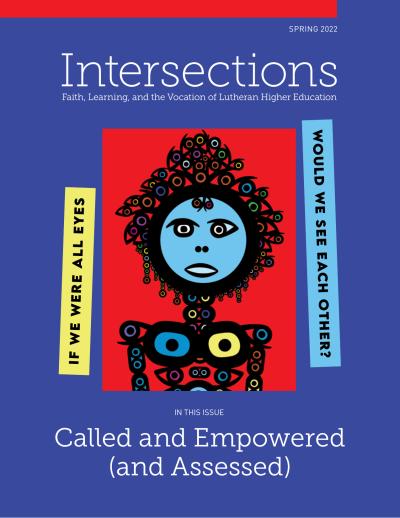
Fox recounts how Bethany College’s NetVUE Program Development Grant — originally designed around service-learning trips — was reimagined under COVID-19 into a guest-speaker model that tripled student participation and opened new vocational possibilities through the close, personal stories of alumni, alums-turned-volunteers, and community partners.
-
 Article
Learning from Luther on Covid-19
Carl Hughes
No. 52 · Fall 2020
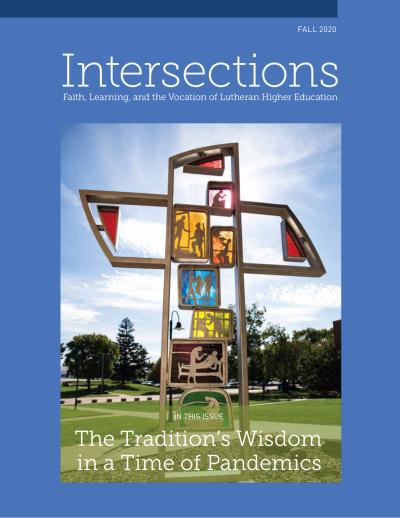
Reading Martin Luther’s 1527 treatise “Whether One May Flee from a Deadly Plague,” Hughes finds practical and spiritual guidance for a pandemic age: serve the neighbor, follow medical experts, honor those whose vocations put them at risk, and trust that even when we fail, God will not abandon the community.
-
 Editorial
From the Editor
Jason A. Mahn
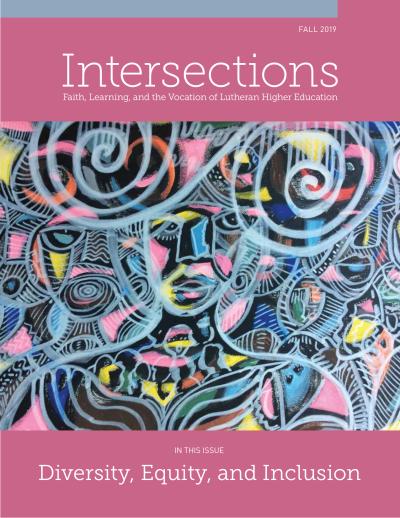
No. 50 · Fall 2019
Mahn opens with Lenny Duncan’s observation that the ELCA is 96 percent white — the whitest denomination in the U.S. — and asks how teachers and administrators at historically, predominantly, and persistently white institutions can turn from white privilege and white supremacy toward spaces where people of color thrive and white people are re-formed into antiracist allies.