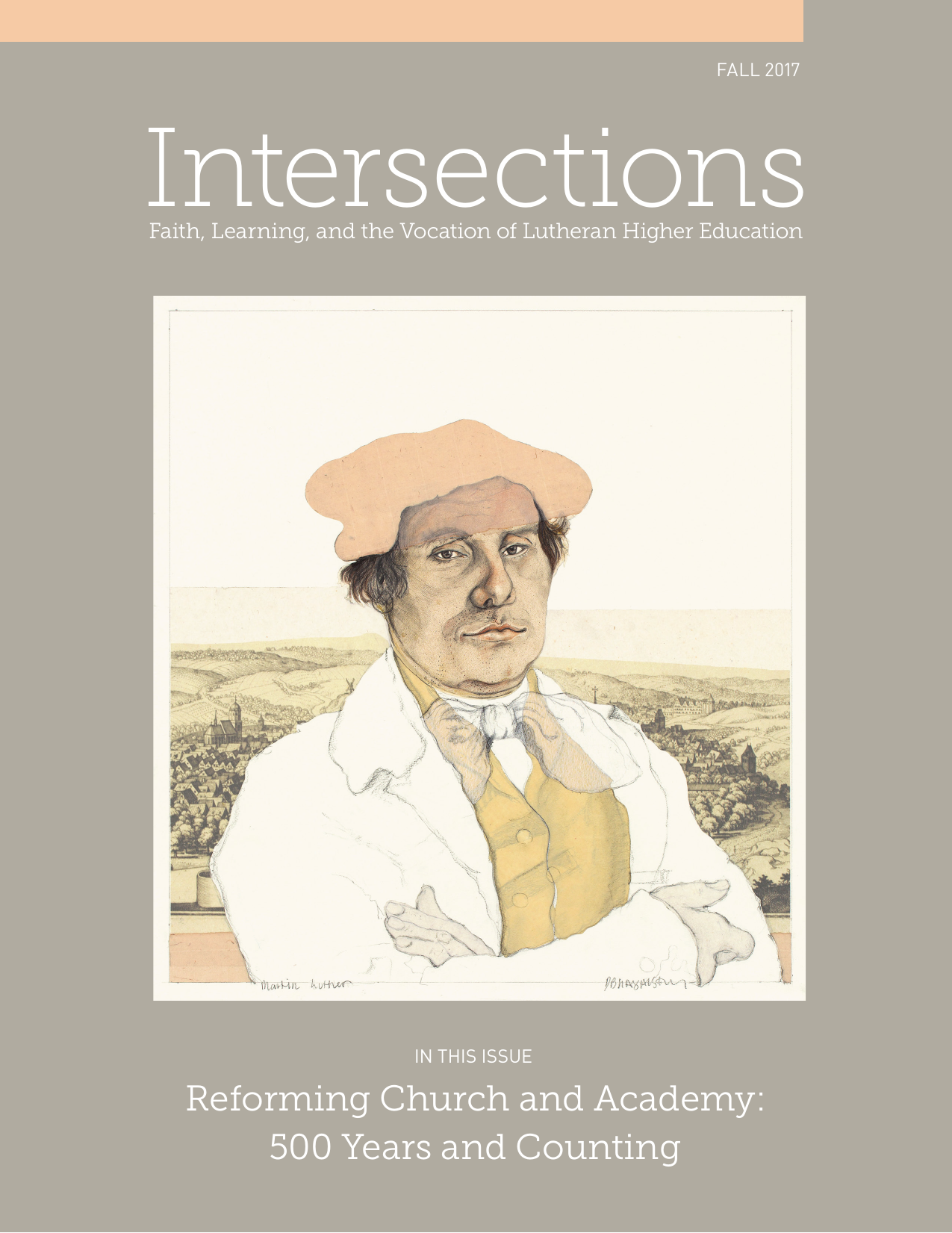
Reforming Church and Academy: 500 Years and Counting
An issue of Intersections marking the five-hundredth anniversary of the Lutheran Reformation. Essays gathered here move beyond celebration to careful assessment and creative re-appropriation of the Reformation tradition — engaging vocation, education, social service, the “Book of Nature,” Luther among the poor, the centrality of the Word, a Dalit reading of Luther’s sutra, and the call for ecclesiological reflection in Lutheran higher education.
Editors
Articles in this Issue
-
 Editorial
From the Publisher
Mark Wilhelm
Wilhelm reflects on how NECU’s focused work on Lutheran identity in higher education — including the forthcoming document Rooted and Open: Our Common Institutional Calling — turns out to be a fitting commemoration of the five-hundredth anniversary of the Lutheran Reformation, even though it did not arise from anniversary planning.
-
Editorial
From the Editor
Jason A. Mahn
Mahn returns to Luther’s opening thesis on whole-life repentance to argue that the deepest critique of the indulgence economy — and of our own American meritocracy — is the very assumption that grace and human striving can be measured, exchanged, and earned.
-
Article
Why Martin Luther and the Reformation Matter 500 Years Later
Kathryn A. Kleinhans
Adapted from a 2017 address to Wartburg College’s entering class, Kleinhans surveys Luther’s lasting impact in vocation, education, social service, and the necessary work of repentance — closing with the Lutheran World Federation’s Windhoek assembly and the Reformation World Exhibition’s call to live reform forward into the next 500 years.
-
Article
Celebrating the Reformation: The Lutheran Foundation of a Called Life
Mark D. Tranvik
Tranvik traces vocation from the monastic impulse through Luther’s rejection of the monk’s vow as the only true calling, and translates the “called life” for twenty-first-century Lutheran colleges — institutions that see students as made in the image of God, enlist the whole community in discernment, and make room for faith and its convictions.
-
Article
Reforming Our Visions of City Nature
Lea F. Schweitz
Through a Chicago story of Canada geese at North Pond, Schweitz takes up two Reformation-era ways of reading the “Book of Nature” — Konrad Rosbach’s moral readings and Philip Melanchthon’s scientific ones — and proposes a third: Luther’s sacramental principle that the finite is capable of the infinite, worn as “reading glasses” for an urban planet.
-
Article
Both Priest and Beggar: Luther among the Poor
Martha E. Stortz
Reading Luther’s deathbed remark “We are all beggars” against his “priesthood of all believers,” Stortz argues that priest and beggar are two sides of a human reality — one that locates civic responsibility for the poor at the heart of the Reformation legacy and that pushes beyond paternalistic service toward the systemic question of justice.
-
Article
In the Beginning of the Reformation Was the Word
George Connell
Drawing on a Concordia faculty pilgrimage to German Luther sites, Connell appropriates John’s prologue to frame the Reformation as a movement about words — the printed page, the university classroom, the Marburg confession, the Wartburg translation, Bach’s music, and the dining-room conversations of Table Talk — while soberly noting that words can wound as well as heal.
-
Article
Luther's Sutra: An Indian, Subaltern (Dalit) Perspective
Surekha Nelavala
Nelavala traces how Luther’s “sutra” — grace alone, faith alone, scripture alone, Christ alone — reached the mud hut of her Dalit grandparents in rural India, transforming three generations, and then reads the parable of the vineyard laborers from a subaltern perspective in which grace for all is the heart of God’s alternative kingdom.
-
Article
Reforming Lutheran Higher Education: Ecclesiological Reflection and Theological Leadership
Brian Beckstrom
Beckstrom diagnoses an “identity crisis” at ELCA colleges and universities rooted in inherited Enlightenment assumptions and a thin functional ecclesiology, and proposes that a Trinitarian, perichoretic understanding of God offers an ecclesiological foundation that holds together unity and diversity in a pluralistic, post-Christian context.