Each year, the entering class at Wartburg College is asked to read a book over the summer. In 2017, the common reading was Martin Luther: A Very Short Introduction, by Scott Hendrix. The following article is adapted from an address given to the entering class on September 13, 2017.
In 1997, Life magazine published “The 100 people who made the millennium.” This lengthy article profiled “The top 100 people—including athletes, physicians, inventors, philosophers, writers, and others—who helped influence the history of the world during the last millennium.”
First on the list: Thomas Edison, inventor of the electric light bulb.
Coming in second: Christopher Columbus.
And third on the list of the 100 most influential people who lived between the years 1000 and 2000 of the common era: Martin Luther.
Each year, I tell students in my Lutheran Heritage course that we don’t study Martin Luther and the Reformation only because Wartburg is a college of the Lutheran church, but also because Martin Luther has world-historical significance. Martin Luther, monk and university professor, stood up against the two most powerful institutions in the world of his day, the Roman Church and the Holy Roman Empire, and lived to tell about it.
Third on the list of the 100 most influential people who lived between the years 1000 and 2000 of the common era: Martin Luther.
Yet in many ways Martin Luther was not unlike some of our students. He was a first generation college student. He was a son who struggled with the tension between living his own life and pleasing his parents. He was someone who began a major field of study only to realize within the first couple of months of school that it was not for him.
Martin’s father, Hans, was in the mining industry. Over time, he worked himself up from labor to management. Like many other upwardly mobile parents, Hans had even greater aspirations for his son. He sent young Martin to Latin schools in preparation for university studies, in a time when a university education was not anywhere near as common as it is today (nor, for that matter, was an elementary education). After university, Martin would continue on to law school.
Just a short time into his legal studies, Martin left the university and joined a monastery. He progressed well in monastic life, just as he had progressed well in school. He was given leadership responsibilities in the Augustinian order, and was eventually sent to earn a doctoral degree and to become a teacher.
Through his study of the Bible, Luther came to a new insight: God doesn’t require us to do enough good works to work our way up to heaven. Instead, God comes down to earth, to us, in the person of Jesus Christ. Jesus loved us enough to die for us, and for his sake, our sins are forgiven.
This insight is what led to Luther’s posting of his 95 Theses against indulgences on the door of the castle church in Wittenberg on October 31, 1517. His theses were an invitation to debate, and the proposed subject of the debate was that God’s grace could not be earned or purchased. It was, and is, a gift. As Luther expressed it several years later while writing in seclusion at the Wartburg Castle, “The chief article and foundation of the gospel is that before you take Christ as an example, you accept and recognize him as a gift, as a present that God has given you and that is your own” (“A Brief Instruction” 119).
Why have Luther and the Reformation had such an Enduring Impact?
Just imagine: a sixteenth-century reform movement started in the small university town of Wittenberg, in the territory of Electoral Saxony, now spans the globe, with over 76 million Lutheran Christians in the world. Imagine: there are approximately 6.5 million Lutheran Christians in the United States, the majority of whom are of German or Scandinavian descent. Yet there are also almost 8 million Lutheran Christians in Ethiopia alone—and over 6 million more in Tanzania. In fact, over 20 million of the world’s 76 million Lutherans live in Africa. Who’d have imagined such a thing 500 years ago?
The sixteenth century was a perfect storm of factors making the world ripe for reformation. Luther lived in a time of tremendous cultural, political, and social change. He witnessed the growth of cities, along with the rise of a middle class. He benefitted from technological innovations, most notably the movable-type printing press. Luther lived in a time of expanded global awareness, marked not least by Christopher Columbus’s arrival in the “New World” in 1492. Apocalyptic expectations were strong; many religious people expected that the end of the world was imminent.
We too live in a time of tremendous cultural, political, and social change. Many refer to this period as postmodernity, but while different scholars make different claims about exactly what that means, perhaps we can agree that postmodernity means at least this: We know that things have changed, and are changing, and we’re not quite sure what to make of that yet.
For this reason, Luther can serve as a valuable resource for today. Luther was a truly contextual theologian, addressing specific issues in his own place and time. He spoke and wrote in response to the situations that presented themselves: the abuses within the medieval Catholic church, the Peasants War and the Turkish threat, the excesses of other reformers, a barber’s request for advise on how to pray, a soldier’s request for career counseling, and of course the many, many classroom lectures and sermons. His tireless engagement with the issues of his day is a model for us. This Lutheran commitment to applying insights and commitments in changing contexts is, I think, precisely why Lutheranism is thriving in places like Africa and Asia.
Areas of Lasting Impact
I’d like to explore with you several specific areas in which Luther and the Reformation made a significant impact in the sixteenth century and which continue to be influential in our day.
Vocation
The first is Luther’s understanding of vocation. The word “vocation” simply means “calling.” Before the Reformation, “vocation” was a technical term limited to religious professionals, who were considered to have a special calling from God. Luther expanded the understanding of vocation to include all people, insisting that all work done responsibly for the sake of others is a calling. Everyone, regardless of job, social status, gender, age, etc., is called by God. In fact, Luther taught that we all have multiple callings. He did not limit the language of vocation to work, as such, but included the other areas of life in which we have roles and responsibilities, such as family and community. As times change, and throughout our individual lives, our roles and responsibilities change, but the bottom line remains that God calls us to serve our neighbors.
For Luther, this understanding of vocation was not just something for Christians. Luther believed that God created all people to work together and to care for each other. In part, he was inspired by the parable of the Good Samaritan, told by Jesus to answer the question, “Who is my neighbor?” In the parable, it is a religious outsider who cares for the victim in need. Luther challenged the human tendency to make divisions between “us” and “them,” writing: “Now our neighbor is any human being, especially one who needs our help, as Christ interprets it in Luke 10:30–37. Even one who has done me some sort of injury or harm has not shed his humanity on that account or stopped being flesh and blood, a creature of God very much like me; in other words, he does not stop being my neighbor” (Lectures 58).
Education
Another area in which Luther and the Reformation made a significant impact is education. Within the church, Luther’s commitment to education took the form of translating the Bible into the language of the common people and writing hymns and catechisms to teach the basics of the faith. The commitment to education extended beyond the church, however.
Luther and his fellow reformers were committed to universal education, for boys and for girls, regardless of social class. One reason for this was to equip everyone to read the Bible for her- or himself. Another reason for education is directly related to Luther’s understanding of vocation. Since the community is one of the areas in which one is called to be of service to neighbors, education is necessary to be prepared to respond to the changing needs of society. According to Luther, “A city’s best and greatest welfare, safety, and strength consist in its having many able, learned, wise, honorable, and well-educated citizens.” (“To the Councilmen” 356). He added:
This one consideration alone would be sufficient to justify the establishment everywhere of the very best schools for both boys and girls, namely, that in order to maintain its temporal estate outwardly the world must have good and capable men and women… Now such men must come from our boys, and such women from our girls. Therefore, it is a matter of properly educating and training our boys and girls to that end. (368)
(Note that the gender-inclusive language is Luther’s own.) Luther was practical and realistic in his support of education. He wrote to civic leaders encouraging them to establish and maintain schools. Recognizing that some families chose not to send their children to school because they felt it was more important for the boys to work to help support the family, Luther also wrote to parents encouraging them to keep their children in school. He described the education of young people as one of the best long-term investments someone can make. Ever the pragmatist, he also encouraged both the government and those with financial means to provide scholarships for students in need.
Social Service
Another area in which Luther and the Reformation made a significant impact is social service. Luther’s advocacy in social matters was a response to the dismantling of late medieval church structures and practices. Luther’s emphasis on grace as a free gift of God led to a decrease in alms-giving, since people no longer saw giving to the poor as a good work that might earn them favor with God. By the mid-1520s, Luther and his colleagues noticed that people were falling through the cracks and that something needed to be done about it.
Luther assisted in the development of a “common chest” to care for those in the community who had fallen on hard times. Specific guidelines were developed for the collection and distribution of funds for the common chest. The chests themselves were fitted with three or four locks, each lock with a different key, each key held by a different public official. A chest could only be unlocked by the agreement of all responsible parties, which was a safeguard against theft and corruption.
As Lutheranism spread throughout Europe and the world, wherever Lutherans went, they not only preached the Gospel and translated the scriptures, but also built schools and provided institutions of human care. In the United States, for example, Lutheran Services in America (LSA) is an umbrella organization comprised of more than 300 health and human services organizations associated with the Evangelical Lutheran Church in America or the Lutheran Church Missouri Synod. Different member organizations of LSA provide a range of social services, including senior services, health care, services to children and families, disability services, economic empowerment, and housing and community development. While founded and supported by Lutherans, these social ministry organizations serve anyone in need, regardless of age, race, culture, or religious affiliation. Overseas, Lutherans are involved in building hospitals and clinics, digging wells to provide clean water, combatting malaria and HIV/AIDS, supporting microenterprise, and much more.
The twin strands of education and social service are hallmarks of the Lutheran presence throughout the world, and doubtless also a factor in the spread and growth of Lutheranism.
Repentance
So far, I have focused on positive aspects of Luther and the Reformation, but there is another side of the coin, too. There were, of course, literal negative images of Luther produced as anti-Reformation propaganda. One well-known sixteenth-century image portrays Luther as a seven-headed monster while another shows the devil playing Luther’s head like a musical instrument.
Unfortunately, the most lasting negative images are of Luther’s own making. Luther did not always live up to his own best insights. The same theologian who wrote that every human being, even one who has done me harm, is my neighbor, also wrote crude and even violent words directed to those with whom he disagreed. This prompts a deep self-searching question for those who follow in Luther’s footsteps today: How are we responsible for the consequences of our words and our actions, even when those consequences happen long afterwards? Luther’s vicious treatise, On the Jews and Their Lies, is not only studied by scholars examining the past. An inexpensive paperback edition is available from Amazon, with enthusiastic ratings from contemporary proponents of antisemitism. A recent post on Facebook suggested that perhaps the removal of statues of Confederate war heroes because of their racism should be followed by the removal of statues of Martin Luther, too, because of his anti-Jewish writings.
Most contemporary Lutheran bodies have rejected Luther’s vitriol, but perhaps this has not been done frequently and publicly enough. Contemporary Lutheranism is not defined by a repristination of all things Luther. Consequently, recent observances of the Reformation anniversary have highlighted themes of confession and active repentance for the harms done by Luther’s words and by Luther’s followers. This is fitting, given that the first of Luther’s 95 theses calls believers to whole lives of repentance.
The Future
In this year of recognizing the five-hundredth anniversary of Luther’s posting of the 95 Theses, it’s important to be clear that the Reformation is not only about the past but also about the future.
An important shift in recent years is that Lutherans and Catholics no longer see each other as adversaries. For the four hundred and ninety-ninth anniversary of the 95 theses, Pope Francis participated in a worship service with Lutheran church leaders in the Lutheran cathedral in Lund, Sweden, in recognition of our growing partnership as fellow Christians. In many local communities, Lutherans and Catholics are also holding joint worship services in recognition of the Reformation anniversary.
When the Lutheran World Federation (LWF) held its assembly in May 2017, the location was not Wittenberg, Germany, but Windhoek, Namibia.
When the Lutheran World Federation (LWF), a communion of churches representing over 74 million members in 98 countries, held its assembly in May 2017, the location was not Wittenberg, Germany, but Windhoek, Namibia. Rather than meeting in the place where the Reformation began 500 years ago, the assembly was held in Africa in recognition that the center of Lutheranism in the world today is shifting. As another expression of the LWF’s commitment to the future, the preacher at the closing worship service of the Assembly was selected through an international preaching contest, open only to Lutheran pastors under the age of 35. (The preacher selected, the Rev. Lydia Posselt, is a Wartburg College alumna ’07, as well as an alumna of Luther Seminary ’11.)
The overarching theme of the Lutheran World Federation’s observance of the five hundredth anniversary of the Reformation is “Liberated by God’s Grace.” The three subthemes are “Salvation—Not for Sale,” “Human Beings—Not for Sale,” and “Creation—Not for Sale.” The repeated “Not for sale” is, at the simplest level, an expression of Luther’s insight that God’s grace is a free gift. It is also a strong challenge to a world that seeks to commodify almost everything and that determines value according to the bottom line. Human beings, created in the image of God, are “not for sale,” whether in the obvious form of slavery and human trafficking or the more subtle practices of valuing people according to their financial assets, providing unlivable wages without fundamental benefits, or holding women and girls to unrealistic physical standards. The creation itself is also “not for sale,” since God placed the first humans on the earth with the charge to be good stewards of what God had made, not to exploit its natural resources for their own benefit.
In a world where Christianity is often associated with moralism and judgmentalism, these LWF themes are a statement not only about the relevance of the Lutheran Christian vision but about its ongoing commitment to justice and to the common good.
I spent much of my summer this year in Wittenberg, Germany, participating in what was called the Reformation World Exhibition. Because Wittenberg is in the part of Germany that was under communist control for over 40 years following WWII, less than 20 percent of the population today identify as Christian. The thrust of the Reformation World Exhibition was not to celebrate the past but to emphasize the need for reformation as an ongoing task in our world today. Lectures and activities addressed sustainability, ecumenism and interfaith relationships, migration, gender equity, and other vital issues—emphases that undercut common stereotypes of the irrelevance of Christianity.
The motto of the World Expedition was: “Reformation means ‘Questioning the world as it is!’” Lutheran churches and institutions today would do well to claim that motto, living reform forward into the next 500 years. The Reformation World Exhibition in Wittenberg posed piercing questions about what in our own lives might need reforming. Large colorful banners throughout the town asked:
“Do I have my smartphone in hand, or does it have me?”
With an image of planet earth, “Is the boat too full or the heart too empty?”
“Shouldn’t we rather open our hearts instead of closing our borders?”
A Bread for the World advertisement at the train station boldly proclaimed: “Love your neighbor. The same, wherever the neighbor comes from.”
In a display of Reformation-themed messages from communities throughout Germany, the banner from the city of Eisenach, home of the Wartburg Castle, read: “From the Wartburg to the world.”
This is our hope for our students, that they, too, will journey out from our ELCA colleges and universities to the world, and that the world will never be the same!
Works Cited
“The 100 people who made the millennium.” Life, suppl. The Millennium; New York vol. 20 no. 10A, 1997, pp. 135-166. Accessed 1 Oct 2017, http://search.proquest.com/docview/202759122
Luther, Martin. “A Brief Instruction on What to Look for and Expect in the Gospels,” Luther’s Works (American Edition), volume 35. Philadelphia: Fortress, 1960.
———. Lectures on Galatians, 1535. Luther’s Works (American Edition), volume 27. Philadelphia: Fortress, 1962.
———. “To the Councilmen of All Cities in Germany That They Establish and Maintain Christian Schools,” Luther’s Works (American Edition), volume 45. Philadelphia: Fortress, 1962.
-
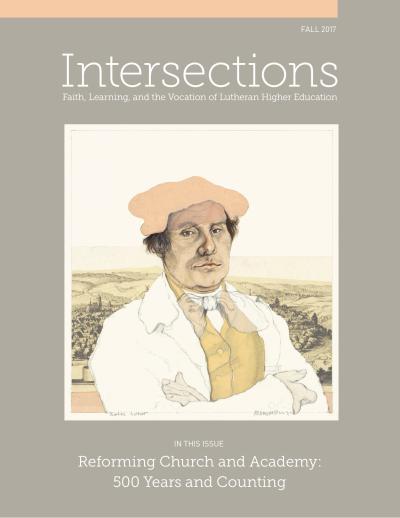 Editorial
From the Publisher
Mark Wilhelm
Wilhelm reflects on how NECU’s focused work on Lutheran identity in higher education — including the forthcoming document Rooted and Open: Our Common Institutional Calling — turns out to be a fitting commemoration of the five-hundredth anniversary of the Lutheran Reformation, even though it did not arise from anniversary planning.
-
Editorial
From the Editor
Jason A. Mahn
Mahn returns to Luther’s opening thesis on whole-life repentance to argue that the deepest critique of the indulgence economy — and of our own American meritocracy — is the very assumption that grace and human striving can be measured, exchanged, and earned.
-
Article
Celebrating the Reformation: The Lutheran Foundation of a Called Life
Mark D. Tranvik
Tranvik traces vocation from the monastic impulse through Luther’s rejection of the monk’s vow as the only true calling, and translates the “called life” for twenty-first-century Lutheran colleges — institutions that see students as made in the image of God, enlist the whole community in discernment, and make room for faith and its convictions.
-
Article
Reforming Our Visions of City Nature
Lea F. Schweitz
Through a Chicago story of Canada geese at North Pond, Schweitz takes up two Reformation-era ways of reading the “Book of Nature” — Konrad Rosbach’s moral readings and Philip Melanchthon’s scientific ones — and proposes a third: Luther’s sacramental principle that the finite is capable of the infinite, worn as “reading glasses” for an urban planet.
-
Article
Both Priest and Beggar: Luther among the Poor
Martha E. Stortz
Reading Luther’s deathbed remark “We are all beggars” against his “priesthood of all believers,” Stortz argues that priest and beggar are two sides of a human reality — one that locates civic responsibility for the poor at the heart of the Reformation legacy and that pushes beyond paternalistic service toward the systemic question of justice.
-
Article
In the Beginning of the Reformation Was the Word
George Connell
Drawing on a Concordia faculty pilgrimage to German Luther sites, Connell appropriates John’s prologue to frame the Reformation as a movement about words — the printed page, the university classroom, the Marburg confession, the Wartburg translation, Bach’s music, and the dining-room conversations of Table Talk — while soberly noting that words can wound as well as heal.
-
Article
Luther's Sutra: An Indian, Subaltern (Dalit) Perspective
Surekha Nelavala
Nelavala traces how Luther’s “sutra” — grace alone, faith alone, scripture alone, Christ alone — reached the mud hut of her Dalit grandparents in rural India, transforming three generations, and then reads the parable of the vineyard laborers from a subaltern perspective in which grace for all is the heart of God’s alternative kingdom.
-
Article
Reforming Lutheran Higher Education: Ecclesiological Reflection and Theological Leadership
Brian Beckstrom
Beckstrom diagnoses an “identity crisis” at ELCA colleges and universities rooted in inherited Enlightenment assumptions and a thin functional ecclesiology, and proposes that a Trinitarian, perichoretic understanding of God offers an ecclesiological foundation that holds together unity and diversity in a pluralistic, post-Christian context.
-
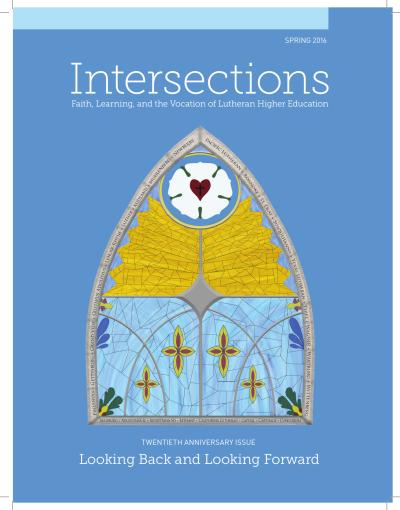 Article
Distinctive Lutheran Contributions to the Conversation about Vocation
Kathryn A. Kleinhans
No. 43 · Spring 2016
Kleinhans surveys the recent resurgence of vocation talk in American higher education — from Frederick Buechner’s widely quoted definition to Lilly Endowment’s PTEV grants and the CIC’s NetVUE Scholarly Resources Project — and uses her chapter in At This Time and In This Place: Vocation and Higher Education to highlight distinctively Lutheran emphases: vocation grounded in creation rather than redemption, the given-ness of multiple simultaneous callings, and a frank acknowledgment of the constraints and “dark side” of vocation.
-
 Article
Lutheran Heritage Across the Curriculum: Reflections from a Faculty/Staff Development Seminar
Cynthia Bane, Fred Waldstein, Kathryn A. Kleinhans, Penni Pier
No. 26 · Fall 2007
Four Wartburg College colleagues share fruits of the 2006 Lilly-funded “Discovering and Claiming Our Callings” faculty/staff development seminar in Wittenberg, Eisenach, and Neuendettelsau. Kleinhans frames the curriculum and books used; Bane (psychology) finds Lutheran convictions about the value of humans, the affirmation of creation, and the universality of sin congruent with her discipline; Pier (communication arts) reads Luther as a model of dialectical rhetoric that gives educators permission to challenge students with uncomfortable ideas; and Waldstein (political science) reflects on the paradox of humility and self-confidence in Luther and on the Luther-Melanchthon collaboration as a model for the seminar group’s own work.
-
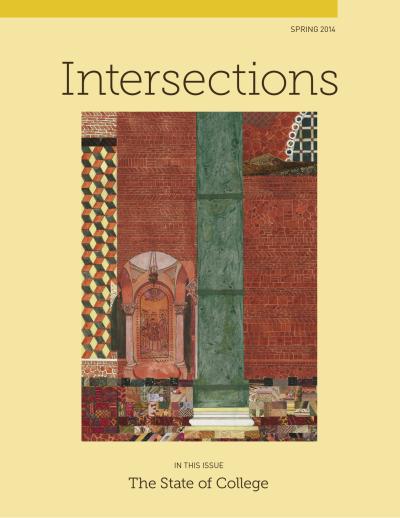 Editorial
From the Publisher
Mark Wilhelm
No. 39 · Spring 2014
Wilhelm interrogates the widely used phrase “the model is broken,” arguing that it blames the victim, masks the demographic and public-funding pressures actually facing ELCA higher education, and distracts from the work of modifying—rather than discarding—a model of educating the whole person that has successfully adjusted across the centuries.
-
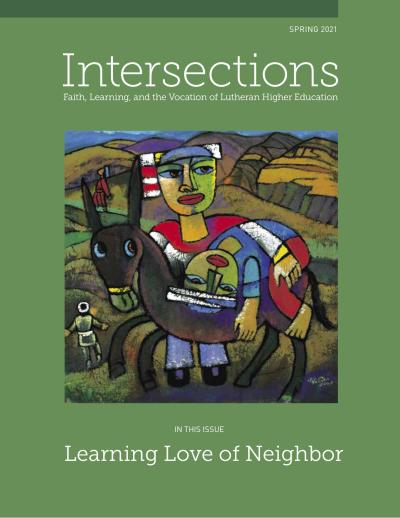 Editorial
From the Publisher
Mark Wilhelm
No. 53 · Spring 2021
Wilhelm reflects on an NPR report of teenagers’ pandemic diaries and the fraught Christian history of struggling to live out Jesus’s ethic of love, framing the issue as a record of NECU institutions working out how to act for the common good through the pandemic of 2020–2021.
-
 Article
Point / Counterpoint: What It Means to be a "College of the Church"
Robert Benne, Tom Christenson
No. 28 · Fall 2008
Moderated by Wartburg College pastor Larry Trachte and introduced by Kathryn Kleinhans, this Wartburg campus conversation between Robert Benne (Roanoke College) and Thomas Christenson (Capital University) probes what it means to be a college of the church—Benne emphasizing ethos, vocation, and the Christian intellectual tradition over against secularization and generic education, and Christenson lifting up persistent vocational questions, the gift of difference, and induction into a community of discourse—and finds large common ground around hiring for mission, pedagogy that asks deep questions, and the courage to claim a living religious tradition while inviting everyone to the banquet.
-
 Editorial
From the Editor
Jason A. Mahn
No. 52 · Fall 2020
Mahn narrates a year of crisscrossing pandemics — Covid-19, economic collapse, partisan politics, and the long pandemic of white supremacy revealed anew by the murder of George Floyd — and argues that Lutheran liberal arts schools, by educating for vocation, are uniquely poised to help students respond with character and capable callings.
-
Article
Activism, Justice, and the Danger of Silence
Dezi Gillon
No. 52 · Fall 2020
In conversation with Jason Mahn, Augustana College alumnux Dezi Gillon traces the call to action they felt as a Black student organizing for Black Lives Matter on a predominately white campus — through seminary, art, spirituality, and restorative justice work — and warns white professors that staying silent “actually speaks volumes.”
-
Editorial
From the Editor
Jason A. Mahn
No. 39 · Spring 2014
Mahn reports on the working group “People of Wondrous Ability: Introducing Faculty and Staff to Lutheran Higher Education,” shares creative ways campuses are introducing colleagues to the charisms of the Lutheran tradition, and frames the issue as a set of reflective reviews that move from national trends to homegrown conversations about the state of college.