Lutheranism, which started in early sixteenth-century Europe, made its way to the small mud hut of my grandparents in a remote village of India, in the early twentieth century. My grandparents lived as daily wage laborers, and were completely illiterate. Lutheranism transformed their lives, and thus transformed mine.
“Justification by grace alone, faith alone, scripture alone, and Christ alone!” That is something of Luther’s sutra—the Sanskrit term for the “thread” or “string” of a whole way of life, captured in aphoristic form. Why does Luther’s sutra—grace alone, faith alone, scripture alone, Christ alone—matter after 500 years and to those on different corners of our earth?
The Sutra in Luther’s Life
Church has always been about transformation and reformation. What do I mean by that? It is essential for faith communities in every generation and in different parts of the world to ask for the guidance of the Holy Spirit for the church’s renewal. Now, 500 years after the start of the Lutheran church, we are wondering what this reformation means. Is the Lutheran Reformation an event or is it an ongoing theological movement? Martin Luther’s 95 Theses of 1517 may mark a reformation event, but the church is dynamic, and reformation and renewal is an ongoing process. Another question that needs to be asked is whether the ongoing reformation is taking place in the right direction. We need to revisit this reforming movement again and again in order to continue to speak truth to power, and thus to carry forward the legacy of Luther. He stood for what he believed was the truth, and so led a liberation movement against oppressive traditions that denied access to scriptures and truth.
We need to revisit this reforming movement again and again in order to continue to speak truth to power, and thus to carry forward the legacy of Luther.
Luther’s sutra summarizes the gist of what the reformation movement was, and is, all about. It is about justification—or how a person is made “right” with God. What the medieval church proclaimed about justification differed dramatically from what Luther discovered from scripture. Searching for justification through the means that the church offered, Luther not only experienced the lack of justification, but was filled with fear for the wrath of God. Being a monk, he tried everything that the church claimed would bring justification, and he was extraordinarily successful as a monk. You name it, he did it—all in the quest to be righteous or justified in God’s eyes. Later, by reconsidering scriptural proclamations such as, “justification by faith” (Rom 1:17), Luther unlocked a door that transformed his life and the life of the church at large.
Many of us may no longer take Luther’s sutra—justification by grace alone, faith alone, scripture alone, and Christ alone—as a matter of life and death. Does it still matter after 500 years?
That a person is justified by God’s unmerited grace through faith—and not by the person’s own works—was the most important teaching that Luther found in the scriptures. It stood in stark contrast to what he had been taught. The selling of indulgences easily led to abuse. They signaled a misinterpretation of the scriptures; indeed, these imperialistic and hierarchical practices controlled access to the scriptures and to grace itself. By critiquing the sale of indulgences, in fact, by critiquing the entire system that controlled access to God’s Word and God’s grace, Martin Luther opened a door that brought light and enlightenment first to Western culture and church and then to the rest of the world.
Fast-forward to our globally interconnected, postmodern context. Many of us may no longer take Luther’s sutra—justification by grace alone, faith alone, scripture alone, and Christ alone—as a matter of life and death. Does it still matter after 500 years? Are we far too “advanced” that it no longer matters? Or does it have implications for us in other ways?
The Sutra in Rural India
Certainly Lutheranism and Luther’s sutra has touched my life. They touched the lives of my grandparents, who belonged to a community that was designated as outcasts, treated as untouchables, and called chandalas (disgusting people). Such designations attribute eternal impurity to whole communities and bar access to redemption based on one’s birth.
According to the Manu Smriti or Laws of Manu (the popular social and religious law for the land of India), the “dwellings [of the untouchables] should be outside of the village; they must use discarded bowls, and dogs and donkeys shall be their wealth. Their clothing should be the clothes of the dead, and their food should be in broken dishes” (Laws of Manu 10:51-52). Until today, untouchables, those who self-identify as “Dalits,” have lived mostly in the outskirts of Indian villages, especially in rural India. However, by education, migration, and upgraded economic status, Dalits are now able to buy or rent space in mainstream places, and the Indian Constitution ensures equal rights to all the citizens. Yet discrimination, even within this contemporary context, happens in subtle ways.
My grandparents—Dalits in India—converted to Lutheran Christianity. After their conversion, another door to education opened, but then my grandparents had to make a hard choice: whether or not to let their daughter, their first born, go to a boarding school in a nearby town. It was unheard of. They had to make this choice in isolation, as none of the other villagers were willing to send their daughters. The bold choice of my grandparents was critical again to my own transformation. Their daughter, my mother, completed her high school diploma, trained as a teacher and served as an elementary school teacher for nearly 35 years. She was the only woman from her village and her generation to be educated.
There was another door that was critical, yet again. My father was a shepherd boy until he was eleven years old. He went along with his father since he was six, and at age ten he was given the responsibility as a shepherd of the flock that belonged to their Dalit village. There were some others who went to the boarding school, and he listened to the tales of school and education from other friends. His desire to be educated and to participate in sports (being gifted by athletic instincts) led him to a bold act of resistance. One fine day, he left the flock in the fields, ran ten miles to a nearby town, and made his way to speak to the principal of a boarding school. He was ridiculed for his image of shepherd boy, shamed for his age, for his desire to begin his schooling at the age of eleven. But his relentless efforts also helped him go to school. Soon he became popular through sports and surpassed many obstacles. It was critical that my father opened this door to pave the way to my life that is today. He graduated from high school, and trained and served as a teacher for nearly 30 years.
With the same spirit and strength that he ran away with as an eleven year old boy, my father soon assumed some leadership roles in his teaching career. He stood by what he believed was truth, and was unafraid to speak truth to power against people who discriminated some of the Dalit teachers. As a result, my parents were transferred to a punishment area on an island, where most people were fishermen folk. Submitting to the order, my parents moved to the island, where they were the only educated adults. They became the people who practiced first aid, ran the school (two teachers teaching the entire elementary school consisting of 200 students!), and motivated the parents to send their children to school. They established a relationship with the people of this island, but paid the price of losing two children, each under the age of one, due to the remoteness of the village that made medical help inaccessible. All that they know is that both children cried through the night, but they are not sure why they passed.
I was born, along with my five other siblings, in a hut, with no medical assistance, except for my grandaunt, who is completely illiterate, and a group of a few other women in the village. It is by grace alone that I am still alive, as I could have been struck by any number of deadly diseases. My parent’s education, their teaching careers, their economic upgrade to the lower middle-class stage (according to Indian standards) helped open one door at a time to transcend my life in many ways, and to break through the barriers of many obstacles. I stand here today giving voice to and interpreting the experience with complete privilege as an educated woman, living in the western world, shaped by the consciousness of subaltern people, in my case, by the Dalits. My voice is a reminder of my privilege. My lens is informed by my own life experiences, sharpened by educational tools, and cleansed by a critical consciousness.
Subaltern Women
“Can the subaltern speak?” Writing from a Dalit woman’s perspective, Gayatri Spivak’s question has been widely cited and used in contextual, post-colonial, feminist, literary, and biblical studies.1 This question is unsettling to me, both as a subaltern woman, on the one hand, and as a person who has “voice,” on the other hand. By definition and by its rhetoric, subaltern cannot speak, because they are often treated as noisy beings, and thus they are suppressed as people with no voice.
The question, “can the subaltern speak?” almost comes as an irrelevant question in the Dalit context, because they are often seen as louder than other women of caste, as in Indian culture it is shameful for women to be loud and to be heard in public. Thus, from a certain perspective and level, all women from India are socially and culturally expected to be subaltern. In such a culture, when one asks whether the subaltern can speak, it comes across as unwarranted rhetoric in a context in which to be subaltern is an honorable state for a woman. However, the shameless Dalit women are not afraid of being shamed, since they don’t carry “honor” by their outcaste status to guard themselves against being shamed in the first place. They are subaltern because they are not heard—not because they cannot speak. They are often disregarded as clumsy and noisy by the dominant patriarchal caste culture.
The Sutra in Scripture
Subaltern people receive grace, and they have faith but do not have tools to read scriptures and understand high church doctrines or traditions. They are justified in Christ because justification does not require knowledge of scriptures. It does not require one to be a particular color, creed, race or religion—contrary to what was told to my ancestors. Lutheranism approached them with good news that they are children of God.
In popular understandings of justification, facing the righteous God means entering into the Kingdom of God, or rather, to eternal life. Here I would like to provide a lens from a subaltern perspective to one of the parables that explains the Kingdom of God in different terms. What does it mean when a subaltern person looks at the text? Do they bring a different view, a different vision?
The parable of the vineyard and the laborers begins with Jesus’s statement: “For the kingdom of heaven is like a landowner who went out early in the morning to hire laborers for his vineyard” (Matt 20:1). Even though Jesus explains some of his parables, this parable goes without explanation, thus calling readers to come to their own understandings and interpretations.
According to the parable, the owner of the vineyard hires workers and promises to pay them a denarius for a full day’s work. Without any further negotiations, the laborers begin their work, evidently accepting that the deal is fair. About the third hour, the owner goes out, sees the people who are jobless, and invites them to work in his vineyard. He tells them, “’you also go into the vineyard, and I will pay you whatever is right.’ So they went” (v. 4). Here again there is evidence of trust between the owner and the laborers. Interestingly, the owner goes out again two more times and invites even more workers to work for him in the vineyard.
But the owner doesn’t stop; the day is almost over, yet he goes out again and finds some others standing around. The owner does not just invite them this time but asks them a question, seemingly a genuine question: “Why are you standing here idle all day?” (v. 6) The answer is rather surprising. They tell him, “because no one has hired us” (v. 7). The story makes a shift at this point. The landowner’s question conveys prejudgment, as if the laborers were lazy and did not look for work, standing idle all day. Although the potential workers are taken aback with that question, they tell him that no one has hired them, including the landowner himself.
A subaltern perspective ask some deeper questions at this point: What makes them stand there all day long? Why were they denied an opportunity to work? What factors could cause their invisibility? They lost a day of work, not because they were lazy, but because they didn’t find someone to hire them to work. They were simply deprived of earning their daily bread. They were unemployed even though there is potential work. Only when they tell him no one has hired them does the landowner invite them to work and join the other laborers.
My memory of listening to the interpretation of this parable—from Sunday school, from pulpits, and from general readings—is registered around the landowner’s generosity and magnanimity, which then called for submission to a model of power-disparity that exists even in the Kingdom of God. My memory matches historical interpretations, which applauded God the King for his generosity, who offers an alternative kingdom model.
The landowner unmistakably asks those who can’t find work a famously judgmental question.
The landowner in the parable exhibits an alternative model of kingship. The landowner continues to invite the laborers who are in need of work. My interpretation here is best kept in tension with the fact that kingdom imagery often leads to injustice. While it does seem unfair at the outset, the landowner, who represents God, ensures fairness and justice through an act of reconciliation. The workers who are hired at first are the people who are privileged and are able to grab an opportunity for work and earn their livelihood. Compared to these workers, the ones who did not find work until later are faced with factors that leave them somewhat marginalized in the society. People who are marginalized have to make extra efforts to be able to find work and make a living. The final group of people called into the fields are the downtrodden, marginalized, invisible and subaltern people, who are often misunderstood and misjudged for their misfortunes and thus re-victimized as judged. The landowner unmistakably asks those who can’t find work a famously judgmental question: “Why are you standing here idle all day?” Although the landowner who represents God enters the dialogue with stereotypical presumption, upon hearing their answer, he quickly responds with appropriate action, inviting them to the work.
Grace for all is a subaltern perspective.
The landowner in the story offers an alternative model for perceiving God’s this-worldly justice. Not only is he willing to hire them in the last hour, he also offers fairness to the people who were denied an opportunity to work by paying them one denarius. Equivalent wages is his act of reconciliation. Earlier, the landowner must have somehow ignored the potential workers even though he was in a position to hire them. There are factors that made the last-hired laborers invisible. The landowner takes responsibility for their lack of opportunity, if not for intentionally denying them an opportunity to work. He compensates them with an act of reconciliation and thus ensures equity, fairness, and justice.
In the end all the workers were justified in the kingdom of God. They were all made equal. Grace for all is a subaltern perspective. Those who feel deserving of the place in the Kingdom of God will resist grace, because it makes them equal to the so-called undeserving. And yet, the God of this Kingdom and this justice does not rest until all are in, which is what Lutheranism also proclaims.
Endnotes
1. Since the focus and scope of this essay is not to discuss the question that Spivak asks, I can only here note its existence and importance among a number of scholarly fields.
Works Cited
The Laws of Manu. Translated by Wendy Doniger with Brian K. Smith. London: Penguin, 1991.
Spivak, Gayatri, “Can the Subaltern Speak?” In Marxism and the Interpretation of Culture, edited by Cary Nelson and Lawrence Grossberg. Bloomington, IL: University of Illinois Press, 1988.
-
 Editorial
From the Publisher
Mark Wilhelm
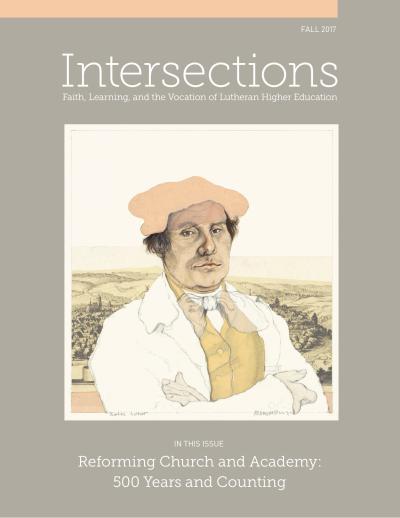
Wilhelm reflects on how NECU’s focused work on Lutheran identity in higher education — including the forthcoming document Rooted and Open: Our Common Institutional Calling — turns out to be a fitting commemoration of the five-hundredth anniversary of the Lutheran Reformation, even though it did not arise from anniversary planning.
-
Editorial
From the Editor
Jason A. Mahn
Mahn returns to Luther’s opening thesis on whole-life repentance to argue that the deepest critique of the indulgence economy — and of our own American meritocracy — is the very assumption that grace and human striving can be measured, exchanged, and earned.
-
Article
Why Martin Luther and the Reformation Matter 500 Years Later
Kathryn A. Kleinhans
Adapted from a 2017 address to Wartburg College’s entering class, Kleinhans surveys Luther’s lasting impact in vocation, education, social service, and the necessary work of repentance — closing with the Lutheran World Federation’s Windhoek assembly and the Reformation World Exhibition’s call to live reform forward into the next 500 years.
-
Article
Celebrating the Reformation: The Lutheran Foundation of a Called Life
Mark D. Tranvik
Tranvik traces vocation from the monastic impulse through Luther’s rejection of the monk’s vow as the only true calling, and translates the “called life” for twenty-first-century Lutheran colleges — institutions that see students as made in the image of God, enlist the whole community in discernment, and make room for faith and its convictions.
-
Article
Reforming Our Visions of City Nature
Lea F. Schweitz
Through a Chicago story of Canada geese at North Pond, Schweitz takes up two Reformation-era ways of reading the “Book of Nature” — Konrad Rosbach’s moral readings and Philip Melanchthon’s scientific ones — and proposes a third: Luther’s sacramental principle that the finite is capable of the infinite, worn as “reading glasses” for an urban planet.
-
Article
Both Priest and Beggar: Luther among the Poor
Martha E. Stortz
Reading Luther’s deathbed remark “We are all beggars” against his “priesthood of all believers,” Stortz argues that priest and beggar are two sides of a human reality — one that locates civic responsibility for the poor at the heart of the Reformation legacy and that pushes beyond paternalistic service toward the systemic question of justice.
-
Article
In the Beginning of the Reformation Was the Word
George Connell
Drawing on a Concordia faculty pilgrimage to German Luther sites, Connell appropriates John’s prologue to frame the Reformation as a movement about words — the printed page, the university classroom, the Marburg confession, the Wartburg translation, Bach’s music, and the dining-room conversations of Table Talk — while soberly noting that words can wound as well as heal.
-
Article
Reforming Lutheran Higher Education: Ecclesiological Reflection and Theological Leadership
Brian Beckstrom
Beckstrom diagnoses an “identity crisis” at ELCA colleges and universities rooted in inherited Enlightenment assumptions and a thin functional ecclesiology, and proposes that a Trinitarian, perichoretic understanding of God offers an ecclesiological foundation that holds together unity and diversity in a pluralistic, post-Christian context.
-
 Editorial
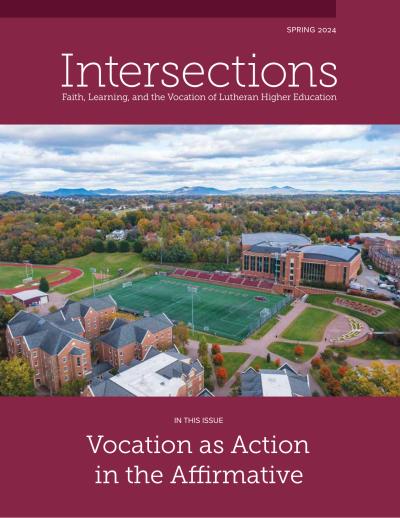
From the Editor: Vocation as Action in the Affirmative
Colleen Windham-Hughes
No. 59 · Spring 2024
Windham-Hughes frames vocation as practicing “at the borders of our incompetence” — every small yes to the callings we experience, every effort made in the direction of life, is action in the affirmative — and previews the issue’s essays on diversity, transformation, AI, championship team culture, and dreaming big within and beyond our limitations.
-
 Article
Making Dry Bones Stand: Lutheran Higher Education at Century's End
Diane Scholl
No. 17 · Summer 2003
Scholl reads John Winthrop’s “A Model of Christian Charity,” the banishment of Anne Hutchinson, de Crevecoeur’s American farmer, Olaudah Equiano, Phyllis Wheatley, and Hawthorne’s The Scarlet Letter alongside Ezekiel’s vision of the dry bones to ask how a Lutheran college can be a community that holds difference and commonality together. Drawing on Ernest Simmons’s warning against collapsing into either dogmatic absolutism or thoroughgoing relativism and Bruce Reichenbach’s companion essay in this issue, she identifies five features of shared life at a Lutheran college—the liberal arts, political process, the arts, the community of caring, and the recognition of difference and the right to dissent—and argues that the necessary tension between individualism and corporate identity, framed by theological vision, is “our best legacy and our best hope for the future.”
-
 Editorial
From the Publisher
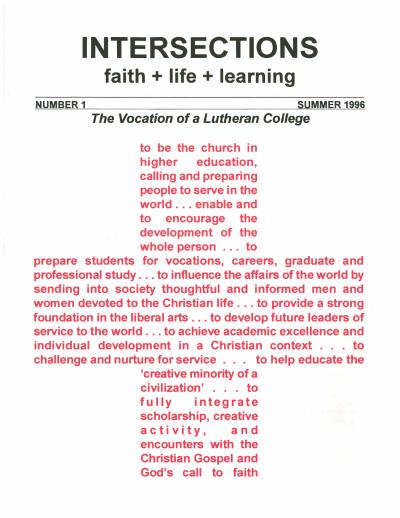
James M. Unglaube
No. 1 · Summer 1996
Unglaube welcomes readers to the inaugural issue of Intersections, crediting Editor Tom Christenson and Capital University, and announces the new annual Vocation of a Lutheran College Conference whose continuing dialogue the journal exists to enhance. He gives thanks to the Lilly Endowment for a sizable grant supporting the 1996 conference, campus dialogues, and the birth of the publication.
-
 Reflection
Shelter in Place: Reflections from March 22, 2020
Jason A. Mahn
No. 53 · Spring 2021
On the fourth Sunday of Lent in 2020, Mahn meditates on the etymology of “shelter” (from shield) and on an email from a former student in Boston whose mutual-aid organizing models a Lutheran understanding of vocation: the upending of ego by divine love that frees us, finally, to see and serve the neighbor.
-
 Article
Vocare: A Spiritual Practice for the Spaces Between
Charlene Rachuy Cox
No. 58 · Fall 2023
Cox introduces Vocare, a six-word spiritual practice developed through the Nourishing Vocation Project at St. Olaf, that uses the acronym V-O-C-A-R-E to help individuals and communities honor the spaces “between no longer and not yet” and discern their callings for the common good.
-
 Article
Radical Hospitality on Haunted Grounds: Anti-Racism in Lutheran Higher Education
Krista E. Hughes
No. 52 · Fall 2020
Writing from Newberry College’s campus on land once home to the Cherokee and within a day’s drive of Mother Emanuel A.M.E., Hughes argues that NECU’s call to “practice radical hospitality” demands that predominately white institutions open themselves to the hauntings of racism — pursuing belonging rather than mere welcome, and risking kenotic transformation of institutional identity itself.