Anytime we wish to define our institutions and their missions and hiring practices we have to remember that we are dealing with several moving targets, not just the role of the faculty. We frequently memorialize a past that may or may not have existed. Those of us who are graduates of sister institutions may have a relatively fixed memory of that institution and its nuances. We fix in our minds that institution’s persons and ambiance as the “role model” by which we measure other Lutheran institutions as well as our current institutions. During my years as Dean and Provost, the Vice President of Resource Management and I were both Wartburg grads and I know that if Capital people heard, “when I was at Wartburg,” one more time they would have had involuntary seizures.
We must be very careful in drawing such analogies across time. The last time I visited Wartburg was to have my youngest son visit. While much was familiar and recognizable, it wasn’t “my” Wartburg. Roy’s place was gone, the Pub House where I met my wife was gone. Change is the norm at all of our institutions.
Perhaps in contrast to our own personal fixed views are the phrases of current mission statements which are vague and open to a broad range of personal interpretations. One university states clearly that they are “related to the ELCA,” and “encourages an environment of respect for all people and diverse beliefs.” With perhaps a clearer focus, TLU states that “the College provides an education in the arts and sciences which is given perspective by the Christian faith.” My own institution writes that it “promotes thinking, discussion, and debate that enhances ethical, moral and religious values essential to leadership in society and the church…” Each of these statements are certainly open to interpretation by the individual who reads them. They were written to be inclusive rather than exclusive.
This issue may be even more vital today than ever. This summer delegates to the ELCA convention in Philadelphia consider formalizing relationships with fellow Protestants in Presbyterian, Reformed, and Episcopal traditions. Some fear a blurring of distinctions. Most of our institutions would not be solvent if we depended upon a preponderance of Lutheran students and Lutheran faculty members. We have adapted to a less exclusive environment and become part of a larger educational program.
Most of our colleges were founded by immigrants to America or their descendants of German or Scandinavian backgrounds in the “contamination” of the English-based ninteenth century American social sytem. Immigrants sought, with an enthusiastic energy, to preserve the culture of the homeland, to provide clergy and teachers for the now Scandanavian-American or German-American congregations, to maintain a bilingualism that allowed the second generation to appreciate both the mores of the homeland as well as that of the United States. Much like the Turnervereins and Saengerbunds, the Lutheran college was an oasis in which the moral, ethical, and theological norms of Europe could be taught to the offspring.
Our colleges were founded as purposeful institutions with a specific mission. And that was accomplished unapologetically, with pride and enthusiasm. One of our colleges proudly proclaimed that, “Having truth, we pass it on.” While not seen in the mid-nineteenth century as a boastful statement, the assumption of truth as something we own certainly could not be the focal point of modern Lutheran higher education in the context of the ELCA. Our institutions today are proud of change as one of the hallmarks of our existence. Goal four at Capital University state that it “must change and grow in order to better serve changing student needs.”
As one reads Professor Reichenbach’s article, the motto referred to above, and the goal statement from Capital, one realizes how open and inclusive our instutions have become heading toward a broader and less specific mission which has less concerns about the centrality of Lutheranism or even a broader Christian tradition.
Alvin Toffler in Future Shock warned us about the persistency of change. We see it in every aspect of our campus life, making it far more difficult to remain as centrally focused as Reichenbach would prefer. There is no doubt that what Reichenbach advoactes is legal and in some religious traditions possible. We see it in modern America in the presence of the evangelical colleges. My youngest son is on the admissions staff at a Mennonite college. Attending a conference on admissions tactics at “Christian” colleges, he was amazed, as a Lutheran college graduate, of the fervency of the decidedly evangelical approach to admissions activity.
Defining the role of our campuses and therefore the role of the facutly on our campuses is clearly a moving target. Just as American society has changed, just as the Lutheran church and its expectations for higher education have changed, just as the students who seek an education at our instutions have changed, the colleges of the Lutheran tradtition have evolved into different institutions.
Today I received one of our Lutheran college’s magazines. It is beautiful, slick and filled with impresive approaches to improving education, obviously intended primarily for the consumption of alumni. Yet the magazine lacks any centrality to its Lutheran or for that matter Christian heritage. One reference is there to a $50,000 grant from Lutheran Brotherhood for its chaplaincy program. But in a beautifully presented five page update on the institution’s objectives for the future of the college the word Lutheran appears as a subscript in the sixth objective which focuses on the goal of encouraging service and leadership opportunities for students. No mention is made in connection with the typical academic functions.
Let’s face the fact that we ourselves become somewhat ambivalent and that we focus on our specific Christian role when it is beneficial and elect not to focus on it when it may be controversial or have a negative economic effect.
Yet it is easy to see why such ambivalence dominates our institutions. The ELCA has been ambivalent about the role of the colleges. From the perspective of a former Provost now faculty member, my observation is that the colleges of the ELCA are viewed as tangential to the primary mission of the church rather than having a critical or central role.
Churches and pastors of the congregations which we serve are increasingly distant from the colleges. Pastors come into their ministries increasingly as second career persons who have been educated in public or non-Lutheran institutions and do not value the impact which Lutheran colleges have had or could have on their parishioners. I am a prime example of a person encouraged by pastor and congregation to go to Wartburg. The previous pastor in my congregation had been a Capital graduate and somehow the college bound members of that congregation then found their way to Columbus, Ohio.
The ambivalence from the church body allows and encourages ambivalent attitudes on our campuses. It is quite difficult to achieve any consensus on what it means to be an institution which is Christian, let alone, Lutheran. This year at a dinner meeting arranged by the president to specifically discuss what it means to be a church related institution, I allowed as how I thought that it would be difficult since many faculty did not care about the centrality of that part of the mission. An award winning colleague, exclaimed how incorrect I was because Capital was different because of its close atmosphere, she proclaimed that “everybody is nice to each other.”
Somehow we have drifted from the theological implications of what Lutheran or Christian higher education stands for to “niceness” as the hallmark. While that spirit of cooperation is a valued attribute of my colleagues, I doubt that it is the hallmark of a Christian institution of higher education. But a group of twenty handpicked faculty and administrators who have a real interest in the question wrestled in vain to come to a conclusion about what it did mean.
While Reichenbach and Marsden place central responsibility on the faculty, it needs to be noted that our institutions have evolved significantly in recent years, bringing to our campuses persons who have less natural affiliation with those institutions that existed in an earlier strong bond with church, congregation, and ethnic society. Even those colleges that pride themselves on having maintained the strong liberal arts focus have seen the demand for professional educations and career focused learning increasing in a rapacious manner. This has revised the focus of what we do at our institutions. Responding to the market place has been an economic necessity for many Lutheran colleges and universities.
Our campuses have evolved out of the desire to respond to the needs of our students. Most of our campuses have readily embraced multiculturalism and the impact of diversity has opened our institutions to include African-American and Hispanic-American groups. Which of our institutions has refused to discuss gender and sexual preference issues. And by the evolving nature of the world in which we live, our campuses house significant numbers of international students for whom the religious conviction of the campus carries little cultural affiliation.
Most of our campuses are no longer teaching to those who learned scripture in Sunday School, Catechism classes, and sang in the youth choir. In order to maintain academic quality, to maintain fiscal integrity, and to reach a broader audience, we have to recruit a broader range of student. This includes many who could care less about the religious nature of the university. In a required “Cultural Pluralism” class this past semester, we surveyed the religious diversity on the Capital campus. Many of these first year students forthrightly claimed that they did not know or affirmed that they did not care that our campus had a Lutheran tradition. Even though the second sentence of most of our brochures and publications state that we are an institution of the Evangelical Lutheran Church, it was bothersome to hear both their lack of knowledge and their disdain for religious education.
It is clear that in the 1990’s that faculty at Lutheran and Christian institutions are no longer teaching to the congregation. The critical mass issue impacts not only the faculty but the student body as well. As students become increasingly those who care little about religion and spirituality, those who have little or no education in theology or scripture, including many from Lutheran congregations, and those who have some significant hostility toward theological education, has made the task of faculty in religion and philosophy departments as well as throughout the professorate to make a connection with students and their own spirituality much more difficult. One could argue that it calls upon the institutions to be more explicit about the religious nature of the college, others may find that dealing with the importance of academic, disciplinary issues is far more critical to improving the students who select our campuses as the place to reach toward their professional aspirations.
As Reichenbach has noted, faculty have similar characteristics. In the middle of the 1980’s I gave a talk at the Lutheran Dean’s Conference in which I talked about the changing nature of the faculty. I used a retired faculty member as a prime example of “Mr. Capital” University. It is alleged that he was so dedicated to Capital that before he became engaged to his wife, he let her know that Capital was, next to his faith, the number one priority in his life. But what these “Mr. Chips” types brought to the campus in the early and mid-twentieth century was a deep seated commitment to the mission of the institution, a TOTAL view of the campus, and a fervent agreement with the specific mission. Strong disciplinarians who were active and visible in the campus congregation, athletic events, committee after committee, and thoroughly imbued with the tradition and the trappings of the institution, they became the personification of what Dana and midland Lutheran stood for.
Each Dean who attended that session talked wistfully about similar persons and how sorely they were missed on the campuses. Each wondered how we would continue to maintain a “critical mass” given the dearth of candidates who were both solid academics and solidly representative of the traditions in which the institution was rooted.
I interviewed many potential faculty in fifteen years as Dean and Provost. It was indeed a minority who really wanted to hear much about the religious backgrounds and persuasion. Many questions focus on the impact that the Lutheran tradition would have on their individual academic freedom. Indelibly etched in my mind is a conversion with a potential sociologist. We had had breakfast across from the campus and while walking across the campus we passed the religious life center which has a large cross in front of it. The candidate observed before we reached my office that she hoped that the cross really did not mean anything. And she hoped that we did not expect faculty to spend much time in their office since she did not look forward to one on one meetings with students. The candidate may as well not have been brought to campus.
A promotion review committee once asked candidates how their efforts promoted the mission of the institution. I was amazed that I as the Dean received complaints because some faculty believed that the question was irrelevant to what should be considered for promotion and tenure.
Many of our institutions are now universities, no longer liberal arts colleges. Many struggle to call themselves “liberal arts universities,” “liberally educated universities,” or some such euphemism. But a university by any other name is different from the liberal arts colleges that are intimate, sometimes isolated, and generally tightly focused. The modern Lutheran colleges and universities have extended their mission to include a broader range of educational programs.
Teacher education, nursing, athletic training may be related to the liberal arts and the process of free inquiry, but they all are professionally focused and not a part of the trivium and quadrivium. Business schools and conservatories prefer to be as separate as possible. The Lutheran tradition there seems irrelevent or certainly less relevant. The professional focus of both programs with an emphasis in the community for business and on playing “gigs” for the popular music programs, and very little with church music, allow little focus on the sacred traditions of the Lutheran college.
Post graduate education is equally common. Even the smallest schools are bent on masters programs in Education. MBA programs proliferate in order to keep up with the competing regional institutions. A few, like Capital and Valparaiso, have added legal education to the curriculum. Adult education programs fit into the mission but further cause the shift away from the original foci of the residential Lutheran campus.
The expansion of curriculum has necessitated bringing highly specialized faculty members to the campus. Whether they are committed to the distincitive mission of the university or whether their expertise in biochemistry meets acceptable standards remains a point of contention. I suspect that Reichenbach wrote the article because he sees the expertise winning out over the allegiance to the mission.
That indeed is at stake in the 1990’s, and it may be a central question. But my point is that all phases and constituencies related to the institution have also evolved and should be equally challenged. Pointing to the faculty as the standard bearer is a valuable reference point, but to focus attention on only one constituency, however, critical, is to dismiss what has been occuring among the other constituencies.
Mission must indeed be both academic and cocurricular, it must be seen in faculty, administrators, hourly persons, and athletic personnel. To insist that the critical mass is particularly the domain of hte faculty misses the breadth of the modern campus. In an age of specialization both in academic departments as well as in the functioning of the modern campus, all facets of the campus must be “critical” to maintining the mission.
But first we need to make sure what it is that the mission is and with some specificity what it means in the day to day life of our campuses!!!! I sense that we are quite ambivalent about the mission on most of our campuses. The self assured days of having truth and passing it on are gone. We as faculty and staff have moved into less self-assured waters and are paddling fast to maintain some ties to the original and revised mission as we chart a new route which may or may not have close ties to the old ethnic, church focused standards upon which our instituions were founded.
-
 Editorial
From the Publisher
James M. Unglaube
Unglaube opens the journal’s second year by previewing the 1997 Vocation of a Lutheran College conference at Carthage, which will examine the Lutheran tradition from outside (Richard Hughes of Pepperdine on the Lilly Endowment’s Models for Christian Higher Education; David Johnson, President of the University of Minnesota at Morris and Luther College graduate, on the tradition from the public sector) and inside (Ann Pederson of Augustana in Sioux Falls; Timothy Lull of Pacific Lutheran Theological Seminary), and previews Eric Eliason’s emerging proposal for an Academy of Scholars in Lutheran Higher Education modeled on NEH/NSF-style summer seminars.
-
Editorial
From the Editor
Tom Christenson
Christenson explains that this issue breaks from the first two issues’ single-focus pattern to feature three principal papers on the environment, the education of desire, and hiring and personnel policies, plus two poems and a piece of reflective bemusement. He then commends George Marsden’s The Outrageous Idea of Christian Scholarship (Oxford, 1997) and challenges Lutheran scholars to articulate how the particulars of their faith inform their scholarship—in conversation with Calvinist work like Nicholas Wolterstorff’s Reason Within the Bounds of Religion and Art in Action—rather than remaining silently complicit in the view that faith has no place in the academy.
-
Article
The Lutheran Liberal Arts College and Care for the Earth
H. Paul Santmire
Santmire, author of The Travail of Nature, proposes three mandates for the Lutheran liberal arts college: take responsibility for spiritual particularity by confronting the ambiguities of the classical Christian tradition (Lynn White’s charge against anthropocentric Christianity vs. the Franciscan ecological tradition from Irenaeus through Luther) and of classical Lutheran social ethics (the Two Kingdoms, Romans 13, the Third Reich, Bonhoeffer); promote responsible cultural criticism (against Thoreau’s sociopathic anti-urban suburbanism); and promote a holistic environmental ethos through an interdisciplinary core curriculum with ecology as the queen of the sciences, a community that liberates the social imagination (Mumford, Marcuse), a cosmic Liturgical praxis rooted in the Colossians 1:15–20 hymn to the cosmic Christ, and an academy that models ecological responsibility.
-
Article
An Aristotelian Twist to Faith and Learning
Gregg Muilenberg
Muilenburg, chair of Philosophy at Concordia, surveys the four traditional models for faith and reason—conflict, independence, dialogue, and integration—and argues that the Lutheran dialogical model is insufficient for wholeness. Drawing on the post-foundationalist epistemology of perspective and Aristotle’s account of knowing as desire-driven action, he proposes that faith is an ultimate value (an assessment belief of the form ‘x is better than y’), that learning is desire-directed action, and that the core of Christian education is the education of Christian desire—requiring both reflection and commitment, both integration and diversity.
-
Poem
Two Poems: The Dark Angels / Decorative Cooking
Gary Fincke
Two poems by Gary Fincke of Susquehanna University: “The Dark Angels,” a return to the sidewalk in front of the father’s razed bakery in Etna, the soot-pocked windows, the Saturday trash fire, the last eclair on the work room’s folding chair; and “Decorative Cooking,” the mother’s story of St. Julitta, Betty Crocker’s “New Design for Happiness,” the Sunday dinners of shaped Jellos and anise Magi cookies, the visit of the former pastor returned to Pittsburgh to declaim the death of God, and the father who lays evergreen crosses by the mother’s headstone in the Garden of Dreams.
-
Article
Mission and Hiring in the Christian College
Bruce Reichenbach
Reichenbach of Augsburg argues that the Christian or Church-related college’s mission to educate the whole person from a perspective of Christian faith and values can only succeed through intentional hiring of a “critical mass” of faculty, administrators, and staff committed to that mission (following George Marsden and the 1960s Danforth Commission), supplemented by on-going faculty development. He defends an inclusive community-with-diversity, a freedom-and-commitment tension grounded in Alasdair MacIntyre’s account of tradition, and the legality of preferential religious hiring under Title VII of the Civil Rights Act and the relevant case law (Tilton, Hunt, Roemer, Blanton, Grove City, Amos).
-
Response
A Call for Creative Education
Wendy McCredie
McCredie of Texas Lutheran responds to Reichenbach by reframing the four ideas embedded in his claim that “the entire college community should be knowledgeably committed to the college’s mission”—community, knowledge, commitment, mission—and argues that the Lutheran tradition’s unwillingness to be separate from the world should lead us to educate the public about the Lutheran tradition rather than interrogate prospective employees about their faith. She questions whether agreement on “Christian values” is possible (or even Lutheran), and reads Reichenbach’s “creative education” as the dialectical tension between gospel and law, God’s love and our human limits, that members of communities related to the Lutheran church are uniquely positioned to inhabit.
-
Reflection
Confessions of a Collaborator
Chuck Huff
Huff of St. Olaf offers a tongue-in-cheek public confession of his lifelong sin of collaboration—from elementary-school reports on dinosaurs and Cliff notes on Faulkner, through high-school algebra and college group projects, to borrowed syllabi, group work imposed on resentful students, tutorials, independent studies on every form of self-reliance, and circulated drafts. Even this confession was collaborated on, and (he confesses) he enjoyed it.
-
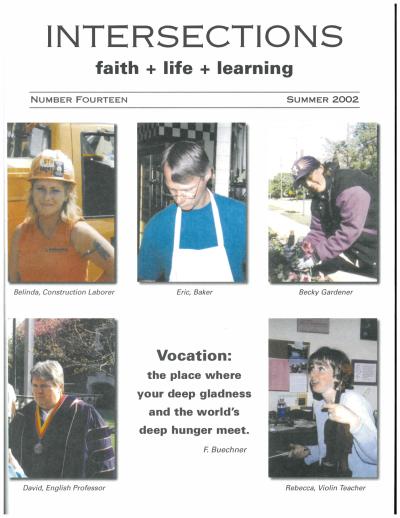 Article
Of Fathers and Feminism: How One Lutheran Woman Came to a Vocation
Karla G. Bohmbach
No. 14 · Summer 2002
Bohmbach, a recently tenured Susquehanna University feminist biblical scholar one month shy of forty, traces her vocation back through a Vacation Bible School injury, an LCMS upbringing in which only men could preach or preside, her father’s contradictory message that she could do anything while modeling a church that limited women, St. Olaf’s revelation of a Lutheran female face, and a Duke graduate seminar on the History of Feminist Thought with Carol Meyers. Her published feminist work on biblical daughters and on the concubine of Judges 19 is read alongside Kathleen Norris’s account of word-bombardment in church, Michel Tournier on childhood as “ardent confusion,” and her own recent participation as both student and teacher in an Authorized Lay Worship Leaders Program.
-
 Institutional Focus
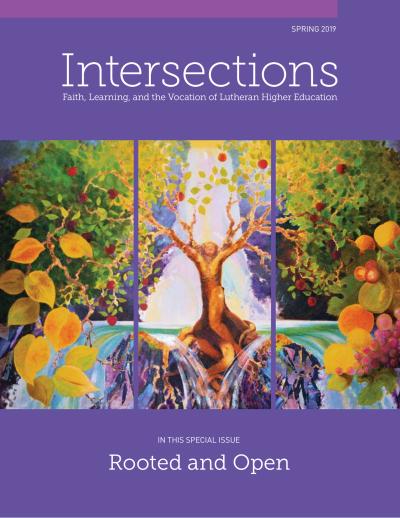
About the Cover and Artist
No. 49 · Spring 2019
Kristen Gilje, a Bellingham, Washington artist who spent nine years as Artist in Residence at Holden Village, recounts the “Tree of Life” she painted for the Holden Village 1999 summer theme and the unexpected interpretation Lapidary Fred offered of Yggdrasol, Prometheus, the Druid Tree Spirit, and the crucifix all at once.
-
Article
"Faithful Nones" and the Importance of a Rooted and Open Pedagogy
John Eggen
No. 49 · Spring 2019
Drawing on a student survey from his D.Min. thesis at Midland University, Eggen identifies a distinctive subset of religious “nones” — the “faithful nones” — who reject institutional religion yet retain substantive beliefs and practices, and argues that the non-binary, third-path pedagogy commended by Rooted and Open is uniquely positioned to engage a generation that has disambiguated faith, religion, and spirituality.
-
 Article
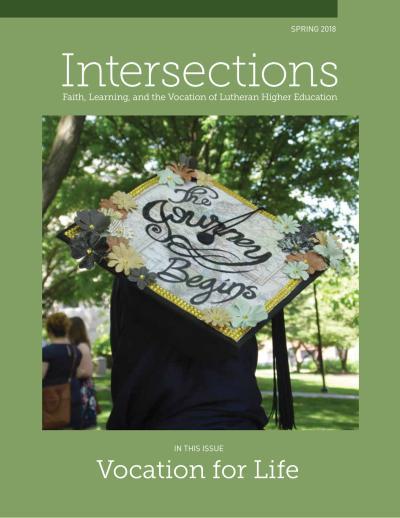
Lutheran Higher Education in the Land of Anxiety
Jon Micheels Leiseth
No. 47 · Spring 2018
Leiseth, returning to Concordia from work with the ELCA’s Young Adults in Global Mission in Southern Africa, draws on Bessel van der Kolk and Babette Rothschild to argue that pervasive student anxiety functions as low-grade trauma that hijacks the storytelling at the heart of vocational discernment — and explores embodied, breath-based practices that might help students reclaim their stories.
-
 Response
Response to Robert Benne
Baird Tipson
No. 17 · Summer 2003
Tipson responds to Robert Benne’s comments in the previous issue about his review essay of The Future of Religious Colleges, affirming their fundamental agreement that the Enlightenment epistemology dominant in higher education poses the most serious threat to the vitality of Lutheran colleges. Using the example of lecturing on early Mormon history and the Book of Mormon, he concedes that the methodological “solvent” of Enlightenment historiography acts on Christian as well as Mormon faith claims, and concludes that while H. Richard Niebuhr’s “inner” and “outer” history and Walter Brueggemann’s approach in The Theology of the Old Testament are comforting to believers, they do not offer an epistemology that can stand alongside the Enlightenment model in evaluating truth claims in the academy.
-
 Article
Hope in a Period of Economic Decline
Rebecca Judge
No. 32 · Spring 2010
Judge reads the 2008-2009 recession against the panic-free 1982 downturn and argues that this panic comes from the genuine surprise of a generation that had been told—by George Will and others—that business cycles had been tamed by deregulation, globalization, and Greenspan. Drawing on Luther’s “Trade and Usury” and Large Catechism, Paul Tillich, Stephen Marglin, Karl Polanyi, and Larry Summers, she critiques the “crude utilitarianism” of Homo economicus and benefit-cost analysis, finding hope in the possibility that this recession will renew a national conversation about moral obligation to neighbor in a market whose “raging bull” has broken out of its squeeze chute.