For the opening chapel talk during Concordia College’s Fall Symposium on the Reformation, past, present, and future, I was given the daunting assignment to say something about the Reformation in hindsight. What happened? Where has it taken us? When I received this request, I instinctively looked for a dodge, a way out. There is a widely told story of a conversation between Henry Kissinger and China’s Zhou Enlai during Nixon’s trip to China in 1972. When asked about his assessment of the French Revolution, Zhou replied evasively, “Too early to say.” It turns out that Zhou had misunderstood the question as about the Paris uprisings of 1968, just a few years prior. Nonetheless, the anecdote has come to stand for the Chinese ability to take a long view, regarding the two centuries since the French Revolution of 1789 as too brief to reveal what that historical convulsion really means.
If two centuries is too short of time to say what the French Revolution means, I’m tempted to plead the same excuse as a way out of my charge to say something about the Reformation. The Reformation was clearly an earthquake of global proportions. It shattered the unity of Western Christianity, plunging Europe into long periods of religious warfare. It challenged the division of society into religious and lay, propelling the West into an ongoing process of secularization. By calling the Magisterium, the doctrinal authority, of the Catholic Church into question, it plunged us into a crisis of uncertainty with which we still live. So, what the Reformation means is still up for grabs, the game is still afoot, the curtain hasn’t yet closed.
At its heart, the Reformation is about words.
As tempting as that evasion is, I accepted the invitation to give the chapel talk (and write this essay), and so it’s on me to take a stab at it. What can we say about the Reformation, even as its “long tail” continues to unfold? Our reading for the chapel homily began: “In the beginning was the Word…” (John 1:1). John opens his gospel with this powerful declaration that language, speech, word is cosmically basic, central, fundamental. Not only is the Word with God, Word is God. It is who God is. John then tells us that Word is also what God does. Echoing the opening chapters of Genesis in which God speaks the world into existence, John writes, “All things came into being through him [the Word]” (John 1:3). Thus John opens his Gospel, his account of the Good News of Jesus Christ, by naming Christ as logos, as Word.
While John speaks cosmically, I propose to appropriate those same words to frame the Reformation. At its heart, the Reformation is about words. It is about Word capital W—the Word of God—the saving power of the Gospel message of forgiveness, reconciliation and redemption. But it is also very much about words—lower case w—about language in all its multifarious, powerful, dangerous grandeur.
I was among a group of Concordia faculty and staff who travelled to Germany this past May to visit Luther sites, and the experiences of that trip still loom large as I try to take stock of the Reformation. What strikes me as I look back over the places we visited is that most are tied together by the thread of language. Our first bleary, jetlagged day was spent in Mainz, visiting the Guttenberg Museum and learning about the development of the printing press. Before Luther, other reformers, such as Jan Hus, had challenged the religious establishment, but without a means to spread their ideas widely, their protests (and their lives) were easily snuffed out. The Reformation and the printed page are, as it were, conjoined twins, born together and profoundly connected, joined at the hip. To paraphrase John, in the Reformation’s beginning is the printed word.
From Mainz, we went on to Marburg, one of the great German university towns, and most days of our trip centered on one German university town or another: Leipzig, Halle, Erfurt (where Luther himself studied), and, of course, Wittenberg, the university where Luther taught and birthplace of the Reformation. We should never forget that the Reformation emerged out of a university setting. These distinctive enclaves of learning—of reading, writing, speaking and debating, that is, of intensive exchanges of words—developed in the Middle Ages, but were undergoing fundamental transformation in the years leading up to the Luther, Melanchthon, Calvin, and the other reformers. After centuries of scholasticism and an exclusive use of church Latin, the rise of humanism ignited a desire to read ancient texts in their original languages—the Latin of the heyday of Roman literature, the Greek not only of the New Testament but also of Greek literature and philosophy, the Hebrew of the Hebrew Bible. Luther’s Reformation message of salvation by grace and faith developed out of his ongoing struggles to teach the Bible to his students at Wittenberg. He insisted on close, careful engagement with original texts on readings that probed for hidden treasures within ancient writings. So, in Luther we see vividly a reverent, even awed attitude toward the power of language to contain, to preserve, to convey messages of indescribable importance. As institutions of higher learning, the Network of ELCA Colleges and Universities stand in that university tradition as it was inflected by humanism. The start of the school year reminds us of this, not only by our dressing up in medieval academic garb for the opening convocation, but even more by students heading to the bookstore to pick up their books—language magically materialized—around which our educational programs revolve. Our colleges and universities, like the institutions out of which the Reformation emerged, are fundamentally places of language, places where words are the currency of exchange.
Our colleges and universities, like the institutions out of which the Reformation emerged, are fundamentally places of language, places where words are the currency of exchange.
Colleges are also places of debate and dispute, where words challenge other words in a struggle of ideas. At Marburg, we stood in a room in the prince’s castle where the Marburg Colloquy took place, a debate between Lutherans on the one hand and Calvinists on the other. With so much shared, there was great incentive for the main factions of the Reformation to join together, to make common cause against existential threats. While they agreed on 20 out of 21 shared principles, disagreement over one principle—the proper understanding of the Eucharist—kept the two wings of the Reformation apart. Here we see another way in which the Reformation is deeply about words: the reformers were confessional. They insisted on sharp, clear formulations of what they believed, and they took those formulations deeply seriously. These confessions guided theological reflection as well as the faith-formation of believers. Again, language, here language as confession, is at the core of Reformation faith.
From Marburg, on to the Wartburg. After his defiant clash with the Catholic hierarchy at Worms, Luther was whisked away to Wartburg for safe keeping by Phillip of Hesse. While there, undercover as Junker George, Luther translated the New Testament into German in just a few months, an accomplishment that left me dumbfounded as I stood in the room where he pulled off this feat. Reformation faith puts the biblical text at the center of faith—sola scriptura—and so Luther worked mightily to make that text available to all believers. This room is the site of one of the most colorful stories about Luther, namely, that one night there he hurled his ink well at the devil. Our guide told us that caretakers of the Wartburg long refreshed an ink stain on the wall for the edification of visitors. But I prefer to read the story figuratively rather than literally. It was by translating the Bible, which was then printed with ink, that Luther attacked the devil.
After the Wartburg, on to Bach sites, Eisenach, and later Leipzig. Bach embodies the crucial musical dimension of the Reformation tradition. Holy words joined to powerful music and sung in congregational worship takes language to a whole new level, and we were lucky to experience that transcendent combination a number of times during our trip.
To stand in the very church where Luther rose service after service to proclaim the Word of God was to stand at ground zero of the Reformation.
And finally to Wittenberg itself, birthplace of the Reformation. Wittenberg, a small, rather peripheral town, no longer home to a university, nonetheless resonates with the powerful words uttered here. As a university, it was where Luther worked his way as a teacher toward his retrieval of the gospel message. It is the town where Luther composed and released his 95 theses, a short text whose consequences are still unfolding. And above all, it is the town where Luther preached. While he purportedly nailed his theses to the door of the castle church in Wittenberg, Luther preached in the city church. The Reformation elevated preaching, the service of the word, to centrality in worship, so to stand in the very church where Luther rose service after service to proclaim the Word of God was to stand at ground zero of the Reformation. While at Wittenberg, I also visited Luther’s home, the former monastery, but later the home of the monk notoriously married to the nun, Katy. What drew me most in Luther’s home was the dining room where Luther ate with students, spending hours in lively conversation. Those talks are recorded in Table Talk, and my favorite Luther is the Luther of Table Talk. This is the earthy, sometimes even obscene, and frequently humorous Luther whose deep humanistic learning is joined to a very down to earth sensibility of his very ordinary upbringing. As we read the frank, good-humored, exchanges of Luther and his students, we see language at its best, as the medium that binds us together.
The chapel theme at Concordia College this semester is “seeking community.” Without words, without language, there is no human community. How fitting: Luther saw worship as comprising two main elements: word and sacrament, proclaiming the gospel message in the presence of the communion table. In similar manner, he joined word and shared meal around his own table.
In closing, I’ll note that the Reformation shows us the power of the word, but also its dangers. The image of Luther standing up to the church hierarchy at Worms, declaring “Here I stand, I can do no other,” is the iconic moment of the Reformation. It embodies word standing up to power, meaning standing up to might, reason standing up to force. John Lewis will soon visit our campus. The story of the American civil rights movement is a similar story of moral courage in the face of overwhelming institutional power. Through expressive words, their speeches, and expressive actions, such as the Selma March, they changed the course of history just as Luther’s expressive words and actions changed history. But words also wound. As we read Luther’s painful words about the Jews and about the peasants’ uprising, we are chastened to remember that words can do just as much damage as they can do good.
And so, we can say of the Reformation that, in its beginning was the word. Word is also the Reformation’s legacy to us as well as its imperative to us. Perhaps that imperative is nowhere more succinctly expressed than Ephesians 4:15: “Speak the truth in love.”
-
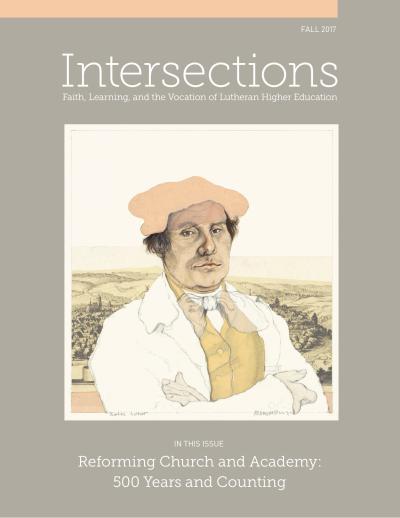 Editorial
From the Publisher
Mark Wilhelm
Wilhelm reflects on how NECU’s focused work on Lutheran identity in higher education — including the forthcoming document Rooted and Open: Our Common Institutional Calling — turns out to be a fitting commemoration of the five-hundredth anniversary of the Lutheran Reformation, even though it did not arise from anniversary planning.
-
Editorial
From the Editor
Jason A. Mahn
Mahn returns to Luther’s opening thesis on whole-life repentance to argue that the deepest critique of the indulgence economy — and of our own American meritocracy — is the very assumption that grace and human striving can be measured, exchanged, and earned.
-
Article
Why Martin Luther and the Reformation Matter 500 Years Later
Kathryn A. Kleinhans
Adapted from a 2017 address to Wartburg College’s entering class, Kleinhans surveys Luther’s lasting impact in vocation, education, social service, and the necessary work of repentance — closing with the Lutheran World Federation’s Windhoek assembly and the Reformation World Exhibition’s call to live reform forward into the next 500 years.
-
Article
Celebrating the Reformation: The Lutheran Foundation of a Called Life
Mark D. Tranvik
Tranvik traces vocation from the monastic impulse through Luther’s rejection of the monk’s vow as the only true calling, and translates the “called life” for twenty-first-century Lutheran colleges — institutions that see students as made in the image of God, enlist the whole community in discernment, and make room for faith and its convictions.
-
Article
Reforming Our Visions of City Nature
Lea F. Schweitz
Through a Chicago story of Canada geese at North Pond, Schweitz takes up two Reformation-era ways of reading the “Book of Nature” — Konrad Rosbach’s moral readings and Philip Melanchthon’s scientific ones — and proposes a third: Luther’s sacramental principle that the finite is capable of the infinite, worn as “reading glasses” for an urban planet.
-
Article
Both Priest and Beggar: Luther among the Poor
Martha E. Stortz
Reading Luther’s deathbed remark “We are all beggars” against his “priesthood of all believers,” Stortz argues that priest and beggar are two sides of a human reality — one that locates civic responsibility for the poor at the heart of the Reformation legacy and that pushes beyond paternalistic service toward the systemic question of justice.
-
Article
Luther's Sutra: An Indian, Subaltern (Dalit) Perspective
Surekha Nelavala
Nelavala traces how Luther’s “sutra” — grace alone, faith alone, scripture alone, Christ alone — reached the mud hut of her Dalit grandparents in rural India, transforming three generations, and then reads the parable of the vineyard laborers from a subaltern perspective in which grace for all is the heart of God’s alternative kingdom.
-
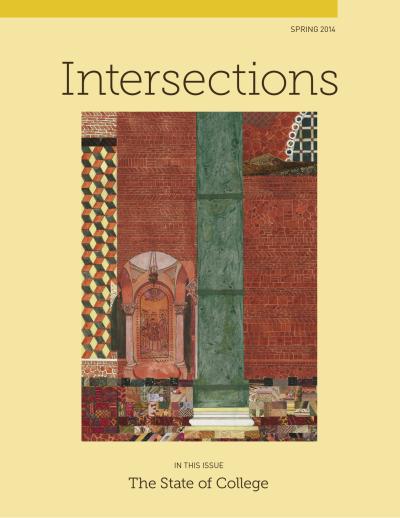
Article
Reforming Lutheran Higher Education: Ecclesiological Reflection and Theological Leadership
Brian Beckstrom
Beckstrom diagnoses an “identity crisis” at ELCA colleges and universities rooted in inherited Enlightenment assumptions and a thin functional ecclesiology, and proposes that a Trinitarian, perichoretic understanding of God offers an ecclesiological foundation that holds together unity and diversity in a pluralistic, post-Christian context.
-
 Article
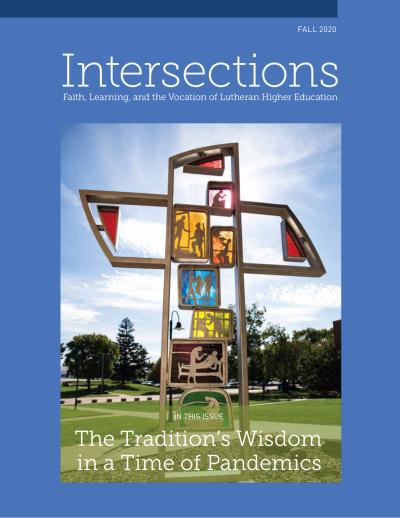
Through Truth to Freedom—by Way of Reconciliation
Paul C. Pribbenow
No. 52 · Fall 2020
Reflecting on Augsburg’s 150th-anniversary motto “Through truth to freedom,” Pribbenow argues that in a season of three pandemics — pandemic illness, economic collapse, and the racial sin laid bare by the murder of George Floyd — higher education’s most authentic work is to educate for truth and freedom by way of confession and reconciliation.
-
 Article
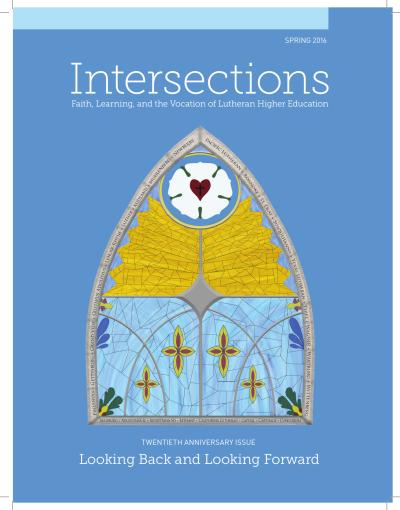
Semper Reformanda: Lutheran Higher Education in the Anthropocene
Ernest L. Simmons
No. 43 · Spring 2016
Simmons enumerates the ELCA initiatives over the past twenty years that have helped Lutheran higher education retrieve a Christian understanding of vocation, then argues that the looming reality of human-caused climate change — the geological epoch of the Anthropocene — now requires Lutheran liberal arts education to prepare students for “planetary citizenship” as sustainability leaders, drawing on the classical Trivium, Luther’s panentheism, and a quantum-physics-inflected theology of divine entanglement and hope.
-
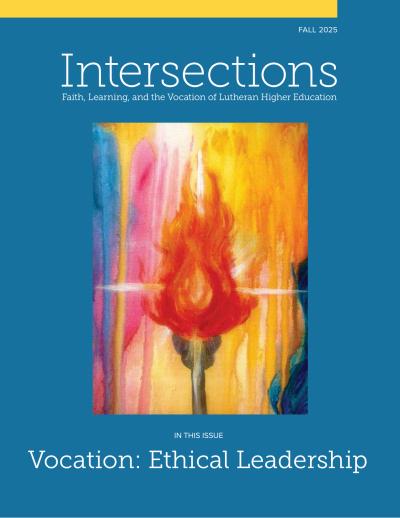 Article
Ethical Leadership for a Changing World: A Shared Calling from Cradle to Career
Cory Newman, Janelle Rozek Hooper
No. 62 · Fall 2025
5 min audio
Hooper and Newman recount how an ELCA Barna survey on early childhood education sparked the realization at VLHE 2025 that ELCA colleges and the 1,200 Lutheran schools and early learning centers share identical challenges — and an untapped potential to form ethical leaders across the full educational continuum from cradle to career.
-
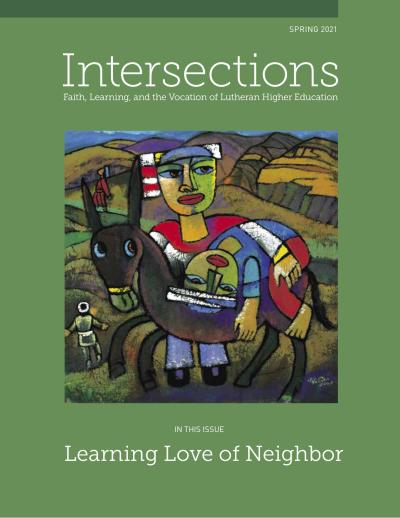 Article
(Re)Defining Vocation: Gladly Challenging a Vocational Giant
Andrew Tucker
No. 53 · Spring 2021
Tucker challenges Frederick Buechner’s famous definition of vocation as “where your deep gladness and the world’s deep hunger meet,” arguing that gladness reflects a privileged perspective and proposing instead that vocation be defined as “any meaningful, life-giving work you do for the world.”
-
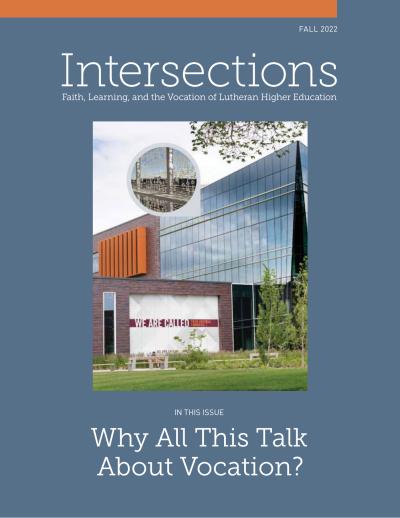 Response
Response to Mark Wilhelm: Distinguishing Between Identity and Vocation
Andrew Tucker
No. 56 · Fall 2022
Tucker proposes that NECU’s next most faithful step is to faithfully and effectively differentiate vocations and identities — arguing that identity is who you are, vocation is what you do, and that recognizing the plurality of both helps Lutheran institutions name which work is theirs to take up and which is good work that belongs to someone else.
-
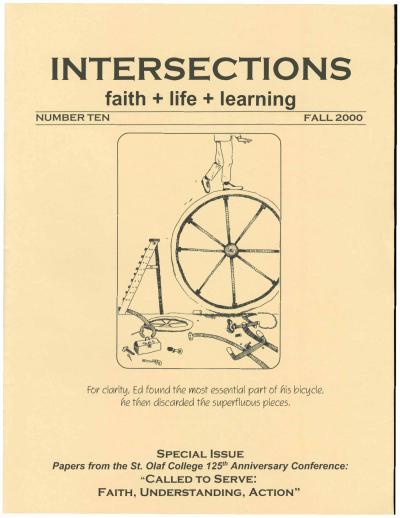 Article
Education for Peace and Justice
David J. O'Brien
No. 10 · Fall 2000
O’Brien surveys justice and peace education in Catholic higher education from Vatican II through the 1980s pastoral letters on nuclear weapons and the American economy, contrasting evangelical radicals (“what would Jesus do?”) with comfortable accomodationists, and argues that Catholic social teaching remains the church’s “best-kept secret.” Drawing on Bryan Hehir, David Hollenbach, Pope John XXIII, Patricia Hample’s “placing ourselves in the world to be of use,” and Martin Luther King’s last book on the “world house,” he develops pastoral care, solidarity (rooted in the mystical Body of Christ), and a realistic vocation-and-citizenship as the three needed responses for Catholic and Lutheran colleges alike.