Reforming Lutheran Higher Education: Ecclesiological Reflection and Theological Leadership
Intersections No. 46 · Fall 2017
The colleges and universities of the Evangelical Lutheran Church in America (ELCA) were founded to educate church leaders to serve ethnically-specific populations within the context of Christendom. Identity, mission, and outcomes were clearly defined by the narrowness of that focus. At the time, there was no perceived need for institutions to reflect theologically on their identity or mission, as nearly everyone came from the same Lutheran and/or Protestant tradition.
Today the context has shifted dramatically. Lutherans are still the largest group on many campuses, but they are joined by followers of many other world religions and the religiously-unaffiliated. This has generated a new awareness of the importance of interfaith relationships and understanding. It has also brought to light an underlying confusion about the identity of our institutions. We can no longer rely on a “critical mass” of Lutherans for our identity, so what will be the foundation?
Over the past several years I’ve been researching the ways ELCA schools communicate their religious identity and mission, as well as the perceptions of these espoused values among members of the campus community. If I had to sum up the results of my research in one word it would be: confusion. There seems to be a pervasive sense of uncertainty about the identity and mission of ELCA schools that transcends geography and piety. There are many reasons for this predicament that cannot be addressed in this article. The primary issue that I want to focus on is the lack of a developed theology (thinking about God) and ecclesiology (thinking about church) for ELCA colleges and universities.
Enlightenment, Postmodernity, and Institutional Self-Knowledge
Ecclesiology is the study of the nature of the church and how it relates to the world. At first glance, it may not seem particularly relevant to discussions about the identity of our institutions because ELCA colleges and universities are not congregations. Although we may not be churches in the typical congregational sense, according to the ELCA constitution we are part of the church, and “an essential part of God’s mission in the world” (“Constitutions” 58).
Based on my experience as an administrator in various roles at ELCA schools, it seems that ecclesiological and theological reflection is an underutilized resource in understanding and communicating our identity. This is not an indictment of the leadership at ELCA colleges but rather a symptom of several cultural shifts.
It is difficult to maintain theology and ecclesiology as a part of identity in any setting because we live in a post-Christian age in which faith has been relegated to the private world of individual choice.
It is difficult to maintain theology and ecclesiology as a part of identity in any setting because we live in a post-Christian age in which faith has been relegated to the private world of individual choice (Ammerman and Farnsley 356; Peterson 30; Van Gelder, “Hermeneutics” 137). That’s not to say that religious faith or spirituality have disappeared. While there has been a decline in overall religious participation among young people, it’s unlikely that the United States will become a secular culture. If the current rate of attrition among young adults persists into older adulthood (and we don’t know whether it will), it would take several centuries before the United States becomes as secularized as Western Europe—a development that is considered unlikely (Putnam and Campbell 76).
Even if North America does not follow the same secularization pattern as Western Europe, there is no question that the way we view faith has changed. This changing worldview began shortly after the Reformation. Through a process of what Charles Tayloe calls excarnation, religious ideas and God’s activity were gradually pushed to the margins of life. With this move from an enchanted universe to a closed system of universal, natural laws, God became unnecessary for public life (Taylor 613). This development reached its zenith during the period of the Enlightenment, and most academic disciplines are based on enlightenment era principles.
The marginalization of faith during the enlightenment period is evidenced by theological developments based on a rationalistic cosmology that left little room for God or transcendence. In John Morrison’s words, “The accepted view (during the enlightenment) was that the universe was a closed system, and that everything in the world was subject to the natural laws of cause and effect” (Morrison 260–61). These views have been expressed by both theological progressives and conservatives in at least three different ways.
The first is the idea that religious faith is exclusively a means of developing “moral fiber” or political change (Bosch 278). Whether that is traditional “family values” or the Social Gospel, moral transformation within the finite world has become the primary arena for religious activity.
The second is the reduction of the Gospel to a means of personal salvation and escape from the world (Bosch 71). This mainly has been expressed from conservative Christians—in its most extreme form as premillennialism—and sees escape from the “closed universe” of the enlightenment to be the sole or primary objective of Christianity (203). Theologians of all perspectives have begun to question this kind of theological reductionism as anti-biblical and dubious toward mission.
The third theological development is deism, the concept that God is like a great clockmaker who winds up the world and then steps back and allows it to operate on its own. Deism has remained a persistent theological force and something of the standard assumption of youth and their parents in this country. Indeed, according to the National Study on Youth and Religion, American teenagers readily exhibit all three enlightenment developments insofar as they confuse historic Christianity with “moralistic therapeutic deism” (Smith and Snell 154–56).
And yet, with the triumph of Moralistic Therapeutic Deism there are signs that the enlightenment’s hermeneutic hegemony is weakening and that deism is mutating. Rather than pure deism, most people subscribe to a theological bricolage in which God is an active agent in the world when therapeutic intervention is needed, but otherwise may be absent (Wuthnow 15). This may not seem much different than pure enlightenment deism, but the mere fact that people are acknowledging that God is at least sometimes active in the world is a marked departure from the past. This idea of God as an active subject in the world is essential to authentic Christian witness (Peterson 49, 88).
The enlightenment worldview has also been challenged epistemologically by the rise of postmodernism. As we begin to realize the highly contextual nature of observation, it becomes increasingly difficult to maintain that anyone can be a purely objective observer. Is it really possible for anyone to interpret reality without being affected by their gender, sexual orientation, or socio-economic identity? Why should religious beliefs be treated any differently than other hermeneutical lenses?
This idea of God as an active subject in the world is essential to authentic Christian witness.
Postmodernism’s premise that all knowledge is subjectively conditioned has opened up a new opportunity for theology. As Craig Van Gelder writes,
In contrast to the Enlightenment’s scientific worldview, which relied on an epistemology that assumed the natural explanation of all phenomena, a hermeneutical perspective no longer requires that the God hypothesis be cancelled out a priori… Interestingly in a hermeneutically-shaped, postmodern context, faith claims regarding the leading of God’s Spirit in a Christian community have taken on a renewed viability. (Van Gelder, “Method” 49)
Lutheran colleges and universities are sometimes accused of being disconnected from their theological roots. I would argue that this may be true, but not necessarily for the reasons people think. It’s not that the Lutheran theological tradition is ignored on campus, but rather that it is interpreted through the lens of enlightenment rationality. Theology and the college’s religious heritage are treated as one among many objective sources of influence in institutional self-understanding. The idea that God may somehow be an active subject in the process of discerning religious identity and mission in a post-Christian age is simply not on the radar.
The Who of Churches and Colleges
The “identity crisis” of ELCA colleges and universities parallels that of Christian churches. The Christian church, too, is struggling to come to grips with a changing cultural context in which it no longer occupies a place of prominence within the culture (Bosch 373). Christianity was the dominant cultural force during the period of Christendom and the surrounding culture reinforced its values. There was little need to deal with ecclesiological issues such as the identity of the church because we assumed that there was a common understanding. In a post-Christian age, we must learn to “hold our assumptions lightly” because we cannot be sure that a common understanding of fundamental theological issues like the nature of the church actually exists (Zscheile 5). Cheryl Peterson explains,
There is a deeper and more basic issue that must be explored, one that has to do with the church’s theological identity, that is, what it means to be the church. It is my thesis that the church today is facing an identity crisis. It is not simply that the church is culturally irrelevant or inauthentic; these are symptoms of the underlying issue, which is that we don’t know who we are as the church…Who is the church? This is a theological question that calls for a theological answer. (Peterson 4)
This identity crisis is exacerbated by the fact that ecclesiology (the study of the nature of the church) has tended to be undervalued by Protestant denominations (13). American churches have tended to be more pragmatic when it comes to ecclesiology, holding to an ecclesiological theory-in-use that views the church as a “voluntary association” (Peterson 35; Argyris 1). Voluntary associations do not have an ontological, spiritual, or theological identity—they are merely organizations of individuals who choose to come together around a common purpose, in this case, around religious faith (Peterson 27). Consequentially the American church has tended to view ecclesiology in functional and organizational terms—what the church does—rather than probe deeper theological issues like identity—what the church is (Van Gelder, Essence 23).
American churches have tended to be more pragmatic when it comes to ecclesiology, holding to an ecclesiological theory-in-use that views the church as a ‘voluntary association.’
In a similar way, part of the reason that God is not considered an active subject in the life of ELCA colleges and universities is due to lack of reflection on the “who” of Lutheran colleges, by which I mean a lack of theological leadership. At one time, many executive leaders at Lutheran colleges and universities were clergy or theologically trained lay people. In response to rising levels of complexity in the higher education market, leadership has become more specialized.
There are many good things about this shift to hiring leaders with expertise in the higher education sector. There are also downsides. Today very few executive leaders have theological training. By no means are they incapable of theological reflection, but they may feel as if they don’t have the necessary skills to introduce theological reflection into their deliberations, or lead the community in sustained theological dialogue.
Failure to consider the theological aspects of leadership is thus an issue for ELCA colleges and congregations. Secular models for organizational leadership are helpful but incomplete without theological reflection. Both the church and church-related colleges must always begin with their identity or essence before they proceed to organizational issues. The identity of each begins with understanding who God is and what God is doing. In other words, organizational leadership at ELCA institutions that value their religious identity must have a different starting point than at secular schools. Many Catholic schools and several Lutheran schools (California Lutheran University is one example) have acknowledged the importance of theological reflection by adding executive level staff who are paying attention to the institution’s identity and mission.
Both the church and church-related colleges must always begin with their identity or essence before they proceed to organizational issues.
Unfortunately, the ELCA’s statements about colleges and universities focus almost entirely on organizational and functional concerns. The ELCA constitution concentrates on the ways in which the colleges and universities relate to the churchwide organizational structure. There is only one paragraph that even comes close to an ecclesiological statement: “The relationship of this church to its colleges and universities shall be guided by policies fostering educational institutions dedicated to the Lutheran tradition wherein such institutions are an essential part of God’s mission in the world” (Constitutions 58). The rest of the document focus on what the colleges and universities do rather than who they are.
Perhaps this is understandable given that governing documents are not necessarily intended to be theological documents. And yet, this functional approach to ecclesiology is consistent in other ELCA documents. None of the other documents I could find included substantive theological conversation about the most basic of matters—how the colleges and universities of the ELCA are related to the broader Church, and who God is calling colleges and universities to be. While these are all admirable and important statements, there is little evidence that God is an active subject at work within ELCA colleges and universities.
In order to clarify our religious identity and mission, it is imperative that we begin with basic ecclesiological questions such as: What is the nature of the church? How does it affect the identity and mission of ELCA colleges and universities in a post-Christian world?
The Trinity as Foundation
This essay is a call to develop an ecclesiology that encompasses ELCA colleges and universities and that is actually incorporated into the life of our institutions. There will undoubtedly be disagreement about whether this is an appropriate endeavor for ELCA schools, particularly in light of the realities of religious pluralism and our discomfort with the idea of God as an active subject.
Without an articulated ecclesiology it is hard to imagine how our institutions will live into these new realities while still being grounded in a religious identity.
I understand these concerns, however, without an articulated ecclesiology it is hard to imagine how our institutions will live into these new realities while still being grounded in a religious identity. I believe that our institutions can learn from the work of organizations such as Interfaith Youth Core (IFYC) which brings together recent college graduates from many different religious traditions to serve and work together. One of the things I most respect about IFYC is their belief that we needn’t check our religious identities at the door when interacting with those from other faith traditions. In this way IFYC is able to pursue both interfaith cooperation without marginalizing or genericizing religious identity. The question that IFYC asks participants to consider is: “How do the values of my religious tradition speak to this value or issue?” (Brown 98).
Perhaps it would be wise for ELCA colleges and universities to ask similar questions. What within the Lutheran tradition speaks to the identity of our schools? How does our Lutheran ecclesiological identity speak to religious diversity? Why does our ecclesiological identity reject attempts to coerce theological uniformity? How does it allow us to see people of all faith traditions as full partners in our mission?
Understandably, ELCA colleges and universities have often appealed to Luther when addressing questions of identity. While there is a place in the conversation for Luther, we also must acknowledge that his work is a product of Christendom and may not be particularly helpful in addressing our ecclesiological identity at the present time:
In a post Christendom era the questions being asked by the church, and of the church, are quite different than in the Reformation. People are no longer asking “where do I find the true Church?” but rather “why the church?” or “why should I bother?” This requires a new understanding of the church’s identity that takes present contextual realities seriously. (Peterson 54)
If we ask ourselves the question, “How does our ecclesiological identity speak to a pluralistic, post-Christian culture?,” we may realize that Luther is not an ideal starting point. I would argue that a Trinitarian approach is more helpful, especially when the classical Western notion of the Trinity, which focuses on its oneness, is paired with the Eastern understanding of Trinity that begins with its threeness.
If we ask ourselves the question, ‘How does our ecclesiological identity speak to a pluralistic, post-Christian culture?,’ we may realize that Luther is not an ideal starting point.
Many metaphors have been used to describe the eastern view of the relationship within the Trinity—a divine dance, circulation around the neighborhood, whirl, rotation, and even the passing around of a jug of a wine (Moltmann, “Perichoresis,” 111–25; compare Rohr). Regardless of the metaphors employed they all point to a deep mutuality and divine flow known by the term perichoresis.
Jürgen Moltmann describes perichoresis by claiming that “the three divine Persons have everything in common, except for their personal characteristics. So, the Trinity corresponds to a community in which people are defined through their relations with one another and in their significance for one another, not in opposition to one another, in terms of power and possession” (Moltmann, Trinity 198). He further argues that perichoresis “links together in a brilliant way the Threeness and the unity (of God), without reducing the Threeness to the unity, or dissolving the unity in the Threeness” (Ibid 175).
What difference does all this make for reflecting on the church-related identity of ELCA colleges and universities in a way that takes seriously our contextual realities? According to Craig Van Gelder, ecclesiology begins not with the nature of the church, but rather with the nature of God. The church is a community created by the Spirit and its identity reflects God’s own identity. If God’s nature is perichoretic, then that means that the nature of the church is also perichoretic and our relationships are meant to mirror the perichoretic nature of God. That means that the church and its colleges and universities can be places where identity (oneness) need not exist in opposition to diversity (threeness). The perichoretic nature of the Trinity seems to be an ideal ecclesiological foundation for our colleges and universities in a pluralistic world. It holds together both unity and diversity without diminishing either.
Concluding Thoughts
There is much more that could be said about the need for ELCA colleges and universities to engage in ecclesiological reflection. This article is intended to begin this conversation by offering some insight into how we have gotten to where we are, and some possible ways forward. As we continue to commemorate the five-hundredth anniversary of the Reformation, I hope that inspired theological leadership will seek what God may be doing to reform Lutheran higher education for its important work in the world.
Works Cited
Ammerman, Nancy Tatom, and Arthur Emery Farnsley. Congregation & Community. New Brunswick, NJ: Rutgers University Press, 1997.
Argyris, Chris. “Action Science and Organizational Learning.” Journal of Managerial Psychology 10.6 (1995): 20-26.
Bosch, David Jacobus. Transforming Mission: Paradigm Shifts in Theology of Mission. Maryknoll, NY: Orbis Books, 2011.
Brown, Daniel S. A Communication Perspective on Interfaith Dialogue: Living Within the Abrahamic Traditions. Lanham, MD: Rowman & Littlefield, 2013.
“Constitutions, Bylaws, and Continuing Resolutions of the Evangelical Lutheran Church in America.” Accessed 1 October 2017, http://download.elca.org/ELCA%20Resource%20Repository/Constitutions_Bylaws_and_Continuing_Resolutions_of_the_ELCA.pdf
Moltmann, Jürgen. “Perichoresis: An Old Magic Word for a New Trinitarian Theology.” In Trinity, Community, and Power: Mapping Trajectories in Wesleyan Theology, ed. M. Douglas Meeks. Nashville, TN: Kingswood, 2000.
———. The Trinity and the Kingdom: The Doctrine of God. San Francisco, CA: Harper & Row, 1981.
Morrison, John D. “Teaching Them to Obey All Things in a Pluralist Society: The ‘Open Secret’ of the Gospel in the Thought and ‘Emergent’ Influence of Lesslie Newbigin.” The Evangelical Quarterly 84.3 (2012): 253–71.
Peterson, Cheryl M. Who Is the Church?: An Ecclesiology for the Twenty-First Century. Minneapolis: Fortress, 2013.
Putnam, Robert D., and David E. Campbell. American Grace: How Religion Divides and Unites Us. New York: Simon & Schuster, 2010.
Rohr, Richard. The Divine Dance: The Trinity and Your Transformation. New Kensington, PA: Whitaker House, 2016.
Smith, Christian, and Patricia Snell. Souls in Transition: The Religious and Spiritual Lives of Emerging Adults. New York: Oxford University Press, 2009.
Taylor, Charles. A Secular Age. Cambridge, MA: Harvard University Press, 2007.
Van Gelder, Craig. The Essence of the Church: A Community Created by the Spirit. Grand Rapids, MI: Baker, 2000.
———. “The Hermeneutics of Leading in Mission.” Journal of Religious Leadership 3.1–2 (2004): 139–71.
———. “Method in Light of Scriptures and in Relation to Hermeneutics.” Journal of Religious Leadership 3.1–2 (2004): 43–73.
Wunthnow, Robert. After the Baby Boomers: How Twenty- and Thirty-Somethings Are Shaping the Future of American Religion. Princeton, NJ: Princeton University Press, 2007.
Zscheile, Dwight J. Agile Church: Spirit-Led Innovation in an Uncertain Age. Nashville, TN: Abingdon, 2014.
-
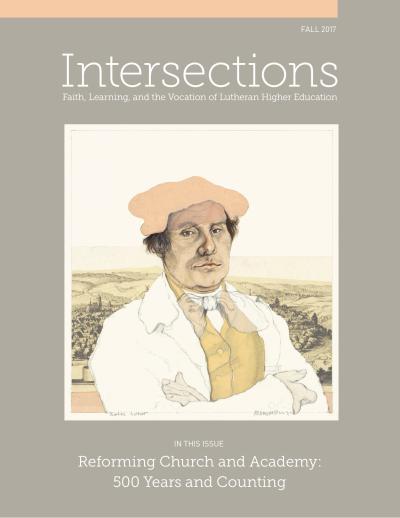 Editorial
From the Publisher
Mark Wilhelm
Wilhelm reflects on how NECU’s focused work on Lutheran identity in higher education — including the forthcoming document Rooted and Open: Our Common Institutional Calling — turns out to be a fitting commemoration of the five-hundredth anniversary of the Lutheran Reformation, even though it did not arise from anniversary planning.
-
Editorial
From the Editor
Jason A. Mahn
Mahn returns to Luther’s opening thesis on whole-life repentance to argue that the deepest critique of the indulgence economy — and of our own American meritocracy — is the very assumption that grace and human striving can be measured, exchanged, and earned.
-
Article
Why Martin Luther and the Reformation Matter 500 Years Later
Kathryn A. Kleinhans
Adapted from a 2017 address to Wartburg College’s entering class, Kleinhans surveys Luther’s lasting impact in vocation, education, social service, and the necessary work of repentance — closing with the Lutheran World Federation’s Windhoek assembly and the Reformation World Exhibition’s call to live reform forward into the next 500 years.
-
Article
Celebrating the Reformation: The Lutheran Foundation of a Called Life
Mark D. Tranvik
Tranvik traces vocation from the monastic impulse through Luther’s rejection of the monk’s vow as the only true calling, and translates the “called life” for twenty-first-century Lutheran colleges — institutions that see students as made in the image of God, enlist the whole community in discernment, and make room for faith and its convictions.
-
Article
Reforming Our Visions of City Nature
Lea F. Schweitz
Through a Chicago story of Canada geese at North Pond, Schweitz takes up two Reformation-era ways of reading the “Book of Nature” — Konrad Rosbach’s moral readings and Philip Melanchthon’s scientific ones — and proposes a third: Luther’s sacramental principle that the finite is capable of the infinite, worn as “reading glasses” for an urban planet.
-
Article
Both Priest and Beggar: Luther among the Poor
Martha E. Stortz
Reading Luther’s deathbed remark “We are all beggars” against his “priesthood of all believers,” Stortz argues that priest and beggar are two sides of a human reality — one that locates civic responsibility for the poor at the heart of the Reformation legacy and that pushes beyond paternalistic service toward the systemic question of justice.
-
Article
In the Beginning of the Reformation Was the Word
George Connell
Drawing on a Concordia faculty pilgrimage to German Luther sites, Connell appropriates John’s prologue to frame the Reformation as a movement about words — the printed page, the university classroom, the Marburg confession, the Wartburg translation, Bach’s music, and the dining-room conversations of Table Talk — while soberly noting that words can wound as well as heal.
-
Article
Luther's Sutra: An Indian, Subaltern (Dalit) Perspective
Surekha Nelavala
Nelavala traces how Luther’s “sutra” — grace alone, faith alone, scripture alone, Christ alone — reached the mud hut of her Dalit grandparents in rural India, transforming three generations, and then reads the parable of the vineyard laborers from a subaltern perspective in which grace for all is the heart of God’s alternative kingdom.
-
 Article
A Response to Paul Santmire
Don Braxton
No. 4 · Winter 1998
Braxton appreciates the dialectical structure of Santmire’s mandates—“skeletons in our closets and riches in our own vaults”—and reads it as a faithful expression of the Lutheran tradition of Paul, Augustine, and Luther. He argues that Santmire is on target in warning against premature flight to non-Christian traditions for environmental wisdom (theoretical sensitivity does not translate into ecological behavior in practice), and that classical Lutheran social ethics has too often been quietistic. But Lutheran ethics at its best is dialectical, not dualistic—recognizing the interpenetration of church and world, Law and Gospel, eschatological Kingdom and present realities, as in Hegel, Ritschl, Bonhoeffer, Reinhold Niebuhr, and Larry Rasmussen. Braxton commends environmental responsibility, social criticism of unsustainable practices, and a liturgical practice of resistance to instrumentalism as appropriate next steps for Lutheran liberal arts colleges, especially Capital University.
-
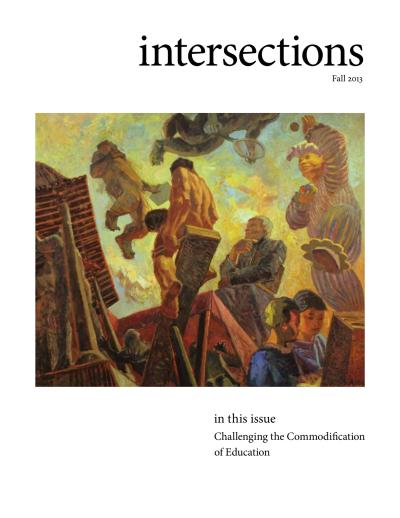 Article
Welfare of the City and Why Lutherans Care about Education
L. DeAne Lagerquist
No. 38 · Fall 2013
Lagerquist takes readers on a historical tour from sixteenth-century Saxony through the founding decades of Lutheran higher education in the United States to the present day, recovering Luther’s “gift economy” alongside Lewis Hyde and Oswald Bayer as a counter to the market logic that increasingly governs American higher education. She offers four propositions on vocation and commodification and proposes that Lutheran institutional vocation is to accept and pass along the gifts that come to our schools for the well-being of students, neighbors, and the world.
-
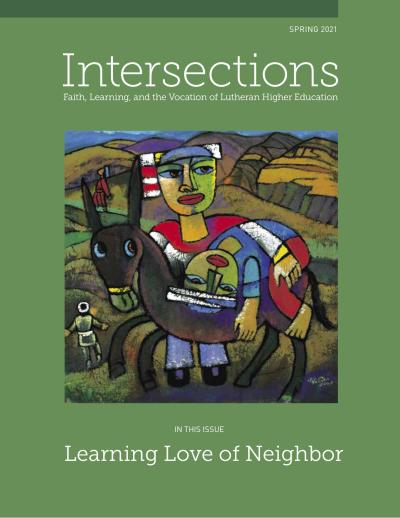 Article
Down and Out: First Year Students Encounter Lutheran Theology
Lindsey Leonard
No. 53 · Spring 2021
Leonard describes how Wartburg’s IS 101 first-year seminar wove the Dalai Lama, Paul Kingsnorth, Chimamanda Ngozi Adichie, and Mary Robinson’s Climate Justice into the Fall 2020 reader so the “COVID class” could encounter Lutheran theology’s call to serve the neighbor across the pandemics of disease, racism, and climate change.
-
 Article
Called for Life
Brian Pittman, Ellen Shelton, Greg Owen
No. 31 · Winter 2010
Owen, Shelton, and Pittman of Wilder Research present the key findings of the Called for Life study, comparing the class of 2007 “Lilly graduates” from Luther, Augsburg, and Augustana to a pre-Lilly cohort from the class of 2001. They report that Lilly graduates were more than twice as likely to associate vocation with “calling” rather than “just a job,” and they identify four common ingredients of effective programming: relationships with caring adults, experiential learning outside the classroom, vocation-infused courses, and peer relationships within a pervasive campus culture of vocational exploration.
-
 Editorial
From the Editor: Why All This Talk About Vocation?
Colleen Windham-Hughes
No. 56 · Fall 2022
Windham-Hughes introduces the Fall 2022 issue built around Mark Wilhelm’s keynote “Why all this talk about vocation?” and previews five panel responses, two first-time conference reflections, and companion pieces on Womanist theology — framing vocation as a call not to privilege but to constructive and corrective work that undoes unjust systems.
-
 Article
The Search for a Just Peace in a Globalized World
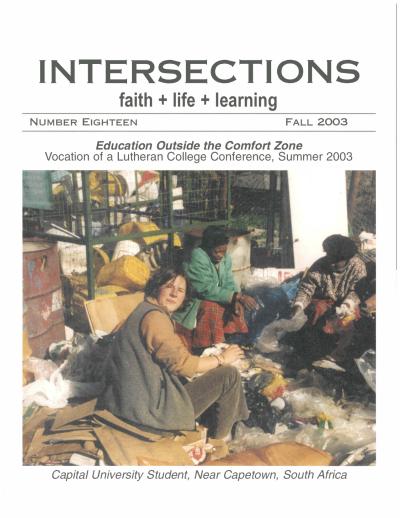
Munib A. Younan
No. 18 · Fall 2003
Younan, Lutheran Bishop in Jerusalem, grounds Palestinian Christian identity in Incarnation theology and a Lutheran theology of grace and the cross, then surveys the Evangelical movement’s nineteenth-century legacy in the Middle East—the 1864 Arabic Bible, ELCJ schools, women’s ordination, and the Middle East Council of Churches. Engaging Edward Said’s critique of Samuel Huntington, he calls for international and local mutual-recognition agreements (including the Jerusalem Lutheran-Anglican agreement and a Lutheran-Reformed agreement in the Middle East), four marks of interfaith dialogue, and a sharp distinction between Lutheran “Evangelical” identity and the Dispensationalist evangelistic Right whose Israel-Palestine scenarios he names a heresy. He closes by proposing concrete scholarship, faculty exchange, and sabbatical partnerships between U.S. Lutheran colleges and the ELCJ’s churches, schools, and Dar al-Kalima Lutheran Academy.