Paul Dovre, ed., The Future of Religious Colleges: The Proceedings of the Harvard Conference on the Future of Religious Colleges October 6–7, 2000 (Grand Rapids: William B. Eerdmans, 2002)
As its title page suggests, this book contains texts of the papers and formal responses delivered at a conference organized by Paul Dovre, funded by the John M. Olin Foundation, and held at Harvard in the Fall of 2000. The conference (and so the essays) was designed to address five questions:
1) What will be the place of religiously informed scholarship in the academy of tomorrow?
2) Is the trend toward disengagement from a distinctive religious identity and mission inevitable?
3) Can churches that have lost their college relatedness be transformed? Can colleges that have lost their church-relatedness be transformed?
4) Are the diverse educational missions of religious colleges viable in an intellectual sense? In a social sense? How can such viability be encouraged and secured?
5) Will public policy and the interpretation thereof be an ally or an enemy of religious colleges? (“Introduction,” p. xi)
Undergirding and provoking these questions lies some influential recent scholarship, in particular James Burtchaell’s, The Dying of the Light: The Disengagement of Colleges and Universities from Their Christian Churches (1998), George Marsden’s The Soul of the American University: From Protestant Establishment to Established Nonbelief (1994) and The Outrageous Idea of Christian Scholarship (1997), Douglas Sloan, Faith and Knowledge: Mainstream Protestantism and American Higher Education (1994), and Mark Schwehn, Exiles from Eden: Religion and the Academic Vocation (1993); with the exception of Burtchaell, all of these scholars are contributors to this volume.
I take my assignment in these comments to be threefold: first, to give readers of Intersections some sense of which contributions are likely to be of most interest to them and what those contributors had to say; second, to identify the most significant issues raised explicitly or implicitly by the conference, and third, to offer my own reflections, not as a scholarly contributor to the discussion but as a practicing faculty member turned administrator, on those issues.
The book begins with a most provocative essay by Sloan which draws out some of the implications of Faith and Knowledge. He argues that the leading intellectuals of post World War II mainstream Protestantism, Paul Tillich and the two Niebuhrs, tried but failed to provide a persuasive response to a fundamental epistemological question: how could the truth claims of religion compete with truth that resulted from rigorous application of the scientific ways of knowing which dominated the modern university? On what basis besides sheer faith assertion, in other words, could a religious claim be defended in the academy? Ultimately these theologians were forced back on a “two-realm theory of truth” that preserved the possibility of religion’s providing “meaning and interpretation and affective mood,” but ceded examination of ethics, science, and the sensible world in general to purely naturalistic ways of knowing. At roughly the same time, the mainstream churches were making a similar effort to engage the university through groups like the National Student Christian Federation and the Faculty Christian Fellowship. Bereft of epistemological grounding and seduced by the lure of social action, these organizations collapsed in the late 1960s. Without a coherent way to explain and defend religious knowing, Sloan believes, religious thinkers will have no alternative to the two-realm theory, and any challenge to the pervasive secularism of the modern university will remain problematic. The essay concludes with some suggestions as to how a qualitative epistemology, more adequate to religious knowledge, might be developed.
George Marsden’s essay attempts to clarify, with reference to his own work, how an individual scholar’s religious commitment might shape scholarship without diminishing its credibility in the larger academy. To each of five questions—“(1) What do I think important enough to study? (2) What questions do I ask about it? (3) What currently fashionable interpretive strategies are compatible with my religious outlook? (4) How do I, implicitly or explicitly, evaluate various developments as positive, negative, or something in between? (5) How do these evaluations shape my narrative?” (p. 45)—Marsden finds his responses different from those of most secular historians. “I practice the craft within the rules of the guild,” he argues, “yet my theological perspectives provide a basis for an outlook critical of some widely accepted assumptions.” (p. 49)
Speaking from her Lutheran perspective, DeAne Lagerquist claims she is used to living with the tension of being two or even three things at once. Rather than forcing faith and knowledge together, she wonders “if we might do better to allow that faith and knowledge both contribute to some other thing, some better thing [i.e. the love of God] that requires both” (p. 58).
Turning to the issue of whether religious colleges are doomed to slow death by secularization, Father David O’Connell, President of The Catholic University of America, contends that a college can usefully be termed “religious” only if it meets two conditions: the sponsoring religious group must have direct influence upon the institution, and there must be an institutional imperative to remain “religious.” Within the diversity of institutions that constitute American higher education, he asserts against Burtchaell, there will always be room—and presumably demand—for such colleges.
My own academic field is the history of Christianity; perhaps for that reason I found Mark Noll’s essay, which suggests that some important lessons can be learned from the past, especially fine. Like Burtchaell, Noll questions how explicitly and robustly many religiously-founded colleges (he is particularly knowledgeable about Princeton) were ever grounded in their sponsoring institutions. He draws attention to the enormous success of Roman Catholic higher education in America during the first 2/3 of the 20th century as an example worth more consideration. Much like Marsden, he sees new possibility for faith-based scholarship in the post-enlightenment university, but he is more sanguine than Marsden about the realization of those possibilities: “more and better self-consciously Christian learning is taking place than at any previous period in American higher education since the seventeenth century” (p. 87). And he is more cautious than O’Connell about the future of religious colleges: “commitments to preserve religion must be structural, systemic, and courageous if such institutions are to avoid the secularizing fate of America’s first religious colleges…. The slippery slope, if it is not the only possibility, is certainly still one of the possibilities” (p. 90).
Robert Benne’s response (do we detect unconscious bias on our good editor’s part in assigning the last word on these two important topics to Lutherans?) draws out several issues implicit in O’Connell and Noll. First, religious colleges depend upon the vitality of the sponsoring religious body, and in particular the willingness of its members to send their children to their denominational colleges. Mainline denominations, certainly including the ELCA, do not stack up well: the “Reclaiming Lutheran Students” study found fewer than 5% of Lutheran youth attending Lutheran colleges. Second, if so much good Christian scholarship is being carried out at secular colleges, do we need religious colleges at all? Third, what about the majority (75%?) of church-related colleges, his and mine included, whose church-relationship is less than robust? Are they simply fated to become religiously comatose? I will return to the first and third question later.
I pass over the section on Catholic, Baptist, and Nazarene models of church-relatedness not because the essays lack substance but because they address the issues in Dovre’s third question almost entirely from within their own specific traditions and thus seem less germane to a specifically Lutheran plight. The opposite is true of the essays by Mark Roche, Joel Carpenter, and Mark Schwehn in the fourth section (I will also pass over essays in this section on evangelical Christian, historically black United Methodist, and Anabaptist-Mennonite colleges). Roche, Dean of the College of Arts and Letters at the University of Notre Dame, offers what he terms “an idealized portrait of Notre Dame, focusing on what the university can and should become” (p. 165) [For the warts, he refers readers to a 1997 Christmas address to the arts & sciences faculty available on the Notre Dame website.] Deans and presidents tend to learn this genre of address quickly for use on those occasions when alumni and other potential donors can be energized by a vision of what—with the proper financial support—a university can become. But Roche’s essay is particularly successful at drawing attention to what makes Notre Dame distinctively Catholic. Not only is Notre Dame’s culture recognizably Catholic, but its curriculum also unmistakably reflects its Catholic commitments. Every student takes two courses in theology, and interdisciplinary minors are available in religious subjects such as Catholic social traditions. So far, so good; most church-related colleges would not drastically differ. But Notre Dame also tends to define its areas of disciplinary strength in the light of its Catholicism. Philosophy, theology, medieval studies, Irish studies (do we have to ask why this is Catholic?), and Latin American studies are particularly strong. Within other departments, distinctive sub-disciplines are held up: Irish literature, medieval literature, literature and religion in the English Department, American religious and intellectual history in the History Department (including the Calvinist Professor Marsden), sacred music in the Music Department, social justice issues such as poverty and development in the Economics Department.
Roche goes on to argue that, given their sacramental vision of the natural world, Catholics are less susceptible than Protestants to the temptation to retreat to what Sloan would call the “two-realm theory of truth.” Correctly understood, natural science and the arts point the learner to God. Lutherans have much to learn, and to envy, in Roche’s vision for a Catholic university.
Carpenter’s vision, no less convincingly presented, is of the neo-Calvinist university shaped by the vision of Abraham Kuyper. Teaching and scholarship are intentionally conducted from Christian principles; one pursues Christian literature, Christian sociology, even Christian medical science. Carpenter quotes James Braat approvingly that what makes higher education Christian is
not required chapel or Bible courses, not opportunities for extracurricular “service,” not the cultivation of “character” or “citizenship,” not the baptism of middle-class decency with Christian rhetoric or the frosting of Christian conviction with cultural refinement, not the promotion of piety alongside of scholarship or professional preparation; but the classroom as a chapel, scholarship as devotion, Christianity as the base of the curriculum and suffusing all studies. (p. 203).
What might a Lutheran college look like? Mark Schwehn urges us to recognize our minority status and marginal standing within the academy. “Heavily residential, often emphasizing liberal education, relatively small in size, relatively homogenous in racial and ethnic composition, overwhelmingly undergraduate, and mainly Midwestern” (p. 210) we differ in almost every respect from the places where most Americans seek higher education. He echoes Lagerquist in celebrating “the Lutheran conviction that one must always operate with one eye on the God who loves the world and the other on the world that God loves. The more firmly for the Lutheran that the eye of faith rests upon God, the more fervently the eye of reason can acknowledge, celebrate, and seek to advance the best of secular learning and the best of university life” (ibid.). I would add that this vision separates us no less from Kuyper’s neo-Calvinist program than from the secular academy.
Schwehn also tackles Benne’s question of the vitality of the supporting institution. Recognizing that neither individual parishes nor the national Lutheran church bodies have been “especially generous with financial support for Lutheran colleges…,” he calls upon us “to discover and to some extent form a college- and university-related church” consisting “of Lutheran laypeople who long for theological substance and spiritual wisdom that is commensurate with the advanced knowledge that informs other aspects of their lives; of Lutheran parents of prospective students who want to provide their children with an excellent education but who are almost completely unaware of the present quality of their own colleges; and of prosperous Lutherans who can be persuaded to support some of the pan-Lutheran endeavors that are necessary to transmit and enrich the best of the Lutheran tradition” (p. 215). I will return to this challenge as well.
Schwehn proposes that Lutheran colleges distinguish themselves by a more explicit focus on the centrality of vocation. Arguing much as he did in Exiles from Eden, he proposes that one is called “at the moment when desire and duty become one, when the source of one’s deepest longing is at the same time something to which one is obedient.” For a Christian academic, that is to understand the truth she seeks “as that through which and by which the Truth draws the academic ever unto Himself” (p. 218). A deeper and more self-conscious understanding of the concept of vocation “might well lead to a complete reformulation of such fundamental educational matters as the nature of human excellence and the relationship between the active and the contemplative life” (p. 219).
The final section, on issues likely to arise with the courts on federal, state, and local funding and with the AAUP on academic freedom, is definitely worth the attention of anyone concerned with those issues, but is less germane to our purposes here.
What appear to me to be the most significant issues raised by these essays and the scholarship to which they refer?
First, there is confusion about the very term “religious college.” Although most of the authors were well aware that there are vast differences in the degree of affiliation among denominationally affiliated colleges, the essays on the whole seem to presume that these differences were—or at least ought to be—outweighed by commonness of purpose. There are also strong suggestions that for the good of the churches as well as American higher education, the stronger the affiliation, the better. Although I detected no enthusiasm for institutions like Bob Jones University, none of the essayists suggested that more distance between a church and its colleges might be a healthy development rather than a sign of decay. Even Professor Benne, who was at least willing to question how well the model of church-relatedness endorsed by most presenters actually fit the majority of church-related colleges, plainly subscribes to the school of more is better. But is stronger church-affiliation, more church control, movement toward the kind of ideal type represented here by Notre Dame, Calvin, or Baylor, always the optimal direction for a college?
Second, are the fortunes of religious colleges, however defined, sufficiently independent from their constituencies and from the larger culture that they can reasonably be said to control their own destinies? Several contributors recognize the importance of a strong denominational constituency, but anyone who has raised money or recruited students recognizes that the wishes of donors and potential students and parents enter very quickly into the conversation. It appears to be no accident that many of the model institutions—Calvin, Baylor, St. Olaf, Brigham Young, Yeshiva—rely on a strong ethnic/geographic base for students and support. If, as is frequently the case with more settled and acculturated constituencies, the passing years bring less and less interest in denominational exclusiveness, will the colleges not be forced, even against their will, to (in Noll’s words) “broaden their appeal”? To use an ELCA example, to what extent might the difference in robustness of church affiliation between a Gettysburg College and a Luther College be largely a function of the level of acculturation of Gettysburg’s constituency relative to that of Luther’s? All the ELCA colleges would like to recruit more Lutheran students, as the very title of the “Reclaiming Lutheran Students” study suggests. It is our constituencies—students, parents, pastors and bishops—who appear to lack knowledge of, enthusiasm for, or even interest in the demonstrably better education we provide for Lutheran students, and—without the enormous endowments enjoyed by a Princeton or a Williams—we depend upon those constituencies for our survival.
Third, none of the authors questions the assumption that the cost of the “secularization” of formerly denominational institutes has been too high. Yet even within this rarified scholarly company, I suspect that no one would seriously argue that the United States would be better off today if Harvard had remained committed to its Puritan roots. Might it be that there were reasons other than the cowardice and venality of college administrators for colleges to be drawn to the secular Enlightenment model? Despite the many legitimate criticisms that can be directed at American higher education at the beginning of the twenty-first century, might we be overstating the gains and minimizing the deficits of education at religious colleges? Many of our colleges were distinctly more religious fifty years ago, but were they not also more rigid, more parochial, more dogmatic, more moralistic, less academically rigorous? To state the point in a completely unfair manner, were our colleges half a century ago entirely free of the characteristics that caused such well-known novelists as Mary McCarthy and Peter DeVries to reject their faith communities? Would our colleges as they were then have resisted the kind of evangelical Christian pressure brought on the University of North Carolina to remove a book on the Q’uran from it summer reading list? Might we at least wish to engage more directly critiques of Marsden’s “secularization” argument by scholars like David Hollinger?
I will close with some of my own reflections on these issues.
First, I am much more comfortable than any of the contributors in endorsing the notion that there can be many viable models of church relationship. Wittenberg’s relationship to the church, to take the example I know best, has never in its almost 160-year history been Lutheran enough to satisfy Professor Benne’s expectations for robustness. Our ELCA Director for Higher Education, Arne Selbyg, explained at last summer’s Vocation of a Lutheran College Conference that during the conversations that led to the creation of the ELCA, colleges like Wittenberg, Gettysburg, and Roanoke were originally assigned to a category of “church-related colleges” rather than the more robust, and presumably more deserving, “colleges of the church.” Yet there is no doubt in my mind that much would be lost if we—or the ELCA—severed our relationship. Wittenberg is the better, and the church is the better, because we are connected. We do not want to move in the direction of Baylor, but we find the Ohio State model equally unattractive. The “Reclaiming Lutheran Students” study shows clearly that our graduates find us unusually successful in the very ways most prized by Lutheran parents and opinion leaders. Never one to shy from the logic of his arguments, Professor Benne recognizes that if we insist on his most robust model for Lutheran colleges, “in the future we may be able to sustain only two or three” (p. 98). I fail to see how this represents a gain for the church or for higher education.
Perhaps I am overly suspicious, but I also detect in the argument for more direct church influence an underlying concern that laypeople may be a little out of control, or at least may be taking things in a direction that clergy (and in this instance I would lump many of our most informed and committed faculty with the clergy) would prefer they not go. In the Catholic case my discomfort is more than a suspicion. Lay and clerical, Catholic administrators nationwide are feeling the effects of largely unwanted ecclesiastical interference stemming from the pope’s encyclical Ex Corde Ecclesiae. I fear no such interference from Bishop Hanson and his colleagues, but it is undoubtedly the case that the predominantly lay Boards of Trustees and presidents that operate most of the ELCA colleges are far less dominated by theological concerns than most clergy (and than the contributors to this volume). Do not many of the less robust colleges, in other words, reflect rather well what most laypeople are looking for in a church-related college, an institution that finds ways to express values that combine the same religiosity that motivates their churchgoing with a broader commitment to take their places in American society? And is it a surprise that this strikes the highly committed as lukewarm, lackadaisical, almost worse than no church-relationship at all?
I am inescapably reminded of the period I study, early seventeenth century England, when a group of highly-educated, theologically-driven clergy succeeded in converting prominent laypeople to their cause and then attempted to impose their version of Christianity on the population of England. The ultimate result was a bloody civil war and a Church of England ever afterwards hostile to their cause. Had these Puritans (the same ones who founded Harvard, by the way) taken a little more seriously the concerns of those who respected religion but whose lives were not dominated by it—had they been willing to settle for a less theologically pure but more comprehensive church—the bloodshed might have been avoided and the final outcome more positive for themselves.
I agree with Professor Benne that some—perhaps many—students will not want to be conformed to this world and will seek out the Lutheran, or Reformed, or Catholic ghetto. I have the greatest respect for the colleges that exist to satisfy their needs. But I am unwilling to cede the honor of being a “religious college” entirely to those colleges.
My reflections on the second issue piggyback on those of the first. Let me return to Professor Benne’s conjecture that “in the future we may be able to sustain only two or three” authentically Lutheran colleges. [I come back to Benne not to beat up on him—I know he gives better than he gets—but because I respect his willingness to state the implications of his positions forthrightly.] Who is “we” in this sentence, I would ask, and what is the meaning of “sustain”? Are “we” the ELCA as a whole, Lutheran students and parents, concerned clergy and faculty, significant donors? It we understand “sustain” in economic terms to mean tuition, room and board, annual giving, and capital campaign gifts, the ELCA all but disappears from the picture, and congregations and synods, welcome as their support is, are not far behind. In Wittenberg’s case, and I must believe in Roanoke’s as well, even Lutheran parents, clergy, and donors contribute significantly less than half our total operating budget. I admit to being stunned by the extent of mainstream Protestant withdrawal from higher education documented by Sloan—fortunately for us, the Division of Higher Education and Schools labors faithfully to remind the ELCA of the importance of its colleges. But even the most faithful advocates for higher education within the ELCA would hardly argue that support for the colleges—material or moral—looms large at synod assemblies or in the day-to-day concerns of pastors and bishops. Even the Lutheran fraternal associations—now combined as Thrivent—have been moving away from direct support to colleges toward matching gifts from policyholders. Apart from students and parents, and alumni, our most significant support probably comes from the members of our faculty and staff, who work for less—often far less—than they could earn at secular institutions because they are living out a vocation at our colleges.
Mark Schwehn recognizes the challenge of Benne’s “we”; he would like to see the formation of a “college-related church” of Lutheran laypeople, Lutheran parents, and prosperous Lutherans prepared to support pan-Lutheran endeavors. Include our faculties and staffs in this support group, and I suspect most ELCA college presidents would welcome such a “church” even more than Schwehn. In fact, the college presidents and their development and admissions staffs have long been laboring to create it. But as I suggested above, we will need to be realistic about what these constituencies, not least the faculty, want from us. Noll’s recognition that many ethnic Americans want nothing more than to assimilate, the loyalty of faculty members to their academic discipline (so effectively described and critiqued by Schwehn in Exiles from Eden), the importance of the most academically rigorous preparation for jobs and graduate school, demands for ever more sophisticated access to electronic information technology, the importance to this generation of students of residence hall and recreational facilities beyond the wildest dreams of those of us who attended college in the 1960s—these are only a few of “extra-Lutheran” constituency expectations that a Lutheran college must today fulfill. None of these demands need conflict with a firm commitment to manifest Lutheran values, but it is fruitless to imagine that we can give them short shrift in our desire to make our church relationship more robust. As they loom larger in student/parent expectation—and our research would indicate that for most prospective Wittenberg students and parents they loom larger than our Lutheranness—they will shape our institutions in ways that we can manage but hardly control.
As is often the case, Benne is right on the money here. Because we cannot rely entirely on Lutheran “sustaining,” most of us have had to broaden our support base, and that in turn has led us to be less Lutheran. Rather than fault our twentieth-century predecessors for this fact, perhaps we should praise them for maintaining as much Lutheran presence as our colleges have. We may taste unleavened to the palates of the purists, but our lump is a lot yeastier than it might have been without the consistent support those leaders showed for our ties to the church.
I come finally to the evil of secularization. Here I must begin with the obvious historical question: if movement toward more robust church affiliation is so clearly desirable, why have the large majority of “religious colleges” moved consistently in the other direction? I would begin by piggybacking on my reflections on the second issue: lack of adequate support—in money or students—from the sponsoring denomination has forced colleges to attract a broader segment of students and donors. But I believe Sloan’s essay suggests an equally compelling explanation—that the enlightenment had a good reason for choosing to put claims based on faith assertions to the side. Some scholars would go so far as to argue that the enlightenment model arose in significant part as a reaction to the clashing faith-assertions of the religious wars that followed the Protestant and Catholic Reformations. Those seeking truth welcomed a method that could set claims one against another without regard for the personal convictions of the claimants; “privileging” occurred only when an explanation stood the test of criticism over time. [This is of course an ideal; Noll reminds us that enlightenment scholarship has in fact privileged elites over women, the poor, and members of minority groups, and Thomas Kuhn’s Structure of Scientific Revolutions (1962) showed how even paradigms in the natural sciences could exercise dogmatic control over the search for new truth (p. 85). Personally, I see such observations as challenges to reform the enlightenment model rather than simply to toss it away.] Despite the argument that the academy has now entered a post-modern, post-structural, or post-enlightenment state of development, I remain cold toward the proposal, not seldom heard from segments of the church, that Lutheran or Christian positions should be “privileged” in the classroom. Joel Carpenter’s essay, delivered not quite a year before September 11, 2001, reminds us of Samuel Huntington’s contention (The Clash of Civilizations [1996]) that religious traditions will play a powerful role in the culture clashes of the twenty-first century. I believe we will need the enlightenment model more than ever; my Lutheran respect for seeking the truth without any dogmatic limitations only reinforces my respect for a university model that subjects all truth claims to the most rigorous criticism and grants no special privileges to particular interpretations, be they liberal, conservative, individualistic, conservative, Muslim, or Christian.
Let me try to state this point less obliquely. I think our Lutheran tradition demands that our colleges maintain an allegiance to the highest ideals of academic scholarship no less than an allegiance to the church body to whom we are related. We ought to yield to no one in the rigor of our scholarship, and we ought to ask no special indulgence from the critiques of our non-Lutheran colleagues. [This includes the Religion Department, by the way. I do not share the disdain of some theologians for the results of sociological, anthropological, historical, and literary study of religious traditions or the assumption that religion courses exist to teach “biblical truth.”] On this point I see Wittenberg in the mainstream of Lutheranism, not on its secular fringe. If I understand DeAne Lagerquist correctly, I agree with her conviction that the reconciliation of faith and knowledge occurs not in the subordination of one to the other but beyond them both. If this is secularization, colleges have been wise to embrace it.
I need to add that I have often heard colleagues at other ELCA colleges explain at Vocation Conferences how welcome their non-Lutheran colleagues feel at their institutions. I take their assertions at face value, but I think we ought to beware of the possibility of wishful thinking on this point. It may be that my experiences at Wittenberg and Gettysburg are anomalous, but colleagues at both institutions, particularly Jewish colleagues, are quick to bristle when they sense Lutheran favoritism. Shortly after my arrival at Wittenberg, I was told sorrowfully that it was well-known until 1970 that a Roman Catholic could never receive tenure, regardless of the quality of her teaching and scholarship. And those who would measure our commitment to the church by the percentage of Lutheran students might at least consider that both Capital University and Wittenberg have a percentage of African Americans in our student body that most ELCA colleges would envy. These students are disproportionately serious about their Christianity, but almost none of them is Lutheran, and I wonder whether they would have found us as attractive if our Lutheran identity were significantly more robust?
If not by privileging Lutheran values in the classroom, how then do we differ from secular institutions? One important way is in the co-curriculum, and particularly in programs in the chapel. I described how our church relationship enriches Wittenberg’s life at the 1999 Vocations Conference, so I will not repeat those directions here.
What about the curriculum? Reading these essays has brought to mind several areas—explored at Notre Dame—where colleges like Wittenberg could significantly improve the quality of their church relationship. First, we could reflect our history and commitments more clearly in the areas we choose to emphasize. To take a “secular” example, one might expect the Gettysburg College History Department to pay more than usual attention to the American Civil War (and it does). Lutheran college history and religion departments ought to be especially strong in Reformation (Protestant and Catholic, I would hope) studies and offer ample opportunity for serious biblical study. Many are and do. One could, like Augsburg College, emphasize global studies with a particular interest in the developing world. Like Notre Dame, many of our colleges offer special opportunities to study the language, history, and culture of their founding ethnic groups. The teaching and scholarship in those courses should be as rigorous as any, but the very existence of the courses and other curricular emphases can show forth the college’s sense of itself.
Second, we could follow Notre Dame’s example and hire scholars like Marsden, scholars who may not be from the founding church but who self-consciously reflect their faith commitments in the five ways Marsden enumerates. Marsden asks no dispensation from the adherence to the discipline of his craft. No supernatural explanations—from demons or the holy spirit—are invoked to explain natural and historical events. Were Marsden convictions different, were he a socialist, for example, or a libertarian, those convictions might equally be apparent in his scholarship. But he would adhere to the rules of his craft nonetheless. Noll suggests that such scholars are faring well at large research universities. Rather than counting the number of Lutherans on our faculties, we might well try to increase the number of those whose reflections have led them to pursue their vocation more self-consciously out of their commitments.
Third, we might be more open to the qualitative epistemologies called for by Sloan (and present to some degree in Roche’s vision for Notre Dame). Dennis O’Brien, former president of Bucknell and the University of Rochester, has recently made the case for such an epistemology in The Idea of a Catholic University (2002), which appeared after the conclusion of this conference. O’Brien argues that the university has learned—perhaps somewhat grudgingly, to accept the fine arts into its curriculum, even though the arts with their commitment to a highly personal, “signatured” truth expand the bounds of the scientific epistemology. He calls for it to find ways of including the sacramental, “iconic,” “participatory” truth of religion as well, so as not to exclude encounter with our ultimate reality. Parker Palmer makes a similar call for participatory knowledge in To Know as We Are Known.
Enough. It should be evident that these essays can provoke even the most phlegmatic reviewer to vigorous engagement with the topic. That, I believe, was the editor’s hope.
-
 Editorial
From the Publisher
Arne Selbyg
Selbyg announces that the 2001 ELCA Churchwide Assembly has commissioned a new social statement on education, placing it alongside the economy, the environment, abortion, sexuality, health, and peace, and invites Intersections readers to submit input on which topics within the field of education the statement should address.
-
Editorial
From the Editor
Tom Christenson
Christenson introduces an issue of varied voices—bishops and university presidents, philosophers and poets, students and their teachers—and defends the T. S. Eliot cover selection (“Where is the wisdom we have lost in knowledge?”) against the charge of being too depressing, arguing with cover artist Ida that Lutherans are realists about human accomplishments and that there is a huge difference between optimism and hope.
-
Article
The Marks of an ELCA College: One Bishop's Reflections
Stanley Olson
Olson, speaking as a bishop and “Harness Boy” whose job is to keep the church’s connections working, replaces his original four-noun outline (fealty, ingenuity, insouciance, focus) with eight marks the ELCA should be able to observe in its colleges: intentional Lutheran identity, significant Lutheran presence, Christian faith at every table, freedom of inquiry, coaching toward vocation, gravity and grace, nurtured community, and excellence by its own standards. Drawing on his survey of all twenty-eight ELCA college mission statements (two tables) and on Darrell Jodock and Mark Edwards, he argues that the Lutheran connection must be made explicit in mission, marketing, and faculty searches, and closes with six reciprocal expectations the colleges should hold of the ELCA—commissioner, mature parent, supporter of adventurous teenagers, advocate, steward of graduates, and a church faithful to its own Lutheran mission.
-
Article
Welcome Strangers
Gregg Muilenberg
Muilenberg, a non-Lutheran philosopher at Concordia, argues that self-consciously Lutheran colleges cannot make non-Lutheran faculty feel welcome through “institutional fit” rhetoric (he cites Concordia’s own hiring boilerplate) because identity must be sustained and developed, not preserved like a pickle. Drawing on Nikos Kazantzakis’s Report to Greco and the three marks of the “profoundly religious person”—commitment to the truth, to the power of the spirit, and to metousiosis through myth—he proposes that faith and reason are best understood as an unending struggle into which strangers must be invited as valuable and active participants, safeguarded by the strongest possible affirmation of academic freedom (citing Martha Nussbaum on Notre Dame and BYU).
-
Poem
Drunks in a Midnight Choir
Kevin Griffith
A pantoum-like Christmas-season poem in which red-robed choristers, flasks clinking and hands trembling, mangle the words of carols beneath “the midnight sky, your endless dark coat,” trusting that “it’s the season to forgive what’s vile” and that even wise men praise the humble and make glad.
-
Poem
The Etiology of Eschatology
Kevin Griffith
A wry meditation on end-times and beginnings in which the last trumpet is only a prelude to the longest dawn, newly handmade animals grow fat waiting for caretakers to name them, dark-robed cryptologists fret over the end of everything, and once everyone has solved the great conundrum the big man simply hits rewind.
-
Article
The Identity, Mission, Vision, and Goals of a Lutheran College vis a vis Bacon's "Of Studies" and Newman's "The Idea of a University"
Cora Lazor, Mary Theresa Hall
Hall, an Associate Professor of English at Thiel, and Lazor, a Thiel junior and 2002 ELCA Division for Higher Education summer intern, read Thiel College’s Statements of Identity, Mission, Vision, and Goals alongside Sir Francis Bacon’s “Of Studies” (1625) and John Henry Cardinal Newman’s The Idea of a University (engaging Azade Seyhan’s May 2002 PMLA essay along the way). They argue that Bacon’s “Read…to weigh and consider” and Newman’s defense of liberal over technical training underwrite Thiel’s new Writing-Intensive Course requirement, its ten institutional objectives, and its commitment to “service to society” in the Judeo-Christian tradition.
-
Article
Honesty of Mind: On the Uses and Abuses of Socratic Ignorance in Environmental Studies, Religion, and the Classroom
Don Braxton
Braxton, taking his cue from David James Duncan’s defense of ignorance as a fly-fisher’s most crucial tool and from Socrates’ midwife’s art in the Theaetetus, defends a doctrine of “honesty of mind” resting on four premises—knowledge is constructed, judgments are wagered amid imperfect knowledge, expertise can disable learning, and we are encumbered by other ways of knowing. He field-tests the disposition against three domains: the climate-change and creationism debates in environmental studies, the post-September 11 turn toward religious pluralism (engaging Union Seminary’s Joseph Hough and Hauer and Young’s “three-world” approach to the Bible), and the liberal arts classroom where students “become democrats of the mind” through Reinhold Niebuhr’s balance of conviction and contrition.
-
 Article
Sustaining Sustainability
Baird Tipson
No. 36 · Fall 2012
Tipson—former Provost of Gettysburg College, President of Wittenberg University, and President of Washington College—reads Romans 12:2 (“be not conformed to this world…”) against Victor Ferrall’s Liberal Arts at the Brink and the contemporary financial reality of small Lutheran colleges. He tells three case-study stories from Washington College’s Center for the Environment and Society—the Chino Farms partnership, the Chesapeake Semester, and the acquisition of the work boat Callinectes—to show how presidents must engage “the world” to secure resources for sustainability work without being conformed to it.
-
 Response
Response to Robert Benne
Baird Tipson
No. 17 · Summer 2003
Tipson responds to Robert Benne’s comments in the previous issue about his review essay of The Future of Religious Colleges, affirming their fundamental agreement that the Enlightenment epistemology dominant in higher education poses the most serious threat to the vitality of Lutheran colleges. Using the example of lecturing on early Mormon history and the Book of Mormon, he concedes that the methodological “solvent” of Enlightenment historiography acts on Christian as well as Mormon faith claims, and concludes that while H. Richard Niebuhr’s “inner” and “outer” history and Walter Brueggemann’s approach in The Theology of the Old Testament are comforting to believers, they do not offer an epistemology that can stand alongside the Enlightenment model in evaluating truth claims in the academy.
-
 Institutional Focus
Embodying the Tradition: The Case of Wittenberg University
Baird Tipson
No. 2 · Winter 1997
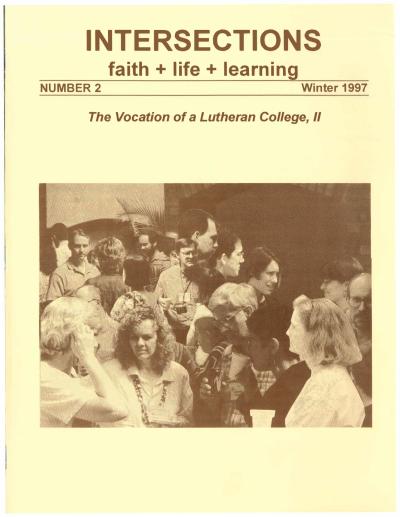
Tipson, President of Wittenberg University, locates Wittenberg in the “American” strain of Ohio Lutheranism founded in 1845 under Ezra Keller (a Pennsylvania College and Gettysburg Seminary graduate and disciple of Samuel Simon Schmucker), with English-language preaching, financial support from the pan-Protestant New England Society, Presbyterians on the Board, and an Episcopalian teaching Latin. He names two ongoing challenges—remaining authentically Lutheran while welcoming a pluralistic student body (just under a quarter are Lutheran in a primary service area that is 5% Lutheran), and making the tradition clear and compelling to non-Lutheran or lukewarm Lutheran students—and presents the five things every Wittenberg graduate should be able to do (respond to the human condition; recognize, define, and solve problems; develop a sense of vocation; assume servant-leadership; take moral responsibility) as authentic expressions of the Gospel and of the university’s ELCA relationship.
-
 Article
The Promise and Peril of the Interfaith Classroom
Matthew Maruggi
No. 44 · Fall 2016
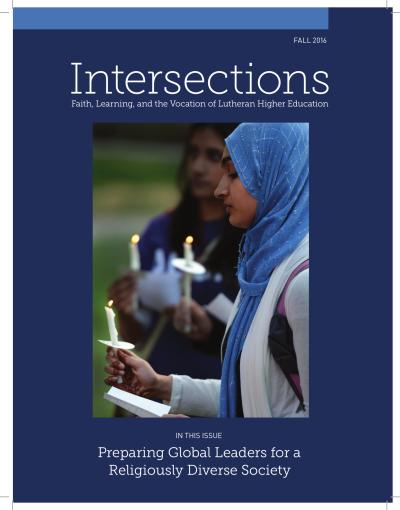
Maruggi draws on his years teaching in the Augsburg religion department to identify three pairs of seeming opposites — dialogue and debate, safety and risk, commonality and particularity — that, held in creative tension, nurture a vibrant interfaith classroom where pluralism is actively engaged rather than merely present.
-
 Article
It's Time to Rewrite the Rules of Civility
Jon Micheels Leiseth
No. 48 · Fall 2018
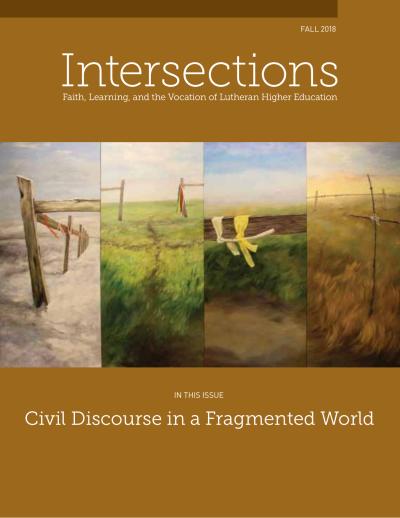
Leiseth contends that the prevailing rules of civility too often function as the majority’s rules, stifling those facing real harm — and proposes that NECU institutions rewrite civility as “neighboring,” guided by the ELCA’s five values of accompaniment: mutuality, inclusivity, empowerment, sustainability, and vulnerability.
-
 Editorial
From the Publisher
Arne Selbyg
No. 8 · Winter 2000
Selbyg reflects on the origins of Intersections—begun out of concern that the philosophy and theology behind Lutheran higher education could be lost to retirements and other preoccupations—and credits Paul Dovre of Concordia and Robert Sorensen of the ELCA Division for Higher Education and Schools as key figures behind the resumption of the debate. He points to three recent books (Ernest Simmons’s Lutheran Higher Education, Paul Contino and David Morgan’s The Lutheran Reader, and Pamela Schwandt’s Called to Serve) and to the new Lutheran Academy for Scholars in Higher Education, and previews the next “Vocation of a Lutheran College” conference at Dana College in August on what differentiates Lutheran colleges within American higher education.
-
 Book Review
Learning Across Campus: Hearing Bok's Call to Conversation
David Ratke
No. 39 · Spring 2014
Ratke reads Derek Bok’s Our Underachieving Colleges from Lenoir-Rhyne and argues that Bok’s call to think holistically about undergraduate education and to dialogue across disciplinary boundaries names the work already underway at ELCA colleges. He weighs faculty attitudes, the role of skills in the core curriculum and the major, and the importance of the extracurriculum for student formation.
-
 Editorial
From the Publisher
Arne Selbyg
No. 6 · Winter 1999
Selbyg reports on the work of the Division of Higher Education and Schools to focus what makes Lutheran colleges and universities distinctive, recaps the 1998 Vocation of a Lutheran College conference at Wittenberg, previews the 1999 Susquehanna conference on “Identity and Fragmentation: Can the Lutheran Center hold?” (inspired by Yeats’s vision of the Second Coming), commends Ernest Simmons’s Lutheran Higher Education: An Introduction for Faculty (Augsburg Fortress, 1998), and announces a new NEH/NSF-style initiative called “The Lutheran Academy of Scholars in Higher Education.”
-
 Article
Building a Third Space in the Age of AI: A Conversation with Dr. Walter Earl Fluker
Elizabeth Kubek
No. 62 · Fall 2025
11 min audio
Prompted by AI chatbots being marketed to students as a safer alternative to messy human relationships, Kubek interviews Fluker on how Howard Thurman’s vision of common consciousness, somaesthetics, and nature-rooted learning offers educators a “third space” alternative to AI’s hall of mirrors.