Let Me Tell You a Story…
One of the stories my family tells is about my mother as a young girl on a family outing. The only thing I know about this outing is that my mom was bitten by a Canada goose (Branta canadensis). Technically, since geese don’t have teeth, the story may be slightly exaggerated. In defense of the goose, it is likely that there were goslings nearby, and they were simply trying to protect them. However, my mom’s encounter left an impression. Although there are no physical scars, the impact has been mythic in scope because it has served as a warning for two generations: Do not get too close to a Canada goose!
Both my older son and I had learned this lesson at my mother’s knee. It echoed in our collective memory as my younger son skipped curiously into an approaching flock of Canada geese.
We were at the Peggy Notebaert nature museum on Chicago’s north side. On this particular August day, it was hot—as in, 100-degree heat index hot. And this was the day that the battery of the car died in the parking lot of the Peggy Notebaert nature museum.
My younger son and I were there to pick up my older son from nature camp. We chose this camp because its gives its campers an all-access pass to the great north lawn, the North Pond nature sanctuary, and the award-winning nature museum. The lawn, pond, and museum are part of Lincoln Park, an expanse of more than 1200 acres of green space in an expensive real estate market on the city’s north side. Along with the lakefront, Lincoln Park is a showcase for the vision of Chicago as “Urbs in Horto”—“City in a Garden.”
The campers had spent the day running on the lawn, meeting snakes and turtles, and digging holes. When we arrived at the museum, we expected some tales about these adventures before the talk turned to baseball and our camper dove his nose into a book for the drive home. Instead, the kids were buckled into a sweltering car, as two separate sets of kind neighbor-strangers tried to get us jump-started.
To no avail.
Sweaty kids poured out of the car to find some refuge in the shade under the leafy oak trees and whatever cooler Lake Michigan breezes could be found. They wanted to kick off their sandals and run in the grass, but ubiquitous goose poop prevented it.
This is the scene. I am negotiating the dead battery, the connection with the tow truck driver, overheated kids, and my own rising anxiety. This is when my younger son wanders wide eyed toward the flock of Canada geese. Because my older son knows my mom’s childhood story, he believes his brother is headed toward certain death.
I think we have a little more time, but that moment of decision is visceral. I remember standing beside the parking lot in between the prickly, shrubby roses as this moment of decision stretched out before me. Do I rush in and swoop him out of the approaching flock? Or, do I let him explore a little longer?
It’s in this stretched-out moment of time that I realize how little I know about these birds. I have no idea what the real risks are in this situation. Will they really bite? If they do, I mean, what kind of damage are we talking about? Do they have diseases? If they do, can they be passed on to humans? Faced with this chasm of unknowing, I simply call: “Please stay close.”
What are the stories that we want to tell—and tell our children—about nature in the city?
Once all the children and car seats and I were buckled into an air-conditioned car with a ridiculously kind and patient Uber driver, I recognized how much of that drama was enacted because of the story I had learned about my mom being bitten by a goose. In that moment, a new moment of decision emerged.
What are the stories that we want to tell—and tell our children—about nature in the city? How will our family retell this story of our encounter with Canada geese at North Pond? How do we keep our kids and ourselves safe enough and yet cultivate the curiosity that roots them deeply into a place that is infinitely wondrous, but often invisible? These questions apply acutely in the city, and they extend into rural and suburban communities alike.
Theological Context
How can the stories we tell about the city open up both to the nature we find there and to the God who finds us there? These questions participate in the long theological history that claims that the Book of Nature can be read alongside the Book of Scripture as God’s self-revelation to us. This is sometimes called the “two books metaphor” in Christian theological history. It claims that both the Book of Scripture and the Book of Nature can be read by faithful Christians. It affirms that both Scripture and Nature can teach us about the God confessed, taught, and preached in the scriptures. It recognizes that both the Book of Scripture and the Book of Nature are authored by the same Creator God.
Lutherans have a long history of swimming in this theological stream. We will see two examples in the following sections. The first comes from a late sixteenth-century German Lutheran pastor. The second comes from the writings of Philip Melanchthon. Neither approach is sufficient. Yet, they attest to the importance of theologically robust, empirically grounded visions of nature in the Lutheran heritage. Grounded in this heritage, we can tell new stories about urban nature that inspire connection to creation and the Creator in the city.
First Reading: Moral of the Story
Kathleen Crowther surveys some writings from Reformation-era German Lutheran pastors. Although they are lesser known today, they were widely read in their own time (Crowther 21). In these authors, she finds evidence of a Lutheran reading of the Book of Nature. One example is Konrad Rosbach, born in 1535, a German Lutheran pastor near Frankfurt.
In his text, Paradise Garden, published in 1588, he describes the flowering herb, Devil’s Bite. The description includes biological features: e.g., it blooms in May and should be gathered then. It includes medicinal uses: Rosbach claims it can be used against poison and plague, and to heal sores (Crowther 29-30). Then, finally, in an allegorical reading, Rosbach gives the spiritual meaning. The root of Devil’s Bite seems to have been bitten off just as humans are cut off from the grace of God. And yet, the same little plant also reminds of the promise of Christ because it is a healing herb. Rosbach reads the natural history of plants and animals to teach a lesson.
They echo of the more familiar genre of Aesop’s fables. In these fables, natural objects (usually animals) are used to teach a lesson. Consider the surprise ending of a race where the constancy of the tortoise wins over the raw speed of the hare. The moral of the story? “Slow and steady wins the race.”
It’s like Rosbach’s reading of the Book of Nature: “Even a small flowering herb points to Christ.” The moral of Rosbach’s story is that God’s promise extends to sinners; Devil’s Bite is both poison and cure just as we are saint and sinner. And, yet, because of God’s promise of salvation in Christ, poison and sinner shall find a remedy and a savior. Rosbach, unlike the fables, adds biological, medical, and natural history to the telling of the tale, but in both cases the story is meant to teach a lesson.
Rosbach’s reading of the Book of Nature: ‘Even a small flowering herb points to Christ.’
In Rosbach’s context, the theological lesson isn’t the only thing he wishes to convey. The message is simultaneously a work of polemics. When Rosbach instrumentalizes the little herb, Devil’s Bite, for his moral reading of the Book of Nature, he simultaneously, and not so subtlety in the Reformation context, employs nature to distinguish itself from Reformed and Catholic alternatives. The Book of Nature is read as being distinctly Lutheran. Consider how effective this might be as a polemical strategy: according to Rosbach, even Nature confirms that the Lutherans got it right.
This way of reading the Book of Nature could be applied to the Canada geese. In the 1950s, this species was nearly wiped out in North America. Overhunting and declining habitats and waterways brought the number of geese dangerously close to extinction. Canada geese nearly went the way of the Passenger Pigeon, which marked the centenary of its extinction in 2014. In contrast, as a conversation status, Canada geese are in the category of least concern.
The moral of the story? From the impossible and improbable, God brings new life. Canada geese have been restored—abundantly to North America. They could be read as a reminder that in God, even death can be overcome. In the face of extinction, life abundant remains possible through God’s promise of salvation in Christ.
If you’re like my students, this reading is utterly unpersuasive. Rather than being spiritually edifying or theologically formative, it raises suspicions about the inappropriate co-opting of nature to do the work of polemics. The situation has shifted from a polemical need to distinguish oneself from other Protestants and Catholics to being able to live well together on an increasingly urban planet. These “moral of the story” style readings don’t help with this. Are there other ways to read the Book of Nature that can ignite our spiritual imaginations to make meaningful lives in our urban homes?
Second Reading: Laying Down the Law
A second reading is not sufficient either, but it highlights the Lutheran legacy of yoking emerging scientific developments and theology. Philip Melanchthon, like the Lutheran pastors that came after him, read the Book of Nature as expressing distinctively Lutheran themes. Given his formative place in the development of the Lutheran Confessions, this is not surprising. However, unlike the moral reading of the Book of Nature described above, Melanchthon read the Book of Nature to “lay down the Law.” Whereas authors like Rosbach took up individual natural objects to teach a theological or spiritual lesson, Melanchthon drew on advances in anatomy and astronomy in order to reveal both the providential presence of the Creator God in humans and humanity’s fallenness.
In Melanchthon’s Commentarius de anima, human anatomy as described by Galen (130-200 CE) and updated by Vesal (1514-1564) helps explain the human condition after the Fall. For Melanchthon, contemporary anatomy and physiology have a role in describing the human condition as both disordered and yet situated in a providentially organized creation, which is dependent on divine grace (Kusukawa 60). One does not get the good news of the Gospel from reading the Book of Nature alone, but reading the Book of Nature was essential (Helm 61). Sachiko Kusukawa describes Melanchthon’s contributions as nothing short of a transformation of natural philosophy, one that incorporates anatomy—and also some astronomy—as necessary aspects of the theological formation. In Melanchthon’s hands, a distinctly Lutheran kind of natural philosophy emerges as a way to read the Book of Nature (Kusukawa 114).
What does any of this have to do with the North Pond Canada geese in the opening story? In the style of Melanchthon, we might take up, for example, urban ecology or population genetics to read the Book of Nature as a story of ecological complexity and adaptation. These emerging ecological sciences could be marshaled to reveal a complex, connected world that is increasingly crafted by humans and not surprisingly—oh, so, fallen. With this lens, the opening story about the Canada goose reveals the mirror of the law. This isn’t a story that ends with species being saved from the brink of extinction, as in the first “moral of the story” reading. No, when humans are at the helm without the grace of God, what you get is overpopulation and crap on your shoes. Instead of a creature of God, geese are pests. Like anatomy in the hands of Melanchthon, ecology could be used to read the story as laying down the law and thus grounding a theological anthropology of justification by grace through faith alone.
If not through teaching moral lessons or laying down the Law, how can the Lutheran gift of robust readings of the Book of Nature be re-gifted for an urban planet?
My attempts to tell the story of our Canada goose encounter through the lens of these two Reformation strategies was an attempt to make Rosbach’s and Melanchthon’s approach more familiar and plausible. It sets a course for unfolding the gift of Lutheran natural history. If not through teaching moral lessons or laying down the Law, how can the Lutheran gift of robust readings of the Book of Nature be re-gifted for an urban planet?
Reading Glasses
Let’s stay with our “Book of Nature” metaphor. In order to read a book, one needs the right tools for the job. One needs to know the alphabet, phonics, grammar, idioms, and some sensory means of access to the words: eyes or ears or touch. In addition, some of us need additional assistance—like reading glasses. In this section, I will argue that Lutheran sacramental theology provides a helpful lens to see the Book of Nature. Lutheran theology is like a pair of glasses for reading the Book of Nature.
Time-lapse photography gives a clear example of what I’m after. Take, for instance, Louie Schwartzberg’s National Geographic film, Mysteries of the Unseen World. Schwartzberg uses technology to see aspects of the natural world that escape our notice. For him, film operates as reading glasses for the Book of Nature. Because humans are mid-sized creatures in a universe that is bigger, smaller, faster, and slower than us, we simply do not have access to parts of the universe without some technology such as film. By using film, aspects of nature open up to us. It is not as though the filming created the aspect—it simply revealed it. This is the sense I intend for Lutheran theology as reading glasses that reveals aspects of the Book of Nature to us.
Paul Santmire’s spiritual practice of praying the Trinity Prayer has a similar function. Santmire regularly prays: “Lord Jesus Christ, have mercy on me. Praise Father, Son, and Holy Spirit. Come Holy Spirit, Come and Reign.” His practice of praying this prayer has molded his “Lutheran-colored reading glasses,” and it changes what and how he sees—especially, for instance, when he takes to his field with his scythe. He writes:
It’s not simply a matter of going out to the field to “commune with nature.” When I arrive in the backfield with my scythe, the eyes of my faith have already been opened by the use of the Trinity Prayer, so that I can then see more readily what is given me to see. The Trinity Prayer is for me, in this spiritual sense, before nature… The Trinity Prayer gives me the insight that allows me to see with new eyes. (Santmire 31)
The Trinity prayer is “before nature” as a pair of reading glasses for Santmire; film is “before nature” as a pair of “reading glasses” for Schwartzberg. For me, the sacramental principle that the finite is capable of the infinite is “before nature.” It’s the theological principle that functions like a pair of reading glasses to make visible the often invisible Book of Nature in the city.
Martin Luther had a spirituality of everyday things. One of the theological centers of Lutheran theology is the sacramental principle that the finite is capable of the infinite. In the Reformation, this claim was hotly contested.
The issue is the status of the bread and wine in the sacrament of communion and how Christ is present. Reformation debates pitted Zwingli and his followers against Luther and his. The former claimed that Christ was present in the memory of Christ’s redemptive works; the latter claimed that Christ was really and truly present in, with, and under the bread and the wine. In other words, for Zwingli, “finitum non capax infiniti.” The finite is not capable of the infinite. The bread and wine of communion have a symbolic function. They point to the redemptive work of Christ, but Christ is not truly present in the bread and wine. They remind us of our forgiveness through Christ. Christ is present in our remembrance of his sacrifice, but Christ is not truly present.
For me, the sacramental principle that the finite is capable of the infinite is the theological principle that functions like a pair of reading glasses to make visible the often invisible Book of Nature in the city.
In contrast, Luther claimed, “finitum capax infiniti.” The finite is capable of the infinite. What does this mean? In Luther’s Small Catechism, the Sacrament of the Altar is described as follows: “It is the true body and blood of our Lord Jesus Christ under the bread and wine, instituted by Christ himself for us Christians to eat and drink” (Luther 362). Understood as such, Luther claimed that life, salvation, and the forgiveness of sins are given to those who believe the promise that bread and wine were “given for you.” This is possible because God keeps the promise to be really and truly present in the bread and wine of communion.
When I talk with folks about this urban nature project, the idea that the finite can hold the infinite gets traction in the conversation even where a translation to sacramental language does not. Everyday connections to the sacred are grounded in God’s promises that it is possible for the sacred to be present in, with, and under ordinary, everyday things like bread and wine and water. As a place to start conversations about nature in the city, a spirituality of everyday things resonates. There is space to bring a gift of Lutheran sacramental theology as reading glasses for other city dwellers to see and name the infinite when it shows up in these unexpected places. It grounds the hope that the sacred can be surprisingly present—even in things like Canada geese.
Take care here. The claim is not that geese are sacraments like the bread and wine of communion. It is rather the claim that nature is sacramental, like music, for instance. Music, while not a sacrament, is sacramental insofar as it is a finite thing capable of the infinite (Hendel 432). It can carry spiritual messages, work as a catechetical resource, and sing, “Soli Deo Gloria!”
An everyday, sacramental spirituality is an aspect of the Reformation legacy that can help reform our visions of nature so that the Book of Nature can be read in the city. But, the proof, finally, is in the stories these reading glasses allow us to tell. When I read the Book of Urban Nature, it is not only with unearned privileges that I have as a heterosexual, upper-middle class, white woman. I also go in with the eyes and ears of a Lutheran. One of the things that this Lutheran lens has given me is the practice of meeting the world and the creatures in it—human and non-human—with an unshakable sense that there is always something more going on than what is immediately presented: the finite is always capable of the infinite.
These “reading glasses” created the space for that visceral moment of pause as my son ran toward the geese. I didn’t simply rush in to save my son from the geese because I read that scene through glasses that keep me open to the possibility that something more might be there—just beyond what I can readily see. It’s a practice of staying open to the many stories of the Book of Urban Nature, and of finally being moved to act once they’ve been recognized.
Third Reading: #FlocktheSystem with #Hope and #FaithActiveinLove
Our story of the geese on North Pond didn’t end after the Uber ride on that hot August day. Not long after our run-in with the geese, I was back at North Pond, sitting on a bench under a burr oak tree. The whole reason I was at the pond that day was because of the goose encounter with my kids. In that visceral pause and the realization that I knew nothing about these geese-creatures of God, I did a little research trying to figure out the ecology of this place. One of the things I learned was that North Pond—despite being home to all these birds and prairie plants and turtles and snakes, and probably coyotes—was only four feet deep, and potable city water was being used to keep it at that level. The pond was over 130 years old and aging quickly.
We need stories like these infused with the infinity principle to see the nature of our cities and to build hope-filled visions of vital cities for the future. Stories are ways to build a flock; the right stories can #FlocktheSystem with #Hope and #FaithActiveinLove. That’s why this theological educator/scholar is now blogging at www.wildsparrows.com. It’s one more way to try to read the Book of Urban Nature and share its stories. It’s Lutheran natural history for an urban planet.
Just in case this all smacks of a little too much Walden Pond romanticism, let me say in closing that these glasses are to be worn in places that are much worse off than North Pond. Take, for instance, Hegewisch Marsh. It’s another urban wetland, but instead of being next to preserved ponds, a zoo, a treasured urban park, and a nature museum, this one is situated in the industrial corridor of Southeast Chicago’s steel industry—or what’s left of it. A discontinued landfill, an active railway, and a Ford Automotive Plant surround Hegewisch Marsh. The Marsh itself has been resuscitated from the landfill runoff, contaminated soils, and past use as a recreation area for all-terrain vehicles. It is home to an array of birds and turtles and frogs but it doesn’t fit the story of pristine wilderness. The vernal ponds where the frogs live were cut into the land by those recreational vehicles. The sounds of the wind and the birds are punctuated by the noise of trains, cars, industrial horns, and air traffic. It would be easy to write off these chapters of the Book of Urban Nature, but the possibility of the infinite is here too.
Nature in the city needs a chorus of voices telling its stories, asking questions such as: How has this space been crafted? From whom was it taken? What stories haven’t been told about it? With Lutheran natural history reading glasses we can tell stories that describe the place as it is, and at the same time, open up to the sacred that may lie hidden within. If this is right, then the conclusion of this essay is an invitation to join the flock and tell these stories. The last words are not “The End” but rather the start of your own story of nature. If you’re not sure where to start, let me suggest an opening that usually works at our house. It begins, “Let me tell you a story…”
End Notes
1. I had the pleasure of presenting a version of this lecture at the Lilly Fellows Program National Conference at Augsburg College on October 15, 2016. Thanks to the participants for thoughtful questions. Thanks also to the University of Chicago Enhancing Life Project and the Lutheran School of Theology at Chicago for support to pursue this research. For more essays like this, please join the mailing list at www.wildsparrows.com, and watch for the monograph in progress.
Works Cited
City of Chicago. “City of Chicago: Facts and Statistics.” Accessed 1 October 2017, https://www.cityofchicago.org/city/en/about/facts.html
Crowther, Kathleen. “The Lutheran Book of Nature.” In The Book of Nature and Humanity in the Middle Ages and the Renaissance, eds. David Hawkes and Richard G. Newhauser. Turnhout: Brepols, 2013.
Helm, Jurgen. “Religion and Medicine: Anatomical Education at Wittenberg and Ingolstadt.” In Religious Confessions and the Sciences in the Sixteenth Century, eds. Jurgen Helm and Annette Winkelmann, Leiden: E.J. Brill, 2001.
Hendel, Kurt. “Finitum capax infiniti: Luther’s Radical Incarnational Perspective.” Currents in Theology and Mission, 35.6 (2008): 420-33.
Kusukawa, Sachiko. The Transformation of Natural Philosophy: The Case of Philip Melanchthon. Cambridge: Cambridge University Press, 1995.
Luther, Martin. “The Small Catechism.” In The Book of Concord: The Confessions of the Evangelical Lutheran Church, eds. Robert Kolb and Timothy J. Wengert. Minneapolis: Fortress, 2000.
Santmire, Paul H. Before Nature: A Christian Spirituality. Minneapolis: Fortress, 2014.
United Nations. “World’s Population Increasingly Urban with More Than Half Living in Urban Areas,” Accessed 1 October 2017, http://www.un.org/en/development/desa/news/population/world-urbanization-prospects-
-
 Editorial
From the Publisher
Mark Wilhelm
Wilhelm reflects on how NECU’s focused work on Lutheran identity in higher education — including the forthcoming document Rooted and Open: Our Common Institutional Calling — turns out to be a fitting commemoration of the five-hundredth anniversary of the Lutheran Reformation, even though it did not arise from anniversary planning.
-
Editorial
From the Editor
Jason A. Mahn
Mahn returns to Luther’s opening thesis on whole-life repentance to argue that the deepest critique of the indulgence economy — and of our own American meritocracy — is the very assumption that grace and human striving can be measured, exchanged, and earned.
-
Article
Why Martin Luther and the Reformation Matter 500 Years Later
Kathryn A. Kleinhans
Adapted from a 2017 address to Wartburg College’s entering class, Kleinhans surveys Luther’s lasting impact in vocation, education, social service, and the necessary work of repentance — closing with the Lutheran World Federation’s Windhoek assembly and the Reformation World Exhibition’s call to live reform forward into the next 500 years.
-
Article
Celebrating the Reformation: The Lutheran Foundation of a Called Life
Mark D. Tranvik
Tranvik traces vocation from the monastic impulse through Luther’s rejection of the monk’s vow as the only true calling, and translates the “called life” for twenty-first-century Lutheran colleges — institutions that see students as made in the image of God, enlist the whole community in discernment, and make room for faith and its convictions.
-
Article
Both Priest and Beggar: Luther among the Poor
Martha E. Stortz
Reading Luther’s deathbed remark “We are all beggars” against his “priesthood of all believers,” Stortz argues that priest and beggar are two sides of a human reality — one that locates civic responsibility for the poor at the heart of the Reformation legacy and that pushes beyond paternalistic service toward the systemic question of justice.
-
Article
In the Beginning of the Reformation Was the Word
George Connell
Drawing on a Concordia faculty pilgrimage to German Luther sites, Connell appropriates John’s prologue to frame the Reformation as a movement about words — the printed page, the university classroom, the Marburg confession, the Wartburg translation, Bach’s music, and the dining-room conversations of Table Talk — while soberly noting that words can wound as well as heal.
-
Article
Luther's Sutra: An Indian, Subaltern (Dalit) Perspective
Surekha Nelavala
Nelavala traces how Luther’s “sutra” — grace alone, faith alone, scripture alone, Christ alone — reached the mud hut of her Dalit grandparents in rural India, transforming three generations, and then reads the parable of the vineyard laborers from a subaltern perspective in which grace for all is the heart of God’s alternative kingdom.
-
Article
Reforming Lutheran Higher Education: Ecclesiological Reflection and Theological Leadership
Brian Beckstrom
Beckstrom diagnoses an “identity crisis” at ELCA colleges and universities rooted in inherited Enlightenment assumptions and a thin functional ecclesiology, and proposes that a Trinitarian, perichoretic understanding of God offers an ecclesiological foundation that holds together unity and diversity in a pluralistic, post-Christian context.
-
 Article
Take Heart: Is Neutrality Really What We Need Right Now?
Abbylynn Helgevold
No. 57 · Spring 2023
Helgevold, an ethicist at Wartburg College, argues that calls for faculty neutrality on abortion in the post-Roe classroom stifle the courageous conversations Lutheran higher education is uniquely positioned to host — conversations grounded in “Rooted and Open” and the ELCA’s 1991 Social Statement on Abortion.
-
 Article
Climate Justice, Environmental Racism, and a Lutheran Moral Vision
Cynthia Moe-Lobeda
No. 36 · Fall 2012
Moe-Lobeda argues that the vocation of a Lutheran college is to prepare students for Thomas Berry’s “great work”: forging a sustainable relationship between the human species and the planet while diminishing the gap between those who have too much and those who have not enough. She develops a three-fold “moral vision” rooted in Luther’s theology of the cross—seeing what is (climate injustice and environmental racism for what they are), seeing more just and sustainable alternatives, and seeing God’s saving presence at work—and offers it as a distinctive Lutheran contribution to the panhuman and interfaith challenge of our day.
-
 Editorial
From the Publisher
Mark Wilhelm
No. 40 · Fall 2014
Wilhelm draws a parallel between the rediscovery of vocation and the rediscovery of interfaith understanding in Lutheran higher education, arguing that previously under-emphasized aspects of the Lutheran tradition point us to interfaith work and that an authentic Lutheran college or university will make interfaith understanding a feature of its mission.
-
 Editorial
From the Editor
Jason A. Mahn
No. 43 · Spring 2016
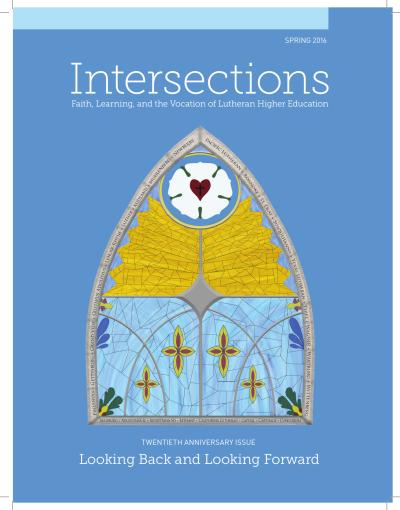
Mahn introduces the twentieth anniversary issue of Intersections, recalling its 1996 birth at Capital University “in the twinkle of an idea” in the mind of founding editor Tom Christenson, and previewing essays by Wilhelm, Amamoto, Kleinhans, Glass Perez, and Simmons that together look back at twenty years of the journal and forward to its work in the decades to come.
-
 Article
Lutheran Identity, Academic Integrity, and Religious Diversity
Storm Bailey
No. 25 · Spring 2007
Bailey argues that one might rightly say of a college “that’s a pretty good school because it’s religious,” defending the proposition under three headings: academic and curricular virtues, free inquiry, and religious diversity. Drawing on Mark Schwehn’s Exiles from Eden, Richard Hughes on the Lutheran tradition’s “most potent theological resources” for the life of the mind, Parker Palmer, Lendol Calder, Mill’s On Liberty, Newman’s Idea of a University, and the AAUP’s 1940 Statement, he proposes a “critical mass” alternative in which the Lutheran commitment to truth-seeking and self-critique itself requires—rather than tolerates—a religiously diverse faculty whose opposing voices are needed for the mission to flourish.
-
 Article
Practicing Hope: The Charisms of Lutheran Higher Education
Martha E. Stortz
No. 32 · Spring 2010
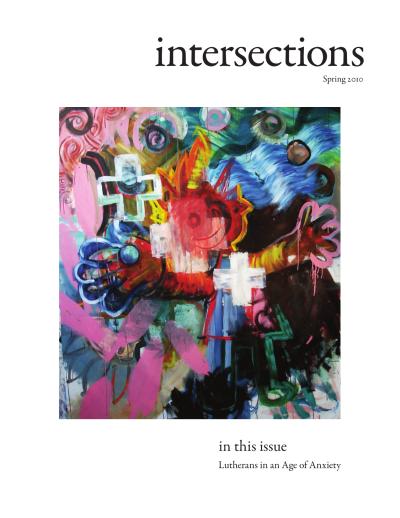
Stortz names four charisms—theological gifts of identity rather than commodities—that Lutheran higher education brings to a culture of fear: semper reformanda as flexible, responsive institutions; the freedom of a Christian as simul justus et peccator critical inquiry that holds opposites in creative tension; regard for the other as “neighbor” rather than friend or alien; and the priesthood of all believers as a public, civic calling to know the poor. Drawing on Augustine, George Lindbeck, Patricia Killen, James Clifford, Earl Shorris, Carter Lindberg, and Augsburg’s Center for Global Education, she argues that immersion trips, neighbor-regard, and welfare reform witness that the gift Lutherans bring is hope grounded in Christ in you, the hope of glory.