Last spring, USA TODAY reported on a venture that it was taking on alongside the world’s great coffee company:
Starbucks, in partnership with USA TODAY, is about to tackle the issue of race in America.
This week, baristas at 12,000 Starbucks locations nationally will try to spark customer conversation on the topic of race by writing two words on customer cups: Race Together. Also, a special “Race Together” newspaper supplement, co-authored by Starbucks and USA TODAY, will appear in USA TODAY print editions beginning Friday, March 20. It also will be distributed at Starbucks stores.
Starbucks CEO Howard Schultz is on a mission to encourage Starbucks customers and employees to discuss race, under the firm belief that it’s a critical first step toward confronting—and solving—racial issues as a nation. It is scheduled to be a key topic at the java giant’s annual meeting on Wednesday.
“Racial diversity is the story of America, our triumphs as well as our faults,” says the opening letter to the eight-page supplement and conversation guide, signed by Schultz and Larry Kramer, president and publisher of USA TODAY. “Yet racial inequality is not a topic we readily discuss. It’s time to start.” (Horowitz)
Only three days later, The New York Times ran a very different story about the same topic:
Howard D. Schultz, the chief executive of Starbucks, said in a letter to employees on Sunday that baristas would no longer be encouraged to write the phrase “Race Together” on customers’ coffee cups, drawing to a close a widely derided component of the company’s plan to promote a discussion on racial issues.
“While there has been criticism of the initiative — and I know this hasn’t been easy for any of you—let me assure you that we didn’t expect universal praise,” Mr. Schultz wrote. (Somaiya)
Well, so much for that.
As someone who strives to work for the common good, but also enjoys the humor of everyday life, the Starbucks example tears at me. Ultimately, I have to appreciate the daring naivety with which the company surged into the stormy waters of race relations in America with the bold energy of a freshly brewed cup of Pike Place Roast. If you’re going to get involved with Grande-sized conversations about the common good, aren’t you going to need to be ready to err boldly? To look like a fool?
Missional Commitments
When we work for a goal as big as the “common good,” don’t we risk looking like those suits in the Starbucks boardroom drawing up the “Race Together” game plan? In hindsight, I’m sure the Starbucks folks can see how naive they were. What they thought was a good idea was certainly bold, certainly unconventional.
How many ways have we on college campuses felt totally abandoned by others on our quest to serve the common good? How many RSVPs have gone unfulfilled? How many campus conversations ended with doors slamming? How many times have we been left at the interfaith altar, having planned a grand feast for hundreds of folks who never showed up? Think of all the programming funds and speaker fees wasted!
And yet meeting these challenges head-on is why I have enjoyed teaching at a liberal arts college, and especially why I love teaching at an ELCA school. We take the education of the whole person seriously. Moreover, I have used the concept of vocation to articulate why my scholarship and research matter as academic exercises, and why it is vital that the university support my quest for knowledge. In this way, I get to model for my students what my interpretation of the “life of the mind” looks like. Reminding myself that I am modeling this for them helps me take care to be responsible to my own self-care and cultivate my curiosity.
I plug vocation into the “common good” in a few different ways as a professor in an ELCA Religion department. For us at Cal Lutheran, our commitment to Interfaith Cooperation is something that emerges out of our Lutheran identity. In my first-year Religion class, we read the memoir of Interfaith Youth Core founder Eboo Patel, called Acts of Faith. Using this book as a model, we connect it to our own lives by delving into a genre of writing spiritual autobiographies. It requires students to imagine the story that they have and bring to the study of religion, and to their interactions with other folks who orient around faith differently than they do.
The Vocation of the Lutheran College Conference itself embodies the missional commitment that ELCA institutions have to this quest. I have recently learned that the Second World War helped to raise awareness that Lutherans engaged in a kind of ethnic separatism in the American context. I have been told that the ELCA hosts the Vocation of a Lutheran Conference to investigate and invigorate the church’s shared identity and mission. I hear often that “serving the neighbor” is the Lutheran “calling”. One way the ELCA accomplishes this services is to make opportunities for excellent higher education available to a broad constituency. Creating leaders for a global society, developing whole persons, and being responsible servants to a complex world are part and parcel of what we do. Our mission and identity statements remind us where we are headed and why we do our jobs.
Lines of Difference and the Common Good
But on particularly difficult days, often deep into the semester, these missional commitments can taunt us like the naive smiles of well-meaning baristas. This is to be expected, because working for the common good is messy. You might muck it up. It might require you to be vulnerable and to put more on the line than you thought you signed up for.
Somehow, in the midst of those moments of vertigo from the whirlwind of vulnerability, we have to remind each other that work for the common good is common to us all. We have to stop playing hero-ball and remember to pass. We can lean back against solidarity and collegiality.
“These missional commitments can taunt us like the naive smiles of well-meaning baristas. This is to be expected, because working for the common good is messy.”
Donors may call in to endowment offices to complain that the Religion Department is full of non-Lutherans, or that interfaith understanding is watering down a proper Christian ethos. But as I take on the mantle of vocation, such stakeholders have to contend with the truth in the following aphorism: “If you want to go fast, go alone. If you want to go far, go together.”1
We need to go far, and we need to be in this together, across lines of difference. Just from recent news, here is a rudimentary list of issues staring the common good in the face right now: race relations in America; mass incarceration (who gets incarcerated, for what, and how long?); women in science; responsibilities of nations to people forced to leave their homelands; nuclear proliferation; border disputes; mental health treatment; the disproportional impacts of global warming on the poor; educational priorities (should we focus on STEM or on reading, writing, and thinking?); and even what we might call “vocational” priorities (should we focus on reading, writing, and thinking and/or on the formation of good people who care about the earth?).
The list could go on. But whatever list one makes, there is no one position on any of these items that fits a “common” understanding of the problem. There are different visions of the common good rooted in differing value systems. What is more, any one particular vision sits at a number of different intersections of our identities. You know these well: race, class, gender, sexual orientation, religion, nationality, partisan affiliation, regional differences, geography, and so forth.
In the search for the common good, we have to resist the rush to conclude that these differences somehow do not matter. They do matter, and very much. All of these aspects of our identities impact how any of us come down on any one issue in relation to the common good. Each of us comes with different gifts, different talents, and different stories. The big news about the common good is that there may be nothing “common” about this “good.” And that’s why striving for “it” is messy. And that’s why our work is necessary.
Re-Storying our Campuses
From Martin Marty’s The One and the Many: America’s Struggle for the Common Good, I learned about the “porcupine’s dilemma,” or “hedgehog’s dilemma,” which is often associated with philosopher Arthur Schopenhauer. A metaphor for civil society, the story tells of the struggle of a group of porcupines that huddle to find warmth on a winter’s day. As they get closer to find warmth, their sharp quills poke one another. This drives them far apart. They try again, and the same happens. After a while of huddling and running away, they find a distance from each other where they could just be warm enough without the danger of getting poked by a neighbor’s quills. Like the porcupines, we social human beings learn to keep our distance from one another, just enough to still enjoy the benefits of social interaction. Some call this “politeness.”
Is this the best we can hope for? Are we to keep just enough distance to not prick each other? That cannot be our highest aspiration. Which is why I love how Marty ends his book with a passage that is as relevant today as in the 1990s when it was written:
The trauma in the body politic, the civil network, the social organism, continues. But in the meantime, and for the sake of a longer future, every story well told, well heard, and creatively enacted will contribute to the common good and make possible the deepening of values, virtues, and conversation. At the outset I described this book as an effort to contribute to the restoration of the body politic, or, with the many groups in view, the bodies politic. We have been speaking throughout of the “re-storying” of the republic and its associations. The advice for every citizen who wishes to participate in American life and its necessary arguments: start associating, telling, hearing, and keep talking. (Marty 225, emphasis added)
Re-storying our campuses is a great opportunity because great stories are particular: they speak to individuals because they speak for individuals. And if stories get told and retold, it’s because there’s something common and human about them. What stories of preparing students to work for the common good would you tell from your campus?
“What stories of preparing students to work for the common good would you tell from your campus?”
Maybe your mind goes first to a certain exceptional student on your campus. Maybe she gets great grades while leading the Amnesty International student club and building houses with Habitat for Humanity on the weekends. Great. Turn your attention also, though, to the blasé student. The one you meet at lunchtime at the cafeteria, who has skipped your class for the day and is digging into all-he-can-eat lucky charms at 1:30 PM in the afternoon in flip flops and flannel pajamas. How do we get him psyched on the common good?
Equipping students on our campuses to struggle for the common good happens in ordinary moments in our offices, classrooms, dorms, cafeterias, and chapels. We cannot take for granted that there is anything common, which is to say ordinary, about the common good. We cannot take for granted that our extraordinary dreams are going to fit into the ordinary aspirations of our Lucky Charms-eating, morning class-skipping students.
I remember the first semester I taught at Cal Lutheran, when a rather forgettable student in my global religions class who was a pastor’s daughter came to me bearing triumphant news. “Dr. Gill, I just wanted to thank you for this class. I was scared about it at first, but it’s made me stronger in my faith.” In the moment, green out of my public and secular graduate school program as I was, I couldn’t comprehend what she could have possibly meant. Frankly, I was miffed! The class wasn’t about “her faith.” It was about religion, globalization, and how to study both. But as I have become more experienced, I understand better what she meant. Whereas once the diversity of worldviews made her fear for her own security in her faith, she had been able to face that diversity in the course, and still loved her own tradition. It was a victory to celebrate.
With both shrewdness and naiveté, let us design experiences that allow students to wake up to the larger question of a shared humanity. Let us design experiences by which our students can come to understand what the common good means to them. To do this, we might even have to be vulnerable enough to abandon some pre-conceived outcomes.
If that seems too daunting to tackle, liberate yourself with one final idea: achieving the common good is not our vocation as faculty, administration, and staff of ELCA colleges and universities. Our vocation simply calls us to invite this generation of students to imagine and realize what their approach to a common good might be.
As I have meditated on these issues, I have found a new vocation: speaking and writing about purpose, meaning, diversity, and pluralism. I now speak on campuses and in workplaces about why we need to engage across boundaries, and how it is actually good for the bottom line. We can better engage the common good (of our organizations, our teams, our businesses) when we reach deep into our own stories and our motivations. Together, we can help create a society that is more engaged with itself, whose members take care of each other as a way to understand one another.
Endnote
1. I am fortunate to be reminded of these words from time to time by my colleague and interfaith expert Dr. Colleen Windham-Hughes.
Works Cited
Horowitz, Bruce. “Starbucks, USA TODAY team to tackle racial issues.” USA Today. 19 March 2015: Money section. Accessed 1 November 2015, http://www.usatoday.com/story/money/2015/03/16/starbucks-fast-food-restaurants-race-relations-usa-today/24851991.
Marty, Martin E. The One and the Many: America’s Struggle for the Common Good. Boston: Harvard University Press, 1998.
Patel, Eboo. Acts of Faith: The Story of an American Muslim, the Struggle for the Soul of a Generation. Boston: Beacon, 2007.
Somaiya, Ravi. “Starbucks Ends Conversation Starters on Race.” New York Times. 22 March 2015: B3. Accessed 1 November 2015, http://www.nytimes.com/2015/03/23/business/media/starbucks-ends-tempestuous-initiative-on-race.html
-
 Editorial
From the Editor
Jason A. Mahn
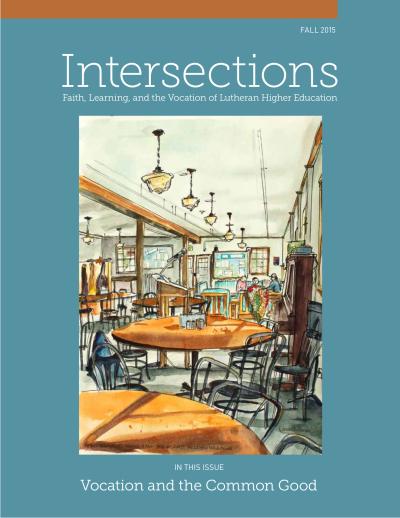
Mahn introduces the “Vocation and the Common Good” issue by asking what is left of “the commons” in an age of privatized goods and education-as-commodity, and frames church-related colleges — with their stubborn vocabulary of “liberal arts,” “collegiate,” and “calling” — as among the least fully-privatized resources left in American life.
-
Article
Vocation and the Common Good
Mark Wilhelm
Wilhelm argues that ELCA colleges and universities are Lutheran not by ethnic culture or institutional checklists but because they stand in a 500-year-old intellectual tradition that educates for vocation. He draws out two insights from that tradition — a common walk of life shared across callings, and a humility about claims to know the good — to ground the schools’ commitment to prepare students for the common good.
-
Article
Making the Common Good Common
René Johnson
Johnson reflects on the Servant Leadership House for women at Finlandia University — from a sweaty trip to the local landfill to weekly habits of campus presence — to argue that the common good becomes truly common when it is embedded in the ordinary details of vocational living, and that Luther’s sense of neighbor calls servant leaders to “little bits of good” as well as to more radical pursuits of justice.
-
Article
"Greed is an Unbelieving Scoundrel": The Common Good as Commitment to Social Justice
Samuel Torvend
Torvend uses his Lutheran Heritage course at Pacific Lutheran University to ask what “the common good” might mean concretely — fresh air, clean water, food, shelter, healthcare — and traces the early Lutheran reform of literacy and social welfare to argue that the first gift of Lutheran education is the capacity to question the status quo and to push beyond charity into the pursuit of social justice.
-
Article
Attentional Commons and the Common Good: Technology and Higher Education
Amy Weldon
Weldon argues that the electronic devices our students (and we) reach for are designed to monetize attention and fragment the very capacities — tolerance for complexity, sustained focus, real conversation — that build lives of meaning and service to the common good. Drawing on Crawford, Lanier, Arendt, and Palmer, she sketches practical tech-mindfulness for the small-college classroom as a defense of the “attentional commons.”
-
Article
Say Something Theological: A Meditation on the Vocation of Lutheran Colleges and Universities to Serve the Common Good
Paul C. Pribbenow
Pribbenow expands Luther’s “priesthood of all believers” into a meditation on doing theology with the Bible in one hand and the New York Times in the other — reading Luke 14 alongside walls, immigration, and hunger in his Minneapolis neighborhood — and argues that the leadership of Lutheran colleges demands a willingness to engage the theological issues at the heart of their public vocation.
-
Article
Women Presidents in Higher Education: How They Experience Their Calling
Aimee Goldschmidt, Gary McLean, Katherine A. Tunheim
Drawing on in-depth interviews with fifteen women college presidents and a transformative-learning-theory framework, Tunheim, McLean, and Goldschmidt trace a three-stage journey — identifying, interpreting, and pursuing the call — and ask what the language of vocation contributes to the preparation and mentoring of women leaders in higher education.
-
 Reflection
I am a Treaty Partner
Kyrie Fairbairn
No. 63 · Spring 2026
7 min audio
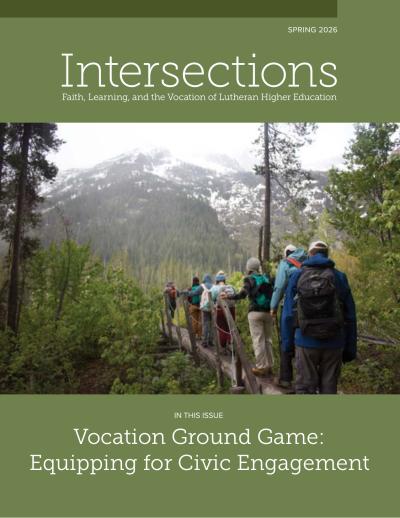
A recent California Lutheran graduate reflects on how a course on Indigenous Rights and Practices, and a conversation with a former Chairman of the Lummi Nation, led her to claim a “treaty partner” identity and to challenge readers to learn the treaties that shape the lands they call home.
-
 Article
Educating for Peace: 21st Century Models for Thinking Globally and Acting Locally
Janet E. Rasmussen
No. 18 · Fall 2003
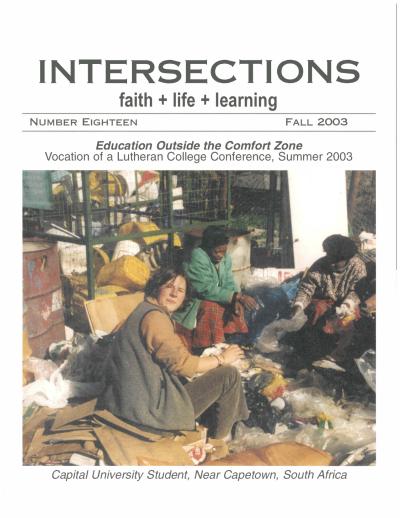
Rasmussen opens with a rabbinic story about the one-step distance between East and West and describes Pacific Lutheran University’s four-phase “Global Education Continuum”—Introductory, Exploratory, Participatory, Integrative—developed with Teagle Foundation support and grounded in Perry, Bennett, and Musil. She illustrates intentional global/local partnership through three case studies: Barbara Temple-Thurston’s Trinidad-and-Salishan initiative; the China Partners Network with the Amity Foundation, Good Samaritan Hospital, and PLU’s Wang Center; and Ann Kelleher’s three-institution “Norway in Namibia” partnership with Hedmark University College, the University of Namibia, NAMAS, and the Ondao mobile schools for the Himba people. She closes with Daloz, Keen, Keen, and Parks’s Common Fire research and Lee Knefelkamp’s call to be “communities of peace.”
-
 Reflection
The Long Pilgrimage of 2020-21
Kara Baylor
No. 52 · Fall 2020
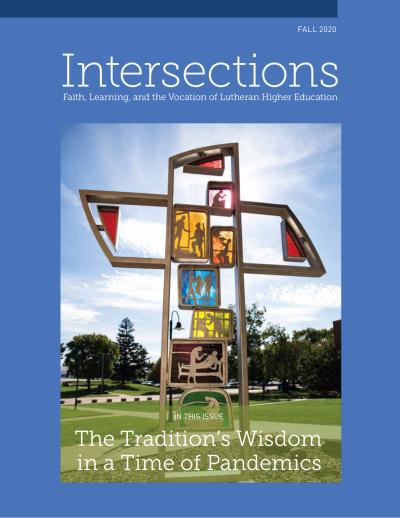
Drawing on Martha Stortz’s definition of pilgrimage as “intentional dislocation, for the sake of transformation, where the body teaches the soul,” Baylor invites students and educators worn out by the 2020-21 academic year to ask what is essential, to listen to what their bodies are telling their souls, and to be more open to the transformations the dislocation might still yield.
-
 Book Review
Old and New Ideas of the Liberal Arts: A Review of Claiming Our Callings
David Crowe, Katie Hanson
No. 41 · Spring 2015
Crowe and Hanson review Claiming Our Callings: Toward a New Understanding of Vocation in the Liberal Arts (Oxford 2014), a collection of thirteen essays by St. Olaf faculty edited by Kaethe Schwehn and L. DeAne Lagerquist. They commend the book’s thoughtful, sincere engagement with consumerism, sustainability, Buddhist meditation, and Lutheran-Bonhoefferian theology — and recommend it for any liberal arts campus pulled between idealistic mission and career-minded pressure.
-
 Article
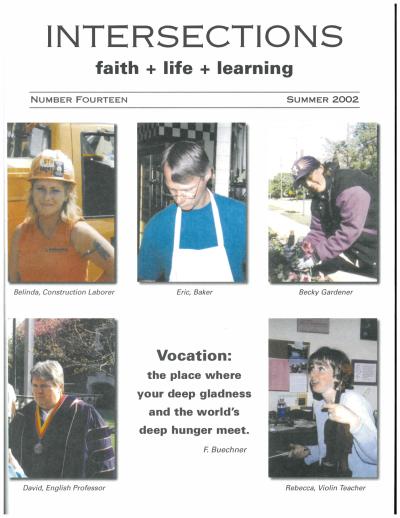
Renewing a Sense of Vocation at Lutheran Colleges and Universities: Insights from a Project at Valparaiso University
Marcia Bunge
No. 14 · Summer 2002
Bunge, director of the process for writing Valparaiso’s nearly two-million-dollar Lilly grant on the Theological Exploration of Vocation, argues that contemporary culture’s reduction of vocation to either paid work or self-fulfillment requires Lutheran institutions to renew attention to a rich theological concept rooted in Luther’s expansion of vocation beyond the priesthood. She outlines eight low-cost “doorways”—caring adults, prayer, worship leadership, music and the arts, service, cross-cultural experience, church camps and wilderness, study and reflection—and describes Valparaiso’s two-program structure: a Campus-Wide Program weaving vocation into Freshman Core Courses and chapel life, and a Church Vocations Program for students considering full-time ministry. She closes with four troubling questions for any institution carrying out such a grant: what faith traditions can learn from one another, how to involve parents, whether faculty and staff have space to reflect on their own vocations, and whether daily institutional practices—family policies, treatment of low-paid staff, environmental responsibility, obligations to the wider community—actually reflect a commitment to love of neighbor.
-
Editorial
From the Editor
Jason A. Mahn
No. 52 · Fall 2020
Mahn narrates a year of crisscrossing pandemics — Covid-19, economic collapse, partisan politics, and the long pandemic of white supremacy revealed anew by the murder of George Floyd — and argues that Lutheran liberal arts schools, by educating for vocation, are uniquely poised to help students respond with character and capable callings.