I usually do not start my articles with autobiography—in fact, this is unique, but I feel it is important to say something about myself to put my remarks in context. I am a third generation Japanese-American who teaches American literature at Gustavus Adolphus College in St. Peter, MN. I am a Buddhist—who regularly attends daily chapel. Although I went to large research institutions for all of my own schooling, I have always wanted to teach at a small liberal arts college and feel the church-relatedness of Gustavus is a bonus. In other words, this is the perspective of a sort of “inside outsider.”
Mark Schwehn began the closing section of his address “The Future of Lutheran Higher Education” by noting:
And so I leave you with tasks rather than predictions, opportunities rather than prescriptions, and large ideas rather than a set of discrete practical and programmatic suggestions. I really do think that the future of our schools will depend less upon material factors and more upon the power of our collective imaginations to refurbish our ideal of the Lutheran college and the Lutheran university for the 21st century.
The pressures of “material factors” are immense as any college president will tell you, as are the pressures toward secularization. However, I would argue that first, church-related colleges are vitally important to our society and second, part of this “refurbishing” needs to consider the issue of diversity. Last, I will examine some of the ways in which Lutheranism or church-relatedness is manifest at Gustavus and some of the pressures surrounding them. Although every school is unique, I suspect the issues at Gustavus are not so different from those at other ELCA colleges and perhaps discussing “discrete practical and programmatic” practices at Gustavus can help spark the dialogues that will help keep these colleges vital—and Lutheran—into the 21st century.
I know from experience that being Buddhist at a Lutheran College has not only taught me more about Lutheranism but has deepened my knowledge of and my faith in my own religion.
I.
In speaking to prospective students and their parents, as I often do, distinguishing between us, a small, liberal arts Lutheran college and large research universities like the ones I attended as a student is easy—smaller classes, bright and accessible professors who care about teaching and students, a friendly atmosphere, greater opportunities to be involved with extracurricular activities. But these attributes do not separate us from what is often our more serious competition: small, secular, liberal arts colleges. Here the obvious difference, perhaps the only difference, is our church-affiliation. I would submit that it is a vital difference.
Perhaps because I am an Americanist, I feel one of the crucial functions of college is to mold good citizens and community leaders. The optimism that the racial situation was improved and that “the people” could change “the system” of my own college years have disappeared. Political, economic, social changes, and the widening gap between haves and have nots have fueled social problems which continue to mount in an atmosphere ever more divisive and volatile. An education that “addresses simultaneously the mind and the spirit” is not just the “most meaningful” as Schwehn argues, but necessary. The moral vision and commitment required to address these problems are more easily developed in church-affiliated schools where discussion of values and faith are part of the identity of the school.
II.
If church-affiliated colleges are uniquely positioned to make this important contribution to society, it is because they embody and carry on the conversation about the relationship between “Christ and culture,” which Schwehn notes. Although worship may strengthen one’s faith, real faith to me is shown in how one acts in the world. Perhaps the most salient characteristic of our culture is its diversity. As W.E.B. DuBois prophetically foresaw, this has been the major problem of the 20th century. Religiously affiliated colleges allow us to address questions of diversity in a way that goes beyond the easy appreciation of exotic music and food to ask the harder questions: Who is my brother? How shall I treat my neighbor?
Schwehn argues that “the role of the Lutheran college… would be not simply to maintain and reinvigorate the Lutheran accents and emphases in this conversation but also to open itself up to change and enlargement of its own vision of the relationship between Christ and culture.” I couldn’t agree more, but opening itself up to engagement with the culture as well as with other voices can help this reinvigoration. Exploring the connections between life, faith, and learning give all more meaning and depth. As for diversity in particular, I have found in teaching that comparison is an effective way to highlight and explore. I know from experience that being Buddhist at a Lutheran college has not only taught me more about Lutheranism but has deepened my knowledge of and my faith in my own religion. From conversations I’ve had with Christian friends here, I know my homilies, which often reflect on Scripture passages from a Buddhist perspective have done the same for them. I agree with Schwehn that a Lutheran college should engage in constant critical self-examination and have a desire for dialogue; I believe that the two reinforce and deepen one another.
Although I am accenting here the need for diversity in the curriculum and in personnel, to create the most meaningful educational experience for our students, I think that dialogue would be healthiest if the school maintained its Lutheran identity. The Lutheran identity keeps us mindful that there is a larger framework within which we live our lives and do our work although we might not all define it in the same way. It is a delicate balance, but one that can produce a creative tension. I have felt very fortunate to be at Gustavus because I think it has such a creative tension. But it is under pressure from many sides, and both the ways in which Gustavus has expressed its Lutheran heritage and the pressures facing their continuance are the subject of the rest of this article.
III.
The Lutheran church is visible at Gustavus quite literally in the form of Christ Chapel, a large and beautiful building in the center of campus. Its steeple is the highest point on campus and its lit silhouette can be seen standing over not just the campus but also the town of St. Peter. Plans for expansion of the campus have been designed to keep the chapel as the focal point of campus, a physical statement of its centrality to the identity of the college.
But the chapel would be an empty symbol without an active chapel program. The chapel is home to many important college events—convocation, Christmas in Christ Chapel, May Day, Honors Day, Baccalaureate. Although chapel attendance is no longer mandatory, there are no classes between 10 and 10:30 a.m. so people can go to daily chapel, a powerful statement of the importance the institution places on spiritual life.
Much of the credit for the vitality of the chapel program and its visibility on campus must go to Richard Elvee, the chaplain at Gustavus for more than 30 years. A professor in Communications regularly asks his classes to name the three most important people on campus. It is no surprise that Chaplain Elvee is consistently one of the three most frequently mentioned names. Elvee is important not just because he is visible and not just because he has built and sustained a vigorous chapel program. Elvee also provides a model of a man of the church who is also deeply committed to the life of the mind. Elvee has been instrumental as the main organizer of the Nobel Conferences. The quality of the participants which Gustavus has been able to attract to this conference has been astounding but just as impressive to me has been Elvee’s insistence on a format that has always included a philosopher or theologian participating in these discussions on an equal footing with the scientists. As importantly, Elvee can be found any day of the week in the Canteen, in his office, walking around campus, provoking, questioning, arguing, equally ready to discuss controversial and cutting-edge issues in theology, science, or politics.
Elvee’s leadership is half of the equation for the successful chapel program. The other half is the professional staff and strong faculty and administration support. The chapel program is ecumenical and inclusive. Lutheran, Catholic, Episcopalian, Jewish, Quaker, Buddhist, agnostic speakers have all been welcome in the pulpit, providing a real diversity of views and traditions. I believe it is important for the professors to think of the spiritual side of their lives to keep their lives and their work in perspective—and I think it is important for the students to see their professors in the pulpit and to hear the fruits of those reflections.
… challenges are opportunities to make us define and refine our ideas about the purposes of our colleges and our vocations as teachers. Let us seize these opportunities—together.
As important as the chapel program is, it is also important that consideration of spiritual issues at Gustavus does not stop at the Chapel doors. Although the religion requirement for general education is now only a single course, the recently instituted First-term Seminar must involve questions of values. As we reconsider our general education program there has been some talk of adding a senior values capstone course. One of the things I value about a church-related college is that considerations of questions of values in courses is encouraged.
It is also encouraged outside the classroom. The Religion Department for several years has sponsored a series called Tuesday Conversations: Religion and Society, where a faculty member speaks on research relating to religion and society with a commentary by a faculty member from a different department followed by questions from the audience. These forums are open to everyone on campus—students, faculty, administrators, and staff. In the last few years, Gustavus has also stepped up its support of service programs. We hired a director of community services programs who has not only coordinated the volunteer programs but has also worked to expand service programs and make them more visible on campus. In addition, Philosophy professor Deane Curtin organized an India study abroad program focussing on women, community, and development issues in the third world. He also arranged to have Desmond D’Abreo, highly respected community organizer in India, here this year on a Fulbright. Generous donors have helped strengthen the college with gifts like the Sponberg Chair in Ethics in the Religion Department, which brings speakers to campus.
Obviously, religion, particularly Lutheranism, values, and ethics currently permeate Gustavus in many forms. However, none of these things happen automatically. The fact that a number of these programs are new argues for the importance of change, of “refurbishing our ideal of the Lutheran college.” But change is also threatening that ideal. Chaplain Elvee’s long tenure means that we will have to face his retirement sometime in the foreseeable future. His pungent personality, wide-ranging intellectual curiosity, and charismatic presence will be impossible to replace, but it will be important for Gustavus to think carefully about his replacement. We need to find someone who can keep the chapel program vital and linked to the intellectual life of the college. If we are very lucky, we might find someone like Elvee who will also bring vision to that position.
The fragility of the Lutheran/religious presence on campus has also been underlined by other recent occurances. Although it is one of the few truly unique programs in our study abroad offerings (which otherwise resemble those of other colleges), Deane Curtin has been having trouble finding other faculty members willing to lead the group. The Tuesday Conversations for the past few years have been somewhat sporadic, as money and people’s schedules get tighter. Faculty—especially untenured, non-Lutheran faculty like me—become concerned when Board of Trustees members raise the issue of “ethos”—but recent events have also raised concerns that the push for “excellence” measure mainly by the number of publications may eventually erode the commitment to service, values, and community that has long distinguished religiously affiliated liberal arts colleges including Gustavus from their secular sister institutions.
If Gustavus is any indication, we are at a critical juncture in our history. Financial pressures are acute and the pressure toward secularization tremendous and subtle, fueled as it is by valid concerns for excellence and marketability. But if my students (and the graduate students at last year’s conference on the vocation of Lutheran higher education) are any indication, what they value most about their education is that these schools are genuinely concerned with the growth of the whole person and actually nurture the intellect, the emotions, and the spirit. The faculty are academically challenging but personally accessible and supportive. I believe that the kind of education of the whole person offered by church-affiliated colleges and universities has an important part to play in our world—and that it is marketable.
It has been precisely the tension between Christ and culture, the intersection between life, faith, and learning, which has produced some of the most innovative and exciting new programs on campus. I would like to see us continue to balance our concerns for our Lutheran heritage and professionalism. At the least, we need to think critically about where our colleges are going and where we want them to go. And we all—students, faculty, administration, Board members—need to talk to each other. Too many of these conversations—when they are happening at all—are happening in isolation, within but not across groups. We need dialogues—on campuses, but also between campuses, at conferences, in journals like this. Although each ELCA college has its unique history and set of circumstances, or perhaps because they do, we have much we could learn from each other. There are many ways church-relatedness may be manifest, many ways the common challenges facing us may be met.
Challenges certainly abound for those of us who would like to see our colleges retain their religious and specifically Lutheran character. But challenges are opportunites to make us define and refine our ideas about the purposes of our colleges and our vocations as teachers. Let us seize these opportunities—together.
-
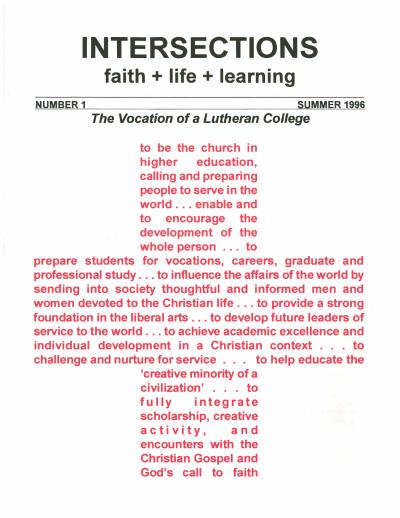 Editorial
From the Publisher
James M. Unglaube
Unglaube welcomes readers to the inaugural issue of Intersections, crediting Editor Tom Christenson and Capital University, and announces the new annual Vocation of a Lutheran College Conference whose continuing dialogue the journal exists to enhance. He gives thanks to the Lilly Endowment for a sizable grant supporting the 1996 conference, campus dialogues, and the birth of the publication.
-
Editorial
From the Editor
Tom Christenson
Christenson, feeling like a proud parent, welcomes readers to the inaugural issue and acknowledges three people without whom the publication would still be just an idea: Naomi Linnel of the ELCA office for Higher Education and Schools, publisher Jim Unglaube, and Capital University president Josiah Blackmore. He invites readers’ reactions, suggestions, and active involvement as editors, reviewers, authors, artists, and critics in shaping the dialogue across the ELCA college and university family.
-
Article
The Future of Lutheran Higher Education
Mark Schwehn
Schwehn’s keynote, framed against Otto Paul Kretzmann’s October 1940 inaugural at Valparaiso, organizes itself around four topics: the idea of a Christian University (Lutheran schools as a tributary of the Christian intellectual tradition, voices in a conversation in the spirit of H. Richard Niebuhr and Alasdair MacIntyre rather than phases of James Burtchaell’s devolutionary scheme); the pursuit of truth (against Foucauldian reduction of truth to power, with Hilary Putnam, toward a cruciform discipleship that discovers truth ambulando); the critique of knowledge (developing Christian theories of knowing in conversation with Benne, Lotz, Wolterstorff, LeClerc, and Augustine); and Christianity and liberal learning (objectivity refurbished as Thomas Haskell’s ascetic self-discipline, and the recovery of texts that have claims upon us).
-
Response
"Whose Future?" or "Social Justice and the Lutheran Academy?"
Marsha Heck
Heck argues that the future of Lutheran higher education lies less in defining Lutheran distinctiveness than in moral action grounded in face-to-face relationships with others. Drawing on David Lotz’s two-kingdoms theology of citizenship, Ernest Simmons’s relational reading of Luther, Arthur Preisinger’s indictment of the German Lutheran misreading of two kingdoms during the Third Reich, Starla Stensaas of Dana College, and Paulo Freire’s dialectic of empowerment, she calls Lutheran colleges to integrate moral reflection with moral action—to move students’ muscles against what is not true as well as to feel truths in their bones.
-
Response
Knowing and a Tradition to be Known
Kurt Keljo
Keljo, University Pastor at Capital, embraces Schwehn’s vocational call but challenges his epistemological framing. We are called to bear witness to the Truth more than to pursue it; truth and power need not be dissociated when power is understood cruciform-ly as love and service; alongside objectivity, a case can be made from the tradition for connected knowing (image of God, idolatry, repentance, Incarnation). Christians offer not a particular epistemology but a foundation for epistemology—a tradition to be known. He closes with James Fowler’s four marks of the “public church”: particularly Christian, prepared for pluralism, balancing intimacy with public engagement, and unafraid of ideological pluralism in confident, nondefensive civility.
-
Response
Lutheran Colleges: The Context for the Conversation
Thomas Templeton Taylor
Taylor of Wittenberg engages Schwehn’s first argument by sketching the institutional predicament of Lutheran colleges through three converging forces: the collapse of differences among old-line Protestant groups in the wake of ELCA-era ecumenism (with Robert Wuthnow); the secularization of American higher education described by George Marsden; and the post-war decline of liberal arts colleges under pressure to professionalize. The result is an “in-between stage” in which Lutheran colleges retain rhetoric without substance. Following Richard John Neuhaus’s “Eleven Theses,” he argues that, for a time at least, Lutheran colleges’ institutional affiliations must remain actively Lutheran if they are to remain in any sense Christian.
-
Response
Renewing Our Journey: Some Thoughts on Pursuing the Truth
John Rehl
Rehl, a Capital University graduate pursuing doctorates in theology at Chicago and in economics at Wisconsin, takes up Schwehn’s invitation to think again on the nature of truth. He sets aside truth as information, as object, and as mere words; recasts the church-related college’s task as a renewed emphasis on classroom teaching (Kierkegaard’s teacher as midwife) and on brave, articulate professors. He calls for moral education in courage, discipline, patience, and love, illustrates the costs of the fact-value split with examples from economics, and argues that we honor Lutheran heritage not by preserving it as a museum piece but by testing it—Luther’s theology of the cross over a theology of glory—and by preparing students for a world of Untruth, strengthened (with Julian of Norwich) by the promise that they will not be overwhelmed.
-
Institutional Focus
Continuing the Dialogue: Augustana College
Sandra C. Looney
Looney describes Augustana College, Sioux Falls, debating and renaming its values—Christian, Liberal Arts, Community, Excellence, Service—under the leadership of religion professor Dr. Arthur Olsen and the T’N’T (“Through Thick and Thin”) committee, in the wake of ELCA Region III’s “What Does It Mean to be a College of the Church?” conversations. She describes Augustana’s 56% Lutheran student body, daily 10 a.m. chapel, dual Christmas Vespers in Our Savior’s Lutheran Church and St. Joseph’s Cathedral, the Capstone classes on moral and aesthetic issues, and the ongoing work of enlarging Augustana’s conversation to include Native American, Jewish, and Islamic voices.
-
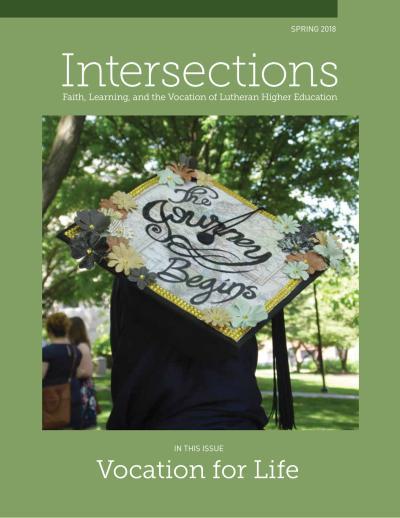 Article
Called to Compassion over the Course of a Life: A Buddhist Perspective
Florence D. Amamoto
No. 47 · Spring 2018
Amamoto, an associate professor at Gustavus Adolphus shaped by Jodo Shin Shu Buddhism, argues that although Buddhism has no “caller” God, it has a strong sense of calling — we are called by the world to respond to the suffering around us with mindfulness, egolessness, and compassion — and that this lifelong journey is enriched by encounter with the Lutheran vocational tradition.
-
 Article
Diversity and Dialogue: Twenty Years and Counting
Florence D. Amamoto
No. 43 · Spring 2016
Twenty years after her essay “Diversity and Dialogue” in the first issue of Intersections, Amamoto returns to Gustavus Adolphus College to reflect on what has changed and what has not: rising numbers of students of color and international students, faculty turnover and increased publication pressures, the disappearance of the Center for Vocational Reflection, and the renewed importance of articulating Gustavus’s Swedish Lutheran heritage and inclusive sense of community in a tuition-dependent, cost-cutting environment.
-
 Article
Diversity, Integrity, and Lutheran Colleges
Florence D. Amamoto
No. 8 · Winter 2000
Amamoto—a sansei Jodo Shin Shu Buddhist who is “an inside outsider” at Gustavus Adolphus—argues that diversity and integrity belong together in Lutheran higher education, perhaps in a way unmatched by other church-related traditions. She affirms the importance of Gustavus’s 60% Lutheran student body and vibrant Christ Chapel under Richard Elvee and Brian Johnson while warning that numbers and chapel are not enough, draws on Tom Christenson, Patricia Gurin, Sylvia Hurtado, Anthony Carnevale, Martha Nussbaum, W. E. B. DuBois (the deaths of Matthew Shepard and Isaiah Shoels), Richard Hughes’s reading of finitum capax infiniti, Richard Solberg, and Mark Schwehn’s mutual hospitality model, and concludes that the real enemy is not diversity but indifference—and that Lutheran finitude grounds a theological commitment to keeping diversity and identity in creative conversation.
-
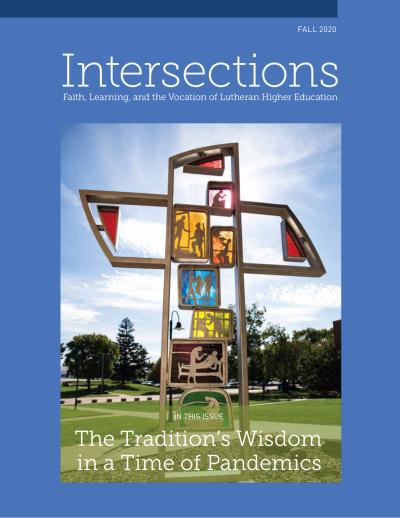 Article
Learning from Luther on Covid-19
Carl Hughes
No. 52 · Fall 2020
Reading Martin Luther’s 1527 treatise “Whether One May Flee from a Deadly Plague,” Hughes finds practical and spiritual guidance for a pandemic age: serve the neighbor, follow medical experts, honor those whose vocations put them at risk, and trust that even when we fail, God will not abandon the community.
-
 Editorial
From the Editor
Robert D. Haak
No. 28 · Fall 2008
Haak frames the issue around “Lutheran conversations,” centered on the exchange between Robert Benne and Tom Christenson at Wartburg College’s ongoing campus conversation about what it means to be a “college of the church,” alongside Mark Wilhelm’s historical and social context, Lake Lambert’s sermon, and Bishop Mark Hanson’s short piece reprinted from The Lutheran—and points readers to the Lutheran Academy of Scholars seminar at Harvard as a place to continue the conversation.
-
Editorial
From the Publisher
Mark Wilhelm
No. 47 · Spring 2018
Wilhelm celebrates that NECU schools continue to educate for vocation but warns that the culture of Lutheran higher education is at risk — sustained largely by informal cadres of individuals — and introduces NECU’s Rooted and Open statement as a first institutional step toward reclaiming the 500-year-old Lutheran intellectual and educational tradition.
-
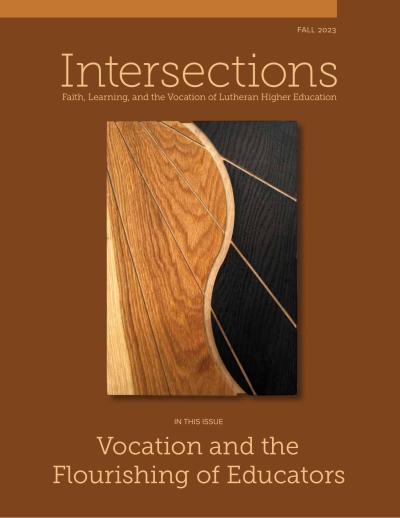 Article
A Lutheran Call for Educator Flourishing
Krista E. Hughes
No. 58 · Fall 2023
Hughes argues that without educator flourishing there is no student flourishing, traces how an exploitative “passion tax” can distort vocation, and offers seven Lutheran “third-way” value pairings — including Metrics/Grace, Efficiency/Kairos, and DEI/Priesthood of All Believers — to reframe institutional success at NECU campuses.
-
 Editorial
From the Publisher
Mark Wilhelm
No. 51 · Spring 2020
Wilhelm frames the issue by tracing how Lutheran educational ideals — once a primary source of contemporary higher education — were masked in the United States, and introduces a NECU initiative that uses the case of business ethics to explore Lutheran social teaching as an academic resource.
-
 Response
A Call for Creative Education
Wendy McCredie
No. 3 · Summer 1997
McCredie of Texas Lutheran responds to Reichenbach by reframing the four ideas embedded in his claim that “the entire college community should be knowledgeably committed to the college’s mission”—community, knowledge, commitment, mission—and argues that the Lutheran tradition’s unwillingness to be separate from the world should lead us to educate the public about the Lutheran tradition rather than interrogate prospective employees about their faith. She questions whether agreement on “Christian values” is possible (or even Lutheran), and reads Reichenbach’s “creative education” as the dialectical tension between gospel and law, God’s love and our human limits, that members of communities related to the Lutheran church are uniquely positioned to inhabit.