There will come a day, a last perfect day
When an unblemished Sun makes the cool Ocean roll,
And the great sea beasts cast their perfect white spray
For the very last time with untroubled soul.For each frail mortal and each questing mind
Stands to the Ocean as foam to the wave.
Before it is scattered, it longs that it find
The pulse of the Deep at the edge of the grave.It is our conviction that something remain,
Engendering life when our time has passed:
The Sea, the Life-Giver, the clouds and the rain,
Making forms ever new and the drama recast.When the Sun shall expand, and the great Ocean dies,
When the blues become black and greens become red,
Let it die full of Life! Let its murmurs and sighs
Give the drama a meaning. Let it not, Lord, die dead.
-
 Editorial
From the Publisher
Mark Wilhelm
Wilhelm bids farewell to Robert D. Haak, who is leaving the editorship of Intersections and the Augustana College Center for Vocational Reflection for a chief-academic-officer post at Hiram College in Ohio, and welcomes Jason A. Mahn as the incoming editor. He celebrates Haak’s tireless work to integrate the Lutheran concept of vocation into the practices and rhetoric of Augustana and ELCA higher education through six years of Intersections, and frames the journal as a vital tool for sustaining the conversation about education in a Lutheran key—even at colleges and universities where most students, faculty, and staff are not Lutheran themselves.
-
Editorial
From the Outgoing and Incoming Editors
Jason A. Mahn, Robert D. Haak
Outgoing editor Robert D. Haak reflects on a six-year run inheriting Intersections from founder Tom Christenson, the “powerful voices” that have driven the conversation (Dovre, Jodock, Christenson, Simmons, Morgan, Olsen, Wilhelm) and the newer ones now entering (Mahn, Bussie); incoming editor Jason A. Mahn, picked up from the airport in Bob’s pickup truck five years ago, names central issues that “Lutherans on Faith and Learning” engages and previews essays by Dovre, Jodock, McDonald, Hill, Turnbull, and Jodock again.
-
Article
A Lutheran Learning Paradigm
Paul J. Dovre
Drawing on Hughes and Adrian’s Models of Christian Higher Education and on Ernest Simmons, Darrell Jodock, Tom Christenson, Robert Benne, and Richard Hughes, Dovre sketches a Lutheran learning paradigm shaped by four deep narratives—the biblical, the confessional, the theological, and the vocational—and traces their implications for curriculum (the study of scripture, theology, and vocation), for the religion faculty’s college-wide responsibility, and for pedagogy (moral deliberation, dialectic, paradox, the engagement of faith and the secular disciplines).
-
Article
Gift and Calling: A Lutheran Perspective on Higher Education
Darrell Jodock
Jodock argues that a Lutheran perspective on higher education rests on three underlying ideas—that we are gifted (a giftedness that calls forth wonder, awe, gratitude, a sense of humor, and vocation as response to neighbor); that the Lutheran tradition affirms a particular kind of God who is down-to-earth and at work in the world for justice and human wholeness; and that a Lutheran “third path” can be both rooted in the tradition and inclusive of others. He draws out ten implications for higher education, from wonder as the heart of religion through liberal learning oriented toward the freedom of its members.
-
Article
Lutheran Colleges, the Lutheran Tradition, and the Future of Service-Learning
Joseph McDonald
McDonald, who has used service-learning since the early 1990s and now directs the Values Based Learning Program at Newberry College, traces the service-learning movement from its 1960s socio-political pioneers (Nadinne Cruz, Ira Harkavy) through its institutionalization as classroom pedagogy and citizenship education (Stanton, Giles, and Cruz; Edward Zlotkowski; Jane Addams’s Hull House and John Dewey). He argues that three strengths of the Lutheran tradition—robust reflection as a community of discourse, Christian vocation as service infused in all roles, and the capacity to negotiate tension and paradox—uniquely equip Lutheran colleges to hold the pedagogical and socio-political dimensions of service-learning together, recovering the energy of the pioneers without sacrificing classroom rigor.
-
Reflection
Dreaming God's Dream: A Sermon on Isaiah 56:1-2, 6-8
Stephan K. Turnbull
Preached at the 2008 “Savvy with Substance” Convocation of the ELCA at Central Lutheran Church, Minneapolis, this sermon by parish pastor Stephan K. Turnbull (First Lutheran Church, White Bear Lake) sets the small dreams of pastors and academics—balanced budgets, peaceful congregations, coherent midterm papers—over against the prophet’s dream in Isaiah 56 of a God who gathers all nations to a house of prayer for all peoples. Turnbull calls educators, preachers, and church leaders to articulate God’s dream of getting the world back through the dying of Jesus the Messiah and the resurrection’s first fruits of new creation.
-
Reflection
Fumbling Toward Integrity: A Sermon on Mark 8:34-38, Pastor Kaj Munk, and Father Maximilian Kolbe
Darrell Jodock
Preached at the 2007 ELCA Convocation of Teaching Theologians at Lenoir-Rhyne College, Jodock holds up two World War II martyrs—Polish Franciscan Father Maximilian Kolbe, who took the place of a condemned father in Auschwitz’s starvation bunker, and Danish pastor-playwright Kaj Munk, who was shot by the Nazis after helping save 97 percent of Denmark’s Jews—as mirrors for our own priorities. Drawing on the rescuer characteristics identified by Samuel and Pearl Oliner (agency, moral independence, universalistic caring, a history of care-giving) and on Jesus’s words in Mark 8:34-38, Jodock asks how we who routinely opt out at the first sign of opposition might fumble toward integrity in our own time.
-
 Article
Civic Engagement and Faith Perspectives
William O'Brochta
No. 63 · Spring 2026
15 min audio
Guest editor William O’Brochta introduces the section by overviewing the ELCA’s call to civic engagement, recapping the Fall 2025 Civic Engagement and Faith Perspectives conference at Texas Lutheran University, and previewing the participant essays that follow.
-
 Editorial
From the Publisher
Arne Selbyg
No. 10 · Fall 2000
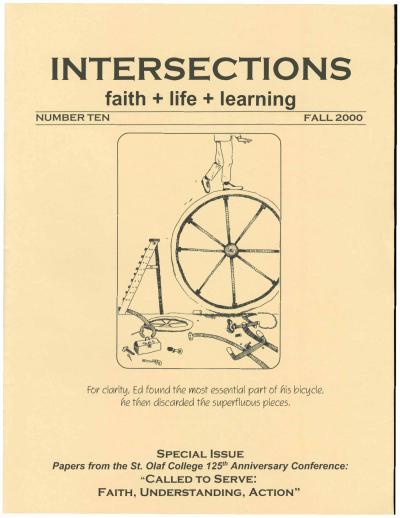
Selbyg explains that, while Intersections usually publishes papers from the annual Vocation of a Lutheran College conferences, this issue gathers presentations from a St. Olaf 125th-anniversary conference—a companion to the volume Called to Serve edited by Pamela Schwandt—because the theology and educational perspectives behind them apply to any Lutheran college and clarify what makes ELCA church-related colleges excellent institutions for students of any faith.
-
 Article
Wake Up Running! A Call to Ethical Leaders in Quest of Democratic Space
Walter Earl Fluker
No. 62 · Fall 2025
44 min audio
Abridged from his VLHE keynote, Fluker draws on Habakkuk and Octavia Butler’s Parable of the Sower to call a new generation of ethical leaders to “wake up running” toward democratic futures, packing their runaway bags with love-filled-justice, grace-filled-empathy, and hope-filled-resiliency for the soul-filled work the moment requires.
-
 Article
Calling Economists
Lynn Hunnicutt
No. 37 · Spring 2013
Reading Luther’s Whether Soldiers, Too, Can Be Saved alongside Adam Smith’s Theory of Moral Sentiments and Wealth of Nations, Hunnicutt asks whether economists, too, can be saved—and whether economics can host a serious conversation about vocation. She traces her own move from Utah State to Pacific Lutheran University and its Wild Hope Center for Vocation, and turns to Deirdre McCloskey and George DeMartino as economists whose work makes room for vocation and the common good within the discipline.
-
 Reflection
On the Power of Transformation and Becoming Human
Ken Yanai Flores
No. 59 · Spring 2024
Flores, a Cal Lutheran sophomore, reflects on personal and institutional transformation as the slow work of shedding the armor of trauma responses, engaging discomfort rather than turning away, and trusting that the work of becoming more human — more empathetic, knowledgeable, and free — will be reflected in our institutions as well.
-
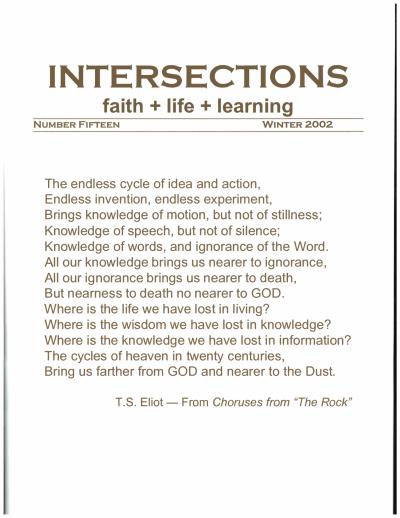 Article
Welcome Strangers
Gregg Muilenberg
No. 15 · Winter 2002
Muilenberg, a non-Lutheran philosopher at Concordia, argues that self-consciously Lutheran colleges cannot make non-Lutheran faculty feel welcome through “institutional fit” rhetoric (he cites Concordia’s own hiring boilerplate) because identity must be sustained and developed, not preserved like a pickle. Drawing on Nikos Kazantzakis’s Report to Greco and the three marks of the “profoundly religious person”—commitment to the truth, to the power of the spirit, and to metousiosis through myth—he proposes that faith and reason are best understood as an unending struggle into which strangers must be invited as valuable and active participants, safeguarded by the strongest possible affirmation of academic freedom (citing Martha Nussbaum on Notre Dame and BYU).