Do you have dreams? Dreams for your kids, if you have any? Dreams for your career? The next book you want to write, the problem you want to solve, or the influence you’d like to have? Do you have dreams for your church? For the next hill to climb as an organization? For how you’d like to reach your community with the Gospel? Or maybe other achievements like finishing a marathon or traveling the world or visiting your ancestral home?
Oddly enough, I’ve always been light on dreams. I’m a pretty driven person, but I have mostly kept my distance from dreams. I’m naturally uneasy with emotion, and not wanting to be disappointed, I think I taught myself not to dream. In fact, I’ve had to re-learn the art of dreaming as I’ve gotten older. And probably my greatest teacher in this regard has been the Bible itself. The longer I live as a Christian, the longer I read the Bible, the more opportunity I have to teach the Bible, the more I find myself drawn to dream the dreams that drive the plot of the story that is the Bible.
One articulation of that dream comes from the passage that has been assigned for our worship tonight. The passage is from Isaiah 56: 1–2, 6–8:
This is what YAHWEH says:
“Maintain justice
and do what is right,
for my salvation is close at hand
and my righteousness will soon be revealed.
Blessed are those who do this—
who hold it fast,
those who keep the Sabbath without desecrating it,
and keep their hands from doing any evil.
And foreigners who bind themselves to YAHWEH
to minister to him,
to love the name of YAHWEH,
and to be his servants,
all who keep the Sabbath without desecrating it
and who hold fast to my covenant—
these I will bring to my holy mountain
and give them joy in my house of prayer.
Their burnt offerings and sacrifices
will be accepted on my altar;
for my house will be called
a house of prayer for all nations.”
YAHWEH the Sovereign one declares—
he who gathers the exiles of Israel:
“I will gather still others to them
besides those already gathered.”
There’s something beautiful in that dream, isn’t there? All the nations of the world, scattered in their rebellion, addicted to their worship of things that are not god, returning to the Living God in worship and obedience. All the peoples of the world, alienated from God by the power of sin, by their injustice and idolatry, are reconciled to God. And God is worshipped in His house, a house of prayer for all nations—a verse which, by the way, was quoted by Jesus and is inscribed in steel on stone on the rear of the sanctuary where I lead worship each Sunday, in case I needed a reminder of God’s dream.
There’s something beautiful in that dream. God is in his heaven, as my grandmother used to say, and all is right with the world. You could almost say that it’s Edenic, if it weren’t at the same time so Sinaitic. But table that thought for a minute, if you can, and see what’s even more basic here. Isaiah is dreaming God’s dream. And God is dreaming of getting his world back. God is dreaming of bringing his creatures home again after their sojourn under the power of sin, after their adultery with false gods of a bewildering variety. God wants his world back, and that is a dream worth dreaming.
I wish I could say that whatever dreams I do have were composed of that dream. But I’ve got piddly little dreams. Maybe you do, too. I’m a parish pastor now. My heart is constantly pulled toward, tempted by, shadow dreams of a shadow mission. Dreams of balanced budgets that even get met. Dreams of a stable, peaceful congregation. Dreams of going 6 months without navigating some kind of personnel issue.
Many of you are vocational academics. Your heart is analogously tempted. Ah, to read a whole batch of midterm papers written in clear English, arguing a single thesis coherently, citing works properly and plagiarizing none. It’s almost too much to hope. Deans who lead clearly, copious opportunity for intellectually stimulating collegial conversations, students whom we can disabuse of one sort of fundamentalism or another. Visions of sugarplums dancing in our heads.
Small dreams. Components of God’s dream, perhaps, but often masquerading as the dream itself.
We’ve got a lot of company, though. Long generations of worshipers of our God have similarly downsized their versions of God’s dream to fit within the shrunken parameters of fallen imaginations. Kings of roughly Isaiah’s day (no matter which Isaiah you wish to locate chronologically) dreamed of peace in Zion and figured that political alliances with nearby pagan powers would do the trick. That’s sure to make the dream come true, don’t you think? Pharisees, Essenes, Zealots, and Sadducees of Jesus’ day worshiped Yahweh and dreamed of the coming of His Israelite Kingdom and each pursued it according to different strategies: nomistic, separatist, revolutionary, or political-assimilationist. One of those things would have to make the dream come true, right? I guess I’m not the only one who’s been a pretty lousy dreamer.
Good thing God’s dream wasn’t waiting on ours. Who could have dreamed that God getting His world back, that the birth of God’s reconciled new creation would come when the dying of the old one would be taken up into the dying of God’s Messiah? Who could have imagined that seeing this dream become reality would happen in waking up, when Jesus the Messiah woke up again from the dead, the first fruits of the new creation, early in the morning in the garden on the first day of the new week.
I want to wake up into that dream. I want to dream that dream when I lie down and when I rise up. I want to live my life watching that dream come true, knowing that it will come true without my work or even my praying for it. But I also want to participate in the work of seeing it happen in my life.
And you and I are teachers, preachers, and church leaders. We have the unearned and unsurpassed privilege of articulating this dream to others. We have the opportunity to teach them to read the Biblical story of God’s mission, of God’s unswerving commitment to his post-Eden dream of getting His world back in Christ.
And never in the history of this dream has the need for its telling been any higher. The stakes for us are sky high. The world around us is literally dying to hear this story. They need to hear it on our lips, and they need us to multiply the lips who tell it.
I was talking recently to my colleague who is the director of student ministries at our church, and we were talking about the latest research on youth culture and student-age folks who are walking away from the church and from the God we worship. And he said more and more students are saying that the church just isn’t offering them anything that’s worth their time, their energy, and their life. The church hasn’t offered them a big enough story, an inspiring story for their lives to be caught up into. Now is that just their natural opinio legis striving for their own significance or is it a hunger for the God who made them? Or is it a case of the former perverting the latter? Whatever it is, it needs the Gospel.
They have perceived that the church has offered them a gospel that’s smaller than the hopelessness and chaos that they see and experience all around them. They’ve heard a gospel that says, “Believe in Jesus. Wait to die. Go to Heaven.” That’s not quite the same dream. Yet, we have all preached sermons that small, born of dreams that small. And I think that there is something in their hearts that intuits that that dream is too small to be biblical.
The dying of this world is not news. Most of our world is aware of its degenerative condition. Postmodern hopelessness is alive and well—merely taking the place of modern hopelessness. What is news however is that this dying has been foundationally transformed by the cross. It has been detoured from a road that leads from cross to grave to dead end onto a road that leads from cross to grave to new creation, to the restoration of all things, to the reconciling of the world to God in Christ, in the One who makes all things new.
That is the dream of God, the dream that Isaiah sensed and spoke, but also the dream that God has been dreaming and pursuing even before Sinai shaped the prophetic imagination and the Torah played its custodial role. It is the dream of God that drives the plot of the story of the entire Biblical canon, revolving around the cross, coming true at Easter’s dawn, and inviting us to participate in the work of its fruition. And it is the dream into which the world will wake up as we tell it and teach others to the same.
Endnotes
1. This sermon was preached Aug. 12, 2008, at the “Savvy with Substance” Convocation of the Evangelical Lutheran Church of America, Central Lutheran Church, Minneapolis, MN.
-
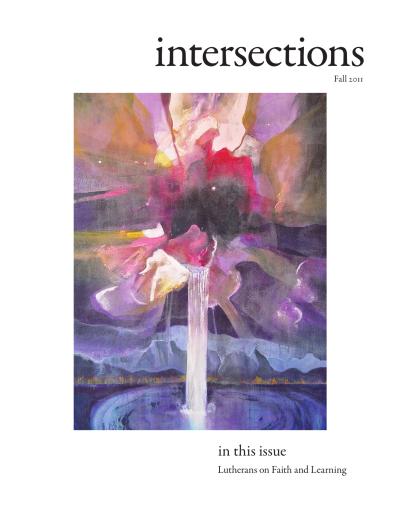 Editorial
From the Publisher
Mark Wilhelm
Wilhelm bids farewell to Robert D. Haak, who is leaving the editorship of Intersections and the Augustana College Center for Vocational Reflection for a chief-academic-officer post at Hiram College in Ohio, and welcomes Jason A. Mahn as the incoming editor. He celebrates Haak’s tireless work to integrate the Lutheran concept of vocation into the practices and rhetoric of Augustana and ELCA higher education through six years of Intersections, and frames the journal as a vital tool for sustaining the conversation about education in a Lutheran key—even at colleges and universities where most students, faculty, and staff are not Lutheran themselves.
-
Editorial
From the Outgoing and Incoming Editors
Jason A. Mahn, Robert D. Haak
Outgoing editor Robert D. Haak reflects on a six-year run inheriting Intersections from founder Tom Christenson, the “powerful voices” that have driven the conversation (Dovre, Jodock, Christenson, Simmons, Morgan, Olsen, Wilhelm) and the newer ones now entering (Mahn, Bussie); incoming editor Jason A. Mahn, picked up from the airport in Bob’s pickup truck five years ago, names central issues that “Lutherans on Faith and Learning” engages and previews essays by Dovre, Jodock, McDonald, Hill, Turnbull, and Jodock again.
-
Article
A Lutheran Learning Paradigm
Paul J. Dovre
Drawing on Hughes and Adrian’s Models of Christian Higher Education and on Ernest Simmons, Darrell Jodock, Tom Christenson, Robert Benne, and Richard Hughes, Dovre sketches a Lutheran learning paradigm shaped by four deep narratives—the biblical, the confessional, the theological, and the vocational—and traces their implications for curriculum (the study of scripture, theology, and vocation), for the religion faculty’s college-wide responsibility, and for pedagogy (moral deliberation, dialectic, paradox, the engagement of faith and the secular disciplines).
-
Poem
Endtimes
Dave Hill
A four-stanza meditation on the “last perfect day” when an unblemished Sun makes the cool Ocean roll—and on the relation of each questing mind to the Deep, of each frail mortal to the pulse of the Sea at the edge of the grave. “Let it die full of Life! Let its murmurs and sighs / Give the drama a meaning. Let it not, Lord, die dead.”
-
Article
Gift and Calling: A Lutheran Perspective on Higher Education
Darrell Jodock
Jodock argues that a Lutheran perspective on higher education rests on three underlying ideas—that we are gifted (a giftedness that calls forth wonder, awe, gratitude, a sense of humor, and vocation as response to neighbor); that the Lutheran tradition affirms a particular kind of God who is down-to-earth and at work in the world for justice and human wholeness; and that a Lutheran “third path” can be both rooted in the tradition and inclusive of others. He draws out ten implications for higher education, from wonder as the heart of religion through liberal learning oriented toward the freedom of its members.
-
Article
Lutheran Colleges, the Lutheran Tradition, and the Future of Service-Learning
Joseph McDonald
McDonald, who has used service-learning since the early 1990s and now directs the Values Based Learning Program at Newberry College, traces the service-learning movement from its 1960s socio-political pioneers (Nadinne Cruz, Ira Harkavy) through its institutionalization as classroom pedagogy and citizenship education (Stanton, Giles, and Cruz; Edward Zlotkowski; Jane Addams’s Hull House and John Dewey). He argues that three strengths of the Lutheran tradition—robust reflection as a community of discourse, Christian vocation as service infused in all roles, and the capacity to negotiate tension and paradox—uniquely equip Lutheran colleges to hold the pedagogical and socio-political dimensions of service-learning together, recovering the energy of the pioneers without sacrificing classroom rigor.
-
Reflection
Fumbling Toward Integrity: A Sermon on Mark 8:34-38, Pastor Kaj Munk, and Father Maximilian Kolbe
Darrell Jodock
Preached at the 2007 ELCA Convocation of Teaching Theologians at Lenoir-Rhyne College, Jodock holds up two World War II martyrs—Polish Franciscan Father Maximilian Kolbe, who took the place of a condemned father in Auschwitz’s starvation bunker, and Danish pastor-playwright Kaj Munk, who was shot by the Nazis after helping save 97 percent of Denmark’s Jews—as mirrors for our own priorities. Drawing on the rescuer characteristics identified by Samuel and Pearl Oliner (agency, moral independence, universalistic caring, a history of care-giving) and on Jesus’s words in Mark 8:34-38, Jodock asks how we who routinely opt out at the first sign of opposition might fumble toward integrity in our own time.
-
 Institutional Focus
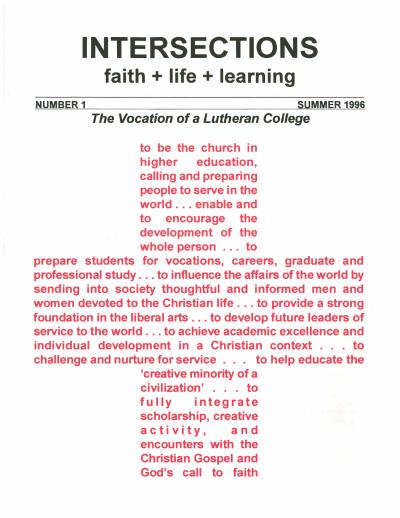
Continuing the Dialogue: Augustana College
Sandra C. Looney
No. 1 · Summer 1996
Looney describes Augustana College, Sioux Falls, debating and renaming its values—Christian, Liberal Arts, Community, Excellence, Service—under the leadership of religion professor Dr. Arthur Olsen and the T’N’T (“Through Thick and Thin”) committee, in the wake of ELCA Region III’s “What Does It Mean to be a College of the Church?” conversations. She describes Augustana’s 56% Lutheran student body, daily 10 a.m. chapel, dual Christmas Vespers in Our Savior’s Lutheran Church and St. Joseph’s Cathedral, the Capstone classes on moral and aesthetic issues, and the ongoing work of enlarging Augustana’s conversation to include Native American, Jewish, and Islamic voices.
-
 Article
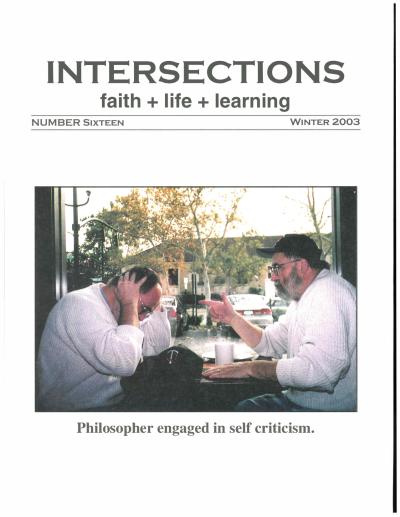
The Impropriety of Jesus' Teaching: The Woman at the Well and The Vagina Monologues
Susan M. O'Shaughnessy
No. 16 · Winter 2003
O’Shaughnessy Poppe dedicates her message to those who worked to put on Eve Ensler’s The Vagina Monologues against administrative resistance and reads the Samaritan woman at Jacob’s well alongside the testimony of a Bosnian rape survivor whose story Ensler asked to tell, arguing that the “impropriety” of Jesus—his scandalous recognition of those silenced by sexism, racism, war, custom, and the church—is the model for the mission of a college of the church to defend academic freedom and to break the chains of oppression by inflicting discomfort on the proper and pure.
-
 Article
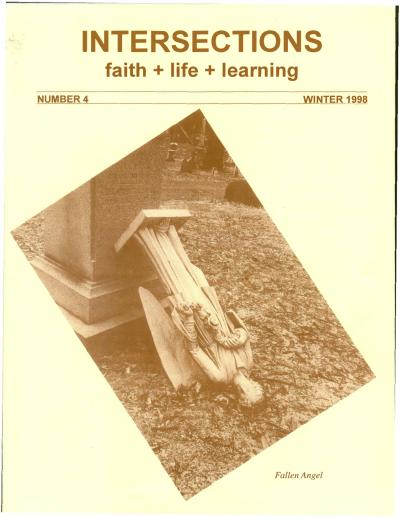
The Skeptical Theologian's Dictionary
Carl Skrade, Spencer Porter
No. 4 · Winter 1998
Porter and Skrade offer selections from a mock-lexicon of theological terms: answer, church, faith, God, grace, hope, justification, love, prayer, sin, soul, and theology, among others. Each entry begins with a standard definition and then unsettles it—answer reminds the reader that in theology and poetry the questions matter more than their answers; church alternates between “the mystical Body of Christ” and ordinary human gatherings whose machinery often obscures the gospel; God is the One whose name we are told not to take in vain and yet whose name we keep using; prayer is communion with God yet often degenerates into a list of demands. The form’s irony exposes the gap between the language of theology and its lived realities—a sober, witty corrective for Lutheran classrooms and chapels alike.
-
 Editorial
From the Editor
Robert D. Haak
No. 27 · Spring 2008
Haak frames the issue around the question of why Lutherans engage the world rather than retreat from it, locating the answer in the doctrines of creation and incarnation, and introduces essays by Erwin on globalism, Carlsen on local community engagement, Marty on multiple callings, and Mattes on the Grundtvigian heritage at Grand View. He also bids farewell to publisher Arne Selbyg, noting the fittingness of the Adinkra (“farewell”) cloth on the cover of this final issue under Selbyg’s leadership.
-
 Response
Tat for Teat: Ratke Responds
David Ratke
No. 9 · Summer 2000
Ratke, agreeing with much of VonDohlen’s critique but contending that VonDohlen misreads both Luther and the two-realms doctrine, marshals Luther’s To the Christian Nobility, On the Freedom of a Christian, Temporal Authority, Whether Soldiers Too Can Be Saved, and the “Sermon on Keeping Children in School,” along with Walther von Loewenich, to argue that Luther was well aware of structurally differentiated society, made no claim to a monistic epistemology, and intended the two-realms doctrine to combat—not introduce—dualistic bifurcation between sacred and secular. Our identity is “not as either Christian or academic, but as Christian and scholar.”
-
 Article
Vocational Leadership
Darrell Jodock
No. 41 · Spring 2015
Jodock proposes “vocational leadership” as a name for a distinctive educational value at the heart of a Lutheran college — one that seeks to benefit the neighbor and the community, inspires and invites others to participate in that service, and is institutionally anchored in the Lutheran concept of vocation. He unpacks twelve facets of vocational leadership and ties them to Luther’s own leadership around indulgences, public schooling, and beggary.