This essay identifies some of the distinctive resources of the Lutheran tradition and the ways in which they inform the learning paradigm of Lutheran colleges. This project is prompted by the recent renewal of interest in such matters among Christian colleges in general and Lutheran colleges in particular. For a variety of reasons, many Lutheran colleges are seeking to recover and extend the distinguishing ele- ments of their religious tradition and identity. In most cases, the faculties are religiously diverse and most, including the Lutherans among them, lack an awareness and understanding of the distinctive elements of the Lutheran tradition. This essay is also motivated by the work of others, especially the volume edited by Richard T. Hughes and William B. Adrian, Models of Christian Higher Education.
The distinctive connections between particular religious tradi- tions and their learning paradigms are evident from a cursory survey: While Roman Catholic colleges vary from one order to another, they maintain a relatively consistent focus on the social teachings of the church as well as the work of the great philoso- phers and theologians. In addition, one notes the Thomist and neo-Thomist traditions of the Jesuits and the focus on hospital- ity and service among the Benedictines. The Mennonite schools have a particular focus on the application of Christian ethics and social justice teachings in domestic and international venues of service. There is the rigorous Kyperian tradition among Dutch Reformed schools with their emphasis on the formulation of a Christian worldview, discipline by discipline, leading to a true integration of faith and learning.
Hughes and Adrian’s book (Models of Christian Higher Education) was published in 1997. The editors and other contribu- tors characterized, and distinguished among, various learning models (or paradigms) in religious higher education. They noted that Lutherans, out of their culture affirming, two kingdoms dialectical construct, typically seek to establish a dialogue between the Christian vision and the world. Out of their sacramental tradi- tion, Roman Catholic schools seek to bring the presence of Christ into a world in need. On the other hand, out of their convictions about the sovereignty of God, schools in the Reformed tradition seek to approach every discipline from a distinctive Christian perspective. In cryptic expression, schools in the Reformed tradition seek to transform learning by bringing it under the sovereignty of God, Lutherans seek an engagement between faith and learning, and Roman Catholic institutions seek to integrate a Christian vision into the life of the academy. Spurred by the work of Hughes, Adrian, and others, I think it is useful to explore in more detail the resources inherent in the Lutheran tradition and the ways in which they might conceivable shape the learning para- digm—that is, both the program of learning and its execution.
Five Contemporary Resources
The work of others shapes this paper in a number of ways. In addition to the works of Luther and the Lutheran Confessions, I have been informed most recently by the work of five con- temporary scholars. They are Ernest Simmons, Darrell Jodock, Tom Christenson, Robert Benne, and Richard Hughes. In his text designed to introduce faculty to the Lutheran tradition in higher education, Simmons sketches out the history of Lutheran higher education and mines the theological lode of Lutheranism. He identifies the doctrines of justification and the incarnation as formative as well as the Lutheran distinction between law and gospel and the Lutheran teachings on vocation. He describes the Lutheran notion that we are simultaneously saint and sinner, unable to escape human temptation yet capable of righteous acts. He cites the work of K. Glen Johnson describing the Lutheran penchant for paradox and the “tension-filled distinctions such as law and gospel, faith and works, saint and sinner, finite versus infinite, reason and faith.”
Simmons gives extensive treatment to the notion of vocation as does his friend and colleague, Darrell Jodock. Jodock has written frequently and lectured widely on Lutheran higher edu- cation. He places vocation in a Lutheran context and sees it as a response to the grace of God that is lived out in service to our neighbor and the world and for the sake of the common good. Vocation is lived out in the home, church, career, and com- munity and it is inclusive of all honorable callings, both secular and sacred. Drawing on the Lutheran understanding of human nature, living out one’s vocation involves struggle, ambiguity, and change. For that reason among others, we live out our voca- tion with others, that is, in community where together we test ideas, share wisdom, and seek divine guidance. As Jodock and other writers note, Lutherans stand in a tradition of encourag- ing diligent study in preparation for the living out of vocation in the world. With the encouragement and assistance of the Lilly Endowment, vocation has become a widely employed tool for centering and focusing Christian higher education.
In his well read book, Quality with Soul, Robert Benne identi- fies three defining themes in the Lutheran theological tradition including a strong emphasis on the confessions and confession- ally trained pastors, the emphasis on calling or vocation, and the affirmation of “human reason as a guide to earthly, civil life.” For Benne, the Christian account of reality should give vision, direc- tion, and content to the academic enterprise of a Christian college in intentional, self-conscious ways. It should be embedded in the faculty and staff, in the course of study, and in the ethos of the community. Benne’s assessment of St. Olaf College and Valparaiso University illustrate the dynamics of his template.
A fourth contemporary resource is Tom Christenson and his The Gift and Promise of Lutheran Higher Education. In this book Christenson takes into account the significant changes in the Christian academy and seeks to tell the Lutheran story using both new and familiar categories of thought. He is committed to the Lutheran idea of vocation as an organizing principal. He identifies eight theological theses inherent in the Lutheran tradi- tion with fresh language and engaging illustrations. One of the other unique contributions of his book is his discussion of the constituents and dynamics of a Lutheran epistemology. He goes on to identify some of the implications of the Lutheran gift in the formation of the curriculum and its pedagogy.
Especially interesting is the work of Richard Hughes. What makes it interesting is both his perspective as an outsider from the Lutheran tradition and his assessment of both the strengths and weaknesses of our theological resources. He identifies our key resources as Luther’s insistence on human finitude, the sovereignty of God, and the notion of paradox that is embedded in Luther’s theology of the cross and is expressed in his notion of the two kingdoms. Hughes has great confidence in this tradition to keep questions alive, to live with complexity, to avoid the dogmatic, and to deal with the limits to human understanding gracefully. He also warns of the temptation of paradox thinking to fall off one side or another of the paradox or, alternately, to surrender to a relativism.
To conclude this survey, I note again that my task is to draw on these several insights about the Lutheran tradition in sketch- ing a Lutheran learning paradigm and its implications for both the content and pedagogy of the curriculum. To be sure, while this is the sort of thing that people in, for example, the Dutch Reformed tradition do with discipline and regularity, it is not the sort of thing Lutherans have done for a variety of reasons. So in providing this sketch I mean to be helpful by providing a template and not a formula, a list of possibilities and not a fixed plan. I do so knowing that Lutheran college faculties will, in any case, make their own best judgment on these matters.
Four Deep Narratives
So to the task at hand: I submit that the Lutheran tradition is shaped by four narratives: the biblical, the confessional, the theological, and the vocational.
Luther was an Old Testament scholar and the biblical story was the bedrock of his preaching, teaching, and leadership. Most of his published work was about Biblical resources. He came at his theology, never systematized, out of his biblical work for the most part. For Luther, “Word alone, grace alone, faith alone” starts there.
The Lutheran confessional narrative was shaped by many church leaders over the centuries. It includes the classical creeds of the church including the Apostles, the Nicean, and the Athanasian Creeds, as well as the Augsburg Confession. Each was an attempt to express biblical truths in relationship to the believer and the world. These confessions provide Christians with a paradigm for understanding themselves in relationship to God and the world. Inspired by God’s spirit and created by God’s people, they are subject to interpretation and reconsidera- tion from age to age. But over the centuries they have proven durable and useful guides to the Christian life.
Lutherans do not claim a unique theological system but they do affirm the importance of the human quest to understand the implications of God’s revelation for the lives of God’s people in the world. Lutherans have sought out and affirmed theologi- cal work from many traditions. With strong grounding in the scholastic, pietistic, and critical traditions, Lutherans have been in the first rank of the world’s theologians. Lutherans bring to the ecumenical theological conversation certain distinctive motifs including most notably the two kingdoms, the priest- hood of all believers, original sin, the theology of the cross, simul justis et peccator, the incarnation, and its teaching on justifica- tion. Imbedded in the Lutheran theological tradition are some pedagogical proclivities including the dialectic, the paradoxical, the commitment to moral deliberation, and freedom of inquiry. As exemplified by Luther’s theology of the cross, “there is a per- sistent warning…to avoid the facile, the simplistic—to offer easy religious answers to human questions” (Hall).
Imbedded in the Lutheran theological tradition are some pedagogical pro- clivities including the dialectic, the paradoxical, the commitment to moral deliberation, and freedom of inquiry.
The vocational narrative is also distinctive in the Lutheran tradition. Luther’s passion for the priesthood of all believers, his commitment to love the neighbor, and his sense that all areas of life are avenues for the expression of our love for God constitute substantive elements of the Lutheran vocational narrative. For Luther, vocation was not to be equated with a career or a job or the calling to a holy order. Rather, our vocation comes to us in baptism and is lived out in joyful response to God’s gift of love. God frees us to love our neighbor and promote the common good in all of our places of responsibility in daily life—home, congregation, work place, neighborhood, nation, and global soci- ety. For Lutherans, vocation is where God’s gift and call come together in the concreteness, the humus, of life. In this context, the purpose of Lutheran higher education is to prepare students for vocation, with all that implies.
So if these are the key narratives, what might a Lutheran learning paradigm look like and what would be its implications for curricula and the pedagogical design of academic programs in Lutheran colleges?
Toward a Paradigm of Lutheran Learning
First of all, the aim of a Lutheran paradigm of learning is the engagement of faith and the secular disciplines. Consistent with its two kingdoms framework and its respect for the secular disci- plines of the academy, Lutherans seek to discover what the propo- sitions of faith have to contribute to secular disciplines and vice versa. Since God is a transcendent reality, knowledge of the faith and knowledge of the world is all from God and all about God.
Now in light of the goal and nature of the learning paradigm, what about the curriculum? In view of the centrality of the bibli- cal narrative, the study of sacred scriptures will be de rigor in the curriculum. The objective here is both knowledge of the story and knowing how to read it for oneself. This kind of knowledge will be of value to all persons, Christian and other, since it is a cultural and world shaping literature. Given the dismal state of biblical literacy in a world of many faiths and cultures, one could give special priority to this matter in the modern age, especially at Lutheran places.
Studies in theology will be another explicit element in the curriculum. These courses will set up and address both the big issues of meaning and the ordinary issues of living. The study of theology comes in many forms from history to systematic theol- ogy to confessional theology to ethics. What used to be thought of as the sole province of professional theologians is now claimed by practitioners in a variety of academic disciplines (e.g. ethics and business, ethics and science, ethics and communication, etc) for the Word has something to do with everything and everyone and theologians are not the only players in this arena. However, at Lutheran schools it would be most desirable to see theologians involved as partners in the “and” curricula.
It is anticipated that the Lutheran confessional narrative may be nested in both the study of scripture and the study of theology. The confessions provide evidence of the way in which human beings have come to understand the truths of the scripture and the continuing revelation of God. They answer the perennial Lutheran question, “what does this mean?” Such questions are especially germane in the lives of the millennial generation that seeks both significance and status.
The vocational narrative is receiving growing attention in Lutheran and other Christian colleges in America. This development reflects both a response to the initiatives of the Lilly Endowment and the reclaiming of a central theological theme. Not many places will establish courses devoted solely to vocation. Rather, the idea of our calling to vocation underlies the whole academic project at Lutheran places. It becomes foundational for the whole enterprise. But the groundwork, the building blocks, must be established and then reiterated through out the college years. Some schools introduce the idea in the orientation of new students, others include it as an explicit consideration in one or another core courses (some- times in religion).
Closely related to the unfolding of the Lutheran idea of voca- tion is the call to serve the neighbor, the common good. Again, in recent years we have seen the advent of service learning in which theory is integrated with practice. In this way, the cur- riculum and service to the neighbor and the advancement of the common good are of a piece. Lutheran schools are in a unique position in that they may bring to this form of applied learning the rationale of our theological tradition and thus value is added to the experience.
In what ways might the Lutheran tradition inform pedagogi- cal practices? Luther exemplified moral deliberation in his life, ministry, and scholarship. He was especially committed to, and confident in, the moral deliberation of the community. He would say, in effect: “Here is what scripture says and here is the situation we face, so what shall we do?” He felt such deliberation was neces- sary both because there were not always clear answers in scripture to every situation and because human beings, by nature, distort reality. So he believed deliberation, the give and take of the com- munity, was needed. Luther didn’t always get it right and he knew that but he believed in the power of the Spirit working among the people of God as they sought practical solutions in both material and churchly matters. He also had confidence that in gracious- ness, God would forgive the mistakes. All of which suggests that Lutheran places will, explicitly and self consciously, be places of moral deliberation in which faculty serve as models and students are engaged in the discernment of wisdom.
Closely related to moral deliberation is the dialectic. Dialectic, or dialogue, may be a solo activity or a communal activity. We often speak about the dialogue between faith and learning wherein we attempt to discover what the truth of faith has to contribute to our understanding of a body of knowledge and what that body of knowledge can contribute to our understanding of faith. Such conversation is tinged with the realism of ambiguity, of not knowing all there is to know, of sometimes coming out in the wrong place. Thus there is a necessary humility about it. Mistakes in human judgment and the humility those mistakes engender are among the reasons that many Lutherans (and Protestants) have tended toward quietism and retreat in the face of the inscrutable or imponder- able or the merely controversial. But that historic fact is not an excuse for inaction. Indeed, Luther was quite aware of these problems and, in spite of them and in view of God’s grace, encouraged his followers to “sin boldly.”
This approach I have described necessitates a strong faculty commitment to, and literacy about, the tradition I have described. It also implies that the religion faculty will carry a college wide responsibility for instruction in the Lutheran bibli- cal and theological tradition. While there will be some specific courses dedicated to particular areas of narrative content (e.g. Bible, church history, theology, etc), the implementation of the tradition must reach to all elements of the curriculum for each provides an opportunity for dialectic, all provide venues for vocational reflection, and many provide challenges in moral discernment. Some schools are introducing the underlying learn- ing paradigm of the school in early course work, reinforcing key ideas strategically throughout the college experience and then seeking a comprehensive integration in the form of a capstone course on the eve of graduation.
In an examination of the resources of various religious traditions, Richard T. Hughes observes that “the Lutheran tradition possesses some of the most potent theological resources for sustaining the life of the mind that one can imagine.” So while the Lutheran tradition, filled with ambiguities and paradox, is a challenging one to grasp and live out in the academy, it is buttressed by an account of reality that is full of hope. It is a tradition that is appropriate to a world that is both wonder-full and broken.
Endnotes
- This essay was previously published as Chapter 14 in Paul J. Dovre, The Cross and the Academy, 170-78. Besides small formatting changes, it is reprinted verbatim here with permission by The Dovre Center for Faith and Learning, Concordia College, Moorehead, MN; Ernie Simmons, Director.
Works Cited
Benne, Robert. Quality with Soul. Grand Rapids, MI: Eerdmans, 2001. Christenson, Tom. The Gift and Task of Lutheran Higher Education. Minneapolis: Augsburg Fortress, 2004.
Dovre, Paul J. The Cross and the Academy: Occasional Papers and Addresses 1975-2009. Minneapolis: Lutheran UP, 2011. Hall, Douglas John. The Cross in our Context. Minneapolis: Fortress, 2003.
Hughes, Richard T. How Christian Faith Can Sustain the Life of the Mind. Grand Rapids, MI: Eerdmans, 2001.
Hughes, Richard T. and William B. Adrian. Models of Christian Higher Education. Grand Rapids, MI: Eerdmans, 1997.
Jodock, Darrell. “Freedom, Humor, and Community: A Lutheran Vision of Higher Education,” Intersections 13 (Winter 2002).
__.“The Lutheran Tradition and the Liberal Arts.” Called to Serve: St. Olaf College and the Vocation of a Church Colleged. Ed. Pamela Schwandt. Northfield, MN: St. Olaf College, 1999.
__. Unpublished lectures. Thrivent Fellows Leadership Development Program, 2002-2005.
Luther, Martin. “The Christian in Society.” Luther’s Works (American Edition), Vol. 45. Philadelphia: Fortress, 1962.
Simmons, Ernest L. Lutheran Higher Education: An Introduction for Faculty. Minneapolis: Augsburg Fortress, 1998.
-
 Editorial
From the Publisher
Mark Wilhelm
Wilhelm bids farewell to Robert D. Haak, who is leaving the editorship of Intersections and the Augustana College Center for Vocational Reflection for a chief-academic-officer post at Hiram College in Ohio, and welcomes Jason A. Mahn as the incoming editor. He celebrates Haak’s tireless work to integrate the Lutheran concept of vocation into the practices and rhetoric of Augustana and ELCA higher education through six years of Intersections, and frames the journal as a vital tool for sustaining the conversation about education in a Lutheran key—even at colleges and universities where most students, faculty, and staff are not Lutheran themselves.
-
Editorial
From the Outgoing and Incoming Editors
Jason A. Mahn, Robert D. Haak
Outgoing editor Robert D. Haak reflects on a six-year run inheriting Intersections from founder Tom Christenson, the “powerful voices” that have driven the conversation (Dovre, Jodock, Christenson, Simmons, Morgan, Olsen, Wilhelm) and the newer ones now entering (Mahn, Bussie); incoming editor Jason A. Mahn, picked up from the airport in Bob’s pickup truck five years ago, names central issues that “Lutherans on Faith and Learning” engages and previews essays by Dovre, Jodock, McDonald, Hill, Turnbull, and Jodock again.
-
Poem
Endtimes
Dave Hill
A four-stanza meditation on the “last perfect day” when an unblemished Sun makes the cool Ocean roll—and on the relation of each questing mind to the Deep, of each frail mortal to the pulse of the Sea at the edge of the grave. “Let it die full of Life! Let its murmurs and sighs / Give the drama a meaning. Let it not, Lord, die dead.”
-
Article
Gift and Calling: A Lutheran Perspective on Higher Education
Darrell Jodock
Jodock argues that a Lutheran perspective on higher education rests on three underlying ideas—that we are gifted (a giftedness that calls forth wonder, awe, gratitude, a sense of humor, and vocation as response to neighbor); that the Lutheran tradition affirms a particular kind of God who is down-to-earth and at work in the world for justice and human wholeness; and that a Lutheran “third path” can be both rooted in the tradition and inclusive of others. He draws out ten implications for higher education, from wonder as the heart of religion through liberal learning oriented toward the freedom of its members.
-
Article
Lutheran Colleges, the Lutheran Tradition, and the Future of Service-Learning
Joseph McDonald
McDonald, who has used service-learning since the early 1990s and now directs the Values Based Learning Program at Newberry College, traces the service-learning movement from its 1960s socio-political pioneers (Nadinne Cruz, Ira Harkavy) through its institutionalization as classroom pedagogy and citizenship education (Stanton, Giles, and Cruz; Edward Zlotkowski; Jane Addams’s Hull House and John Dewey). He argues that three strengths of the Lutheran tradition—robust reflection as a community of discourse, Christian vocation as service infused in all roles, and the capacity to negotiate tension and paradox—uniquely equip Lutheran colleges to hold the pedagogical and socio-political dimensions of service-learning together, recovering the energy of the pioneers without sacrificing classroom rigor.
-
Reflection
Dreaming God's Dream: A Sermon on Isaiah 56:1-2, 6-8
Stephan K. Turnbull
Preached at the 2008 “Savvy with Substance” Convocation of the ELCA at Central Lutheran Church, Minneapolis, this sermon by parish pastor Stephan K. Turnbull (First Lutheran Church, White Bear Lake) sets the small dreams of pastors and academics—balanced budgets, peaceful congregations, coherent midterm papers—over against the prophet’s dream in Isaiah 56 of a God who gathers all nations to a house of prayer for all peoples. Turnbull calls educators, preachers, and church leaders to articulate God’s dream of getting the world back through the dying of Jesus the Messiah and the resurrection’s first fruits of new creation.
-
Reflection
Fumbling Toward Integrity: A Sermon on Mark 8:34-38, Pastor Kaj Munk, and Father Maximilian Kolbe
Darrell Jodock
Preached at the 2007 ELCA Convocation of Teaching Theologians at Lenoir-Rhyne College, Jodock holds up two World War II martyrs—Polish Franciscan Father Maximilian Kolbe, who took the place of a condemned father in Auschwitz’s starvation bunker, and Danish pastor-playwright Kaj Munk, who was shot by the Nazis after helping save 97 percent of Denmark’s Jews—as mirrors for our own priorities. Drawing on the rescuer characteristics identified by Samuel and Pearl Oliner (agency, moral independence, universalistic caring, a history of care-giving) and on Jesus’s words in Mark 8:34-38, Jodock asks how we who routinely opt out at the first sign of opposition might fumble toward integrity in our own time.
-
 Article
Lutheran Colleges: Past and Prologue
Paul J. Dovre
No. 30 · Fall 2009
Dovre offers a reminiscence rather than a research paper, drawing on Aristotle’s ethos, logos, and pathos to trace fifty years of change at Midwestern Lutheran colleges through the key issues of survival, respectability, faithfulness, and relationship to the church — from the dependence of the 1950s through the independence of the late twentieth century to the partnership of the 2000s — and identifies key variables (the student marketplace, faculty formation, and the identity/diversity paradox) for shaping the identity and mission of Lutheran colleges into the future.
-
 Article
The Lutheran Calling in Education: Context and Prospect
Paul J. Dovre
No. 23 · Summer 2006
Dovre, President Emeritus of Concordia College and co-chair of the ELCA Task Force on Education, undertakes three tasks: focusing on the current social context (young people’s spiritual lives, the state of mainline denominations, the family map, schools, communities, and higher education); reflecting on why Lutherans care about education (creation in God’s image, vocation, Luther’s legacy, the priesthood of all believers, civic righteousness, and hope); and considering the prospects and possibilities for addressing the calling (biblical, confessional, theological, and pedagogical legacies; the renewal of apostolic ministry, the Christian-college renaissance, K–12 reform, and the congregational education explosion).
-
 Article
Faith, Understanding, and Action
Paul J. Dovre
No. 10 · Fall 2000
Dovre frames the St. Olaf 125th anniversary—originally read as part of a presentation with the St. Olaf Cantorei and organist Paul Manz—around T.F. Gullixson’s story of an immigrant woman who “turned her face to the west wind” and the 1874 gathering at the Holden parsonage of B.J. Muus, Harold Thorson, O.K. Finseth, K.P. Haugen, and O.O. Osmondson. He weaves Anselm’s “faith seeks understanding,” Harold H. Ditmanson on the universal relevance of Christian faith, and the music of Venatius Honorius Fortunatas, John Rutter, Herbert Brokering, Ralph Vaughan Williams, and John Tavener into a meditation on faith as motive, understanding as modus, and action as consequence, against the “ill winds” of poverty, child homicide, AIDS, and consumer gluttony.
-
 Article
Bringing Core Values to Life through Civic Engagement
Austin Trantham
No. 63 · Spring 2026
5 min audio
Trantham shows how Saint Leo University’s Benedictine Core Values shape his civic engagement work — from advising a “Why Vote?” campaign and Constitution Day panels to engaging students in the Unify Challenge for respectful cross-institutional discourse.
-
 Reflection
Reflecting on Belonging
Melissa Woeppel
No. 60 · Fall 2024
Woeppel, campus pastor at her own alma mater, wrestles with a Bethany student’s plea — “I want to feel like this is my home, like I belong” — and Mindy Makant’s reminder that we don’t choose the story of the past but do choose how we tell it forward, opening space for students from 35 faith traditions to find Lutheran institutions to be their home.
-
 Article
Writing Toward the Night Complete: Teaching and Working at the Public, Secular Institution
Bruce Allen Heggen
No. 16 · Winter 2003
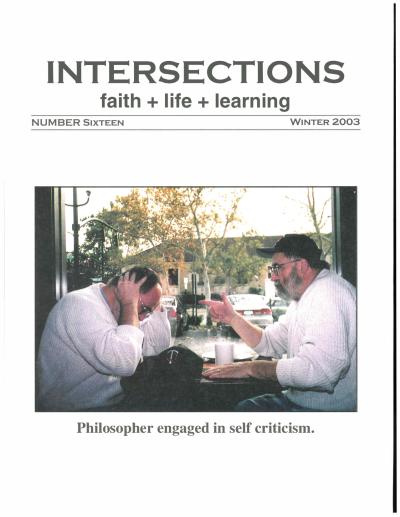
Heggen, Lutheran Campus Ministry pastor and adjunct English professor at the University of Delaware, builds on a freshman’s essay closing line—“All in all our night was complete”—to argue that even in the secular public university one can “teach hope” as a critical principle by drawing on Douglas John Hall’s Heideggerian distinction between calculative and meditative thought, the Frankfurt School’s instrumental versus substantialist reason, Luther’s theology of the cross, Parker Palmer’s “obedience to truth,” bell hooks, Lionel Basney, Shelley Shaver, and Donald Sheehan’s Frost Place “principle of compassion.” The classroom and Lutheran campus ministry together can become “communities of memory and hope” that, like the artist student’s Fourth of July, hold together danger, people getting together, explosions, and lots of fun.
-
 Article
Reconciled Diversity: Reflections on our Calling to Embrace our Religious Neighbors
Jacqueline Bussie
No. 33 · Spring 2011
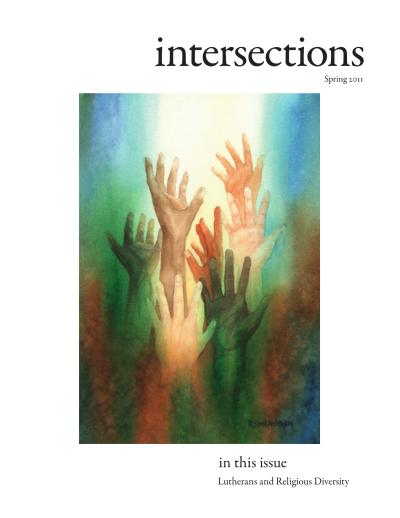
Bussie offers three concrete recommendations for cultivating reconciled religious diversity on Lutheran campuses — Lutheran listening and the telling of stories, engendering encounters with religious neighbors through curriculum and bridge-building events, and choosing empathy and collaboration over evangelism and creed — arguing that what students fear most in encounters with the religious “other” is the loss of their own identity and distinctiveness, and that we can show them how loyalty to one’s own tradition and reverence for different traditions can coexist.
-
 Response
On the Outside Looking Out: A Personal and Social Psychological Response
Chuck Huff
No. 2 · Winter 1997
Huff of St. Olaf—a self-described “Metho-Bap-terian” from the South educated at Bob Jones University—offers a personal response to Bouman’s themes (welcoming the rejection of biblical inerrancy, the distinction between gospel and scripture in the homosexuality debate, the gospel-in-the-creeds reading that releases him from Hellenistic conundrums, and the recasting of justification by faith as meaning rather than insurance policy) and a social-psychological response in which a planned study of campus social networks at St. Olaf was discontinued when preliminary interviews revealed that everyone—storied Lutherans, secular faculty, feminists, fundamentalists—felt like outsiders. Continuing the tradition requires constructing a conversation that is thoughtful, fair, inclusive, charitable, focussed, and still true to the tradition.
-
 Editorial
From the Editor
Jason A. Mahn
No. 38 · Fall 2013
Mahn reads Michael Sandel’s What Money Can’t Buy alongside Larry Rasmussen and Martha Nussbaum to ask how Lutheran schools can articulate the “value added” of vocation without commodifying it, and previews the 2013 Vocation of a Lutheran College conference papers, Patricia Lull’s sermon, and Ann Hill Duin and Eric Childers’ Project DAVID essay that make up the issue.