Living at the intersection of fear and hope has been an image that has formed my thinking, speaking, and leading at least since last January. It was then that I traveled with Evangelical Lutheran Church in America (ELCA) and Evangelical Lutheran Church in Canada (ELCIC) bishops, spouses, and churchwide staff to Jordan, Israel, and Palestine. The trip had been planned for about two years, but what we had not anticipated was the massive incursion of Israeli military forces into Gaza just before our scheduled departure. After much conversation and prayer, we decided to honor the commitment, recognizing that the people we were going to accompany—namely the Evangelical Lutheran Church in Jordan and the Holy Land (ELCJHL)—do not have the option of leaving when conflicts escalate.
I could easily spend this time talking about the intersection of fear and hope in the context of the Middle East and our journey. I trust you know about many of the fears that so persistently hold captive Israelis and Palestinians. I will hold up just three signs of hope in the midst of fear in that context.
We were walking through the streets of Hebron. Jewish settlers have moved into Hebron. Often, the settlers throw garbage down on the Palestinian people as they go to market. As we were walking to the mosque, a man grabbed my arm, “You must come and see my home.”
Up small stone stairs, we walked to his third floor apartment. It was about twenty feet across a rooftop from Jewish settlers. They were separated by a fence and an Israeli armed guard. “Look what they did!” the man yelled pointing to his completely burned-out home. “But this did not burn,” he said, holding his charred Quran. “I can still read the Quran, so I still have hope.”
We visited one of the Lutheran churches in Ramallah. In a classroom of fifth graders, I asked the children what it is like for them to live and study in Ramallah. One young girl said “I wake up crying for my Mom because, in my dream, I see the bombs in Gaza falling on my house.” Fear.
But following our visits to classrooms, we went to the lunchroom where Christian and Muslim students danced together traditional Palestinian folk dances. It was a joyful dance of defiance in the face of war and death. Oh, yes, and the name of the school is Hope.
A third sign of hope from our Middle East visit was my meeting with King Abdullah II of Jordan. I sat down and his majesty immediately put three items on the agenda for our conversation. “Bishop Hanson, I want to talk about how together we can ensure a vibrant future for Arab Christianity; guarantee Jerusalem will be a shared city for Jews, Christians, and Muslims; and deepen Muslim-Christian understanding and relationships throughout the world.”
We continued that conversation when King Abdullah came to Washington, DC to meet with President Obama in April. I look forward to deepening our shared commitment at a conference at Georgetown University in October.
But it was not only our trip to the Holy Land that convinced me that we are living at the intersections of fear and hope. That sense permeated my experiences at President Obama’s inauguration where the daunting challenges facing the new administration were not minimized, but neither were they able to turn back the surging tide of hope that washed over the massive crowds.
Perhaps I do not need to remind you of other factors that contribute to our living at the intersection of hope and fear. The turmoil in the economy certainly has contributed to heightened anxiety on college and university campuses, for the churchwide staff in Chicago, for ELCA congregations, synods, and ecumenical partners. We needed to reduce our 2009 churchwide budget by $7.5 million after the fiscal year had begun, causing a reduction in workforce and executive salaries. You are familiar with these realities from your campuses as endowments shrink, budgets tighten, layoffs occur, and anxieties rise.
In a couple of weeks, we will gather in Minneapolis for our churchwide assembly. It seems human sexuality and the place of gay and lesbian persons in ministry is cause for anxiety for some and hope for others. Yet, I approach the assembly in confident hope because I trust our maturing ability to have civil discourse and to stay focused on the faithful mission that unites us while acknowledging deeply held differences on human sexuality.
At the intersection of fear and hope it is important that we name our fears—name them publicly, communally, and prayerfully. So let us practice. Thinking of ELCA colleges and universities at the intersection of fear and hope, what fears do you hold or perhaps what fears hold you and the academic community in which you serve?
This spring I participated in commencements on three college campuses. I listened for and to the fears being expressed. Certainly, they were what I expected to hear—from presidents, board members, and administrators—fears about the impact of losses in endowment, student financial aid, and enrollment. From students: fears of not finding employment or increased competition for graduate school admissions. From faculty: the fear that the commitment to liberal arts may be sacrificed to meet market demands for more specialized career preparatory course and majors, and the anxiety about financial implications for both tenured and contract positions.
It is important not only to name our fears, but also to know what fear can do to us individually, collectively, and institutionally. To paraphrase a comment Walter Brueggemann made ten years ago, fear can turn us inward and we become possessive of what we have. Fear can make us distrustful of others (particularly those in leadership). Finally, fear can make us downright anti-neighborly.
Systems theorists have been very helpful in describing how anxiety can drive us to react out of the reptilian cortex of our brains, so that we become mean-spirited, defensive, and even aggressive. Both academy and church are affected by the toxicity of the culture wars. Too often erosive currents of ideologies are held and expressed more with divisive bitterness than engaging passion.
Scripture is replete with stories of people living, struggling, believing, and doubting at the intersection of fear and hope. That is certainly a theme in the Easter narratives. In John 20, the risen Christ appears uninvited to his disciples who are behind locked doors for fear of the Jews. This is not anti-Semitic, but a description of the fate the disciples feared for being followers of Jesus. I wonder how many of us are hounded by that fear in the night, “What if someone identifies me as a follower of or believer in Jesus?
The risen Christ’s first words to his terrified disciples were, “Peace be with you.” I hear those as words of absolution for the disciples having betrayed, denied, and abandoned Jesus. I believe they were more than words of greeting. They were God’s gift of peace that becomes a source of hope in Christ at the intersection of fear and hope.
Joseph Sittler described the peace of God as both rest and movement. Sittler wrote,
The peace of God as rest, whose gift is to have no anxiety, fulfills itself in a peace of God as movement which goes out with holy concern about everything. The peace of God as rest in God’s acceptance of a person is not a knowledge that the world can deliver, is not in fact concerned with the world at all. But this same peace … knows that the peaceless world is precisely the place for working out of God’s will for truth, justice, purity, and beauty. (Care 39)
With this admittedly long introduction, I want to turn to the question, “What is the vocation of Lutheran higher education at the intersection of fear and hope?” Much could and perhaps should be said about the meaning of “vocation.” To what you already know about the Lutheran understanding of vocation, I will add two quotations that give perspective on vocation. Frederick Buechner describes vocation this way: “The place God calls us to is the place where our deep gladness and the world’s deep hunger meet.” (95) Or, as W.H. Auden said in less familiar words: “You owe it to us all to get on with what you’re good at.”
In the time remaining, let me share at least some of the things you are good at in Lutheran higher education and some of the forces or factors that challenge you and us at the intersection of fear and hope.
Testing the Spirits
Lutheran communities of higher education are places to examine both the fears and hopes that meet us at this intersection and ourselves.
To use other words, the vocation of our colleges and universities is to be communities that test the veracity of our fears and hopes, and to inquire about their authenticity—whether these fears and hopes lead to a truer engagement with the world (as suggested by Sittler’s observation of peace or movement) or whether they are deceptive and misleading fantasies that draw us into the abyss of self-absorption.
This examination of the veracity or authenticity of the convictions that our deepest fears and hopes express commonly is called “critical inquiry” in academic communities. It is not one area of study among many, but the common calling or vocation of all areas of study. Critical inquiry is our vocation as Lutherans in higher education: it is what we are good at. But it does not begin with higher education. Rather, it is grounded in Luther’s approach to how parents in the home teach their children the catechism. We teach our children not only the words of the Ten Commandments, the Apostles’ Creed, and the Lord’s Prayer, but we also teach them to ask, “What does this mean?”
The vocation of a Lutheran college that is so vital to the mission of the ELCA and to the world is to plant deep within students a lifelong unquenchable curiosity about God, the meaning of life and being human, and the centrality of faith. It is also to give students an unquenchable curiosity about the vastness of the cosmos, the intricacies of DNA, the beauty experienced through the arts, the complexities of science, math, economics, the richness of history, the challenging questions of philosophy, and the haunting consequences of systemic domination and exploitation.
The vocation of Lutheran higher education at the intersection of fear and hope is to resist the mighty forces that would draw us down the path of fear. One sign of such a seductive power is that a commitment to unquenchable curiosity is replaced with the satisfaction of insatiable appetites as the end toward which higher education must lead. Our colleague Jonathan Strandjord says wisdom usually comes in one of two flavors: wisdom that seeks to satisfy our desires or wisdom to reduce our cravings. Both are essential to human life. Yet, he cautions, one can lead to a life preoccupied with our own needs and the other to cool detachment, or even isolation. He calls us to another form of wisdom, wisdom that makes us “other-wise.” This wisdom is not the mastery of a specialized subject, but a basic posture, an overarching purpose, an intellect in search of an extraordinary project. Being other-wise is not driven by the need for power or possessions or by the quest to be above the fray. It is instead born of wonder or ecstasy, which takes us out of ourselves, but not out of the world. It places us before the neighbor.
Please do not misunderstand. I am not dismissing the move toward education as preparation for success in the marketplaces of a competitive world. I am, however, putting down a caution flag if that move comes at the expense of critical inquiry, nurturing unquenchable curiosity, and wrestling with life’s big questions. It is understandable that student and parents will ask, “What will I/we receive as a return for a quite substantial investment of money and time in a Lutheran college or university education?” The need to give a response that is measurable and marketable is understandable. But I am pleading that the response not sacrifice what you are good at: your vocation—critical inquiry, wisdom as wonder, in essence a strong liberal arts education.
As you engage in your vocation of testing the spirits at the intersection of fear and hope, there is another factor or force that merits ongoing critical examination: religious fundamentalism. It may be far too gross a generalization, but I would contend that the more overpowering our fears, the more attractive fundamentalism looms as a supposed, if illusory, source of hope. That phenomenon directly challenges what Douglas John Hall calls “a thinking faith,” which I believe belongs to the vocation of a Lutheran higher education and is a sign and source of hope.
Do we have the courage to be that bold in responding to the demands for assurances of certainty today? What makes fundamentalism so attractive in our turbulent world? Listen to Douglas John Hall in Bound and Free:
Fundamentalism, whatever the origins of the term, has come to mean a position of such exactness and certitude that those embracing it, or more accurately, those embraced by it, feel themselves delivered from all the relativities, uncertainties, indefiniteness, and transience of human existence. They are provided, they feel, with a firm foundation—a fundamentum—greater than their own finitude—greater than any of the sciences, greater than the collective wisdom of the race. (100)
Then Hall reminds us:
God does not meet our demands for certainty with a simple rebut or refusal. God offers an alternative to certitude. It is called trust. God reveals God’s self as one who can be trusted. … Certitude is denied. Confidence is made possible. Consider that word confidence. Literally from the Latin, it means (con) living with (fide) faith. (101-102)
Hall concludes:
Now faith is a living thing. It is a category of the present. It is not a once-for-all accomplishment. It is not a possession like a Visa card that some have and others don’t. Faith is an ongoing, living relationship and response to God, to the world, and to life. (102)
I believe the vocation of Lutheran colleges is not just to offer a critique of religious fundamentalism, but to offer an alternative. That alternative is an academic community in which a “thinking faith” can be expressed and explored. It is a community in which people of diverse religious convictions as well as people with no faith are welcome into conversations so that our understanding of, and appreciation for, the faith of our neighbor might grow. It is also a community in which we might make common commitments to work together for justice, peace, and care of creation, the vitality of neighborhoods, and the practice of citizenship. In other words, the vocation of Lutheran higher education is to prepare citizens to seek the common good and to recognize the contribution of religious beliefs and practices toward that end.
I am serving on President Obama’s advisory task force on inter-religious relationships. We are putting as much energy into encouraging local communities to create inter-religious service opportunities as we are giving advice on the content of President Obama’s speech in Cairo and on policies toward governments that persecute religious minorities. The contributions of colleges and universities to countering the powers of religious extremists should not be underestimated. More than creating a culture of tolerance or abdicating for relativism or eclecticism, it is to exercise your vocation of critical inquiry by engaging in critical pluralism while seeking the common good and the well-being of the neighbor near and far.
I will close with a question that I suspect will be answered by the presenters and discussions throughout this conference. The question is, “What hermeneutic will shape your vocation, the vocation of Lutheran higher education, at the intersection of fear and hope?”
Admittedly, hermeneutics is a word most often associated with the study of scriptural interpretation, the principles that move us from the texts of scripture to the contexts of our lives. I am using hermeneutics a bit more broadly. The Greek root of hermeneutics is related to Hermes, the messenger god in Greek mythology, described as “the patron of boundaries and of the travelers who cross those boundaries, patron of shepherds and cowherds, of thieves and road travelers, of orators and poets. Yes, and of the cunning of thieves and liars.” (Burkert)
In your calling as educators, you are encountering and accompanying people who are often testing, crossing boundaries—boundaries of emotional maturity, of separation and forming new communities, of vocational discernment and moral development, and discovering new intellectual challenges.
Hermeneutics is the lens or window through which you exercise your vocation: what you’re good at as educators. Hermeneutics is also what you are giving or forming within your students. My concern or at least my question is this: “Does the vocation of critical inquiry lead only or inevitably to a hermeneutic of suspicion?”
Obviously, the phrase “hermeneutic of suspicion” and the question merit a paper if not an entire conference. I frankly do not know where one crosses the line from critical inquiry to a hermeneutic of suspicion. However, the perception that a hermeneutic of suspicion is the dominant lens or window used by faculty contributes to an often ambivalent dance between scholarly communities and their religious constituencies and shadows the question of vocation for church-related institutions of higher education.
Peter Rollins described Marx, Nietzsche, Freud and their intellectual descendants as masters of suspicion who always sought to expose “the lie” in “belief.” Lewis Mudge gave this description of critical inquiry practiced as a hermeneutic of suspicion: “that religious language may not mean what it appears to say at all: it may be a coded version of something else of which we would prefer not to be aware.” (4)
So what are the consequences of the hermeneutic of suspicion? What are the signs of its presence? One is that religious communities, including some Lutherans, tend to view the erosive effects of critical inquiry practiced as a hermeneutic of suspicion on religious beliefs, practices, and relationships. Thus, religious communities become suspicious and distrustful of communities of higher learning. In turn, academic communities sometimes—too often—default to a fearful suspicion that academic freedom and scholarly integrity will be lost if higher education is too closely aligned with religious communities and their fears and hopes.
There is perhaps a different twist on the same concern about the consequences of a hermeneutic of suspicion for the vocation of Lutheran higher education: it can lead to a dismissal of the contributions of religion in general and the Lutheran Church in particular to life’s big questions. What makes life meaningful? What does it mean to be human? How do we live together on this planet?
I commend to you an article by W. Robert Connor, president of the Teagle Foundation, in the June 9, 2006, issue of the Chronicle of Higher Education. Titled, “The Right Time and Place for Big Questions,” he asks,
Can students’ interest in and engagement with religion and spiritual matters, and the questions associated with them, invigorate their liberal education? Based on my conversations with faculty members in a wide range of fields, meetings with students, and class visits, the answer clearly is “Yes.” As a result, the Teagle Foundation invited colleges to apply for support for projects that deal with big questions in undergraduate education.
Connor writes,
Despite the number and quality of those applications, however, we can see that there is still reluctance among faculty members to engage with the big questions—many professors clearly feel that they are not adequately trained to deal with them. Faculty members have also expressed concerns that tenure and salary increases will be put in jeopardy if they break out of existing disciplinary paradigms—or that a few students who find that class discussions run counter to their beliefs or preferences could damage professors’ careers by filling out negative course evaluations. Teachers sometimes need to be assured that they do not have to answer the questions for their students; rather, their role is just to help students think about them.
Connor continues that a friend recently wrote, “It is less a question of expertise than of feeling comfortable enough to articulate an issue in a way that is cogent and civil, and encourages and doesn’t close off discussion.” I believe the vocation of critical inquiry—of unquenchable curiosity—can be carried out with a hermeneutic of confidence and trust rather than a hermeneutic of suspicion.
Douglas John Hall reminds us that the God of biblical faith is merciful. At the intersection of fear and hope, God does not meet our need for security only with refusal and rebuff. God offers an alternative to certitude: it is called trust. God reveals God’s self as one who may be trusted.
God does not give us the truth, yet God lets truth live among us, incarnate, and lets us glimpse enough of God’s living truth that we may learn the courage to live despite our real vulnerability, impermanence, and selfishness.
Certitude is denied. Confidence is made possible. Consider that word: confidence. Literally in Latin, it means living with faith… Now, faith is a living thing. It is a category of the present. It is not a once-and-for-all accomplishment. It is not a possession like a Visa card. It is an ongoing … response to the world. (Hall 101-102)
Such a hermeneutic of confidence will not diminish the vocation of Lutheran higher education but might mean the vocation is one of appreciative inquiry—the result of the grace of God—not only critical inquiry. As Joseph Sittler wrote,
What I am appealing for is and understanding of grace that has the magnitude of the doctrine of the Holy Trinity. The grace of God is not simply a holy hypodermic whereby my sins are forgiven. It is the whole giftedness of life, the wonder of life which causes me to ask questions that transcend the moment. (Gravity 14)
The vocation of Lutheran higher education is not only appreciative or critical inquiry, but the creation of communities of discernment. At the many intersections of fear and hope, we must not succumb to contentious, fractious, and partisan divisions, but must seek to discern out of our diversity what serves the common good, what serves the cause of justice and peace.
As Cynthia Moe-Lobeda reminds us, the community has a stake in and a calling to such discernment.
The heart of discernment is to hold ‘what is,’ and ‘what could be,’ in light of the life-giving, life-saving, life-sustaining mystery of God’s ongoing work toward the redemption and flourishing of creation. Said differently, we are to hold our earthly realities in one breath with the power and presence of God, in order to craft ways of living that proclaim God as seen in Jesus Christ. Where vision of life’s realities is obscured by illusions, a task of Christian discernment is to see differently so that we might live differently. Where dominant forces distort historical realities by describing them falsely, Christian discernment must re-see and then ‘re-describe the world.’ (65-66; Cf. Brueggemann 17)
Is she not describing in part the vocation of Lutheran higher education? More accurately, she is describing our shared calling—our shared commitment. As we exercise that calling in our varied contexts, I believe we become signs of hope. For our shared calling let us remember that faith quells our fears and strengthens our courage as we live and serve at the intersection of fear and hope.
Works Cited
Brueggmann, Walter. “Voices of the Night—Against Justice.” To Act Justly, Love Tenderly, Walk Humbly: An Agenda for Ministers. Mahwah, NJ: Paulist, 1986.
Buechner, Frederick. Wishful Thinking: A Theological ABC. New York: Harper & Rows, 1973.
Burkert, Walter. Greek Religion 1985 section III.2.8; “Hermes.” Encyclopedia Mythica from Encyclopedia Mythica Online. Retrieved February 17, 2010.
Connor, W. Robert. “The Right Time and Place for Big Questions.” The Chronicle of Higher Education 9 June 2006: B8+
Hall, Douglas John. Bound and Free: A Theologian’s Journey. Minneapolis: Augsburg Fortress, 2005.
Moe-Lobeda, Cynthia D. Public Church for the Life of the World. Minneapolis: Augsburg Fortress, 2004.
Mudge, Lewis S. “Paul Ricoeur on Biblical Interpretation.” Mudge, Lewis S, and Paul Ricœur. Essays on Biblical Interpretation. Philadelphia: Fortress, 1980. 1-40.
Sittler, Joseph. Gravity and Grace: Reflections and Provocations. Minneapolis: Augsburg, 1986.
———. The Care of the Earth, and Other University Sermons. Philadelphia: Fortress, 1964.
-
 Editorial
From the Publisher
Mark Wilhelm
Wilhelm invites readers to enjoy or revisit the presentations from the 2009 Vocation of a Lutheran College Conference, then reflects on the Higher Learning Commission’s denial of Dana College’s request to transfer accreditation to a for-profit purchaser—an event that effectively ended Dana’s sale and prompted ELCA colleges and universities to welcome Dana students and faculty—and argues that the irreversible entry of for-profit operators into liberal arts education gives the Lutheran community further reason to continue the conversation about the vocation of a Lutheran college.
-
Article
Practicing Hope: The Charisms of Lutheran Higher Education
Martha E. Stortz
Stortz names four charisms—theological gifts of identity rather than commodities—that Lutheran higher education brings to a culture of fear: semper reformanda as flexible, responsive institutions; the freedom of a Christian as simul justus et peccator critical inquiry that holds opposites in creative tension; regard for the other as “neighbor” rather than friend or alien; and the priesthood of all believers as a public, civic calling to know the poor. Drawing on Augustine, George Lindbeck, Patricia Killen, James Clifford, Earl Shorris, Carter Lindberg, and Augsburg’s Center for Global Education, she argues that immersion trips, neighbor-regard, and welfare reform witness that the gift Lutherans bring is hope grounded in Christ in you, the hope of glory.
-
Article
Hope in the Face of Ecological Decline
Jason Peters
Peters reads our ecological crisis—a campus “Birth Control Tree,” feminized fish, population, climate, water, and soil—through Alexander Pope, William Blake, Søren Kierkegaard, and C. S. Lewis’s The Abolition of Man, and argues that the modern project of mastering nature has made despair (the unconscious form Kierkegaard named) our condition. He calls for three reorientations: practical (assigning value to domestic arts and place over disciplinary specialization), philosophical (dismantling the Baconian/Machiavellian/Cartesian project of control), and theological (recovering the Church’s rejection of Gnosticism so that grace comes to us by means of nature, not in contempt of it).
-
Article
Hope in a Period of Economic Decline
Rebecca Judge
Judge reads the 2008-2009 recession against the panic-free 1982 downturn and argues that this panic comes from the genuine surprise of a generation that had been told—by George Will and others—that business cycles had been tamed by deregulation, globalization, and Greenspan. Drawing on Luther’s “Trade and Usury” and Large Catechism, Paul Tillich, Stephen Marglin, Karl Polanyi, and Larry Summers, she critiques the “crude utilitarianism” of Homo economicus and benefit-cost analysis, finding hope in the possibility that this recession will renew a national conversation about moral obligation to neighbor in a market whose “raging bull” has broken out of its squeeze chute.
-
Article
An Apostolate of Hope
David L. Tiede
Tiede argues that the vocation of a Lutheran college is to be “an apostolate of hope” oriented by three metrics of our time: 12,000 (the Dow), 350 (parts per million of CO2), and $1.25 (the daily income of 1.4 billion people in extreme poverty). Drawing on Darrell Jodock’s “third path” for church-related colleges, Larry Rasmussen’s Batalden lectures, Mark Tranvik, Douglas John Hall, Bill McKibben, Stephen Privett, Peter Singer, and Augsburg’s Center for Global Education, he proposes that justification by faith, critical pluralism, stewardship of God’s earth, and love and justice for our students together prepare wise leaders to renew the future.
-
Article
"Annoying the Student With Her Rights:" Human Life Coram Hominibus; Reflections on Vocation, Hope, and Politics
Caryn Riswold
Riswold takes a student’s course-evaluation complaint that she had been “annoyed with her rights” about voting as the entry point for reflection on fear of change, mistrust of difference, and right-wing extremist violence—Poplawski, Von Brunn, Roeder, and the Sotomayor hearings. Drawing on Gerhard Ebeling’s reading of Luther’s fourfold relationality (coram Deo, mundo, meipso, hominibus), Brian Gerrish, Alister McGrath, Gustaf Wingren, Philip Hefner, Mary Rose O’Reilley, and bell hooks, she argues that the vocation of the Lutheran college is precisely to “annoy students with their rights” by forming them for socially responsible voice grounded in faith active in love.
-
Reflection
The Neglected Miracle of Pentecost
Susan M. O'Shaughnessy
O’Shaughnessy, in a homily delivered at Concordia College in 2008, reads the Pentecost narrative of Acts 2 through Maria Lugones and Elizabeth Spelman’s 1983 critique of white feminism’s cultural imperialism. She argues that the miracle is not the disciples’ speaking but the immigrant Jews’ hearing—and that the writer of Acts withholds the content of what was said precisely to teach disciples that people of privilege know less than the foreigner, the immigrant, the oppressed, the woman, the child, and must learn to listen in new languages before they can speak.
-
 Article
Negotiating Legitimate and Conflicting Values
Eboo Patel, Katie Bringman Baxter, Mark S. Hanson
No. 44 · Fall 2016
In a closing-day conversation at the 2016 Vocation of a Lutheran College Conference, Mark Hanson and Eboo Patel — moderated by Katie Bringman Baxter of Interfaith Youth Core — share case studies in which legitimate religious values come into tension with one another, and make the case that Lutheran colleges should teach interfaith leadership through the hard cases rather than the easy ones.
-
 Reflection
Colleges Lead Way: Curiosity, Faith, Discernment, Mission are Key
Mark S. Hanson
No. 28 · Fall 2008
Reprinted from The Lutheran (November 2007), Hanson names four marks of the colleges of this church—nurturing unquenchable curiosity, nourishing faith formation and exploration, modeling public moral deliberation, and preparing students for engagement in the world—and gives thanks for the colleges’ vocation to call us to stand outside ourselves and reach out in mission for the sake of the world.
-
 Article
Reflections on Our Shared Commitments
Mark S. Hanson
No. 25 · Spring 2007
Originally delivered to the Lutheran Educational Conference of North America in March 2007, Hanson’s address describes the ELCA as “an ecology of interdependent ecosystems” and locates the church’s relationship to its twenty-eight colleges and universities in a shared mission rather than in older anxieties about church-relatedness. Drawing on Wittenberg’s Lutheran Identity Study, Augustana’s “Five Faith Commitments,” Pamela Jolicoeur’s Concordia address, W. Robert Connor on “big questions,” Joseph Sittler on grace, Walter Brueggemann on fear, Jonathan Strandjord on being “other-wise,” and Cynthia Moe-Lobeda’s Public Church for the Life of the World, he names four marks of shared mission: communities of free inquiry, encouragement of religious expression in a diverse society, education for the common good, and the formation of leaders for church and religious communities worldwide.
-
 Editorial
From the Editor
Tom Christenson
No. 14 · Summer 2002
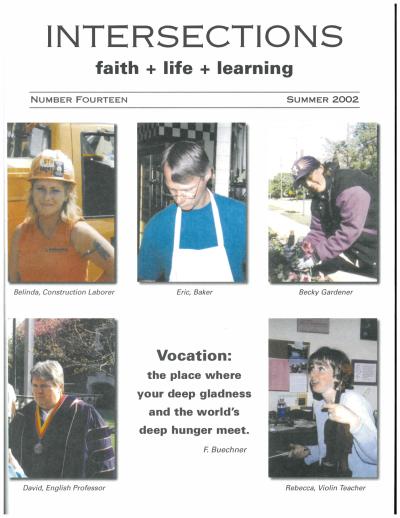
Christenson argues that whether or not the conversation is funded by the “Lilly lottery,” vocation should just be part of who we are and what we do at ELCA colleges, and proposes three low-cost conversations—among faculty (twenty dollars of wine, in vino veritas), with students throughout their four years, and with alumni—explaining why this issue is deliberately “fatter” than usual and inviting feedback on other single-topic issues.
-
 Article
Vocation Outside of Career: Discovering Purpose through Comics
María Evelia Emerson
No. 53 · Spring 2021
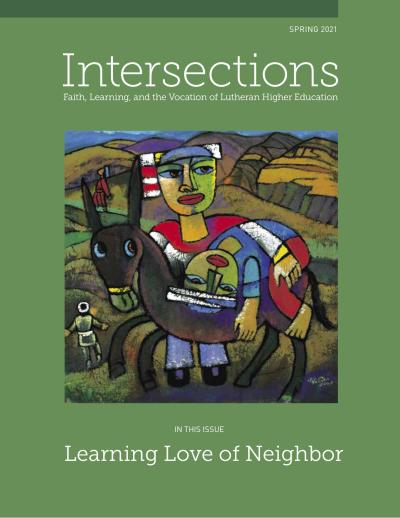
Emerson recounts building an Augustana Vocational Discernment course around G. Willow Wilson’s Ms. Marvel series, using Kamala Khan’s juggling of family, friendship, faith, and superhero identity to help sophomores see vocation as not what they do for a living but how they want to live.
-
 Article
Educating for Peace: 21st Century Models for Thinking Globally and Acting Locally
Janet E. Rasmussen
No. 18 · Fall 2003
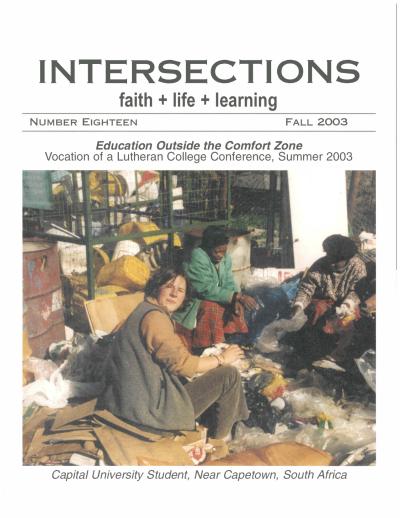
Rasmussen opens with a rabbinic story about the one-step distance between East and West and describes Pacific Lutheran University’s four-phase “Global Education Continuum”—Introductory, Exploratory, Participatory, Integrative—developed with Teagle Foundation support and grounded in Perry, Bennett, and Musil. She illustrates intentional global/local partnership through three case studies: Barbara Temple-Thurston’s Trinidad-and-Salishan initiative; the China Partners Network with the Amity Foundation, Good Samaritan Hospital, and PLU’s Wang Center; and Ann Kelleher’s three-institution “Norway in Namibia” partnership with Hedmark University College, the University of Namibia, NAMAS, and the Ondao mobile schools for the Himba people. She closes with Daloz, Keen, Keen, and Parks’s Common Fire research and Lee Knefelkamp’s call to be “communities of peace.”
-
 Article
It's Time to Rewrite the Rules of Civility
Jon Micheels Leiseth
No. 48 · Fall 2018
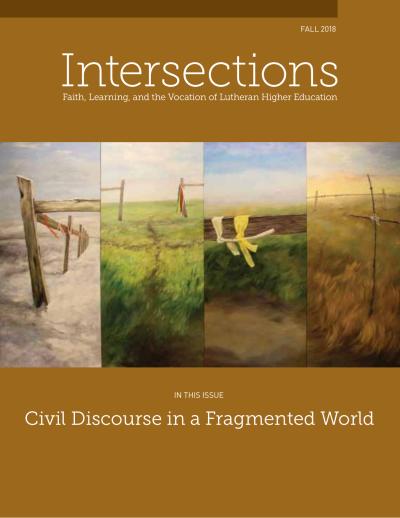
Leiseth contends that the prevailing rules of civility too often function as the majority’s rules, stifling those facing real harm — and proposes that NECU institutions rewrite civility as “neighboring,” guided by the ELCA’s five values of accompaniment: mutuality, inclusivity, empowerment, sustainability, and vulnerability.
-
 Editorial
From the Publisher
Arne Selbyg
No. 15 · Winter 2002
Selbyg announces that the 2001 ELCA Churchwide Assembly has commissioned a new social statement on education, placing it alongside the economy, the environment, abortion, sexuality, health, and peace, and invites Intersections readers to submit input on which topics within the field of education the statement should address.
-
 Article
The Literature of Spiritual Reflection and Social Action
Shirley Hershey Showalter
No. 10 · Fall 2000
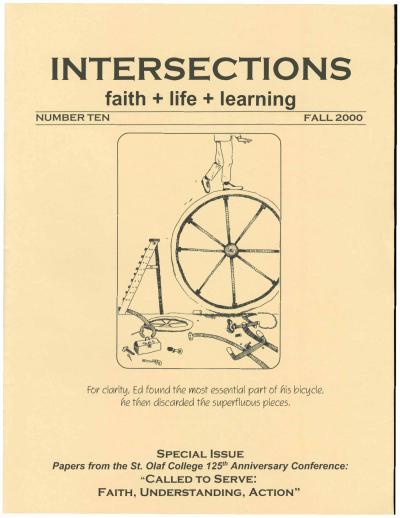
Showalter, president of Goshen College, opens with Garrison Keillor’s “Singing with the Lutherans” and Walter Sundberg’s account of the Anabaptist “radical reformers” to locate Mennonite identity in a theology of suffering, humility, narrative, and song—tracing it through John S. Coffman’s 1904 “The Spirit of Progress,” Harold S. Bender’s 1944 “Anabaptist Vision,” John Howard Yoder’s The Politics of Jesus, and J. Lawrence Burkholder. She uses her Senior Seminar “Pedagogy of the Holy Spirit” reading of Viktor Frankl’s Man’s Search for Meaning, Madeleine L’Engle’s “Be a namer” and Walter Wink on the angels of institutions, and a Goshen Study-Service Term (SST) journal entry by student David Roth returning from Haiti—closing with two poems by Sarah Klassen—to argue for naming as the redemptive practice of church-related education.