Theodore Hesburgh, the legendary president of Notre Dame, raised millions of dollars inviting others into a vision. “Let us make the finest Catholic University since the Middle Ages.” Hesburgh’s appeal to Roman Catholic loyalists was the envy of many development offices, but the case was more difficult within the university. When curricular reform was directed toward “the Catholic intellectual tradition,” more than one faculty cynic declared “Catholic intellectual” to be an oxymoron.
Still, I join the Catholics, non-Catholics, and advocates for diversity in higher education who argue that if you teach, lead, or learn in a Roman Catholic institution of higher education, you owe your work better than such an arrogant dismissal. Let’s also hope that the Quakers at Earlham College will be aware of their intellectual, moral, and spiritual tradition in the core of their work and will sustain their distinctive community of learning. And what does Brandeis bring to the table from its Jewish identity? In the past century, most higher education became secularized, overtly or tacitly, while places like Bob Jones University stand out as sectarian. Marsden notes the transformed soul of the historic American university. Harvard, Chicago, and the University of Minnesota were once publicly committed to veritas or public discourse or being land-grant institutions. And even if Burtchaell’s image of The Dying of the Light is sentimental, the declining cadre of strong colleges with a Christian identity prompted the Lilly Endowment to invest a half-billion dollars to engage in the “theological exploration of vocation.” Put simply, the world of higher education will be more consequential because Notre Dame is a Catholic University, if indeed they know what they are doing in enacting that identity.
No one who understands the economies and ecology of education thinks it is easy.
When we seek to measure the difficulty, our frame of reference could be the sustainability of these institutions themselves. Without revenues and students, “dollars and scholars,” our loftiest educational missions and deepest faith commitments are at risk. We can’t take the fundamental disciplines of institutional management for granted. Fiduciary governance must be exercised continually. It’s like ice skating. If you don’t do the compulsory figures, you won’t be given the opportunity to freestyle.
But when we are discerning “the Vocation of a Lutheran College,” we are looking beyond concerns for self-preservation, and are pursuing more than restoring the past. We are seeking to embody and enact a distinctive wisdom to prepare the leadership that communities, agencies, institutions, and nations need to navigate the uncharted future.
This gathering of ELCA institutions of higher education with our presiding bishop is itself a sign of the care for our shared vocation. It is also worth noting that the Lutherans who generated our array of strong colleges across the land also built a powerful network of social service agencies, disproportional to our national numbers.
I am serving a term as the “Theologian in Residence” for the Board of Lutheran Services in America. Lutherans have engaged the public world of social service at a strength and competence far beyond their numbers. In comparing notes between the governance of social service organizations and educational institutions, one of the pieces in the LSA reading stack was Darrell Jodock’s unpublished essay entitled: “The Third Path: Gustavus Adolphus College and the Lutheran Tradition.”1 Darrell contrasts “the sectarian model” of being a church-related college with the “non-sectarian” model. The one is thoroughly “rooted in a tradition and sees itself as a kind of ‘religious enclave’ in the midst of a secular society.” The other “prizes inclusiveness. …It avoids religious differences—by minimizing them,” emulating the larger, secularized society.
The sectarians direct their enterprise for conversions. The non-sectarians often once had faith identities. But in Jodock’s terms, their “religious commitments are now so general and superficial as to be innocuous.” Neither model engages religious diversity. He proposes a third model that “takes religious diversity seriously enough to engage and struggle with it, while at the same time remaining deeply committed to the importance of its own Lutheran tradition. Rather than an enclave or a microcosm (of the society), the third option is a well dug deep to provide something helpful for the entire community.”
With those in social service, the world of religious and cultural diversity is our context. Like them, we focus in Lutheran higher education on the “well dug deep to provide something helpful for the entire community.”
And that’s where we will go today. What will it mean to fulfill the promise of our vocation publicly? Who in the world needs what we do? My proposal is that the vocation of Lutheran higher education is to be an apostolate of hope for the world. Our challenge is compounded by our need to differentiate ourselves from sectarian educational strategies without allowing academic anxieties about all religious convictions from shutting down our intellectual and institutional vocations. What convictions and practices does the wisdom of the Lutheran tradition bring to our work of equipping our graduates to be leaders in the world of the 21st century?
To prompt our deliberations, listen to the challenge that Larry Rasmussen gave us verbally at Augsburg in the Batalden lectures on campus in February, 2009.
His topic was the grave risks of global warming, not so much for the physical future of the planet, but for the sustainability of the human and biological future of the earth. Even if we kill off human life cooking the earth, he noted, the planet will keep spinning. Well yes, we thought, but that is hardly consoling.
Then Larry, who is the emeritus Reinhold Niebuhr professor of ethics at Union Seminary and a Lutheran expert in Dietrich Bonhoeffer, quoted Teddy Roosevelt, of all people. Old “bully pulpit” Teddy once remarked that every generation is faced with a “presenting occasion,” and those who lead are advantaged by knowing what the times demand and helping people face reality.
Instead of Teddy Roosevelt, his source could have been Martin Luther or Jesus. In Luke’s gospel, Jesus is quoted as saying to the crowds,
When you see a cloud rising in the west, you immediately say, “It is going to rain”; and so it happens. And when you see the south wind blowing, you say, “There will be scorching heat”; and it happens. You hypocrites! You know how to interpret the appearance of earth and sky, but why do you not know how to interpret the present time? (Luke 12:54-56)
Jesus was teaching that smart as people are at predicting the weather or reading the skies, their expertise was self-absorbed hypocrisy unless they were alert to what God is doing in the world. So we better understand the presenting occasion of our time theologically, that is, interpret our times in the light of God’s purposes and call.
Luther was also “playing it forward,” confident that the living God intends the mercy of Christ for the world. He knew the importance of dealing with real, present concerns. Listen to one of my favorite quotes:
If I profess with the loudest voice and clearest exposition every portion of the truth of God except precisely that little point at which the world and the devil are at that moment attacking, I am not confessing Christ, however boldly I may be professing him. Where the battle rages, there the loyalty of the soldier is proved, and to be steady on all the battlefield besides is mere flight and disgrace if one flinches at that point. (Cited in Hall 108)
So what is the “presenting occasion” of our time? What are its metrics? And what does it mean for Lutheran higher education to be an apostolate of hope?
“... these are measures of defining realities of our time.”
12,000, 350, and $1.25 are three metrics, three powerful, public, symbolic numbers: 12,000 for the points needed in the Dow Jones Average to assuage our economic anxiety; 350 for the maximum parts-per-million of CO2 particles to sustain human life on earth; and last year the World Bank identified the income of 1.4 billion people living in extreme poverty as less than $1.25 per day—12,000, 350, and $1.25.
Other numbers can be cited, but these are measures of defining realities of our time. And if the vocation of a Lutheran College is to be an apostolate of hope, we better be smart about how our deepest convictions can inform and equip our institutions and our graduates for leadership in making the world a more trustworthy place.
Apostles are people, agents of an authority or empire or of God’s rule. Apostolates are agencies or institutions or means for the exercise of authorized powers. So, Jesus sent his followers as agents or apostles of his reign to preach, teach, and heal. The orders of the Roman church are still largely defined by their apostolates of preaching, teaching, or healing. And the sixteenth-century Lutheran Reformation centered the commission to preach in the congregation as God’s “mouth house,” to teach in the schools—including the universities, and to heal in the broad systems of health and social service that still exist.
They are all apostolates of faith, hope, and love, not least hope in fearful times.
If the vocation of a Lutheran college is to be an apostolate of hope, how can our deepest convictions inform and equip our institutions and our graduates for leadership in making the world a more trustworthy place?
Our Augsburg students roll their eyes about the “V” word, vocation, but most of them come to appropriate “vocation” as an interpretive lens for their purposeful lives. Many use Dr. Mark Tranvik’s famous triangle diagram where “vocation” stands at the nexus of God, world, and self. Vocation is not just about me and God. God’s love for the world, this earth on which Jesus lived and died, pulls us, sends us into the world’s great need. And we engage that real, concrete world as agents, apostles of God’s love and justice.
So, as they say on NPR, “Let’s do the numbers!”
12,000 is the daily Dow Jones average from a time when we remember it as good news. To be sure, most of the earth’s people have never heard of the Dow Jones average, but the economic flattening of the world means that in a global economic depression, everyone feels the pain, and as usual, the poor suffer most. And everyone is anxious, especially those who have the most. The productivity curve of wealth and abundance is stoked with debt, trade disparities, health inequalities, and immigration disputes. In the politics of Bill Clinton’s campaign and Obama’s presidency, “It’s the economy stupid!” But will the anxiety of our age dissipate, if and when the Dow again surpasses 12,000?
Our faculties are filled with expertise to help us interpret the present economic time. When the news reporters are looking for a financial sound bite, they would do well to interview our economists, political scientists, community planners, and business faculty. The public, along with our own students, will discover our professors are economically smart about the real world. They won’t hear either an uncritical idolatry of the market or an ideological rant against capitalism. Well, it could happen. Some might be tempted to cheer one side or the other. But then our hypocrisy would be transparent in our tuitions, compensation, mortgages, retirement accounts, and the college’s endowments. We are embedded in systems that work quite well, at least for us, even as we seek higher pay.
California Lutheran recently brought over the Center for Economic Research and Forecasting along with faculty from UC Santa Barbara. They are getting ink in the Wall Street Journal. What a coup! What game will they play on the Lutheran education field?
Can our schools communicate a deep understanding along with our technical smarts?
Think about the public strengths of your school. Look at your institutional website. Business and leadership programs are proliferating. Majors in mathematics and digital systems are marked for employability. Do we bring a distinctive intelligence to the work?
“Do we bring a distinctive intelligence to the work?”
Lutherans are known for focusing on justification by God’s grace through faith. Luther identified “justification by faith” as the article of faith by which the church stands or falls. He was protesting the Roman church’s control of the “treasury of merits” needed to enter heaven. That sixteenth-century economy of salvation also created a financial economy that burdened people with proving their worth before God. In studying the Apostle Paul’s letters, Luther rediscovered Christian freedom. Human worth is not based on scrupulous performance nor obtained by purchase, but freely given by God, received purely by faith.
The faith of which he spoke was not merely a list that had to be believed, but a trust, a confidence in the God whose reign was enacted in Jesus. “Anything on which your heart relies and depends,” said Luther, “is really your true God.” He then warned against relying on the false god of wealth, “the most common idol on earth” and also “great learning, wisdom, power, prestige, family and honor.” Those “who trust in them have a god also, but not the one true God.” (387)
Luther’s talk of “the one true God” makes relativists nervous. This is where the prophetic religions of Judaism, Christianity, and Islam part ways with spiritualities of human ascent or enlightenment, confessing that there is a God extra nos, outside of us. But pay attention to the character of this God and the belief that bears the quality of trust. This is the kind of faith that moves with strength from its center rather than guarding its boundaries. This is how the Lutheran tradition navigates the pluralism of a world of many cultures and religions, holding steady without insisting on its own way.
Our new Islamic neighbors in Cedar-Riverside have told us that in the refugee camps in Somalia, the word was that the Lutherans are safe. So Lutheran World Relief and Lutheran Immigration and Relief Services have helped open the door for Muslim students in our Lutheran colleges. In turn, Muslim parents have every right to expect their faith to be respected and their children will be received in good faith in our Lutheran colleges. This is not another environment of relativism, explaining away beliefs, but in authentic, critical pluralism, we deal “faith to faith.” Lutherans are mere “justified sinners” with no cause to manipulate others because their own worth is based on a trust relationship.
Now let me be clear. God’s justification is both personal and public. Lutherans have specialized in pastoral care, and American religion is highly individualistic. But the story is also prophetic. For the prophets, human history is an arena of struggle where God’s reign is enacted and God’s will is defied. The apostle Paul also saw God’s righteousness empowering our vocations in God’s public agency of justice and mercy for the world.
In Christ, God was reconciling the world to himself, not counting their trespasses against them, and entrusting the message of reconciliation to us. So we are ambassadors for Christ, since God is making his appeal through us. (2 Cor. 5:19-20)
Jesus’ freedom in dealing with all conditions of people displayed his Messianic authority in his life and death. His resurrection vindicated his mission of God’s care for apparent outsiders. In Matthew’s Gospel, Jesus is quoted as quoting the prophet Hosea, who was quoting God, “Go learn what this means, I desire mercy not sacrifice.” (Mat. 9:13; Hos. 6:6). When his followers announced “Jesus is Lord,” their faith irritated the empire’s official rhetoric that “Caesar is Lord.” Most were loyal to the Roman order, even in the military. Still their apostolate of hope was prophetic testimony. God’s rule in Christ is finally not a rule-based system of control, but a relationship of trust, even love.
So how does justification by faith inform our apostolate relative to a faltering DOW?
Let me take three quick runs at it to prompt further deliberation.
One: You don’t have to be a wizard to discern that the DOW at 7,500 is a wake-up call, if not a panic. Even 9000 calls for reorientation, for the change of mind the ancients named metanoia or “repentance.” Some breast-beating is surely in order for Wall Street’s abuse of the financial systems as well as by all of us for how our acquisitive economy has enslaved people with debt for doing their duty as consumers, just our getting stuff. But the wisdom of justification by faith moves beyond penance to trust. Jesus’ opening line in Mark 1:15 is “Repent and believe in the good news!” The good news worthy of trust is that your battered financial statement does not measure your true worth or even your impact.
Or your institution’s worth! The schools with the deepest endowments were the first to feel the impact on “business as usual.” When your financial model is locked down, the justification of the status quo is pretty secure. The signs are all around us that profound change is coming to higher education, in part because of the new digital world and in part because the financial projections were scary before the market fell. Merely improving good schools could protect vested interests for a time, even tenure. But denial of change could waste the opportunity of a crisis to reform our institutions for their future work.
Two: Think about the Countrywide fraud and Madoff schemes. What’s the big surprise? We were suckers for a faulty bill of goods on the basis of what Douglas John Hall calls, “doctrinaire optimism.”(158-69) It sounded too good to be true, even when we were tempted by easy money and financial institutions betrayed their public trust. Did we forget sin? Justification by faith is grounded in an analysis of our compromised human condition, and God who justifies the ungodly still is intent on our making the world trustworthy. Imagine what every academic discipline and teacher could contribute to this vocation!
Three: Our Christian story was formed in an anxious time and reformed in another. Listen to a still more ancient witnesses, way before the Dow Jones average.
The author of Isaiah 40-55, who is known as Second Isaiah, was the prophet who interpreted Israel’s return from Israel’s exile in Babylonia. The verse you are about to hear was also cited in Luke’s account of Jesus’ parting words to those who were about to be sent as his apostles to the ends of the earth. In times of profound change, God’s story is about more than the restoration of a glorious past.
Is too light a thing that you should be my servant to raise up the tribes of Jacob and to restore the survivors of Israel; I will give you as a light to the nations, that my salvation may reach to the end of the earth. (Isa. 49:6)
So if the faltering DOW is a sign of the times that alerts us to change and reminds us of our compromised condition, it is also, by God’s grace, a call to renew our apostolate and play it forward in a new time. God has the earth and all the nations in mind.
Let me be more direct on 350 and the hope of stewardship of God’s earth. Bill McKibben, author of Deep Economy identifies 350 as “the most important number on earth!” An active Christian, he sits lightly on theological arguments as he writes for broad publics. 350 CO2 parts per million is a more urgent number than the DOW at 12,000 because we are already beyond the limit. So let me provide some theological grain for that mill as we consider 350 and the exercise of our apostolate in higher education. Maybe we can at least sweep away some of the religious chaff.
Chaff is too kind a word for the popular heresy focused on hastening the end of the Late, Great Planet Earth! (Lindsey) This dismal disdain demonizes environmental science, Palestinian rights, and world peace, giving aid and comfort to theories of American exceptionalism and absolutizing our rights “to get ours while there’s still some left.”
I feel a rant coming! But our apostolate requires more than our self-righteousness.
My exploration of early Christianity as the apostolic form of the faith of Israel has been illumined by how a Jewish friend described the New Testament as “One of the major commentaries on Israel’s scriptures.” Indeed! Jesus’ God is Israel’s God.
The Marcionites tried to throw out Israel’s scriptures, and the Manicheans thought the earth itself was a dirty trap from which their spirits yearned to be free. But Jesus’ scriptures, and Paul’s, and even Luther’s first area of expertise, was our Old Testament.
In Genesis, God made the earth to be good, not perfect or even finished, but good, good, and very good (Gen. 1:4, 10,12, 18,21,24,31). “The earth is the Lord’s and its fullness” sings the psalmist (Ps. 24). The Revelation to John concludes not with torching of the earth, but with God’s reign coming to the earth, renewing the paradise of God’s creation with its plants and animals (Rev. 21-22). Jesus’ God loves the world (John 3:16).
Luther had blind spots, but when asked what he would do if he knew the world would end tomorrow, the old Saxon reportedly replied, “I would go out today and plant a tree so that the Lord would find me doing what I was sent to do, caring for the earth.”
The narrative of our apostolate is not a rigid creationism, locked into the science of previous millennia. But it is a story of human communities of peoples and stewardship of the earth itself. The beginning and end of the story are filled with hope in God. You don’t have to be a Christian to care for the earth. Many others are, in fact, far ahead of us.
I was intrigued to read the 350 website (<http://www.350.org/>) mobilizing October 24, 2009 as the “International Day of Climate Action.” The first line sounds almost like the church at Pentecost. “What’s the best way to introduce the 350 mission to the world?” they ask. And the second line identifies the context of 4000 languages being spoken on earth. “Our mission,” they declare, “is to inspire the world to rise to the challenge of the climate crisis—to create a new sense of urgency and of possibility for our planet.”
The 350 mission to the world is realistic, engaged hope, and so is our apostolate!
And our third number for interpreting the present time is $1.25.
Now we are in the realm of human love and justice.
Neither love nor justice is easy. As an educator who taught only graduate students for thirty-five years, I am in awe of the skill and care so many of you exercise in drawing your students into the adventure of learning. Teaching sophomores in a required religion class is humbling and inspiring. Love and justice start with caring for these young people.
The apostolate of the Lutheran college is grounded in love and justice for our students, welcoming them with a respect for their vocations they may not yet understand and serving their educations with the excellence their callings to leadership will require.
“The beginning and end of the story are filled with hope.”
Mark Tranvik recently told me that he welcomes the new Augsburg students into the world’s 4% club. These are the few in the world with access to higher education. 4% might be a more appropriate metric for our apostolate. It is dramatic enough. But the $1.25 figure pushes us past the guilt of privilege to what the Liberation theologians call conscientization. When he heard about this conference on the vocation of the Lutheran College, Orval Gingerich, our vice-president for International Programs and Director of Augusburg’s Center for Global Education, raised a prophetic voice. He called all of our attention to how “the moral implications of the rich and poor of the world being linked in ways never known before raises serious questions about educational priorities for all students, not just those preparing for work to alleviate poverty.” (E-mail 6/23/09)
Orv also sent along two commentaries from The Chronical of Higher Education. The first is by Stephen Privett, the president of the Jesuit University of San Francisco. As Martha Stortz knows better than I, the Jesuits and the Lutherans have very compatible apostolates in higher education. Well, how obvious is this? Any tradition that honors Jesus and the prophets can’t escape the conviction that hiding from the poor in precincts of privilege is an educational failure, as well as a moral lapse. And we need the full range of our wisdoms to help each fulfill our callings. Catholic Charities and Lutheran Social Service are partners in the Minnesota initiative to end poverty. LSS seeks to focus on the working poor, while Catholic Charities attends to the poorest of the poor. Their approaches are complementary, each grounded in rich understandings.
The Lutheran conviction of Christian freedom means that we don’t have to be perfect, but we are called to be practical. What will actually help the poor in our midst?
Many of our schools have strong community based learning. Look at the Wagner College Plan and its Center for Experiential Learning! When The Center for Democracy and Citizenship moved from the University of Minnesota to Augsburg, our president, Paul Pribbenow, told the press that this is a fit because: “We believe we are called to serve our neighbor.”
The second commentary was by Peter Singer at Princeton University. He and Jeffrey Sachs are truth tellers about the scale and shame of global poverty. Their question is, “When are we going to do something?”
It’s like listening to our radicalized Augsburg nursing faculty when they return from Namibia or Pine Ridge. They prophesy! The thousands we pour into exotic medical procedures for one person could immunize a whole nation of children. And the nurses are superbly professional, linked into the Mayo Clinic. But they are going for it. Listen to the title for their cross-cultural pharmacology class: “Amulets, Potions, and Remedies!”
That’s freedom! And hope!
The prophetic vision is a promise to the world. “I will give you as a light to the nations that my salvation may reach to the end of the earth.” (Isa. 49:6) And Jesus’ followers are also sent with his apostolic commission to the ends of the earth. (Acts 1:8) “Now faith, hope, and love abide, these three;” testifies the apostle, “and the greatest of these is love.” (1 Cor. 13:13)
Trust is the heart of the matter. Love is hands at work. All Christian vocations are grounded in faith and empowered for actions of love for our neighbors and the world. Higher education has a distinct apostolate of hope, refusing to accept things as they are, realistically tracking the metrics, yet confident by God’s grace of what can be.
Our Lutheran Colleges are called and sent to prepare wise leaders who will:
- navigate the ambiguity of our dominant economy with an unfaltering trust;
- act in irrepressible hope to renew the future for the earth and all people; and
- live in love and justice with our neighbors.
End Note
1. Darrell Jodock is the Drell and Adeline Bernhardson Distinguished Professor of Religion at Gustavus Adolphus College. He developed this brief essay from a presentation he made to the Gustavus Board of Trustees in October, 2002. [We hope to publish this essay in the next issue of Intersections. RDH]
Works Cited
Burtchaell, James T. The Dying of the Light: The Disengagement of Colleges and Universities from their Christian Churches. Eerdmans: Grand Rapids, 1998.
Hall, Douglas John. Thinking the Faith: Christian Theology in a North American Context. Minneapolis: Augsburg Fortress, 1989.
Lindsey, Hal. The Late Great Planet Earth. Grand Rapids: Zondervan, 1970.
Luther, Martin. “The Large Catechism.” The Book of Concord. Eds. Robert Kolb and Timothy J. Wengert. Minneapolis: Fortress Press, 2000.
Marsden, George M. The Soul of the American University: From Protestant Establishment to Established Nonbelief. New York: Oxford, 1994.
McKibben, Bill. Deep Economy. New York: Holt, 2007.
Privett, Stephen. “Travel Abroad Is as Eye-Opening for Administrators as It Is for Students.” The Chronicle of Higher Education. May 28, 2009. <http://chronicle.com/article/Travel-Abroad-Is-as-Eye-Ope/44418/>
Singer, Peter. “America’s Shame: When are we going to do something about global poverty?” March 13, 2009. <http://chronicle.com/free/v55/i27/27b00601.htm>
-
 Editorial
From the Publisher
Mark Wilhelm
Wilhelm invites readers to enjoy or revisit the presentations from the 2009 Vocation of a Lutheran College Conference, then reflects on the Higher Learning Commission’s denial of Dana College’s request to transfer accreditation to a for-profit purchaser—an event that effectively ended Dana’s sale and prompted ELCA colleges and universities to welcome Dana students and faculty—and argues that the irreversible entry of for-profit operators into liberal arts education gives the Lutheran community further reason to continue the conversation about the vocation of a Lutheran college.
-
Article
Living at the Intersection of Fear and Hope
Mark S. Hanson
Hanson draws on his January 2009 ELCA/ELCIC visit to Jordan, Israel, and Palestine—a Hebron Quran that did not burn, fifth graders dancing at the Hope School, a conversation with King Abdullah II—to frame the vocation of Lutheran higher education at the intersection of fear and hope. Engaging Brueggemann, Sittler, Buechner, Auden, Strandjord, Douglas John Hall, W. Robert Connor, Lewis Mudge, and Cynthia Moe-Lobeda, he argues that Lutheran colleges are called to critical inquiry that does not collapse into a hermeneutic of suspicion, to a “thinking faith” that resists religious fundamentalism, and to communities of discernment that work for the common good.
-
Article
Practicing Hope: The Charisms of Lutheran Higher Education
Martha E. Stortz
Stortz names four charisms—theological gifts of identity rather than commodities—that Lutheran higher education brings to a culture of fear: semper reformanda as flexible, responsive institutions; the freedom of a Christian as simul justus et peccator critical inquiry that holds opposites in creative tension; regard for the other as “neighbor” rather than friend or alien; and the priesthood of all believers as a public, civic calling to know the poor. Drawing on Augustine, George Lindbeck, Patricia Killen, James Clifford, Earl Shorris, Carter Lindberg, and Augsburg’s Center for Global Education, she argues that immersion trips, neighbor-regard, and welfare reform witness that the gift Lutherans bring is hope grounded in Christ in you, the hope of glory.
-
Article
Hope in the Face of Ecological Decline
Jason Peters
Peters reads our ecological crisis—a campus “Birth Control Tree,” feminized fish, population, climate, water, and soil—through Alexander Pope, William Blake, Søren Kierkegaard, and C. S. Lewis’s The Abolition of Man, and argues that the modern project of mastering nature has made despair (the unconscious form Kierkegaard named) our condition. He calls for three reorientations: practical (assigning value to domestic arts and place over disciplinary specialization), philosophical (dismantling the Baconian/Machiavellian/Cartesian project of control), and theological (recovering the Church’s rejection of Gnosticism so that grace comes to us by means of nature, not in contempt of it).
-
Article
Hope in a Period of Economic Decline
Rebecca Judge
Judge reads the 2008-2009 recession against the panic-free 1982 downturn and argues that this panic comes from the genuine surprise of a generation that had been told—by George Will and others—that business cycles had been tamed by deregulation, globalization, and Greenspan. Drawing on Luther’s “Trade and Usury” and Large Catechism, Paul Tillich, Stephen Marglin, Karl Polanyi, and Larry Summers, she critiques the “crude utilitarianism” of Homo economicus and benefit-cost analysis, finding hope in the possibility that this recession will renew a national conversation about moral obligation to neighbor in a market whose “raging bull” has broken out of its squeeze chute.
-
Article
"Annoying the Student With Her Rights:" Human Life Coram Hominibus; Reflections on Vocation, Hope, and Politics
Caryn Riswold
Riswold takes a student’s course-evaluation complaint that she had been “annoyed with her rights” about voting as the entry point for reflection on fear of change, mistrust of difference, and right-wing extremist violence—Poplawski, Von Brunn, Roeder, and the Sotomayor hearings. Drawing on Gerhard Ebeling’s reading of Luther’s fourfold relationality (coram Deo, mundo, meipso, hominibus), Brian Gerrish, Alister McGrath, Gustaf Wingren, Philip Hefner, Mary Rose O’Reilley, and bell hooks, she argues that the vocation of the Lutheran college is precisely to “annoy students with their rights” by forming them for socially responsible voice grounded in faith active in love.
-
Reflection
The Neglected Miracle of Pentecost
Susan M. O'Shaughnessy
O’Shaughnessy, in a homily delivered at Concordia College in 2008, reads the Pentecost narrative of Acts 2 through Maria Lugones and Elizabeth Spelman’s 1983 critique of white feminism’s cultural imperialism. She argues that the miracle is not the disciples’ speaking but the immigrant Jews’ hearing—and that the writer of Acts withholds the content of what was said precisely to teach disciples that people of privilege know less than the foreigner, the immigrant, the oppressed, the woman, the child, and must learn to listen in new languages before they can speak.
-
 Editorial
From the Editor
Tom Christenson
No. 13 · Winter 2002
Christenson previews a varied issue—Darrell Jodock’s Bernhardson inaugural lecture, Ernie Simmons’ Valparaiso conference talk on student/parent attitudes, two South Africa travel pieces by Brian Wallace and Corin Wesner, and reviews of Richard Hughes’s and Robert Benne’s recent books—and tells the story of “the church lady from hell,” a mid-fifties returning student who condemned everyone in the class with “God and I think…,” to ask what a religious tradition without a sense of humor would look like.
-
 Editorial
Guest Editorial: Moral Deliberation in NECU Classrooms
Ernest L. Simmons
No. 51 · Spring 2020
Simmons introduces the guiding question of the NECU working group: could the ELCA’s twelve social statements and thirteen social messages — expressions of Lutheran social teaching originally formulated for congregational use — turn campuses into “academic communities of moral deliberation”?
-
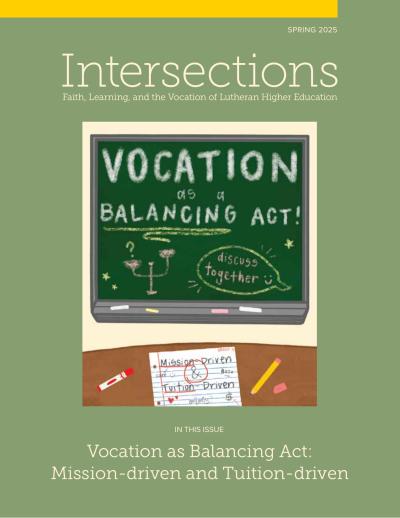 Article
Finding the Miracle in the Intersection of Mission and Limitations: Lessons from Latin America
Kat Peters
No. 61 · Spring 2025
14 min audio
Peters draws on her time interning with Lutheran World Relief and leading a study abroad program in Central America — including a Costa Rican women’s farm cooperative whose ecotourism project was “unprofitable” but life-giving — to argue that the intersection of God’s preference for struggle and God’s desire for abundant life is itself the miracle higher education can claim amid scarcity.
-
 Article
From Pietism to Paradox: The Development of a Lutheran Philosophy of Education
Philip Nordquist
No. 8 · Winter 2000
Nordquist traces a four-decade personal and institutional journey from the “Protestant triumphalism” and aggressive moralism of S. C. Eastvold’s 1950s Pacific Lutheran through the 1960 Ditmanson–Hong–Quanbeck volume The Christian Faith and the Liberal Arts, Gordon Lathrop’s 1972 PLU donor address grounding the university in two-kingdoms theology, the ALC’s 1975 Concordia workshop with Bill Narum, Bob Bertram, Harris Kaasa, and Sydney Ahlstrom’s case for the “critical” tradition over the scholastic and pietistic, the 1976 LCA statement distinguishing “Christian” from “church-related” education, and Richard Hughes’s 1997 Carthage address. He concludes that dialectical (two kingdoms) theology, Christian humanism alongside professional studies (the New American College model), Luther’s commitment to universal compulsory education, environmental and civic responsibility, and academic freedom together constitute the bequest of the Reformation—“Christ and culture in paradox” remains the best approach to education he knows.
-
 Editorial
From the Publisher: Navigating Affirmative Action, DEI Policies, and Lutheran Vocational Identity
Lamont Anthony Wells
No. 59 · Spring 2024
Wells surveys the converging pressures on NECU institutions — the unsettled landscape of affirmative action, political and academic scrutiny of DEI work, and the preservation of distinctively Lutheran vocational identity — and previews how the issue draws on affirmative practices, sociological viewpoints, and theological responses to navigate a path forward.
-
 Response
Response to Bishop Olson and President Tipson
Robert Benne
No. 16 · Winter 2003
Benne responds to two articles in the Winter 2002 Intersections: former Bishop Stanley Olson’s “The Marks of an ELCA College,” whose narrow reading of the two kingdoms cedes all epistemological claims to secular knowledge, and President Tipson’s engagement with The Future of Religious Colleges, whose “rather unchastened Enlightenment spirit” underestimates how loaded the social sciences and humanities are with their own philosophical and religious assumptions. Drawing on Reinhold Niebuhr, John Milbank, and William Buckley, Benne defends a “critical mass” of pervasively Lutheran colleges and calls on bishops and pastors to take the schools seriously lest they drift from their religious heritage.