Early on in its existence, the ELCA determined that it was necessary to continue the practice of its predecessor bodies in producing documents of careful reflection on social issues to benefit congregations, which were understood as “communities of moral deliberation,” according to the 1991 ELCA statement, The Church in Society. Known as social statements, these expressions of Lutheran social teaching are intended to assist both individuals and communities of faith in addressing significant current social issues with integrity, coherence, and responsible and informed faith. (See Roger Willer’s essay in the present issue of Intersections.) This effort has produced twelve social statements and thirteen social messages on a variety of topics ranging from the environment and economics to immigration and genetics. While these statements were initially formulated for congregational use, the question of a current study undertaken by the Network of ELCA Colleges and Universities (NECU) is whether these statements may also be of use in classrooms on our campuses. Could their utilization increase the level of campus ethical reflection such that our campuses become academic communities of moral deliberation?
Martin Luther was a relational thinker who placed Christian life in a simultaneous relationship before both God and neighbor. The faith which inwardly embraces the justifying grace of God is then expressed outwardly in loving service to neighbor, made explicit through one’s vocation in the world. Our colleges and universities over the last 25 years have intentionally raised awareness of vocation for our students, who thereby see their work as a calling, above and beyond a mere career. At a time when “conversation” on challenging topics is absent or divisive, our campuses are one of the few places where reasoned and respectful dialogue can occur without rancor or retribution. These social statements may provide a resource for such college-wide discussions. They may raise the communal level of ethical reflection while acquainting our students with the rich history of Lutheran ethical reflection.
It is the intention of this NECU project to determine if these outcomes are achievable. We began with a pilot workshop on the ELCA social statement on economic life, Sufficient, Sustainable Livelihood for All, among business and finance faculty in July, 2019, at Augsburg University. The working group will be exploring other statements and disciplines over the next two years to determine if they can help faculty attend to ethical issues within their disciplines. Lutheran social teaching may help our campuses address the classic Lutheran question, “What does this mean?” Thoughtful and informed faith for responsible action in the world can do no less.
-
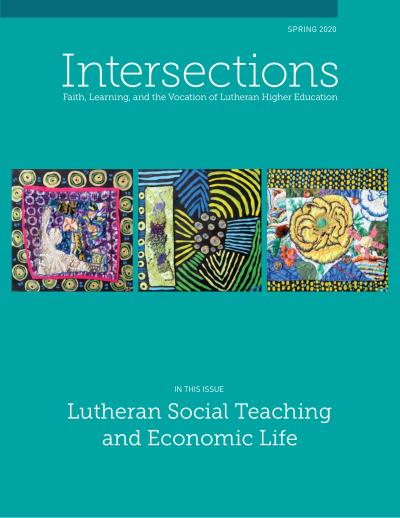 Editorial
From the Publisher
Mark Wilhelm
Wilhelm frames the issue by tracing how Lutheran educational ideals — once a primary source of contemporary higher education — were masked in the United States, and introduces a NECU initiative that uses the case of business ethics to explore Lutheran social teaching as an academic resource.
-
Article
The Responsible Professional: Vocation and Economic Life
Martha E. Stortz, Tom Morgan
Stortz and Morgan argue that the “value-added” of Lutheran higher education is a responsibility ethic — one that frames the professional as a first responder “called and empowered to serve the neighbor so that all may flourish” — and unpack the four criteria of the 1999 ELCA social statement Sufficient, Sustainable Livelihood for All as a framework for economic deliberation.
-
Institutional Focus
A List of ELCA Social Teaching and Policy Documents
A reference list, as of September 2019, of the ELCA’s twelve social statements, fourteen social messages, and over 150 social policy resolutions — with Spanish translations where available.
-
Article
ELCA Social Teaching for the Classroom?
Roger A. Willer
Willer argues that the body of ELCA social teaching, taken as a whole, constitutes an actual social ethic — relatively comprehensive, responsibly consistent, and remarkably cogent — whose mode of responsibility ethics commends it as a classroom resource for any discipline that wrestles with moral questions.
-
Article
The Challenge of Inclusion in the Ethics Classroom
Faith Wambura Ngunjiri
Ngunjiri, the only Black woman tenured faculty member at Concordia College, reflects on her students’ resistant and resonant responses to MLK Day programming on “Not Racist: A White Moderate Myth” — and on what it takes to make the ethics classroom a place where students can “BREW”: Becoming Responsibly Engaged in the World.
-
Article
Business as Usual? Marketing, God, and the Limits of Christian Callings
Emily Beth Hill
Hill, a former corporate marketing consultant turned theologian, returns to Luther’s claim that no vocation is more holy than another — and uses Luther’s Large Catechism definition of God to argue that the modern practice of branding intentionally redirects the love and worship of human beings toward capital, raising the question of whether Christian neighbor-love places limits on what professions Christians should pursue.
-
Article
Responding to Student Hunger at NECU Institutions
Kristen Glass Perez
Glass Perez recounts how her work as college chaplain at Augustana and Muhlenberg evolved after a student offhandedly declared, “I am always so hungry at this school,” and shares five lessons learned from launching campus pantries, emergency grant programs, and the HOPE Survey to address food insecurity as a defining calling of NECU institutions.
-
Article
Gen Z is Made for Lutheran Higher Education
W. Kent Barnds
Barnds argues that Generation Z’s defining traits — socially responsible, purpose-driven, cost-conscious, culturally open, and tech-expectant — align almost perfectly with the missions of NECU institutions, and offers concrete suggestions (from replacing “vocation” with “purpose” to embracing Gen X parents as co-pilots) for Lutheran colleges seeking to attract and serve this generation.
-
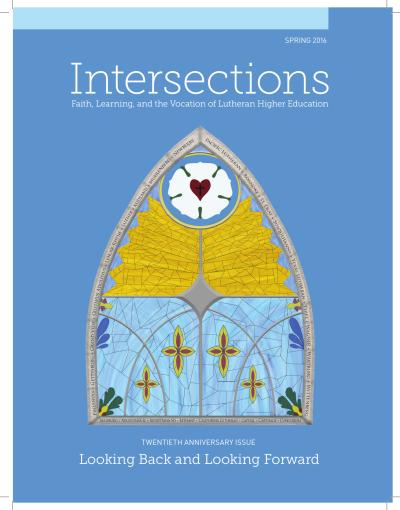 Article
Semper Reformanda: Lutheran Higher Education in the Anthropocene
Ernest L. Simmons
No. 43 · Spring 2016
Simmons enumerates the ELCA initiatives over the past twenty years that have helped Lutheran higher education retrieve a Christian understanding of vocation, then argues that the looming reality of human-caused climate change — the geological epoch of the Anthropocene — now requires Lutheran liberal arts education to prepare students for “planetary citizenship” as sustainability leaders, drawing on the classical Trivium, Luther’s panentheism, and a quantum-physics-inflected theology of divine entanglement and hope.
-
 Article
A Lutheran Dialectical Model for Higher Education
Ernest L. Simmons
No. 37 · Spring 2013
Drawing on “The Freedom of a Christian,” simul justus et peccator, Richard Hughes, Joseph Sittler, Martha Nussbaum, and Tom Christenson, Simmons argues that the Lutheran tradition informs an open, dialectical educational model that holds Christian and academic freedom together. He locates vocation at the intersection of the practical (why are you here?) and the existential (why are you here?) and proposes Lutheran higher education as education for self-transcendence and leadership Soli Deo Gloria.
-
 Article
Lutheran Higher Education and the Public Intellectual
Ernest L. Simmons
No. 26 · Fall 2007
Simmons argues that college faculty and administrators are, like it or not, public intellectuals, and that Lutheran higher education’s dialectical understanding of Christ and culture is well suited to support four functions of the public intellectual: articulating constructive critique of received social explanation (especially the “collage identity” described by Renate Schacht); presenting a transcendent theological perspective through the theology of the cross that takes seriously God’s hiddeness, the presence of ambiguity, and the reality of suffering; pursuing the common good amid the demise of the “commons” through H. Richard Niebuhr’s “Christ and Culture in Paradox”; and educating for citizenship through Christian vocation by connecting the practical and existential dimensions of the question “Why are you here?”
-
 Article
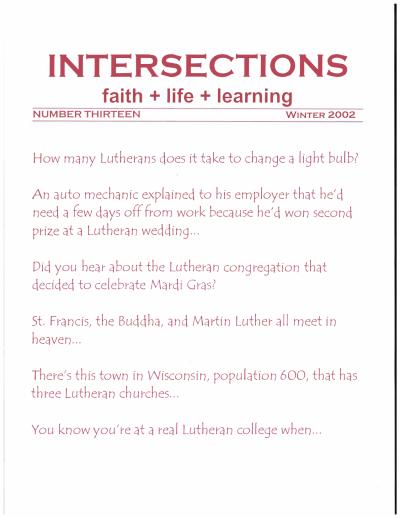
The Lutheran Theological Tradition and Recruiting Lutheran Students
Ernest L. Simmons
No. 13 · Winter 2002
Simmons opens with an Abraham-and-Isaac “Windows 98” joke to illustrate the dialectic of faith and learning, then argues that in a new market era of limited religious background, intentional mission and marketing go together. Drawing on Levine and Cureton’s When Hope and Fear Collide for the Millennial Generation born in 1982 and Tom Beaudoin’s Virtual Faith for their GenX parents, he reads “Reclaiming Lutheran Students” survey results showing 86% strong community at ELCA colleges versus 54% at flagship publics and 61% alumni mentoring versus 39%. He then develops three areas where the Lutheran tradition uniquely equips its colleges—community, mentoring and vocation, and the integration of faith and values—using Luther’s “two kingdoms” image of the “Left Hand” (reason) and “Right Hand” (faith) of God, with academic freedom as a product of Ahlstrom’s “Critical Current” in the tradition, and closes with three challenges: recruiting and retaining mentoring faculty, educating church leaders, and reaching potential students and parents.
-
 Book Review
Learning Across Campus: Hearing Bok's Call to Conversation
David Ratke
No. 39 · Spring 2014
Ratke reads Derek Bok’s Our Underachieving Colleges from Lenoir-Rhyne and argues that Bok’s call to think holistically about undergraduate education and to dialogue across disciplinary boundaries names the work already underway at ELCA colleges. He weighs faculty attitudes, the role of skills in the core curriculum and the major, and the importance of the extracurriculum for student formation.
-
 Response
Disputatio Pro Quo? The Search for Lutheran Education
Jon-David Hague, Kimberly Hague
No. 2 · Winter 1997
Kimberly and Jon-David Hague—both Luther College graduates completing graduate studies at Berkeley and Boston University respectively—respond to Bouman by offering Luther’s curriculum reform at Wittenberg University in the spring of 1518, only months after the 95 theses, as a model of the Lutheran voice in higher education. Inspired by humanistic principles, Luther introduced lectures on classical authors and the first instruction in Greek and Hebrew, giving students the tools to encounter scripture directly rather than receive dictated doctrine. The spirit of that reform—providing students with every possible tool while acknowledging that an instructor’s perspective is neither ultimate authority nor final word—remains useful for the search for Lutheran academia today.
-
 Editorial
From the Publisher
Arne Selbyg
No. 25 · Spring 2007
Selbyg notes that most papers in this issue grew out of a pan-Lutheran conference organized by the Association of Lutheran College Faculties in fall 2006 rather than the annual Vocation of a Lutheran College conference, and argues that the ELCA’s ecumenical posture—truthful but open to learning from others—is a good foundation for institutions of higher education whose faculty likewise profess while remaining subject to change based on new research and insights.
-
 Article
The Critical Role of Lutheran Higher Education in the Age of Artificial Intelligence
Jose Marichal, Maya Goehner, Tyler Haug
No. 59 · Spring 2024
A Cal Lutheran political science professor and two of his students draw on Rooted and Open to argue that Lutheran higher education is uniquely positioned to stake out a middle path between AI utopianism and AI doom — cultivating a “healthy sense of human limit,” resisting data colonialism, and forming students to see the neighbor rather than the enemy as the world becomes increasingly synthetic.
-
 Article
(Re)Defining Vocation: Gladly Challenging a Vocational Giant
Andrew Tucker
No. 53 · Spring 2021
Tucker challenges Frederick Buechner’s famous definition of vocation as “where your deep gladness and the world’s deep hunger meet,” arguing that gladness reflects a privileged perspective and proposing instead that vocation be defined as “any meaningful, life-giving work you do for the world.”
-
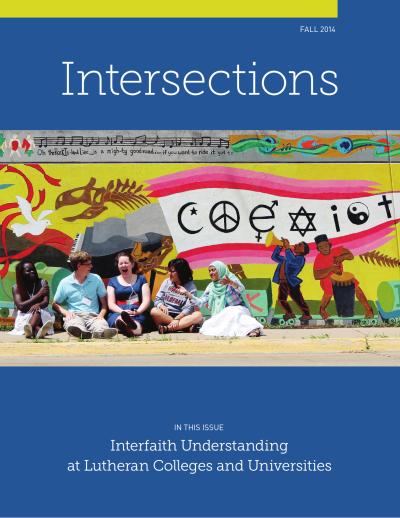 Reflection
Gifty Arthur
Gifty Arthur
No. 40 · Fall 2014
Reading John 10:3 as a Ghanaian Christian student at Luther College, Arthur reflects on how Luther’s Journey Conversations have deepened her own spirituality precisely by giving room for students to share the personal experiences and beliefs at the center of their own traditions.