It is a privilege for Ione and me to be with you and to thank you for your exceptional leadership. Although it has been four years since I was with this group last in Sarasota, I have appreciated the opportunity to be with many of you on your campuses and in other gatherings.
This academic year, I have been on five of your campuses, maintaining my commitment to support the twenty-eight colleges and universities of this church and to be with students. Last week I was on two campuses—Dana and Luther. I was so impressed as I listened to the students share their passions and their faith and reflect their varied experiences in the classroom and in the world.
I often comment that the current generation of students seems increasingly clear that they want to be part of a church that matters: a church in which faith matters, worship matters, commitment matters, Jesus matters, the Bible matters, and the experience of God matters. They also want to be part of a church that makes a difference. They want to be part of a church that makes a difference in their personal lives of faith, in families, and in neighborhoods; a church that makes a difference in confronting the issues of HIV/AIDS, global warming, poverty, war, and peace. They are impatient with a church that seems turned inward and preoccupied with what appears to students to be secondary, even insignificant, issues. I recognize that I am not describing all students, but significant numbers of them. I believe your schools, your faculty, your staff, and your boards are creating the context that nurtures and encourages such commitments.
When I have the opportunity to talk personally with you who are presidents, my appreciation for the complexities of your callings always grows. The incredible expectations that you will have a major role in raising funds; in balancing budgets; in increasing enrollments, but reducing or at least maintaining discount rates; attending to alumni expectations while increasing their participation in the annual fund; recruiting and retaining gifted faculty; maintaining staff morale; building relationships with civic and corporate leaders; tending to relationships with the church. Should I continue or did you come to Florida to distance yourselves from those realities?
You have my deep respect and profound gratitude. I want to say a special word of thanks to the four presidents who will be completing or have completed their calls this year: Jon Moline, Texas Lutheran; Steven Titus, Midland; Paul Formo, Bethany; and Bob Ubbelohde, Finlandia.
I am privileged to address you today, but it is my churchwide staff colleagues who daily tend to our relationships with you with great dedication and imagination—Stan Olson, Mark Wilhelm, Arne Selbyg, Marilyn Olson, and Myrna Sheie. They are advocates for you, interpreters, and accompaniers.
The last time we met it was not yet clear how we would restructure the churchwide organization, including personnel and budgets to undergird our strategic Plan for Mission. You as presidents and board chairs were very helpful and sometimes critical in shaping what is now the Vocation and Education program unit. I believe Vocation and Education reflects this church’s commitment to our colleges and universities within the broader context of our Lutheran understanding of vocation and life. Many dimensions of the ELCA Plan for Mission relate to colleges and universities, but one strategic direction in particular does: “Assist this church to bring forth and support faithful, wise, and courageous leaders whose vocations serve God’s mission in a pluralistic world.”
“Vocation and Education reflects this church’s commitment to our colleges and universities.”
In a recent interview, I was asked by a New York Times reporter what I understand to be the role of a national church denomination and its leaders given the changing landscape of American religious life. I said I believe we in churchwide leadership are called to steward the ecology of interdependent ecosystems that make up this church. There was total silence on the other end. “You’re not going to use that quote in your story, are you?” I asked. “No,” was the one word response. I was not to be deterred, so I continued, “I believe we are to build capacity and encourage imagination for our shared mission.” Not only did that statement also fail to capture how we interact, the entire interview did not result in a story.
The image of the ELCA as an ecology of interdependent ecosystems is one I received from Dr. Craig Dykstra, vice president for religion at the Lilly Endowment, when he described how he sees the ELCA. It certainly is reflected in our polity. We say in our governing documents that we are one church in three expressions—congregations, synods, and the churchwide organization. By the way, I am convinced the word “churchwide” to describe the national expression of the ELCA is not accomplishing its intent. So, increasingly the churchwide expression—or more specifically, the churchwide organization—is referred to as “the ELCA” when, in fact, the whole ecology is the ELCA. Three expressions, but also eight seminaries, twenty-eight colleges and universities, outdoor ministries, campus ministries, schools, the varied vocations of the 4.9 million members of this church as they live out their baptismal callings in daily life (note that all of those belong to Vocation and Education program unit), social ministry organizations, ecumenical partners, and global companions. Therefore, when I speak today about our shared commitments, it is within the context of our tending to and stewarding this living, changing ecology of interdependent, deep, and abiding relationships.
The report of the Wittenberg Lutheran Identity Study Commission is a rich, thoughtful, historical analysis of Wittenberg’s Lutheran identity with concrete proposals for strengthening that identity because it is core to Wittenberg’s mission.
The “Five Faith Commitments” of Augustana College, Rock Island are each made with specific descriptions of how the commitment is carried out in the life of the college. The appendix sets the commitments in historical context and includes President Bahls’ insightful reflections about the Lutheran expression of higher education at Augustana. Again, it is clear one is reading commitments core to the identity, microcosm, and vocation of this college and this church.
Pamela Jolicoeur’s inaugural address as the 10th president of Concordia College was titled, “Re-imagining Concordia’s Mission Moment.” Building upon Concordia’s history and citing Gustavus Adolphus professor Darryl Jodock’s interlocking set of five characteristics that define the Lutheran approach to higher education, President Jolicoeur called Concordia into a process of re-imagining liberal arts education that cultivates compassionate education and connects students to the world.
A favorite example is the collected papers and presentations of Bill Frame under the title “Faith and Reason.” The papers reflect Dr. Frame’s immense contributions to our rethinking, reclaiming, and re-imagining the mission of Lutheran higher education as it continues to be informed by Luther and Melancthon, and especially by the Lutheran understanding of vocation and the two kingdoms.
These are just a few examples of the many that indicate our shared commitment in the context of a deep and abiding relationship that belongs to our shared mission, shared identity, and shared vocation as Lutherans.
“I believe shared mission is increasingly and rightfully becoming our focus.”
That is a significant change from the not-too-distant past, when discussions of this relationship often focused on whether the colleges would remain church-related, whether in fact the relationship was deep and abiding; or whether there was an inevitable trajectory in American life that would lead colleges to abandon their church-relatedness. Was the relationship between culture and the church a reality that most colleges would discover with time? Implicit in these conversations was the sense that the mission of a higher education and the mission of a church body, while not congruent, were not easily compatible. As if God is opposed to free inquiry.
We still debate the nature of the relationship between the church and the colleges, but I sense the question is shifting from whether colleges will and should be church-related (although that question remains with us somewhat) to the question of the content of this deep and abiding relationship or what should it be.
I don’t want to minimize these various indicators of our shared relationship that reflect our shared commitments, including:
- The make-up of your boards and how many members are Lutherans
- Whether the president is or must be Lutheran
- The number of Lutheran students
- The level of financial support from the church—be it churchwide grants, synodical grants, congregational gifts, or individual gifts
- Your religion requirements
- Your understanding of your ownership both legally and how you perceive the church as “moral owners”
- Your branding and whether it includes your Lutheran identity
- How the churchwide organization reflects in structure, budget, staffing, and communication this church’s commitment to its twenty-eight colleges and universities
- The presence of ELCA clergy in your campus ministries
- How you structure church relations
All of those are important indicators of our shared commitments, yet it is a shared mission in higher education that is truly central—core—to our deep and abiding relationship. I believe shared mission is increasingly and rightfully becoming our focus.
I am sure that each of you can share examples from your own context about how attention is being given to our shared mission, identity, and vocation, and about how these shape the life of the colleges and universities and the life of this church. Let me share just a few recent examples that I have found very helpful as I reflect upon stewarding this relationship.
What does this shared mission look like? I recently had the privilege of giving convocation addresses at Dana and Luther. I titled one of the addresses, “A College of the Church Reaching Out in Mission for the Sake of the World” and the other, “Unquenchable Curiosity and Evangelical Persistence.” From these addresses I want to highlight at least four characteristics of our shared mission in higher education to which I hope we are committed.
Our shared mission means the twenty-eight colleges and universities of this church will be communities of free inquiry that nurture unquenchable curiosity in a cultural context that often seems preoccupied with satisfying our insatiable appetites for possessions, power, and consuming.
Recently, a young woman wrote to Dear Abby, “I’m 19 and dropped out of college in December 2005. After years of going through honors classes, I felt like I had nothing left. My brain was on cruise control. I think I want to go back to school in August, but I also feel I’m doing it to please everyone else. Honestly, I no longer know what I want to be in life. I have no idea what I want to major in. I’m just lost. I’ve never dated, done drugs, drunk, partied or anything else besides go to school. And I was good at it. I have dreams of what I want out of life—a mansion, a nice car, money in the bank, but I don’t necessarily have to go to college to achieve that. I know it sounds like a cliché, but I feel like I don’t know who I am.”
Dear Abby said something like this, “Your first step should be to return to college. The next step should be a visit to the college career counseling department. It is important that you learn what it is you enjoy as well as have an aptitude for.”
The vocation of a Lutheran college that is so vital to the mission of this church is to plant deep within students a lifelong unquenchable curiosity about God, about the meaning of life and being human, and the centrality of faith; an unquenchable curiosity about the vastness of the cosmos, the intricacies of DNA, and the beauty of the earth; the complexities of science, math, and economics; the richness of history; an unquenchable curiosity about life’s big questions. However, it is also vital that ELCA colleges and universities value and provide for religious study as an important tool for the intellectual exploration of the big questions of life such as: What makes life meaningful? What does it mean to be human? How do we live together on this planet?
I commend to you an article by W. Robert Connor, president of the Teagle Foundation titled, “The Right Time and Place for Big Questions.” He asks, “Can students’ interest in and engagement with religion and spiritual matters, and the questions associated with them, invigorate their liberal education? Based on my conversations with faculty members in a wide range of fields, meetings with students, and class visits, the answer clearly is ‘Yes.’ As a result, the Teagle Foundation invited colleges to apply for support for projects that deal with big questions in undergraduate education.”
Connor writes, “Despite the number and quality of those applications, however, we can see that there is still reluctance among faculty members to engage with the big questions—many professors clearly feel that they are not adequately trained to deal with them. Faculty members have also expressed concerns that tenure and salary increases will be put in jeopardy if they break out of existing disciplinary paradigms—or that a few students who find that class discussions run counter to their beliefs or preferences could damage professors’ careers by filling out negative course evaluations. Teachers sometimes need to be assured that they do not have to answer the questions for their students; rather, their role is just to help students think about them.” Connor continues that a friend recently wrote, “It is less a question of expertise than of feeling comfortable enough to articulate an issue in a way that is cogent and civil, and encourages and doesn’t close off discussion.”
Isn’t he describing Lutheran higher education? We who were formed catechetically by asking the question, “What does this mean?” will be a church drawn to—rather than fearful of—big questions. We are committed to being a church that nurtures unquenchable curiosity. Therefore, as an ELCA church-related college, our schools shall ensure that all students, especially undergraduates, are confronted with the role of religion in civilization and its importance in asking (and for believers, in answering) the critical “big questions” of life. To be educated is to understand this and to grasp its significance. Joseph Sittler wrote, “What I am appealing for is an understanding of grace that has the magnitude of the doctrine of the Holy Trinity. The grace of God is not simply a holy hypodermic whereby my sins are forgiven. It is the whole giftedness of life, the wonder of life which causes me to ask questions that transcend the moment.” (14)
“We are committed to being a church that nurtures unquenchable curiosity.”
Two weeks ago my 95-year old aunt and godmother died. Betty Burtness was a vibrant, wise woman of faith who taught English in high school and at Waldorf College. She never lost her Hauge piety or her unquenchable search for wisdom. Betty’s passion for sharing the Word led her to call me after she turned age 88 and ask me what I thought of her leading worship at Commonwealth Nursing Home. I said, “That’s great,” figuring she wasn’t really seeking permission anyway. The Saturday before the first Sunday she called and asked, “Are you preaching tomorrow, Mark?” I answered, “Yes,” and she replied, “So am I. I’m going to use the lectionary text from Luke 13 where Jesus is being asked if he thinks the eighteen who were killed when the tower of Siloam fell on them were worse offenders than all the others living in Jerusalem.”
“What are you going to say?” I asked.
“Well, I’ve been reading the commentaries,” she said, “maybe I’ll talk about the difference between moral and natural evil.”
I said, “Well, you go, Betty! I think I’m going to stick with talking about the righteousness of God.”
She called me back that evening and said, “I gave up on evil. I’m just going to preach grace. It’s what the people most need to hear.”
Betty increasingly believed that it is the questions with which one lives and not necessarily the answers one gives that give evidence of faith.
In our commitments to our shared mission, I believe it is vital that ELCA colleges and universities value and provide for religious study and reflection as an important tool for the intellectual exploration of the “big questions” of life—in other words, to be communities of free inquiry that nurture unquenchable curiosity. Our shared mission means the twenty-eight colleges and universities of this church will be communities that encourage religious expression, exploration, and conversations in our increasingly diverse society.
I know of none of the twenty-eight ELCA colleges and universities that greet incoming students with a sign that says, “Welcome. Drop your faith at the door and pick it up again in four years in case you still need it.” Yet, though not explicitly stated, it could become a not-too-subtle implicit message conveyed. When visiting Bethany College last fall I preached in chapel led by an ELCA campus pastor. The room was full. That evening I was invited to the first fall meeting of the Fellowship of Christian Athletes. Some of your campuses have a strong presence of Campus Crusade for Christ in addition to Lutheran Campus Ministries. I know at least from our youngest daughter in her first year at Augsburg, that it is important for her that there is worship in which her faith is nourished through music, Word and Sacrament, and prayer. It is also important that there are religious classes in which faith is stretched and even challenged and that there are experiences—such as she had in January to travel to El Salvador—to see first-hand the resiliency and challenge people of faith experience in daily life and the church’s solidarity with those who live in poverty and struggle for justice.
The article by Connor references research with which I imagine you are all familiar. The UCLA Spirituality in Higher Education Project revealed, according to Helen Astin, “Students become less religious while in college with respect to attending church, but their goal to integrate spirituality into their lives increases in importance.” (Connor 4)
A University of Indiana study of 150,000 students at 461 four-year colleges found that what they termed “spiritually enhancing activities” such as worship, meditation, and prayer had no negative affect on “educationally purposeful activities” (i.e. deep learning reflected in the students ability to analyze, integrate, and synthesize information from various sources and apply it to new experiences). The National Longitudinal Survey of 4000 freshmen from 28 highly selective colleges found that students who participated in religious rituals at least once a week studied longer and reported higher grade point averages and greater institutional satisfaction than their peers. But you don’t need convincing—just encouragement—to remain strong in your school’s commitments.
9/11 is no doubt a—if not the—formative event in the lives of college students. On that day, we were awakened to the reality of our vulnerability in a world of violence. Since then, it seems we increasingly are living in—dare I say—socialized and politicized into a culture of fear. Yet we know what happens when fear drives our lives. We become preoccupied with fortifying borders, erecting barriers, and defining rigid boundaries. We become distrustful of others, especially those who do not look, act, or speak like us—particularly if they appear Middle Eastern. Fear, says Walter Brueggemann, makes us possessive of what we have and finally downright anti-neighborly. The core of the Gospel is the good news that we have been saved by God’s grace in Christ, which frees us to live in faith not fear; faith that frees us to be Christ to the neighbor next door and Christ to the world.
Think of the incredibly important role your college or university plays in providing experiences in which students not only can express and explore their own faith, but also begin to understand and appreciate the religious beliefs and practices of others. The rabbi serving as one of the campus chaplains at Muhlenberg College says that religious Jewish students have found a home at Muhlenberg because it is related to the ELCA, a tradition that values religion in life and affords opportunity for religious practice in an environment of free inquiry.
There are two other characteristics or marks of our shared mission to which I believe we share commitment. Vitally important to our shared mission is our commitment to the education of learners who can contribute to the common good in part because they have learned to address the “big questions” of life. For Christians, exploring meaningful purpose in life is related to God’s call that we serve the common good—freedom in Christ to love and serve the neighbor. The genius of the vocations program sponsored by the Lilly Endowment lies in this truth. Students of other religious beliefs and practices and even non-religious students can share in the exploration of “big questions” and how they might serve the common good, even if the motivation is not believed to be a call from God.
The ELCA mission statement is, “Marked with the cross of Christ forever, we are claimed, gathered, and sent for the sake of the world.” The college students with whom I meet understand that our baptismal identity and calling leads to our being sent for the sake of the world. Last night our son at St. Olaf called, “Dad, I need two deposit checks, one to go to New Orleans for spring break to work on Katrina cleanup and the other to go to India in the fall to work and study at a biological research center.” Your students get it: education is for the neighbor, for the common good.
“For Christians, exploring meaningful purpose in life is related to God’s call that we serve the common good.”
Our colleague Jonathan Strandjord says wisdom usually comes in one of two flavors: wisdom that seeks to satisfy our desires or wisdom to reduce our cravings. Both are essential to human life. Yet, he cautions, one can lead to a life preoccupied with our own needs and the other to cool detachment, even isolation. He calls us to another form of wisdom: wisdom that makes us “other-wise.” Not the mastery of a specialized subject, but a basic posture, an over arching purpose, intellect in search of an extraordinary project. Being other-wise is not driven by the need for power or possessions or by the quest to be above the fray. It is instead, born of wonder or ecstasy, which takes us out of ourselves, but not out of the world; it places us before the neighbor.
A part of the calling to form students who are other-wise, whose gifts and passions serve the common good—the neighbor next door in Namibia—is for the Lutheran college or university to be a community of moral deliberation and discernment.
In our contentious, fractious, and polarized society, your school can help students, help the church, and help communities learn the art of public moral deliberation: respectful, thoughtful, civil engagement, and even disagreement for sake of the common good. Cynthia Moe Lobeda in Public Church for the Life of the World writes, “The heart of discernment is to hold ‘what is’ and ‘what could be’ in light of the life-giving, life-saving, life-sustaining mystery of God’s ongoing work toward the redemption and flourishing of creation. Where vision of life’s realities is obscured by illusions, a task of Christian discernment is to see differently, so that we might live differently. Where dominant forces distort historical realities by describing them falsely, Christian discernment must re-see and then ‘re-describe the world.’” (65-66) Is she not describing the vocation and mission of Lutheran higher education? To such a task we are called in our shared mission—to a shared commitment.
Finally, and briefly—but not at all insignificant—is our shared mission to provide leaders for this church and for religious communities throughout the world. I am not only speaking of future pastors or other church workers—though I must say how delighted I was to learn Luther College has about seventy students in a group considering church vocations—I am referring also to future leaders of Lutheran educational and social ministry organizations, to Lutheran scientists who will help this church’s reflections on the revolution in genetics, science, and religion and its impact on human life and to Lutheran economists who will be part of the growing conversation about the strengths and weaknesses of economic globalization, to Lutherans who are committed participants in the sustaining and the changing of rural and small town communities.
Your faculty members are important contributors to the development of ELCA social statements. It is vital that our twenty-eight colleges and universities continue to develop collaborative programs with the eight ELCA seminaries such as the creative ventures involving Carthage College and Lutheran School of Theology at Chicago; Wagner College and Philadelphia Seminary; Augsburg College and Luther Seminary in the Faith in the City program; and Wartburg College and seminary.
This church remains deeply committed to our shared mission in higher education. It is a shared commitment that calls for constant exploration, imagination, and mutual accountability. It is a shared commitment to which I pledge my leadership and for which your continued leadership is vitally important. As competitive as higher education is today, I am convinced that a commitment to our deep and abiding relationship and our shared mission will strengthen each of the twenty-eight colleges and universities and the contribution we as the ELCA are making to the common good and the life of the world.
Works Cited
Conner, W. Robert. “The Right Time and Place for Big Questions.” The Chronicle of Higher Education 9 June 2006: B8+.
Moe-Lobeda, Cynthia. Public Church for the Life of the World. Minneapolis: Augsburg Fortress, 2004.
Sittler, Joseph. Gravity and Grace: Reflections and Provocations. Minneapolis: Augsburg, 1986.
-
 Editorial
From the Publisher
Arne Selbyg
Selbyg notes that most papers in this issue grew out of a pan-Lutheran conference organized by the Association of Lutheran College Faculties in fall 2006 rather than the annual Vocation of a Lutheran College conference, and argues that the ELCA’s ecumenical posture—truthful but open to learning from others—is a good foundation for institutions of higher education whose faculty likewise profess while remaining subject to change based on new research and insights.
-
Editorial
From the Editor
Robert D. Haak
Haak frames the issue around the question of what holds the twenty-eight ELCA colleges together amid their geographic, economic, and theological diversity, introducing Mark Hanson’s address to the assembled college presidents, Randall Balmer’s outsider perspective on the commonalities of Christian liberal arts, José Marichal and Pamela Brubaker on diversity rooted in community and globe, Storm Bailey’s argument that being Lutheran is precisely what makes us embrace diversity, and Jaime Schillinger’s St. Olaf chapel reflection on the formative power of worship and liturgy.
-
Reflection
Currents
Jaime Schillinger
Preached in St. Olaf chapel on March 29, 2005, Schillinger reads three “currents” pulling on her hearers—Minnesota spring, the academic year’s final stretch, and Holy Week’s passion and resurrection—against poetic voices from ee cummings, Gerard Manley Hopkins, and Edna St. Vincent Millay, before turning to the Song of Songs to suggest that this nexus calls students into the rhythms of love, awakened desire, and an elusive, unresolved promise that animates academic, spiritual, and vocational search alike.
-
Editorial
Guest Editor
Madeleine Forell Marshall
Marshall introduces the four papers in this issue from the 70th annual meeting of the Association of Lutheran College Faculties, held at California Lutheran University in October 2006 on the theme “Identity and Diversity in the Lutheran College.” She notes a geographic pattern—the two East Coast contributors (Balmer and Bailey) defend Christian liberal arts against perceived suspicion, while the two Westerners (Marichal and Brubaker) treat Lutheran identity as advantage and diversity as a Lutheran given—and announces the 2007 ALCF meeting at Newberry College on “Beyond ‘Whatever’: Values Based Learning in Lutheran Higher Education.”
-
Article
Sojourners in a Pluralistic Land: The Promise and Peril of Christian Higher Education
Randall Balmer
Balmer, a Barnard scholar of American evangelicalism reared in evangelical parsonages and formed at Trinity College in the Chicago suburbs, defends public education even as he champions Christian higher education as a “halfway house” for students moving from religious subculture into a pluralistic world. Drawing on his own undergraduate experience, his books Mine Eyes Have Seen the Glory and Thy Kingdom Come, and a chastening visit to Patrick Henry College, he names three perils of Christian higher education—the Scylla of secularism (intellectual arrogance allergic to piety), the Charybdis of sectarianism (intellectual dishonesty as exemplified by intelligent design’s special pleading), and insularity—and prescribes mentors, primary sources, internships outside the subculture, and a broader, intergenerational pluralism on campus.
-
Article
Lutheran Identity, Academic Integrity, and Religious Diversity
Storm Bailey
Bailey argues that one might rightly say of a college “that’s a pretty good school because it’s religious,” defending the proposition under three headings: academic and curricular virtues, free inquiry, and religious diversity. Drawing on Mark Schwehn’s Exiles from Eden, Richard Hughes on the Lutheran tradition’s “most potent theological resources” for the life of the mind, Parker Palmer, Lendol Calder, Mill’s On Liberty, Newman’s Idea of a University, and the AAUP’s 1940 Statement, he proposes a “critical mass” alternative in which the Lutheran commitment to truth-seeking and self-critique itself requires—rather than tolerates—a religiously diverse faculty whose opposing voices are needed for the mission to flourish.
-
Article
Why Diversity and Civic Engagement Don't Talk to Each Other on College Campuses: The Need for Public Work
Jose Marichal
Marichal opens with Thurgood Marshall’s line from Milliken v. Bradley and traces the “decoupling” of campus diversity and civic engagement initiatives back to their shared grounding in Benjamin Barber’s “thin” or pluralist democracy. Reviewing CIRCLE data on youth political disengagement, the limits of mandatory volunteerism, and persistent residential segregation, and drawing on Mary Ann Glendon, Lani Guinier, Caryn McTighe Musil, and Richard Rorty, he argues that only Harry Boyte’s notion of “public work” can bind diversity and civic engagement together—and contends that Lutheran colleges, with their understanding of vocation as call into the world, are uniquely positioned to build that infrastructure.
-
Article
Rich and Poor in an Era of Globalized Religion and Economies: Challenges to Lutheran Colleges
Pamela K. Brubaker
Brubaker opens with two World Council of Churches communion stories—a generous Aymara potato meal in Bolivia and a gated invitation-only lunch at a prosperous immigrant German Lutheran church in Brazil—to frame the question of which stance Lutheran colleges will adopt toward diversity. Drawing on Richard Hughes and Ernest Simmons on Lutheran “ecumenical confessionalism,” Linell Cady, Ulrich Beck, Held and McGrew, the World Bank’s 2006 Equity and Development report, Mark Juergensmeyer’s Global Religions, Harvey Cox on the Market as God, the WCC’s “economy of life” / AGAPE document, and Larry Rasmussen on universal human rights, she argues that part of the academic work of Lutheran colleges is to educate for critical citizenship by questioning neo-liberal assumptions and equipping students to claim social, economic, cultural, civil, and political rights for the whole human family.
-
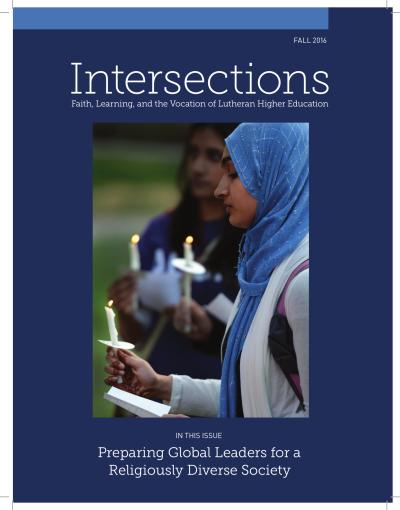 Article
Negotiating Legitimate and Conflicting Values
Eboo Patel, Katie Bringman Baxter, Mark S. Hanson
No. 44 · Fall 2016
In a closing-day conversation at the 2016 Vocation of a Lutheran College Conference, Mark Hanson and Eboo Patel — moderated by Katie Bringman Baxter of Interfaith Youth Core — share case studies in which legitimate religious values come into tension with one another, and make the case that Lutheran colleges should teach interfaith leadership through the hard cases rather than the easy ones.
-
 Article
Living at the Intersection of Fear and Hope
Mark S. Hanson
No. 32 · Spring 2010
Hanson draws on his January 2009 ELCA/ELCIC visit to Jordan, Israel, and Palestine—a Hebron Quran that did not burn, fifth graders dancing at the Hope School, a conversation with King Abdullah II—to frame the vocation of Lutheran higher education at the intersection of fear and hope. Engaging Brueggemann, Sittler, Buechner, Auden, Strandjord, Douglas John Hall, W. Robert Connor, Lewis Mudge, and Cynthia Moe-Lobeda, he argues that Lutheran colleges are called to critical inquiry that does not collapse into a hermeneutic of suspicion, to a “thinking faith” that resists religious fundamentalism, and to communities of discernment that work for the common good.
-
 Reflection
Colleges Lead Way: Curiosity, Faith, Discernment, Mission are Key
Mark S. Hanson
No. 28 · Fall 2008
Reprinted from The Lutheran (November 2007), Hanson names four marks of the colleges of this church—nurturing unquenchable curiosity, nourishing faith formation and exploration, modeling public moral deliberation, and preparing students for engagement in the world—and gives thanks for the colleges’ vocation to call us to stand outside ourselves and reach out in mission for the sake of the world.
-
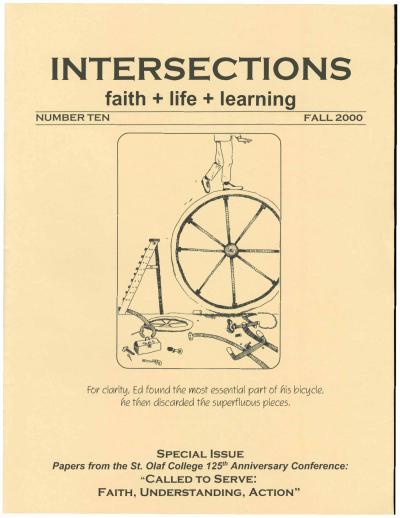 Article
Education for Peace and Justice
David J. O'Brien
No. 10 · Fall 2000
O’Brien surveys justice and peace education in Catholic higher education from Vatican II through the 1980s pastoral letters on nuclear weapons and the American economy, contrasting evangelical radicals (“what would Jesus do?”) with comfortable accomodationists, and argues that Catholic social teaching remains the church’s “best-kept secret.” Drawing on Bryan Hehir, David Hollenbach, Pope John XXIII, Patricia Hample’s “placing ourselves in the world to be of use,” and Martin Luther King’s last book on the “world house,” he develops pastoral care, solidarity (rooted in the mystical Body of Christ), and a realistic vocation-and-citizenship as the three needed responses for Catholic and Lutheran colleges alike.
-
 Institutional Focus
So That All May Flourish Study Guide
No. 57 · Spring 2023
A chapter-by-chapter study guide to So That All May Flourish (Fortress Press 2023), a new volume by NECU authors that develops the central tenet of “Rooted and Open” and offers discussion questions for use in orientation programs, classes, workshops, task forces, and professional development settings.
-
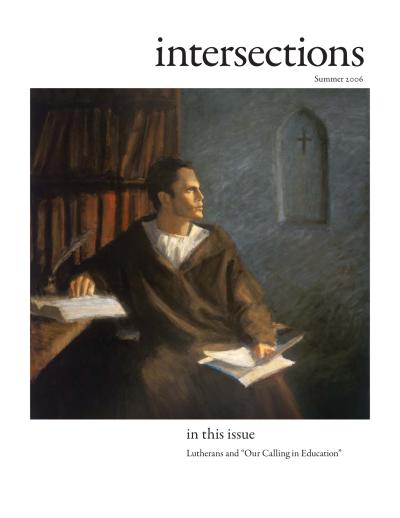 Article
The Lutheran Calling in Education: Context and Prospect
Paul J. Dovre
No. 23 · Summer 2006
Dovre, President Emeritus of Concordia College and co-chair of the ELCA Task Force on Education, undertakes three tasks: focusing on the current social context (young people’s spiritual lives, the state of mainline denominations, the family map, schools, communities, and higher education); reflecting on why Lutherans care about education (creation in God’s image, vocation, Luther’s legacy, the priesthood of all believers, civic righteousness, and hope); and considering the prospects and possibilities for addressing the calling (biblical, confessional, theological, and pedagogical legacies; the renewal of apostolic ministry, the Christian-college renaissance, K–12 reform, and the congregational education explosion).
-
 Article
Our Place in Church-Related Higher Education in the United States
Richard Hughes
No. 4 · Winter 1998
Adapting his 1997 Vocation of a Lutheran College Conference address, Hughes asks how the Lutheran heritage can sustain the life of the mind in church-related higher education. He compares Reformed, Mennonite, and Catholic traditions in turn—the Reformed integration of faith and learning around a Christian worldview, the Mennonite priority of discipleship over cognition, and the Catholic sacramental affirmation of the secular as bridge—before arguing that the Lutheran heritage’s particular gifts (justification by grace, theology of the cross, two kingdoms, paradoxical sensibility, vocation, and openness to ambiguity) uniquely support rigorous inquiry, genuine pluralistic conversation, and critical analysis. Drawing on Arthur Holmes, John Howard Yoder, Mark Schwehn, Alasdair MacIntyre, and Lutheran writers including Bob Benne and Tom Christenson, Hughes contends that Lutheran finitude grounds an unusually open and self-critical academic posture.
-
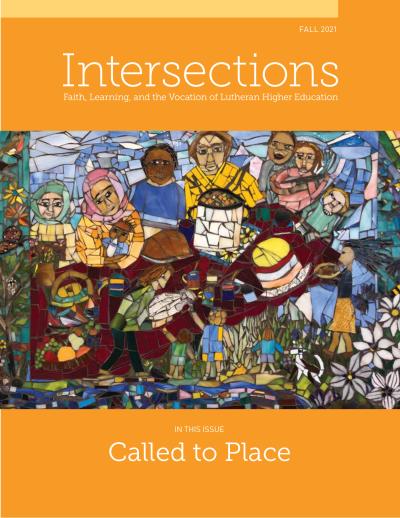 Article
Community-Building On Campus and Beyond
Krista E. Hughes
No. 54 · Fall 2021
Hughes describes Newberry College’s effort to build a “culture of community” that mirrors South Carolina’s demographics while reckoning with the institution’s founding ties to slavery — and names the challenges and promising city-college collaborations that shape this ongoing work.
-
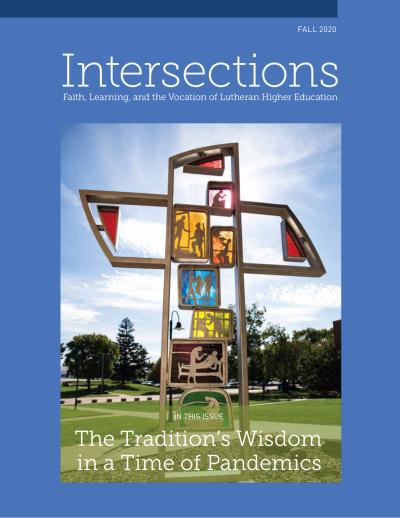 Article
Activism, Justice, and the Danger of Silence
Dezi Gillon
No. 52 · Fall 2020
In conversation with Jason Mahn, Augustana College alumnux Dezi Gillon traces the call to action they felt as a Black student organizing for Black Lives Matter on a predominately white campus — through seminary, art, spirituality, and restorative justice work — and warns white professors that staying silent “actually speaks volumes.”