Lutheran Heritage Across the Curriculum: Reflections from a Faculty/Staff Development Seminar
Cynthia Bane
Wartburg College
Fred Waldstein
Wartburg College
Kathryn A. Kleinhans
Wartburg College
Penni Pier
Wartburg College
Intersections No. 26 · Fall 2007
Kathryn Kleinhans
The ad read like this:
The Discovering and Claiming Our Callings initiative [Wartburg’s Lilly grant-funded Vocation program] is sponsoring a faculty development seminar, “Wartburg’s Heritage and Our Work as Educators,” to be held July 22—August 1, 2006 in Germany.
This is not a whirlwind sight-seeing trip. It’s an on-location continuing education seminar, in which extensive reading and discussion will be interspersed with site visits. We will explore the Lutheran heritage in education and in social service, and we will reflect together on how that heritage might better inform our own vocations as educators and as active citizens.
The geography of the seminar includes: 4 nights in Wittenberg, where Luther lived and taught for 3 1/2 decades; 2 nights in Eisenach, site of the Wartburg Castle; and 3 nights in Neuendettelsau, where Lutheran pastor Wilhelm Loehe established a host of vibrant social ministry institutions and from where Loehe sent Georg Grossmann to the United States to found Wartburg College.
Along the way, the decision was made to open the opportunity to staff as well as faculty. The eventual participant group of twenty reflected a broad cross-section of the campus, including faculty from psychology, business, education, computer science, communication arts and more, as well as staff from IT, communications and marketing, development, the college registrar, and a lab science supervisor.1
With local lectures and tours arranged through the ELCA Wittenberg Center, my own job was to develop a curriculum that would engage a diverse group in wrestling with the best of the college’s Lutheran heritage in ways that would prove fruitful for their work and for our community.
Participants were given four books. A biography of Martin Luther and Tim Lull’s imaginative little volume My Conversations with Martin Luther were to be read prior to departure. The two texts that formed the basis of our on-site conversations were Tom Christenson’s The Gift and Task of Lutheran Higher Education and an additional reader of collected articles that included treatises on education by Martin Luther himself, articles on Lutheranism and on vocation written by my colleague Lake Lambert and myself, articles on the life and ministry of Wilhelm Loehe (from the seminary journals Currents in Theology and Mission and Word and World), and articles from our own Intersections and The Cresset.
The reader included this invitation:
Since our goal is not only to learn about the Lutheran heritage but also to reflect actively and constructively on how it impacts our own work, here are three questions to ponder for each of the readings:
- What do I most appreciate about this, or what new insight have I gained?
- What question do I have for the author, or what point do I most want to challenge?
- What connections can I make…to Wartburg College, to my own work, to our shared work, to our students?
I’ll gloss over the trip itself briefly, saying only that it was even richer than we’d hoped for – and we’d hoped for a lot!
Shortly after we returned from Germany, trip participants received their final homework assignment, a short reflection paper addressing the following:
What impact has what we learned and experienced had on you both personally and professionally? In particular, please try to make specific connections to the work you do at / for Wartburg College (whether in the classroom, in administration, etc.) For example, how did learning about Luther intersect with your self-understanding as a Catholic, a Methodist, or a Lutheran and also how might your learning about the Lutheran heritage of education and service impact your work as a development officer, as a department chair, as a teacher of x, y, or z, etc.?
Additionally, given our conversations, what specific reflections on and suggestions for the mission-effectiveness of Wartburg College do you have?
As an alternative for those of you who are creatively minded, feel free to take inspiration from the Tim Lull book and write your own “conversation with” Martin Luther and/or Wilhelm Loehe. What questions do you have for them? Given your own work, what issues would you like their input on? How would you attempt to explain your work and our times to them?
As papers began to flow in, I was impressed with the depth of engagement reflected and a bit humbled to be invited intimately into the thought-world of my colleagues. As a religion professor specializing in Lutheran theology and as one who tends to see the world through Lutheran heritage-colored glasses, it was a privilege for me to see aspects of that heritage anew through the eyes of others.
The colleagues who join me on this panel, as well as Kathy Book, whose presentation follows later this afternoon, are here to share the fruits of their own reflection on our summer seminar.
Cynthia Bane
Three years ago, I was finishing a sabbatical replacement position in a psychology department at a small, liberal arts school in Ohio. After I learned that I had been invited for an interview at Wartburg, one of my colleagues pulled me aside and said, “You know, I was talking to someone at a conference, and she said that Wartburg is an evangelical school. Did you know that?” Just a few days later, another colleague in psychology asked, “Wartburg is a religious school—will you be able to talk about evolution in your classes?”
At the time, I simply told my colleagues that Wartburg wasn’t the kind of evangelical they were thinking of and that I, myself, had graduated from a Lutheran institution, and I had taken an entire class on evolution. I did not anticipate problems with academic freedom. I was surprised to hear these questions from faculty members who had been teaching at a college similar to Wartburg for a number of years. I had assumed that faculty members from small, private colleges would be knowledgeable about ELCA institutions, but my colleagues were concerned that Wartburg’s religious affiliation would interfere with my ability to function in my discipline.
After participating in the Wartburg Heritage tour, I now understand that the values of an ELCA institution are not in conflict with values important in the field of psychology; in fact, Lutheran beliefs and the discipline of psychology are very compatible. These are just a few of the similarities I see between a Lutheran perspective and a psychological perspective:
Value of humans. It is clear that valuing all humans is an important Lutheran belief, and this was made most apparent to me in our visit to the Diakonie Neuendettelsau, the institution for social welfare work founded by Wilhelm Loehe. Psychologists understand that there are many factors that moderate behaviors, beliefs, and emotions (e.g., culture, personality, gender), but psychologists are fundamentally interested in developing broad theories of behavior and experience. Although the psychological research that is most familiar to the public deals with the extremes of human behavior (i.e., psychological disorders), psychologists are interested in all humans. Psychologists want to understand the human condition. Developing an understanding of the basic mental processes that all humans share fosters an awareness of the equality of all humans. Comprehending the origins of problematic mental processes can create compassion for people who struggle with daily life.
Affirming creation; honoring the ordinary. Psychologists are awed by the most basic aspects of behavior and experience. How do babies learn language? How does memory work? How do people cope with the uncertainty of life? Psychologists are amazed at the incredible complexity of the human experience. We are humbled by the resilience that humans show in the face of great challenges. Although psychologists value the use of the scientific method as a way to understand phenomena, we acknowledge that we cannot take into account the myriad variables that influence behavior and emotions; our predictions are far from perfect. This imperfection serves as a constant reminder of the extraordinary intricacy of mental processes.
The term “sinner” applies to all. Psychologists recognize that all humans are prone to biases, self-serving behaviors, blind obedience, conformity, and cruelty towards others. Social psychologists are especially aware of human flaws. People stereotype others, harm others to preserve their own sense of worth, and fall prey to dangerous group dynamics. During our visit to Buchenwald, I wondered how other visitors tend to view the SS officers who once lived and worked there. My background in social psychology immediately led my own thoughts to Stanley Milgram’s research on obedience to authority (1974), which demonstrated that situational factors can cause ordinary people to inflict harm on others. Milgram himself noted the resemblance between his own research and Hannah Arendt’s interviews with Adolf Eichmann. Arendt concluded that Eichmann’s involvement in the Holocaust was an example of the “banality of evil” (1963). Intensive propaganda, indoctrination, and efforts to dehumanize victims can lead average people to commit acts of brutality. And just as the belief that sin is inevitable does not erase culpability for sin, psychologists believe that understanding how situational factors contribute to violence and torture does not excuse those behaviors.
Along with the recognition that humans are capable of great malevolence, the Lutheran perspective holds hope for social change, a hope that was reflected in Luther and Loehe’s work to make reforms in doctrine and practice. The field of psychology also embraces the goal of social change. Psychologists study love, altruism, and friendship alongside the uglier topics of deceit, discrimination, and aggression. There are people who refuse to obey commands to harm others, continue to view victims as human despite exposure to propaganda, and selflessly help others in need.
My colleagues at my former place of employment were not familiar with ELCA institutions of higher learning and were concerned that the values at Wartburg would be at odds with my work as a psychologist. I can now better articulate what it means to be a “Lutheran institution.” It does not mean requiring conformity to specific beliefs with no opportunity for questioning. What it means to be a Lutheran institution is to avoid limitations in our approaches to education and research and to work toward a more complete understanding of all aspects of humanity, goals that are very much congruent with those of the discipline of psychology.
Penni Pier
I was raised in the Missouri Synod Lutheran tradition and was very familiar with Luther’s works, or so I thought. While intimately familiar with his Small Catechism, I was unfamiliar with his life as a scholar and political activist (if you will permit me to give him that title). While it is possible to characterize Luther as rigid, pious, an ultimate authority figure, a martyr and a man of God, these labels do not begin to adequately convey the nature of Luther’s rhetoric. It is likely that most non-Luther scholars, or Lutheran lay persons, comprehend his role as a critic of the church and have a general understanding of the overarching elements of the reformation effort. However, it is only when one looks more closely at the writings of Luther that it is possible to uncover the global nature of his critical approach.
Whether in the church or in teaching, Luther advocates a dialectic approach to knowledge and learning. This classical approach employed by Socrates, Plato and Aristotle creates a tension and an interdependence between the two parties involved in the discourse. Without an existing rhetorical tension between positions, progress toward understanding is hampered because the scope of possible solutions is limited. While this rhetorical tension is necessary, it can also become very uncomfortable for those involved, because “answers” are neither readily apparent nor are they often simplistic in nature. Luther’s use of a dialectical tension is redolent throughout reformation rhetoric and his treatises on education. His discourse is often a passionate display of the dialectical tension needed to fully explore an idea or a thought. It is quite natural that Luther would be a controversial figure in history due to his implementation of classical argumentation and reasoning. For those engaged in dialectical reasoning it is quite possible to adopt a both/and approach to solving a problem. Additionally, it is also reasonable for scholars engaged in a dialectic to be comfortable with an ongoing tension/discussion, where continued exploration is valued more than definitive resolution.
“We need to give ourselves permission to not be afraid of challenging students by exposing them to ideas that they may not be comfortable with.”
What might an understanding of Luther and his critical approach mean for a contemporary Lutheran educator in the classroom? Luther models an unapologetic approach to teaching. Many of us teach subject matter that is often controversial and frightening. It is all too easy today to be tempted to “soften the blow” for our students. We may feel that by at least introducing our students to the subject matter we have succeeded. I don’t believe that Luther would agree. To water down the issues so as to not be offensive or make people feel uncomfortable is to not be genuine and to turn one’s back on what it means to be engaged in educational debate. We need to give ourselves permission to not be afraid of challenging students by exposing them to ideas that they may not be comfortable with. However, it is also important when using a dialectical approach to fully investigate all sides of an argument or issue to come to an educated decision about the issue. All educators need to be diligent about this in the classroom.
In a larger professional context, by studying Luther’s writings and examining the dialectical tensions surrounding his rhetoric we may come to a better understanding about what it means to provide a Lutheran education. It isn’t defined by a denomination. The concept of a “Lutheran education” promotes an ideal of what it means to be educated without the fear of limitation or censorship. It means that we ought to challenge our students to ask questions and be critical. It means that we ought to embrace multiple voices and opinions and give them each thoughtful, critical consideration (even those accepted practices that seem beyond the point of amendment). Luther has offered himself as a model for Socratic inquiry and his rhetoric serves as a reminder that education is a living, changing entity and that we as educators have an awesome responsibility.
Fred Waldstein
The purpose of this paper is to reflect from an interdisciplinary perspective on the value of the Wartburg College Luther seminar conducted during the summer of 2006. The perspective I brought into the seminar was (and is) as someone raised in the Lutheran tradition, who attended and graduated from a Lutheran college (Wartburg), and continues to practice the Lutheran faith. The seminar deepened my personal understanding of Lutheranism and provided insight into my understanding of professing at a college of the church.
Learning about the deep level of critical self-analysis that Luther pursued throughout his life—certainly his early and middle professional life—was enlightening. He had achieved significant tokens of success as an academic and as a religious practitioner. But he was not satisfied with these trappings of success because they did not address his desire to understand himself as a creature of the world in search of a meritorious place in God’s divine kingdom. For this he had to look inward. This was not only an act of great courage; it was also an act paradoxical in nature. It represented simultaneously an act of humility and an act of supreme self-confidence. It is this paradox of humility and self-confidence that will serve as the focus for my remarks.
The seminar allowed me to reclaim an appreciation for the paradox of Lutheranism as something to be valued if one is willing to follow Luther’s search for personal truth with both humility and confidence. He encourages a sense of confidence in our capacity to investigate for ourselves the meaning of our place in the world, and a sense of humility that gives us the capacity to appreciate that there is no definitive answer to this investigation and that it must be approached anew every day of our lives.
Luther is, in many ways, an excellent role model for the educator both in terms of how we should and should not behave. For all of his greatness, he was a man of many contradictions, foibles, and error. He had the wisdom to recognize himself as much a sinner as a saint. Some of his highly opinionated commentaries are both laughable and embarrassing for their overstatement and sense of passionate assuredness even (or especially) as they are wrong; sometimes tragically so. We have much to learn as academics from the behavior he modeled. First, it teaches us that we would be wise to examine our own behavior and sense of self-importance. But it also gives us permission to be passionate without apology as long as we temper that passion with a sense of empathy and humility.
“He encourages a sense of confidence in our capacity to investigate for ourselves the meaning of our place in the world.”
The Luther seminar has served to reinforce the sense of what we are trying to accomplish in leadership education at Wartburg College. It has allowed me to understand that what I perceived to have evolved out of intuition and serendipity is, in fact, grounded firmly in the rich cultural tradition of our Lutheran heritage. This manifests itself in both a sense of confidence and humility as noted above. It gives me the confidence to value how our definition of leadership2 connects directly and deeply to the Lutheran tradition which defines our mission. It also gives me the humility to appreciate that this definition and how it connects to our mission is not static but rather dynamic, and must be constantly reevaluated to assure that what we are doing is true to the mission of the College in helping our students understand their potential to help make the world a better place as part of our Christian responsibility. It means we have to be willing to renew our understanding of life’s journey within the eyes of our students and where they are at in their journeys. Our confidence manifests itself in the degree to which we are able to check our egos (an expression of humility) and appreciate that the value of our personal life’s journey is at least partly measured in the value we add to the quality of the life’s journey of our students.
Perhaps that which stimulated my greatest sense of curiosity and reflection was what I learned about Philipp Melanchthon and his contribution to both the Reformation and to the German educational system. I am curious to learn more about this individual who appears to have played such a key role in the reformation, but whose name I had never heard before this seminar.
Based on my limited understanding and knowledge at this point, the Luther-Melanchthon collaboration was important because, while they did not always agree and came at issues from very different perspectives, each understood the value of what the other contributed to their shared mission. Their mutual respect allowed them to be honest with one another in ways that helped maximize each other’s strengths and minimize each other’s weaknesses. This is the kind of reciprocity that makes for a sustainable collaboration. The whole was greater that the sum of its parts.
I use this perspective as I reflect on our group and the work we undertook together. Although we came from different personal and professional backgrounds, we developed a shared mutual respect that allowed us to challenge our own and each other’s thinking in ways that were collectively positive and productive. Like Luther and Melanchthon, we developed a sense of collaboration which had the effect of creating an intellectual product where the intellectual climate created by the group as a whole was greater than the sum of its individual members.
This required among all group members a confidence to share candidly our respective visions for the College and the humility to appreciate that the richness of our learning was dependent on the collective visions and truths to which we each contributed.
Our challenge is to share this paradox with the broader campus community in a way that is both affirming (representing confidence) and non-threatening (representing humility). This process continues to evolve, and that, from my perspective, is and will be a measure of understanding and intellectual growth that has potential benefit for the entire college community.
Kathryn Kleinhans
Early in fall term, a group of trip participants met with the college leadership cabinet to share their reflections on the impact of the summer seminar. In addition to expressing our enthusiasm and our gratitude, we presented the cabinet with written recommendations to enhance the mission-effectiveness of the college, in areas ranging from faculty and staff mentoring, to curriculum, to improved communications and transparency of decision-making. For instance, the Faculty Handbook explicitly requires all faculty to support the mission of the college, but the Staff Handbook has no such requirement; it should. Further, requiring all employees of the college to support the mission of the college entails educating and engaging faculty and staff alike with a dynamic, inclusive understanding of that mission, so that “challenging and nurturing students for lives of leadership and service as a spirited expression of their faith and learning” is more than lip-service.
Our summer seminar continues to bear fruit in exciting ways. Our presence here is one of those fruits. Another is that our relatively new professor of music therapy now plans to begin sending music therapy interns to Neuendettelsau to work with the disabled persons served by the diaconal ministries there. I expect a continuing harvest.
End Notes
1. The decision to expand the seminar to include staff participants was made by the administration and was initially met with resistance. It is nothing less than a confession of sin for me to admit that we feared the inclusion of participants without advanced degrees would result in the “dumbing down” of the curriculum and of our conversations. To our delight, the inclusion of staff proved to be one of the most powerful components of the experience. Community was forged across lines of turf and responsibility. To hear a staff person say, “I try to teach the students I work with that …” brought home forcefully the realization that educating the student as a whole person requires a whole campus of educators, faculty and staff alike.
2. “taking responsibility for our communities, and making them better through public action”
Works Cited
Arendt, H. Eichmann in Jerusalem: A Report on the Banality of Evil. New York: Viking, 1963.
Christenson, Tom. The Gift and Task of Lutheran Higher Education. Minneapolis: Augsburg Fortress, 2004.
Lull, Timothy F. My Conversations with Martin Luther In Which I Learn About God, Faith, Marriage, Sexuality, Family, Education, War, Spirituality, Church Life, the Future, Ecumenism, Politics, Heaven and Other Things, Too. Minneapolis: Augsburg, 1999.
Milgram, Stanley. Obedience to Authority. New York: Harper, 1974.
Nestingen, James Arne. Martin Luther A Life. Minneapolis: Augsburg, 2003.
-
 Editorial
From the Publisher
Arne Selbyg
Selbyg notes that, while a stated purpose of Intersections over its twelve years and twenty-six issues has been the intersection of faith, learning, and teaching, surprisingly few articles have addressed how Lutheran faculty teach and why — and credits the editor for assembling essays from authors whose teaching has benefited from the ELCA Wittenberg Center, on the eve of the City of Wittenberg’s “Luther Decade” leading up to the 2017 Reformation anniversary.
-
Editorial
From the Editor
Robert D. Haak
Haak introduces the issue with the question of whether “our Lutheranism” should have any discernible effect on how we operate as Lutheran colleges, and proposes a working list of “Lutheran” values that characterize our institutions — complexity, real evil, suffering as part of human experience, the centrality of discourse, transcendent values, attention to place, institutional self-criticism, and unity over division — inviting campuses to extend the conversation begun by Simmons, O’Hara, and the Wartburg colleagues.
-
Article
Lutheran Higher Education and the Public Intellectual
Ernest L. Simmons
Simmons argues that college faculty and administrators are, like it or not, public intellectuals, and that Lutheran higher education’s dialectical understanding of Christ and culture is well suited to support four functions of the public intellectual: articulating constructive critique of received social explanation (especially the “collage identity” described by Renate Schacht); presenting a transcendent theological perspective through the theology of the cross that takes seriously God’s hiddeness, the presence of ambiguity, and the reality of suffering; pursuing the common good amid the demise of the “commons” through H. Richard Niebuhr’s “Christ and Culture in Paradox”; and educating for citizenship through Christian vocation by connecting the practical and existential dimensions of the question “Why are you here?”
-
Article
The Vocation of a Lutheran College—Living the Legacy of the Reformation in the Twenty-first Century
Sabine U. O'Hara
O’Hara reflects on Luther’s understanding of education as Bildung — “becoming in the image of God” — through four key aspects: education must be relevant, education demands engagement with the community, education requires attention to place, and education demands engagement with the world. Drawing on her German upbringing, her work as president of Roanoke College, and on Darrell Jodock and Dietrich Bonhoeffer, she argues that Luther’s vision of a well-educated citizenry as the priesthood of all believers calls Lutheran colleges to messy, interdisciplinary, communal scholarship in service to the neighbor.
-
Article
No Child Left Behind Meets Philip Melanchthon: A Reflective Conversation
Kathy Book
Inspired by Tim Lull’s My Conversations with Martin Luther, Book imagines an interview with Philip Melanchthon in the cobblestone courtyard of the University of Wittenberg, in which the Praeceptor Germaniae reflects on his pedagogy (Socratic questioning, brevity and example, declamations, repetition, and interdisciplinary connections), his graded curriculum from primer to university, and his collaboration with Luther on the responsibility of community, parents, and government for the education of all children — and finds his vision strikingly resonant with the No Child Left Behind legislation of 2006.
-
Book Review
Reviews
Matthew J. Marohl
Marohl reviews two 2006 Lutheran University Press volumes from Grand View College (Des Moines, IA). Mark C. Mattes and Ronald R. Darge’s Imaging the Journey … of Contemplation, Meditation, Reflection, and Adventure pairs Mattes’s Lutheran meditations on seven themes (from a spirituality of communication to Alpha and Omega) with Darge’s photographs and Ronald Taylor’s short prayers, with Mattes’s writing on vocation singled out as the volume’s finest. The Grand View College Reader, edited by Mattes, Evan A. Thomas, Kathryn Pohlman Duffy, and Ronald Taylor, surveys the college’s Foundations, Creativity, and Vocation through chapters by Thorvald Hanson, Kenneth Sundet Jones, Kevin Gannon, Ammertte C. Deibert, Steven Snyder, and President Kent Henning, tracing Grand View’s Grundtvigian and Danish Lutheran roots.
-
 Article
Why Martin Luther and the Reformation Matter 500 Years Later
Kathryn A. Kleinhans
No. 46 · Fall 2017
Adapted from a 2017 address to Wartburg College’s entering class, Kleinhans surveys Luther’s lasting impact in vocation, education, social service, and the necessary work of repentance — closing with the Lutheran World Federation’s Windhoek assembly and the Reformation World Exhibition’s call to live reform forward into the next 500 years.
-
 Article
Distinctive Lutheran Contributions to the Conversation about Vocation
Kathryn A. Kleinhans
No. 43 · Spring 2016
Kleinhans surveys the recent resurgence of vocation talk in American higher education — from Frederick Buechner’s widely quoted definition to Lilly Endowment’s PTEV grants and the CIC’s NetVUE Scholarly Resources Project — and uses her chapter in At This Time and In This Place: Vocation and Higher Education to highlight distinctively Lutheran emphases: vocation grounded in creation rather than redemption, the given-ness of multiple simultaneous callings, and a frank acknowledgment of the constraints and “dark side” of vocation.
-
 Editorial
From the Publisher
Arne Selbyg
No. 19 · Summer 2004
Selbyg notes that while the primary source of articles for Intersections is the annual Vocation of a Lutheran College Conference, this issue draws on participants in the Lutheran Academy of Scholars in Higher Education, whose Lutheran Brotherhood and Lilly Endowment grants have been exhausted but which has been continued through DHES, the colleges, and especially St. Olaf’s release of DeAne Lagerquist to direct it. He draws attention to editor Tom Christenson’s new book The Gift and Task of Lutheran Higher Education (Augsburg Fortress).
-
 Article
Where Disruption and Vocation Meet: One Path Toward Teaching Reproductive Justice in Challenging Times
Lena R. Hann
No. 57 · Spring 2023
Hann recounts how a missed math class in her first college term led her into volunteer work at a feminist abortion clinic and ultimately a career in public health, and describes how she designed and taught a Reproductive Justice immersive term course at Augustana College through the disruptions of COVID-19, George Floyd’s murder, and the Dobbs decision.
-
Article
The Duty to Teach and Restore Bodily Autonomy: Reflections from the Classroom
Cynthia Richards
No. 57 · Spring 2023
Richards reflects on a Narrative Medicine course she taught at Wittenberg University in the wake of the Dobbs decision, in which students examined cultural “first recognitions” of the reproductive body and discovered that almost none had ever had a way of talking openly about their reproductive selves — an alienation she calls educators to address.
-
 Editorial
From the Publisher
Mark Wilhelm
No. 41 · Spring 2015
Wilhelm celebrates the leadership of ELCA colleges and universities within American higher education — from presidential service in major higher-education agencies to recognized leadership in global education and interfaith understanding — and lifts up the health of the ELCA network of schools as a church-related community that maintains shared identity while living as good citizens of the larger academy.
-
 Editorial
From the Editor
Jason A. Mahn
No. 48 · Fall 2018
Mahn recounts how a participant’s probing questions at the 2018 Vocation of a Lutheran College Conference turned “civil discourse” from an innocuous theme into a contested one — and previews essays that variously urge listening and common ground, or speaking truthfully even when those words sound angry.
-
 Article
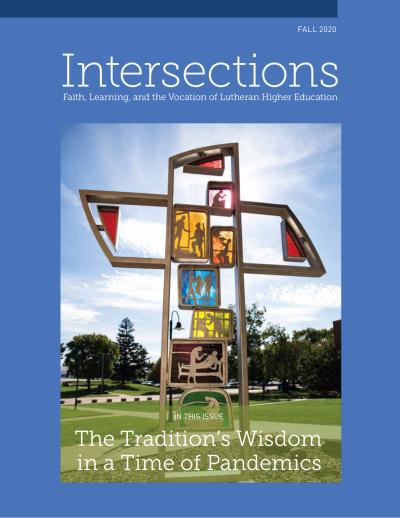
A New Image for an Ancient Call: Lutheran Higher Education Amidst Pandemics Today
Caryn Riswold
No. 52 · Fall 2020
Pairing Wartburg’s Lebenskreuz sculpture with the Matthew 25 acts of mercy and the commitments of Rooted and Open, Riswold reads the calls to feed the hungry, welcome the stranger, and care for the sick as urgent summons for Lutheran higher education in a year of overlapping pandemics — and as a call to dismantle the structures that produced them.