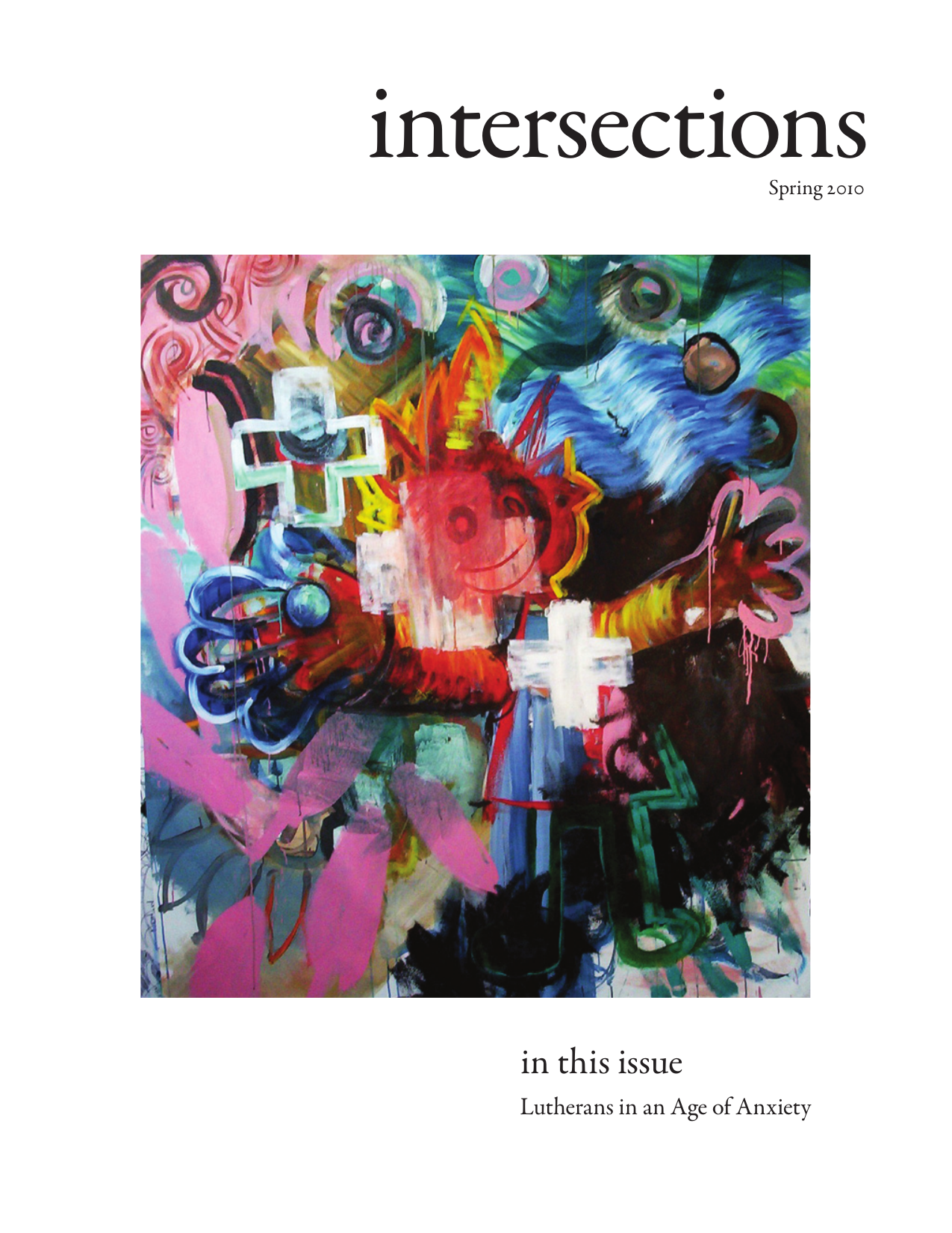
Lutherans in an Age of Anxiety
The Spring 2010 “Lutherans in an Age of Anxiety” issue draws on the 2009 Vocation of a Lutheran College Conference. Presiding Bishop Mark S. Hanson reflects on living at the intersection of fear and hope; Martha E. Stortz names four charisms Lutheran higher education brings to a culture of fear; Jason Peters reads ecological decline through Pope, Blake, Lewis, and Kierkegaard; Rebecca Judge finds hope in the bursting of market fundamentalism; David L. Tiede frames Lutheran higher education as “an apostolate of hope”; Susan M. O’Shaughnessy rereads Pentecost as a corrective to cultural imperialism.
Editors
Articles in this Issue
-
 Editorial
From the Publisher
Mark Wilhelm
Wilhelm invites readers to enjoy or revisit the presentations from the 2009 Vocation of a Lutheran College Conference, then reflects on the Higher Learning Commission’s denial of Dana College’s request to transfer accreditation to a for-profit purchaser—an event that effectively ended Dana’s sale and prompted ELCA colleges and universities to welcome Dana students and faculty—and argues that the irreversible entry of for-profit operators into liberal arts education gives the Lutheran community further reason to continue the conversation about the vocation of a Lutheran college.
-
Article
Living at the Intersection of Fear and Hope
Mark S. Hanson
Hanson draws on his January 2009 ELCA/ELCIC visit to Jordan, Israel, and Palestine—a Hebron Quran that did not burn, fifth graders dancing at the Hope School, a conversation with King Abdullah II—to frame the vocation of Lutheran higher education at the intersection of fear and hope. Engaging Brueggemann, Sittler, Buechner, Auden, Strandjord, Douglas John Hall, W. Robert Connor, Lewis Mudge, and Cynthia Moe-Lobeda, he argues that Lutheran colleges are called to critical inquiry that does not collapse into a hermeneutic of suspicion, to a “thinking faith” that resists religious fundamentalism, and to communities of discernment that work for the common good.
-
Article
Practicing Hope: The Charisms of Lutheran Higher Education
Martha E. Stortz
Stortz names four charisms—theological gifts of identity rather than commodities—that Lutheran higher education brings to a culture of fear: semper reformanda as flexible, responsive institutions; the freedom of a Christian as simul justus et peccator critical inquiry that holds opposites in creative tension; regard for the other as “neighbor” rather than friend or alien; and the priesthood of all believers as a public, civic calling to know the poor. Drawing on Augustine, George Lindbeck, Patricia Killen, James Clifford, Earl Shorris, Carter Lindberg, and Augsburg’s Center for Global Education, she argues that immersion trips, neighbor-regard, and welfare reform witness that the gift Lutherans bring is hope grounded in Christ in you, the hope of glory.
-
Article
Hope in the Face of Ecological Decline
Jason Peters
Peters reads our ecological crisis—a campus “Birth Control Tree,” feminized fish, population, climate, water, and soil—through Alexander Pope, William Blake, Søren Kierkegaard, and C. S. Lewis’s The Abolition of Man, and argues that the modern project of mastering nature has made despair (the unconscious form Kierkegaard named) our condition. He calls for three reorientations: practical (assigning value to domestic arts and place over disciplinary specialization), philosophical (dismantling the Baconian/Machiavellian/Cartesian project of control), and theological (recovering the Church’s rejection of Gnosticism so that grace comes to us by means of nature, not in contempt of it).
-
Article
Hope in a Period of Economic Decline
Rebecca Judge
Judge reads the 2008-2009 recession against the panic-free 1982 downturn and argues that this panic comes from the genuine surprise of a generation that had been told—by George Will and others—that business cycles had been tamed by deregulation, globalization, and Greenspan. Drawing on Luther’s “Trade and Usury” and Large Catechism, Paul Tillich, Stephen Marglin, Karl Polanyi, and Larry Summers, she critiques the “crude utilitarianism” of Homo economicus and benefit-cost analysis, finding hope in the possibility that this recession will renew a national conversation about moral obligation to neighbor in a market whose “raging bull” has broken out of its squeeze chute.
-
Article
An Apostolate of Hope
David L. Tiede
Tiede argues that the vocation of a Lutheran college is to be “an apostolate of hope” oriented by three metrics of our time: 12,000 (the Dow), 350 (parts per million of CO2), and $1.25 (the daily income of 1.4 billion people in extreme poverty). Drawing on Darrell Jodock’s “third path” for church-related colleges, Larry Rasmussen’s Batalden lectures, Mark Tranvik, Douglas John Hall, Bill McKibben, Stephen Privett, Peter Singer, and Augsburg’s Center for Global Education, he proposes that justification by faith, critical pluralism, stewardship of God’s earth, and love and justice for our students together prepare wise leaders to renew the future.
-
Article
"Annoying the Student With Her Rights:" Human Life Coram Hominibus; Reflections on Vocation, Hope, and Politics
Caryn Riswold
Riswold takes a student’s course-evaluation complaint that she had been “annoyed with her rights” about voting as the entry point for reflection on fear of change, mistrust of difference, and right-wing extremist violence—Poplawski, Von Brunn, Roeder, and the Sotomayor hearings. Drawing on Gerhard Ebeling’s reading of Luther’s fourfold relationality (coram Deo, mundo, meipso, hominibus), Brian Gerrish, Alister McGrath, Gustaf Wingren, Philip Hefner, Mary Rose O’Reilley, and bell hooks, she argues that the vocation of the Lutheran college is precisely to “annoy students with their rights” by forming them for socially responsible voice grounded in faith active in love.
-
Reflection
The Neglected Miracle of Pentecost
Susan M. O'Shaughnessy
O’Shaughnessy, in a homily delivered at Concordia College in 2008, reads the Pentecost narrative of Acts 2 through Maria Lugones and Elizabeth Spelman’s 1983 critique of white feminism’s cultural imperialism. She argues that the miracle is not the disciples’ speaking but the immigrant Jews’ hearing—and that the writer of Acts withholds the content of what was said precisely to teach disciples that people of privilege know less than the foreigner, the immigrant, the oppressed, the woman, the child, and must learn to listen in new languages before they can speak.