Run an experiment … first on yourself, and then on others—maybe your students. What is the answer to the question, “Why are you religious? What is the goal of religion, your religion?” I try this experiment in most of the religion classes I teach. The answer is surprisingly consistent. “I’m religious so that I can get to heaven (or, in some cases it is stated as avoiding the alternative).” This seems to be by far the dominant reason for religion in the minds of our culture. It is true of young people and those who are in our congregations. Religion is about the future world. Religion is a retreat from world….
All around we see the result of this sort of religion. The focus is on “saving your soul” (however that is imagined by the practitioner confronting us). Will you get to heaven? Or will you be left behind?
It’s not the case that there isn’t precedent for this way of thinking. From near the beginning of our history as a religion, Christians have withdrawn from the world—some seeking the grace of God in the solitude of the desert, some within the walls of monasteries. The complexities of the relation of religion and culture has been explored famously by Richard Niebuhr. It continues to be debated by those who wonder what the role of religion should be in our own day. Should religious folks withdraw to the scrubland of Texas to build their own society? Should religious folks take over the political system for good, Christian purposes? How do/should Lutherans be heard in this conversation?
It might be surprising to some who have had the experience of Lutheran churches (and colleges?) as insular that Lutherans, because they are Lutheran, enter the conversation among those who seek, even demand, engagement with the world as a religious principle. That viewpoint is well represented in the contributions in this issue.
What draws Lutherans into engagement with the world rather than retreat? Maybe the first motivator is the first story we read … and confess. “We believe in God … the creator.” This world, with all its mystery and complexity is the world created by (and blessed by) God. Those who hold this view are understandably reluctant to leave a connection with this world too easily. It is the good gift that has been given. We are not too eager to walk away from it.
And secondly, this is the place that God has come to us. Incarnation. He may draw us to himself … but first he comes to us—here. In this world. God seems to think that it is pretty important to be involved. It seems like a dangerous hubris to claim that this place isn’t really that important, that what concerns the divine is really only that which happens next, in some other/un-worldly place.
What are the implications of such doctrines? That is what is explored in the articles that follow … and we hope in the conversations that they spark.
This movement toward the world is clearly the thesis of Guy Erwin as he suggests that, as Lutheran colleges and universities, we must define ourselves as places that move across the flatland of the globe and engage. He suggests that, to be Lutheran, we have to move from our comfort zones into the larger world. He also suggests that we tell our constituents that we intend to do this. Mary Carlsson points out that at times the comfort zones that we need to leave are much closer than we admit. How do we as Lutherans relate to the borders that exist in our local communities? Peter Marty would claim, I believe, that this is not an either/or situation—either global or local—but rather a good Lutheran both/and. Mark Mattes provides one helpful example of how history shapes and defines one place—and might shape others.
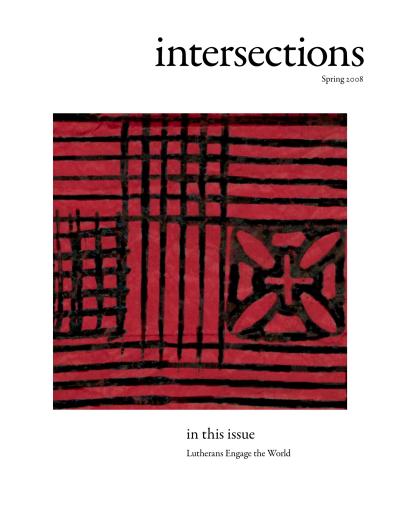
This reach into the world may be exemplified by the image on the cover of this issue. It is a pattern of cloth encountered by students and faculty from Augustana (RI) while on foreign term in Ghana in 2006. These sorts of programs, to engage our students at home and around the world, are not unique to Lutheran colleges and universities … but they should be characteristic of what we are about as Lutheran institutions. We expect our students to engage “the other.”
This Adinkra cloth is also appropriate for another reason. It is cloth about “farewells.” With this issue if Intersections we say “Farewell” to Arne Selbyg who, as Director for ELCA Colleges and Universities, has been responsible for the continuation of this publication.
I have known Arne for many years. He was my “boss” when he was Dean of the Faculty at Augustana College in Rock Island (as much as any dean can be the “boss” of a member of the faculty!). Those years ago I remember him well working hard to increase diversity at the college. It seems fitting that the last issue of Intersections continues that theme on a broader canvas. Since that time Arne has provided leadership from the ELCA offices to all twenty-eight colleges and universities. He has made a difference for me and for many of us. He will be well remembered. Arne, we wish you well and hope that from here onward you board only flights that are of your own choosing!
Works Cited
Niebuhr, H. Richard. Christ and Culture. New York: Harper, 1951.
-
 Editorial
From the Publisher
Arne Selbyg
Selbyg, retiring this summer as Director for ELCA Colleges and Universities, reflects on his decade serving as spokesperson between the church and its twenty-eight colleges and universities, and argues that the link between the colleges and the church has grown stronger over the last ten years — sustained by supportive church leaders like Presiding Bishop Mark Hanson, the annual Vocation of a Lutheran College conference, and a Lutheran theology of higher education whose principles (questioning authority, returning to the sources, including the excluded, serving the neighbor) remain a strong basis for operating colleges and universities in the twenty-first century.
-
Article
Engaging the Local Community: Why Bother?
Mary S. Carlsen
Carlsen traces the often adversarial history of town-gown relations from the medieval universities through the Battle of St. Scholastica Day to the “ivory tower” pattern of American higher education, then argues that Lutheran colleges should engage their local communities for practical, educational, ecological, moral, and theological reasons. Drawing on her work in social work education at St. Olaf and on Ira Harkavy, Ernest Boyer, and the ELCA’s “Our Calling in Education,” she offers a recipe for engagement that is Passionate, Ethical (Needed, Welcomed, Mutual, Long-term, Attentive to diversity, Strengths-based, Respectful), and Reflective.
-
Article
Lutheran Higher Education in Global Context: Called to Serve the World
R. Guy Erwin
Erwin advances three theses on the global vocation of Lutheran higher education: that the vocation of a Lutheran college is to live out its mission in a service-oriented way; that Luther’s definition of vocation as love of neighbor must today have global dimensions; and that a Lutheran college best fulfills its vocation when it fosters a global perspective in its community, curriculum, and ethos. Drawing on Gustav Wingren and Luther’s catechisms, sermons on schooling, and three-realms ethics, he surveys the mission statements and websites of all twenty-eight ELCA colleges and universities for evidence of globalist commitment.
-
Article
Who Said You Have Only One Calling?
Peter Marty
Marty argues that our normal practice of thinking singularly about vocation must be enlarged: God has not limited any of us to one expression or gift, and Martin Luther never spoke of individuals as having only one calling. Drawing on Max DePree’s parable of the millwright-poet, William May on the etymology of “career,” Evelyn Underhill on the verb “to Be,” James VanOosting, Scot McKnight’s “Jesus Creed,” and a Golden Gate Bridge patrolman who has saved hundreds of lives, he identifies four features common to every story of vocation in scripture: special purpose, special gifts, a caller from outside, and the requirement of sacrifice and generosity.
-
Article
Reclaiming Grundtvig at Grand View College
Mark C. Mattes
Mattes traces the Grundtvigian heritage of Grand View College — the only North American institution founded by Grundtvigian Danes — from its origins in the 1880s split between Pietist Inner Mission and Grundtvigian Danish Lutherans through its golden years of folk dancing, gymnastics, and the weekly lecture, to the demographic and curricular changes of the 1950s through 1990s. He describes recent tangible initiatives, including the Grand View College Reader, Imaging the Journey, and the 2007 Strategic Planning Commission’s “Faith Foundations” statement, that seek to recover the “Human first, then Christian” mantra of Grand View’s ancestors for a generation of students whose “ship” has had not only its planks but its very model replaced.
-
Reflection
John 3:16-17
Richard Priggie
Preached at the Vocation of the Lutheran College conference in August 2007, Priggie’s sermon on John 3:16-17 reads the Greek word “cosmos” as evidence that “God was into globalism long before we were” and calls Lutheran colleges to embrace Matthew Fox’s “deep ecumenism” — an embrace of and care for all created things. Drawing on J.B. Philipps’s Your God Is Too Small and the movie Pleasantville, he invites his hearers to come to Rock Island in order to leave Rock Island, to be Christian in order to be more than Christian, and to find the places where the roads don’t go in a circle but just keep going.
-
 Book Review
Assessing the Value of Liberal Arts: A Review of The Evidence Liberal Arts Needs, by Richard A. Detweiler
Robert D. Haak
No. 55 · Spring 2022
Haak reviews Richard A. Detweiler’s The Evidence Liberal Arts Needs, in which the former president of the Great Lakes Colleges Association analyzes 240 college mission statements and interviews more than 1,000 graduates to argue that liberal arts educational experiences have a measurable impact on adult lives of consequence, inquiry, and accomplishment — and invites NECU institutions into a further conversation about how Detweiler’s methodology applies to Lutheran higher education.
-
 Article
The Vocation of Intersections on its Twentieth Birthday
Jason A. Mahn, Robert D. Haak, Tom Christenson
No. 43 · Spring 2016
The three editors of Intersections — Bob Haak, Jason Mahn, and Tom Christenson (in spirit, following his death in 2013) — trace the twenty-year vocation of the journal itself: its 1996 birth at Capital University; its coming-of-age years of debate over institutional markers, two-kingdoms theology, and Lutheran identity; the ascendancy of “education for vocation” as the central marker of Lutheran higher education; and its ongoing identity in relation to a changing ELCA and to the broader cultural conversation about purpose, wholeness, and the vocation of higher education.
-
 Editorial
From the Outgoing and Incoming Editors
Jason A. Mahn, Robert D. Haak
No. 34 · Fall 2011
Outgoing editor Robert D. Haak reflects on a six-year run inheriting Intersections from founder Tom Christenson, the “powerful voices” that have driven the conversation (Dovre, Jodock, Christenson, Simmons, Morgan, Olsen, Wilhelm) and the newer ones now entering (Mahn, Bussie); incoming editor Jason A. Mahn, picked up from the airport in Bob’s pickup truck five years ago, names central issues that “Lutherans on Faith and Learning” engages and previews essays by Dovre, Jodock, McDonald, Hill, Turnbull, and Jodock again.
-
 Editorial
From the Editor
Robert D. Haak
No. 33 · Spring 2011
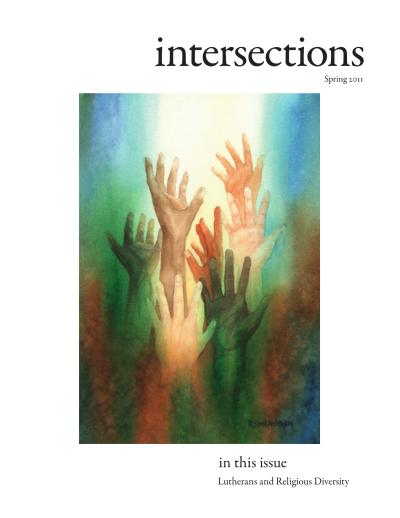
Haak frames the issue by asking how Lutheran colleges and universities understand the changing landscape of religious identification on their campuses, and argues that Lutheran theological commitments — including the work of the Spirit and the Incarnation — call institutions to create places where the voice of “the other” is heard and valued.
-
 Article
Called to Serve
Robert D. Haak
No. 31 · Winter 2010
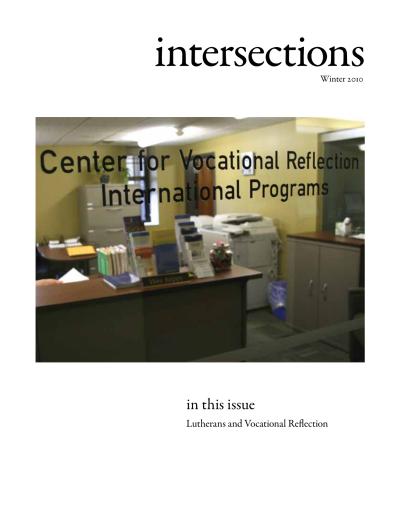
Haak describes Augustana’s Center for Vocational Reflection (CVR) and its threefold framework of skills/gifts/talents, passions/values, and needs of the community. He surveys the CVR’s Working with Faith group, seminary visits, spiritual companioning, Servant Leader Internships, international travel reflection, and the major Senior Inquiry curriculum revision—then reports the lessons learned at Augustana: that multiple exposures matter more than any single program, that the language of vocation works even for non-religious students, that student-initiated ideas (like Erin Blecha’s Athletes Giving Back) often succeed most, and that the CVR will soon merge into a new Community Engagement Center.
-
 Editorial
From the Editor
Robert D. Haak
No. 30 · Fall 2009
Haak frames the issue around the question of Lutheran college identity as formed in distinction from some “other,” introducing essays by Witherup on the Joint Declaration, Reuther on Holden Village, Afzaal on Christian-Muslim dialogue, Dovre on the history of Midwestern Lutheran colleges, Radecke on service-learning, and Ratke on Wilhelm Löhe — each making the claim that the “other” is an essential partner in conversation who helps us know who we are and shape who we will become.
-
 Institutional Focus
Continuing the Dialogue: Augustana College
Sandra C. Looney
No. 1 · Summer 1996
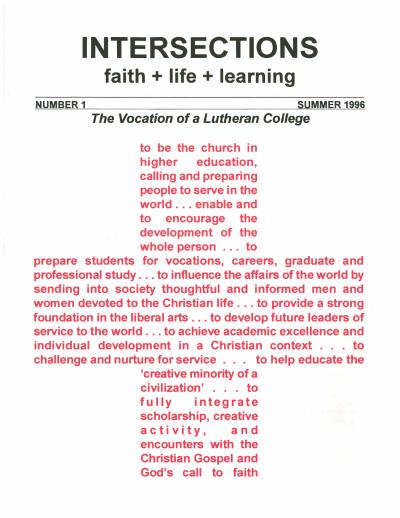
Looney describes Augustana College, Sioux Falls, debating and renaming its values—Christian, Liberal Arts, Community, Excellence, Service—under the leadership of religion professor Dr. Arthur Olsen and the T’N’T (“Through Thick and Thin”) committee, in the wake of ELCA Region III’s “What Does It Mean to be a College of the Church?” conversations. She describes Augustana’s 56% Lutheran student body, daily 10 a.m. chapel, dual Christmas Vespers in Our Savior’s Lutheran Church and St. Joseph’s Cathedral, the Capstone classes on moral and aesthetic issues, and the ongoing work of enlarging Augustana’s conversation to include Native American, Jewish, and Islamic voices.
-
 Institutional Focus
Interfaith Campus Organizing at California Lutheran University
Allison Bermann, Mehak Sachdev
No. 44 · Fall 2016
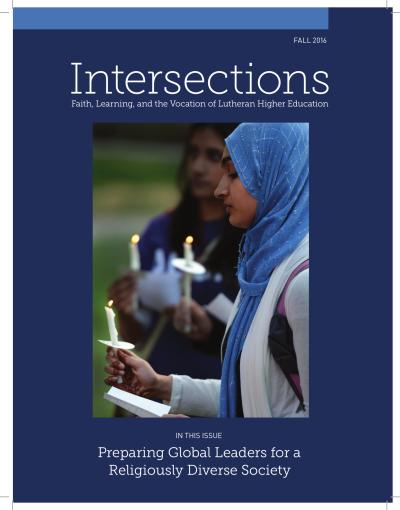
California Lutheran University students Allison Bermann and Mehak Sachdev describe how interfaith participation at CLU grew from a grassroots movement into a sustained, integrated part of campus identity — with an intern program, Interfaith Allies, co-curricular events from Diwali dinners to Hunger Banquets, and a classroom practice of storytelling that opens the required Introduction to Christianity course to students of every faith and none.
-
 Article
Welcome Strangers
Gregg Muilenberg
No. 15 · Winter 2002
Muilenberg, a non-Lutheran philosopher at Concordia, argues that self-consciously Lutheran colleges cannot make non-Lutheran faculty feel welcome through “institutional fit” rhetoric (he cites Concordia’s own hiring boilerplate) because identity must be sustained and developed, not preserved like a pickle. Drawing on Nikos Kazantzakis’s Report to Greco and the three marks of the “profoundly religious person”—commitment to the truth, to the power of the spirit, and to metousiosis through myth—he proposes that faith and reason are best understood as an unending struggle into which strangers must be invited as valuable and active participants, safeguarded by the strongest possible affirmation of academic freedom (citing Martha Nussbaum on Notre Dame and BYU).
-
 Article
The University in the City of God: Beyond Dialectics and Rhetoric
Gregory A. Clark
No. 4 · Winter 1998
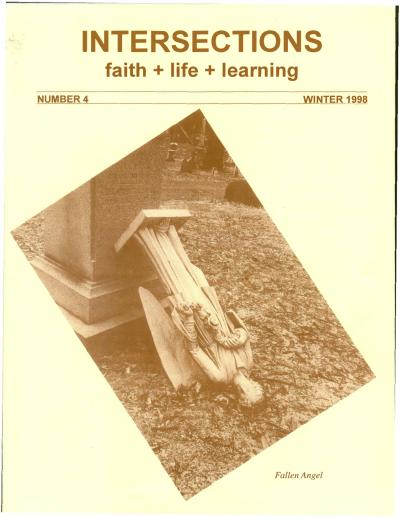
Clark, drawing on Alasdair MacIntyre’s Three Rival Versions of Moral Enquiry, distinguishes the preliberal, liberal, and postliberal university and argues that the liberal university’s pretense of dialectical neutrality has masked a particular rhetoric of its own. Following John Milbank’s Theology and Social Theory, he holds that every philosophy and institution is finally a rhetoric and that the church’s task is not to win on the secular university’s terms but to proclaim and embody an alternative city. The Christian college, then, should give up the apologetic pose of meeting secular reason halfway and instead practice the rhetoric of the gospel: a proclamation of Jesus, an enactment of Christian friendship and peace, and a willingness to be vulnerable to the violence of the world as Jesus was vulnerable to his own. Clark commends this stance to colleges related to the church.
-
 Article
A Lutheran Call for Educator Flourishing
Krista E. Hughes
No. 58 · Fall 2023
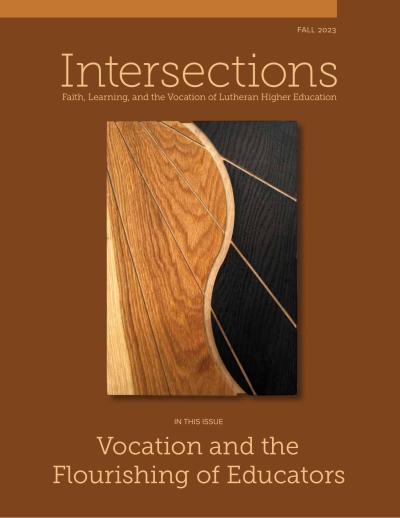
Hughes argues that without educator flourishing there is no student flourishing, traces how an exploitative “passion tax” can distort vocation, and offers seven Lutheran “third-way” value pairings — including Metrics/Grace, Efficiency/Kairos, and DEI/Priesthood of All Believers — to reframe institutional success at NECU campuses.
-
 Editorial
From the Publisher
Mark Wilhelm
No. 28 · Fall 2008
Wilhelm introduces himself as the new Director for Colleges and Universities and publisher of Intersections, thanks his predecessor Arne Selbyg, and previews an issue devoted to the aims and purposes of Lutheran higher education—reflections from Presiding Bishop Mark Hanson, two pieces from Wartburg College’s fall 2008 campus conversation about being a college of the church (his own essay and the Benne/Christenson dialogue), and a sermon by Lake Lambert III preached in the Castle Church in Wittenberg.