Tom Christenson began his introduction to the last issue by asking what adjective should be used to describe that issue. That also seems like an appropriate question to begin my introduction to this Spring 2006 issue. Some of you who pay particular attention to the arrival of Intersections in your mailbox will answer that the most fitting adjective will be “late.” There is truth in this description. As is often the case, when I inherited the editing duties for this journal from Tom Christenson, I misjudged the complexity of the task (and maybe also my own resources!). I hope that those of you who have been patiently waiting will find that the result was worth the wait.
My own preferred adjective would be “new” (we will have to wait to decide whether “and improved” should be added to the phrase). The journal has a new look and feel. We hope that the changes will enhance its readability and “eye appeal.” We are coming to you from a new place—Augustana College in Rock Island, Illinois. I would like to thank Augustana for its commitment to and support of this project. I hope that you will find some of the ideas in this issue new as well.
As is announced on the cover page, the theme of this issue is “Lutherans and Human Sexuality.” I have to admit that growing up it never would have occurred to me that these two concepts belonged together. I imagine there are some readers out there who still feel this way. But, as Lutherans, it seems that we ought to have something valuable to say about such an important topic. The need to continue (or begin?) discussions was made clear by the controversies swirling around the votes taken at the Churchwide Assembly in Orlando last summer. While it is clear that some members of the ELCA hope the Orlando resolutions will be the last words on such topics, the continuing work of the Task Force for ELCA Studies on Sexuality and the report they will issue mean that the conversations are just beginning. This is especially true as we begin to talk about the much broader issues of human sexuality.
The question that I asked in putting together this issue was “what might ELCA colleges be able to contribute to the conversations about human sexuality?” Each of the articles in this issue gives a part of an answer to this question. Yeager calls on the colleges to educate in a way that will create the sort of community that can have these sorts of conversations and still remain a community. Colleges might well be models of this discourse. Benne ends with a similar thought but doubts that Lutheran colleges will be able to be the sort of place where this will happen. He concludes with a challenge to the colleges and universities to gather and to put into action the sort of conversations that they claim are at the heart of their identity.
In between these two calls for conversation we find the conversation modeled by Williams and Bussie. Williams proposes a model for how Lutherans might use the biblical text to inform the conversations that take place. She terms this a “critical traditionalist hermeneutic.” Bussie proposes that the Lutheran confessions and Lutheran theology also can provide resources for this conversation.
While much of the conversation to this point has centered on the understanding of same sex relationships, Nack reminds us that the range of questions dealing with sexuality (Lutheran and non-Lutheran) is much broader than this question. Pastors and parishioners and college faculty and others are all faced with a wide range of ethical and social issues surrounding the understanding of human sexuality. One of the questions that I asked when beginning to think about these issues was what the data told us about the sexual activities and understandings of Lutheran college students today. My experience as a college teacher over the last twenty years seemed to indicate to me that sexuality was an issue that was fairly high on the list of “interesting topics” for my students. When checking into what we know about “sex and the Lutheran college student,” I was a bit shocked to find out that we really don’t know much about the topic. Our college students are surveyed on a wide range of subjects, but (maybe not too surprisingly) their sexual attitudes have not been an area of exploration. It may be that collecting some relevant data to inform the discussion is something that the Lutheran colleges and universities could well contribute to the conversation.
In order to begin to fill the void, I asked the folks who conducted the National Study of Youth and Religion (http://www.youthandreligion.org) if they had data specifically on sexuality and Lutheran students. The answer came back that no one had ever asked the question before. That in itself is an interesting fact. I asked them to determine if there was enough data in their set to be able to say anything significant specifically about Lutheran youth. They found the following facts in their survey.1
- Nearly 43% of Lutheran teens do not necessarily believe that people should wait for marriage to have sex. (About the same percentage as for the total sample of teens sampled.)
- 68% of the ELCA teens would consider living with a partner to whom they were not married.
- Nearly 24% of Lutheran teens have engaged in oral sex. (Slightly higher than the total sample. Over 8% of the Lutherans had engaged in oral sex before age 15.)
- Over 16% of Lutheran teens have had sexual intercourse.
- Almost 80% of the Lutheran teens who had intercourse used protection.
- Over 90% of those Lutheran teens who had intercourse were not under the influence of alcohol or drugs during their first experience.
- More than 18% of Lutheran teens never attend church.
- More than 57% of Lutheran teens attend church more than a few times a year.
- Of this last group, 25% of the ELCA teens report that the church has done nothing to help them with their sexuality.
This might be the beginning of a conversation that seems to be very important to Lutheran teens—and probably to all of us. If 25% of these teens feel that the church has nothing helpful to say to them in this conversation, it seems that there is considerable room for improvement. Many questions remain. Would a larger data base result in significantly different results? What other questions could we ask with a larger sample? What are the important questions that need to be asked?
With Yeager and Benne, I would like to see what ELCA colleges and universities could add to the conversation about important issues facing the church and our communities. These conversations are also important for our own understanding of our role as “Lutheran colleges,” not colleges isolated from the communities in which they exist.
I would like to thank Arne Selbyg, Director for Colleges and Universities and the Vocation and Education program unit for the chance to make a contribution to the ongoing conversations about the nature of Lutheran colleges. I would also like to thank Tom Christenson for all the assistance he has given in making the transition to this “new” journal a smooth one. I would ask each of you who read and value Intersections to consider submitting your thoughts for perusal by your colleagues. Please send any submissions (preferably in electronic MLA format) to me. I look forward to the continuation of this work!
Endnotes
1. These results were reported to me on 4/5/2006 based on the analysis of Kyle Longest who works for the National Study of Youth and Religion. “Lutheran teens” for the purposes of this study are defined as teens whose parents identified themselves as Lutheran. They are not necessarily teens who attend Lutheran colleges and universities. The total number of “Lutheran teens” was 135. The number of “ELCA Lutheran teens” was 50. This is a relatively small number within the total survey. While it might be hoped that a larger sample could be examined, this is the best that I could find at this point. Have any of the faculty at any of our colleges asked these sorts of questions of their students?
-
 Editorial
From the Publisher
Arne Selbyg
Selbyg notes that both the ELCA and Intersections have undergone major changes this year—the Division for Higher Education and Schools is gone, replaced by the Educational Partnerships and Institutions group within the Vocation and Education unit, and the journal has a new editor (Robert Haak), a new home at Augustana College, a new printer, and a new design. He commends the issue’s focus on human sexuality and points readers to the first draft of Our Calling in Education.
-
Article
A Church, the Human Condition, and the Fissured Face of Peace
D. M. Yeager
Yeager, a member of the ELCA Task Force for Studies on Sexuality, reflects on lessons for the church’s educational mission in the wake of the 2005 Churchwide Assembly. Drawing on Macquarrie’s The Concept of Peace, Polanyi on the personal coefficient of knowledge, Hannah Arendt’s The Human Condition, and responses to the task force report from Roy Harrisville III and Larry Rasmussen, she proposes “the fissured face of peace”—peace as the absence of hostility rather than disagreement—and maps how Arendt’s five conditions of human existence (life, earth, natality, mortality, worldliness, plurality) might shape Lutheran colleges’ curricula in history, epistemology, and the sociology of knowledge so that graduates can disagree without hostility and embrace the slow work of reformation.
-
Article
Sexuality over the Lifespan—Social Trends Pose Moral Dilemmas for Communities of Faith
Adina Nack
Nack, a sociologist who presented to the ELCA Task Force for Studies on Sexuality, surveys empirical research on three life-stages flagged by the Task Force as particularly contested—premarital sexuality among adolescents and young adults, sexuality after divorce and within single parenting, and sexuality in late adulthood. Drawing on the Alan Guttmacher Institute, the Office of the Surgeon General, AARP, National Council on the Aging, and the World Health Organization’s 2002 definition of sexual health, she closes each section with questions about the church’s role in education, blessing of committed nonmarital relationships, and dismantling stereotypes about aging and sexuality.
-
Article
Ethical Deliberation and the Biblical Text—A Lutheran Contribution to Reading the Bible
Ritva Williams
Williams articulates a Lutheran “critical traditionalist hermeneutic”—a phrase borrowed from her Hebrew Bible professor Robert Polzin—that honors Scripture as queen while keeping Christ as its king, and tests it by critiquing Robert Gagnon’s use of Romans 1:18-32 in The Bible and Homosexual Practice. Drawing on Lazareth, Lotz, Philip Esler’s Conflict and Identity in Romans, Stanley Stowers’ Rereading Romans, and Ben Witherington III, she proposes an alternative reading in which Paul recites a Hellenistic-Jewish ethnic caricature in 1:18-32 only to overturn it in 2:1-16, making the passage a critique of self-righteous stereotyping rather than the foundation of a moral doctrine on same-sex intercourse.
-
Article
Scarred Epistemologies: What a Theology of the Cross Has to Say about the Gay Marriage Ban
Jacqueline Bussie
Responding to Robert Benne’s claim (citing Gilbert Meilander and Wolfhart Pannenberg) that one cannot defend gay marriage on biblical or confessional grounds, Bussie reads three theses of Luther’s Heidelberg Disputation alongside Moltmann’s Crucified God and Martin Luther King Jr.’s Letter from Birmingham Jail to argue that the theologia crucis—with its insistence on calling the thing what it is, its acknowledgment of scarred epistemologies and simul justus et peccator, and its refusal to domesticate God—exposes the Ohio Defense of Marriage Act as scapegoating, selective literalism, and an unjust law that the Christian conscience must reject.
-
Article
What Could the Lutheran Colleges and Universities Contribute to the ELCA Discussion of Sexuality—But What Would They Actually Contribute?
Robert Benne
Benne hopes that Lutheran colleges might model fair moral discourse on sexuality by gathering a balanced mix of what James Davison Hunter calls “orthodox” and “progressive” voices from religion and social-science faculties, with the Great Tradition treated as the default position. He doubts this is what would actually happen: citing Klein, Stern, and Western’s research showing a ten-to-one liberal-to-conservative ratio in social-science and humanities associations, he suspects Lutheran faculties skew further left than other private colleges and would simply reinforce the ELCA’s already-progressive seminary and churchwide leadership.
-
 Book Review
Assessing the Value of Liberal Arts: A Review of The Evidence Liberal Arts Needs, by Richard A. Detweiler
Robert D. Haak
No. 55 · Spring 2022
Haak reviews Richard A. Detweiler’s The Evidence Liberal Arts Needs, in which the former president of the Great Lakes Colleges Association analyzes 240 college mission statements and interviews more than 1,000 graduates to argue that liberal arts educational experiences have a measurable impact on adult lives of consequence, inquiry, and accomplishment — and invites NECU institutions into a further conversation about how Detweiler’s methodology applies to Lutheran higher education.
-
 Article
The Vocation of Intersections on its Twentieth Birthday
Jason A. Mahn, Robert D. Haak, Tom Christenson
No. 43 · Spring 2016
The three editors of Intersections — Bob Haak, Jason Mahn, and Tom Christenson (in spirit, following his death in 2013) — trace the twenty-year vocation of the journal itself: its 1996 birth at Capital University; its coming-of-age years of debate over institutional markers, two-kingdoms theology, and Lutheran identity; the ascendancy of “education for vocation” as the central marker of Lutheran higher education; and its ongoing identity in relation to a changing ELCA and to the broader cultural conversation about purpose, wholeness, and the vocation of higher education.
-
 Editorial
From the Outgoing and Incoming Editors
Jason A. Mahn, Robert D. Haak
No. 34 · Fall 2011
Outgoing editor Robert D. Haak reflects on a six-year run inheriting Intersections from founder Tom Christenson, the “powerful voices” that have driven the conversation (Dovre, Jodock, Christenson, Simmons, Morgan, Olsen, Wilhelm) and the newer ones now entering (Mahn, Bussie); incoming editor Jason A. Mahn, picked up from the airport in Bob’s pickup truck five years ago, names central issues that “Lutherans on Faith and Learning” engages and previews essays by Dovre, Jodock, McDonald, Hill, Turnbull, and Jodock again.
-
 Editorial
From the Editor
Robert D. Haak
No. 33 · Spring 2011
Haak frames the issue by asking how Lutheran colleges and universities understand the changing landscape of religious identification on their campuses, and argues that Lutheran theological commitments — including the work of the Spirit and the Incarnation — call institutions to create places where the voice of “the other” is heard and valued.
-
 Article
Called to Serve
Robert D. Haak
No. 31 · Winter 2010
Haak describes Augustana’s Center for Vocational Reflection (CVR) and its threefold framework of skills/gifts/talents, passions/values, and needs of the community. He surveys the CVR’s Working with Faith group, seminary visits, spiritual companioning, Servant Leader Internships, international travel reflection, and the major Senior Inquiry curriculum revision—then reports the lessons learned at Augustana: that multiple exposures matter more than any single program, that the language of vocation works even for non-religious students, that student-initiated ideas (like Erin Blecha’s Athletes Giving Back) often succeed most, and that the CVR will soon merge into a new Community Engagement Center.
-
 Editorial
From the Editor
Robert D. Haak
No. 30 · Fall 2009
Haak frames the issue around the question of Lutheran college identity as formed in distinction from some “other,” introducing essays by Witherup on the Joint Declaration, Reuther on Holden Village, Afzaal on Christian-Muslim dialogue, Dovre on the history of Midwestern Lutheran colleges, Radecke on service-learning, and Ratke on Wilhelm Löhe — each making the claim that the “other” is an essential partner in conversation who helps us know who we are and shape who we will become.
-
 Article
Why Did the Chicken Cross the Road? A Homily on Liminality and Vocation
Lori Brandt Hale
No. 45 · Spring 2017
Drawing on Wes Moore’s The Other Wes Moore, Warren St. John’s Outcasts United, Victor Turner’s anthropology of liminality, and Dietrich Bonhoeffer’s poem “Who Am I?”, Hale considers how Hmong, Muslim, Latinx, LGBTQ+, non-traditional, and other students live in “double liminal” spaces — and asks whether liminality might itself be a place of transformation in conversations about vocation.
-
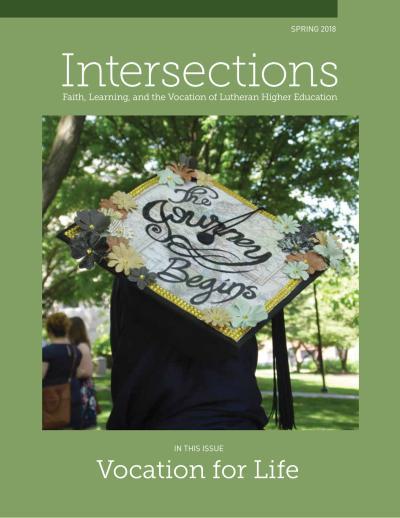 Article
One Life, Many Callings: Vocation Across the Lifespan
Katherine Turpin
No. 47 · Spring 2018
Turpin, drawing on the collaborative research behind Calling All Years Good, traces how vocational discernment shifts through adolescence, younger adulthood, middle adulthood, late adulthood, and older adulthood — arguing that focusing vocation on entry into the workforce limits the capacity of intergenerational college communities to wrestle with calling throughout life.
-
 Article
Mission and Hiring in the Christian College
Bruce Reichenbach
No. 3 · Summer 1997
Reichenbach of Augsburg argues that the Christian or Church-related college’s mission to educate the whole person from a perspective of Christian faith and values can only succeed through intentional hiring of a “critical mass” of faculty, administrators, and staff committed to that mission (following George Marsden and the 1960s Danforth Commission), supplemented by on-going faculty development. He defends an inclusive community-with-diversity, a freedom-and-commitment tension grounded in Alasdair MacIntyre’s account of tradition, and the legality of preferential religious hiring under Title VII of the Civil Rights Act and the relevant case law (Tilton, Hunt, Roemer, Blanton, Grove City, Amos).
-
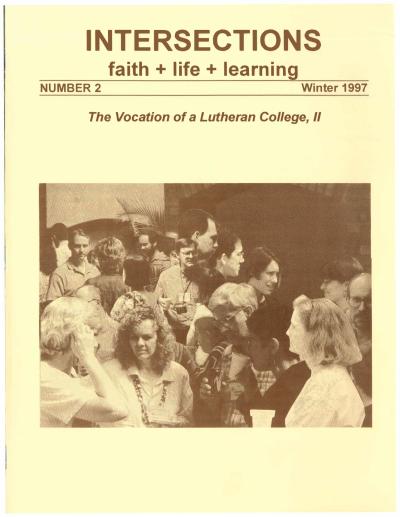 Article
Lutheran Tradition: Five Continuing Themes
Walter R. Bouman
No. 2 · Winter 1997
Bouman of Trinity Lutheran Seminary identifies five themes central to the Lutheran theological tradition (understood through Alasdair MacIntyre’s account of tradition as “an historically extended, socially embodied argument”): biblical (a non-oppressive authority for the Bible rooted in the gospel rather than in scholastic inerrancy, against the backdrop of Luther’s 1517 challenge to Tetzel and the post-Enlightenment marginalization of theology); catholic (continuity with the Book of Concord and the three ancient creeds, with Luther’s “Christology from below” recovering a Jewish rather than Hellenistic understanding of God, revived by Tillich, Pannenberg, Forde, and Jenson); evangelical (justification by faith as the answer to mortality’s radical question); sacramental (Word, Eucharist, and Baptism as Christ’s presence from the future of God’s consummated Reign); and world-affirming (creation as gift, vocation as God’s work in every calling, and stewardship of the ecological crisis).
-
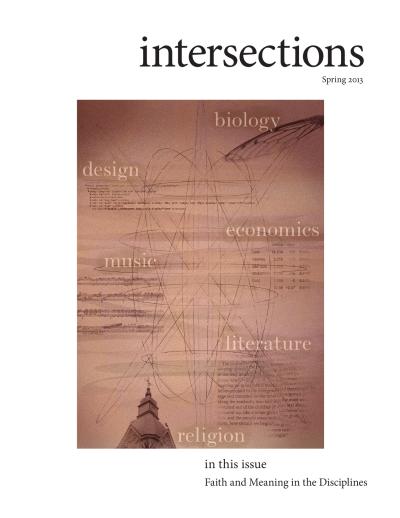 Article
Professing Religion
John D. Barbour
No. 37 · Spring 2013
Barbour reflects on the vocation of a Professor of Religion at St. Olaf College, asking when and how a teacher should disclose personal faith in the classroom. Drawing on his graduate teachers Anthony C. Yu and Langdon Gilkey, and on Augustine’s Confessions, Dorothy Day, Malcolm X, C. S. Lewis, and Kathleen Norris, he argues that teaching autobiography invites teaching autobiographically—and that professing religion is finally a matter of how one believes, not just what.
-
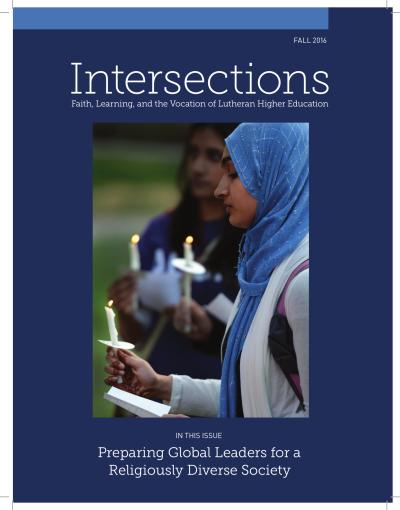 Article
The Promise and Peril of the Interfaith Classroom
Matthew Maruggi
No. 44 · Fall 2016
Maruggi draws on his years teaching in the Augsburg religion department to identify three pairs of seeming opposites — dialogue and debate, safety and risk, commonality and particularity — that, held in creative tension, nurture a vibrant interfaith classroom where pluralism is actively engaged rather than merely present.