In the late 19th century, British settlement worker and teacher Margaret Sewell discussed the beginnings of social work education in Britain and around the world stating what was needed was a
serious, thoughtful and organized effort to tackle social ills not only as part of personal religion, but a social obligation; not merely as an expression of sympathy but as a recognition of difficulties urgently presenting themselves to be resolved, and demanding for their solution gifts of the head as well as of the heart. (cited in Kendall 75)
The reformers were not abandoning the religious obligation to help the poor. They were instead wedding it to the emerging social science understandings of society. What I do in social work and what I teach as a social work educator are framed by this marriage of mind and heart, of academic and experiential learning. Both are informed by my religious faith. In this talk, I will address a series of questions: Why should colleges engage the local communities? Who/what is our local community? What should engagement look like?
My father was a Lutheran pastor, and at his funeral, many people I’d never met from our community made a point to tell me how Dad had ministered to them. These people were not members of our church. Several said they were unchurched. Yet, his commitment to the whole community made a difference in those lives and that message has stayed with me. We need to bother, with passion, integrity and reflection.
Why Should the College Engage the Local Community?
Through history, some have said “Don’t bother.” In years past, universities didn’t bother. The initial relationship between the medieval universities and the host town was, in fact, often adversarial. The medieval universities had no investment in a physical campus. They could threaten to move. An excerpt from Wikipedia includes a description of some of these threats:
Because they had no investment in a physical campus, they could threaten to migrate to another town if their demands weren’t met. This wasn’t an empty threat. The scholars at the University of Lisbon in Portugal migrated to Coimbra, and then later back to Lisbon in the 14th century. Scholars would also go on strike, leave the host city, and not return for years. This happened at the University of Paris after a riot in 1229 (started by the students). The university did not return to Paris for two years.
Can you imagine if St. Olaf decided to up and move to Chicago when neighbors complained about student housing? In addition, “students in the medieval universities enjoyed certain exemptions from the jurisdiction of the ordinary civil court.… This often led to abuses and outright criminal behavior among students who realized they enjoyed immunity from civil authorities.” (Wikipedia) This exacerbated tensions between town and gown. At least we know that our students are ticketed and carded!
One of the most famous confrontations between students and the local community was the Battle of St. Scholastica Day that occurred on February 10, 1355 at the University of Oxford. An argument in a tavern—a familiar scenario in contemporary life—escalated into a protracted two-day battle in which local citizens armed with bows attacked the academic village, killing and maiming scores of scholars. For five hundred years, Oxford observed a day of mourning. So the steady encroachment of universities upon neighboring areas created contention between town and gown, continuing from medieval times to the present.
Lawrence Martin, in an essay entitled “University and Community: A Tale of Two Cultures,” described succinctly the history of town/gown relationship in more modern times:
In the United States, hostility towards universities was initially born out of geographical isolation. Universities were often located in rural (frequently remote) areas far removed from the economic and social problems of the broader society. [true of most in the ELCA—MC] Universities promoted themselves as elite bastions of information and knowledge. (Martin 3)
Despite their beginnings in relative isolation, many became urban universities simply by the expansion of areas around them. The response of many was to build higher walls and stronger gates in an attempt to maintain a separation from their surrounding communities. This added to the pejorative use of the term “ivory tower,” a world or atmosphere where intellectuals engage in pursuits that are disconnected from the practical concerns of everyday life or academic elitism that shows condescension to those around them/us. (Martin) They didn’t want to bother.
Consider the entrance(s) to your campus. Ours at St. Olaf are pretty open and welcoming, but due to a conceal-and-carry law passed recently in Minnesota, we have on major buildings signs that say “St. Olaf bans guns on these premises.” How welcoming is that? Ira Harkavy, who directs the Center for Community Partnerships at the University of Pennsylvania, shows us that not only the physical expressions of our campuses separate us from the community, but also the internal workings.
In the decades after World Wars I and II, American higher education increasingly competed, ferociously, egocentrically, narcissistically, for institutional prestige and material resources. Almost single-mindedly, pursuing their self-centered goals, they increasingly concentrated on essentially scholastic, inside-the-academy problems and conflicts rather than on the very hard, very complex problems involved in helping American society realize the democratic promise of American life for all Americans. (9)
So, for much of history, universities didn’t bother much.
Not all historical relationships between universities and communities were hostile or aloof, however. Positive examples abound. The Land Grant College Act (1862) facilitated the development of agricultural and mechanical education, as well as other areas, for the middle and working classes. In 1889, the University of Chicago opened Hull House, a university-community partnership to help the low-income population of Chicago’s West Side. When Seth Lowe was president of Columbia University, he encouraged faculty and students to become involved in community work (Harkavy). And in Northfield, Norwegian immigrant farmers, pastors and others founded St. Olaf as an institution of “higher education for the practical life” (Farrell). Your institutions no doubt also have important stories. So, if we are not hostile, and are now less indifferent, must we engage? Do we need to bother? Some think perhaps soon we won’t!
Might the very future of town/gown as a relationship be in doubt? Online programs such as at the University of Phoenix hardly rely on geographical presence. Many universities have distance education courses via television and the internet. Maybe the college student of the future will be sitting at his or her personal computer miles from a college campus. Maybe the traditional commencement ceremony will be gone as students graduate year around. However, many leaders still stress the continuing value of traditional learning and teaching methods at brick and mortar places. So far, ELCA colleges do, too. Are there some reasons now why we do/should connect with our geographical communities? I suggest many reasons for college engagement with the community are relevant; reasons can be practical, educational, ecological, moral and theological.
Engagement is practical
We can give back in response to our large footprints. This footprint concept is described by Ronald Kysiak. “Although universities bring great prestige to a community, many citizens perceive them solely as large, powerful, non-taxpaying entities that soak up city services and provide little in return.” (50) A college can generate housing, security, political, and tax issues. Off-campus parties and the excessive noise and public drunkenness associated with them can create town-gown animosity. Student voting can cause local political conflicts. In 2004, students at Hamilton College were turned away from the polls by election board officials in Utica, NY. Officials claimed that only permanent residents of the county could register to vote there, and that a college dorm does not meet this criterion. The question of jurisdiction for college security and local law enforcement can be an issue when students live off campus. And, as universities expand, more land is removed from property tax rolls. Our footprints can be large and deep.
The “engaged university” is a recent term used by Campus Compact to describe community partnerships and joint planning with city officials. In the case of St. Olaf and Northfield, the college paid for purchase of a tall ladder truck with the fire department so it could reach the top floor of our residence hall, the highest building in the community. Both Northfield colleges contribute money annually to the Northfield Community Investment Fund. Our Dean of Students meets regularly with neighbors who want to discuss student housing concerns. Ameliorating the effects of our footprints is important, but what about the reason we exist?
Engagement is educational
Experiential learning for students is another reason we should engage the local community. An AAC&U report in 1991 on The Challenge of Connected Learning says “students come into the academic ‘home’ not to become permanent residents, but to be nurtured and supported as they develop the capabilities to enter, negotiate, and make connections across communities … inside and out of the academy” (qtd. in Dalgaard 7).
Social work history provides an illustration of experiential learning. As the governing council of the Charity Organization Society in London was poised to merge with the institution that would become London School of Economics, their written report stated:
By a strange perversity … sociologists and economists are frequently led to deal with questions of social science without acquiring at first hand a careful and consistent knowledge of the facts and conditions of personal and social life in the daily competition and struggle of the common people, the poor, the very poor, who form a large part of the population. (Qtd. in Kendall 72)
We need to know what is happening in our community to better enable our students to learn and to apply their knowledge. This need to know has hatched a whole arena of scholarship, new departments at our colleges, and funding resources like the Lilly Endowment. Time limits my ability to further develop this reason for engagement here, but others have done important work on this.
Engagement is ecological
My colleague Dr. Mary Titus calls this the “mindful attention to place.” Consider the following: St. Olaf is on Manitou Heights, an Anishinaabe word meaning “spirit,” and “Gitche Manitou” means “Great Spirit.” We sit on the Jordan aquifer. It’s windy on the hill and we are surrounded by farms, rapidly giving way to development in our ex-urban environment. At St. Olaf, the attention to sustainability is growing exponentially, with a new wind turbine and a new science building that will be green, among other initiatives. Our former president, Mark U. Edwards, said, “The experience of community at a Lutheran college should help students develop a sense of the world’s true interdependence of both people and the rest of creation.” (226) At our colleges, we need to prepare students for citizenship and leadership, including care and nurturing of our physical location.
Engagement is moral
We can, and should, provide genuine helping in our community. The Lutheran Educational Conference of North America recently surveyed thousands of graduates of both Lutheran colleges and public university graduates. Findings indicated that students at ELCA colleges benefited from an emphasis on values and ethics, and that college helped them develop a sense of purpose in life. I wonder if we’ve ever surveyed our local communities—leaders of organizations, townspeople of all ages and interests and human differences—about whether and how much we have “helped” them? I think it would be interesting to find out! In Northfield, my sense is that there has been genuine help provided over the one-hundred thirty-four years of our existence. While it is difficult to quantify the friendships between college students and seniors in the retirement centers, among the college students and the children needing mentors, in the churches where students teach Sunday school and help with youth groups, I think we can, do, and should provide genuine help in our communities.
Finally, engagement is theological
Location, location, location is our vocation! The Lutheran conception of vocation as connection to community is found in many places, among them are:
- Our Calling in Education, the social statement on education of the ELCA, which says, “Vocation involves God’s saving call to us in Baptism and life lived in joyful response to this call. In Jesus Christ we are loved by a gracious God who frees us to love our neighbor and promote the common good; in gratitude for God’s love we live out our vocation in our places of responsibility in our daily life—home congregation, workplace, neighborhood, nation, and global society.” (Task Force)
- the ELCA Higher Education theme “equipping people to practice their callings under the Gospel for the sake of the world”; and
- the Luther Seminary Centered Life in the Center for Life-long Learning website that states that we are called, “… by God to God ... to daily tasks and duty... to use [our] unique strengths and abilities.” We are called to all arenas of life … “home in how [we] love, care for, and sustain those who live with or visit [us] there … work in doing whatever [we] do in the way that best serves and supports others … community [in] seeking the common good in neighborhoods, schools and elections…. To paraphrase Martin Luther: Wherever you are, there you are called. Only if you absolutely cannot serve God there, must you seek another place.” (Calling: The Basics)
We in church colleges have this responsibility to live out our vocations where we are. There are reasons to bother. So, we start with our communities.
What and Who is Our Local Community?
Northfield was founded by John North, a pioneer statesman who was in the legislature of the territory and wrote the legislation that resulted in the charter for the University of Minnesota. He also founded Riverside, CA. We have 17,000 people, on the full socio-economic scale, with higher levels of education than many small communities. We have an active, engaged citizenry. We have an estimated 1,000 permanent Latino residents, and we have a protected, but polluted river. Our identifiable, quaint downtown is threatened by development out on the highway. And, we have 5,000 or so college students ready and eager to make a difference. Our organizational riches include churches, youth organizations, charitable foundations, civic and cultural organizations (e.g. Citizens for a Quieter Northfield, Defeat of Jesse James Days), health and social services, and schools and colleges. Numerous resources, strengths and needs. We must know our own communities. But, where to start? If we look carefully, such knowing is already present.
What Does Local Engagement Look Like?
It would only take a couple minutes in conversation with a colleague at this conference to learn about an initiative between another college and its community. These initiatives can include volunteering one time, volunteering over many months or years, experiential learning (service learning, practicums, clinicals, labs), and civic engagement (we’ve started a college student internship with the League of Women Voters and have work-study options in helping capacities like tutoring). While these imply campus to community; many initiatives also bring community to campus. You can think of other examples.
It was fun for me to view web sites of some of our colleges and universities. I would have liked to peruse all of them to see your community connections, but did not have enough time. Here’s a sample of what I found in just one arena of engagement—community service.
Pacific Lutheran University, Tacoma, WA
The Center for Public Service celebrates the full partnership of the surrounding community, recognizing that in order for service and civic engagement to be responsive to community needs, participants must fully embrace their role as members of an on-going dialogue about impact and implications, as well as respect the complexity of the social fabric, the give and take of human endeavor.
Newberry College, Newberry, SC
The Division of Humanities and Social Sciences (esp. Mike Beggs, Religion) has courses in community service, among them Service and Reflection … “an examination of the relationship between community service and contemporary thought. Literary, philosophical, political and sociological texts are examined to assist in the moral and social reflection about serving others.”
Wagner College, Staten Island, NY
Curriculum named The Wagner Plan or the Practical Liberal Arts: Reading, Writing & Doing. The Civic Engagement Certificate Program exists to show students how they can bridge their academic life with the economic realities of the communities they serve. It helps immerse students into the Staten Island community by giving them access to different community organizations such as Project Hospitality and the African Refugee Center, and combines volunteer work with an academic curriculum.
Augustana College, Rock Island, IL
The Center for Vocational Reflection helps students recognize who they are called to be. Vocation/Calling is realized when one’s skills, gifts, and talents combine with one’s passions to meet the needs of the community.
What Should Engagement Look Like?
“Should” implies an ethical commitment. I’m convinced this is an ethical matter, and I hope you are also. Here’s an excerpt from the St. Olaf website: “Welcome, Northfielders! St. Olaf College is proud to be a part of the Northfield community—and invite you to take advantage of having a college as your neighbor, too.” David Gonnerman in our Communications office started a piece called Posten. Three times per academic year he sends out a newsletter with a calendar of events to 11,000 “neighbors” of the College. That’s a good start.
Here is my recipe for engagement: Passionate + Ethical + Reflective.
First … Passionate
You need to want to do it. This will help overcome many challenges and barriers to engagement locally. What do you care about? What opportunities in your community match your interests? When you talk about the engagement with your community, do your eyes light up? Can you see that something is changing for the better? How might you tie that to your work at the college? Start small, for sure, but have it really address your own dream or passions so you are careful about it and stay with it. Maybe there is a little park near your campus that you pass every day in your car, and you’d like to see that it stays as colorful as possible with flowers. Maybe your parents have died and you want to spend time with older people regularly.
Next … Ethical
You need to be clear about your passions, and then make certain those fit with the community or are at least not at odds with what is happening. One of my biggest soap box issues is the unleashing of lots of do-gooder students, faculty, and staff on an unsuspecting community. Every time St. Olaf has a new initiative for working with the community, I raise my voice (some think I’m a pest, I’m certain). Doing good is not enough; doing good must be done well—with knowledge, skill and ethics. Several elements are crucial to ethical college/community engagement. I’ve listed seven:
Needed
In social work, we teach about the planned change process, not unlike change processes in many disciplines. To help students remember this, my colleague has among her Lennox Rules of Practice: Intervention begins at R. This means that if the process of change follows the alphabet, introductions and data-gathering start at A, assessment of need and planning are at about H, and intervention doesn’t occur until about R. We shouldn’t jump in and do before we know there is a need. Who says there is a need? Is it the people on the ground or those in positions of power and influence? What does the need look like? Who is defining it?
Welcomed
Even when a need is carefully assessed and understood, engagement might not be welcome. It’s clear that the Latino youth in Northfield need to be educated. One way our community set about addressing that need was to motivate students to go on to higher education in the United States. Do they all want that? While many do, some want to get married and raise a family, some want to return to Mexico, some want to serve in the military.
Mutual
Why didn’t I title this talk “The Local Community Engaging the College”? What initiatives come from the community to our institutions? I suspect you could think of many instances where this happened. In Northfield, our social work senior projects often respond to requests from the community. For instance, Familias en Accion, a group of local teachers, community organizers, and Latino youth, teach our students about reality in the public schools while our students carry out useful evaluation research for grant-writing purposes.
Long-term
I don’t know what is worse, not engaging at all, or engaging haphazardly and short term. There are instances where short-term engagement is the only way … voter registration efforts before an election, one-time clean up after a tornado. However, many efforts to connect college and community start and then stop, leaving behind resentment and mistrust. This can affect later efforts, sometimes unbeknownst to the new engager. Some examples? The after school tutoring that falls apart when finals or spring break means our students do not attend; or, a service learning requirement in a course that is taught by a one year adjunct. Helping a little bit and raising hopes and expectations—then leaving or moving on to something more sexy and exciting. HIV/AIDS is off the radar in local communities because it isn’t as interesting as HIV/AIDS in sub-Saharan Africa. Long term requires commitment and patience and even sometimes a written agreement and a paid person (or at least a permanent structure, like St. Olaf’s student-run Volunteer Network).
Attentive to diversity
I’m an extrovert and the oldest child of five. I talk, loudly and directly. I am a “J” on the Meyers Briggs Personality Inventory. I like timelines, deadlines, and outlines. It is crucial to pay attention to diverse styles of work and diverse priorities. We must attend to differences in ethnicity, class, sexual orientation, religion, and other forms of difference in human beings. This is a soapbox of mine. “I want to help the Latino community in Northfield” is a phrase I hear a lot on campus. This community has sub-groups, though many do come from a certain area of Mexico. They are Catholic or evangelical. They speak Spanish and English with variable fluency. Some are undocumented, with families living in two countries. Many have worked in agriculture or factories all their lives. Some have high school education, others have primary school only. Some are immigrants; others are first or second generation. They are mainly young and largely male (though this is changing). What does this mean for helping from our students, faculty, and staff who are primarily white, citizens, educated, middle or upper-class? Who speak English and perhaps are studying Greek?
A little excerpt from Wikipedia:
… in medieval times, many university students were foreigners with exotic manners and dress who spoke and wrote Latin, the lingua franca of medieval higher education. Students often couldn’t speak the local dialect, and most uneducated townspeople spoke no Latin. The language barrier and the cultural differences did nothing to improve relations between scholars and townspeople. The tenor of town-gown relations became a matter of arrogance on the one hand and resentment on the other.
Does this “strangeness”—both ways—between students and townspeople cause concerns in our communities? Must we be just like those with whom we engage? Not at all. My father taught me a valuable lesson. We don’t have to be the same, but can work alongside people and learn from our differences.
Strengths-based
Engagement is often problem-based. In social work, we teach our students to first ask clients: “How do you see your future? What do you want to have happen? What’s helping you live your life well?” We should not be surprised that even the most grief-stricken parent or the person with severe disabilities or the runaway with HIV has something positive happening. Maybe it’s only that she got up and got dressed that morning. There are strengths in every situation, and our engagement is made easier when we look for them, capitalize on them, and help them mature. For an example, one senior recently was asked by the agency to design a financial information class for clients who were low-income. The agency said, “Our clients can’t handle their money; they are in debt and spend foolishly” … PROBLEM. She re-framed it by saying, “they work hard, send money home” … STRENGTHS. The end result? The offered a class on managing money when the clients wanted it, with child care and transportation provided.
Respectful
Perhaps I should have put this first. At Olaf it’s difficult, as we “come down” from the Hill to “help.” We need humility. We need respect and care for those with whom we interact. We need to see everyone as children of God. We must respect the dignity of those served. Octavia Hill, another reformer in England who was a founder of the social work profession, said at the outset of her crusade to improve tenement housing for the poor in London that a major goal was to help people help themselves “… to believe in the value and dignity of even the most bedraggled and degraded of her tenants.” (Kendall 13)
Last … Reflective
British social work educators teach “reflective practice.” They routinely take time out in their work place to reflect actively and thoroughly on what they are doing. Who cares? What matters? Does it work? We need to be evaluating our collaborations with the community and be open to changing what we do. This can be difficult when we get set in our ways. We need to be open to evaluation, adaptation, and even (can we imagine!), termination of the effort (the fastest way to get action is for someone to say “let’s just quit this” or “what happens if we just stop this tomorrow?”). Such conversation should be continuous and reciprocal. In 2001 the Task Force on Experiential Education at St. Olaf College broadly defined experiential education as the study, action and reflection of a “hands on” experience. The importance of reflection on our actions in the community was directly influenced by the writings of John Dewey and of Paolo Freire. Experiential education owes them a debt of gratitude.
So, the Best Engagement is Passionate, Ethical and Reflective
Ernest Boyer took the importance of engagement to a higher level when he made the case that the mandated mission of higher education is the “scholarship of engagement.” He means
connecting the rich resources of the university to our pressing social, civic, and ethical problems, to our children to our schools, to our teachers, and to our cities … ultimately the scholarship of engagement also means creating a special climate in which the academic and civic cultures communicate more continuously and more creatively with each other. (21)
We as faculty members need to view this work as scholarly, as important, and as weighty as other types of research, writing, and scholarly activity in our tenure and promotion decisions. A wonderful resource on practical aspects of community-college engagement, the “how to,” is The Promise of Partnerships: Tapping into the College as a Community Asset by Scheibel, Bowley, and Jones (2005).
Conclusions
In 1876, Daniel C. Gilman, the first president of John Hopkins University, expressed the hope that American universities would one day, “make for less misery among the poor, less ignorance in the schools, less bigotry in the temple, less suffering in the hospital, less fraud in business and less folly in politics.” (Martin 3)
I would pose this question for the future of ELCA colleges and universities, “How do we link the core mission of colleges—teaching, research and service—to help local communities?” One answer, from Dr. Harkavy, is “to advance knowledge through service … to improve human welfare. Service which does not seek to deeply improve the quality of life in the local community can become a hollow activity failing to contribute to citizenship and offering communities false, unfulfilling promises.” (par.7)
My challenge to you today is to leave this conference with a promise to incorporate something from your local community, whether large or small, into your academic or administrative work. If you teach history at Carthage, give an assignment to bring to class one historical fact from the city of Kenosha. If you teach music, require your students to attend one concert in the Lindsborg public schools; better yet, make it possible for local school children to attend a concert at Bethany. If you teach theology at Texas Lutheran, have students count the number of churches in Seguin and discuss the array of theological stances present among them and how those traditions came to be in your community. If you work in Dana’s administration, find out how many Blair residents are employed who live within two miles of campus. If you are in student services at Wittenberg, check when college last had a town/gown committee to discuss relationships in Springfield.
I believe that God intends us to live in community. For we who teach and work in Lutheran institutions, that means not only our own campus communities provide context for service, but also those communities that surround our campuses. These are the communities in which we live, shop, worship, and play, as well as work. It’s not a bother to bother. It’s an honor, a privilege, and a calling.
Works Cited
Boyer, Earnest. ”The Scholarship of Engagement.” Journal of Public Service and Outreach 1 (1996): 11-20. Rpt. in Engaged Scholarship as an Expression of Community Engagement. Ed. L. Sandmann. University of Georgia. 2007. February 6, 2008 <http://www.umass.edu/outreach/scholarly_engagement/pdf/Engaged%20Scholarship%202%20pager%20.pdf>
“Calling: The Basics.” Luther Seminary Center for Life Long Learning. May 13, 2008 <http://www.centeredlife.org/calling/default.asp?m=-2877>
Dalgaard, Bruce. “Making Experiential Learning Academic and Scholarly.” Presentation at The Role of the Liberal Arts Colleges in Public Scholarship: Engaging Our Communities and Expanding Our Classrooms Conference. Beloit College, 2005.
Edwards, Mark U. “Called to Serve.” Called to Serve: St. Olaf and the Vocation of a Church College. Ed. Pamela Schwandt, Gary DeKrey, L. DeAne Lagerquist. Northfield, MN: St. Olaf College, 1999. 215-230.
Farrell, Jim, et al. St. Olaf 2000: Identity and Mission in the 21st Century. Northfield, MN: St. Olaf College, 2000.
Harkavy, Ira. “The Growing Role of Urban Four-Year Universities in Service-Learning, School Reform, School-to-Work and Community Change.” May 22, 1998. American Youth Policy Forum brief. February 6, 2008 <http://www.aypf.org/forumbriefs/1998/fbo52298.htm>
Kendall, Katherine. Social Work Education: Its Origins in Europe. Alexandria, VA: The Council on Social Work Education, 2000.
Kysiak, Ronald C. “The Role of the University in Public-Private Partnerships.” Proceedings of the Academy of Political Science 36.2 (1986): 47-59. <http://www.jstor.org/stable/1173898>
Martin, Lawrence L., Hayden Smith, and Wende Phillips. “Bridging ‘Town & Gown’ Through Innovative University-Community Partnerships.” The Public Sector Innovation Journal 10.2 (2005): Article 20. Center for Community Partnerships University of Central Florida. February 6, 2008 <http://www.innovation.cc/volumes-issues/martin-u-partner4final.pdf>
Scheibel, Jim, Erin M. Bowley, and Steven Jones. The Promise of Partnerships: Tapping into the College as a Community Asset. Providence, RI: Campus Compact. 2005.
Task Force on Education, Evangelical Lutheran Church in America. “Our Calling in Education.” August 10, 2007. <http://archive.elca.org/socialstatements/education/pdf/Our_Calling_in_Education_Web_Version.pdf>
Wikipedia. “Town and Gown.” February 6, 2008 <http://en.wikipedia.org/wiki/Town_and_gown>
-
 Editorial
From the Publisher
Arne Selbyg
Selbyg, retiring this summer as Director for ELCA Colleges and Universities, reflects on his decade serving as spokesperson between the church and its twenty-eight colleges and universities, and argues that the link between the colleges and the church has grown stronger over the last ten years — sustained by supportive church leaders like Presiding Bishop Mark Hanson, the annual Vocation of a Lutheran College conference, and a Lutheran theology of higher education whose principles (questioning authority, returning to the sources, including the excluded, serving the neighbor) remain a strong basis for operating colleges and universities in the twenty-first century.
-
Editorial
From the Editor
Robert D. Haak
Haak frames the issue around the question of why Lutherans engage the world rather than retreat from it, locating the answer in the doctrines of creation and incarnation, and introduces essays by Erwin on globalism, Carlsen on local community engagement, Marty on multiple callings, and Mattes on the Grundtvigian heritage at Grand View. He also bids farewell to publisher Arne Selbyg, noting the fittingness of the Adinkra (“farewell”) cloth on the cover of this final issue under Selbyg’s leadership.
-
Article
Lutheran Higher Education in Global Context: Called to Serve the World
R. Guy Erwin
Erwin advances three theses on the global vocation of Lutheran higher education: that the vocation of a Lutheran college is to live out its mission in a service-oriented way; that Luther’s definition of vocation as love of neighbor must today have global dimensions; and that a Lutheran college best fulfills its vocation when it fosters a global perspective in its community, curriculum, and ethos. Drawing on Gustav Wingren and Luther’s catechisms, sermons on schooling, and three-realms ethics, he surveys the mission statements and websites of all twenty-eight ELCA colleges and universities for evidence of globalist commitment.
-
Article
Who Said You Have Only One Calling?
Peter Marty
Marty argues that our normal practice of thinking singularly about vocation must be enlarged: God has not limited any of us to one expression or gift, and Martin Luther never spoke of individuals as having only one calling. Drawing on Max DePree’s parable of the millwright-poet, William May on the etymology of “career,” Evelyn Underhill on the verb “to Be,” James VanOosting, Scot McKnight’s “Jesus Creed,” and a Golden Gate Bridge patrolman who has saved hundreds of lives, he identifies four features common to every story of vocation in scripture: special purpose, special gifts, a caller from outside, and the requirement of sacrifice and generosity.
-
Article
Reclaiming Grundtvig at Grand View College
Mark C. Mattes
Mattes traces the Grundtvigian heritage of Grand View College — the only North American institution founded by Grundtvigian Danes — from its origins in the 1880s split between Pietist Inner Mission and Grundtvigian Danish Lutherans through its golden years of folk dancing, gymnastics, and the weekly lecture, to the demographic and curricular changes of the 1950s through 1990s. He describes recent tangible initiatives, including the Grand View College Reader, Imaging the Journey, and the 2007 Strategic Planning Commission’s “Faith Foundations” statement, that seek to recover the “Human first, then Christian” mantra of Grand View’s ancestors for a generation of students whose “ship” has had not only its planks but its very model replaced.
-
Reflection
John 3:16-17
Richard Priggie
Preached at the Vocation of the Lutheran College conference in August 2007, Priggie’s sermon on John 3:16-17 reads the Greek word “cosmos” as evidence that “God was into globalism long before we were” and calls Lutheran colleges to embrace Matthew Fox’s “deep ecumenism” — an embrace of and care for all created things. Drawing on J.B. Philipps’s Your God Is Too Small and the movie Pleasantville, he invites his hearers to come to Rock Island in order to leave Rock Island, to be Christian in order to be more than Christian, and to find the places where the roads don’t go in a circle but just keep going.
-
 Article
Gen Z is Made for Lutheran Higher Education
W. Kent Barnds
No. 51 · Spring 2020
Barnds argues that Generation Z’s defining traits — socially responsible, purpose-driven, cost-conscious, culturally open, and tech-expectant — align almost perfectly with the missions of NECU institutions, and offers concrete suggestions (from replacing “vocation” with “purpose” to embracing Gen X parents as co-pilots) for Lutheran colleges seeking to attract and serve this generation.
-
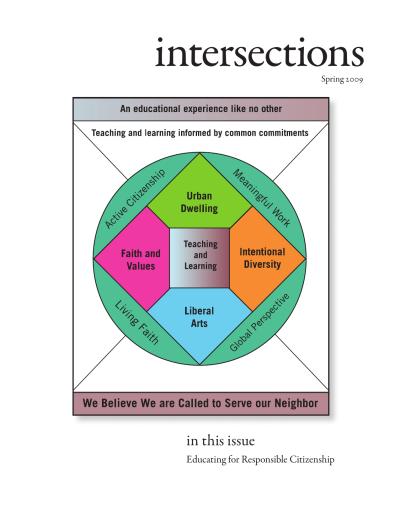 Article
Students in the Cloud: Creating Digital Citizens
Jose Marichal
No. 29 · Spring 2009
Marichal weighs the utopian and dystopian views of the “networked information economy,” drawing on Yochai Benkler, Manuel Castells, Henry Jenkins, Cass Sunstein, Robert Putnam, Nicholas Carr, and Andrew Keen to chart the promise and peril of life “in the cloud,” and proposes Aristotle’s intellectual virtue of phronesis—developed through Hubert Dreyfus’s five stages of skill acquisition—as the goal of digital citizenship for college faculty and their students.
-
 Editorial
From the Publisher
Arne Selbyg
No. 17 · Summer 2003
Selbyg explains that the four essays in this issue grew out of the first Lutheran Academy of Scholars in Higher Education—a two-week seminar funded by the Lutheran Brotherhood Foundation and the Lilly Endowment, led for its first three years by Dr. Ronald Thiemann of Harvard Divinity School—whose official theme “Finding Our Voice—Christian Faith and Critical Vision” became informally “What’s Faith Got To Do With It?”
-
 Article
Making Diversity Matter: Inclusion is the Key
Monica Smith
No. 50 · Fall 2019
Smith, Augustana’s inaugural Vice President for Diversity, Equity and Inclusion, frames the work of a Chief Diversity Officer as that of a disrupter and argues that while diversity in higher education is already happening, inclusion is a choice — one requiring a fundamental institutional transformation that diversifies faculty and staff, infuses diversity into the curriculum, invests in professional development, and draws on senior leadership to dismantle barriers.
-
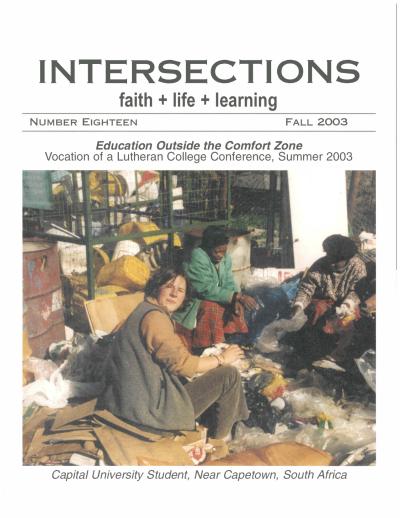 Article
The Search for a Just Peace in a Globalized World
Munib A. Younan
No. 18 · Fall 2003
Younan, Lutheran Bishop in Jerusalem, grounds Palestinian Christian identity in Incarnation theology and a Lutheran theology of grace and the cross, then surveys the Evangelical movement’s nineteenth-century legacy in the Middle East—the 1864 Arabic Bible, ELCJ schools, women’s ordination, and the Middle East Council of Churches. Engaging Edward Said’s critique of Samuel Huntington, he calls for international and local mutual-recognition agreements (including the Jerusalem Lutheran-Anglican agreement and a Lutheran-Reformed agreement in the Middle East), four marks of interfaith dialogue, and a sharp distinction between Lutheran “Evangelical” identity and the Dispensationalist evangelistic Right whose Israel-Palestine scenarios he names a heresy. He closes by proposing concrete scholarship, faculty exchange, and sabbatical partnerships between U.S. Lutheran colleges and the ELCJ’s churches, schools, and Dar al-Kalima Lutheran Academy.
-
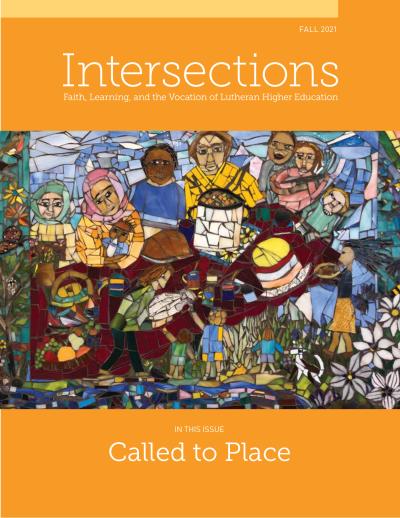 Article
Hospitality to the Wild
Laura M. Hartman
No. 54 · Fall 2021
Drawing on research with a Wild Ones Native Landscaping chapter and Marilyn Matevia’s ethic of “creature comfort,” Hartman argues that Christian hospitality must extend to non-human animals and plants — and asks whether college campuses can foster not just human diversity but biodiversity.