The American Myth of White Supremacy: A Review of Myths America Lives By
Intersections No. 50 · Fall 2019
In 1989 a young white woman running through New York’s Central Park was seized, brutally beaten, raped, and dumped in a ravine. Miraculously, she survived, despite extensive injuries and a complete loss of memory. Five black and brown teenagers from Harlem, labeled the Central Park Five, were quickly apprehended and, after twenty-four hours of questioning without legal counsel, confessed to the crime. Although they were all minors, some as young as fourteen, the New York Police Department publicly released their names. Angry demands for punishment filled the local and national media. In subsequent trials, all five were found guilty and swallowed up by the New York prison system. However, they were innocent.
When They See Us, a recent Netflix limited series directed by Ava DuVernay, powerfully depicts the circumstances that led to this terrible miscarriage of justice. Korey Wise, Raymond Santana, Yusef Salaam, Kevin Richardson, and Antron McCray were fully exonerated in 2002, thirteen years after the event, when the real rapist confessed and DNA evidence confirmed his guilt. The five adolescents had been convicted without the prosecution presenting any physical evidence, witness identification, or even a coherent account of events. They simply were boys of color in the wrong place at the wrong time. DuVernay’s film depicts the family situations of each of the teens, recounts the events that led to their convictions, and explores the men they have become after their years in prison. When They See Us prompts its audience to see five unique individuals rather than a mythic Central Park Five, as created by the assumption of white supremacy, which has fogged the vision of so many for so long.
The United States, historian Richard T. Hughes claims in Myths America Lives By: White Supremacy and the Stories that Give Us Meaning, has always embraced the myth of white supremacy, either purposefully or unconsciously. His book provides a detailed historical account of this claim. Institutions of higher education pledged to be guided by Lutheran thought must explore the ways in which white supremacy marks both American history and our current social reality. DuVernay’s film and Hughes’s book offer riveting entrees to such conversations.
While diversity, equity, and inclusion are commonplace priorities in American higher education today, Lutheran theological values should ground, shape, and inspire efforts to achieve such goals. As Darrell Jodock writes about the goals of Lutheran higher education, “Taken individually... [our] educational priorities may not be distinctive, but they become so when shaped and informed by Lutheran values” (12). Our values, what we say we believe about human beings, can either create or obstruct the ways that we treat each other and form communities. Three values providing a theological foundation for resistance to the myth of white supremacy are the classic Lutheran freedom from having to save oneself and freedom for a life of service, the call to see those we think of as Others as actually our neighbors, and finally a commitment to justice based on God’s unmerited love and concern for all.
In Myths America Lives By, Hughes identifies what he calls “national myths”—stories shared by the American people that convey, reinforce, and affirm a commonly shared conviction regarding the nation’s meaning and purpose. Without an established church establishing a common narrative, Hughes claims, the United States grounds its values and identity in five myths: the Chosen Nation, Nature’s Nation, Christian Nation, Millennial Nation, and Innocent Nation. All grew out of Christian roots, Hughes asserts. As a Chosen Nation, America was selected by God to proclaim the truth of democracy and freedom to the world. As Nature’s Nation, its ideals are rooted in God’s intentions in creation or in the natural order of things. As a Christian Nation, it is consistently guided by Christian values. Finally, as a Millennial Nation, it is destined to become an exemplar of freedom and democracy that inspires the rest of the world and brings about the end of time. These five myths, as Hughes readily admits, are complexly intertwined. The original Chosen Nation rhetoric, for example, arose with the Puritan settlers, and relied on their millennial vision to create a Christian nation to serve as a city on a hill for the rest of the world. America as Nature’s Nation originated with the idea of a perfect world created by God but in the Enlightenment morphed into a belief in a natural order discernable through reason and science. Finally, the Innocent Nation myth assumes that the nobility of America’s cause established in the previous four myths always redeems and justifies its actions.
While diversity, equity, and inclusion are commonplace priorities in American higher education today, Lutheran theological values should ground, shape, and inspire efforts to achieve such goals.
Hughes’s account of these influential stories of American identity is not groundbreaking. However, what is more unusual and contentious is Hughes’s assertion that all these myths are informed by “the primal myth of White Supremacy” and that one of the chief functions of the five myths is to protect and obscure that primal myth. He backs up that claim by identifying and naming the racist elements pervading the other myths. For example, Puritan self-identification as a Chosen People meant that others, especially the indigenous peoples already inhabiting North America, were cast as non-human devils; the eighteenth-century idea of “men” in the natural order deliberately, after much debate and compromise during the Constitutional Convention, excluded African people. The concept of the “natural” or “created” order was employed in the nineteenth century to “prove” the inferiority of black people; and the Christian millennial vision was white-washed, leaving people of color out of a nation defined by freedom and democracy.
What is more unusual and contentious is Hughes’s assertion that all these myths are informed by ‘the primal myth of White Supremacy.’
These myths were perpetuated by racist acts and words, as numerous examples illustrate. Hughes recounts the brutal realities of slavery, lynching, Native American displacement, immigrant exclusion acts, and racially skewed incarceration rates. He also cites the racist rhetoric and assumptions of many American leaders. Even those founding fathers who opposed the institution of slavery frequently operated with an explicit assumption of white supremacy. Thomas Jefferson not only wrote “all men are created equal” and attempted to condemn slavery in his first draft of the Declaration of Independence, but also believed that blacks were “inferior to ... whites in the endowments both of body and mind” (qtd. in Hughes 75). Abraham Lincoln not only issued the Emancipation Proclamation, but also stated in his debate with Stephen Douglas:
There is a physical difference between the white and black races which I believe will forever forbid the two races living together on terms of social and political equality. And inasmuch as they cannot so live, while they do remain together there must be the position of superior and inferior, and I...am in favor of having the superior position assigned to the white race. (qtd. in Hughes 14)
Hughes also presents a range of dissenting voices critiquing the national myths, including David Walker, Frederick Douglass, Black Elk, Anna J. Cooper, Ida B. Wells, W.E.B. DuBois, Martin Luther King Jr., Malcolm X, and Ta-Nehisi Coates. The book could well be called, When They Hear Us.
Despite Hughes’s unrelenting account of the racist elements permeating the other myths, he still thinks that these myths—with the exception of the myth of innocence and the myth of white supremacy—can be salvaged if they are re-interpreted and stripped of their racist elements. He wants to hold onto what he terms “the American Creed,” that is, the primary meaning of America established in the Declaration of Independence that “all men are created equal” and are “endowed by their Creator with certain unalienable rights,” including “Life, Liberty, and the Pursuit of Happiness.” Hughes thus joins many thinkers in positing that the founding documents of the United States, including the Constitution, affirm values opposed to slavery and represent an ideal that the country has yet to achieve.
Hughes joins many thinkers in positing that the founding documents of the United States, including the Constitution, affirm values opposed to slavery and represent an ideal that the country has yet to achieve.
The great abolitionist Frederick Douglass eventually took such a position himself. As a young, recently escaped former slave in the 1840s, Douglass first gained national prominence as a powerful orator for William Garrison’s American Anti-Slavery Society, which held that the Constitution was a pro-slavery document. But in 1851 Douglass dramatically broke with Garrison, arguing that those who claimed the Constitution supported slavery were misreading it. The Constitution, Douglass now affirmed, had “noble purposes,” which were “avowed in its preamble” whose words about liberty rendered it an “instrument” that could be “wielded in behalf of emancipation” (“Change”). Douglass’s about-face on interpreting the Constitution, Philip Foner has argued, allowed him to appeal to a wider segment of the American public. By embracing the founding myth of freedom (another key American story), Douglass could become a participant in American society rather than an insurgent. Yet the shift in Douglass’s perspective also stems from the fact that the Constitution is a deeply contradictory document that affirms human equality and freedom in its preamble, never mentions the word slavery, and yet includes the notorious three-fifths clause.
The Constitution is a deeply contradictory document that affirms human equality and freedom in its preamble, never mentions the word slavery, and yet includes the notorious three-fifths clause.
The “richest possible meaning of the Great American Myths,” says Hughes, would support true equality and freedom. But why should we try to keep these myths? What value lies in embracing the idea of Americans as a Chosen People or terming the United States as a “Christian nation”? On the one hand, Hughes wants to insist that white supremacy is a “primal myth,” one that does more than “merely overlap and connect with the other American myths.” On the other hand, he suggests that four of the myths can be salvaged, if re-interpreted. I’m not sure you can have it both ways.
Perhaps a better way forward is to acknowledge and repent of what many call our nation’s “original sin”—the Constitution’s sanctioning of slavery, as well as Christendom’s all-too-frequent complicity with white supremacy. While communities need narratives or stories to hold them together, form their identity, and provide a vision for the future, such accounts should acknowledge failures as well as ideals. National myths tend to shy away from such confession. But need they? With a more complete knowledge of the atrocities of American history and the differing ways in which whites and people of color view that history (both of which this book expertly provides), we might be able to craft a new national myth. If white supremacy and racism are in the DNA of the United States, genetic modification needs to occur. However, that same American DNA also includes an unprecedented revolutionary commitment to the myth of human equality and freedom that appears in every era, as the contending voices that Hughes peppers throughout his pages demonstrate so well. Perhaps it’s time to jettison some of the other myths.
A better way forward is to acknowledge and repent of what many call our nation’s ‘original sin’—the Constitution’s sanctioning of slavery, as well as Christendom’s all-too-frequent complicity with white supremacy.
Nonetheless, the myth of white supremacy, as Hughes shows, is deeply embedded both in American culture and in American Christianity, which makes its recognition and extermination so crucial for Lutheran colleges and universities. American Christians have too often confused national myths with the Christian myth. Hughes’s account of the Christian roots of the five myths helps us to understand why such confusion ensues, but our sinful tendency to pride and selfishness also plays a key role. Historical Christianity unquestionably bears the mark of white supremacy. Ideal Christianity, I believe, denies that mark in favor of the imago dei found in every human being. White supremacy may be a primal American myth, but it is not a primal Christian myth. Consequently, distinguishing America’s troubled civil religion from orthodox Christian belief—or, as Frederick Douglass put it, “The Christianity of the land and the Christianity of Christ”—is an urgent imperative in today’s racially divided world. Hughes’s book offers a helpful primer for the task.
Works Cited
Douglass, Frederick. “Change of Opinion Announced,” The Liberator. May 23, 1851.
———. Narrative of The Life of Frederick Douglass, An American Slave, Written by Himself. 1845.
DuVernay, Ava. When They See Us. Netflix, 2019.
Foner, Philip W., ed. The Life and Writings of Frederick Douglass. 5 vols. International, 1950.
Hughes, Richard T. Myths America Lives By: White Supremacy and the Stories that Give Us Meaning. 2nd ed. University of Illinois Press, 2018.
Jodock, Darrell. “In a Diverse Society, Why Should Lutheran Colleges/Universities Claim Their Theological Roots?” Intersections 29 (Spring 2019): 10-16.
-
 Editorial
From the Publisher
Mark Wilhelm
Wilhelm frames the issue by noting that a federal court’s vindication of Harvard’s race-conscious admissions process is a win for higher education’s commitments to diversity, equity, and inclusion — and argues that for Lutheran higher education, the commitment to diversity is an old and foundational claim, rooted in Christianity’s openness to all and reflected in the four diverse gospels of the New Testament.
-
Editorial
From the Editor
Jason A. Mahn
Mahn opens with Lenny Duncan’s observation that the ELCA is 96 percent white — the whitest denomination in the U.S. — and asks how teachers and administrators at historically, predominantly, and persistently white institutions can turn from white privilege and white supremacy toward spaces where people of color thrive and white people are re-formed into antiracist allies.
-
Article
Making Diversity Matter: Inclusion is the Key
Monica Smith
Smith, Augustana’s inaugural Vice President for Diversity, Equity and Inclusion, frames the work of a Chief Diversity Officer as that of a disrupter and argues that while diversity in higher education is already happening, inclusion is a choice — one requiring a fundamental institutional transformation that diversifies faculty and staff, infuses diversity into the curriculum, invests in professional development, and draws on senior leadership to dismantle barriers.
-
Article
The Perils and Promise of Privilege
Guy Nave
Nave argues that privilege is always used in one of two ways — to preserve privilege by promoting inequity, or to challenge privilege by promoting diversity, inclusion, and equity — and uses examples from Indianapolis Catholic schools, Martin Luther, and equity-mindedness research to call Lutheran institutions to address the racist practices and policies that reproduce whiteness on their campuses.
-
Article
The Vocation of White People in a Racist Society
Caryn Riswold
Riswold proposes that whiteness is a weakness borne of apathy, atrophy, and ignorance — an atrophied muscle of race-consciousness — and offers concrete practices (reading, adjusting one’s gaze, consuming media differently, drawing on ELCA social statements like the repudiation of the Doctrine of Discovery) for exercising that muscle and naming the vocation of white people in a racist and white supremacist culture.
-
Article
Learning the Language of Inclusive Pedagogy
David Thompson
Thompson frames inclusive pedagogy as a foreign language with its own vocabulary, grammar, and cultural values, and reflects on a year of immersing himself in readings, conversations, and workshops — arguing that proficiency grows when instructors study and practice these languages repeatedly and atrophies when ignored.
-
Article
The "V" Word: Different Dimensions of Vocation in a Religiously Diverse Classroom
Martha E. Stortz
Stortz responds to a sea of blank stares when she used the word “vocation” in a religiously diverse required course by offering five metaphors — place, path, relationships, lens, and story — that point to different dimensions of vocation across the world’s religions and help students articulate their callings on their own terms.
-
Reflection
Seeing in a New Way: A Meditation
Kara Baylor
Baylor, the only Black campus pastor in the NECU, weaves Psalm 25, the parable of the Good Samaritan as re-read through Lenny Duncan, and the “crimson thread of divine justice” from Allen Dwight Callahan into a meditation that closes with the invitation she offered at the 2019 conference — to tie a crimson thread around the wrist as a symbol of collective commitment to moving beyond privilege toward inclusion and equity.
-
Article
Conciliatory and Queer: The Radical Love of Lutheran Higher Education
Kiki Kosnick, Sharon Varallo
Kosnick and Varallo reflect in conversation on how Augustana’s Five Faith Commitments and its conciliatory ecumenical roots in the Augsburg Confession have given them — a non-binary queer first-generation faculty member and a twenty-one-year veteran — the “street cred” to act on radical love, build bridges to imprisoned and non-binary communities, and discover that Augustana is welcoming not despite the fact that it is Lutheran, but because of it.
-
 Reflection
Saving Minds
Lake Lambert
No. 28 · Fall 2008
In a sermon preached in the Castle Church in Wittenberg during Wartburg College’s 2006 faculty and staff development seminar, Lambert names two sins of the mind—coveting and mental sloth (in both its rigid refusal to think and its mindless relativism)—and, drawing on Luther’s Large Catechism and Martin Luther King, Jr.’s “A Tough Mind and a Tender Heart,” calls Christians to receive the wisdom that comes when faith puts knowledge into action, sustained by the hope of the resurrection.
-
 Editorial
From the Editor
Tom Christenson
No. 7 · Summer 1999
Christenson introduces the issue’s contents—papers from the 1998 Vocation conference by Cheryl Ney and Robert Scholz, a response by Jennifer Sacher Wiley, an interview with four Capital University faculty about Cuba, a meditation by St. Olaf senior Erik Haaland, and the journal’s first letter to the editor—and commends the Mount Mary College volume Wagering on Transcendence as a model of a faculty community sustained by Friday-afternoon conversation over a glass of wine.
-
 Editorial
From the Editor
Tom Christenson
No. 19 · Summer 2004
Christenson reflects on the scarcity of time in over-committed academic lives and posts a tongue-in-cheek help-wanted advertisement for his own successor as editor. He introduces the issue’s four authors as “three friends and one new acquaintance” whose work addresses Lutheran higher education, the significance of Paul Ricoeur, the implications of being a reformation community, and the perils of teaching ethics.
-
 Article
Vocare: A Spiritual Practice for the Spaces Between
Charlene Rachuy Cox
No. 58 · Fall 2023
Cox introduces Vocare, a six-word spiritual practice developed through the Nourishing Vocation Project at St. Olaf, that uses the acronym V-O-C-A-R-E to help individuals and communities honor the spaces “between no longer and not yet” and discern their callings for the common good.
-
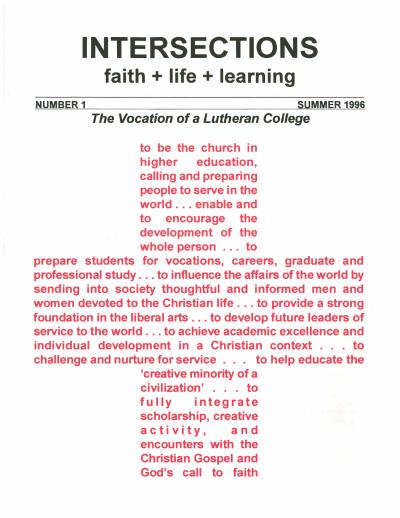 Response
"Whose Future?" or "Social Justice and the Lutheran Academy?"
Marsha Heck
No. 1 · Summer 1996
Heck argues that the future of Lutheran higher education lies less in defining Lutheran distinctiveness than in moral action grounded in face-to-face relationships with others. Drawing on David Lotz’s two-kingdoms theology of citizenship, Ernest Simmons’s relational reading of Luther, Arthur Preisinger’s indictment of the German Lutheran misreading of two kingdoms during the Third Reich, Starla Stensaas of Dana College, and Paulo Freire’s dialectic of empowerment, she calls Lutheran colleges to integrate moral reflection with moral action—to move students’ muscles against what is not true as well as to feel truths in their bones.
-
 Article
It's Time to Rewrite the Rules of Civility
Jon Micheels Leiseth
No. 48 · Fall 2018
Leiseth contends that the prevailing rules of civility too often function as the majority’s rules, stifling those facing real harm — and proposes that NECU institutions rewrite civility as “neighboring,” guided by the ELCA’s five values of accompaniment: mutuality, inclusivity, empowerment, sustainability, and vulnerability.