My life is composed of a range of complexities, just like yours. If you have ever tried to describe yourself to another person, you know what I mean. It’s very difficult to do. You either go too deep, or too shallow, in plotting the intricacies of your life for them. You may cut too professionally, or reveal far too much personally. It is not hard to come up with an unhelpful and incomplete sketch of what makes you who you are. Sometimes our self-portrait bears far too much detail.
The subject of this presentation is to think poly-dimensionally about your vocational lives. Notice: I did not say life, but lives. You do not do just one thing with your days. You are not merely equipped to operate in one exclusive fashion. God has not limited you to one expression or one gift for sharing with the world. No, you have many callings and many ways of being. My contention in this brief talk is to make the claim that our normal practice of thinking singularly with respect to the word vocation must be enlarged. The endowments of the Holy Spirit are far too ample to speak in such limiting ways about our precious lives. Martin Luther never talked, as far as we know, of individuals having only one calling. ELCA colleges and universities, for their part, foster a culture where students are challenged to live multi-faceted lives with any number of rich callings.
There is an exercise I helpfully, but playfully, engage from time to time. It is the imagining of alternative fields in which I could envision working. If I could not do what I presently do for daily work and fulfillment, what would I do in its stead? For example, if I was to suffer a physical or mental impairment, that would not allow me to do my current work well, how might I otherwise use the gifts God has given me for a new purpose? This is a constructive exercise, both for what it teaches about larger possibilities, but also for the way it challenges narrow or presumptive understandings of one’s own vocations. We certainly would be dull and uninteresting creatures if we could only do one thing in the world, or see ourselves as doing only one thing, no matter how good we are at that “thing” or how fulfilling we find it to be.
A former traffic light installer in West Palm Beach, FL, who installed and maintained city traffic lights, was fired because he was colorblind and unable to distinguish the colors of red and green properly. Last year, he initiated a lawsuit against the county, hoping to retrieve lost wages. Beyond the instinct to sue, one would hope that this individual could also imagine other lines of work that he might undertake involving good meaning and valuable service to the world.
As much as we may love what we do, it is a powerful exercise to be able to imagine getting excited about other worlds as well. To close off other possibilities for meaning in our lives is to become closed to the wider imagination of God at work in us, and to disrespect God’s capacity to think broadly on our behalf. If the very God we worship lives as three persons, or in three different expressions, we can imagine that same God rejoicing over lives that avoid narrow definition.
I sometimes speak of my current life’s energies as bi-vocationally focused. To speak in this way is to be mindful of the complex terrain surrounding the world of vocation. The very concept of vocation is too expansive to be linked too closely to the concept of profession. But for the purposes of this conversation, where I want to dwell on how we locate meaning in our daily lives, there is good reason to speak of a connection between edifying work and vocation. (A bit later, I’ll draw some distinctions between vocation and profession.) I send the bulk of my professional life between two principal fields: parish ministry and radio broadcasting. I love the work of the pastorate—its draw upon my heart, mind, soul, and strength. Where else can one enjoy quite the same contact with other people through all the stages of life? Yet I also find deep fulfillment in hosting a radio program. Sitting in a soundproof studio booth hardly constitutes the same experience as holding the hand of a leukemia patient, or sitting with a woman grieving over her son’s tragic death. But it still bears extraordinary meaning and is hardly inconsequential ministry. The two worlds remain vastly different in scope and shape.
“To close off other possibilities for meaning in our lives is to become closed to the wider imagination of God at work in us.”
I say bi-vocational, but that is hardly correct. If my wife were present for this conversation, she might well say, “What do you mean bi-vocational? There is another lovely vocation, and it’s called marriage. And there is another one, and it is called parenting. These could be explored more deeply as well, in case you should need a reminder of their presence.” Oftentimes it is the vision of others that help us see beyond the myopia of our own sight. An outsider may well be the one to remind you of the multiple vocations you are called to navigate.
For thirty years, Max DePree was chairman and CEO of Herman Miller Inc., the second largest furniture maker in the world, at the time. Upon his retirement, he had these words to offer:
My father is ninety-six years old. He is the founder of Herman Miller … In the furniture industry of the 1920’s the machines of most factories were not run by electric motors, but by pulleys from a central drive shaft. The central drive shaft was run by the steam engine. The steam engine got its steam from the boiler. The boiler, in our case, got its fuel from the sawdust and other waste coming out of the machine room—a beautiful cycle. The millwright was the person who oversaw that cycle and on whom the entire activity of the operation depended. He was a key person. One day the millwright died. My father, being a young manager at the time, did not particularly know what he should do when a key person died, but thought he ought to go visit the family. He went to the house and was invited to join the family in the living room. There was some awkward conversation—the kind with which many of us are familiar. The widow asked my father if it would be all right if she read aloud some poetry. Naturally, he agreed. She went into another room, came back with a bound book, and for many minutes read selected pieces of beautiful poetry. When she finished, my father commented on how beautiful the poetry was and asked who wrote it. She replied that her husband, the millwright, was the poet. It is now nearly sixty years since the millwright died, and my father and many of us at Herman Miller continue to wonder: Was he a poet who did millwright’s work, or was he a millwright who wrote poetry? (Depree 7-9)
Who said you have only one calling in your life? Or in a single day? And if each of your multiple callings have a different shape, who says they must resemble one another?
The Biblical notion of one calling appears to have found concrete form in the writings of the Apostle Paul and the early church. “We have gifts that differ … and they differ according to the grace given us,” Paul said. He pronounced that some individuals would be teachers or prophets. Others would be poets or millwrights. The assumption was that a person was gifted in one specific way.
Jesus of Nazareth appears to have espoused a much broader concept of vocation. When instructing his disciples one day for their ambitious responsibilities ahead, he spoke of curing the sick, raising the dead, cleansing lepers, casting out demons, preaching, and teaching (Matt. 10:8). He did not say: “Bartholomew, you’ve got the demon work. Philip, you go and take care of AIDS patients. James, why don’t you raise the dead and put funeral directors out of business.” No, Jesus charged all of them to engage in a host of different projects. To say that “the harvest is plentiful but the laborers are few” meant that a narrow or limited definition of calling would not suffice.
William May, professor emeritus of BioEthics at Southern Methodist University, gives an interesting etymology of the word career. The word car and career, he notes, come from the same root: carrerra, which is the Latin word for racetrack. Both a car and a career have us going in circles, often quite rapidly and competitively. These circles are not always deeply meaningful in nature. (5)
A career demands learned skills and a certain kind of intelligence that help us find a way to get “from here to there.” A vocation requires a critical intelligence that is capable of questioning whether “there” is even worth going to. ELCA colleges and universities are equipped to foster this second kind of intelligence, the critical variety that asks the deep vocational questions.
My son Jacob leaves for college in three weeks. He is a multi-talented young man, perfectly equipped to prosper in a liberal arts setting. I have no idea what he might do with his life and how he might spend the bulk of his years. It has been interesting to listen in on many friends asking the same question of him: “What are you going to study?” The presumption, of course, is that he will study one thing. One discipline will lead him to one career so that he can spend his one precious life on one racetrack, going round and round in one predictable circle. In his own seventeen-year-old way, Jacob answers the question that others pose to him with increasing finesse and subtlety. He quietly wishes he could have departed for school weeks ago and be done with the irritating question.
Evelyn Underhill in her book, The Spiritual Life, contends that, “We mostly spend [our] lives conjugating three verbs: To Want, to Have, and to Do. Craving, clutching, fussing … we are kept in perpetual unrest, forgetting that none of these verbs have any ultimate significance, except so far as they are transcended by, and included in, the fundamental verb, to Be.” (20) In today’s landscape of higher education, many students approach college with most of their energies devoted to conjugating these three verbs: to Want, to Have, and to Do. There is a perpetual unrest about their pursuit. We teach a different kind of grammar at our ELCA colleges and universities. It is one that celebrates the most fundamental verb of all: To Be.
An errant form of Christianity has been widely practiced for a long time. It goes something like this: We pray for what we can get from Jesus instead of who we can become with Jesus. In the Gospel accounts, whenever crowds would gather around Jesus, they almost always wanted something from him. More specifically, they wanted him to do something for them, often in the way of performing a miracle. Jesus healed an astonishingly few number of people, bypassing all sorts of sick others. This may have been because his purpose for us is notably different than our purpose for him. It is not what we can get from Jesus, but who we can become with Jesus.
I have the sense that many people in this world are waiting to find out what their true purpose in life is. “What is God expecting me to do?” Many individuals arrive at an answer to this question by waiting for the circumstances in their lives to become just right. So, as logic would have it, once I get into the right college and graduate, and once I land a job that suits my major well, and once I get more experience, and once I get married and have the house paid off, then I will be living. Really living. By this way of thinking, the present life is essentially practice for the future. The present certainly cannot be what God has in mind for me. I would rather dream about the future and continually question the validity of the present.
Four years of life spent at an ELCA college is its own intrinsic joy. It is a wholistic experience. With good reason, students often speak of this experience as the best four years of their lives.
Jonathan Kozol, long-time critic of American education, railed against the travesty of sticking whole communities of inner city kids into career-centered magnet schools. When interviewed on the subject, Kozol argued persuasively that we are taking away the childhood of these youth. (541) We are treating them as commodities whose value will only become apparent once they have been trained up to do something particular, like perform a job requiring certain technical skills.
If we are going to get to the heart of an inquiry about vocation, we must probe some deep questions of identity. Our identity is always tethered to a history, a family, a tradition, a Lord. There is no such thing as an identity of its own making. The inquiry that captures the link between our human identity, and those zones and people to which our identity is anchored, is one of the distinctive responsibilities of our colleges and universities in the Lutheran tradition.
In the Gospel account of the Last Supper, John 13, the evangelist describes part of the dinner moment in this way: “During supper, Jesus, knowing that the Father had given all things into his hands, and that he had come from God and was going to God, got up from the table, took off his outer robe, and tied a towel around himself. Then he poured water into a basin and began to wash the disciples’ feet.” Notice what permitted Jesus to be able to serve in this “upside-down” way, a way that defied all conventions of the day. It was the reminding knowledge of his origin and destiny. He knew where he had come from and where he was going. His capacity to be available to his disciples in this servant capacity was directly related to his secure sense of identity.
Kunte Kinte in Alex Haley’s Roots knows he is an African warrior and not a slave. That self-knowledge makes all the difference for how he lives his life. His daughter, Kizzy, explains why she cannot marry a man she has come to love: “He’s not like us. Nobody ever told him where he came from, so he doesn’t know where he is going.” Origin and destiny are not insignificant coordinates on the map of vocational identity.
ELCA colleges and universities do more than help students claim a self, or pick a mask to wear through life. They help students know themselves in connection with their environment. They grow a capacity in students for understanding crucial bonds that exist with family, tradition, and the world’s people. The best forms of Lutheran learning in our colleges and universities allow students to retrieve and recognize their identity as creatures of the Lord.
We must be careful with the identity question lest it quickly become a self-focused question. Identity asks: “Who am I?” Vocation asks: “How shall I respond?” If one is constantly searching for an identity, that same individual will likely end up living a very self-focused life. Vocation embraces the identity we already have been given by an external other. Vocational pondering gives us the opportunity to deepen our knowledge and understanding of that identity. In their better moments, parents assume the responsibility of helping children know where their identity is most deeply anchored. Liberal arts learning does something similar, though of course on a different scale.
“The best forms of Lutheran learning in our colleges and universities allow students to retrieve and recognize their identity as creatures of the Lord.”
James VanOosting, Dean of the College of Arts and Sciences at Seton Hall, writes about the difference between two distinct approaches to life—the professional and the vocational. They do not occupy the same fields of play. Instead, they are like two different languages that speak of entirely different priorities. (3)
The professional approach has such iconic power that it almost has a monopoly on our view of life’s choices. It bears personal power, economic currency, and institutional legitimacy. We know the professional approach through the power, money, and institutional strength evidenced through many who embody it. Vocation does not rely on these same things. It is a radical alternative to things professional. Four features are common to every story of vocation told in the Hebrew and Christian scriptures.
First, vocation involves a commitment to fulfilling a special purpose. Moses had a vocation with a special purpose. One probably couldn’t find a profession called “Liberator of Slaves” in those days, if one were to try. The disadvantages to such a career probably would have chased away any interested parties. Similarly, we don’t find a profession in the New Testament called “Mother of God.” There too, if this had been a career choice, who would have signed up? Yet it became the wonderful vocation of Mary.
To say that a vocation is linked to a special purpose is not to limit the number of vocations in one individual’s life. We have no indication, for example, that Moses stopped herding sheep once he became a liberator of slaves. When Jesus called some fishermen to follow him, he did not speak of the relative worthlessness of fishing. He could have, but he did not. He could have said there is the “real work” of becoming a pastor to people that beats the useless work of being a fisherman. But he doesn’t say this. He says instead, “Put out into the deep and let down your nets for a catch” (Luke 5:4)—a clear indication that the disciples would not be forsaking their customary work for the addition of new expectations.
Second, a person with a calling has special gifts. These gifts may not be exactly the same as talents or skills. They may not be special aptitudes. A gift is something we receive, something we come to know, not something we make. For Martin Luther, this was a big deal. A calling is primarily a gift. It is not a duty. Nor is it a fabrication. It is something that calls out unique gifts in each of us—gifts that are often revealed in strange ways.
Twenty-five years ago, Charles Garfield told the story of a toll taker on the Oakland Bay Bridge. Driving up to a tollbooth one morning, Garfield heard loud music emanating from the tiny box. Inside was a dancing man. Without breaking rhythm to his dance, the tollbooth operator handed Garfield his change, and Garfield drove off.
Garfield was so fascinated by the joy-filled behavior of this one operator that he decided he was going to try and find this same man on another day. One day he did. Garfield pulled up to a booth on the bridge with loud music inside and the same individual dancing away. When asked what he was doing, this tollbooth operator indicated he was having a party. When asked why others weren’t doing the same thing as he was, he offered that they weren’t invited to the party. Further interviewing of the happy dancer revealed his happiness. “I have a corner office, glass on all sides, I can see the Golden Gate, San Francisco, the Berkeley Hills, half the Western world vacations here … and I just stroll in every day and practice dancing.” He explained that he wanted to become a professional dancer, and was enjoying the fact that his bosses were paying for his training. (Crawford 113)
“Four features are common to every story of vocation.”
A person with a calling has special gifts that he or she comes to know. Sometimes the expression of that calling takes on an unconventional appearance.
Third, implicit in vocation is the notion of a caller who speaks from outside a person. In scripture, this caller is often God or Jesus. Sometimes this caller is hard to hear. God had to call out to Saul several times: “Saul. Saul.” Moses had to be called a couple of times. God called Samuel three times before Samuel really made a move. Listening is important for people interested in honing in on their vocations. The Latin infinitive vocare means “to call.” The related Latin word vox means voice. It takes great energy to quit listening only to ourselves and to begin listening to God. But this is the task of those who care about vocation.
Fourth, accepting a vocation means that some sacrifice, faith, and responsibility will be required. A giving back to others is a natural part of our responsiveness to being called. A spirit of generosity is often contained in our different callings.
Scot McKnight, author of the book The Jesus Creed, describes the credo that he believes guided Jesus’ every day. “You shall love the Lord your God with all of your heart, soul, and mind” was the Jewish Shema in the Hebrew Bible. Jesus took that Shema and added a neighborly component. “You shall also love your neighbor as yourself.” This, says McKnight, is the Jesus Creed—both the love of God and the love of neighbor, always together, never separated. Balancing these two priorities is key. How we balance holiness to God and service to our neighbors is the challenge of Christian people who care about vocation. In their best moments, ELCA institutions of higher learning take this balance seriously as one of their chief commitments.
In Native American theology, the nature of a gift is that it be given away. It is not to be kept. If one keeps a gift, something else deserves to move on because of it, much like a billiard ball transfers momentum when it strikes another ball. Living out the balance of the Jesus Creed reminds us to keep on giving a part of ourselves away for the sake of others. People who live the Christian life in a vocationally fulfilling way strive to live generously, transferring the momentum of their giftedness to others.
Let me close with a story that was featured in the New Yorker magazine several years ago. It involves the actions of a rather remarkable highway patrol officer. Kevin Briggs is a motorcycle patrolman who has worked the Golden Gate Bridge for many years. The Golden Gate is a favorite local landmark for those who wish to jump to their death. Summertime is notorious for the count of jumpers rising.
Briggs won an Employee of the Year Award for the Highway Patrol for his excellent work in trying to coax suicide-inclined people from jumping. His strategy is fairly simple. He looks for an abandoned backpack, briefcase, or wallet—dead giveaways for an individual planning to leave a mark behind—and then for a jumper nearby. Once the troubled person is found somewhere on the bridge, Briggs seeks to start a conversation. “How are you feeling today?” Then, “What’s your plan for tomorrow?” If the person cannot state a plan, the patrolman gets constructive: “Well, let’s make one. If it doesn’t work out, you can always come back here later.” (Friend)
Through this brief conversation, Kevin Briggs has saved hundreds of lives. How would we describe his vocation? Is it riding a motorcycle for the purpose of law enforcement? Is it ensuring public safety? Any number of ideas might be proposed. It would appear, though, that he, like the rest of us, has a range of callings. One thing is clear: He has the gift of helping distressed people envision more than one way of being in the world. That is indeed a gift. It is also a reminder of what we might do purposefully with our lives. We can prompt others, even as we encourage ourselves, to discover the multiple ways that God calls us to be effective contributors to the life of the world.
Works Cited
Crawford, Rhiannon, Paul Crawford, and Brian Brown. Storytelling in Therapy. Cheltenham, UK: Nelson Thornes, 2004.
Depree, Max. Leadership is an Art. Dell Trade Paperback, 1989.
Friend, Tad. “Jumpers.” The New Yorker 13 Oct. 2003: 5-6. http://www.newyorker.com/archive/2003/10/13/031013fa_fact?currentPage=5
Kozol, Jonathan. “The Hopeful Years: Children of the South Bronx.” The Christian Century. 117.15 (10 May 2000): 536-41.
May, William in Willimon, Will, ed. Pulpit Resource. 7 January 1996: 5.
McKnight, Scot. The Jesus Creed: Loving God, Loving Others. Brewster, MS: Paraclete Press, 2004.
Underhill, Evelyn. The Spiritual Life. London: Hodder and Stoughton, 1937.
VanOosting, James. Context Newsletter, 10.1.02
-
 Editorial
From the Publisher
Arne Selbyg
Selbyg, retiring this summer as Director for ELCA Colleges and Universities, reflects on his decade serving as spokesperson between the church and its twenty-eight colleges and universities, and argues that the link between the colleges and the church has grown stronger over the last ten years — sustained by supportive church leaders like Presiding Bishop Mark Hanson, the annual Vocation of a Lutheran College conference, and a Lutheran theology of higher education whose principles (questioning authority, returning to the sources, including the excluded, serving the neighbor) remain a strong basis for operating colleges and universities in the twenty-first century.
-
Editorial
From the Editor
Robert D. Haak
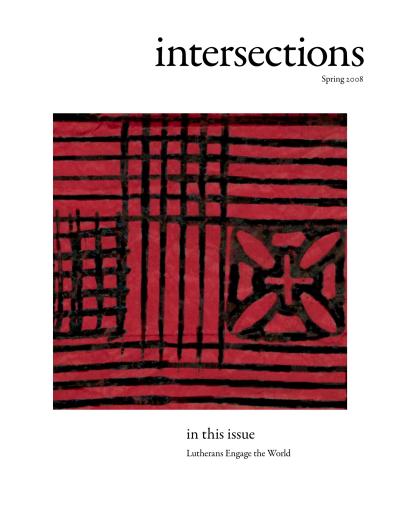
Haak frames the issue around the question of why Lutherans engage the world rather than retreat from it, locating the answer in the doctrines of creation and incarnation, and introduces essays by Erwin on globalism, Carlsen on local community engagement, Marty on multiple callings, and Mattes on the Grundtvigian heritage at Grand View. He also bids farewell to publisher Arne Selbyg, noting the fittingness of the Adinkra (“farewell”) cloth on the cover of this final issue under Selbyg’s leadership.
-
Article
Engaging the Local Community: Why Bother?
Mary S. Carlsen
Carlsen traces the often adversarial history of town-gown relations from the medieval universities through the Battle of St. Scholastica Day to the “ivory tower” pattern of American higher education, then argues that Lutheran colleges should engage their local communities for practical, educational, ecological, moral, and theological reasons. Drawing on her work in social work education at St. Olaf and on Ira Harkavy, Ernest Boyer, and the ELCA’s “Our Calling in Education,” she offers a recipe for engagement that is Passionate, Ethical (Needed, Welcomed, Mutual, Long-term, Attentive to diversity, Strengths-based, Respectful), and Reflective.
-
Article
Lutheran Higher Education in Global Context: Called to Serve the World
R. Guy Erwin
Erwin advances three theses on the global vocation of Lutheran higher education: that the vocation of a Lutheran college is to live out its mission in a service-oriented way; that Luther’s definition of vocation as love of neighbor must today have global dimensions; and that a Lutheran college best fulfills its vocation when it fosters a global perspective in its community, curriculum, and ethos. Drawing on Gustav Wingren and Luther’s catechisms, sermons on schooling, and three-realms ethics, he surveys the mission statements and websites of all twenty-eight ELCA colleges and universities for evidence of globalist commitment.
-
Article
Reclaiming Grundtvig at Grand View College
Mark C. Mattes
Mattes traces the Grundtvigian heritage of Grand View College — the only North American institution founded by Grundtvigian Danes — from its origins in the 1880s split between Pietist Inner Mission and Grundtvigian Danish Lutherans through its golden years of folk dancing, gymnastics, and the weekly lecture, to the demographic and curricular changes of the 1950s through 1990s. He describes recent tangible initiatives, including the Grand View College Reader, Imaging the Journey, and the 2007 Strategic Planning Commission’s “Faith Foundations” statement, that seek to recover the “Human first, then Christian” mantra of Grand View’s ancestors for a generation of students whose “ship” has had not only its planks but its very model replaced.
-
Reflection
John 3:16-17
Richard Priggie
Preached at the Vocation of the Lutheran College conference in August 2007, Priggie’s sermon on John 3:16-17 reads the Greek word “cosmos” as evidence that “God was into globalism long before we were” and calls Lutheran colleges to embrace Matthew Fox’s “deep ecumenism” — an embrace of and care for all created things. Drawing on J.B. Philipps’s Your God Is Too Small and the movie Pleasantville, he invites his hearers to come to Rock Island in order to leave Rock Island, to be Christian in order to be more than Christian, and to find the places where the roads don’t go in a circle but just keep going.
-
 Response
"Whose Future?" or "Social Justice and the Lutheran Academy?"
Marsha Heck
No. 1 · Summer 1996
Heck argues that the future of Lutheran higher education lies less in defining Lutheran distinctiveness than in moral action grounded in face-to-face relationships with others. Drawing on David Lotz’s two-kingdoms theology of citizenship, Ernest Simmons’s relational reading of Luther, Arthur Preisinger’s indictment of the German Lutheran misreading of two kingdoms during the Third Reich, Starla Stensaas of Dana College, and Paulo Freire’s dialectic of empowerment, she calls Lutheran colleges to integrate moral reflection with moral action—to move students’ muscles against what is not true as well as to feel truths in their bones.
-
 Article
Welfare of the City and Why Lutherans Care about Education
L. DeAne Lagerquist
No. 38 · Fall 2013
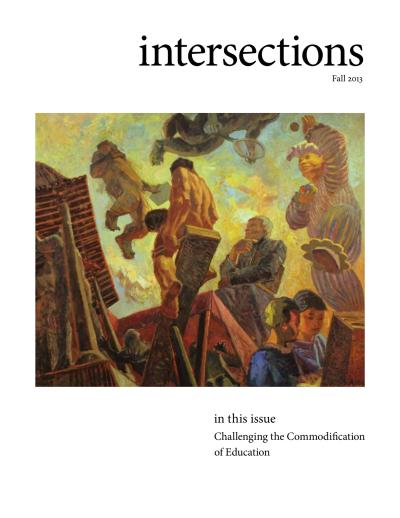
Lagerquist takes readers on a historical tour from sixteenth-century Saxony through the founding decades of Lutheran higher education in the United States to the present day, recovering Luther’s “gift economy” alongside Lewis Hyde and Oswald Bayer as a counter to the market logic that increasingly governs American higher education. She offers four propositions on vocation and commodification and proposes that Lutheran institutional vocation is to accept and pass along the gifts that come to our schools for the well-being of students, neighbors, and the world.
-
 Article
Cultivating Transformative Responsible Dialogue: Community of Moral Deliberation and Lutheran Higher Education
Per Anderson
No. 35 · Spring 2012
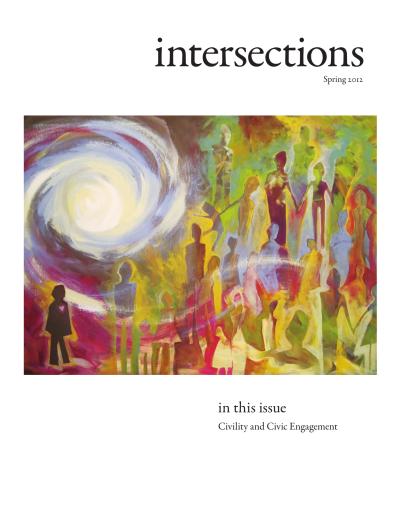
Anderson proposes that ELCA colleges and universities embrace a project of “transformative responsible dialogue” that advances the ELCA’s commitment to be a “community of moral deliberation” and answers the LIFT Report’s call for a culture of faithful discernment. Drawing on Michael Meyer’s “liberal civility,” Martha Nussbaum, Hans Jonas’s responsibility ethic, Patrick Keifert’s ecclesiology of strangers, and Kathryn Tanner on culture, he argues that liberal education at our schools can form students whose dialogue knits together civility, responsibility, and Christian openness to the other.
-
 Article
Necessary Disruptions: Centering Vocation in the Common Good
Erin VanLaningham
No. 57 · Spring 2023
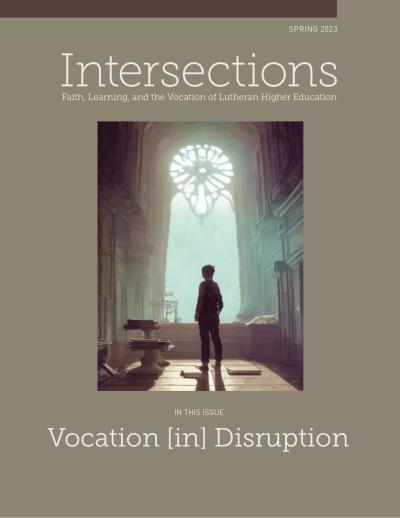
VanLaningham previews the forthcoming NetVUE volume Called Beyond Our Selves: Vocation and the Common Good, arguing that vocation, common, and good all need to be disrupted and expanded so that students might arrive at a wider sense of individual purpose and collective well-being.
-
 Article
Reconciled Diversity: Reflections on our Calling to Embrace our Religious Neighbors
Jacqueline Bussie
No. 33 · Spring 2011
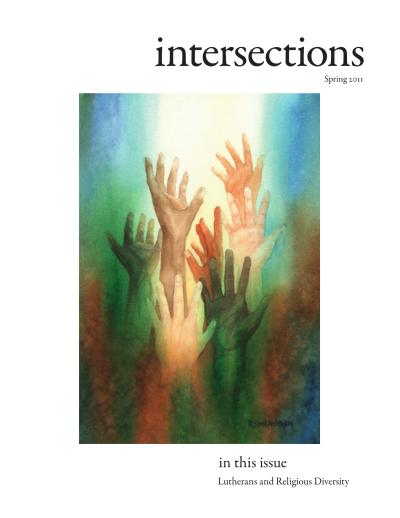
Bussie offers three concrete recommendations for cultivating reconciled religious diversity on Lutheran campuses — Lutheran listening and the telling of stories, engendering encounters with religious neighbors through curriculum and bridge-building events, and choosing empathy and collaboration over evangelism and creed — arguing that what students fear most in encounters with the religious “other” is the loss of their own identity and distinctiveness, and that we can show them how loyalty to one’s own tradition and reverence for different traditions can coexist.
-
 Editorial
From the Editor
Jason A. Mahn
No. 45 · Spring 2017
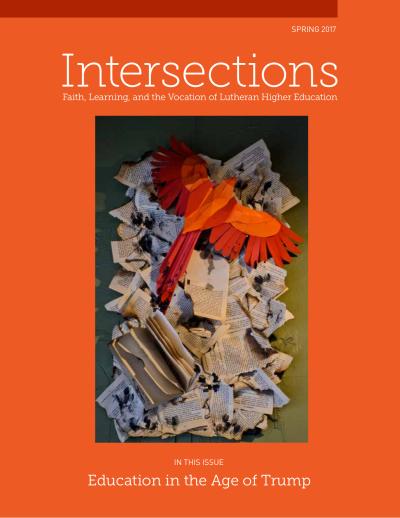
Mahn introduces “Education in the Age of Trump” by recounting a difficult academic year on his own campus — the Augustana “chalking” incident, a Latinx Unidos rally, and post-election conversations with marginalized students and quietly conservative Trump supporters alike — and frames the issue’s essays as careful (re)imaginings of the vocation of Lutheran higher education in an anxious political climate.