Lutheran Higher Education in Global Context: Called to Serve the World
Intersections No. 27 · Spring 2008
A Diverse and Changing World
No one can deny that we live in what our Lutheran college and university mission statements like to call a “diverse and changing world.” For some, even in the developed world, “diversity and change” have gone from being exciting to being somewhat menacing words: the growing gap between North and South, rich and poor; the rise of religious fundamentalisms and intractable ethnic and tribal hatred; the despoiling of the earth’s natural resources; and the ongoing spread and persistence of epidemic disease—all these have challenged the optimism of many that the end of the Cold War would usher in a time of global progress and peace. At no point in human history has it been more true than it is now that what happens in one country or on one continent affects us all—and the Internet ties it all together in a web of instant news, potent images, and an overwhelming flood of undigested information.
If there was ever a time in which the qualities inherent in a liberal education would seem to be essential to the world’s peace and prosperity, it is now. By that we mean an education that values critical thinking, the ability to communicate accurately and effectively, and the skill of judging and using information so as to create new knowledge—the kind of education the colleges and universities of the Evangelical Lutheran Church in America pride themselves on being able to provide for our students. This is a “meaning-giving” education, not just a set of usable skills. Lutheran colleges and universities have an additional value to add to the traditional liberal education, however: the idea of “vocation” as the calling to a useful and meaningful life, one oriented toward the wellbeing of one’s neighbors. That most ELCA colleges and universities aspire to offer their students such an education is a given. But who is the “neighbor” whose wellbeing we serve? How might we better and more consciously connect our vocation as Lutheran educators with our vocation to be responsible global citizens, and orient our students toward service to the world?
Luther, Vocation, and Education
Thesis One: The vocation of a Lutheran college is to live out its educational mission in a consciously service-oriented way, and the vocation of Lutheran educators is to model for and to teach their students the value of a life lived in relationship with others and in service to one’s neighbor.
This first thesis, that the vocation of a Lutheran college or university is to live out its mission in a service-oriented way, is a commonplace of our educational mission. Every ELCA institution of higher learning expresses this ideal in one way or another in its mission or vision statement; many of our institutions have focused programs within them that seek to define and apply this vocational ideal to the education they provide their students. The ELCA also sponsors regular reflection on this common ideal in the form of annual “Vocation of a Lutheran College” conferences such as the one at Augustana College in Illinois that is the immediate occasion for these reflections.
Seasoned Lutheran educators, particularly those who have attended a number of these regular conferences, know already in broad terms how Martin Luther’s impact on what we in Lutheran contexts call vocation has determined the language for our conversations about the mission and calling of Lutheran higher education. But one of the primary purposes of these conferences is also to initiate those who are new to Lutheran higher education, or at least new to this vocation conversation, into the mysteries of what can seem like a somewhat bewildering special understanding of commonplace terms. Thus it makes sense to begin with a summary of what Martin Luther’s thought has to contribute to the question of the vocation of a Lutheran college again as we consider what it means for our institutions to consider “Engaging the World.”
Luther developed his understanding of vocation in the context of his break from Rome. He felt that the church of his day, both in its teaching and its practice, had obscured the essential message communicated in the life and teaching of Jesus and recorded in Scripture. This essential message can be expressed as a pair of realities that always exist in tension with one another: the loving kindness and mercy of God vs. the essential selfishness of the human person. (Wingren)
The particular area in which Luther saw this understanding obscured by the Christian authorities of his day was in two ways: the claim of the church to be able to change the equation by external action; and theologically, by the teaching that in some way it was possible for humans to cooperate with and build upon God’s grace, thus contributing meaningfully to their own salvation. The first of these Luther saw as a false claim to a non-existent power, easily (and in the case of the selling of indulgences) egregiously abused; the latter, in Luther’s view, led to a false confidence on the part of Christians that their actions, good works, and lifestyle choices could have an effect on the divine judgment all humans faced. A special focus of Luther’s disdain was the idea that some persons in society, by dint of the religious status they enjoyed (as monks, nuns, or priests) were leading lives inherently more pleasing to God than were ordinary lay Christians, however devout.
It is in this connection that Luther’s mature understanding of vocation must be understood, as an attempt to describe rightly the relationship of humans to God and to each other in a way consistent with Luther’s Gospel understanding of human egocentricity and divine mercy.
For Luther, vocation (vocatio or Beruf) has three dimensions or definitions: first, the relationship of the human to God (God calls all persons to repentance and offers forgiveness and mercy); second, the relationship of humans to each other in daily life and work (giving shape to his idea of how Christians should live and understand their lives in community); and third, as the special “call” to public ministry—in traditional Catholic understanding, a call to the priesthood or consecrated religious life. It is this final definition that is probably best known to non-Lutherans, but for Luther it is by far the narrowest and least important. On the other side, the first definition is broad and basic to Christian belief. It is the second definition with which we will concern ourselves here, and which has come to be known as “Luther’s doctrine of vocation.”
It should be emphasized that for Luther all human freedom and responsibility and goodness are rooted in the prior love of God for a rebellious humanity, and the Luther never speaks of vocation outside a Christian context. This does not mean, however, that the term and its meaning cannot be understood or valued outside the Christian community and in a pluralist or even secular society.
Luther sees humans not as autonomous entities, but as essentially relational beings. Their primary relationship is—of course—to God, who created all things and loves all that has been created; the secondary relationship of humans is that to other human beings. It is in this second set of relationships that Luther develops his mature concept of vocation, and it is the cornerstone of his understanding of the Christian life.
“It should be emphasized that for Luther all human freedom and responsibility and goodness are rooted in the prior love of God for a rebellious humanity.”
Luther is clear that all humans stand (from birth to death) in relationship with other humans. Quite literally, no man is an island. The relationships of humans to each other can be described as natural (based in the order of creation) or social (determined by human needs and desires). Luther believed that these social relationships, in turn, were expressed in three “realms” of existence: the ecclesial, the political, and the economic. These were in turn defined as church, government, and family. In the first, churchly realm, every Christian person is a member of the church, but within it some are called to leadership as clergy and the rest are laypeople. In the second “realm” belong the duties and relationships of political life: for Luther, this meant the duty of subjects to their rulers and of rulers to their subjects. In our time this could be seen by rough analogy to involve the relationship of citizens/voters to politicians/officeholders. In the third “realm” that of “economy” or family, Luther explains that one is either parent or child, husband or wife, master or servant. In twenty-first century perspective Luther’s schema seems simplistic and quaint, but the essence of the concept is not in his social typology but in his insight that humans live out their lives and callings in a variety of ways, relating to others in differing ways but all at the same time and in a layered way. One is never just “one thing” but may be many: parent and child at the same time, and a clergyperson or magistrate as well.
One important relationship, however—that of teacher to pupil—is not clearly placed in Luther’s schematic, as it has elements of all three of the prior sets of relationships: teaching at a primary level was in Luther’s time a church function, financed by the city government, and the teacher exercised both an official and a quasi-parental authority over the pupil. Even in Luther’s own time, the realities on the ground did not always correspond to the conceptual frameworks he constructed.
But the key to this is that Luther understands human life relationally, not individualistically. His is an ethic of relationship, of connectedness, and of service to neighbor. Modern concepts of self-fulfillment or freedom of vocational choice were unknown to him, but the kernel remains useable: each human life is lived out in relationship, and when it is lived well, it benefits others. One of the places Luther makes this most clear is in his Small and Large Catechisms of 1529, in which he turns the “shalt not” prohibitions of the Decalogue on their heads and transforms them into positive rules for constructive life in community. Through Luther’s lens, the commandment not to murder becomes an instruction to help one’s neighbor flourish through concern for the neighbor’s wellbeing and protection of the neighbor’s interests. “Thou shalt not kill” thus becomes a positive obligation to look out for one another.
Luther understands vocation as a way of seeing oneself as a responsible agent imbedded in a community, one whose life should be lived in awareness of its impact on others and in charitable disposition toward others. If each of us lives with others in mind, Luther believed, society would be harmonious, hunger and misery and loneliness would vanish, and peace would prevail. But even Luther understood that this was an unattainable ideal—that human pursuit of self-interest militated constantly against such altruism and idealism. But even so, Luther believed people should try to act according to his principles of neighbor-love: to try and fail was perhaps inevitable, to fail to try another form of self-indulgence. Life is lived in-between the ideal and the attainable. And when individuals or groups fail to live up to this noble challenge, there are always the rules and the rulers to keep order—hence the three “realms” of human authority and hierarchy.
Even in his own lifetime Luther had reason to be disillusioned about human self-interestedness. The princes who protected him and his message plundered their lands; the magistrates who opened up the church then refused to pay the preachers. But Luther never abandoned the larger principle, that humans are called to live their lives and practice their livelihoods within an ethical framework defined by relationships and mutual responsibility. This vocational ideal is one that still inspires and motivates Lutherans and Lutheran institutions, not least of all our educational institutions. Meetings such as this recurring one and efforts on many of our campuses have helped redefine and revive ideas of vocation in relation both to our educational work and the professional lives of our students. One might even say that, now in the second decade of such a vocational revival, that our Lutheran colleges and universities have a clearer understanding of their vocation and its implications than at any earlier point in their history. This is now more than ever a clearly articulated part of our common calling as Lutheran educators, whether we are Lutherans or not or even religious believers.
“His is an ethic of relationship.”
There are two significant ways in which Luther’s idea of vocation corresponds with and connects to his understanding of the importance of education: first, in Luther’s firm belief that education for all people is an underpinning of stable, prosperous, Godly communities; and second, in the particular vocation of educators to be providers and conduits of learning, what Luther would call a most precious and essential good for society. Educators, second only to clergy, for Luther combine two goods: the conscientious performance of their duties is a good in itself, and the learning they transmit and inspire empowers others to live out their vocations more fully.
That Luther’s attitude toward education in his own time has shaped our modern understanding, and that his development of a powerful and appealing doctrine of “vocation” as definitive of a Christian’s life and work has had a deep impact on the way Lutherans and Lutheran institutions understand their meaning and their task, goes almost without saying. What is less obvious, however, is whether or to what degree these two perspectives from Luther are well and consistently understood. Luther’s insights are of limited usefulness if there is not a clear, shared understanding of what they are and what they mean. Part of the purpose of a “Vocation of a Lutheran College” conference is to bring us back again to these basic issues, that we may all fruitfully engage in reflection and conversation from a common starting point. Martin Luther himself was, both in self-understanding and effect, an educator. From his professor’s chair, he articulated, developed and taught ideas both new and old, including many that profoundly changed the attitudes of his hearers, and which, relayed by retelling or by publications throughout Germany and Europe, permanently altered the world in which he lived. From the very beginning of Luther’s career as a critic of church conditions and an advocate for a simpler, more direct, more honest teaching of the Christian faith, he understood the church’s main duty to be to teach the faithful. That Christians are to be taught, and taught rightly—docendi sunt Christiani—was a foundational principle of Luther’s entire reforming program, articulated already in his famous Ninety-five Theses of 1517, the first battle cry of the Reformation (Theses 42-43, 45-51: WA 6, 404-5; LW 44, 124).
Luther’s personal experience led him to see the world in which he lived as a place of darkness and ignorance, into which the light of divine truth and revelation could break in and affect transformation. What he knew to be true, Luther believed, must also be taught if it is to be effective in the world.1 This he saw not only as his own duty, but that of all preachers and teachers at every level of instruction from parish priests teaching catechism to illiterate children and adults on the one end of the spectrum, to (on the other end) university professors teaching doctoral students and preparing tomorrow’s teachers. Luther believed—correctly—that the conventional authorities of church hierarchy and dogmatic theologians were arrayed against him, armed with systems of thought that could not be questioned and structures of power that would be difficult to overcome. But he even more firmly believed that the sources of truth upon which he relied: conscience, reason, and—most of all—Holy Scripture, were ones with which he could challenge the seemingly irresistible forces of reaction. (Heidelberg Disputation, 1518: WA 1, XXX; LW 31, 39-58)
In his earliest writings that refer to education, Luther calls for a complete reform of learning in every school and in every subject, replacing the neo-Aristotelianism that had become canonical in his time with a Scriptural perspective. From our modern perspective, this could seem like the simple replacement of one dogmatic system with another, but in sixteenth century context this was a great step forward, and opened the door to a more historically aware, more empirical, more genuinely reality-based approach to truth and learning than had been the case before. But Luther’s contribution to modern education does not chiefly lie in his method or his hermeneutic, or (outside theology) even to his understanding of revelation, but in the broader area of the purposes and reach of education. Luther changed his world not just through the content of what he taught, but also in his firm belief that it was the right of each person to at least a rudimentary education, and his advocacy of public schools for both male and female children. In his famous 1530 sermon On Keeping Children in School (LW 46, 213-58), Luther argued that the welfare of society depended on widespread—if by modern standards rudimentary—public education.
Luther’s approach was a pragmatic one, and motivated by both practical and religious impulses: first, to provide for a stable and prosperous society, in which each person is fully trained to a productive form of work; and, second, to give all people the ability to read the Bible for themselves. Luther was more confident at the beginning of his career that such widespread Bible reading would lead to a consensus on the basics of Christian faith and life than he was later, and we know now just how elusive such consensus is.
Of what usefulness is Luther’s understanding of education to us as twenty-first century people? Not very much, if one considers it to be teaching Luther’s curriculum or using Luther’s pedagogy. We have come a long way in educational theory and practice in five hundred years. But what might be seen as enduringly valuable in Luther’s experience are a few basic concepts: first, that literacy is basic to all other learning, and that the reading and comparison of texts and the ideas they contain is the beginning of critical thinking; second, that being able effectively to communicate what one has learned, both in spoken and written form, is essential to the advancement of knowledge; and third, that the education each person needs to exercise his or her vocation fully is a basic right and a prerequisite for a just society.
The Global Implications
Thesis Two: Love of neighbor, the heart of Luther’s definition of vocation as living a life of usefulness and service, must be understood in the twenty-first century situation to have global dimensions.
Luther’s answer to the question “Who is my neighbor?” was firmly rooted in his sense of each individual’s limited range of influence and agency. In pre- and early modern societies of a rigid hierarchical sort, the free movement and action of individuals was dependent on their wealth and social status, and the twin modern ideas of “upward mobility” and “freedom of action” were not yet strongly developed, even though signs of them can be seen already in the sixteenth century. The sense of individual opportunity and vocational autonomy that is so strongly expressed in the developed world today would not have been understood or recognized by Luther’s contemporaries, who would have been astounded by the ease at which old social boundaries can now be crossed.
Today, a shrinking world has coupled this sense of individual agency with a wider acquaintance with the world and the global situation. The ease of travel, the luxury of surplus wealth, and the concept of recreational time in the developed world, and more universal education and pervasive media of communication everywhere on earth, enable most of the world’s citizens to know more of places and peoples on the far side of the globe than most people in Luther’s day would ever have known of what lay beyond their own geographical horizon a few miles away. And with knowledge comes responsibility; with familiarity comes community.
In yet another dimension, the increasingly interdependent global economic system also binds people together in a common network of needs and goods. “Globalism” is the basic concept describing this phenomenon, and deals with the reality of the world’s interconnectedness. Globalism is not a value-neutral term to some who see the interconnectedness itself as inherently dangerous, but the term is not politically loaded to the same degree as “globalization,” which has come for many to be seen as the negative outgrowth of globalism. Globalization, in its most neutral sense, describes the phenomenon of rapidly growing globalism, particularly in the area of economic development and resource exploitation. Globalization is often understood negatively; the belief among its ardent proponents that the free market alone should determine globalization’s speed and dimensions has provoked fierce opposition among those who take a humanitarian perspective and understand the increasingly enmeshed global economy as an aggrandizement of the already rich developed world at the expense of the already disadvantaged developing world. For the purposes of this reflection, I will use “globalism” as a neutral term describing a commitment to seeing and understanding the interconnectedness of humans and their societies.
In the realities of an increasingly well-informed world population and an increasingly interconnected world economy, the question “Who is my neighbor?” quickly and convincingly requires a global answer. In the new “flat world” of globalism, mutual responsibility among humans (in Luther’s sense of service to neighbor) and common responsibility for care of the earth become both realities and challenging duties. The answer to the question becomes “Everyone is my neighbor; the earth is our common responsibility.”
Lutheran Colleges and Their Global Commitments
Thesis Three: A Lutheran college best fulfills its vocation when it fosters a global perspective in its community, its curriculum and its ethos, together with a respect for difference and a sense of the common humanity of all peoples.
How do our Lutheran colleges and universities live out their vocations to serve the world and to educate students who understand their own vocations in a global sense? Part of what should come out of a conference devoted to “Engaging the World” is a sharing of some of our varied institutional understandings, commitments, and experiences—and information about how global issues are considered and global perspectives manifested on each of our campuses.
In considering how the ELCA’s colleges and universities each reflect a commitment to global perspectives, it seemed useful to do a quick study of our institutions’ level of public commitment to such perspectives and emphases. As one gauge of commitment in principle to globalist understandings in our Lutheran institutions, one might usefully begin by examining the mission statements of our twenty-eight ELCA colleges and universities for indications of their self-understanding in this regard. In doing so, one will be struck by the frequency and consistency with which ELCA institutions of higher learning have articulated a commitment to a globalist understanding of vocation, primarily as an outcome of the education they offer their students. My own institution’s mission statement has as a key part of its mission the goal of educating “leaders for a global society.”2 Very often, our institutions claim to want to prepare their students “for a diverse and changing world.”3 The idea of preparation of students to face global challenges or to serve the world were widespread enough among our college and university missions as to be almost commonplace—about two-thirds of ELCA colleges and universities have some specific language about this in their mission statements. Mission statements being what they are, naturally very few go into specifics about how this is to be done.
To reach a higher level of detail as to the public commitment among ELCA institutions to globalist perspectives, a casual survey can reveal how these institutions communicate, explicitly or implicitly, a commitment to globalist goals or perspectives on what is now their most potent marketing and recruitment tool—their websites. California Lutheran is typical in this regard as having come to see its website as its principal “front door” for prospective students, their parents, alumni, and many other constituencies and audiences. How well do our schools’ websites reflect a global perspective in the education our institutions promise? To gauge this, I looked on each homepage for any evidence in words or images that that particular college valued a globalist approach enough to make it part of their basic marketing.4 Very few did, at least in terms of what appears on the “front page”—the initial homepage. This is not of course any kind of indication of the institution’s ultimate commitment to global perspectives or study abroad or anything else—just that for whatever reasons, this commitment is not often clear from the first and most immediate impression. The institutions that did have some global or international dimension to their homepages (five in total) showed study abroad programs, international studies majors or emphases, or a conspicuous welcome to prospective international students.5 I did not include the study of foreign languages in and of themselves, nor did I consider “heritage programs” connecting the college to the nationality of its Swedish, Danish, Finnish or other European founders. A look at a few of these heritage links convinced me that they were mostly historical in nature and did not reflect a future-oriented globalist approach. I also counted two institutions which had no explicit mention of international or global emphases, but which adorned their homepages with images of students or alumni in obviously foreign settings.
Because so few of our institutions (only five out of twenty-eight) had a visible connection to the wider world on their homepages, I then decided to go a step deeper, and clicked on each of the available buttons or tabs on each of the ELCA college and university homepages. This tedious exercise revealed, as I expected, that most of our schools have study abroad programs of some kind, many expect or hope that international students will apply and enroll, and some have international studies or other interdisciplinary majors, programs, or institutes. Deeper than this I did not go, but from what I understand from expert colleagues about the patience of the average web-searcher, going to the third level of information is very unusual for a casual search. Those further treasures remain buried, except in the case of the very determined seeker.
The results of such a superficial survey cannot bear the weight of much analysis, but I did think that it was revealing that for whatever reasons, fairly few of our institutions have put global perspectives at the public center of what they do. This omission is set in higher relief by the two institutions that both do so and tell you about it on their website: Pacific Lutheran University and Concordia College, Moorhead, MN. Pacific Lutheran’s website, in particular, is very internationalist and highly attractive. One other particular case worth mentioning is that of Waldorf College in Forest City, IA. Waldorf has the conventional commitment to global perspectives in its mission statement and on its webpage, but it also goes a very concrete step further by stressing its college goal to have at least fifteen percent of its enrollment be international students. Both in their mission statement and on their webpage this international commitment is made very clear. I don’t know to what degree this is an aspiration or a reality, but Waldorf is unique among ELCA colleges in the emphasis it places on this goal.
In all of this I applied the charitable principle that the presence of something was more positively a sign of commitment than the absence of it was a sign of indifference. Nonetheless, it was interesting to me that a small number of our institutions (two to be precise, which I will not identify) had no apparent interest in communicating any international or global interests or commitments either in their mission statements or on the first two levels of their webpage.
The Challenge to Lutheran Colleges
It should be apparent by this point that an important future task for our ELCA colleges and universities in realizing their vocation as Lutheran institutions is the challenge of globalizing their perspectives, their communities, and their curricula. The benefits to our world, our society, and our students seem obvious. But how can this be done? What are the risks?
First, the colleges and universities of the ELCA have much to learn from each other. Several of our institutions have long been highly regarded for their internationalist emphasis, particularly in their study abroad programs and in their teaching of foreign languages. Both of these are essential aspects of a globalist emphasis in higher education, but where the first—study abroad—has grown in popularity among students and in institutional support, the second—the study of languages—is (at least anecdotally) threatened by the tendency on some campuses to allocate resources to disciplines with large numbers of “majors,” thereby undermining departments with small enrollments but a disproportional role in maintaining the “liberal arts.” How, in the Internet age of rapid communication, do we better engage our students in the slow discipline of foreign language acquisition? Educating globally without teaching every student basic competence in a second language is to expect the world to encounter the student on his or her own terms, in English, and seems (to this writer at least) less globalist than colonialist in effect.
Second, ELCA colleges and universities (to the degree that they take seriously their connection to the church) are already embedded in a global institutional network of churches through the ELCA’s influential membership in the Lutheran World Federation, a communion of one-hundred forty Lutheran churches in seventy-eight countries, whose over sixty-eight million members include people of every race, almost every continent, and many languages and cultures. Every Synod of the ELCA maintains a “companion synod” relationship with at least one other LWF member church or a unit of one. If each ELCA synod pledged to support one worthy student from its companion synod to study in the United States at an ELCA college or university, that would mean sixty-five additional international students each year, many from developing nations, able to avail themselves of an American college education under the auspices of the ELCA. Conversely, ELCA colleges and universities have resources to cooperate and assist in higher education around the world through partnerships with schools outside the United States, whether through exchange programs for students or by lending or borrowing faculty across national lines. Some Lutheran churches overseas have highly developed educational programs and colleges and universities of their own—the international network of such institutions could certainly become closer and more intentional.
The ELCA’s colleges and universities clearly understand themselves (with very few exceptions) as institutions which prepare students for life in a globalist economy and in a shrinking world; some do so with great self-consciousness and skill. What they do not always know or acknowledge is that there are specifically Lutheran reasons for this mission to the world, reasons connected to Luther’s idea of the human vocation of love of God and service to neighbor. In asserting and living their vocation as Lutheran colleges and universities, our institutions are clearly both called to such service, and challenged to intensify it further.
Endnotes
1. Luther connects theology and pedagogy repeatedly in his writings: the standard study is still Asheim 1961.
2. California Lutheran University’s mission statement is typical: “The mission of the University is to educate leaders for a global society who are strong in character and judgment, confident in their identity and vocation, and committed to service and justice.” (Emphasis mine.)
3. Our host institution, Augustana College, Rock Island, IL, uses this language: “Augustana College, rooted in the liberal arts and sciences and a Lutheran expression of the Christian faith, is committed to offering a challenging education that develops qualities of mind, spirit and body necessary for a rewarding life of leadership and service in a diverse and changing world.” (Emphasis mine.)
4. This quick survey was carried out in July of 2007. Institutional websites change quickly and often, and current websites may no longer correspond to the findings of that time. A summary of the data from that snapshot in time may be obtained upon request from the author.
5. I should add that I included drop-down menus that made reference to such ideas as being part of the homepage, even though an action on the viewer’s part is necessary to see them, and a further click would be required to reach the actual content.
Works Cited
Asheim, Ivar. Glaube und Erziehung bei Luther: Ein Beitrag zur Geschichte des Verhältnisses von Theologie und Pädagogik. Heidelberg: Quelle and Meyer, 1961.
Wingren, Gustav. Luther on Vocation. Philadelphia: Muhlenberg Press, 1957.
-
 Editorial
From the Publisher
Arne Selbyg
Selbyg, retiring this summer as Director for ELCA Colleges and Universities, reflects on his decade serving as spokesperson between the church and its twenty-eight colleges and universities, and argues that the link between the colleges and the church has grown stronger over the last ten years — sustained by supportive church leaders like Presiding Bishop Mark Hanson, the annual Vocation of a Lutheran College conference, and a Lutheran theology of higher education whose principles (questioning authority, returning to the sources, including the excluded, serving the neighbor) remain a strong basis for operating colleges and universities in the twenty-first century.
-
Editorial
From the Editor
Robert D. Haak
Haak frames the issue around the question of why Lutherans engage the world rather than retreat from it, locating the answer in the doctrines of creation and incarnation, and introduces essays by Erwin on globalism, Carlsen on local community engagement, Marty on multiple callings, and Mattes on the Grundtvigian heritage at Grand View. He also bids farewell to publisher Arne Selbyg, noting the fittingness of the Adinkra (“farewell”) cloth on the cover of this final issue under Selbyg’s leadership.
-
Article
Engaging the Local Community: Why Bother?
Mary S. Carlsen
Carlsen traces the often adversarial history of town-gown relations from the medieval universities through the Battle of St. Scholastica Day to the “ivory tower” pattern of American higher education, then argues that Lutheran colleges should engage their local communities for practical, educational, ecological, moral, and theological reasons. Drawing on her work in social work education at St. Olaf and on Ira Harkavy, Ernest Boyer, and the ELCA’s “Our Calling in Education,” she offers a recipe for engagement that is Passionate, Ethical (Needed, Welcomed, Mutual, Long-term, Attentive to diversity, Strengths-based, Respectful), and Reflective.
-
Article
Who Said You Have Only One Calling?
Peter Marty
Marty argues that our normal practice of thinking singularly about vocation must be enlarged: God has not limited any of us to one expression or gift, and Martin Luther never spoke of individuals as having only one calling. Drawing on Max DePree’s parable of the millwright-poet, William May on the etymology of “career,” Evelyn Underhill on the verb “to Be,” James VanOosting, Scot McKnight’s “Jesus Creed,” and a Golden Gate Bridge patrolman who has saved hundreds of lives, he identifies four features common to every story of vocation in scripture: special purpose, special gifts, a caller from outside, and the requirement of sacrifice and generosity.
-
Article
Reclaiming Grundtvig at Grand View College
Mark C. Mattes
Mattes traces the Grundtvigian heritage of Grand View College — the only North American institution founded by Grundtvigian Danes — from its origins in the 1880s split between Pietist Inner Mission and Grundtvigian Danish Lutherans through its golden years of folk dancing, gymnastics, and the weekly lecture, to the demographic and curricular changes of the 1950s through 1990s. He describes recent tangible initiatives, including the Grand View College Reader, Imaging the Journey, and the 2007 Strategic Planning Commission’s “Faith Foundations” statement, that seek to recover the “Human first, then Christian” mantra of Grand View’s ancestors for a generation of students whose “ship” has had not only its planks but its very model replaced.
-
Reflection
John 3:16-17
Richard Priggie
Preached at the Vocation of the Lutheran College conference in August 2007, Priggie’s sermon on John 3:16-17 reads the Greek word “cosmos” as evidence that “God was into globalism long before we were” and calls Lutheran colleges to embrace Matthew Fox’s “deep ecumenism” — an embrace of and care for all created things. Drawing on J.B. Philipps’s Your God Is Too Small and the movie Pleasantville, he invites his hearers to come to Rock Island in order to leave Rock Island, to be Christian in order to be more than Christian, and to find the places where the roads don’t go in a circle but just keep going.
-
 Article
Superheroes and Origin Stories: Tools to Discover and Claim One's Callings
TJ Warren
No. 41 · Spring 2015
Warren argues that the “Hero’s Journey” — Joseph Campbell’s monomyth with its ordinary world, call to adventure, mentors, and return with the elixir — offers a powerful pedagogical tool for helping college students discover their origin stories and claim their callings. Drawing on Superman, Wonder Woman, and Rosa Parks alike, he invites educators to mentor students into becoming the heroes of their own lives.
-
 Book Review
Vocation on Campus: Reading Mark Tranvik's Martin Luther and the Called Life at Pacific Lutheran University
Alex Lund, Michael Halvorson
No. 47 · Spring 2018
Halvorson and Lund — faculty member and student — review Mark Tranvik’s Martin Luther and the Called Life alongside PLU’s Wild Hope Center for Vocation, weighing the book’s warning against “vocation lite” against the challenge of speaking of God’s call to students in the Pacific Northwest’s “None Zone,” where most students have little exposure to Lutheranism.
-
 Institutional Focus
LibGuide: Introduction to Womanist Theology
Elli Cucksey
No. 56 · Fall 2022
Cucksey, the head librarian at Trinity Lutheran Seminary, recounts how Beverly Wallace’s Introduction to Womanist Theology class — the first offering of the ELCA Seminaries’ Womanist Theology Initiative — led her to build a publicly available LibGuide that amplifies Black women’s voices and gathers the resources of the course for future students.
-
 Editorial
From the Publisher
James M. Unglaube
No. 1 · Summer 1996
Unglaube welcomes readers to the inaugural issue of Intersections, crediting Editor Tom Christenson and Capital University, and announces the new annual Vocation of a Lutheran College Conference whose continuing dialogue the journal exists to enhance. He gives thanks to the Lilly Endowment for a sizable grant supporting the 1996 conference, campus dialogues, and the birth of the publication.
-
 Editorial
From the Editor
Colleen Windham-Hughes
No. 60 · Fall 2024
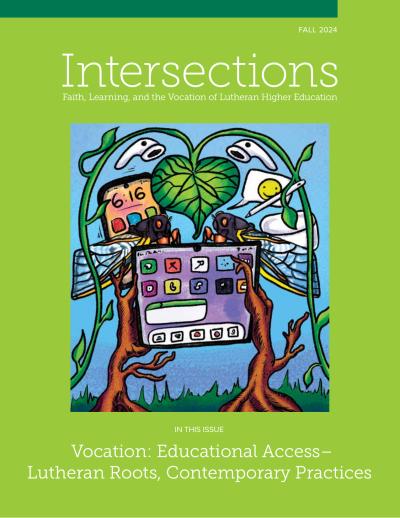
Windham-Hughes welcomes newcomers and seasoned colleagues to the conversation, lifts up Mary Elise Lowe’s three Lutheran “whys” for educational access, and commends Rev. Jen Rude’s “Sacred Pause” practice as a way to humanize one another and make opening access both easier and more joyful.
-
 Editorial
Guest Editorial
Kristen Glass Perez, Richard Priggie
No. 40 · Fall 2014
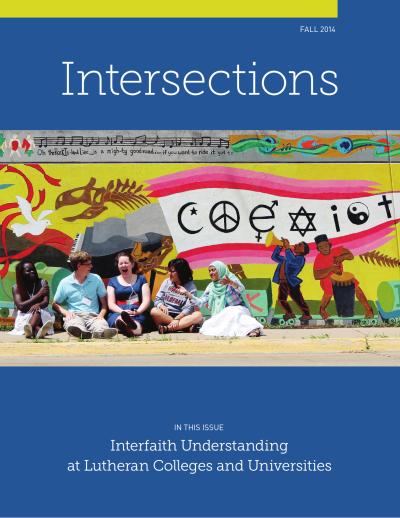
Glass Perez and Priggie introduce the issue by recounting the campus conversations and the June 2014 Interfaith Understanding Conference at Augustana College that gave rise to it, framing the central question, “What does it mean to be Interfaith at a Lutheran College?,” as a living example of the praxis of being a Lutheran college in the twenty-first century.