For God so loved Israel, God’s chosen people … well … no.
For God so loved the Church, the bride of Christ … but that’s not how it reads.
For God so loved the world … the word in Greek is “cosmos”… For God so loved the whole cosmos, the universe—discovered and not yet discovered…. For God so loved the world that he gave his only Son.
It turns out that God was into globalism long before we were!
We are singing some evocative images in the two hymns we have sung thus far at this conference. Last evening we sang that “the peace of the Lord kept within cannot live.” (ELW #646) God’s peace withers and dies when confined to a single individual or nation. It wants out into the world, as an animal wants outdoors.
This morning we have sung of the big-heartedness of God. God’s heart is so big, we sang, that it contains all of God’s vast domain. And then the hymn becomes a prayer, “O Christ, create new hearts in us that beat in time with yours … that, joined by faith with your great heart, become love’s open doors.” (ELW #722) Imagine! To have a heart as big as God’s heart, a heart that beats in time with the life and the love of Jesus.
In the early 1960s Anglican pastor and theologian J.B. Philipps wrote a book the title of which judges our hearts when left to their own devices. Your God Is Too Small (Macmillan: New York, 1961) is the title of his book, as telling an indictment today as in 1961. Too small our concept of God. Too tribal. Too personal. Too pinched.
Matthew Fox, by contrast, head of The Institute for Creation Spirituality, preaches what he calls “deep ecumenism.” Ecumenism, says Matthew Fox, is well and good—to draw closer in understanding and relationship to the whole Christian family. Interfaith relations are the next step and are urgent in a world that is increasingly polarized over religion. And then beyond religion, to feel for all human beings, asserting their value simply because they are human, is a heart-enlarging instinct.
But Saint John did not say, For God so loved Christians … nor did he say, For God so loved all religious people … nor even all people. Instead, the word is “cosmos.” For God so loved the cosmos that he gave his Son, and deep ecumenism is our response to that cosmic love of God; it is our embrace of and care for all created things, simply because all things have been created by God. Visit the website, <www.thecosmicmass.org>, and you can see how this plays itself out in worship. The Cosmic Mass draws upon visual art and music and nature and the breadth of sacred scripture and tradition. It begins in grieving and ends in dancing. It is different. It is long. There is nothing small, or tribal, or pinched, about it.
So how about at our colleges, instead of an Office of International Studies, we start an Office of Cosmic Relations… or perhaps that’s another name for Campus Ministries! How about changing the title, “Ecumenical Officer”—we have one at churchwide and in most synods. Let’s change the title to “Advocate for Deep Ecumenism”—people would really wonder what that means! And I hear there is an addendum to Evangelical Lutheran Worship coming out—Setting #11, The Cosmic Mass (just kidding). All of this an attempted answer to our prayer this morning … remember? “O Christ, create new hearts in us that beat in time with yours, that, joined by faith with your great heart, become love’s open doors.”
One of my all-time favorite movies is almost ten years old now. Called Pleasantville, the movie transports Jennifer and David, two millennial teenagers, back into a fictitious 1950s community, aptly named Pleasantville, the world of Father Knows Best and Leave It to Beaver, the world of Your God Is Too Small. In the movie the first high school class that Jennifer visits in her new hometown is geography, where the students are studying the differences between Main Street and Elm Street in Pleasantville. Profoundly bored, Jennifer raises her hand and asks, “Excuse me, but is there anything beyond Pleasantville?” At which point all the other students turn around and stare open-mouthed at Jennifer, as if she had just uttered an obscenity.
I want to claim that question as part of our vocation as Lutheran colleges. We exist here in Rock Island to encourage our students to ask, “Excuse me, but is there anything beyond Rock Island? ... anything beyond Lutheran, beyond Christian, beyond religion, beyond human?
After geography class in the movie, outside the school, Jennifer presses one other student she decides to trust. “Come on,” she says, “What’s outside Pleasantville? Tell me.” And he says, “There are places where the roads don’t go in a circle. They just keep going.”
Now, we have colleges on Main Street and congregations on Elm, and they are fine communities on well-traveled roads. But as far as the life of the mind goes, or the life of the spirit, I want to find the places where the roads don’t go in a circle, they just keep going. It’s uncharted territory, to be sure.… Imagine! to come to Rock Island in order to leave Rock Island! to be Christian in order to be more than Christian! But there is a world out there—yes, there is—a world that God loves.
We come to the table now to feed on God’s love, to take God’s love into our hearts, so that, by God’s grace, our hearts may beat in time with God’s and we come to love even the whole cosmos in the name of Christ. Amen.
-
 Editorial
From the Publisher
Arne Selbyg
Selbyg, retiring this summer as Director for ELCA Colleges and Universities, reflects on his decade serving as spokesperson between the church and its twenty-eight colleges and universities, and argues that the link between the colleges and the church has grown stronger over the last ten years — sustained by supportive church leaders like Presiding Bishop Mark Hanson, the annual Vocation of a Lutheran College conference, and a Lutheran theology of higher education whose principles (questioning authority, returning to the sources, including the excluded, serving the neighbor) remain a strong basis for operating colleges and universities in the twenty-first century.
-
Editorial
From the Editor
Robert D. Haak
Haak frames the issue around the question of why Lutherans engage the world rather than retreat from it, locating the answer in the doctrines of creation and incarnation, and introduces essays by Erwin on globalism, Carlsen on local community engagement, Marty on multiple callings, and Mattes on the Grundtvigian heritage at Grand View. He also bids farewell to publisher Arne Selbyg, noting the fittingness of the Adinkra (“farewell”) cloth on the cover of this final issue under Selbyg’s leadership.
-
Article
Engaging the Local Community: Why Bother?
Mary S. Carlsen
Carlsen traces the often adversarial history of town-gown relations from the medieval universities through the Battle of St. Scholastica Day to the “ivory tower” pattern of American higher education, then argues that Lutheran colleges should engage their local communities for practical, educational, ecological, moral, and theological reasons. Drawing on her work in social work education at St. Olaf and on Ira Harkavy, Ernest Boyer, and the ELCA’s “Our Calling in Education,” she offers a recipe for engagement that is Passionate, Ethical (Needed, Welcomed, Mutual, Long-term, Attentive to diversity, Strengths-based, Respectful), and Reflective.
-
Article
Lutheran Higher Education in Global Context: Called to Serve the World
R. Guy Erwin
Erwin advances three theses on the global vocation of Lutheran higher education: that the vocation of a Lutheran college is to live out its mission in a service-oriented way; that Luther’s definition of vocation as love of neighbor must today have global dimensions; and that a Lutheran college best fulfills its vocation when it fosters a global perspective in its community, curriculum, and ethos. Drawing on Gustav Wingren and Luther’s catechisms, sermons on schooling, and three-realms ethics, he surveys the mission statements and websites of all twenty-eight ELCA colleges and universities for evidence of globalist commitment.
-
Article
Who Said You Have Only One Calling?
Peter Marty
Marty argues that our normal practice of thinking singularly about vocation must be enlarged: God has not limited any of us to one expression or gift, and Martin Luther never spoke of individuals as having only one calling. Drawing on Max DePree’s parable of the millwright-poet, William May on the etymology of “career,” Evelyn Underhill on the verb “to Be,” James VanOosting, Scot McKnight’s “Jesus Creed,” and a Golden Gate Bridge patrolman who has saved hundreds of lives, he identifies four features common to every story of vocation in scripture: special purpose, special gifts, a caller from outside, and the requirement of sacrifice and generosity.
-
Article
Reclaiming Grundtvig at Grand View College
Mark C. Mattes
Mattes traces the Grundtvigian heritage of Grand View College — the only North American institution founded by Grundtvigian Danes — from its origins in the 1880s split between Pietist Inner Mission and Grundtvigian Danish Lutherans through its golden years of folk dancing, gymnastics, and the weekly lecture, to the demographic and curricular changes of the 1950s through 1990s. He describes recent tangible initiatives, including the Grand View College Reader, Imaging the Journey, and the 2007 Strategic Planning Commission’s “Faith Foundations” statement, that seek to recover the “Human first, then Christian” mantra of Grand View’s ancestors for a generation of students whose “ship” has had not only its planks but its very model replaced.
-
 Article
Conciliatory and Queer: The Radical Love of Lutheran Higher Education
Kiki Kosnick, Sharon Varallo
No. 50 · Fall 2019
Kosnick and Varallo reflect in conversation on how Augustana’s Five Faith Commitments and its conciliatory ecumenical roots in the Augsburg Confession have given them — a non-binary queer first-generation faculty member and a twenty-one-year veteran — the “street cred” to act on radical love, build bridges to imprisoned and non-binary communities, and discover that Augustana is welcoming not despite the fact that it is Lutheran, but because of it.
-
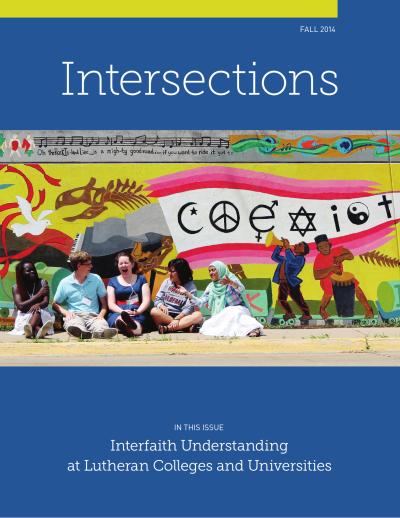 Editorial
Guest Editorial
Kristen Glass Perez, Richard Priggie
No. 40 · Fall 2014
Glass Perez and Priggie introduce the issue by recounting the campus conversations and the June 2014 Interfaith Understanding Conference at Augustana College that gave rise to it, framing the central question, “What does it mean to be Interfaith at a Lutheran College?,” as a living example of the praxis of being a Lutheran college in the twenty-first century.
-
 Article
Views on Flourishing After the Age of Roe
Caryn Riswold, Mary J. Streufert
No. 57 · Spring 2023
Riswold and Streufert reflect on the Radcliffe Institute’s January 2023 conference “The Age of Roe” and argue that the ELCA’s 1991 Social Statement on Abortion and its 2019 statement Faith, Sexism, and Justice offer Lutheran higher education a third way to approach reproductive justice grounded in serving the neighbor so that all may flourish.
-
 Article
Dual Citizenship in Athens and Jerusalem: Ricoeur's Hermeneutics and the Promise of Lutheran Higher Education
Mark C. Mattes
No. 19 · Summer 2004
Mattes proposes a Lutheran model of Christian higher education that develops conversation between faith and learning while preserving the integrity of each, in contrast to Reformed, Roman Catholic, and Mennonite/free-church alternatives. Drawing extensively on Paul Ricoeur’s hermeneutics of suspicion and retrieval, his account of myth and symbol, and his understanding of truth as manifestation rather than mere correspondence, Mattes argues that issues of faith can be genuinely public; that the four phenomenological contours of dialogue—risk, listening, mutuality, and open-endedness—mark authentic Lutheran pedagogy; and that Lutheran education is best served when it charts a path between accommodationist and sectarian responses to the liberal-rationalist tradition.
-
 Book Review
Paul Dovre, ed.: The Future of Religious Colleges
Baird Tipson
No. 15 · Winter 2002
Tipson, president of Wittenberg University, reviews Paul Dovre’s edited proceedings of the October 2000 Harvard Conference on the Future of Religious Colleges (Eerdmans, 2002), summarizing essays by Douglas Sloan on the failure of the “two-realm theory of truth,” George Marsden on faith-shaped scholarship, DeAne Lagerquist, Father David O’Connell, Mark Noll, Robert Benne, Mark Roche on Notre Dame, Joel Carpenter on neo-Calvinist Kuyperianism, and Mark Schwehn on a Lutheran “college-related church” and the centrality of vocation. Against Benne’s suggestion that only two or three robustly Lutheran colleges can be sustained, Tipson defends a less robust but still authentically Lutheran model embodied at places like Wittenberg, Gettysburg, and Roanoke, arguing for the enlightenment commitment to subjecting all truth claims to rigorous criticism and for hiring Marsden-style faith-shaped scholars rather than counting Lutheran heads.
-
 Article
Reforming Lutheran Higher Education: Ecclesiological Reflection and Theological Leadership
Brian Beckstrom
No. 46 · Fall 2017
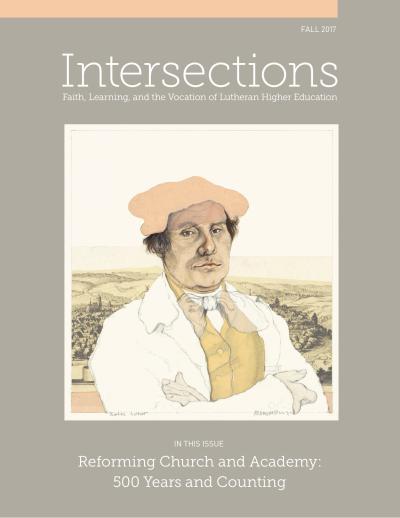
Beckstrom diagnoses an “identity crisis” at ELCA colleges and universities rooted in inherited Enlightenment assumptions and a thin functional ecclesiology, and proposes that a Trinitarian, perichoretic understanding of God offers an ecclesiological foundation that holds together unity and diversity in a pluralistic, post-Christian context.