What is Required of You?: Higher Education Leadership in a Moral Key
Intersections No. 62 · Fall 2025
Excerpted from an opening plenary address at the Vocation of Lutheran Higher Education Conference, July 14, 2025
Each year, I offer an opening convocation address to our incoming students with the title, “What is required of you?” In it, I remind them that change happens—as it always has—but I also let them know that there are things that have not changed for our university because they are at the heart of our identity and values and mission. Students will receive the highest quality education we can offer—in partnership with each other and a remarkable faculty. They will be challenged by ideas and experiences and relationships new to them—because that is what it means to be educated. They will meet friends and peers for life. And they will be equipped for democratic citizenship—because the world needs them.
I begin with the obvious allusion in my title to the well-known passage from the Old Testament prophet Micah, the sixth chapter, verse eight:
6.8 He has showed you, [O mortal,] what is good. And what does the LORD require of you? To act justly and to love mercy and to walk humbly with your God.
And, if I was smart, I might leave it right there, because if each of us were to behave as Micah claims the Lord requires, all would be well with the world. Justice, mercy and humility set a high bar for God’s faithful people, but the theological claim embedded in Micah’s prophetic words is not mine to negotiate for our students. The links between their faith, their relationship with the divine, and how they live in the world, are for them to explore and work out. We provide a rich and challenging context for them to do just that, but we do not pretend to know how they will make sense of what the Lord requires of them.
On the other hand, there are some things that we can and do require of our students. And that is the simple message I share as they commence their Augsburg education. And maybe—just maybe—if they do what we require of them, they will find a pathway to understand what the Lord requires of them. That would be the bold claim at the heart of an education for vocation in the world, that how and what they learn here, that who they meet and engage here, that what they find out here about themselves and their various gifts, will offer them a clearer idea of what it is that they are called to do and be in the world.
This message lands with some urgency at this time, because in a time fraught with social and political division and fear, many are questioning whether or not both higher education and our democracy will survive. Throughout the past few years, our city, country and world have been torn apart by violence fueled by all sorts of isms—racism, nationalism, fundamentalism. During our lifetimes, our economic lives have been marked by a growing gap between those who have and those who have not, a gap that threatens to unravel the social fabric of our communities.
In the midst of all of this volatility, we welcome our students to an institution that at its very core believes in democracy, not simply as a political system, but as an ethic, a way of life. And this democratic ethic means that they become members of a teaching and learning community—students, faculty, staff and partners—that believes that there are clear parameters for our lives together, in classrooms, residence halls, playing fields, in this chapel and everywhere we navigate daily life. There is, in other words, what Yale law professor Stephen Carter has called an “etiquette of democracy,” rules we must follow if we are to live and work and study in ways that live out our mission as a college.
I have always believed that a college education is about challenging ourselves with new ways of thinking, provocative questions, mind-stretching inquiry and conversations, pursuing knowledge and wisdom with abandon. And that is deeply intense and sometimes emotional work. The commitment to our academic vocation—critical thinking, openness to other perspectives and experiences, having your mind changed and your life transformed—may be even more difficult in the midst of our social disruptions. It can be frightening to learn new things; it can make us angry to be challenged by provocative ideas and experiences; it can be threatening to risk our social identities in the midst of those who do not share our paths in the world.
And for all of these reasons, the etiquette of our lives together has perhaps never been more important to the well-being of our common lives. Here is the wrestling that our students must engage and here is the call to be generous and gentle with each other, perhaps with a portion of forgiveness and grace, not so that freedoms are abridged or opinions squashed—college is not meant to be a safe place for our minds, students will encounter provocative, even troubling ideas—but so that we might pursue our teaching and learning in ways that advance our mission and our democracy. Gentle and generous, the etiquette of democracy—a claim upon all of us in the university.
In this context, then, I offer our students the following challenge—a challenge to wrestle with an ethic that may be more relevant than ever in our university and in our democracy.
Show up
The first requirement is really pretty fundamental but certainly not simple.
As the coming days pass, we know that students will be tempted by many distractions and late nights and other obligations to not show up, to miss a class or a meeting, to say that it doesn’t matter whether you attend every class session. I know this tendency—I lived it myself, making elaborate excuses for why I could skip every 7th class session and no one would notice. And we might not notice every time, but they will notice (whether they fully get it now or not) that it is a slippery slope to not show up. Statistics show that skipping even one class session has an impact on whether or not first year college students stay in school, let alone graduate, or perhaps most importantly whether or not they learn something.
But, of course, this is not simply about physical presence. Showing up is also a sort of spiritual practice. It is about being present now. It is about being in relationship to a text, a classmate, and/or a teacher. It is about accompanying each other on a journey that is both solitary and social. The famous educational philosopher, John Dewey, said that genuine education is not preparation for life, it is life itself. And if we believe that, then showing up, being present now, is the key factor in whether or not you get the education you need in order to live in the world.
Pay attention
The second requirement is also quite simple. But the equally simple fact is that we live in a world full of distractions and paying attention doesn’t come easy. This may be the most pressing requirement in this time of unprecedented chaos and confusion
Like all of our students, I’m on social media. I have a myriad of devices. I follow the news through various channels. I do my best to lead a wonderful and complex university. I have a family, and a life full of things I “must” pay attention to—and it’s hard work. And I’m old. Our students are young and have grown up in a time when multitasking is not an option, it’s an expectation. I really can’t imagine how they keep it all together. I admire them, but I also worry about them.
So yes, I ask students to put away all the distractions that they can control. Turn off the cell phone occasionally, spend some time away from the computer. Focus on what teachers and classmates are saying and doing. Find ways to pay attention.
But it is more than that, of course, because even when we have put away all those sources of distraction, it remains our responsibility to figure out what is most important and how you can make what is important the center of your life. The sociologist, Robert Bellah and his associates, have written that “Democracy means paying attention,” (from The Good Society) by which they mean that the psychic energy we use to pay attention is the key to the sort of person we hope to be—as individuals and as a society. If we continue to be distracted, our attention and the energy that it requires of us will also be distracted, and the values and people and ideas and causes we should care about and attend to will not get our energy. And we will not become the people we want to be.
Do the work
The final requirement follows logically from the first two.
If we show up and learn to truly pay attention, we will find that there is work that must be done.
For our students, on many days, the work will be assigned. Read this text, explore these ideas, test this hypothesis, run this experiment, play this scale, practice this drill. Our students know all about doing school work already, but they need to know that this is college and college signals a quantum leap in the work required. Don’t get behind on reading and papers. Take advantage of the support we offer to help manage time and learn to study. Support each other and ask for help when you feel you need it.
Because more and more, on many days the work will be theirs to discern and pursue. There will be no one there to tell them what to do. They will need to seize the work that needs to be done. The profound truth at the heart of our academic mission is that the work our students learn to do—in the classroom, on campus, in the neighborhood and around the world—is the basis for pursuing the important work to be done in the world—and we need them to do it. We are counting on them to do it. That is why our university exists—to educate students to be informed citizens, thoughtful stewards, critical thinkers and responsible leaders—not just because we think it would be nice if they were all of those sorts of citizens and stewards and thinkers and leaders, but because the world needs them. There is utility to this education, there is purpose and direction, there is work to be done by educated folks. Work they are called to do. Work that might just have to do with what the prophet Micah claimed—the work of justice and compassion and humility.
Show up, pay attention, and do the work. That is how I invite our students into the wrestling they are about to commence. In a university dedicated to pluralism and democratic engagement, simple lessons that I challenge them to remember. Lessons that abide, lessons that will help them in college, surely, but most critically and urgently, lessons that ground a democratic social ethic and that will serve them for a lifetime of following their passions and calls for the good of the world. I believe that wrestling with their education—showing up, paying attention, and doing the work—equips our students to live together as engaged citizens in our democracy.
-
 Editorial
From the Publisher
Lamont Anthony Wells
5 min audio
Wells frames the issue as a record of the 2025 VLHE Conference at Augsburg under the theme “Ethical Leadership in a Changing World,” arguing that vocation is never solitary but a collective, public witness of ethical formation, theology and care, flourishing and belonging, and leadership rooted in God’s grace.
-
Editorial
From the Editor
Colleen Windham-Hughes
5 min audio
Windham-Hughes plays on the shared Latin root of “education” and “seduction” (ducere, to lead) to warn against the No-saying seductions of giving up or condemnation, and to call educators to the riskier Yes of showing up to build third-space communities of truth-telling and hope.
-
Article
Wake Up Running! A Call to Ethical Leaders in Quest of Democratic Space
Walter Earl Fluker
44 min audio
Abridged from his VLHE keynote, Fluker draws on Habakkuk and Octavia Butler’s Parable of the Sower to call a new generation of ethical leaders to “wake up running” toward democratic futures, packing their runaway bags with love-filled-justice, grace-filled-empathy, and hope-filled-resiliency for the soul-filled work the moment requires.
-
Article
Building a Third Space in the Age of AI: A Conversation with Dr. Walter Earl Fluker
Elizabeth Kubek
11 min audio
Prompted by AI chatbots being marketed to students as a safer alternative to messy human relationships, Kubek interviews Fluker on how Howard Thurman’s vision of common consciousness, somaesthetics, and nature-rooted learning offers educators a “third space” alternative to AI’s hall of mirrors.
-
Article
Ethical Leadership: Rooted, Open, Generative, and Mindful
John Arthur Nunes
25 min audio
As he prepares to teach an Ethical Leadership First Year Seminar at California Lutheran, Nunes organizes his pedagogy around three mutually-reinforcing “turns” — inward, outward, and intellectual — grounded in Luther’s mandatum dei and larvae dei, Bonhoeffer’s estates, and Howard Thurman’s call to hear “the sound of the genuine” in oneself.
-
Article
Ethical Leadership for a Changing World: A Shared Calling from Cradle to Career
Cory Newman, Janelle Rozek Hooper
5 min audio
Hooper and Newman recount how an ELCA Barna survey on early childhood education sparked the realization at VLHE 2025 that ELCA colleges and the 1,200 Lutheran schools and early learning centers share identical challenges — and an untapped potential to form ethical leaders across the full educational continuum from cradle to career.
-
Article
What Does Ethical Leadership in a Changing World Require?
Kristina Frugé
5 min audio
Frugé argues that ethical leadership in a changing — perhaps ending — world means cultivating trustworthy communities through patient, co-created relationship work, drawing on her experience stewarding the writing community behind Hungry for Hope: Letters to the Church from Young Adults.
-
Article
Fostering Moral Imagination and Inclusivity: The Role of Ethical Leadership in ELCA Colleges and Universities Amid Societal Challenges
Lamont Anthony Wells
12 min audio
Wells argues that “moral imagination” — the capacity to envision ethical alternatives, empathize across difference, and respond creatively to injustice — is the heart of ethical leadership in NECU institutions, and that anchoring leadership in this principle positions Lutheran higher education to cultivate socially responsible citizens.
-
Reflection
VLHE—Wednesday Morning Sacred Pause
Ann Rosendale
8 min audio
Rosendale draws on Esther 4:14 and the Lutheran practice of holding death and resurrection together — with “and” as the hardest word — to argue that the calling of Lutheran higher education for “just such a time as this” requires us to remember and name out loud that ours are places where God is at work.
-
 Response
Response to Mark Wilhelm: Adopting the Framework of ‘Because’ and ‘Therefore’
Paul C. Pribbenow
No. 56 · Fall 2022
Pribbenow describes how Augsburg University responded to its dramatic demographic transformation (from 18% to nearly 70% BIPOC entering students over sixteen years) by adopting an institutional vocational statement and a simple “because/therefore” framework for translating particular Lutheran theological convictions into institutional programs, policies, and practices.
-
 Institutional Focus
Sharing the Gift of Vocation at (and beyond) Augsburg University
Paul C. Pribbenow
No. 55 · Spring 2022
Pribbenow, drawing on a 2022 NetVUE panel with Dorothy Bass and Jodi Porter, considers how the gift of vocation forged with undergraduates can be extended — beyond undergraduate campuses to graduate students, faculty, and staff; across the vocational lifespan from high schoolers to alumni navigating the “gig economy”; and into accompaniment of faith communities through Augsburg’s Riverside Innovation Hub.
-
 Article
Through Truth to Freedom—by Way of Reconciliation
Paul C. Pribbenow
No. 52 · Fall 2020
Reflecting on Augsburg’s 150th-anniversary motto “Through truth to freedom,” Pribbenow argues that in a season of three pandemics — pandemic illness, economic collapse, and the racial sin laid bare by the murder of George Floyd — higher education’s most authentic work is to educate for truth and freedom by way of confession and reconciliation.
-
 Article
Say Something Theological: A Meditation on the Vocation of Lutheran Colleges and Universities to Serve the Common Good
Paul C. Pribbenow
No. 42 · Fall 2015
Pribbenow expands Luther’s “priesthood of all believers” into a meditation on doing theology with the Bible in one hand and the New York Times in the other — reading Luke 14 alongside walls, immigration, and hunger in his Minneapolis neighborhood — and argues that the leadership of Lutheran colleges demands a willingness to engage the theological issues at the heart of their public vocation.
-
 Article
Hospitality is Not Enough: Claims of Justice in the Work of Colleges and Universities
Paul C. Pribbenow
No. 35 · Spring 2012
Pribbenow argues that Augsburg’s incarnational motto — “And the Word became flesh” — grounds a calling beyond hospitality to justice. Drawing on Stephen Carter on civility, Letty Russell on just hospitality, Henri Nouwen, Parker Palmer, Michael Sandel, Bonhoeffer, Niebuhr, and Teresa of Avila, he describes four components of Augsburg’s practice: education “off the main road,” co-created common life, abundance over entitlement, and the anchor-institution model in which colleges become economic and civic partners with their neighborhoods.
-
 Article
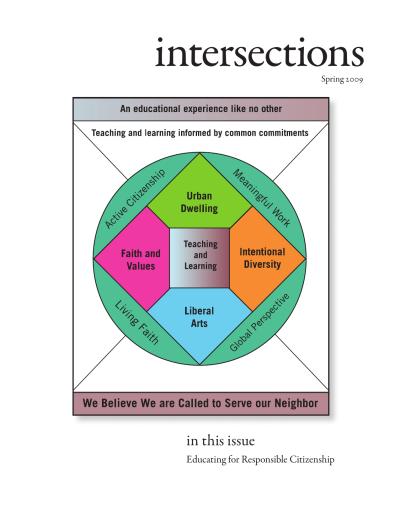
Dual Citizenship: Reflections on Educating Citizens at Augsburg College
Paul C. Pribbenow
No. 29 · Spring 2009
Pribbenow argues that the vocation of Augsburg College is to educate “dual citizens”—those able to live within the messiness of common work rather than resolve every tension once and for all. Drawing on John Courtney Murray on democracy as “the intersection of conspiracies,” Bill Moyers, Jean Bethke Elshtain, Stephen Carter, and the Augsburg vision statement “We believe we are called to serve our neighbor,” he names four common commitments and five principles of civic education that ground Augsburg’s incarnational mission in its city neighborhood.
-
 Article
A Fifth Teat on a Cow: The Irrelevance of the Lutheran Doctrine of the Two Kingdoms for Academic Life
Richard VonDohlen
No. 9 · Summer 2000
VonDohlen, responding to Richard Hughes, Carol LaHurd, David Ratke, Philip Nordquist, and Robert Benne, argues that the Lutheran doctrine of the two kingdoms as commonly deployed in recent discussions of Lutheran higher education rests on a faulty sociology (taking Luther’s sixteenth-century structure for our highly differentiated society) and an epistemological monism (assuming a single neutral reason against the pluralism described by Alasdair MacIntyre and others), making it anti-intellectual, hostile to interdisciplinary dialogue and Christian social ethics, and ultimately as a defense of theology’s relevance about as useful as “a fifth teat on a cow.” Drawing on his experience on the Catawba Valley Hospice Ethics Committee, his Dutch Reformed and dispensationalist background, and the ELCA social statement “Sufficient, Sustainable Livelihood for All,” he calls for an “intellectually ecumenical” dialogue between Lutherans and non-Lutherans willing to take each other’s paradigms seriously.
-
Article
Learning from Luther on Covid-19
Carl Hughes
No. 52 · Fall 2020
Reading Martin Luther’s 1527 treatise “Whether One May Flee from a Deadly Plague,” Hughes finds practical and spiritual guidance for a pandemic age: serve the neighbor, follow medical experts, honor those whose vocations put them at risk, and trust that even when we fail, God will not abandon the community.
-
Institutional Focus
Building a Developmental Framework for Vocational Reflection at Thiel College
Brian Riddle, Greg Q. Butcher, Liza Anne Schaef
No. 55 · Spring 2022
Riddle, Schaef, and Butcher describe how a NetVUE Program Development Grant enabled Thiel College to build “the Tomcat Way” — a four-year developmental framework with personal, social, academic, and professional domains and four phases (Explore, Envision, Belong and Lead, Launch) — that now guides every aspect of the student experience.
-
 Article
The Vocation of a Lutheran College—Living the Legacy of the Reformation in the Twenty-first Century
Sabine U. O'Hara
No. 26 · Fall 2007
O’Hara reflects on Luther’s understanding of education as Bildung — “becoming in the image of God” — through four key aspects: education must be relevant, education demands engagement with the community, education requires attention to place, and education demands engagement with the world. Drawing on her German upbringing, her work as president of Roanoke College, and on Darrell Jodock and Dietrich Bonhoeffer, she argues that Luther’s vision of a well-educated citizenry as the priesthood of all believers calls Lutheran colleges to messy, interdisciplinary, communal scholarship in service to the neighbor.
-
 Article
Lutheran Identity, Academic Integrity, and Religious Diversity
Storm Bailey
No. 25 · Spring 2007
Bailey argues that one might rightly say of a college “that’s a pretty good school because it’s religious,” defending the proposition under three headings: academic and curricular virtues, free inquiry, and religious diversity. Drawing on Mark Schwehn’s Exiles from Eden, Richard Hughes on the Lutheran tradition’s “most potent theological resources” for the life of the mind, Parker Palmer, Lendol Calder, Mill’s On Liberty, Newman’s Idea of a University, and the AAUP’s 1940 Statement, he proposes a “critical mass” alternative in which the Lutheran commitment to truth-seeking and self-critique itself requires—rather than tolerates—a religiously diverse faculty whose opposing voices are needed for the mission to flourish.
-
Article
Cultivating Transformative Responsible Dialogue: Community of Moral Deliberation and Lutheran Higher Education
Per Anderson
No. 35 · Spring 2012
Anderson proposes that ELCA colleges and universities embrace a project of “transformative responsible dialogue” that advances the ELCA’s commitment to be a “community of moral deliberation” and answers the LIFT Report’s call for a culture of faithful discernment. Drawing on Michael Meyer’s “liberal civility,” Martha Nussbaum, Hans Jonas’s responsibility ethic, Patrick Keifert’s ecclesiology of strangers, and Kathryn Tanner on culture, he argues that liberal education at our schools can form students whose dialogue knits together civility, responsibility, and Christian openness to the other.