Dual Citizenship: Reflections on Educating Citizens at Augsburg College
Intersections No. 29 · Spring 2009
And the Word became flesh… (John 1:14a)
From faith there flows a love and joy in the Lord. From love there proceeds a joyful, willing, and free mind that serves the neighbor and takes no account of gratitude or ingratitude, praise or blame, gain or loss. (Luther 83)
The old man rose and gazed into my face
and said that was official recognition
that I was now a dual citizen.
He therefore desired me when I got home
to consider myself a representative
and to speak on their behalf in my own tongue.
Their embassies, he said, were everywhere
but operated independently
and no ambassador would ever be relieved. (Heaney 277)
Three years ago, when I first learned that my predecessor as Augsburg’s president, Bill Frame, had decided to retire after nine successful years, I was intrigued by the possibility that I might be called to serve as Augsburg’s next president. It was a college with deep roots in the liberal arts; a strong and distinctive faith tradition; and a provocative (if aspirational) claim to pursue intentional diversity. But, above all, I was drawn to a college located in the midst of a thriving city neighborhood with a reputation for educating students for citizenship.
And I have not been disappointed. Called to serve as Augsburg’s tenth president—myself a product of Lutheran higher education in the liberal arts tradition, a social ethicist with a passion for the intersection of higher education and democracy, and an urbanist with a love for the diverse richness and messiness of life in the city—I could not feel more privileged by the opportunity I have been given to share in Augsburg’s mission-based work early in the twenty-first century. It is good and healthy and meaningful when individual and institutional vocations coincide, as I believe they have for me and Augsburg College.
That said, I also found myself intrigued by some of the pressing issues that were raised both during the presidential search process and in the first few months of my time on campus. In a variety of settings, I heard from students, faculty, staff, alumni, regents, parents and friends about myriad tensions they believed were present within the college: tensions between the church and the academy; between the traditional liberal arts and professional studies; between academic access and excellence; between the campus community and the city. I was not surprised so much by the fact that the tensions existed—I think we all would agree that such tensions are an abiding part of our work in the academy—but I was struck by the assumption in many of these conversations that the tensions needed to be resolved if we were to be successful.
I remember, in one striking instance, a faculty member pushing me during the search interview about where I would come down if it came to pass that the values of the church (supposedly the Evangelical Lutheran Church in America) came into an irresolvable conflict with the values of the college. She wanted to know whose side I would take in that fight. I assure you I gave the best “presidential” answer I could muster (read: not much of an answer at all), but thought to myself how fascinating it was that good, intelligent people could not imagine a way to hold such a conflict in creative and constructive trust. I wondered how that person imagined that people could live together in community, in neighborhood, even in democracy, without a tolerance for the inevitable messiness and conflict that characterizes common effort and purpose. I wondered how a college that genuinely believes in educating for citizenship could not recognize that the heart of that education needed to be about how to live in the midst of tensions that would not be resolved, only negotiated! In other words, I wondered how well Augsburg educated dual citizens, those able to live through the messiness of common work.
Apart from reminding these good folks that, as a Lutheran college, we were called to live with the paradoxes of life (how about simul justus et peccator?), I did wonder at how often these tensions were presented as conflicts that needed to be resolved once and for all. I imagine we all recognize the ways in which dichotomies become polarized, thereby losing their creative promise. I have come to recognize that our capacity to develop a narrative framework in which these tensions are lived—not just debated—is one of the central features of creating contexts for civic education. In other words, the daily life of places like Augsburg become genuine classrooms for democracy, not just because of what we teach (as important as this is) but also because of how we live our lives together.
I have long been a student of democracy and find Roman Catholic political theologian and philosopher, John Courtney Murray’s definition of democracy as “the intersection of conspiracies” especially instructive. The question is whether or not the inevitable tensions of life together can be reframed as intersections within an unfolding narrative that has synergistic and constructive power, and not how we do away with tension or conflict. The question is how do we teach and learn about how to navigate and negotiate these intersections.
The journalist and keen cultural observer Bill Moyers recently suggested that “Watching and listening to our public discourse today, I realize we are all ‘institutionalized’ in one form or another—locked away in our separate realities, our parochial loyalties, our fixed ways of seeing ourselves and others. For democracy to flourish, we need to escape those bonds and join what John Dewey called ‘a life of free and enriching communion’—an apt description of the conversation of democracy.” (89)
I would go further to suggest that, in order to escape the bonds Moyers describes, we need to become (and to help educate) what political ethicist Jean Bethke Elshtain has called “chastened patriots,” those who are able to navigate the various loyalties and realities of common life, loving critically if you will. Law professor (and novelist) Stephen Carter contends that one of the central rules of etiquette in democracy is that whenever we enter into conversation, we must be open to the possibility that we could be persuaded of someone else’s position. How do we teach and learn this sort of civic education, this openness to being a dual citizen, members of a particular culture and society, but also citizens of a wider community that is our home as well?
The good news is that Augsburg has a long history of addressing these intersections in our lives, theologically and academically, and thus there is a strong foundation upon which to consider how faith and reason, theory and practice, and the academy and world exist alongside each other in an overarching narrative that has both depth and breadth. And upon this foundation, we have the opportunity to explore and practice the daily practices of civic life, balancing sometimes competing interests, loyalties and conspiracies in healthy and constructive ways.
The early Augsburg presidents—August Weenas, Georg Sverdrup, Sven Oftedal and George Sverdrup—were learned and faithful theologians and pastors, whose strong love of Christ and the church were not separated from their sense of duty and vigilance for a free and well-functioning society. Bernhard Christensen, who served as Augsburg’s president from 1938-1962, was ahead of his time as a theologian who embraced the Christian mystics and the diversity of ecumenism even as he proclaimed his deep and firm faith that Christ was the true path to the divine. He also was ahead of his time as a citizen who served, for example, in Mayor Hubert Humphrey’s Minneapolis Human Rights Commission.
In the modern era, Augsburg presidents Oscar Anderson and Charles Anderson, respected theological scholars and leaders, turned their attention to the pressing needs of the city in the 1960s, 70s and 80s—to race relations, to urban renewal, to the resurgent immigrant trends, to poverty and crime in the streets—while also reaffirming Augsburg’s academic and theological principles in a new college motto, “From truth to freedom.”
It is only in recent years, though, during the tenure of William Frame, that the entire college community was called into conversation about the historical, theological and academic legacies that combine to offer Augsburg its distinctive vocation as a college of the church in the city. In two remarkable documents, Augsburg 2004: Extending the Vision and The Augsburg Vocation: Access and Excellence, the college community affirmed that:
If this were an epic, a work that recalls the past to locate the present and chart the future, we might wish to invoke as our muse Thales, truth-seeker and navigator… (We offer) a vision for the educational program at Augsburg College that connects the College’s past with its future. It submits that an Augsburg education can and will provide navigational skills: To the extent possible for any institution of higher education, Augsburg will develop graduates who will be prepared for life and work in a complex and increasingly globalized world; equipped to deal with its diversity of peoples, movements and opinions; experienced in the uses and limitations of technology; and possessed with a character and outlook influenced by a rich understanding of the Christian faith. (Engebretson and Griffin 1998: 2)
In other words, the college affirms its commitment to educating dual citizens who can navigate the inevitable tensions and intersections of life in the world as informed, nimble and faithful people.
So, the inevitable question for me is just what am I going to do as the current Augsburg president given this legacy and vision? Apart from not messing it up—which strikes me as a worthy goal!—I would suggest that my work at Augsburg is about helping the college community to figure out just how radical this vision is as a blueprint for citizenship and then offering whatever support I can muster to make it so.
And that takes me back to the questions I heard when I first arrived at Augsburg and to my concerns that the tensions people named as important for me to know (and by extension, I imagine, for me to resolve) were still very much present in the daily life and culture of the college—which is not in itself a surprise, but is a sign that the navigating and negotiation of these tensions was not always seen as part of the education we offered each other and our students. In other words, the “stuff” of educating citizens was right in front of us and we didn’t seem to fully grasp it.
As an aside, I want to lift up the fact that Augsburg’s curricular and co-curricular programs are increasingly aligned with this sense that students must learn how to navigate complex personal, professional, organizational and public worlds—certainly core components of a genuine civic education. We are a leader in service-learning and civic engagement programs in the city and around the world. We play a growing role in civic conversations in our region as we emphasize the gift of healthy public discourse. The college’s relatively new core curriculum offers opportunities for teaching and learning in the classroom, on campus, in the city and around the world that strike me as well-grounded in our mission and aspirational in our sense that vocation, caritas, community and civility are the requisite aspects of an education for service and citizenship.
That said, you might wonder why I don’t just sit back and enjoy all of this progress on so many fronts? And the truth is that I do honor and celebrate this remarkable vision and initiative, even as I pursue my strong contention that the daily life and work of the college demands greater attention as the context in which the work of educating citizens occurs. In other words, it is not good enough to claim victory on our aspirations when there are those who do not recognize the opportunities we have every day on our campus, in the neighborhood and around the world to be even more intentional, reflective and faithful in our distinctive calling as a college.
We therefore have returned to our envisioning work and have raised to the level of institutional values and vision the questions of how we all can learn to navigate these tensions creatively. We have begun to “translate,” if you will (an important concept for our work), the vocation and vision of Augsburg into the daily practices of our lives together in the college and thereby begun to understand education for citizenship as a more expansive and integrated aspect of our daily lives.
We have identified three consistent patterns to our work as a college that mark out a clear vision for Augsburg—a vision that is thoroughly articulated in the expansive work of Augsburg 2004 and the subsequent Access to Excellence vision documents. The three patterns—each of which also names a central intersection in our common lives—are:
We believe. We are grounded in a deep and confident Christian and Lutheran faith, and thereby we are a college freed to consider how the ideas and practices of diverse religions are central to our work. Faith is a central value, idea and practice in our life as a college. Faith and learning can never be separated from each other.
We are called. The theological idea of vocation or calling is central to how we educate students at Augsburg. Education (for whatever career a student might choose) combines with histories, experiences, commitments, faith and values to bring coherence and meaning to life in the world. We aspire to integrate this understanding of vocation into all that we do as a college. Reflection and practice can never be separated from each other in this concept of vocational education.
To serve our neighbor. Education at Augsburg is aimed at preparing our students for lives of service in the world. We live in a diverse neighborhood known as Cedar-Riverside where our neighbors are Somali and Vietnamese; we are part of a very diverse metropolitan area where our neighbors are business people and street people and ordinary people, alongside of whom we seek to make our world a better place; we are linked through our campuses around the world (Namibia, Mexico, Nicaragua, El Salvador) to our global neighbors. The gifts of faith and call lead us to service of neighbor. Our lives on campus and in the city and the world are entangled in all we do as a college.
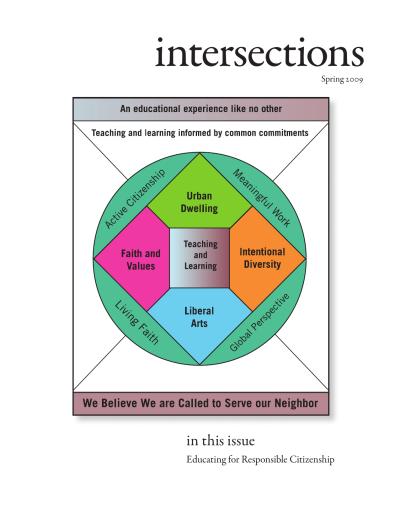
We believe we are called to serve our neighbor. This is a statement of our vision for Augsburg College and for the vocation we embrace for the college in the years ahead. We believe we are called to serve our neighbor—a deeply Lutheran vision statement, but also deeply relevant to our work as a college. At Augsburg College, the privilege of education—through truth to freedom—carries with it the obligation to come here to learn, to live, to serve, to be an even stronger and more faithful presence in the world.
In the context of mission and vision, we then have worked to identify and explore pathways for our future work—what I call “common commitments.” These commitments are the means by which the experience and story of Augsburg College is most persuasively crafted and told. The four common commitments are:
- Living faith
- Active citizenship
- Meaningful work
- Global perspective
Each commitment captures our historic work as a college; our centers of excellence at present in curriculum, co-curriculum, faculty and student life, organizational culture, and outreach efforts; and our commitments for the future. The chart above captures visually the links between mission, vision and common commitments (all focused on students and learning!)
Augsburg Mission, Vision and Common Commitments
Another way in which we have begun to talk about this vision and common commitments is through the lens of what we call “The Augsburg Promise.” We are inviting our entire community into an “educational experience unlike any other” that is centered around the promises we make to each other—promises that at their core are about how we live as fellow citizens in this community and thereby learn how to negotiate the tensions of life together—education for citizenship.
So what are the principles of this broader civic education we offer as we learn to live out this vision? How do students, faculty, staff and others gain a civic education within and outside of an institution that has this vision for its work, this set of common commitments, this idea of the promise it makes to its students?
At the heart of our common work is an unfolding narrative that allows us to understand and negotiate the intersections of conspiracies within our institution, and thereby involve our entire community in the work of educating dual citizens. We have named five abiding principles for our lives together here at Augsburg that I would contend are the building blocks of civic education:
We work out of abundance. This is the promise of abundance in a world of scarcity—this is the promise into which we are called as God’s people. This also is the promise of civic prosperity, commonwealth, and the foundation for mature citizenship, doing things together that we cannot do as well alone.
We live with generosity. “And the Word became flesh” (John 1: 14a) is our historic motto. It is the generosity of our lives and whereabouts that we celebrate. It is our nature and identity and character that we lift up, our links to a particular place and culture and set of values and practices that make us Augsburg—as we have been known since 1869.
We learn through engagement—In many ways, engagement is an obvious aspect of Augsburg’s longstanding traditions of experiential education and community relations. Engagement involves both attitude and behavior. We engage each other because we are committed to learning from each other. We engage each other because together we are stronger.
We educate for service. Service is by no means an alien concept for Augsburg. In fact, our long-beloved motto, “Education for service,” is ready evidence that Augsburg has made service a central aspect of its curriculum and campus life throughout its history. Education for service focuses on service as a way of life, a set of values, a democratic ethic. It’s about a vision of democracy as a social ethic—the genius of balancing individual needs and interests with the common good.
We see things whole. “We see things whole” is a “liberal arts” way of holding our lives together in this college community in trust. Seeing things whole provides an organizational framework for planning and problem-solving that is grounded in a vision of wholeness and interrelatedness. We’re all in this together and our various voices and perspectives together best ensure our common purpose and engagement.
Here then are the guiding values, principles and practices of a community that is dedicated to an authentic civic education. Here are the practices of citizenship for democracy. We are, in a very real sense, committed to educating “dual citizens,” those who understand and practice within the broader narrative which recognizes that we must not attempt prematurely to resolve the messiness, the tensions of our lives, but instead find in those tensions the “stuff” of lively public discourse, civic literacy and engagement, and the promise of mature and meaningful common work. We are called to be people of abundance, generosity, engagement and service—people who see things whole and hold common purpose in trust—people who grasp the call to citizenship and politics as a distinctive and meaningful vocation in the world.
In the end, it is about the idea that we are what the Christian mystic Teresa of Avila called “the only body of Christ” on earth now, the Word made flesh everyday where we are found, dual citizens who understand that we must share aspirations for our lives together in our own tongues, as ambassadors whose embassies are everywhere and who will never be relieved!
Sources consulted
Addams, Jane. Democracy and Social Ethics. Originally published in 1907. Urbana, IL and Chicago: U of Illinois P, 2002.
Bellah, Robert et al. Habits of the Heart. Berkeley and Los Angeles: U of California P, 1985.
Benson, Lee, Harkavy, Ira and Puckett, John. Dewey’s Dream: Universities and Democracies in an Age of Education Reform. Philadelphia: Temple UP, 2007.
Berry, Wendell. What Are People For? San Francisco: North Point, 1990.
Boyte, Harry. Everyday Politics: Reconnecting Citizens and Public Life. Philadelphia, U of Pennsylvania P, 2004.
Carter, Stephen. Civility: Manners, Morals and the Etiquette of Democracy. New York: Basic Books, 1998.
Chrislock, Carl H. From Fjord to Freeway: 100 Years—Augsburg College. Minneapolis: Augsburg College, 1969.
Dewey, John. Experience and Education. First published in 1938. New York: Touchstone, 1997.
Elshtain, Jean Bethke. “Citizenship and Armed Civic Virtue: Some Critical Questions on the Commitment to Public Life.” Soundings 69 (1987): 99-109.
Engebretson, Mark and Joan Griffin, eds. Augsburg 2004: Extending the Vision. 1998. <http://www.augsburg.edu/about/augsburg2004.pdf>
———. The Augsburg Vocation: Access and Excellence. 2005. <http://beowulf.augsburg.edu/president/pdfs/vocation.pdf>
Frame, William. The Dialogue of Faith and Reason: The Speeches and Papers of William V. Frame. Minneapolis: Lutheran UP, 2006.
Gaudiani, Claire. The Greater Good: How Philanthropy Drives the American Economy and Can Save Capitalism. New York: Times Books, 2003.
Harkavy, Ira and Puckett, John. “Lessons from Hull House for the Contemporary Urban University.” Social Service Review 68:3 (1994): 299-321.
Heaney, Seamus. “From the Republic of Conscience.” Opened Ground: Selected Poems, 1966-1996. New York: Farrar, Straus and Giroux, 1998. 276-77.
Ignatieff, Michael. The Needs of Strangers: An Essay on Privacy, Solidarity, and the Politics of Being Human. New York: Penguin, 1984.
Lovin, Robin, ed. Religion and American Public Life: Interpretations and Explorations. New York: Paulist, 1986.
Luther, Martin. The Freedom of the Christian. Luther Study Edition, translated and introduced by Mark Tranvik. Minneapolis: Fortress, 2008.
Marty, Martin E. The Public Church: Mainline—Evangelical—Catholic. New York: Crossroad, 1981.
Moyers, Bill. Moyers on Democracy. New York: Doubleday, 2008.
Murray, John Courtney. We Hold These Truths: Catholic Reflections on the American Proposition. New York: Sheed and Ward, 1960.
Nelson, Richard C. and Wood, Dave. The Anderson Chronicles: An Intimate Portrait of Augsburg College, 1963-1997. Minneapolis: Kirk House, 2000.
Palmer, Parker. The Promise of Paradox: A Celebration of Contradictions in the Christian Life. Originally published in 1980. San Francisco: Jossey-Bass, 2008.
———. The Active Life: Wisdom for Work, Creativity and Caring. San Francisco: HarperSanFrancisco, 2000.
Putnam, Robert. Bowling Alone: The Collapse and Revival of American Community. New York: Simon and Schuster, 2000.
Schön, Donald A. Educating the Reflective Practitioner. San Francisco: Jossey-Bass, 1987.
Shorris, Earl. Riches for the Poor: The Clemente Course in the Humanities. New York: Norton, 2000.
Simmons, Ernest L. Lutheran Higher Education: An Introduction for Faculty. Minneapolis: Augsburg Fortress, 1998.
Specht, David and Broholm, Richard. Toward a Theology of Institutions. Indianapolis, IN: Greenleaf Center, 2003.
Tocqueville, Alexis de. Democracy in America. Originally published in 1840. New York: HarperPerennial, 1988.
-
 Editorial
From the Publisher
Mark Wilhelm
Wilhelm introduces essays from the 2008 Vocation of a Lutheran College Conference held at Luther College under the theme “Educating for Responsible Citizenship,” previewing contributions from Paul Pribbenow on dual citizenship at Augsburg, Wanda Deifelt on Luther College’s engagement with civic vocation, Jose Marichal on the promise and peril of digital citizenship, and Arne Selbyg on his three experiences of being educated for citizenship.
-
Editorial
From the Editor
Robert D. Haak
Haak frames the issue’s essays around the question of Lutheran colleges and the role of citizen, noting H. Richard Niebuhr’s typology in Christ and Culture and Luther’s own complex understanding of Christian and state, and offers a fitting farewell to Arne Selbyg with Mike Blair’s tribute song “A Fine Norwegian.”
-
Article
Students in the Cloud: Creating Digital Citizens
Jose Marichal
Marichal weighs the utopian and dystopian views of the “networked information economy,” drawing on Yochai Benkler, Manuel Castells, Henry Jenkins, Cass Sunstein, Robert Putnam, Nicholas Carr, and Andrew Keen to chart the promise and peril of life “in the cloud,” and proposes Aristotle’s intellectual virtue of phronesis—developed through Hubert Dreyfus’s five stages of skill acquisition—as the goal of digital citizenship for college faculty and their students.
-
Article
From Alien to Citizen
Arne Selbyg
Selbyg reflects on three experiences of being educated for citizenship—growing up in Norway under the legacy of Lutheran pastors and public school teachers who resisted the Nazi occupation, arriving in America as a resident alien, and becoming a naturalized American citizen—and proposes the jazz ensemble as a better metaphor for American society than the melting pot, one in which different citizens learn skills, study other instruments, and dialog with one another in service to the common music.
-
Article
Seeking the Common Good: Lutheran Contributions to Global Citizenship
Wanda Deifelt
Deifelt draws on Luther’s account of neighborly love in “The Freedom of a Christian” and on his Two Kingdoms theology to argue that a Lutheran ethics of care fosters a sense of responsibility, accountability, and compassion that broadens citizenship beyond rights and virtues. Engaging William Galston’s typology of civic virtues, Sylvia Walby on women’s citizenship, Serene Jones on communitarianism, and Manuel Castells on globalization, she proposes that Lutheran theology equips the church to educate for transformative participation in world affairs.
-
 Article
What is Required of You?: Higher Education Leadership in a Moral Key
Paul C. Pribbenow
No. 62 · Fall 2025
15 min audio
Drawing on Micah 6:8 and Stephen Carter’s “etiquette of democracy,” Pribbenow describes the three things Augsburg requires of every incoming student — show up, pay attention, and do the work — as a democratic social ethic that prepares students for engaged citizenship in a fractured public life.
-
 Response
Response to Mark Wilhelm: Adopting the Framework of ‘Because’ and ‘Therefore’
Paul C. Pribbenow
No. 56 · Fall 2022
Pribbenow describes how Augsburg University responded to its dramatic demographic transformation (from 18% to nearly 70% BIPOC entering students over sixteen years) by adopting an institutional vocational statement and a simple “because/therefore” framework for translating particular Lutheran theological convictions into institutional programs, policies, and practices.
-
 Institutional Focus
Sharing the Gift of Vocation at (and beyond) Augsburg University
Paul C. Pribbenow
No. 55 · Spring 2022
Pribbenow, drawing on a 2022 NetVUE panel with Dorothy Bass and Jodi Porter, considers how the gift of vocation forged with undergraduates can be extended — beyond undergraduate campuses to graduate students, faculty, and staff; across the vocational lifespan from high schoolers to alumni navigating the “gig economy”; and into accompaniment of faith communities through Augsburg’s Riverside Innovation Hub.
-
 Article
Through Truth to Freedom—by Way of Reconciliation
Paul C. Pribbenow
No. 52 · Fall 2020
Reflecting on Augsburg’s 150th-anniversary motto “Through truth to freedom,” Pribbenow argues that in a season of three pandemics — pandemic illness, economic collapse, and the racial sin laid bare by the murder of George Floyd — higher education’s most authentic work is to educate for truth and freedom by way of confession and reconciliation.
-
 Article
Say Something Theological: A Meditation on the Vocation of Lutheran Colleges and Universities to Serve the Common Good
Paul C. Pribbenow
No. 42 · Fall 2015
Pribbenow expands Luther’s “priesthood of all believers” into a meditation on doing theology with the Bible in one hand and the New York Times in the other — reading Luke 14 alongside walls, immigration, and hunger in his Minneapolis neighborhood — and argues that the leadership of Lutheran colleges demands a willingness to engage the theological issues at the heart of their public vocation.
-
 Article
Hospitality is Not Enough: Claims of Justice in the Work of Colleges and Universities
Paul C. Pribbenow
No. 35 · Spring 2012
Pribbenow argues that Augsburg’s incarnational motto — “And the Word became flesh” — grounds a calling beyond hospitality to justice. Drawing on Stephen Carter on civility, Letty Russell on just hospitality, Henri Nouwen, Parker Palmer, Michael Sandel, Bonhoeffer, Niebuhr, and Teresa of Avila, he describes four components of Augsburg’s practice: education “off the main road,” co-created common life, abundance over entitlement, and the anchor-institution model in which colleges become economic and civic partners with their neighborhoods.
-
 Article
Educating for Peace: 21st Century Models for Thinking Globally and Acting Locally
Janet E. Rasmussen
No. 18 · Fall 2003
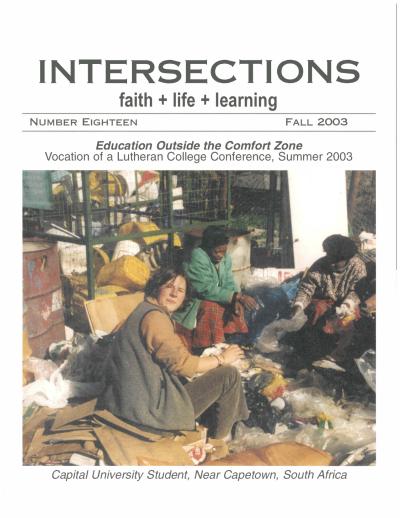
Rasmussen opens with a rabbinic story about the one-step distance between East and West and describes Pacific Lutheran University’s four-phase “Global Education Continuum”—Introductory, Exploratory, Participatory, Integrative—developed with Teagle Foundation support and grounded in Perry, Bennett, and Musil. She illustrates intentional global/local partnership through three case studies: Barbara Temple-Thurston’s Trinidad-and-Salishan initiative; the China Partners Network with the Amity Foundation, Good Samaritan Hospital, and PLU’s Wang Center; and Ann Kelleher’s three-institution “Norway in Namibia” partnership with Hedmark University College, the University of Namibia, NAMAS, and the Ondao mobile schools for the Himba people. She closes with Daloz, Keen, Keen, and Parks’s Common Fire research and Lee Knefelkamp’s call to be “communities of peace.”
-
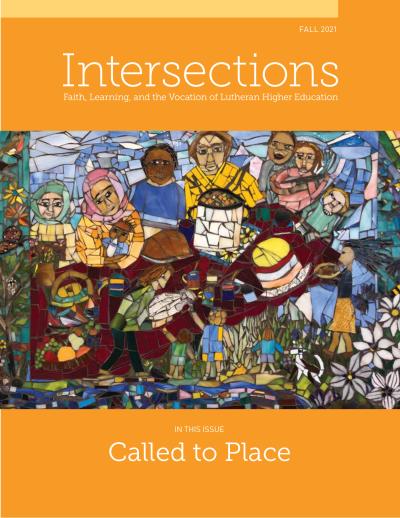 Article
Where Your Feet are Standing: Institutional Engagement and Place
Melissa Maxwell-Doherty
No. 54 · Fall 2021
Maxwell-Doherty draws on Cal Lutheran’s Hispanic-Serving Institution designation and its location on Chumash, Fernandino Tataviam, and Ohlone lands to ask how the university’s mission might shift if it depended on where its students are standing — not just where the institution sits.
-
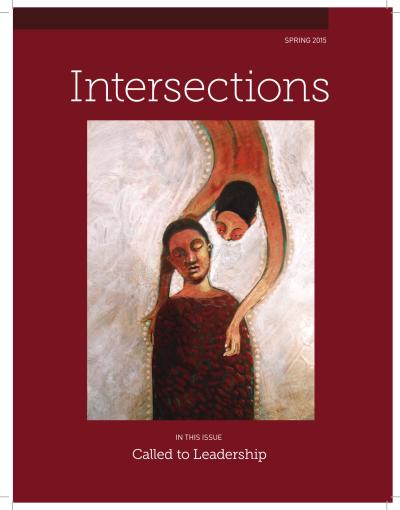 Article
Leading from Within: Peer-Learning Consultations to Explore Our Callings and Campus Capacities for Leadership
Chris Johnson
No. 41 · Spring 2015
Johnson reframes vocational leadership as “soul work” that calls for the deep mind as much as the conscious one, and offers two practices — deep listening and a modified Quaker clearness consultation — as ways for campus colleagues to listen one another into existence. Drawing on Sharon Daloz Parks, Marshall Ganz, Parker Palmer, and Mary Rose O’Reilley, he invites readers to map their stories of self, us, and now.
-
 Article
The Identity, Mission, Vision, and Goals of a Lutheran College vis a vis Bacon's "Of Studies" and Newman's "The Idea of a University"
Cora Lazor, Mary Theresa Hall
No. 15 · Winter 2002
Hall, an Associate Professor of English at Thiel, and Lazor, a Thiel junior and 2002 ELCA Division for Higher Education summer intern, read Thiel College’s Statements of Identity, Mission, Vision, and Goals alongside Sir Francis Bacon’s “Of Studies” (1625) and John Henry Cardinal Newman’s The Idea of a University (engaging Azade Seyhan’s May 2002 PMLA essay along the way). They argue that Bacon’s “Read…to weigh and consider” and Newman’s defense of liberal over technical training underwrite Thiel’s new Writing-Intensive Course requirement, its ten institutional objectives, and its commitment to “service to society” in the Judeo-Christian tradition.
-
 Reflection
Currents
Jaime Schillinger
No. 25 · Spring 2007
Preached in St. Olaf chapel on March 29, 2005, Schillinger reads three “currents” pulling on her hearers—Minnesota spring, the academic year’s final stretch, and Holy Week’s passion and resurrection—against poetic voices from ee cummings, Gerard Manley Hopkins, and Edna St. Vincent Millay, before turning to the Song of Songs to suggest that this nexus calls students into the rhythms of love, awakened desire, and an elusive, unresolved promise that animates academic, spiritual, and vocational search alike.
-
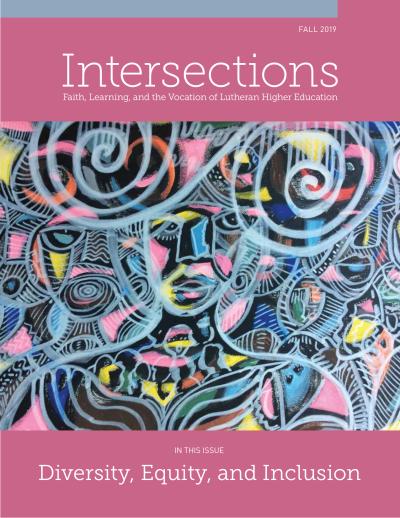 Article
The Perils and Promise of Privilege
Guy Nave
No. 50 · Fall 2019
Nave argues that privilege is always used in one of two ways — to preserve privilege by promoting inequity, or to challenge privilege by promoting diversity, inclusion, and equity — and uses examples from Indianapolis Catholic schools, Martin Luther, and equity-mindedness research to call Lutheran institutions to address the racist practices and policies that reproduce whiteness on their campuses.