I want to be in the room where it happens—that is, the classroom! Of course, students also learn meaningfully in many other campus spaces—the fields and facilities of athletics, the social centers of student services, residence halls, formal and informal gathering sites, contemplative prayer and public liturgies in chapels. But considering the mission of schools belonging to the Network of ELCA Colleges and Universities (NECU) the place for cultivating knowledge, curating dreams, and evaluating growth toward learning goals, our centerpiece and sine qua non is the classroom. So, I am preparing to teach a course titled “Ethical Leadership” as part of the First Year Seminar at California Lutheran University.
For decades I’ve striven and fallen short in enacting my belief that administrators need to be actively engaged in this primary craft of their institution—which is not administration! This daunting and dreamless moment in higher ed makes it more imperative now than ever. In light of heightened business pressures, rising costs, lowering confidence in the value proposition for higher education, as well as the overall intensification of unfavorable public and political environments, leaders seeking to maintain their integrity of purpose and their lucidity of vision will pursue ways to stay connected to students in classrooms.
Seeking to foster this in myself, I am organizing my seminar around three themes: 1) an inward turn 2) an outward turn and 3) an intellectual turn. I see these learning turns as mutually-reinforcing, inter-related building blocks of ethical leadership. Are there three turns or one? Or, both: three turns in one?
Determining Terms
By “turn” I am referring to a methodological focus. For many students, the invitation to consider these “learning turns” may represent a new shift in their worldview, a reorienting approach that develops unrealized dimensions of selfhood. They discover more fully their why. They embrace a mindset (intellectual turn) that liberates them from the prisons of shortsighted, superstitious, superficial, or smallness of thought. Liberating the mind is the literal (“liberal”) purpose of a liberal arts education. Practitioners of these turns are motivated to move towards themselves and towards others with new intellectual openness, embracing a diversity of perspectives. For those who live, love, study, compete, eat, drink, think, publish, pray, and play within the theater of Lutheran higher education, the learning turns will insinuate a direct or indirect invitation to creatively interpret and personally implement an approach to leadership that is ethical.
By “ethical” I am referring first, specifically, to Cal Lutheran’s missional promise to “educate leaders for a global society who are strong in character and judgment.” Then, more broadly, I am engaging the moral imperative brimming within the Christian tradition of Lutheran education, that of vocation; namely, that our lives, by divine design, are purposeful; we are not ontologically unmoored, existentially nomadic, or teleologically aimless but our lives are rooted. In families, in faith communities, in workplaces, in political economies we experience “the reality of God’s love for the world and for human beings,”1 as Dietrich Bonhoeffer (1906-1945) describes these mandatum dei, divinely mandated estates or orders. The purpose of these created orders is to uphold and preserve humankind from careening into chaos, and to provide a concrete, specific context for our moral mission. Bonhoeffer builds these four organizing structures for societies from the three estates of Martin Luther (1483-1546).2
Whether there be three or four civil estates, we leave it to theologians to debate; what is without argument is 1) that all human beings participate—knowingly or unknowingly—in all these orders; and, that 2) these orders all provide the context in which and for which character is developed.
The societal skeleton of these mandatum dei, invigorated by a Lutheran understanding of vocation, can also provide a unique enfleshment for the value proposition of NECU institutions. By marketing a distinctive Lutheran charism within a crowded higher educational marketplace, we differentiate our institutions and add texture to our claims. This identity is particularly suited for a world haunted by the holy yet audaciously viewing itself as secularized or post-Christian. Secular is a good thing. The secular city or human societies constitute the locus for which we form our students, their penultimate destination. Where else can we do concrete world-work (Luther, weltlich3)? But because of sin, the secular devolves idolatrously into abject secularism, and the world—created as good and loved by God—degenerates into self-serving materialism, scientifically reductionist worldliness, and worse into the disordered desire and disfiguring lusts that lead to death. These devolutions thicken the walls of resistance to explicit Christian witness.
Luther offers insight with his notion of the “hidden God” (deus absconditus, Isaiah 45:5). One contemporary theologian helps us to see the prophetic implications of these Reformation-era teachings which I conceive as imbricative to Lutheran higher education—both interwoven through and overlapping with our pedagogical charism:
God is anonymously present within the universal structures of life, whether we feel it or not. God may be experienced within people as the hidden drive to do justice, whether they like it or not. God may be acting on the demands of conscience without our acknowledgment of their ground and source in him. God may be working as a driving force behind the demands human beings make on each other in every social situation. People who do not know the triune God through his self-revelation, according to the Scriptures and church teaching, cannot escape the Creator of all things who is hiddenly at work in our natural lives as the directing power in our everyday encounters. There is no escape from the hidden God anonymously at work under the guise of various masks (see Luther’s idea of the larvae dei).4
These larvae dei or “masks of God” impel the idea of vocation; God is at work, in, with, and under our so-called “secular” callings, for the sake of the common good. For this reason, we engage in the task of Lutheran education. For this reason, we and our colleagues and our students are endowed with reason and enlightened by the Spirit—whether they know it or not—for lives of leadership.
By “leadership” I am not referring to hierarchies of power, privilege, or status. I am pointing to the way of Jesus, a way of being and doing that is spiritually rooted, communally open, intellectually generative, and eternally mindful. A foundational document of NECU captures this paradoxical truth; whether mentor or protégé, professor or student, the goal is to understand how, as created co-creators, we join the divine intent to liberate and free others for lives of flourishing.5 The heartbeat of the Lutheran educational tradition pulses with an emancipatory insistence and vocational priority that is veined within its pedagogy.
Finally, by “pedagogy” I am speaking of a transformational and transcendent goal of our higher educational project: to develop in students a sense of reason that radiates in lives of altruism motivated by love, caritas6; such love will inspire our students with a fire that is “committed to service and justice”—as California Lutheran University’s mission statement puts it. Here, goodness, truth, and beauty converge to capacitize7 students in their personal search for full human flourishing, the common why. There are no individuals. Every person’s telos is entwined with all persons’ teloi. There is no flourishing without attention to serving others and contributing, according to one’s vocation and location in life, to justice for all. Access to this capacitation constitutes a social justice issue of our time.
Justice (צֶדֶק) is a concept that cannot be untied from Judeo-Christian morality or Lutheran pedagogy. In these times, when many families with immigrant backgrounds are suffering through depersonalizing and dehumanizing experiences, students are hungry to discuss interpretations of justice. For example, the strategy being deployed by agents of the United States’ federal government in the enforcement of immigration policy represents a newsworthy topic in 2025. Rather than leaving the conversation to the soundbytes and memes of dopamine-driven digital drivel masquerading as information, we bear a pedagogical responsibility: to guide students in assembling their data and research, constructing points of view, reflecting upon and applying ethical categories, developing and defending sound arguments, and being motivated to deploy their intellectual reasoning and spiritually-rooted wisdom towards lives that are outward facing; lives of public service and civic engagement.
Martin Luther once quipped, anticipating the wise warning of Lord Acton about power’s corruptive tendency—albeit with characteristic hyperbole, perhaps overstating the point to reinforce a point of view: “All experience proves this and in all the histories we find that force, without reason or wisdom, has never once accomplished anything.”8
Humans are endowed with judicious temperaments, inherent senses of what is right and wrong—though sometimes blurred, distorted, and dulled; justice is written on every human soul, whether legible or illegible.9 This flourishing or eudaimonia, the Greeks called it, is both ancient and perennially fresh, both locally realized and universally recognizable, timeless, timely, and time-tested.
With the prolegomenon proposed—presuppositional questions matter as much as the discourses they frame. I turn to the “three turns,” 1) an inward turn; 2) an outward turn; 3) an intellectual turn.
The Turns: Inward, Outward, and Intellectual
Though the first turn in the subtitle is inward, this ordering is more theoretical than sequential. The Christian understanding of the human person cannot be untied from the doctrine of the Trinity (God in three persons); hence, there are no considerations of the inward self which are atomistic or individualistic. Nurturing our contemplative selves addresses at least three personal, existential realities: 1) an affirmation of identity; 2) an exploration of spirituality, and 3) an inward turn that leads necessarily, centripetally, to an outwardness. The Dominican maxim enjoins the contemplative to see the inward turn as contemplare et contemplata aliis tradere—“to contemplate and to hand on to others the fruit of contemplation.” Irrespective of census data’s boxable categories, or stereotyped descriptions, there are neither individualized nor hierarchical ways of being human. From the perspective of theological anthropology, all human persons are inherent possessors of divine dignity, intrinsic value, and infinite purpose. This understanding animates us anew to study the humanities as the human ties which humanize us—the intellectual turn returns us to our inward and outward selves—never towards recondite, disembodied rationality.
Personhood is always integral and never is without social consequences. Interrogating inwardly life’s biggest questions cannot occur without outward ethical deliberation. Since human life is essentially social and moral, so-called inward questions transcend the narrow categories humans use to identify themselves and apply outwardly to the entire community life of the entire species in every major religious tradition: “Who am I? Where have I come from and where am I going? Why is there evil? What is there after this life?”10 To deny these questions is to deny our humanity. Without a clear estimation and knowledge of self, we cannot be in healthy relationship with ourselves or the others who, in a broken world, may draw us or tempt us to deviate into falsehood. We receive this exhortation in the Qohelet—which in the Hebrew Scriptures means one who assembles either students or protégés and shares with them a collection of wisdom sayings—
Guard your heart with all vigilance,
for from it flow the springs of life.
Put away from you crooked speech,
and put devious talk far from you.
Let your eyes look directly forward,
and your gaze be straight before you.
—Proverbs 4:23-25
“Guard your heart,” was the counsel Howard Thurman (1899-1981) provided to a disconsolate Martin Luther King when the pursuit of non-violent resistance became sidetracked. By turning inward to put away what is crooked or devious, ethical leaders will turn outward bearing the time-tested Aristotelian ideal of virtue (aretê or excellence). The Greek verb used by St Paul in Philippians 4:8 to describe fixing one’s focus towards such ends is λογιζεσθε (logizesthe). We hear in it, to logicalize, an actual English verb meaning to prioritize this use of reason in pursuit of truth.11 While staying on course and keeping one’s eyes from straying either to the left or to the right is key to reaching this goal, neither must we avoid “reading” peripherally with discernment the trends and tides of the times. These inward and outward turns are processed in the life of the mind, intelligence; derived from inter (between) and legere (to read), reading between the lines.
The concept of leaders as readers can be understood in two ways using a framework of analytic interpretation; one is “wide sense” and the other “narrow sense”—across a variety of academic disciplines these are sometimes also referred to as “broad sense” and “strict sense.” In the narrow sense, leaders are readers of books—a sort of literacy that has become the union card of being human. A. O. Scott captures what is inherent in the narrow sense’s inward and outward humanistic turns.
Is any other common human undertaking so riddled with contradiction? Reading is supposed to teach us who we are and help us forget ourselves, to enchant and disenchant, to make us more worldly, more introspective, more empathetic and more intelligent. It’s a private, even intimate act, swathed in silence and solitude, and at the same time a social undertaking. It’s democratic and elitist, soothing and challenging, something we do for its own sake and as a means to various cultural, material and moral ends.12
This attentiveness to the text, in the narrow sense, helps to train the mind’s eye for an attentiveness to context, in the wide sense. Reading, in both the narrow and the wise senses, always includes a notion of alterity—“the ability to imagine vividly, and then to assess judicially, another person’s pain, to participate in it and then to ask about its significance.”13 The Lutheran charism always includes a dimension of literacy for two reasons. One, the historic location for the beginning of the Reformation was a college campus, Wittenberg University. Second, the spread of the Reformation was indebted to a revolution in literacy ignited by the technology of Johannes Gutenberg (1400-1468) and his movable type printing press.
Eyes to Read Who Pulls the Strings
One of my ineradicable life-lessons occurred while traveling the world when I was the President and CEO of Lutheran World Relief. We invested globally on behalf of U.S. Lutherans in local communities working their way out of poverty on the continent of Africa, in South Asia, and in Latin America. As I reflected over time on what I saw and whom I met, I became grounded in the conviction that nothing can uproot in human persons their hopes and dreams. And not for themselves only. But personhood is inextricably linked to one’s community and one’s progeny. The love of children and grandchildren is universal. To be fully human is to be a humanitarian. I also became aware, glaringly, of the structures that keep people imprisoned in poverty. I am learning to read the signs of the times, akin to Daniel 5. It takes being contemplative to read “the handwriting on the wall.” It takes reading between the lines to see how systems meant to redeem and support humanity, mandatum dei, can, due to our age-old rebellion, become perverted to perpetuate and systematize injustice. Governments, political institutions, societies, organizations, corporations, systems of economic exchange, workplaces, communities, and families are designed to anchor humans in communities of flourishing. A spirituality of discernment turns inward and outward with intellectual insight to see how these systems no longer are doing their job. They can become habitats of malice which not only deprive humans of access to opportunity and the ability to exercise their agency with dignity, but leave them vulnerable to abuse and susceptible to manipulation.
As a mystic and a mentor to many, Howard Thurman spoke often about inward matters of the soul. His Commencement Address to the graduating class of Morehouse College in May of 1980 addressed the inward turn (identity, spirituality) as correlated to an outward turn (community, personal agency):
There is something in every one of you that waits, listens for the sound of the genuine in yourself. … you are the only you that has ever lived. Your idiom is the only idiom of its kind in all the existences. And if you cannot hear the sound of the genuine in you, you will spend your days on the ends of strings that somebody else pulls.14
To augment value in living, Socrates (469-399 BCE) axiologically suggested that life must be examined. This is no new wisdom, what is good, true, and beautiful is enduring. But we must apply it to new problems, especially in these dreamless times in higher education. The venerable duty and discipline of self-examination matters even more now in our new dizzying world of inter-everything. Witness the rising interdisciplinarity of the academic enterprise, subsisting within a skyrocketing context of tech-driven interconnectivity, as we dwell in a planetary interdependency of livelihoods, with an upsurge in the awareness of identity intersectionality, and a multiethnic pluralism which makes unavoidable the mutuality of interculturity. Therefore, the unexamined life not only does not know itself, it cannot affirm or fully acknowledge the worth of others’ lives because of the inevitability of interconnectivity.
The inward turn not only merely prompts an outward turn, but the pilgrimage into silence, listening, waiting becomes itself a life-giving sacrament. “I am a part of all that I have met” (Tennyson). The more vulnerable we are in our mysticism, the more ethical our leadership; leading will lead to those we meet themselves becoming more spiritually rooted, communally open, intellectually generative, and eternally mindful.
Endnotes
1. Dietrich Bonhoeffer, Ethics, p 390 See also “Creation and Fall” pp. 138-140.
2. In summary, Luther identifies the politia, oeconomia, and ecclesia. These indicate government and state, the household and economic interactions, and the church. “But the holy orders and true religious institutions established by God are these three: the office of priest, the estate of marriage, the civil government.” “Confession Concerning Christ’s Supper” in Luther’s Works (AE) vol. 37:364.
3. die Stad, das ist weltlich regiment (WA 50:562.23-24) Cf. On the Councils and the Church (1539), AE 41:177.
4. Carl E. Braaten, Principles of Lutheran Theology, Second Edition (Minneapolis: Fortress, 2007: 76).
5. Rooted and Open, p. 8. I am appreciative of this Sunday Collect which captures the rooted and open dialectic; composed by Pr Chamie Delkeskamp and prayed at Ascension Lutheran Church, Thousand Oaks, California on Sunday, 10 August 2025: “Gracious and Eternal God, you are our firm foundation and our guiding wind. In a world that shifts and changes, teach us how to be both rooted and responsive, grounded in your Word, yet open to the movement of your Spirit. Shape us into disciples who hold fast to truth while walking with open hands and hearts. In the name of Jesus Christ, the One who is both our Rock and our Redeemer. Amen.”
6. Often attributed to St Bernard of Clairvaux: “There are those who seek knowledge for the sake of knowledge; that is Curiosity. There are those who seek knowledge to be known by others; that is Arrogance (Vanity). There are those who seek knowledge in order to serve; that is Love (Charity).”
7. To capacitize needs to be an English language verb corresponding with the Spanish verb capacitar meaning to train, qualify, empower, and develop a person’s capacity, potential, agency, and ability.
8. Luther’s Works (AE) 34:238.
9. See pages 70-72 of Philip Melanchthon’s Loci Communes of 1543. Translated by J.A.O. Preus (Concordia Publishing House, 1992).
10. This citation concludes with these words: “These are the questions which we find in the sacred writings of Israel, as also in the Veda and the Avesta; we find them in the writings of Confucius and Lao-Tze, and in the preaching of Tirthankara and Buddha; they appear in the poetry of Homer and in the tragedies of Euripides and Sophocles, as they do in the philosophical writings of Plato and Aristotle. They are questions which have their common source in the quest for meaning which has always compelled the human heart. In fact, the answer given to these questions decides the direction which people seek to give to their lives.” in John Paul II, Fides et Ratio: On the Relationship between Faith and Reason (Boston: Pauline, 1998) pp. 9-10.
11. Philippians 4:8. Eugene Peterson’s creative translation of this verse puts it this way: “Summing it all up, friends, I’d say you’ll do best by filling your minds and meditating on things true, noble, reputable, authentic, compelling, gracious—the best, not the worst; the beautiful, not the ugly; things to praise, not things to curse.”
12. A.O. Scott, “The Reading Crisis: Book Bans. Chatbots. Pedagogical Warfare. Does Literacy Have a Future” in The New York Times Book Review, Sunday, June 25, 2023.
13. Martha C. Nussbaum, Poetic Justice: The Literary Imagination and Public Life (Boston: Beacon Press, 1995) 91.
14. https://thurman.pitts.emory.edu/items/show/838 accessed on 9 August 2025.
-
 Editorial
From the Publisher
Lamont Anthony Wells
5 min audio
Wells frames the issue as a record of the 2025 VLHE Conference at Augsburg under the theme “Ethical Leadership in a Changing World,” arguing that vocation is never solitary but a collective, public witness of ethical formation, theology and care, flourishing and belonging, and leadership rooted in God’s grace.
-
Editorial
From the Editor
Colleen Windham-Hughes
5 min audio
Windham-Hughes plays on the shared Latin root of “education” and “seduction” (ducere, to lead) to warn against the No-saying seductions of giving up or condemnation, and to call educators to the riskier Yes of showing up to build third-space communities of truth-telling and hope.
-
Article
Wake Up Running! A Call to Ethical Leaders in Quest of Democratic Space
Walter Earl Fluker
44 min audio
Abridged from his VLHE keynote, Fluker draws on Habakkuk and Octavia Butler’s Parable of the Sower to call a new generation of ethical leaders to “wake up running” toward democratic futures, packing their runaway bags with love-filled-justice, grace-filled-empathy, and hope-filled-resiliency for the soul-filled work the moment requires.
-
Article
Building a Third Space in the Age of AI: A Conversation with Dr. Walter Earl Fluker
Elizabeth Kubek
11 min audio
Prompted by AI chatbots being marketed to students as a safer alternative to messy human relationships, Kubek interviews Fluker on how Howard Thurman’s vision of common consciousness, somaesthetics, and nature-rooted learning offers educators a “third space” alternative to AI’s hall of mirrors.
-
Article
Ethical Leadership for a Changing World: A Shared Calling from Cradle to Career
Cory Newman, Janelle Rozek Hooper
5 min audio
Hooper and Newman recount how an ELCA Barna survey on early childhood education sparked the realization at VLHE 2025 that ELCA colleges and the 1,200 Lutheran schools and early learning centers share identical challenges — and an untapped potential to form ethical leaders across the full educational continuum from cradle to career.
-
Article
What is Required of You?: Higher Education Leadership in a Moral Key
Paul C. Pribbenow
15 min audio
Drawing on Micah 6:8 and Stephen Carter’s “etiquette of democracy,” Pribbenow describes the three things Augsburg requires of every incoming student — show up, pay attention, and do the work — as a democratic social ethic that prepares students for engaged citizenship in a fractured public life.
-
Article
What Does Ethical Leadership in a Changing World Require?
Kristina Frugé
5 min audio
Frugé argues that ethical leadership in a changing — perhaps ending — world means cultivating trustworthy communities through patient, co-created relationship work, drawing on her experience stewarding the writing community behind Hungry for Hope: Letters to the Church from Young Adults.
-
Article
Fostering Moral Imagination and Inclusivity: The Role of Ethical Leadership in ELCA Colleges and Universities Amid Societal Challenges
Lamont Anthony Wells
12 min audio
Wells argues that “moral imagination” — the capacity to envision ethical alternatives, empathize across difference, and respond creatively to injustice — is the heart of ethical leadership in NECU institutions, and that anchoring leadership in this principle positions Lutheran higher education to cultivate socially responsible citizens.
-
Reflection
VLHE—Wednesday Morning Sacred Pause
Ann Rosendale
8 min audio
Rosendale draws on Esther 4:14 and the Lutheran practice of holding death and resurrection together — with “and” as the hardest word — to argue that the calling of Lutheran higher education for “just such a time as this” requires us to remember and name out loud that ours are places where God is at work.
-
 Article
Women Presidents in Higher Education: How They Experience Their Calling
Aimee Goldschmidt, Gary McLean, Katherine A. Tunheim
No. 42 · Fall 2015
Drawing on in-depth interviews with fifteen women college presidents and a transformative-learning-theory framework, Tunheim, McLean, and Goldschmidt trace a three-stage journey — identifying, interpreting, and pursuing the call — and ask what the language of vocation contributes to the preparation and mentoring of women leaders in higher education.
-
 Article
A God of Peace and Love? Reflections From a Biblical Scholar
Karla G. Bohmbach
No. 4 · Winter 1998
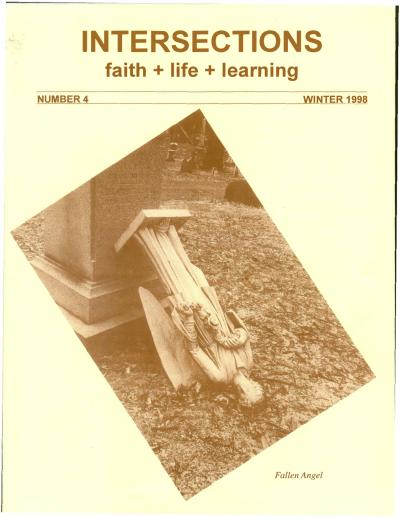
Bohmbach responds to Gregory Clark’s call to proclaim Jesus on Lutheran campuses with biblical-scholar reservations. Israel’s sacred texts also include the herem ban, the conquest narratives, and a God who fights for Israel; the Christian canon includes the apocalyptic violence of Revelation. To proclaim Jesus is therefore to proclaim a particular and contested figure within a tradition that has its own internal violence—not a generic God of peace and love. Bohmbach asks what it would mean for staff, administrators, and teachers on a college campus to take seriously the Jesus who made himself vulnerable to the violence of his world, even to the point of suffering for it, and whether Lutheran colleges are prepared for such a vocation.
-
 Article
Calling Economists
Lynn Hunnicutt
No. 37 · Spring 2013
Reading Luther’s Whether Soldiers, Too, Can Be Saved alongside Adam Smith’s Theory of Moral Sentiments and Wealth of Nations, Hunnicutt asks whether economists, too, can be saved—and whether economics can host a serious conversation about vocation. She traces her own move from Utah State to Pacific Lutheran University and its Wild Hope Center for Vocation, and turns to Deirdre McCloskey and George DeMartino as economists whose work makes room for vocation and the common good within the discipline.
-
 Article
Dual Citizenship in Athens and Jerusalem: Ricoeur's Hermeneutics and the Promise of Lutheran Higher Education
Mark C. Mattes
No. 19 · Summer 2004
Mattes proposes a Lutheran model of Christian higher education that develops conversation between faith and learning while preserving the integrity of each, in contrast to Reformed, Roman Catholic, and Mennonite/free-church alternatives. Drawing extensively on Paul Ricoeur’s hermeneutics of suspicion and retrieval, his account of myth and symbol, and his understanding of truth as manifestation rather than mere correspondence, Mattes argues that issues of faith can be genuinely public; that the four phenomenological contours of dialogue—risk, listening, mutuality, and open-endedness—mark authentic Lutheran pedagogy; and that Lutheran education is best served when it charts a path between accommodationist and sectarian responses to the liberal-rationalist tradition.
-
 Editorial
From the Editor
Jason A. Mahn
No. 48 · Fall 2018
Mahn recounts how a participant’s probing questions at the 2018 Vocation of a Lutheran College Conference turned “civil discourse” from an innocuous theme into a contested one — and previews essays that variously urge listening and common ground, or speaking truthfully even when those words sound angry.
-
 Article
"Faithful Nones" and the Importance of a Rooted and Open Pedagogy
John Eggen
No. 49 · Spring 2019
Drawing on a student survey from his D.Min. thesis at Midland University, Eggen identifies a distinctive subset of religious “nones” — the “faithful nones” — who reject institutional religion yet retain substantive beliefs and practices, and argues that the non-binary, third-path pedagogy commended by Rooted and Open is uniquely positioned to engage a generation that has disambiguated faith, religion, and spirituality.