From the Publisher: Navigating Affirmative Action, DEI Policies, and Lutheran Vocational Identity
Intersections No. 59 · Spring 2024
In the ever-evolving landscape of higher education, institutions across the United States find themselves at a crossroads, addressing critical issues that will shape their futures. In recent years, the Network of ELCA Colleges and Universities (NECU) has leaned into our foundational roots to strengthen our resolve in addressing multiple challenges. Among these, the debates surrounding affirmative action, Diversity, Equity, and Inclusion (DEI) policies, and the preservation of religious and vocational identities, such as that of the Lutheran tradition, stand out as particularly pressing.
Affirmative Action in Flux
The landscape of affirmative action in higher education is currently in a state of uncertainty. Recent legal challenges and Supreme Court rulings have prompted many institutions to reevaluate their admissions policies. The crux of the debate lies in balancing the desire for diverse student bodies with the legal constraints on considering race as a factor in admissions. As a result, universities are exploring alternative approaches to achieve diversity, such as increasing outreach to underserved communities and emphasizing holistic review processes that consider a wide range of applicant experiences and attributes. In this publication of Intersections, we draw from varied perspectives of engaging affirmative practices, sociological viewpoints, and theological responses.
DEI Policies Under Scrutiny
Diversity, Equity, and Inclusion (DEI) initiatives have become central to the mission of many higher education institutions. Each NECU institution has experienced positive results and significant success in myriad ways of achieving diversity on its campuses. These practices and policies aim to create a more inclusive and supportive environment for all students, particularly those from historically marginalized groups. However, several NECU schools are facing challenges from various quarters about DEI efforts, including political pressures and debates over academic freedom and free speech. Across the tumultuous landscape, Lutheran institutions are navigating these complexities by fostering open dialogues, adapting their approaches to be more inclusive of diverse perspectives, and ensuring that DEI efforts are integrated into the fabric of their academic and administrative structures.
Amidst these broader trends, Lutheran-affiliated institutions are grappling with how to maintain their distinctive vocational identity. The Lutheran tradition emphasizes a holistic approach to education, integrating faith, learning, and service. In a time when higher education is increasingly focused on career preparation and immediate job outcomes, Lutheran institutions are striving to preserve their commitment to forming individuals who are not only skilled professionals but also thoughtful citizens and ethical leaders. This involves fostering a campus culture that encourages spiritual growth, critical thinking, and engagement with the world’s complex social and ethical issues.
As NECU institutions navigate these challenges, they are also embracing opportunities for innovation and transformation. Our strategic plan opens us to an alignment with strong liberal arts education in concert with competitive STEM programming that meets the needs of this present age and the future to come. Our efforts to augment technology play a pivotal role in reshaping teaching and learning, with the rise of online education and digital resources expanding access and enabling new pedagogical approaches.
Partnerships between several NECU colleges and employers are becoming more common, providing students with practical experience and a smoother transition to the workforce. For instance, Tim McCarthy (Wittenberg University ’02), has served as the first Professional-in-Residence for his alma mater. McCarthy, former owner of the Raising Cane’s Ohio franchise, volunteers a significant amount of his time to help guide students through the transition into career exploration as a young professional. Drawing from the core values taught in Lutheran education institutions, He hopes to encourage budding entrepreneurs and social entrepreneurs to continue their development of community and national projects that serve the common good as sources of America’s future success.
In conclusion, the state of higher education is marked by a dynamic interplay of challenges and opportunities. Affirmative action, DEI policies, and the preservation of Lutheran vocational identity are just a few of the issues that NECU institutions are addressing as they strive to fulfill their missions in a rapidly changing world. This coming summer at the Vocation of Lutheran Higher Education Conference (VLHEC), we will grow deeper in our collective understanding of each of these topics as we navigate a path forward that will require a commitment to embracing diversity, fostering inclusivity, and maintaining a clear sense of purpose and amplifying the Lutheran identity. I hope to see you at VLHEC in Minneapolis, July 8-10, 2024.
-
 Editorial
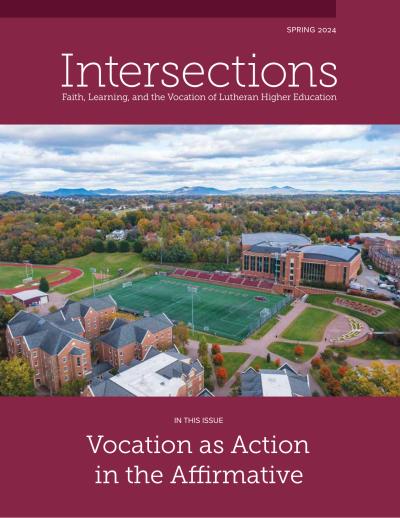
From the Editor: Vocation as Action in the Affirmative
Colleen Windham-Hughes
Windham-Hughes frames vocation as practicing “at the borders of our incompetence” — every small yes to the callings we experience, every effort made in the direction of life, is action in the affirmative — and previews the issue’s essays on diversity, transformation, AI, championship team culture, and dreaming big within and beyond our limitations.
-
Article
Forming the Division for Access, Equity & Belonging at Susquehanna University
Amy Davis, Dena Salerno, María L. O. Muñoz, Nina Mandel, Scott Kershner
Five Susquehanna University colleagues trace the institution’s 166-year arc from a Missionary Institute founded to remove barriers to education through the formation of a new Division for Access, Equity & Belonging in 2023, arguing that access rooted in Lutheran origins must continue to drive policy revision, infrastructure, and belonging for minoritized communities today.
-
Article
On Recruiting Diverse Students, Rooted in Mission
Eric Rowell, Jason A. Mahn
Jason Mahn interviews Eric Rowell, Assistant Director of Admissions and Diversity Outreach at Augustana College, about how recruiting students from a wide variety of backgrounds — rooted in Augustana’s Lutheran commitment to vocation and educating across difference — remains essentially unchanged in the wake of the Supreme Court’s 2023 decisions on affirmative action.
-
Article
What Our Lutheran Heritage Entails for Lutheran Colleges and Affirmative Action
Mark Ellingsen
Ellingsen argues that the Lutheran Two-Kingdom Ethic — far from leading to political reaction — supports the church-relatedness of ELCA colleges and obligates them to keep affirmative action alive, even reading a Chief Justice Roberts “loophole” in Students for Fair Admissions v. Harvard as an open door for Black community partnerships, ELCA congregations, and Lutheran colleges to act in the affirmative.
-
Reflection
On the Power of Transformation and Becoming Human
Ken Yanai Flores
Flores, a Cal Lutheran sophomore, reflects on personal and institutional transformation as the slow work of shedding the armor of trauma responses, engaging discomfort rather than turning away, and trusting that the work of becoming more human — more empathetic, knowledgeable, and free — will be reflected in our institutions as well.
-
Article
The Critical Role of Lutheran Higher Education in the Age of Artificial Intelligence
Jose Marichal, Maya Goehner, Tyler Haug
A Cal Lutheran political science professor and two of his students draw on Rooted and Open to argue that Lutheran higher education is uniquely positioned to stake out a middle path between AI utopianism and AI doom — cultivating a “healthy sense of human limit,” resisting data colonialism, and forming students to see the neighbor rather than the enemy as the world becomes increasingly synthetic.
-
Article
Team Culture is Key to Success: Learning from Student-Athletes
Colleen Windham-Hughes
On a December weekend in “Championship City” Salem, Virginia, both California Lutheran’s Women’s Soccer Team and St. Olaf College’s Men’s Soccer Team won NCAA Division III national titles. Windham-Hughes talks with coaches, faculty mentors, and student-athletes about how off-the-field team culture — built on trust, relationships, and shared why — translates onto the pitch and into liberal arts and sciences education.
-
Article
Low-Hanging Fruit, Moonshots, and Coffee: Dreaming Big Within and Beyond Our Limitations
Jeremy Myers
Myers shares the process used by Augsburg’s Christensen Center for Vocation to help teams move from a shared experience to next steps — an Ignatian-rooted Awareness Examen followed by naming low-hanging fruit, moonshots, and the coffee conversations that build the coalition to make it all happen.
-
 Editorial
From the Publisher & Editor
Colleen Windham-Hughes, Lamont Anthony Wells
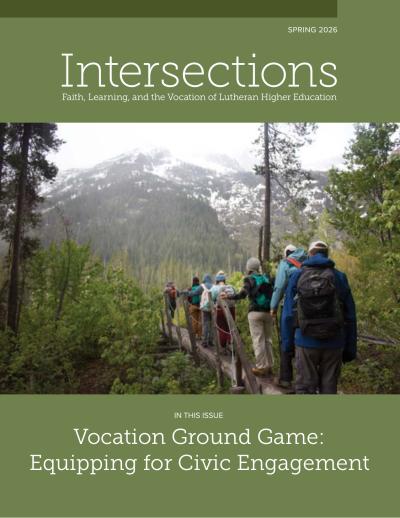
No. 63 · Spring 2026
6 min audio
Wells and Windham-Hughes frame vocation as “ground game” — the practical, public living-out of faith through civic engagement — and introduce the issue’s focus on how Lutheran higher education equips students to repair the world.
-
 Editorial
From the Publisher
Lamont Anthony Wells
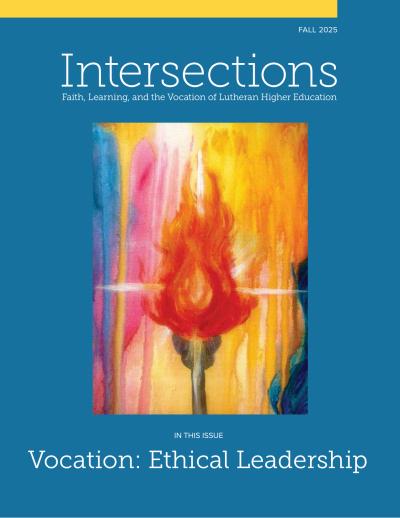
No. 62 · Fall 2025
5 min audio
Wells frames the issue as a record of the 2025 VLHE Conference at Augsburg under the theme “Ethical Leadership in a Changing World,” arguing that vocation is never solitary but a collective, public witness of ethical formation, theology and care, flourishing and belonging, and leadership rooted in God’s grace.
-
Article
Fostering Moral Imagination and Inclusivity: The Role of Ethical Leadership in ELCA Colleges and Universities Amid Societal Challenges
Lamont Anthony Wells
No. 62 · Fall 2025
12 min audio
Wells argues that “moral imagination” — the capacity to envision ethical alternatives, empathize across difference, and respond creatively to injustice — is the heart of ethical leadership in NECU institutions, and that anchoring leadership in this principle positions Lutheran higher education to cultivate socially responsible citizens.
-
 Editorial
From the Publisher
Lamont Anthony Wells
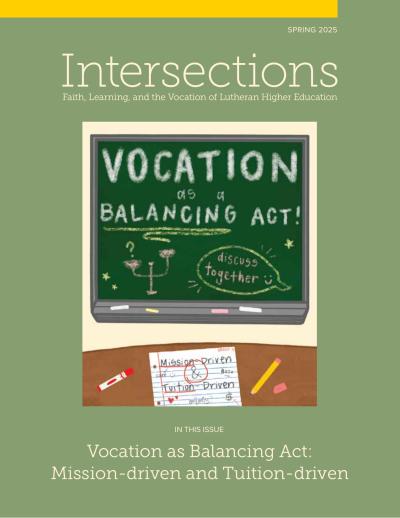
No. 61 · Spring 2025
5 min audio
Wells introduces So That All May Belong: Lutheran Roots for Diversity, Equity, Inclusion, and Justice as a theological and institutional articulation of NECU’s commitments, and previews four accompanying essays that frame vocation as a societal responsibility rooted in justice and not solely an individual pursuit.
-
 Editorial
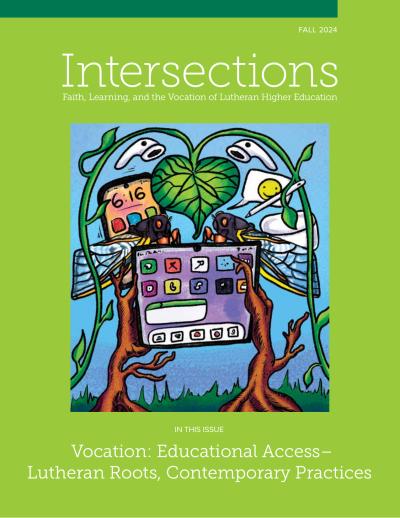
From the Publisher: Reflections on the 2024 Vocational Leaders in Higher Education Conference
Lamont Anthony Wells
No. 60 · Fall 2024
Wells reflects on the 2024 VLHE Conference theme — “Educational Access: Lutheran Roots, Contemporary Practices” — tracing today’s commitment to inclusivity back to Martin Luther’s radical 16th-century insistence that both boys and girls be educated, and previews NECU’s expanded engagement of student leaders alongside faculty and administrators.
-
 Editorial
Maintaining Our Lutheran Identity: A Source of Strength
Lamont Anthony Wells
No. 58 · Fall 2023
Wells reflects on the well-being of staff, faculty, and administration in Lutheran higher education across four pillars — rest, creativity and innovation, religious diversity and pluralism, and the preservation of Lutheran identity — and addresses the painful reality of Finlandia University’s closure as a reminder of the network’s shared mission.
-
 Editorial
From the Publisher
Mark Wilhelm
No. 32 · Spring 2010
Wilhelm invites readers to enjoy or revisit the presentations from the 2009 Vocation of a Lutheran College Conference, then reflects on the Higher Learning Commission’s denial of Dana College’s request to transfer accreditation to a for-profit purchaser—an event that effectively ended Dana’s sale and prompted ELCA colleges and universities to welcome Dana students and faculty—and argues that the irreversible entry of for-profit operators into liberal arts education gives the Lutheran community further reason to continue the conversation about the vocation of a Lutheran college.
-
 Reflection
A View From the Other Side
Daisybelle Thomas-Quinney
No. 8 · Winter 2000
Thomas-Quinney—an ordained Church of God minister and adjunct in Religion at Thiel College—offers “a view from the other side” as a non-Lutheran African American “outsider and novice”: her bittersweet 1995 arrival at Thiel, her swift discovery (alongside one African American secretary, one Hispanic professor, and thirty-eight African American students recruited largely as athletes) of a “chilly” campus unprepared to nurture the very minority students it had recruited, her examination of Thiel’s 1875 founding and the Augsburg Confession Article IV right-hand/left-hand kingdoms, the parables of mustard seed and yeast from Matthew 13, and Bishop James Crumbly’s 1985 LCA manual Inclusiveness and Diversity: Gifts of God. Drawing on Bruce Reichenbach, Samuel Hazo, and Josephine D. Davis’s Coloring the Halls of Ivy, she concludes that the Lutheran center cannot hold “as is” but has “great possibility” when the mission statement is actually followed.
-
 Article
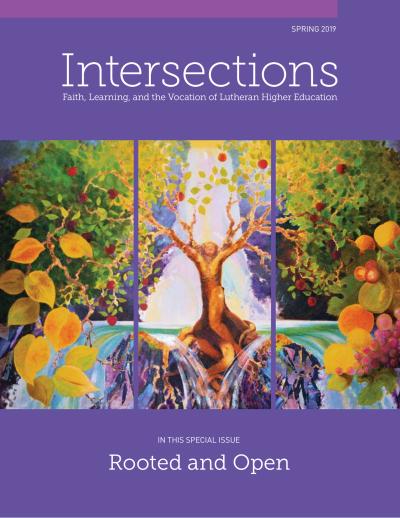
Rooted and Open as Resource for Expanding Opportunities on Your Own Campus
Katherine A. Tunheim, Marcia Bunge
No. 49 · Spring 2019
Bunge and Tunheim describe how Gustavus Adolphus College has paired Rooted and Open with its own companion volume Rooted in Heritage, Open to the World — in board workshops, new-faculty orientation, and classroom assignments — and survey several Network-wide opportunities (the Vocation of a Lutheran College Conference, the LECNA Fellows Program, the Association of Lutheran College Faculties, the Tuition Exchange Program, and international partnerships) that give the common calling tangible institutional form.
-
Institutional Focus
About Rooted and Open: The Common Calling of the Network of ELCA Colleges and Universities
No. 49 · Spring 2019
An institutional framing piece introducing Rooted and Open — NECU’s statement on Lutheran identity in higher education — with a roster of the faculty working group and writing team and an orientation to the essays in this special issue.
-
 Article
Higher Education in the Age of Trump
Daniel B. Braaten
No. 45 · Spring 2017
Braaten surveys what the Trump administration has and has not done on higher education — from the selection of Betsy DeVos and a rumored Falwell-led task force to the travel ban and expanded deportation priorities — and argues that Lutheran colleges, guided by the ELCA’s social message on immigration, have a special obligation to consider what they will do to protect their most vulnerable students.
-
 Editorial
From the Editor
Robert D. Haak
No. 33 · Spring 2011
Haak frames the issue by asking how Lutheran colleges and universities understand the changing landscape of religious identification on their campuses, and argues that Lutheran theological commitments — including the work of the Spirit and the Incarnation — call institutions to create places where the voice of “the other” is heard and valued.