At the end of Summer, just as the academic year was unleashing its usual cannonade of events, excitement and stress, I was gifted an opportunity to unplug. While campus was engulfed by move-in weekend, student orientation, the hustle to find twin-XL sheets and door-mounted full-length mirrors, I escaped to the north shore of Minnesota and the wild coast of Lake Superior. I slept by waves beneath a cliff. I reflected on glaciers, granite, greenstone, greywacke. I sorted rocks and hunted agate. And since I can’t really unplug: I thought about Staff Governance.
Staff Governance at St. Olaf does not exist. At least, not formally. But, as it does exist, it is a lot like the rocky beach up north: many individual pieces, composed of various layers and materials, set under extreme pressure and conditions over a long period of time. Some are worn smooth by the water, weather and currents. Others are younger breaks, still jagged and sharp at the edges.
Our work on Staff Governance began, as likely is the case on many campuses, as a reaction to trauma. For St. Olaf staff, we’d felt a steady decade of difficult events; In the past 10 years the community has directly experienced Title IX conflicts, anti-racism student protests, departmental reallocations, public departures of prominent staff and faculty. A global pandemic. The murder of George Floyd. And meanwhile, the balance between personal lives and work as staff were asked to stretch further than ever to support connection and belonging and the worthy outcomes of student success.
It has been a convergence of many efforts, made crystal-line through common struggles and a shared vision: that staff would have a voice and seat at the table, alongside Faculty and Students, with the deciding leadership of the college. Affinity groups began providing spaces where staff could unite and speak freely. The Council for Equity and Inclusion investigated methods to improve promotion, retention and arbitration of complaints. The Task Force to Confront Structural Racism at St. Olaf unearthed the gaps in staff representation within the college and researched models of governance at peer institutions.
In 2022, facilitated by HR, members of these groups, plus others from across all divisions of the college, met in earnest to draft potential bylaws and committee structures. This new group consisted of hourly and exempt staff. The draft was completed and given to St. Olaf’s new president, Dr. Susan Rundell Singer. After an early meeting with her we were encouraged to continue working as a community. This year we’ll be communicating with staff to gather feedback and interest. We’ll work with Faculty allies and learn from our peers who have also recently taken these paths. We wish to bring our work to the surface.
It no longer feels accurate to say that our development of a Staff Governance model is simply work in progress and instead is, with the power of a glacier, advancing steadily forward. I’ve been honored to work alongside so many dedicated people at this institution. What has been a sustained effort by the staff community, now over 3 years, is a demonstration of some of the best qualities you would hope to see in any workforce: thoughtful in their approaches, resilient through difficulties, and possessing an intentional compassion for the most marginalized voices and underrepresented members of their body. It feels we can move, albeit slowly, and reshape the landscape of our work.
-
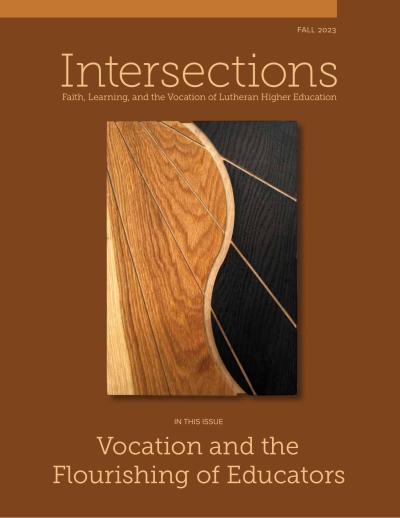 Editorial
From the Editor: So That We, Too, May Flourish
Colleen Windham-Hughes
Windham-Hughes introduces the 2023 VLHE conference theme of educator flourishing, drawing on Dr. Monica Smith’s plenary challenge — “How can we flourish if only some are centered and others are at the margins?” — and invites readers to ground themselves in Us/We, the cover art by Augustana graduate William Hatchet, and join the conversation.
-
Editorial
Maintaining Our Lutheran Identity: A Source of Strength
Lamont Anthony Wells
Wells reflects on the well-being of staff, faculty, and administration in Lutheran higher education across four pillars — rest, creativity and innovation, religious diversity and pluralism, and the preservation of Lutheran identity — and addresses the painful reality of Finlandia University’s closure as a reminder of the network’s shared mission.
-
Article
A Lutheran Call for Educator Flourishing
Krista E. Hughes
Hughes argues that without educator flourishing there is no student flourishing, traces how an exploitative “passion tax” can distort vocation, and offers seven Lutheran “third-way” value pairings — including Metrics/Grace, Efficiency/Kairos, and DEI/Priesthood of All Believers — to reframe institutional success at NECU campuses.
-
Article
Do One Thing: Academic Vocation in the Age of Burnout
Jonathan Malesic
Malesic draws on Oliver Burkeman’s 4,000 Weeks and Søren Kierkegaard’s Purity of Heart is to Will One Thing to argue that academic burnout is fundamentally institutional — a widening gap between mission ideals and working conditions — and urges colleges to resist “projectitis” by focusing on the one thing that matters most.
-
Article
Cultivating Staff Flourishing in Lutheran Higher Education: A Framework for Advocacy and Engagement
Laree Winer
Winer narrates her own “love affair” with Lutheran Higher Education to argue that the heart of the tradition — vocation, de-emphasized hierarchy, and shared humanity — equips NECU institutions to advocate for staff flourishing through data collection, professional development, and ongoing relational commitment.
-
Article
Vocare: A Spiritual Practice for the Spaces Between
Charlene Rachuy Cox
Cox introduces Vocare, a six-word spiritual practice developed through the Nourishing Vocation Project at St. Olaf, that uses the acronym V-O-C-A-R-E to help individuals and communities honor the spaces “between no longer and not yet” and discern their callings for the common good.
-
Reflection
The Importance of Connection
Alex Piedras
Piedras reflects on the 2023 “So that We, Too, May Flourish” Conference at Augsburg as a refreshing space for a weary DEI advocate — surfacing burnout, the Talking Circle on Indigenous Issues, and Dr. Monica Smith’s Racial Healing Circle as opportunities to recharge the soul and build authentic connections for the long journey.
-
Article
“A Decolonizing Conversation”: Indigenous Engagement at Luther College at the University of Regina
Marc Jerry, Sarah Dymund
Jerry and Dymund describe Luther College at the University of Regina’s response to Canada’s Truth and Reconciliation Commission — Land Acknowledgments, a Starblanket ceremony, the Project of Heart, an Elder in Residence, and the unedited video conversation with Elder Lorna Standingready that anchored their 2023 VLHE keynote.
-
Article
Beyond Deep Gladness: Coming to Terms with Vocations We Don’t Choose
Deanna Thompson
Thompson, living with incurable cancer, expands Frederick Buechner’s definition of vocation to make room for deep sadness — drawing on Arthur Frank, Shelly Rambo, Beverly Wallace, and Ross Gay to argue that practices of lament, including the public lament of Friday Flowers at St. Olaf, open space for gladness, joy, and even flourishing to emerge.
-
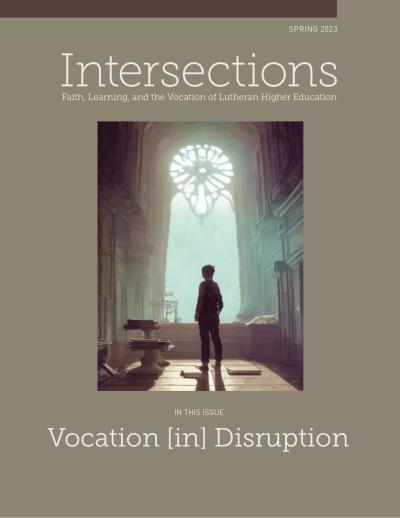 Editorial
From the Editor: Vocation [in] Disruption
Colleen Windham-Hughes
No. 57 · Spring 2023
Windham-Hughes introduces the issue’s theme — vocation amidst disruption — previews new features including contributor contact information, a study guide for So That All May Flourish, and invited pieces on reproductive rights, and shares results from the Fall survey of readers.
-
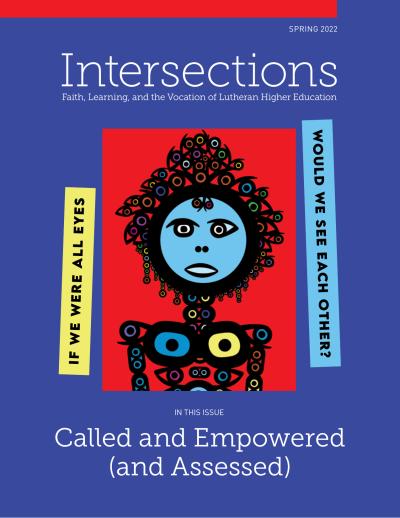 Editorial
From the Publisher
Mark Wilhelm
No. 55 · Spring 2022
Wilhelm announces his planned retirement on January 31, 2023, after serving as the founding executive director of the Network of ELCA Colleges and Universities, and gives thanks for the privilege of helping NECU articulate a shared vision for Lutheran higher education in twenty-first-century North America.
-
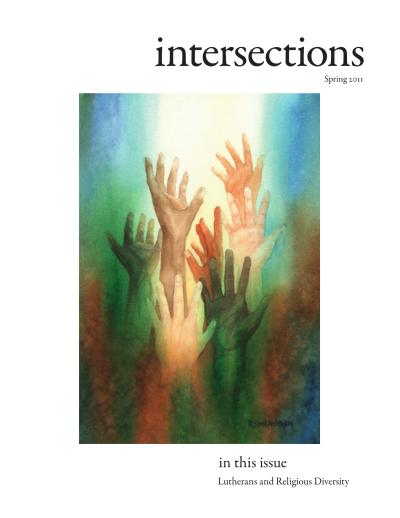 Article
The New (con)Texts of Jewish-Christian Engagement
Karla R. Suomala
No. 33 · Spring 2011
Suomala surveys four contemporary contexts of Jewish-Christian engagement on American college campuses — campus populations, Jewish studies curricula, the changing nature of Jewish identity among Millennials, and the shift from formal Jewish-Christian dialogue toward broader religious pluralism — and argues that at Lutheran colleges this success story can serve as a model for engaging the other religious neighbors who increasingly form part of our society.
-
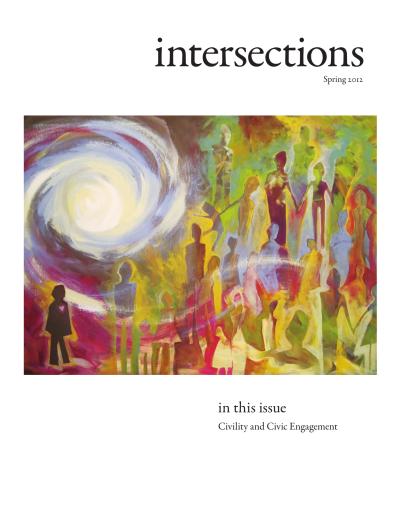 Article
Cultivating Transformative Responsible Dialogue: Community of Moral Deliberation and Lutheran Higher Education
Per Anderson
No. 35 · Spring 2012
Anderson proposes that ELCA colleges and universities embrace a project of “transformative responsible dialogue” that advances the ELCA’s commitment to be a “community of moral deliberation” and answers the LIFT Report’s call for a culture of faithful discernment. Drawing on Michael Meyer’s “liberal civility,” Martha Nussbaum, Hans Jonas’s responsibility ethic, Patrick Keifert’s ecclesiology of strangers, and Kathryn Tanner on culture, he argues that liberal education at our schools can form students whose dialogue knits together civility, responsibility, and Christian openness to the other.
-
 Book Review
Richard T. Hughes: How Christian Faith Can Sustain the Life of the Mind
Tom Christenson
No. 13 · Winter 2002
Christenson reviews Richard Hughes’s How Christian Faith Can Sustain the Life of the Mind (Eerdmans, 2001), which argues, drawing on Tillich’s notion of “religion breaking through its own particularity,” that faith is a means to the open pursuit of truth rather than its enemy. Christenson reads the argument as a natural fit for a Lutheran tradition of semper reformanda but notes Luther’s own dogmatism toward fellow reformers, and wishes Hughes had drawn a sharper line between an absolute truth that relativizes all human truths and a postmodern abandonment of truth altogether. The book was the most-cited title at the November meeting of North American Lutheran academic officers.
-
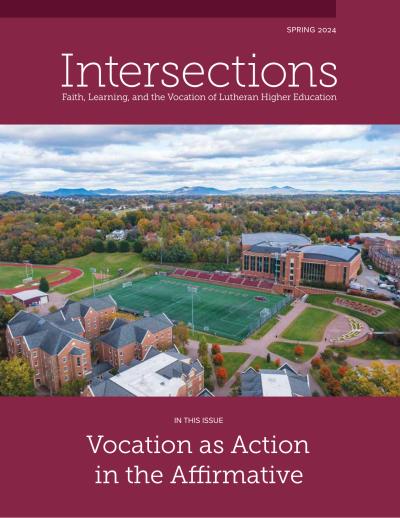 Article
The Critical Role of Lutheran Higher Education in the Age of Artificial Intelligence
Jose Marichal, Maya Goehner, Tyler Haug
No. 59 · Spring 2024
A Cal Lutheran political science professor and two of his students draw on Rooted and Open to argue that Lutheran higher education is uniquely positioned to stake out a middle path between AI utopianism and AI doom — cultivating a “healthy sense of human limit,” resisting data colonialism, and forming students to see the neighbor rather than the enemy as the world becomes increasingly synthetic.