Cultivating Staff Flourishing in Lutheran Higher Education: A Framework for Advocacy and Engagement
Intersections No. 58 · Fall 2023
In the realm of higher education, the concepts of thriving and flourishing are gaining increasing recognition as essential facets of institutional vocation and community well-being. In the following essay, we delve into the notion of staff flourishing within the context of Lutheran Higher Education (LHE), exploring its significance, challenges, and persistent questions. Drawing from our experiences and insights, we aim to suggest multiple frameworks situated within different university contexts for advocating and actively fostering staff flourishing within LHE institutions. We approach this opportunity with gratitude as we bring attention to this vital conversation. We believe it to be not just a relevant and timely topic but one that is essential with respect to the vocation of our institutions.
Specifically we want to suggest that one vocation of LHE is to support the development, vocational discernment, and well being of the university community. Certainly for our students but also faculty and staff. In fact, every institution represented here, not only has this vocation or calling but a vast array of tools furnished by the Lutheran tradition with which to answer that call. LHE stands apart from other educational models due to the depth of its tradition and the values it espouses. At its core, LHE embodies a commitment to vocation, emphasizing meaning and purpose in one’s work rather than mere performance or passion. Moreover, LHE celebrates diversity and unique contributions within the shared context of humanity and the pursuit of the common good. These foundational principles are what captivate educators, administrators, and staff members like ourselves and draw us into a profound relationship with LHE. This deep commitment is akin to a long-lasting love affair, one that we believe should endure the test of time.
Two years ago, in June of 2021, I had the opportunity to attend and present at a virtual conference for ELCA schools. Because I did not grow up Lutheran, folks were interested in how and why I became such a champion for vocation and Lutheran Higher Education. I was asked to share a bit of my story with a group of clergy, scholars, and colleagues in response to the prompt: how I caught LHE. We were still in the midst of the pandemic, and I didn’t want to think about LHE as a disease to be caught so I opted for something rather unconventional. I reframed the prompt to read: how I fell in love with LHE. I shared my response using the metaphor of a romance. I talked about how it wasn’t love at first sight but that it started as a schoolgirl crush. One full of curiosity that gave way to a slow smoldering kind of attraction that led eventually to a full blown passionate love affair. I talked about how being a staff member and a student helped foster this growing interest in LHE. How my faculty were like matchmakers setting me up on a series of dates that nurtured my curiosity and this budding romance. For the sake of time and space, I am sparing you many of the details. I not only fell in love but I made a deep commitment to LHE. The “to death do us part” kind of commitment.
You might be asking me what was it that attracted me? Was it LHEs smile, intellect, good hair, learning outcomes or assessment data? Well, it was actually LHE’s heart. I fell in love with the heart of the tradition. Once again, it is the heart that I think contains the keys and the tools to advocate for staff flourishing. In addition to the commitments to meaning, purpose, diversity and the common good, this tradition also rejects hierarchical structures, recognizing the intrinsic value of every individual’s contribution to the mission of LHE. Although I am deeply committed to LHE, I recognize the very real challenges in cultivating and maintaining a flourishing relationship.
However, just as any enduring relationship can face challenges, the relationship between staff and LHE is not without its complexities. In some instances, staff members may feel undervalued, neglected, or left behind in favor of newer, seemingly more “relevant” models. External factors, such as financial difficulties or unforeseen events, can further strain this relationship. It is in these moments of doubt and frustration that our commitment to LHE and its tradition is put to the test. However, if you really commit to something you don’t give up. You continue to engage, study, reflect, and reform. You remind your love of their commitment. You remind them of who they are and who they are to you. You remind LHE, and those that represent its mission and values, that they come from something. Specifically a tradition:
- A tradition that has a deep history of reforming, accessibility, and innovation. Students are not the only ones who are changing. We must meet our staff members where they are too.
- A tradition that emphasizes vocation—the “third way” is not a way of performance or passion but rather of meaning and purpose. Meaningful work that serves the neighbor is a vocation or in the university context—meaningful work that serves the students and the mission of LHE is a vocation.
- A tradition that de-emphasized hierarchy—everyone has a vocation and everyone’s vocation is essential to the purpose of our institutions.
- A tradition that recognizes our differences and unique contributions through the lens of our shared humanity and our shared purpose to influence the common good.
It’s because of this tradition that I am optimistic that my love will stand the test of time. That we will make it LHE and I. Together forever. And yet, we must continue to work on our relationship.
In this work, advocacy plays a pivotal role. Advocacy implies actively supporting the development, vocational discernment, and overall well-being of not only students but also staff. This kind of advocacy seeks to bridge the gap between the institution’s mission and the daily experiences of its staff members. To that end, I still have a few lingering questions regarding our future together:
- What does it take for staff to flourish? Do we know? If not, how will we know? Who will ask? Who will listen? Who will act? Our institutions get data on everything else. Collecting data on staff flourishing is imperative. In an era where institutions meticulously track various metrics, it is crucial to understand the well-being and satisfaction of staff members. This data can inform targeted initiatives and policies to address areas of concern and enhance overall staff experience.
- Why are staff often viewed differently than other members of the university community? We all agree that we are here to serve the students and the educational mission. Our leadership has stated—“We are all educators”. So why are we viewed differently? Why have the hierarchies been reinstated?
- How can those of us with resources and Centers focused on the work of vocation reflection and discernment, advocate for and contribute to staff flourishing? To truly cultivate flourishing, institutions must also invest in professional development opportunities for staff members. Traditionally, these opportunities have been more accessible to certain roles and departments, leaving others overlooked.
In the next chapter of this love story my hope is that staff flourishing in Lutheran Higher Education is not merely a theoretical concept; it is a calling deeply rooted in the tradition and values of LHE. By embracing advocacy, investing in professional development, and collecting data, LHE institutions can ensure that staff members not only serve the mission but also flourish within the vibrant community of the institutions. We invite our colleagues in the Network of ELCA Colleges and Universities (NECU) to join us in this endeavor to nurture and support staff flourishing as an essential component of our institutional and community well-being.
-
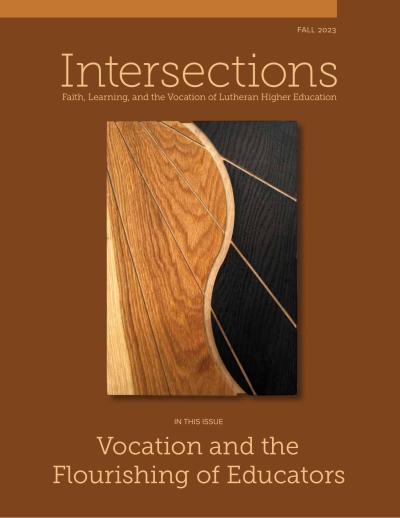 Editorial
From the Editor: So That We, Too, May Flourish
Colleen Windham-Hughes
Windham-Hughes introduces the 2023 VLHE conference theme of educator flourishing, drawing on Dr. Monica Smith’s plenary challenge — “How can we flourish if only some are centered and others are at the margins?” — and invites readers to ground themselves in Us/We, the cover art by Augustana graduate William Hatchet, and join the conversation.
-
Editorial
Maintaining Our Lutheran Identity: A Source of Strength
Lamont Anthony Wells
Wells reflects on the well-being of staff, faculty, and administration in Lutheran higher education across four pillars — rest, creativity and innovation, religious diversity and pluralism, and the preservation of Lutheran identity — and addresses the painful reality of Finlandia University’s closure as a reminder of the network’s shared mission.
-
Article
A Lutheran Call for Educator Flourishing
Krista E. Hughes
Hughes argues that without educator flourishing there is no student flourishing, traces how an exploitative “passion tax” can distort vocation, and offers seven Lutheran “third-way” value pairings — including Metrics/Grace, Efficiency/Kairos, and DEI/Priesthood of All Believers — to reframe institutional success at NECU campuses.
-
Article
Do One Thing: Academic Vocation in the Age of Burnout
Jonathan Malesic
Malesic draws on Oliver Burkeman’s 4,000 Weeks and Søren Kierkegaard’s Purity of Heart is to Will One Thing to argue that academic burnout is fundamentally institutional — a widening gap between mission ideals and working conditions — and urges colleges to resist “projectitis” by focusing on the one thing that matters most.
-
Article
Staff Governance at St. Olaf College, Northfield, MN
Don Ezra Cruz Plemons
Cruz Plemons describes how staff at St. Olaf, in the wake of a decade of difficult events, have built a three-year, glacier-paced effort toward a Staff Governance model — through affinity groups, the Council for Equity and Inclusion, and the Task Force to Confront Structural Racism — that gives staff a voice alongside faculty and students.
-
Article
Vocare: A Spiritual Practice for the Spaces Between
Charlene Rachuy Cox
Cox introduces Vocare, a six-word spiritual practice developed through the Nourishing Vocation Project at St. Olaf, that uses the acronym V-O-C-A-R-E to help individuals and communities honor the spaces “between no longer and not yet” and discern their callings for the common good.
-
Reflection
The Importance of Connection
Alex Piedras
Piedras reflects on the 2023 “So that We, Too, May Flourish” Conference at Augsburg as a refreshing space for a weary DEI advocate — surfacing burnout, the Talking Circle on Indigenous Issues, and Dr. Monica Smith’s Racial Healing Circle as opportunities to recharge the soul and build authentic connections for the long journey.
-
Article
“A Decolonizing Conversation”: Indigenous Engagement at Luther College at the University of Regina
Marc Jerry, Sarah Dymund
Jerry and Dymund describe Luther College at the University of Regina’s response to Canada’s Truth and Reconciliation Commission — Land Acknowledgments, a Starblanket ceremony, the Project of Heart, an Elder in Residence, and the unedited video conversation with Elder Lorna Standingready that anchored their 2023 VLHE keynote.
-
Article
Beyond Deep Gladness: Coming to Terms with Vocations We Don’t Choose
Deanna Thompson
Thompson, living with incurable cancer, expands Frederick Buechner’s definition of vocation to make room for deep sadness — drawing on Arthur Frank, Shelly Rambo, Beverly Wallace, and Ross Gay to argue that practices of lament, including the public lament of Friday Flowers at St. Olaf, open space for gladness, joy, and even flourishing to emerge.
-
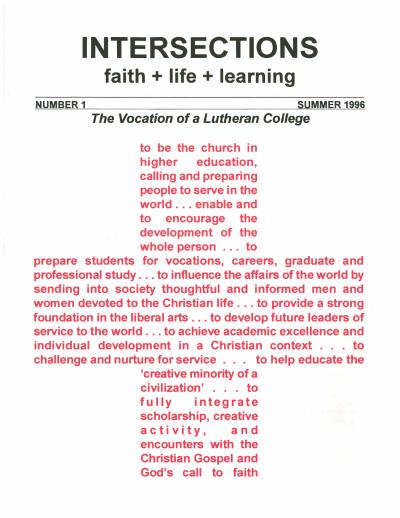 Editorial
From the Publisher
James M. Unglaube
No. 1 · Summer 1996
Unglaube welcomes readers to the inaugural issue of Intersections, crediting Editor Tom Christenson and Capital University, and announces the new annual Vocation of a Lutheran College Conference whose continuing dialogue the journal exists to enhance. He gives thanks to the Lilly Endowment for a sizable grant supporting the 1996 conference, campus dialogues, and the birth of the publication.
-
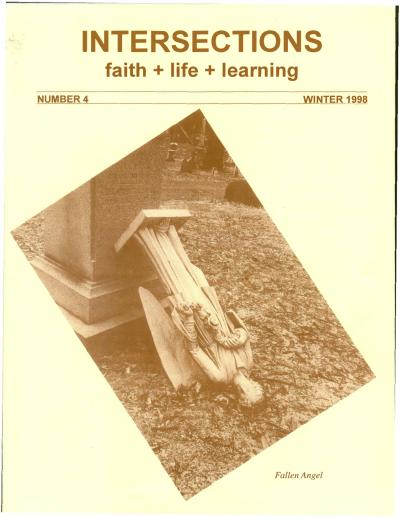 Article
A Response to Paul Santmire
Don Braxton
No. 4 · Winter 1998
Braxton appreciates the dialectical structure of Santmire’s mandates—“skeletons in our closets and riches in our own vaults”—and reads it as a faithful expression of the Lutheran tradition of Paul, Augustine, and Luther. He argues that Santmire is on target in warning against premature flight to non-Christian traditions for environmental wisdom (theoretical sensitivity does not translate into ecological behavior in practice), and that classical Lutheran social ethics has too often been quietistic. But Lutheran ethics at its best is dialectical, not dualistic—recognizing the interpenetration of church and world, Law and Gospel, eschatological Kingdom and present realities, as in Hegel, Ritschl, Bonhoeffer, Reinhold Niebuhr, and Larry Rasmussen. Braxton commends environmental responsibility, social criticism of unsustainable practices, and a liturgical practice of resistance to instrumentalism as appropriate next steps for Lutheran liberal arts colleges, especially Capital University.
-
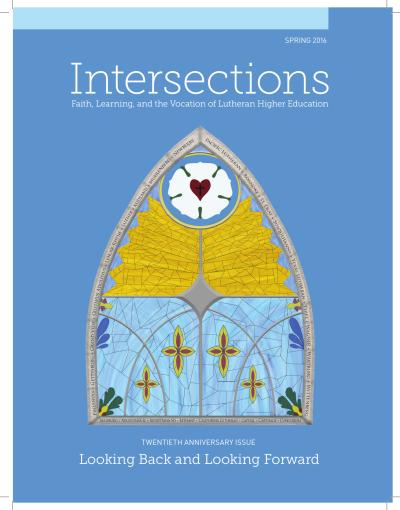 Editorial
From the Publisher
Mark Wilhelm
No. 43 · Spring 2016
Wilhelm announces the new Network of ELCA Colleges and Universities — established in 2015 and convened for its first Board of Directors meeting in February 2016 — as a missional collaboration between the churchwide organization and the twenty-six ELCA colleges and universities, replacing former churchwide units lost to budget reductions and offering a stronger, more viable vision of Lutheran higher education.
-
 Editorial
From the Editor
Jason A. Mahn
No. 35 · Spring 2012
Mahn introduces five essays from the 2011 Vocation of a Lutheran College Conference at Augsburg, framing how Torvend, Anderson, Svennungsen, Tunheim, and Pribbenow press Lutheran colleges to turn outward—recovering the public character of Luther’s gospel, forming students for moral deliberation, investing in the infrastructure of civic renewal, and pursuing justice and education “off the main road.”
-
 Reflection
Walls: Talk At Gustavus Adolphus College
Elizabeth Baer
No. 5 · Summer 1998
Baer’s September 11, 1997 Gustavus Adolphus chapel homily on Joshua 6 turns from the trumpets to the walls—Robert Frost’s “Mending Walls,” the walls of the Warsaw ghetto in Vladka Meed’s On Both Sides of the Wall and Margaret Zassenhaus’s Walls, the Berlin Wall coming down in 1989—and then to the autobiographical, intertextual discourse of Gustavus chapel itself as a place where misunderstandings come down. An author’s note added after the March 29 F3 tornado reports the closing line (“LET’S MAKE THOSE WALLS COME TUMBLING DOWN”) as eerily prescient: roofs, windows, and 90% of campus trees were lost, but the Chapel walls and the eternal flame in the red glass lantern stood firm.
-
 Article
Conciliatory and Queer: The Radical Love of Lutheran Higher Education
Kiki Kosnick, Sharon Varallo
No. 50 · Fall 2019
Kosnick and Varallo reflect in conversation on how Augustana’s Five Faith Commitments and its conciliatory ecumenical roots in the Augsburg Confession have given them — a non-binary queer first-generation faculty member and a twenty-one-year veteran — the “street cred” to act on radical love, build bridges to imprisoned and non-binary communities, and discover that Augustana is welcoming not despite the fact that it is Lutheran, but because of it.