Sexuality over the Lifespan—Social Trends Pose Moral Dilemmas for Communities of Faith
Intersections No. 22 · Spring 2006
AS A SOCIOLOGY PROFESSOR who teaches a course in sexuality at an ELCA institution, I was honored by the invitation to present to the ELCA Task Force for Studies on Sexuality. I enjoyed the interactions as both an educator and a student. I am neither a Lutheran nor a theologian, and I found it fascinating to learn about the process and outcomes of Journey Together Faithfully, Part Two, and about the ongoing process behind the production of Journey Together Faithfully, Part Three. I understood that, while homosexuality had been the primary focus of the previous document, this new document aimed to address the ELCA’s position on other dimensions of sexuality.
My primary role at this meeting was that of a sexuality studies educator. As a researcher, scholar, and professor, I am also informed by past professional experiences as a sexual health educator. I view sexuality as an innate part of being human. In addition to serving the obvious function of reproduction, sexuality can be a source not only of pleasure and intimacy but also of guilt, shame, and fear. From a health education perspective, I see sexuality as a basic component of human health and well-being. From a sociological perspective, I examine how our culture shapes sexual norms (behavioral expectations) and values. I also focus on how our sexual practices transform the societies in which we live.
As we progress through our lives, each of us makes sexual decisions based on knowledge, experiences, and values. Physical changes, developmental concerns, and social factors shape our experiences of sexuality as we age. In this article, I draw on empirical research from the social, behavioral, and life sciences to highlight key findings about the learned components of sexuality from puberty through late adulthood. In particular, I will focus on three aspects of sexuality that the ELCA Task Force found to be particularly relevant and controversial for their parishioners: premarital sexuality, sexuality after divorce, and nonmarital sexuality in late adulthood. I will present some of the key research findings that pertain to these topics and conclude each section with questions that reflect concerns raised in the Task Force discussions.
Premarital Sexuality: Adolescence through Early Adulthood
From birth, we are sexual beings: we learn from our bodies what feels good or bad, and we learn from our parents, pastors, and others what is right and wrong. By the time we reach puberty, about 40% of girls and 38% of boys have masturbated (Bancroft). In addition to the sensual components of sexuality, we have also learned the gender components: the feminine and masculine norms of sexuality that tell us what is right or wrong for girls and for boys.
Sexuality in Adolescence
Biologists define puberty as the developmental stage in which the human body becomes capable of reproduction. Social and behavioral scientists define adolescence as the psychological and social state that takes place from the start of puberty and lasts until full adult status is attained. Sexually, this is a time of growth and confusion, with the body often maturing faster than the corresponding emotional and intellectual capabilities. Hormonal changes bring about a dramatic increase in sexual interest, with increasing incidences of masturbation.
The “sexual revolution” of the 1960s marked a major shift in adolescent sexual norms, and the age of first intercourse began to decrease. By 2002, researchers found that the average age for men’s first intercourse was 16.9 years old, and the average age for women’s was 17.4 years old. One disturbing aspect of this trend was the report of coercive sex: about 22% of teenage girls described their first intercourse as unwanted. Another finding was the demise of a long-standing trend of female teen peer pressure to abstain from premarital intercourse. Today’s teen girls are more likely than in a previous generation to encourage each other to become sexually active during their high-school years (Alan Guttmacher Institute 2002).
Today’s United States teens come of age in an era of conflicting messages about sexuality: the overwhelming majority will receive abstinence-only sex education, while living in a social context where mainstream media normalizes increasingly graphic and permissive portrayals of teen sexual intercourse. While our federal government continues to increase funding for abstinence-only sex education, numerous well-respected studies have concluded that abstinence-only education does not significantly lower the age of first intercourse, reduce STDs, or reduce unintended pregnancies among teens (Contraception Report). In contrast, comprehensive or “abstinence-plus” sexuality education has been found to be highly effective (Kirby, Office of the Surgeon General), yet few United States school districts offer these curricula.
Sexuality in Early Adulthood
Young adults grapple with many developmental concerns related to sexuality: such as how to integrate love and sex, how to commit to intimate relationships, how to make childbearing decisions, and how to protect their sexual health. The post-high school years are a prime time to develop a sexual philosophy because many young adults move out of their family home to pursue educational and career goals. With this newfound freedom and independence, many young adults find themselves re-evaluating the religious standards of sexual morality with which they were raised. Studies have found that most college students expect to engage in sexual intercourse during their undergraduate years and that this sex will take place within loving relationships (Sprecher and McKinney; Sprecher 2002).
Researchers have noted several social shifts that have transformed the sexual landscape for single, young adults. In general, the past few decades have seen a sharp increase in the average age of first marriage. One reason is that more young adults are the children of divorce and do not want to rush into marriage. In addition, longer periods of education and training are required for many career options. For reasons of either self-fulfillment or economic necessity, more women want to establish their careers before marriage: it is increasingly impractical for one spouse to be the breadwinner.
Historically, young adults in the United States found it more reasonable to abstain from sexual intercourse until marriage when first marriages occurred at younger ages: the typical period of abstinence may have been only three to five years (from the end of puberty to the beginning of marital sex). This trend of later marriages has supported the normalization of premarital sex and cohabitation. Cohabitation has become a common part of young adult life, as many opt to defer marriage. Half will have cohabited by age thirty (Strong). “Living in sin,” has become “living together.” The moral and social sanction is nonexistent in the minds of many Americans. However, monogamy is still valued. A 2004 ABC News poll found that 80% of young singles are exclusively dating one person.
The most significant difference between cohabiting same-sex couples and heterosexual couples is that the heterosexuals can legally marry. Another key difference concerns social support for a same-sex couple’s commitment to each other. While most parents of heterosexual young adults give their children a “pro-marriage” message, research finds that parents are much less likely to urge their gay or lesbian child to commit to a stable same-sex relationship (Peplau). This study found that most young adults, no matter their sexual orientation, desire an intimate, loving relationship with another person.
Today’s young singles have greater sexual experience during their adolescence, feel less shame and stigma about premarital sex, and have more options to prevent unintended pregnancies. However, partly due to insufficient sex education, the United States has witnessed a rise in unintended pregnancies and sexually transmitted diseases among the young adult population. In the broader sense of sex education, sexual health educators and researchers have also noticed a disturbing trend in how young adults today approach the trajectory of sexual intimacy. Popular metaphors, such as those about baseball and advancing through the bases on the way to a “homerun” of intercourse, no longer apply to today’s teens and young adults. In a world of abstinence-only education, sexual “abstinence” has become a strangely defined term. Studies reveal that oral sex has become normalized as the behavior one advances to after kissing, and that anal intercourse is a preferable precursor to vaginal intercourse (Alan Guttmacher Institute 2000). While both of these behaviors carry considerable risk for disease transmission, many believe that their virginity is still “intact” as long as penile-vaginal intercourse has not occurred. Sexual health educators are concerned that teens and young adults are not being educated about the full range of sexual behaviors that are less risky than penetrative forms of intercourse: for example, mutual masturbation, sensual massage, and manual stimulation.
Questions to Consider:
- What role should the church play in providing sexuality education, and what type(s) of education should it provide?
- What role should the church play in advising which types of sexual activities are morally and spiritually right for young adults in dating relationships?
- With the normalization of premarital sex and cohabitation, what moral and spiritual guidance can the church offer to adults who may not marry until they are in their thirties or who may never marry?
- Should the church recognize and bless those young adults who are cohabiting and in committed monogamous relationships?
Nonmarital Sexuality: Sexuality Issues of Divorce and Single Parenthood
Our social, religious, and legal institutions continue to view marriage as the relationship in which sexuality is legitimate. However, many United States adults struggle as their sexuality is shaped by realities of divorce and/or single parenting. Demographics reveal a rise in the number of single-parent families and a growth in post-divorce singles. These adults are increasingly deciding to reenter the dating scene, only to discover that there are distinct sexual challenges.
In middle adulthood, individuals often find themselves grappling with developmental concerns such as the biological aging process. The consequences of divorce present additional challenges: stigmatization, decrease in income, and emotional distress. When children are involved, additional stressors factor into decisions to date again.
Engaging in sexual behavior with someone following a separation or divorce is significant. Sexual intimacy with a new partner symbolizes that previous vows are no longer valid. Often, the renewal of a sex life helps adults to accept their single status. However, many religious teachings do not approve of sex outside of marriage, and many divorcees feel anxious about their sexuality. Personally, they may be fearful of becoming physically and emotionally vulnerable with a new partner. Those who have had a long marriage may feel out of touch with the current norms of dating and sex. On the plus side, post-divorce sexual experiences have been linked to increased well-being (Spanier).
Single Parenting
As the results of both divorce and unmarried births, about 30% of families are headed by single parents (Fields). Familial responsibilities often mean that single parents are not part of the “singles world.” They lack the leisure time and money to invest in dating. Research shows that divorced adults’ sexual decisions are directly affected by the presence of children. For example, divorced women who are childless are more likely to be sexually active than those who are parents (Stack). Single parents are often concerned about the morality that they are modeling for their children.
Conscious of being role models, single parents find it more complicated when negotiating the world of dating. Social stereotypes about single men and women often include the trait of promiscuity. Many single parents do not want their children to view them as sexual beings. This results in difficult decisions about how much of their lives they can share with their dates. In particular, they face tough decisions about whether their dates will be allowed to meet their children and whether overnight dates are appropriate.
Questions to Consider:
- What role should the church play in advising which types of sexual activities are morally and spiritually right for divorced adults in dating relationships?
- Divorced adults may have financial and familial reasons for not wanting to remarry. Should the church recognize and bless committed, monogamous relationships between divorced adults?
- How should single parents determine what is right or wrong in terms of their sexual choices and the impact those choices have on their children?
Sexuality in Late Adulthood: Marital and Nonmarital Concerns
As individuals enter late adulthood, they find themselves needing to adjust to the process of aging. People may not be sexually active throughout their entire lives, but they remain sexual beings. Sexual feelings and behaviors can be healthy throughout the lifespan. Good sexual relationships can provide intimacy and human connections that help ease the pain of aging, loss of health, and loss of loved ones.
Sexual Stereotypes of Aging
In our society, we associate sexuality with youth and the ability to procreate. The sexuality of older adults tends to be invisible. Society either discounts or denies their sexuality. These beliefs contribute to a view of old age as a depressing time of life when one is unlikely to be a part of a fulfilling, intimate relationship. Negative stereotypes can also produce negative body image in older adults who may have absorbed social messages that their aging bodies are no longer “sexy.”
In reality, research shows that many older adults experience high levels of satisfaction and well-being. The varied aspects of sexuality – emotional, sensual, and relational – are enjoyed regardless of age. For example, a 1998 survey conducted by the National Council on the Aging found that 66% of adults age sixty or older reported that their sex life was equal to or better than it had been when they were in their forties.
Health and Partner Availability
The most significant determinants of an older individual’s sexual activity are illnesses and partner availability. Health can affect sexual behaviors in many different ways. One common example is that medications may produce “sexual side effects” that render the person less capable or incapable of experiencing sexual pleasure. In addition, increasing frailty and chronic illnesses, such as osteoporosis and heart disease, may limit mobility, strength, stamina, and/or make a person fearful of sexual exertion. Some of the normal physiological changes of aging also impact sexuality by manifesting as slower sexual response, impotency, and vaginal changes (for example, loss of elasticity and lubrication). On the flip side, physicians report that a healthy sex life can promote overall health and well-being for older adults (Cross).
Availability of partners plays a major role in how older adults experience sexuality. It is well documented that the majority of women outlive the majority of men in the United States. In contrast to older women, older men have significantly more opportunities to pursue opposite-sex relationships (Carr). Approximately four out of five women who are seventy-five or older do not have a male sexual partner. In contrast, over 60% of the men in this age group do have a partner (AARP). The consequences of this gender gap have both personal and public health ramifications. With the advent of prescription drugs (for example, Viagra) that aid male erections, older men are more sexually active than in past generations. Drug-enhanced stamina paired with the gender gap makes it likely for partner-sharing to occur, such that each older man may have two or three female sexual partners who are within his peer group. Public health problems are magnified when older men seek out the services of prostitutes and bring sexually transmitted diseases, including HIV, back to their senior girlfriends. In December 2004, a CNN televised special to commemorate World AIDS Day included a segment on the recent outbreaks of HIV/AIDS in Florida retirement communities (“Staying Alive”). Drugs like Viagra, coupled with generational norms against condom use, the absence of fertility issues, and traditional gender norms (for example, men being sexually assertive and females being sexually passive) have produced a current cohort of United States senior citizens who are at high risk for sexually transmitted infections.
Questions to Consider:
- Why are many so offended by the idea of older people wanting to be sexual?
- How might disparaging attitudes about aging and sexuality negatively impact the “golden years” of a marriage?
- What role can or should the church play in dispelling myths, building confidence, and giving older adults permission to be sexual?
- Given that many single older adults have pensions and other financial circumstances that make remarriage not a viable option, should the church recognize and bless their committed, monogamous relationships?
Conclusions
Over time throughout cultures, sexuality has been shaped by gender roles (social expectations for men and women), marital norms, and beliefs about homosexuality. Different religious texts give some guidance as to what is morally and spiritually right. The majority of Judeo-Christian writings on sexuality emphasize the sacredness of sex within the bonds of marriage and the sinfulness of infidelity. However, marriage is an ever-evolving institution, and it is vital that communities of faith consider the contemporary institution of marriage in the United States and its corresponding impact on sexuality norms and values. In discussing key sexuality issues throughout three major stages in the life-span, I have tried to illuminate some current social phenomena and hypothesize the challenges for communities of faith.
One of the difficulties in talking about sexuality – in any context – is that there is little agreement as to what constitutes “healthy sexuality.” In 2002, the World Health Organization defined sexual health as “the state of physical, emotional, mental, and social well-being related to sexuality.” This definition takes us beyond the mere absence of disease or dysfunction. This conceptualization requires a positive and respectful approach to sexuality and sexual relationships. The focus is not only about the freedom from coercion, but also about the freedom to experience safe and pleasurable sexual experiences. If we are willing to consider a broader definition of healthy sexuality within the social context of contemporary trends, then communities of faith face difficult decisions. Does the pursuit of healthy sexuality put one at odds with long-standing religious doctrines? Can the church convince parishioners that modern sexual norms and values are wrong? Or, is it worth considering how religious morality can be preserved in a society with ever-evolving beliefs, attitudes, and behaviors about sexuality? I commend the ELCA for having taken a leadership role in promoting open, honest, and often difficult discussions about sexuality and look forward to reading Journey Together Faithfully, Part Three.
Endnotes
1. I wish to thank the members of the ELCA Task Force for Studies on Sexuality for their helpful comments and suggestions during my presentation on February 4, 2006 (Chicago, IL).
Works Cited
ABC News. “Primetime Live Poll: American Sex Survey.” 2004. 28 Mar. 2006. http://abcnews.go.com/Primetime/News/story?id=156921&page=1.
Alan Guttmacher Institute. “Oral Sex Among Adolescents: Is It Sex or Is It Abstinence?” 2000. 28 Feb. 2006. http://www.guttmacher.org/pubs/journals/3229800.html.
Alan Guttmacher Institute 2002. “Sexual and Reproductive Health: Women and Men.” 2002. 28 Feb. 2006. http://www.agi-usa.org/pubs/fb_10-02.html.
American Association of Retired People. Modern Maturity. “Sexuality Survey.” 1999. 28 Feb. 2006. http://www.aarp.org/research/reference/publicopinions/Articles/aresearch-import-726.html.
Bancroft, J., Herbenick, D., & Reynolds, M. “Masturbation as a Marker of Sexual Development.” Sexual Development in Childhood. Ed. J. Bancroft. Bloomington: Indiana UP, 2003.
Carr, D. “The Desire to Date and Remarry among Older Widows and Widowers.” Journal of Marriage and Family 66 (2004) 1051-1057.
“Staying Alive: An MTV and CNN News Special.” CNN. 01 Dec. 2004.
Contraception Report. Adolescent Issues: Sexual Behavior and Contraception Use. 2001. 28 Feb. 2006 http://www.contraceptiononline.org/contrareport/.
Cross, R. “What Doctors and Others Need to Know: Sex Facts on Human Sexuality and Aging.” SIEUS Report. 1993. 7-9.
Fields, J. and Casper, L.M. “America’s Families and Living Arrangements: Population Characteristics: 2000.” Current Population Reports, Series 20-537. Washington, D.C: U.S. Government Printing Office, 2001.
Kirby, D. “School-Based Interventions to Prevent Unprotected Sex and HIV Among Adolescents.” Handbook of HIV Prevention. Ed. J.L. Peterson and R. J. Di Clemente. New York: Kluwer Academic/Plenum, 2000.
National Council on Aging. “Sex After 60: A Natural Part of Life.” 1998. 28 Mar. 2006. http://www.nvoa.org/content.cfm?sectionID=109&detail=134.
Office of the Surgeon General. The Surgeon General’s Report on Sexual Behavior. 2001. 28 Feb. 2006. http://www.surgeongeneral.gov/library/sexualhealth/.
Peplau, L. “Value Orientations in the Intimate Relationships of Gay Men.” Gay Relationships. Ed. J. DeCecco. New York: Haworth Press, 1988.
Spanier, G. B. and Thompson, L. Parting: The Aftermath of Separation and Divorce. Newbury Park, CA: Sage, 1987.
Sprecher, S., and McKinney, K. Sexuality. Newbury Park, CA: Sage, 1993.
Sprecher, S. “Sexual Satisfaction in Premarital Relationships: Associations with Satisfaction, Love, Commitment, and Stability.” Journal of Sex Research 39 (2002): 190-196.
Stack, S. and Gundlach, J.H. “Divorce and Sex.” Archives of Sexual Behavior 21 (1992): 359-68.
Strong, B., Devault, C., Sayad, B.W., and Yarber, W.L. Human Sexuality: Diversity in Contemporary America. 5th ed. Boston: McGraw-Hill, 2005.
World Health Organization. “Gender and Reproductive Rights : Glossary.” 2002. 31 Mar. 2006. http://www.who.int/reproductive-health/gender/sexual_health.html.
-
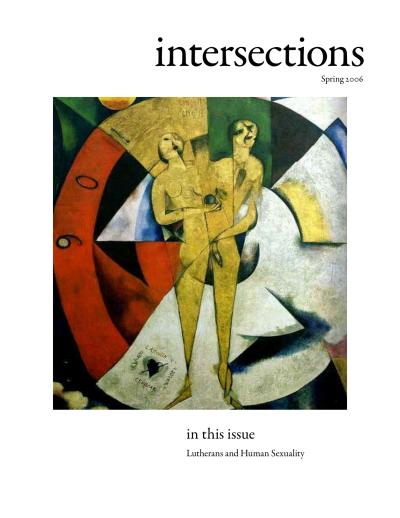 Editorial
From the Publisher
Arne Selbyg
Selbyg notes that both the ELCA and Intersections have undergone major changes this year—the Division for Higher Education and Schools is gone, replaced by the Educational Partnerships and Institutions group within the Vocation and Education unit, and the journal has a new editor (Robert Haak), a new home at Augustana College, a new printer, and a new design. He commends the issue’s focus on human sexuality and points readers to the first draft of Our Calling in Education.
-
Editorial
From the Editor
Robert D. Haak
Haak introduces himself as the new editor inheriting the journal from Tom Christenson and frames the issue around the question of what ELCA colleges might contribute to conversations about human sexuality. He summarizes the contributions of Yeager, Benne, Williams, Bussie, and Nack, and shares previously uncollected National Study of Youth and Religion data on the sexual attitudes and behaviors of Lutheran teens—including that 25% of regularly-attending ELCA teens report the church has done nothing to help them with their sexuality.
-
Article
A Church, the Human Condition, and the Fissured Face of Peace
D. M. Yeager
Yeager, a member of the ELCA Task Force for Studies on Sexuality, reflects on lessons for the church’s educational mission in the wake of the 2005 Churchwide Assembly. Drawing on Macquarrie’s The Concept of Peace, Polanyi on the personal coefficient of knowledge, Hannah Arendt’s The Human Condition, and responses to the task force report from Roy Harrisville III and Larry Rasmussen, she proposes “the fissured face of peace”—peace as the absence of hostility rather than disagreement—and maps how Arendt’s five conditions of human existence (life, earth, natality, mortality, worldliness, plurality) might shape Lutheran colleges’ curricula in history, epistemology, and the sociology of knowledge so that graduates can disagree without hostility and embrace the slow work of reformation.
-
Article
Ethical Deliberation and the Biblical Text—A Lutheran Contribution to Reading the Bible
Ritva Williams
Williams articulates a Lutheran “critical traditionalist hermeneutic”—a phrase borrowed from her Hebrew Bible professor Robert Polzin—that honors Scripture as queen while keeping Christ as its king, and tests it by critiquing Robert Gagnon’s use of Romans 1:18-32 in The Bible and Homosexual Practice. Drawing on Lazareth, Lotz, Philip Esler’s Conflict and Identity in Romans, Stanley Stowers’ Rereading Romans, and Ben Witherington III, she proposes an alternative reading in which Paul recites a Hellenistic-Jewish ethnic caricature in 1:18-32 only to overturn it in 2:1-16, making the passage a critique of self-righteous stereotyping rather than the foundation of a moral doctrine on same-sex intercourse.
-
Article
Scarred Epistemologies: What a Theology of the Cross Has to Say about the Gay Marriage Ban
Jacqueline Bussie
Responding to Robert Benne’s claim (citing Gilbert Meilander and Wolfhart Pannenberg) that one cannot defend gay marriage on biblical or confessional grounds, Bussie reads three theses of Luther’s Heidelberg Disputation alongside Moltmann’s Crucified God and Martin Luther King Jr.’s Letter from Birmingham Jail to argue that the theologia crucis—with its insistence on calling the thing what it is, its acknowledgment of scarred epistemologies and simul justus et peccator, and its refusal to domesticate God—exposes the Ohio Defense of Marriage Act as scapegoating, selective literalism, and an unjust law that the Christian conscience must reject.
-
Article
What Could the Lutheran Colleges and Universities Contribute to the ELCA Discussion of Sexuality—But What Would They Actually Contribute?
Robert Benne
Benne hopes that Lutheran colleges might model fair moral discourse on sexuality by gathering a balanced mix of what James Davison Hunter calls “orthodox” and “progressive” voices from religion and social-science faculties, with the Great Tradition treated as the default position. He doubts this is what would actually happen: citing Klein, Stern, and Western’s research showing a ten-to-one liberal-to-conservative ratio in social-science and humanities associations, he suspects Lutheran faculties skew further left than other private colleges and would simply reinforce the ELCA’s already-progressive seminary and churchwide leadership.
-
 Editorial
From the Editor: Vocation [in] Disruption
Colleen Windham-Hughes
No. 57 · Spring 2023
Windham-Hughes introduces the issue’s theme — vocation amidst disruption — previews new features including contributor contact information, a study guide for So That All May Flourish, and invited pieces on reproductive rights, and shares results from the Fall survey of readers.
-
 Institutional Focus
Sharing the Gift of Vocation at (and beyond) Augsburg University
Paul C. Pribbenow
No. 55 · Spring 2022
Pribbenow, drawing on a 2022 NetVUE panel with Dorothy Bass and Jodi Porter, considers how the gift of vocation forged with undergraduates can be extended — beyond undergraduate campuses to graduate students, faculty, and staff; across the vocational lifespan from high schoolers to alumni navigating the “gig economy”; and into accompaniment of faith communities through Augsburg’s Riverside Innovation Hub.
-
 Article
Affirming, Entrusting, and Acting: A Baptismal Grounding of Affirmative Action in Lutheran Higher Education
Peter Carlson Schattauer
No. 60 · Fall 2024
Schattauer draws on the Lutheran baptism liturgy — where the gathered assembly publicly affirms what it is for and is entrusted with responsibilities for justice and peace — to argue that NECU institutions create truly inclusive communities by affirming commitments, naming responsibilities, and acting in ways that embody both.
-
 Article
Mars, Mammon—and Other Options
Carl Skrade
No. 20 · Fall 2004
In a wide-ranging public lecture from a Capital University Philosophy and Religion department series on “The Empire, Its Religions, and Some Alternatives,” Skrade distinguishes the military from militarism (using Oxford and Chalmers Johnson definitions), catalogs evidence of contemporary U.S. militarism—budget allocations, arms sales, the military-academic complex, post-1945 interventions, overseas bases, and Bush-era profiteering through Bechtel and Halliburton—and traces its roots in resource greed, racism, right-wing religiosity, and Augustinian incurvatus in se ipsum. After surveying the financial and human costs through testimony from Jonathan Shay’s Achilles in Vietnam, Samuel Hynes’s The Soldier’s Tale, Dalton Trumbo’s Johnny Got His Gun, and Staff Sergeant Jimmy Massey, he applies Vincent Ferraro’s seven principles of just war to Gulf II, reads Matthew 5:43-48 as a call to indiscriminate care, and proposes a www.religiousleft.org website to host a Christian alternative to Mars and Mammon.
-
 Editorial
Guest Editor
Madeleine Forell Marshall
No. 25 · Spring 2007
Marshall introduces the four papers in this issue from the 70th annual meeting of the Association of Lutheran College Faculties, held at California Lutheran University in October 2006 on the theme “Identity and Diversity in the Lutheran College.” She notes a geographic pattern—the two East Coast contributors (Balmer and Bailey) defend Christian liberal arts against perceived suspicion, while the two Westerners (Marichal and Brubaker) treat Lutheran identity as advantage and diversity as a Lutheran given—and announces the 2007 ALCF meeting at Newberry College on “Beyond ‘Whatever’: Values Based Learning in Lutheran Higher Education.”
-
 Editorial
From the Editor
Jason A. Mahn
No. 48 · Fall 2018
Mahn recounts how a participant’s probing questions at the 2018 Vocation of a Lutheran College Conference turned “civil discourse” from an innocuous theme into a contested one — and previews essays that variously urge listening and common ground, or speaking truthfully even when those words sound angry.