“In times of change, learners inherit the earth, while the learned find themselves beautifully equipped to deal with a world that no longer exists.” | ERIC HOFFER
Liberal arts education in the United States has experienced quite a few upheavals since 2007, the year I joined Concordia College.1 First came the financial crisis and the great recession, followed by the crisis of the humanities. Then a deadly pandemic arrived, causing yet another shock to enrollments and revenue. As I write these lines, new challenges—more disruptive than the current ones—are on the horizon. It is high time we confront the following questions: How well have we managed these crises? How prepared are we to meet future ones?
Crises are not just unfortunate occurrences; they are also signs that invite interpretation, discussion, and reflection. Crises tell us that we need to pause whatever we have been doing and turn our attention inwards, think about where we are and how we got here, and decide whether a change of direction is warranted. This imperative becomes increasingly urgent as the interval between crises becomes shorter and shorter—for that, too, is a sign. It is, of course, necessary to deal with whatever is demanding our immediate attention, but treating a patient’s acute symptoms is no substitute for diagnosing the underlying disease. It is tempting to evade responsibility by blaming impersonal forces beyond our control, but that attitude is reactive and disempowering; it does nothing to improve our resilience or our capacity to rise up to the occasion.
Throughout this period of crises, colleges have tried to mitigate their troubles as best as they could. Increasingly, however, their best is just not good enough. The main reason, in my view, is that their responses have been driven by a fragmented view of reality. If donations are down, let’s increase tuition or improve fundraising; if enrollments are low, let’s ramp up marketing and recruiting; if expenses are high, let’s downsize the faculty. When these piecemeal measures fail to deliver, the standard response is to intensify the effort—as if doing more of the same will lead to different outcomes. Rarely do leaders entertain the possibility that the fault may lie in some of their own assumptions.
Two critical assumptions have been especially problematic. First, decision-makers have assumed that these difficulties are temporary. Once the pandemic is over, once the economy recovers, once the birth rate goes back up again, once the donations start coming in—then everything will return to normal. As a result, colleges have used strategies that are essentially about buying time. Underlying this approach is the assumption that, except for an occasional glitch or two, the world in the coming decades will remain essentially the same as it has been in the recent past.
Second, decision-makers have assumed that higher education’s leadership and management model is basically sound and need not be questioned, let alone changed in fundamental ways. They have assumed that better alternatives either don’t exist at all or, if they do, are too utopian for the real world. Any attempt to modify how colleges are run is futile, either because the current model cannot be improved upon or because the effort required is not worth it. In effect, all we need are a few small, incremental changes.
The environment within which colleges function is rapidly becoming unstable.
Notice that the first assumption implies the second, for if the difficulties are temporary then, obviously, no major transformation is needed. As I argue below, however, the environment within which colleges function is rapidly becoming unstable in an unprecedented way—where “environment” refers to the totality of our ecological and socio-historical context. If that’s the case, then the assumptions that normalcy will return and business-as-usual will continue are not just problematic; they are outright dangerous. These assumptions create a false sense of optimism, narrow the range of available options, and increase institutional vulnerability. They constrain imagination, stifle creativity, and obviate the need for thinking outside the proverbial box.
Learning from Failure
Chris Argyris (d. 2013) of Harvard Business School was quite familiar with this dynamic, which he described in terms of two types of learning. To understand these types, consider the fact that the strategies that leaders employ to achieve organizational goals are based on particular assumptions about how the world works, and that leaders use the resulting outcomes to measure the effectiveness of their strategies. If the outcomes turn out to be unsatisfactory, then it follows that strategies are flawed and need to be changed. This is called “single-loop” learning, or problem-solving. However, if leaders are willing to allow the feedback from reality to illuminate not only their strategies but also the underlying assumptions, then they have the opportunity to learn in a much more profound way; this is called “double-loop” learning.
Double-loop learning allows leaders to go deeper than mere problem-solving. If they find that their assumptions were invalid, outdated, or inapplicable, they can replace them with more accurate and appropriate ones. Knowing that the problems were stemming not from the strategies but from the underlying assumptions is a priceless insight, for it allows them to reconsider not just the intended outcomes but also the deeper goals and values. In this way, double-loop learning empowers the leaders to make fundamental changes in how they think and act, thereby increasing the chances of achieving better outcomes.
In a famous article, “Teaching Smart People How to Learn,” Argyris points out that it is difficult to institutionalize double-loop learning because successful professional are often too smart for their own good:
Because many professionals are almost always successful at what they do, they rarely experience failure. And because they have rarely failed, they have never learned how to learn from failure. So whenever their single-loop learning strategies go wrong, they become defensive, screen out criticism, and put the “blame” on anyone and everyone but themselves. In short, their ability to learn shuts down precisely at the moment they need it the most.
One might ask: If these professionals haven’t experienced many failures in the past, why are they failing now? The answer lies in change. In a stable environment, there is no need to question the inherited assumptions; leaders can succeed simply by doing what they have always done, while addressing any problems on a case-by-case basis. But conventional problem-solving doesn’t work so well during periods of rapid and disruptive change. Since most leaders are not used to turning the critical and analytical lens back on their own assumptions, they keep using the same old strategies long after they have stopped working.
If the current difficulties of higher education were caused by random events, similar to the ones that have happened many times in the past, then single-loop learning would have sufficed. The reason why the usual strategies are not effective this time around is because we are living in a time when both natural and social systems are breaking down, causing the environment to become increasingly unstable and unpredictable. An environment undergoing rapid deterioration is a breeding ground for crises, each worse than the one before. Some of our most basic assumptions have already become obsolete while many others are starting to fall apart, creating an urgent need for double-loop learning.
Systems Thinking and Soft Landings
To understand the big picture, begin by considering the nature of systems. A system is a coherent network of interconnected parts. Every system, whether natural or social, has an upper limit that it is not supposed to cross. That’s because the longer a system is forced to function above its optimal capacity—i.e., the longer it remains in overshoot—the more susceptible it becomes to collapse (Catton). Our global, hyper-connected human community is also a complex system, one that includes all of our social arrangements, political institutions, and economic flows that make up our “civilization.” Like any other system, human civilization is subject to the inescapable logic of overshoot and collapse (Rockström). For the last half century, civilization has been operating beyond its optimal limits, and, as a result, it is now in a state of collapse—a relatively fast decline in standards of living, social complexity, and population. In non-euphemistic language, this means large-scale death, destruction, and suffering.
The mechanism of our global predicament can be described as follows: Human civilization is built on top of natural systems, in the sense that these natural systems are absolutely necessary for maintaining the physical conditions that make organized human society possible, not to mention life itself. As the global human system expands, it consumes more resources and produces more waste—until it starts compromising the very natural systems on which it is utterly dependent (Meadows). Much of what we celebrate as progress in the modern era was made possible by fossil-fuel driven industrialization, a phenomenon that also led to an unprecedented enlargement of our ecological footprint. The process of expansion took a sharp upward turn in the post-WWII period when economic growth, as measured by the GDP, became the dominant measure of social progress—commonly known as “development” (Steffen). Just as an extravagant lifestyle cannot be maintained indefinitely on borrowed money, the expansion of human numbers and standards of living cannot continue forever on a finite planet. No wonder, then, that natural systems have started to collapse at an accelerating pace, with climate disruption being the most imminent threat to the human enterprise (Catton; Rocksröm; Jamail; Wallace-Wells; and Lynas).
Having seen the big picture, we can appreciate that the current difficulties of higher education are merely a foretaste of what some scientists are calling humanity’s ‘ghastly future.’
Planetary breakdown and civilizational collapse are mutually reinforcing phenomena, which means we can expect to see more and more crises in the foreseeable future. While our predicament is global, its manifestations are necessarily local and varied; the same predicament is affecting different societies—and different sectors within each society—in very different ways. Having seen the big picture, we can appreciate that the current difficulties of higher education are merely a foretaste of what some scientists are calling humanity’s “ghastly future” (Bradshaw).
During times of upheaval, the typical human response is to try to maintain the status quo by any means necessary. Leaders in higher education, just like successful professionals elsewhere, tend to rely on their experience when making decisions. But they acquired this experience during the relatively stable environment of the past, which renders it much less useful for dealing with an entirely unprecedented situation. In a time of decline and disruption, sticking to what we have always done is tantamount to risking irrelevance at best and extinction at worst.
There is a lot we can still do to ensure that our descent is, for the most part, gradual, peaceful, humane, and equitable, as opposed to sudden, violent, catastrophic, and oppressive.
In order for humanity to respond effectively to its global predicament, every community and every organization must be able to think and act in creative ways. I use the word “response” in relation to collapse because it is simply too late for prevention. However, just because we cannot avoid the fall doesn’t mean there are no opportunities for meaningful action. There is a lot we can still do to ensure that our descent is, for the most part, gradual, peaceful, humane, and equitable, as opposed to sudden, violent, catastrophic, and oppressive. When it comes to developing creative responses to the ongoing collapse in order to ensure a “soft landing,” our institutions of higher education have a special responsibility for leading the way. Fulfilling that responsibility, however, involves fundamental changes in how colleges function. Denying the need for the required transformation may be tempting, but the current state of our predicament has already shattered many of the long-established paradigms within which we are used to executing our pedagogical, scholarly, and administrative duties. To continue functioning as if those paradigms were still intact involves sacrificing our intellectual integrity as well as our commitment to the welfare of the younger generation. Moreover, as the planetary and civilizational collapse progresses, the resources on which colleges have traditionally relied will continue to dwindle; as a result, the prevailing model of leadership and management will increasingly lose its legitimacy, forcing us to look for more viable alternatives (Laloux). As our students become better aware of the ongoing collapse and its terrifying implications for their future, they will start questioning the practical value of our course offerings. In response, we will have to learn how to teach our students a significantly different set of skills than what we have been teaching them so far.
As we anticipate the challenges that faculty, administrators, and students are most likely to face in the coming decades, a simple choice appears: We can either initiate the necessary transformation now, or we can wait until we are compelled by the brute force of circumstances to make those same changes. Either way, the option of maintaining business-as-usual is no longer on the menu.
Return to Purpose and Learning to Learn
How can colleges make the fundamental changes that will allow them to thrive in an increasingly unstable and unpredictable environment? The first thing to note is that all change involves learning. In fact, psychologists define the term “learning” as change in behavior as a result of experience, where “behavior” refers to observable actions as well as private or mental events, such as thinking. The college, as an institution, is designed for teaching, but the global predicament that humanity is facing demands that the college becomes adept at learning. Indeed, I would argue that the college needs to rapidly evolve into a “learning organization,” an institution that is able and willing to change its behavior in response to the changing environment so that it can continue serving its purpose. The concept of “learning organizations” was popularized by Peter Senge in the early 1990s, who described them as places “where people continually expand their capacity to create the results they truly desire, where new and expansive patterns of thinking are nurtured, where collective aspiration is set free, and where people are continually learning how to learn together” (Senge 1).
This raises a critical question: Can colleges learn how to learn? Any institution can become a learning organization, provided it can overcome its own resistance to change. Consider the fact that some of the most intelligent, perceptive, and knowledgeable individuals are found within our institutions of higher education. This might lead an ordinary person to assume that colleges must be bastions of good judgment and foresight. Unfortunately, individual brilliance not only interferes with our capacity for double-loop learning, it also does not automatically translate into institutional wisdom. The culprit, of course, is organizational culture. The modern college is a highly conservative institution, and the ascendance of neoliberalism since the 1980s has only strengthened that characteristic. Change is difficult for any organization, but it is especially tricky for the college that takes pride in its long-standing traditions and depends heavily on the support of its alumni. The “Big Money” donors—whether in politics, culture, or philanthropy—tend to dislike fundamental change, for obvious reasons. In addition, any fundamental change requires a strong culture of collaboration, but our colleges follow a scheme of governance that assumes competition among interest groups, incentivizing both departments and individual employees to focus on their own short-term interests. Furthermore, the conservative nature of the college tends to intensify during crises, making it even more risk-avoidant at a time when organizational flexibility is most needed.
Any fundamental change requires a strong culture of collaboration, but our colleges follow a scheme of governance that assumes competition among interest groups, incentivizing both departments and individual employees to focus on their own short-term interests.
Yet, culture is created and maintained through human choices, which means we can change much of our organizational culture by committing to alternative choices. There is, of course, an entire science of deliberate culture change—called applied cultural evolution—that we can draw upon. The task, however, is enormous, and no single individual can provide a complete roadmap for how colleges should move forward in this absolutely unfamiliar terrain. The project is best pursued through multidisciplinary endeavors led by collapse-aware “communities of practice” (Wenger).
Not being able to offer a roadmap, I will nevertheless suggest a starting point for this journey—a return to purpose.
If we trace any successful endeavor to its origin, we are likely to find a small group of people coming together to serve a shared purpose. Over time, however, there is a tendency for purpose to get sidelined, as more and more energy flows into maintaining a particular set of policies, processes, and procedures. Essentially, the means turn into ends, and people become much more committed to the “what” and the “how” than they are to the “why.” Just like single-loop learning, this state of affairs can continue in a stable environment but quickly becomes a liability under conditions of rapid and disruptive change. As the storm intensifies around us, so does our need for a spiritual anchor, a more reliable moral compass, and a deeper wellspring of strength and creativity. Human beings can meet almost any challenge, but only if they are energized by a shared purpose that is worthy of their commitment and sacrifice, one that transcends their everyday concerns while also embodying their deepest values.
A return to purpose would therefore require colleges to re-examine their values, both actual and professed, and to notice any mismatch between the two. All too often, colleges become obsessed with the financial bottom line, treating it as their ultimate concern. This attitude neglects the fact that human beings do not live by bread alone and that the cosmos, as we experience it, is made up of stories rather than soulless atoms. Ultimately, the health of an institution depends a lot less on its endowment, revenue, and enrollment, and a lot more on its spiritual wealth, which can only come from a community’s relationship with a higher purpose, from its collective sense of “why.” Even though “result-oriented” leaders tend to be cynical about the reality of the spirit, it is still disconcerting to encounter that mindset in religiously affiliated colleges. The real bottom line is that God—or history—cannot be deceived by slogans. Ultimately, we are judged by what we actually do, and not by what we say on our brochures and websites. Better marketing can never compensate for a lack of higher purpose, for the issue is not how we tell our story but whether we have a story worth telling.
Both purpose and values are ultimately about meaning. Human beings can always find a sense of meaning in their experience, regardless of how harsh and hopeless their circumstances might be. As educators living in the age of collapse, we are therefore confronted with the following questions: What is the meaning of our vocation in this unique historical moment? Given the reality of planetary and civilizational collapse, what do we owe our students? What do we owe society? How should colleges that claim a religious heritage and a transcendent purpose respond to the unfolding global predicament? What is the most meaningful thing we can do at this time, in this situation?
How should colleges that claim a religious heritage and a transcendent purpose respond to the unfolding global predicament?
In my view, there is probably no way out, but there is definitely a way in. So far, we have avoided acknowledging the full catastrophe of the ongoing planetary and civilizational collapse—to ourselves, to our students, or both—mainly because we think it would lead to paralyzing despair and inaction. But that isn’t true. The end of optimism does not mean the impossibility of meaningful action, just as the diagnosis of a terminal illness does not mean that one is no longer morally responsible. Reality must be accepted, no matter how unpleasant, but acceptance is not synonymous with giving up. Rather, accepting the reality of collapse is a necessary prerequisite for clarifying our values, determining what we want to save and what we need to let go, and then responding to the call of our time with wisdom, compassion, and creativity. Some of the most creative responses to the global predicament, especially the climate crisis, are emerging from within the informal networks of people who have accepted the inevitability of collapse—the “deep adaptation” network being a prominent example—and not from the techno-optimists, who are essentially in a state of denial (Bendell and Read).
What, then, shall we do? As a first step, I suggest that colleges need to turn inwards so they can discover—or create—a new sense of shared purpose, one that takes into account our global predicament and may therefore become more meaningful as the world goes deeper into collapse. It is only after we have taken this first step that we would be able to see the rest of our path.
Endnotes
1. I am grateful to the following individuals for providing feedback on earlier versions of this essay: Jason Mahn, Abdur-Rauf Ahmed, Wendy Freeman, Ken Foster, Michael Johnson, Jonathan Steinwand, David Creech, Elna Solvang, Michelle Lelwica, Anne Mocko, Leila Zakhirova, and Jan Pranger.
Works Cited
Argyris, Chris. “Teaching Smart People How to Learn.” Harvard Business Review. May-June, 1991. Accessed 1 Nov. 2021, https://bit.ly/3xWN7Le
Bendell, Jem and Rupert Read, eds. Deep Adaptation: Navigating the Realities of Climate Chaos. Cambridge, UK: Polity, 2021.
Bradshaw, Corey, et al. “Underestimating the Challenges of Avoiding a Ghastly Future.” Frontiers in Conservation Science. Vol. 1, Article 615419 (January 2021).
Catton, William R. Overshoot: The Ecological Basis of Revolutionary Change. Urbana, IL: University of Illinois Press, 1980.
Jamail, Dahr. The End of Ice: Bearing Witness and Finding Meaning in the Path of Climate Disruption. New York: The New Press, 2019.
Laloux, Frederic. Reinventing Organizations: A Guide to Creating Organizations Inspired by the Next Stage in Human Consciousness. Brussels: Nelson Parker.
Lynas, Mark. Our Final Warning: Six Degrees of Climate Emergency. London, UK: 4th Estate, 2020.
Meadows, Donella, et al. Limits to Growth: The 30-Year Update. White River Junction, VT, 2004.
Rockström, Johan, et al. “Planetary Boundaries: Exploring the Safe Operating Space for Humanity.” Ecology and Society 14.2 (2009).
Senge, Peter. The Fifth Discipline: The Art & Practice of the Learning Organization. Revised & Updated Edition. New York: Doubleday, 2006.
Wallace-Wells, David. The Uninhabitable Earth: Life after Warming. New York: Tim Duggan Books, 2019.
Wenger, Etienne. Communities of Practice: Learning, Meaning, and Identity. Cambridge, UK: Cambridge UP, 1998.
-
 Editorial
From the Editor
Jason A. Mahn
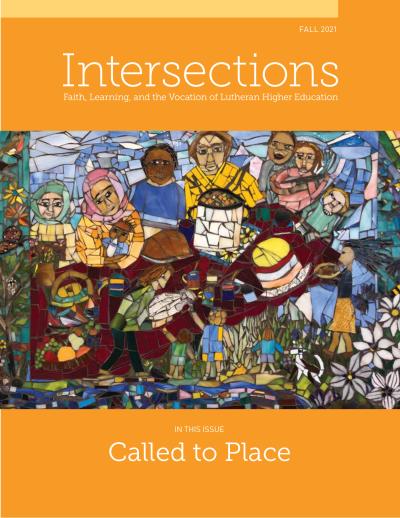
Mahn introduces the “Called to Place” theme of the 2021 VLHE Conference, arguing that Lutheran higher education’s emphasis on vocation must be grounded in particular geographies and embodied communities — for, as Wallace Stegner put it, “If you don’t know where you are, you don’t know who you are.”
-
Article
Where Your Feet are Standing: Institutional Engagement and Place
Melissa Maxwell-Doherty
Maxwell-Doherty draws on Cal Lutheran’s Hispanic-Serving Institution designation and its location on Chumash, Fernandino Tataviam, and Ohlone lands to ask how the university’s mission might shift if it depended on where its students are standing — not just where the institution sits.
-
Article
Community-Building On Campus and Beyond
Krista E. Hughes
Hughes describes Newberry College’s effort to build a “culture of community” that mirrors South Carolina’s demographics while reckoning with the institution’s founding ties to slavery — and names the challenges and promising city-college collaborations that shape this ongoing work.
-
Article
Just Communities: From Liberal Arts in Prison to Racial Healing over Zoom
Monica Smith
Smith showcases how Augustana College’s commitment to social justice extends into the Quad Cities through two initiatives: the Augustana Prison Education Program at East Moline Correctional Center, and Racial Healing conversations developed through the Truth, Racial Healing and Transformation framework.
-
Reflection
Caught in a Place Between Caesar and God
Darrel D. Colson
Colson reflects on his anguish, as Wartburg’s president, over an Iowa law that prevents him from requiring student COVID-19 vaccinations — reading Luther’s “Whether One May Flee From a Deadly Plague” alongside the conflict between obeying the law and serving neighbor.
-
Article
Hospitality to the Wild
Laura M. Hartman
Drawing on research with a Wild Ones Native Landscaping chapter and Marilyn Matevia’s ethic of “creature comfort,” Hartman argues that Christian hospitality must extend to non-human animals and plants — and asks whether college campuses can foster not just human diversity but biodiversity.

-
 Article
Civic Engagement, "Baylor In Deeds," and Engaged Learning
Rebecca Flavin
No. 63 · Spring 2026
6 min audio
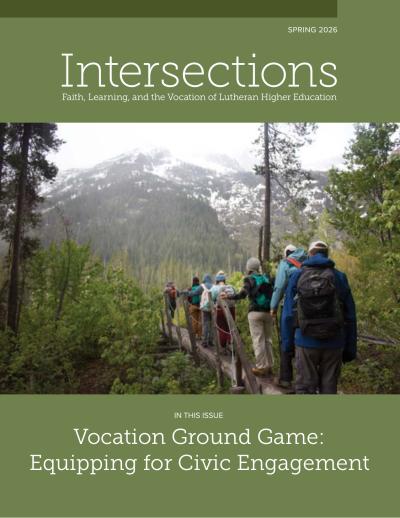
Flavin describes how Baylor’s strategic plan “Baylor in Deeds” and its Office of Engaged Learning are building civic engagement into the Arts & Sciences core curriculum, with early Global Engagement Survey data showing gains in civic efficacy and global civic responsibility.
-
 Article
A River Runs Through It: CLU as a Church-Related University
A. Joseph Everson
No. 12 · Summer 2001
Everson borrows Norman Maclean’s A River Runs Through It and the small creek that flows through California Lutheran University’s Kingsman Park as images for the quiet stream of Christian tradition on campus, describes the dialectic of faith and reason (with a “Lord of Life” student congregation, two required religion courses, and a voluntary Wednesday chapel) as the “theology of paradox” that runs from Luther’s simul justus et peccator through Richard Solberg and Richard Hughes, and names six commitments that constitute the CLU ethos—academic freedom (Jeremiah 29:7 and John 8:32), vocation, service (Amos and Habitat for Humanity), grace and graciousness (Portia’s “quality of mercy” speech from The Merchant of Venice), diversity, and reverence (Proverbs 9 as awe and wonder).
-
 Editorial
From the Editor
Tom Christenson
No. 3 · Summer 1997
Christenson explains that this issue breaks from the first two issues’ single-focus pattern to feature three principal papers on the environment, the education of desire, and hiring and personnel policies, plus two poems and a piece of reflective bemusement. He then commends George Marsden’s The Outrageous Idea of Christian Scholarship (Oxford, 1997) and challenges Lutheran scholars to articulate how the particulars of their faith inform their scholarship—in conversation with Calvinist work like Nicholas Wolterstorff’s Reason Within the Bounds of Religion and Art in Action—rather than remaining silently complicit in the view that faith has no place in the academy.
-
 Article
Point / Counterpoint: What It Means to be a "College of the Church"
Robert Benne, Tom Christenson
No. 28 · Fall 2008
Moderated by Wartburg College pastor Larry Trachte and introduced by Kathryn Kleinhans, this Wartburg campus conversation between Robert Benne (Roanoke College) and Thomas Christenson (Capital University) probes what it means to be a college of the church—Benne emphasizing ethos, vocation, and the Christian intellectual tradition over against secularization and generic education, and Christenson lifting up persistent vocational questions, the gift of difference, and induction into a community of discourse—and finds large common ground around hiring for mission, pedagogy that asks deep questions, and the courage to claim a living religious tradition while inviting everyone to the banquet.
-
 Article
The Marks of an ELCA College: One Bishop's Reflections
Stanley Olson
No. 15 · Winter 2002
Olson, speaking as a bishop and “Harness Boy” whose job is to keep the church’s connections working, replaces his original four-noun outline (fealty, ingenuity, insouciance, focus) with eight marks the ELCA should be able to observe in its colleges: intentional Lutheran identity, significant Lutheran presence, Christian faith at every table, freedom of inquiry, coaching toward vocation, gravity and grace, nurtured community, and excellence by its own standards. Drawing on his survey of all twenty-eight ELCA college mission statements (two tables) and on Darrell Jodock and Mark Edwards, he argues that the Lutheran connection must be made explicit in mission, marketing, and faculty searches, and closes with six reciprocal expectations the colleges should hold of the ELCA—commissioner, mature parent, supporter of adventurous teenagers, advocate, steward of graduates, and a church faithful to its own Lutheran mission.
-
 Article
What Our Lutheran Heritage Entails for Lutheran Colleges and Affirmative Action
Mark Ellingsen
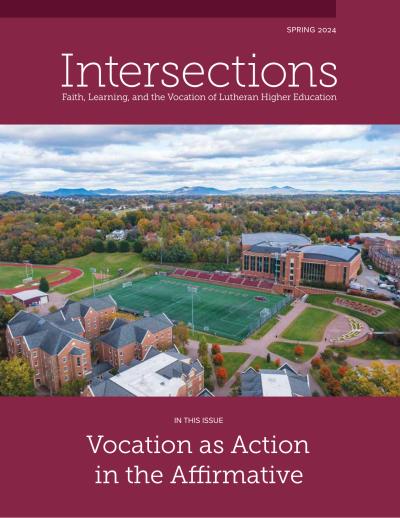
No. 59 · Spring 2024
Ellingsen argues that the Lutheran Two-Kingdom Ethic — far from leading to political reaction — supports the church-relatedness of ELCA colleges and obligates them to keep affirmative action alive, even reading a Chief Justice Roberts “loophole” in Students for Fair Admissions v. Harvard as an open door for Black community partnerships, ELCA congregations, and Lutheran colleges to act in the affirmative.