An absolute commitment to some faith statement can preclude investigation and can lead to mere dogmatism. An absolute commitment to freedom denies the commitments of the institution and the responsibility one assumes when one joins a community that affirms a shared mission.
We owe Bruce Reichenbach a debt of gratitude for so succinctly stating the radical extremes every Lutheran desiring to remain true to his/her tradition and community must guard against. These two absolutes, when they remain absolutes, stymie discussion and paralyze movement. When, however, informed faith and responsive individual freedom are in conversation with one another, the conditions for community building exist. These qualities of faith and freedom are the ones we should seek to foster in all members of our church-related college communities. Reichenbach’s essay focuses on aspects of the hiring process at church-related colleges that might help us create or maintain mission-based communities of learning and faith.
Reichenbach’s most important statements deal with the need to be intentional about hiring practices and with the need for on-going development programs for faculty and staff. Each institution must decide, based on its own community and its relation to the church, what its hiring practices will be; however, as Reichenbach states, it is not in keeping with academic integrity, or with honesty, to hide the Lutheran character of the institution and the expectation for engagement with that character from a prospective employee. In order for such engagement to be as productive as possible, it may also be necessary to institutionalize “constructive and educational discussions about ways to integrate concerns about… faith values into various aspects of service to the college’s community.” These discussions should not be limited to particular constituencies of the college, but could function as means to foster discussion across sub-groups in the community. These discussions should help build community on campus. The ELCA’s annual conference on “The Vocation of a Lutheran College” represents one way in which we currently foster such discussions. Individual colleges have instituted similar discussions on their campuses. It remains to be seen how effective we are in articulating for ourselves and others what we are all about. Can we reach others outside our community of believers or are we doomed to converse only with those whose conversational base resembles our own?
It is perhaps a truism to say that Lutherans hide their light under a bushel. We remain embarrassed about “tooting our own horn.” Such modesty, while admirable, does not serve us well. The ELCA-related colleges and universities have great gifts to share with the world. We are called to do so. We must, however, do a better job of educating not just our new hires, not just our students, not just our natural constituency, but all the public about the gifts the Lutheran education brings to the late twentieth century. Our mission should not be, therefore, to interrogate prospective employees about their own faith commitment and knowledge of our tradition, but to educate the world (and the church) more adequately about that tradition. Yes, we must expect all members of the community to be willing “to effectively and constructively raise the kinds of questions that both Christians and non-Christians should face:” about the institution, the church, education, and our actions in the world. We must also be willing to listen to such questions and to handle productively challenges to our own understandings.
Reichenbach states that “the entire college community should be knowledgeably committed to the college’s mission.” This statement contains four ideas without which colleges related to the church cannot describe themselves: community, knowledge, commitment, and mission. The questions resulting from our self descriptions go something like this: “How do we define community?” “What must we be knowledgeable about?” “What counts as commitment?” and, “How is our mission articulated and manifested every day?” Each institution must answer these questions for itself, which is perhaps one reason presentations, articles, and conference papers articulate only broad and ultimately dissatisfying generalities.
Reichenbach assumes that all members of the community should know what the mission of the college is and be able to either affirm it (if one is Christian) or to engage it productively (if one is non-Christian). Such an assumption means, first, that we must articulate our missions better and, second, that in our day-to-day business it is manifest. But, what about discussions about the mission? Can Christians also interrogate it? Can non-Christians also affirm that mission? In order for a community based in faith and learning to thrive such possibilities must not just exist, but be encouraged. If the question of mission is “off limits” for discussion, we cannot maintain the kind of free inquiry we value so deeply. If the mission is not off limits for discussion, then the community responsible for discussing it must be knowledgeable not only about the current situation of higher education, but also about its roots. It must be knowledgeable about the role of the university in the very genesis of the Lutheran church, the role of disputation in the academic community, and the appeal of the free Renaissance human individual. Essentially, what it means is that our community must be interdisciplinary in spirit. We must look into other disciplines; we must not become perspectival in our approach, except insofar as perpectivalism serves as a heuristic measure, as a means to the end of understanding and respect.
The answer to our need for clearer definition is not to wall ourselves off from those who do not think like us, who do not belong to our conversational community. One of the strengths of the Lutheran tradition is its unwillingness to become separate from the world; we are in the world and are called to engage it. One of the ways in which the colleges have engaged the world is to respond positively and inclusively to cultural diversity. Such a response is in keeping with our mission to be communities of faith and learning. “The goal in hiring should be diversity as a means to further broaden the educational perspectives of students and provide opportunities for growth within the context of a particular community,” let us add to the educational the spiritual, and let us hope we broaden the educational and spiritual perspectives of all members of the community, not just those of students.
One result of the colleges’ varied responses to the culture is that we, along with other groups, struggle with our own identity politics. Intentional diversity within a community can, as it fosters discussion, provide a productive milieu in which to discover anew who and what we are and might become. Reichenbach suggests that “a college that emphasizes intentional diversity as part of its mission statement thereby provides grounds for hiring persons who can not only be creative teachers and articulate spokespersons for various disciplinary and social views, but represent and present non-Christian perspectives in ways that provide an opportunity for serious internal dialogue on the important issues that face the college.” He is right. It is part of our double tradition grounded in faith and informed by the results of disputation within the academy that we should seek out and listen to people different from what we perceive ourselves to be. If we are to be true to our heritage, we must hear challenges both from within the walls of the academy and church and from the outside. Like all humans, we have difficult time with challenges that might result in change. We do however, have sustaining faith that should allow us to face challenges and take risks, not thoughtlessly, but with faith that by God’s grace we participate well and for the good in God’s creation.
Reichenbach makes some important statements, but we are left with little idea about precisely what mission, community, Christian values, knowledge, etc. are. “Christian faith and values should permeate every aspect of the college.” Can we agree on what such values might be? Even among the different Protestant denominations we do not seem to have consensus here. The merger of the predecessor church bodies into the ELCA was perhaps inspired by God, but it remains a human work. Within it we cannot agree on particular social, economic, sexual, ecclesiastical, liturgical, etc. values. Perhaps such agreement is fundamentally antithetical to the Lutheraness of our church. Would we say instead that critical attention to gospel and law, to God’s all-encompassing love and our limited human roles, should be manifest in all our work?
If we cannot agree on what might constitute Christian values or how one appropriately manifests Christian faith, how can we determine precisely a “critical mass” of people manifesting such qualities? Must all members of this “critical mass” be Christians? Reichenbach seems to suggest so when he describes the “challenge of constructing a community staffed by a critical mass of persons who by their own Christian faith, hard work, creativity, courage, sensitivity and joy work with the mercy and providence of God to change lives.” But his arguments for diversity within the community might suggest that it is not so much whether one is a Christian, or even a Lutheran, but whether one is informed about that tradition and willing and able to engage it well in order to build community that should be the primary criterion for inclusion in that “critical mass.” Perhaps, as I suggested earlier, these qualities can only be defined within community and not in a part destined for multiple communities.
Is it true that “commitment to effectively implementing the mission statement means more than that those hired will be sympathetic working in an environment that makes such a Christian statement.” It is also important that those who come to work at colleges such as ours should “choose to teach and work at such an institution.” However, I do not believe all of us, even all of us committed to the kind of educational and spiritual environment the ELCA - related colleges can provide, did, in fact choose to teach or work at these institutions because of their church-relatedness. The church-relatedness may even have been a red flag to those members of our communities who had little or no knowledge about Lutheran education; for others an institution’s Lutheranness may have provided a perceived level of comfort, a bit of the known along with the greater unknowns associated with joining a new community; many more of us, perhaps, came to these institutions assuming that the specific religious aspects of the institution were (and should be) taken care of in areas outside our own academic disciplines. I hope that we were/are all wrong in some degree. It is only after working in such an institution for considerable time and educating oneself about the mission of that institution that one comes to appreciate both the ways in which we fall short of our goals and the ways in which those goals matter enormously.
In short, a college that espouses a mission that includes both being based on the Christian faith and diversity or inclusiveness, faces a situation fraught with tension. The task is to turn the tension into creative education…
Reichenbach’s phrase “creative education” attempts to encapsulate the dialectical tension inherent in our mission of faith and learning in a diverse world. This tension is perhaps analogous to the tension between the two kingdoms of Lutheran theology. As members of communities related to the Lutheran church, we have, therefore, a faith perspective that both motivates and facilitates participation in that tension. The tension is never resolved; it does not go away. Creative education inculcates the ability to live in this tension between and with God’s love and our rules.
-
 Editorial
From the Publisher
James M. Unglaube
Unglaube opens the journal’s second year by previewing the 1997 Vocation of a Lutheran College conference at Carthage, which will examine the Lutheran tradition from outside (Richard Hughes of Pepperdine on the Lilly Endowment’s Models for Christian Higher Education; David Johnson, President of the University of Minnesota at Morris and Luther College graduate, on the tradition from the public sector) and inside (Ann Pederson of Augustana in Sioux Falls; Timothy Lull of Pacific Lutheran Theological Seminary), and previews Eric Eliason’s emerging proposal for an Academy of Scholars in Lutheran Higher Education modeled on NEH/NSF-style summer seminars.
-
Editorial
From the Editor
Tom Christenson
Christenson explains that this issue breaks from the first two issues’ single-focus pattern to feature three principal papers on the environment, the education of desire, and hiring and personnel policies, plus two poems and a piece of reflective bemusement. He then commends George Marsden’s The Outrageous Idea of Christian Scholarship (Oxford, 1997) and challenges Lutheran scholars to articulate how the particulars of their faith inform their scholarship—in conversation with Calvinist work like Nicholas Wolterstorff’s Reason Within the Bounds of Religion and Art in Action—rather than remaining silently complicit in the view that faith has no place in the academy.
-
Article
The Lutheran Liberal Arts College and Care for the Earth
H. Paul Santmire
Santmire, author of The Travail of Nature, proposes three mandates for the Lutheran liberal arts college: take responsibility for spiritual particularity by confronting the ambiguities of the classical Christian tradition (Lynn White’s charge against anthropocentric Christianity vs. the Franciscan ecological tradition from Irenaeus through Luther) and of classical Lutheran social ethics (the Two Kingdoms, Romans 13, the Third Reich, Bonhoeffer); promote responsible cultural criticism (against Thoreau’s sociopathic anti-urban suburbanism); and promote a holistic environmental ethos through an interdisciplinary core curriculum with ecology as the queen of the sciences, a community that liberates the social imagination (Mumford, Marcuse), a cosmic Liturgical praxis rooted in the Colossians 1:15–20 hymn to the cosmic Christ, and an academy that models ecological responsibility.
-
Article
An Aristotelian Twist to Faith and Learning
Gregg Muilenberg
Muilenburg, chair of Philosophy at Concordia, surveys the four traditional models for faith and reason—conflict, independence, dialogue, and integration—and argues that the Lutheran dialogical model is insufficient for wholeness. Drawing on the post-foundationalist epistemology of perspective and Aristotle’s account of knowing as desire-driven action, he proposes that faith is an ultimate value (an assessment belief of the form ‘x is better than y’), that learning is desire-directed action, and that the core of Christian education is the education of Christian desire—requiring both reflection and commitment, both integration and diversity.
-
Poem
Two Poems: The Dark Angels / Decorative Cooking
Gary Fincke
Two poems by Gary Fincke of Susquehanna University: “The Dark Angels,” a return to the sidewalk in front of the father’s razed bakery in Etna, the soot-pocked windows, the Saturday trash fire, the last eclair on the work room’s folding chair; and “Decorative Cooking,” the mother’s story of St. Julitta, Betty Crocker’s “New Design for Happiness,” the Sunday dinners of shaped Jellos and anise Magi cookies, the visit of the former pastor returned to Pittsburgh to declaim the death of God, and the father who lays evergreen crosses by the mother’s headstone in the Garden of Dreams.
-
Article
Mission and Hiring in the Christian College
Bruce Reichenbach
Reichenbach of Augsburg argues that the Christian or Church-related college’s mission to educate the whole person from a perspective of Christian faith and values can only succeed through intentional hiring of a “critical mass” of faculty, administrators, and staff committed to that mission (following George Marsden and the 1960s Danforth Commission), supplemented by on-going faculty development. He defends an inclusive community-with-diversity, a freedom-and-commitment tension grounded in Alasdair MacIntyre’s account of tradition, and the legality of preferential religious hiring under Title VII of the Civil Rights Act and the relevant case law (Tilton, Hunt, Roemer, Blanton, Grove City, Amos).
-
Response
Hitting a Moving Target
Harry Jebsen
Jebsen, former Provost of Capital University, responds to Reichenbach by arguing that the institutions, the ELCA, congregations and pastors, students, and curriculum are all moving targets. Drawing on Alvin Toffler’s Future Shock and his own fifteen years of hiring as Dean and Provost (a candidate who hoped the cross out front didn’t mean anything), he traces the drift from the “Mr. Chips” faculty who personified Dana and Midland Lutheran to a campus culture where “everybody is nice to each other” has replaced theological substance, and where MBA programs, conservatories, law schools, and adult-education programs further dilute the focus of the residential Lutheran college.
-
Reflection
Confessions of a Collaborator
Chuck Huff
Huff of St. Olaf offers a tongue-in-cheek public confession of his lifelong sin of collaboration—from elementary-school reports on dinosaurs and Cliff notes on Faulkner, through high-school algebra and college group projects, to borrowed syllabi, group work imposed on resentful students, tutorials, independent studies on every form of self-reliance, and circulated drafts. Even this confession was collaborated on, and (he confesses) he enjoyed it.
-
 Editorial
From the Editor
Tom Christenson
No. 21 · Summer 2005
In his valedictory letter as outgoing editor, Christenson recounts the 1994 origins of Intersections, when he took the idea to Naomi Linnell and Jim Unglaube at DHES and persuaded the council of presidents to launch the journal on a shoestring with printing paid by DHES and everything else by Capital University. He summarizes the issue’s contents—papers from the 2004 Vocation of a Lutheran College Conference plus two commissioned pieces from former DHES directors Bob Sorensen and Leonard Schulze—and thanks the student copy editors and Capital’s presidents and provosts who sustained the publication.
-
 Article
Why Did the Chicken Cross the Road? A Homily on Liminality and Vocation
Lori Brandt Hale
No. 45 · Spring 2017
Drawing on Wes Moore’s The Other Wes Moore, Warren St. John’s Outcasts United, Victor Turner’s anthropology of liminality, and Dietrich Bonhoeffer’s poem “Who Am I?”, Hale considers how Hmong, Muslim, Latinx, LGBTQ+, non-traditional, and other students live in “double liminal” spaces — and asks whether liminality might itself be a place of transformation in conversations about vocation.
-
 Book Review
The Prophetic Vocation and the Nature(s) of College: Reimagining College with Jim Farrell
Peder Jothen
No. 39 · Spring 2014
Jothen reads the late Jim Farrell’s The Nature of College as a prophetic critique of the dual nature(s) of college—its socio-cultural “normal” and its ecological habitat—and argues that Farrell’s call to model an “Anthropocene Responsibility” resonates with the prophetic dimension of Lutheran higher education. He proposes a re-imagined “About St. Olaf” that names vocation, ecological dependence, and personal involvement as the operative goods of college.
-
 Article
A River Runs Through It: CLU as a Church-Related University
A. Joseph Everson
No. 12 · Summer 2001
Everson borrows Norman Maclean’s A River Runs Through It and the small creek that flows through California Lutheran University’s Kingsman Park as images for the quiet stream of Christian tradition on campus, describes the dialectic of faith and reason (with a “Lord of Life” student congregation, two required religion courses, and a voluntary Wednesday chapel) as the “theology of paradox” that runs from Luther’s simul justus et peccator through Richard Solberg and Richard Hughes, and names six commitments that constitute the CLU ethos—academic freedom (Jeremiah 29:7 and John 8:32), vocation, service (Amos and Habitat for Humanity), grace and graciousness (Portia’s “quality of mercy” speech from The Merchant of Venice), diversity, and reverence (Proverbs 9 as awe and wonder).
-
 Editorial
From the Editor
Robert D. Haak
No. 24 · Fall 2006
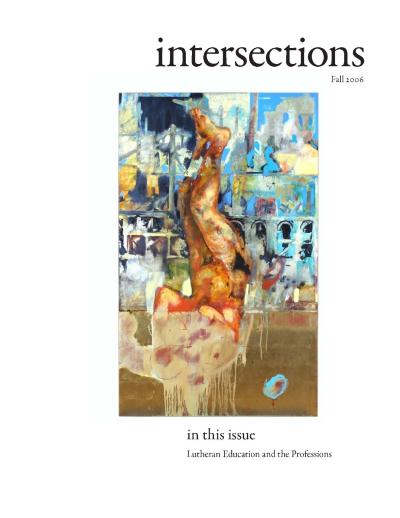
Haak introduces the issue’s essays by Stanley N. Olson, Kathryn L. Johnson, Gail Summer, Lake Lambert, and Steven C. Bahls; argues that on Lutheran campuses, professional programs in business, education, and nursing are not “second-class citizens” but integral to the institution’s vocation; cites Olson’s mantra (“Because of Christ, the world; because of the world, vocation; because of vocation, education”); and thanks Matt Marohl for assisting with the editing.
-
 Article
Making Dry Bones Stand: Lutheran Higher Education at Century's End
Diane Scholl
No. 17 · Summer 2003
Scholl reads John Winthrop’s “A Model of Christian Charity,” the banishment of Anne Hutchinson, de Crevecoeur’s American farmer, Olaudah Equiano, Phyllis Wheatley, and Hawthorne’s The Scarlet Letter alongside Ezekiel’s vision of the dry bones to ask how a Lutheran college can be a community that holds difference and commonality together. Drawing on Ernest Simmons’s warning against collapsing into either dogmatic absolutism or thoroughgoing relativism and Bruce Reichenbach’s companion essay in this issue, she identifies five features of shared life at a Lutheran college—the liberal arts, political process, the arts, the community of caring, and the recognition of difference and the right to dissent—and argues that the necessary tension between individualism and corporate identity, framed by theological vision, is “our best legacy and our best hope for the future.”