I’ve been troubled—deeply troubled—by the state law that prevents me from requiring my students to vaccinate themselves against COVID-19.1 I always chafe when state or federal law prevents me from making the decisions I think best for the college for which I’m responsible. But, after I grumble a bit, I normally accept the government intrusion and soldier on. This, however, has felt different. I complied with the law, of course, but I couldn’t shake the feeling that I was doing something wrong, that there was something different about this law and about my compliance with it. Not until I was re-reading Martin Luther’s letter, “Whether One May Flee From a Deadly Plague,” did I finally realize why I couldn’t shake the sense that I was doing wrong. This law, unlike any other I have faced, limits our religious liberty, and that fact alone makes me feel not only troubled, but violated, too.
Our school is grounded in the Lutheran tradition, and while not all of our employees or students are Lutherans, the principles by which we make decisions are clearly Lutheran. At the heart of that tradition is Luther’s paradoxical claim: “The Christian individual is a completely free lord of all, subject to none. The Christian individual is a completely dutiful servant of all, subject to all” (“Freedom” 488).
Luther’s point is that by our faith, by the grace of God, a Christian enjoys liberation from the burdens of the law, but out of gratitude and love for God, the Christian seeks nothing else but to serve. Luther explains the beckoning arising from gratitude:
I will give myself as a kind of Christ to my neighbor, just as Christ offered himself to me. I will do nothing in this life except what I see will be necessary, advantageous, and salutary for my neighbor, because through faith I am overflowing with all good things in Christ. (524)
As the discussion about vaccines, proof-of-vaccination mandates, and “vaccine passports” gained momentum in our state, policymakers began to focus on liberty, but a peculiar kind of liberty—the liberty of individuals not to vaccinate and nevertheless to have access to every opportunity without regard to how their choices affected others.
The political conversation was jarring, for when we talk about liberty in Lutheran higher education, we naturally understand it as for the benefit of others. We don’t come at the issue by thinking of our bodies as property to do with as we please. Instead: “In all of one’s works a person should … be shaped by and contemplate this thought alone: to serve and benefit others in everything that may be done, having nothing else in view except the need and advantage of the neighbor” (520).
Citing St. Paul’s Letter to the Ephesians, Luther asserts that individuals should care for their own bodies for one reason only, and that is so that “we can work and save money and thereby can protect and support those who are in need. In this way, the stronger members may serve the weaker and we may be sons [and daughters] of God: one person caring and working for another, ‘bearing one another’s burdens and so fulfilling the law of Christ’” (520-21).
Protestants are, of course, keenly interested in personal liberty; indeed, Luther himself insisted that a Christian must be bound by his or her own conscience, not by the instructions of some prominent person in a bureaucratic hierarchy. Hence, the paradox: lord of all, servant of all.
If Wartburg College were allowed to engage the question whether to require or not to require vaccinations of our students, I don’t pretend to know how we’d come down. We would, after all, have to balance the freedom of conscience against the duty to neighbor. And, of course, valuing freedom of association, we know that our college is not for everyone, and that whatever we decided might cause some students to look elsewhere for a school that balances those demands differently.
To have the question simply prejudged by our legislators, to be told by them that I cannot consider the choices in front of us on the basis of our deeply held commitments, is more painful than I would have imagined.
What I do know, however, is that we must, to be faithful to our principled convictions, grapple with the question sincerely, weighing the alternatives thoughtfully and prayerfully. And we would start by acknowledging that we enjoy liberty for a reason, and that is to serve others. To have the question simply prejudged by our legislators, to be told by them that I cannot consider the choices in front of us on the basis of our deeply held commitments, is more painful than I would have imagined.
I grew up in the Bible belt; I attended a Baptist high school. I have witnessed the passion of my fellow Southerners, my former neighbors, when they bristle at any government interference in the practice of their faith. I’ve always felt deep sympathy for them, for I can see, even feel, their anguish in those moments. Until now, however, I had not experienced that level of government interference myself. I had not felt as violated as they have. Not until now. And now I stand where my evangelical neighbors have stood; now I feel the anguish, too.
It’s a weighty thing to know without doubt that I’m not living out my faith, that in that conflict between Caesar and God, I’ve chosen Caesar. And yet, in my role, as president of a college, I cannot disobey the law. The penalty for conscientious objections or noncompliance would fall not on me, but on my institution and the students I serve. The compromise I’ve made is frightful. It’s the kind of compromise that imperils one’s soul.
When Luther gives advice to his contemporaries after an outbreak of the bubonic plague in 1527, he again frames his discussion around service to neighbor. In the midst of plague, he observes, we see two kinds of sinful response. Facing the dangerous disease, some despair, lose their faith, and “desert our neighbors in their troubles” (Luther, “Whether” 399). Others, however, facing the same danger, are
much too rash and reckless, tempting God and disregarding everything which might counteract death and the plague. They disdain the use of medicines; they do not avoid places and persons infected by the plague, but instead lightheartedly make sport of it and wish to prove how independent they are. (“Whether” 403)
Luther’s mention of independence echoes the refrain we hear in our own day—the claim by some that the paramount issue is liberty, specifically, an individual’s right to disdain “medicines,” that is, the vaccines that can put an end to this pandemic.
How shameful it is, he continues, for these libertarians (or, perhaps more accurately, libertines)
to pay no heed to their own bodies and to fail to protect them against the plague the best they are able, and then to infect and poison others who might have remained alive if they had taken care of their bodies as they should have. They are thus responsible before God for their neighbor’s death and are a murderer many times over. (403)
Extraordinarily strong language, that. Those who fail to take heed, who refuse to adopt the strongest measures, bear responsibility for the spread of the plague and the deaths it causes.
Not only does Luther catalogue and condemn sinful responses; he also offers advice:
You ought to think this way: Very well, by God’s decree the enemy has sent us poison and deadly refuse. Therefore I shall ask God mercifully to protect us. Then I shall fumigate, help purify the air, administer medicine, and take it. I shall avoid places and persons where my presence is not needed in order not to become contaminated and thus perchance infect and pollute others, and so cause their death as a result of my negligence. (404)
His fundamental concern throughout the letter is welfare of neighbor. Above and beyond considerations of my own preferences, my own independence or liberty, I should carefully and persistently consider my neighbors, especially the most vulnerable. It is not for the vulnerable to stay clear of me or the common spaces we share, such as stores or schools; it is for me to avoid visiting those places if I might pose any danger to others.
Either I defy the law and imperil my school, or I obey the law and imperil my neighbors.
When one reads our college’s mission statement, Luther’s moral framework is clearly there. We are dedicated, we say, to preparing students for lives of leadership and service in their communities, which expresses our belief that people are called into communities, where they are grounded in relationships with others, and where their choices affect others and should serve others. These are powerfully, deeply held commitments, rooted in the faith of our founders, and they require me as the responsible officer to weigh them carefully. It’s not too great a leap to see that if my decisions lead to the deaths of others, I too am negligent, perhaps even a “murderer many times over.”
And yet, the law is clear; it walls me off from our faith, from our deeply grounded values. It creates a stark choice. Either I defy the law and imperil my school, or I obey the law and imperil my neighbors. One solution might be to resign rather than forsake faith; and yet, making that choice does nothing for the neighbor who’d have to step into my shoes. She or he would face the same dilemma, and I can hardly shift my worries onto another, for that would place my own welfare before another’s.
My government has boxed me in, abridging my own expression of faith and leaving me no way out but to put someone else in this compromising situation. That may just be the purpose of this particular law—to compel those of us committed to the service of neighbors to forsake that commitment, and even to go one step further, to tempt us to put self-interest above the interest of neighbor.
Scattered around the Wartburg campus are crosses bearing artistic depictions of Matthew 25:35-40. Called the “Life Cross,” these images remind us that when we serve those in need—offering food to the hungry, welcome to the stranger, comfort to the ill—we are serving God. I feel as if lawmakers have turned that message on its head, urging us to ignore the needy, to serve ourselves, to endanger the ill. I fear not only for my soul, but for the souls of us all.
Endnotes
1. Iowa’s Law, House File 889, bans businesses and government entities from requiring people coming onto their campuses/premises to prove they have been vaccinated before entering. The law includes churches and private colleges. See “Richardson” below.
Works Cited
Luther, Martin. “The Freedom of a Christian (1520).” In The Annotated Luther, Volume 1: The Roots of Reform. Edited by Timothy J. Wengert. Fortress, 2015.
———. “Whether One May Flee From a Deadly Plague (1527).” In The Annotated Luther, Volume 4: Pastoral Writings. Edited by Mary Jane Haemig. Fortress, 2016.
Richardson, Ian. “Gov. Kim Reynolds Signs Law Limiting Use of Vaccine Passports’ in Iowa.” Des Moines Register, May 20, 2021. Accessed 1 November, 2021, https://tinyurl.com/6xdp6chp
-
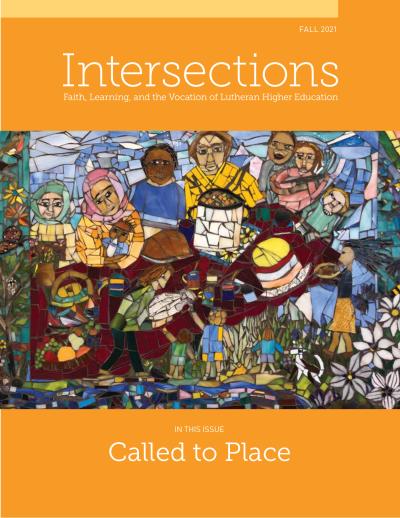 Editorial
From the Editor
Jason A. Mahn
Mahn introduces the “Called to Place” theme of the 2021 VLHE Conference, arguing that Lutheran higher education’s emphasis on vocation must be grounded in particular geographies and embodied communities — for, as Wallace Stegner put it, “If you don’t know where you are, you don’t know who you are.”
-
Article
Where Your Feet are Standing: Institutional Engagement and Place
Melissa Maxwell-Doherty
Maxwell-Doherty draws on Cal Lutheran’s Hispanic-Serving Institution designation and its location on Chumash, Fernandino Tataviam, and Ohlone lands to ask how the university’s mission might shift if it depended on where its students are standing — not just where the institution sits.
-
Article
Community-Building On Campus and Beyond
Krista E. Hughes
Hughes describes Newberry College’s effort to build a “culture of community” that mirrors South Carolina’s demographics while reckoning with the institution’s founding ties to slavery — and names the challenges and promising city-college collaborations that shape this ongoing work.
-
Article
Just Communities: From Liberal Arts in Prison to Racial Healing over Zoom
Monica Smith
Smith showcases how Augustana College’s commitment to social justice extends into the Quad Cities through two initiatives: the Augustana Prison Education Program at East Moline Correctional Center, and Racial Healing conversations developed through the Truth, Racial Healing and Transformation framework.
-
Article
Hospitality to the Wild
Laura M. Hartman
Drawing on research with a Wild Ones Native Landscaping chapter and Marilyn Matevia’s ethic of “creature comfort,” Hartman argues that Christian hospitality must extend to non-human animals and plants — and asks whether college campuses can foster not just human diversity but biodiversity.
-
Article
Return to Purpose: Learning in an Age of Collapse
Ahmed Afzaal
Afzaal argues that the cascading crises facing higher education are not temporary glitches but symptoms of planetary and civilizational collapse — and that colleges must embrace “double-loop” learning and return to a shared sense of purpose if they are to help humanity descend gradually rather than catastrophically.
-
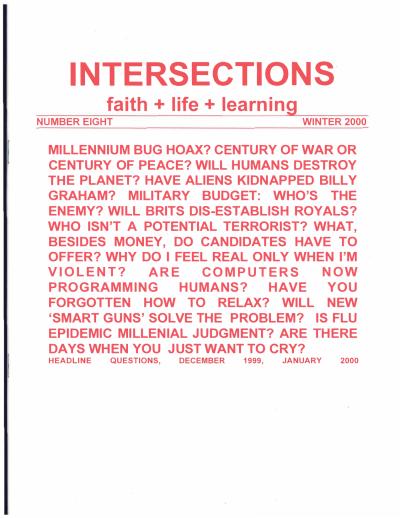 Editorial
From the Editor
Tom Christenson
No. 8 · Winter 2000
Christenson marks the eighth edition of Intersections, expresses gratitude to the ELCA Division for Higher Education and Schools and especially to the soon-retiring Bob Sorenson for backing the journal, the Vocation of a Lutheran College Conferences, and the Lutheran Academy of Scholars, and introduces an issue that gathers analyses and arguments from both insiders to Lutheran theology and outsiders, from veterans of the institutions and recent arrivals—voices that together remind us that what is and what ought to be need to inform each other.
-
 Institutional Focus
About Rooted and Open: The Common Calling of the Network of ELCA Colleges and Universities
No. 49 · Spring 2019
An institutional framing piece introducing Rooted and Open — NECU’s statement on Lutheran identity in higher education — with a roster of the faculty working group and writing team and an orientation to the essays in this special issue.
-
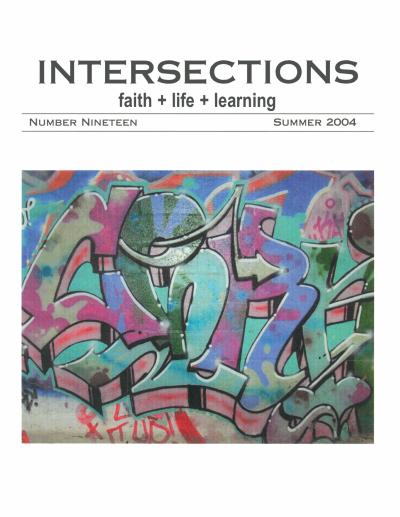 Article
Academic Vocation: What the Lutheran University has to Offer
Wendy McCredie
No. 19 · Summer 2004
Writing as a practicing Lutheran, a trained literary scholar, and the associate director for interpretation at the ELCA churchwide office, McCredie articulates a vocation for ELCA colleges and universities grounded in the dialogical tension Gilbert Meilaender names between “bonds of particular love” and “a love which is open to every neighbor.” Drawing on Berube and Nelson, Marsden, Pelikan, Schwehn, Toulmin, Simmons, Hughes, MacIntyre, and Wolterstorff, she argues that Lutheran tradition resists both the easy separation and the collapse of sacred and secular, that human reason errs while God’s grace makes action possible, and that listening to the marginalized and to those outside the tradition is itself a theology of the cross enacted in classroom and collegial life.
-
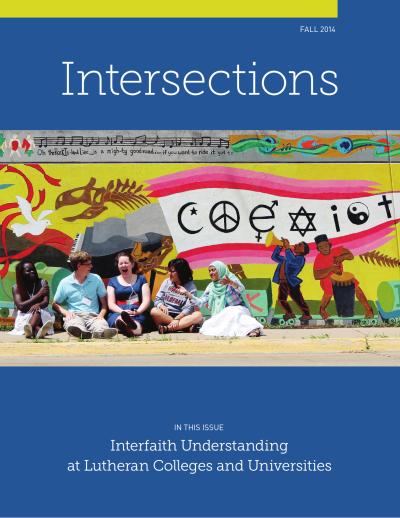 Reflection
Gifty Arthur
Gifty Arthur
No. 40 · Fall 2014
Reading John 10:3 as a Ghanaian Christian student at Luther College, Arthur reflects on how Luther’s Journey Conversations have deepened her own spirituality precisely by giving room for students to share the personal experiences and beliefs at the center of their own traditions.
-
 Article
Take Heart: Is Neutrality Really What We Need Right Now?
Abbylynn Helgevold
No. 57 · Spring 2023
Helgevold, an ethicist at Wartburg College, argues that calls for faculty neutrality on abortion in the post-Roe classroom stifle the courageous conversations Lutheran higher education is uniquely positioned to host — conversations grounded in “Rooted and Open” and the ELCA’s 1991 Social Statement on Abortion.
-
 Editorial
From the Editor
Tom Christenson
No. 18 · Fall 2003
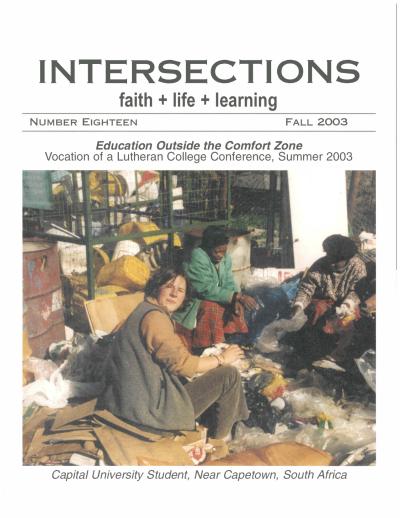
Christenson draws on a ten-year alumni survey at Capital University showing that students most often credit practica, internships, travel-study, and service-learning—not classroom hours—as the places they best learned the university’s stated outcomes, and introduces this issue’s papers from the Summer 2003 Vocation of a Lutheran College Conference on education and global outreach.