Here we are this beautiful morning in March, at a nexus of three currents of life pulling us into their rhythms. First, it is spring in Minnesota, and we can feel the earth starting to stir, starting to grow and green. Second, as faculty, staff and students we’re back from spring break heading into the final seven weeks of school. There is a lot of work to be done, and we may be uncertain about what the future holds, nevertheless, we know that the future will come, the end of the school year will be upon us before we know it, and we’ll be on our way even if we don’t know where we’ll be going. Third, for those of us who find strength and meaning in the church, we’re fresh from the joy and the drama of Holy Week and its passion—the crucifixion, the empty grave, and the resurrection. In this third rhythm, as with the rhythms of spring and the school year, we find ourselves asking “What is happening now? Where is this current pulling us?”
In the midst of these three currents, one might be forgiven for feeling somewhat overwhelmed! Spring, at least for me, is quite enough. It is difficult for me to concentrate. My senses are awakening after the longest slumber. I can smell the earth that has been dormant for too long coming back to life and hear the birds that have been absent. The cycle of birth and life is beginning again, and it makes me giddy.
Perhaps we might content ourselves with celebrating this rebirth of spring. Perhaps we ought to refuse attempts to synthesize its meaning with our own personal journeys, or the mythos of a religious narrative. Maybe spring should be protected against a religious desire to baptize and control it’s unruly energy. ee cummings, for example, seems to urge this resistance when he writes to the earth:
“ how often have religions taken thee upon their scraggy knees
squeezing and buffeting thee that thou mightest conceive gods
(but true to the incomparable couch of death thy rhythmic lover
thou answerest them only with spring)” (O sweet spontaneous)
Alternatively, if the brute naturalism of cummings is unpersuasive, we might try to connect spring with the rhythms of the Christian life, reading into its significance the innocence of the garden, as does Gerald Manley Hopkins when he wonders,
what is all this juice and all this joy?
A strain of the earth’s sweet beginning
In Eden garden –
Have, get, before it cloy
Before it cloud, Christ, land, and sour with sinning
Innocent mind and Mayday in girl and boy. (Spring)
But suppose you hesitate at this tug of spring; you might not find it so innocent. With Edna St. Vincent Millay, you might acknowledge that
The smell of the earth is good
It is apparent that there is no death
And yet, as she does, you might require better answers, noting
But what does that signify?
Not only underground are the brains of men
Eaten by maggots…
It is not enough that yearly, down this hill,
April comes like an idiot,
babbling and strewing flowers.
I leave it to you to decide which current you feel most strongly today, whether you feel swept up by the pulse and eternal rhythm of nature, or can also feel the pull of career, academy, and religious narrative. Regardless, we find ourselves here together this morning in the midst of spring and the Easter season, being called into a future that is redolent with promises of unruly growth, graduation and vocation, a future that is coming but a future that we cannot predict or control.
And the passage from Scripture read this morning, I’d like to suggest, speaks beautifully to our situation. A fragment of a poem taken from the Song of Songs, it offers another poetic voice to add to those I’ve mentioned. (Actually it offers two voices, two rather bold young lovers, a bride and a bridegroom in the P.C. version.
The young woman imagines her beloved, and in her anticipation compares him to spring itself bursting forth in the land, a gazelle bounding over the hills, the very picture of exquisite desire.
And in that bucolic setting, she tells us, she hears her beloved calling to her. He uses the occasion of the tempestuous promise of spring, to call:
Rise up, my darling; my fair one, come away.
For see, the winter is past! ….
Rise up, my darling; my fair one, come away.
To where is she being called? Why can’t he come to her where she is? And, if, following our Jewish and Christian forbearers, we read ourselves into this fragment somehow, we must also ask: To where are we being called in the spring? And who is calling us? And if we respond, will we be found?
With the right kind of imagination, I think, we ought to read ourselves and this spring morning into this biblical passage. Whether you manage to feel all three of the currents carrying us forward this morning or only one or two, I would like to suggest that at this very moment you are being stirred up to the rush and rhythm of something like love, provoked by a promise, called out of yourself by someone else.
Even if we were to focus only on the academic current, the language of love should hardly seem strange. The erotic attraction of truth and beauty and goodness has been an essential element of true liberal-arts learning since Plato penned dialogues like the Symposium and the Phaedrus. You may not realize it, but when you sit down to contemplate that end of the semester seminar paper, I’m suggesting, you’re being called by a kind of love. And how implausible is it really, to extend this excitement to the sense of spiritual journey that your life ought to have—how surprised should you be to discover that your late night jaunt to the L & M, or your chance encounter with a homeless woman on a street corner in the city was a moment for you to experience the agitation of new life presenting itself to you as awakening desire. Why can’t this call be understood in terms of the promise and frustrations of love?
Finally, suppose that you understand your spring, your academic search for knowledge, and your spiritual search for vocation in the context of Easter, suppose that you are flush with the surprise and joy of an empty grave. Consider the astonishing mix of terror and joy the two disciples felt as a result of their encounter on the road to Emmaus. Is it really so implausible to understand the provocations lying in wait for you this season in the same way? As hoped for but unpredictable meetings with the new surprising life to be found in your risen Lord?
In conclusion, let me return to the Song of Songs and observe an important point essential to understanding the kind of love that the text urges. While I’ve invited us all to read the text with imagination, we cheat ourselves if we spiritualize and allegorize too much or too quickly. Particularly as Christians, we may read the Songs as an allegory of Christ and the church; even so, I don’t think we should ignore the fact that the language of love here is the language of love in the spring, it is the language of flirtation, it depends on felt desire in its raw form—insistent, straining, delighting in and surrendering to and searching out the concrete details. She has more hope than cummings will allow. While the lover who calls the woman may be a symbol of Christ to Christians or God to Jews, the main character of the Songs is not the woman’s lover. It is undoubtedly the woman herself, and while she is young, she is not an innocent child to be comforted by a father figure who will keep her safe and secure. So the poet of the Songs offers a counter to Hopkins as well as cummings. It is this bold woman’s desire and her trust in this desire that is felt most vividly in the Songs. And if you read the rest of the Songs, you discover that her felt desire is not easily resolved. Hers is not a love of blessed assurance. Thus, while she is more hopeful than St. Vincent Millay, she does not respond to her request for better answers with pat guarantees. The woman searches for her lover, she tries to answer his call, but she does not seem to find him nor is it clear that she is finally found. This is not to say that she is not truly both lover and beloved; it is only to avoid simplifying or sentimentalizing the desire and love that animates her.
What does it mean then to read the Songs in the spring at St. Olaf? Like the woman in the Songs, you are being caught up in something and called by an elusive promise. “It is spring,” the voice says, “rise up and come away.” This love that can animate us may not be easy or smooth, but it is there if we pay attention and respond, it is coursing through our lives, pulling us into its current, as sure as spring is coming and as sure as our lives will continue to unfold and, we hope and pray, blossom.
-
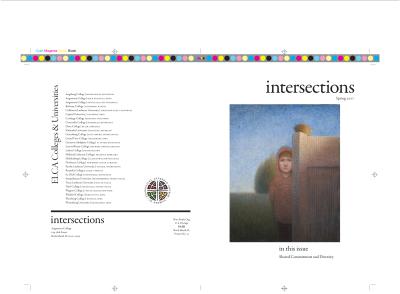 Editorial
From the Publisher
Arne Selbyg
Selbyg notes that most papers in this issue grew out of a pan-Lutheran conference organized by the Association of Lutheran College Faculties in fall 2006 rather than the annual Vocation of a Lutheran College conference, and argues that the ELCA’s ecumenical posture—truthful but open to learning from others—is a good foundation for institutions of higher education whose faculty likewise profess while remaining subject to change based on new research and insights.
-
Editorial
From the Editor
Robert D. Haak
Haak frames the issue around the question of what holds the twenty-eight ELCA colleges together amid their geographic, economic, and theological diversity, introducing Mark Hanson’s address to the assembled college presidents, Randall Balmer’s outsider perspective on the commonalities of Christian liberal arts, José Marichal and Pamela Brubaker on diversity rooted in community and globe, Storm Bailey’s argument that being Lutheran is precisely what makes us embrace diversity, and Jaime Schillinger’s St. Olaf chapel reflection on the formative power of worship and liturgy.
-
Article
Reflections on Our Shared Commitments
Mark S. Hanson
Originally delivered to the Lutheran Educational Conference of North America in March 2007, Hanson’s address describes the ELCA as “an ecology of interdependent ecosystems” and locates the church’s relationship to its twenty-eight colleges and universities in a shared mission rather than in older anxieties about church-relatedness. Drawing on Wittenberg’s Lutheran Identity Study, Augustana’s “Five Faith Commitments,” Pamela Jolicoeur’s Concordia address, W. Robert Connor on “big questions,” Joseph Sittler on grace, Walter Brueggemann on fear, Jonathan Strandjord on being “other-wise,” and Cynthia Moe-Lobeda’s Public Church for the Life of the World, he names four marks of shared mission: communities of free inquiry, encouragement of religious expression in a diverse society, education for the common good, and the formation of leaders for church and religious communities worldwide.
-
Editorial
Guest Editor
Madeleine Forell Marshall
Marshall introduces the four papers in this issue from the 70th annual meeting of the Association of Lutheran College Faculties, held at California Lutheran University in October 2006 on the theme “Identity and Diversity in the Lutheran College.” She notes a geographic pattern—the two East Coast contributors (Balmer and Bailey) defend Christian liberal arts against perceived suspicion, while the two Westerners (Marichal and Brubaker) treat Lutheran identity as advantage and diversity as a Lutheran given—and announces the 2007 ALCF meeting at Newberry College on “Beyond ‘Whatever’: Values Based Learning in Lutheran Higher Education.”
-
Article
Sojourners in a Pluralistic Land: The Promise and Peril of Christian Higher Education
Randall Balmer
Balmer, a Barnard scholar of American evangelicalism reared in evangelical parsonages and formed at Trinity College in the Chicago suburbs, defends public education even as he champions Christian higher education as a “halfway house” for students moving from religious subculture into a pluralistic world. Drawing on his own undergraduate experience, his books Mine Eyes Have Seen the Glory and Thy Kingdom Come, and a chastening visit to Patrick Henry College, he names three perils of Christian higher education—the Scylla of secularism (intellectual arrogance allergic to piety), the Charybdis of sectarianism (intellectual dishonesty as exemplified by intelligent design’s special pleading), and insularity—and prescribes mentors, primary sources, internships outside the subculture, and a broader, intergenerational pluralism on campus.
-
Article
Lutheran Identity, Academic Integrity, and Religious Diversity
Storm Bailey
Bailey argues that one might rightly say of a college “that’s a pretty good school because it’s religious,” defending the proposition under three headings: academic and curricular virtues, free inquiry, and religious diversity. Drawing on Mark Schwehn’s Exiles from Eden, Richard Hughes on the Lutheran tradition’s “most potent theological resources” for the life of the mind, Parker Palmer, Lendol Calder, Mill’s On Liberty, Newman’s Idea of a University, and the AAUP’s 1940 Statement, he proposes a “critical mass” alternative in which the Lutheran commitment to truth-seeking and self-critique itself requires—rather than tolerates—a religiously diverse faculty whose opposing voices are needed for the mission to flourish.
-
Article
Why Diversity and Civic Engagement Don't Talk to Each Other on College Campuses: The Need for Public Work
Jose Marichal
Marichal opens with Thurgood Marshall’s line from Milliken v. Bradley and traces the “decoupling” of campus diversity and civic engagement initiatives back to their shared grounding in Benjamin Barber’s “thin” or pluralist democracy. Reviewing CIRCLE data on youth political disengagement, the limits of mandatory volunteerism, and persistent residential segregation, and drawing on Mary Ann Glendon, Lani Guinier, Caryn McTighe Musil, and Richard Rorty, he argues that only Harry Boyte’s notion of “public work” can bind diversity and civic engagement together—and contends that Lutheran colleges, with their understanding of vocation as call into the world, are uniquely positioned to build that infrastructure.
-
Article
Rich and Poor in an Era of Globalized Religion and Economies: Challenges to Lutheran Colleges
Pamela K. Brubaker
Brubaker opens with two World Council of Churches communion stories—a generous Aymara potato meal in Bolivia and a gated invitation-only lunch at a prosperous immigrant German Lutheran church in Brazil—to frame the question of which stance Lutheran colleges will adopt toward diversity. Drawing on Richard Hughes and Ernest Simmons on Lutheran “ecumenical confessionalism,” Linell Cady, Ulrich Beck, Held and McGrew, the World Bank’s 2006 Equity and Development report, Mark Juergensmeyer’s Global Religions, Harvey Cox on the Market as God, the WCC’s “economy of life” / AGAPE document, and Larry Rasmussen on universal human rights, she argues that part of the academic work of Lutheran colleges is to educate for critical citizenship by questioning neo-liberal assumptions and equipping students to claim social, economic, cultural, civil, and political rights for the whole human family.
-
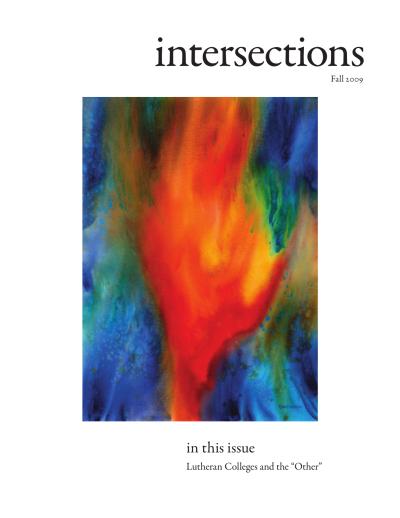 Article
Lutheran Colleges: Past and Prologue
Paul J. Dovre
No. 30 · Fall 2009
Dovre offers a reminiscence rather than a research paper, drawing on Aristotle’s ethos, logos, and pathos to trace fifty years of change at Midwestern Lutheran colleges through the key issues of survival, respectability, faithfulness, and relationship to the church — from the dependence of the 1950s through the independence of the late twentieth century to the partnership of the 2000s — and identifies key variables (the student marketplace, faculty formation, and the identity/diversity paradox) for shaping the identity and mission of Lutheran colleges into the future.
-
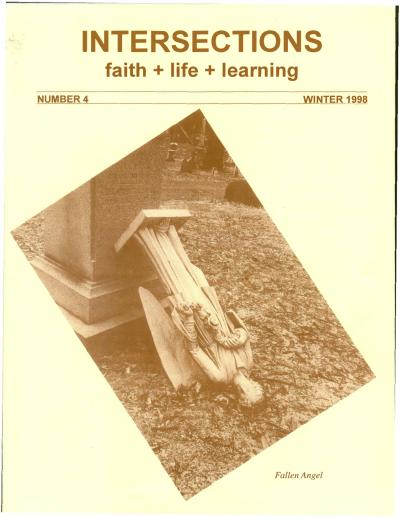 Editorial
The Vocation of a Lutheran College: Some Transitional Thoughts
James M. Unglaube
No. 4 · Winter 1998
Unglaube offers final reflections on thirty years in Lutheran higher education as he leaves the ELCA Division for Higher Education and Schools to join Carthage College, his alma mater. He recalls colleague Richard Solberg’s influence, the closing of Upsala College in 1995, the Higher Education and Namibia program shared with Naomi Linnell, the growth of endowments from $70 million to $1 billion in 25 years, and the Vocation of a Lutheran College project he credits Paul Dovre with inspiring. He likens the twenty-eight ELCA colleges to flowers on a rose bush—same Lutheran tradition, each blossom different—requiring constant nurture if the partnership between church and college is to thrive.
-
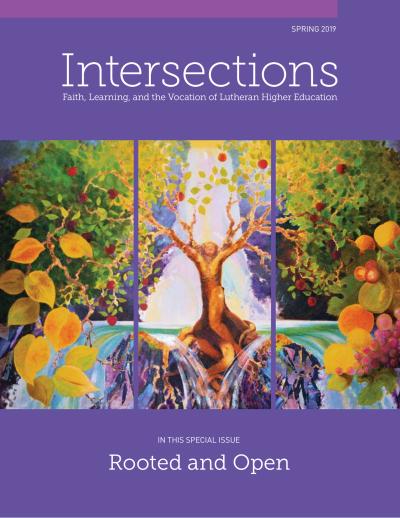 Article
Roots and Shoots: Tending to Lutheran Higher Education
Jason A. Mahn
No. 49 · Spring 2019
Mahn revisits why “education-for-vocation” has become a leitmotif for the 27 NECU schools, distinguishes institutional vocation from individuals’ religious identities and educational priorities from their theological grounding, and offers a friendly critique of Jodock’s bridge metaphor: Lutheran colleges grow in two directions like plants — deep roots and wide branches alike require constant tending.
-
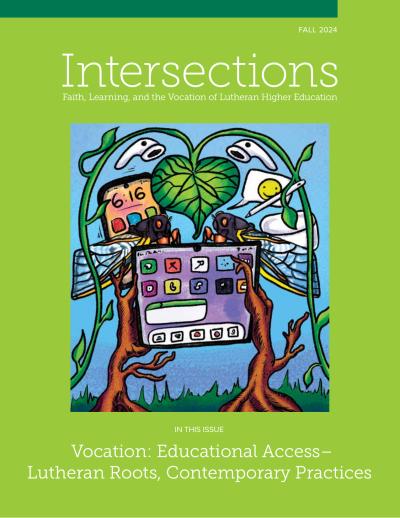 Reflection
Reflecting on Belonging
Melissa Woeppel
No. 60 · Fall 2024
Woeppel, campus pastor at her own alma mater, wrestles with a Bethany student’s plea — “I want to feel like this is my home, like I belong” — and Mindy Makant’s reminder that we don’t choose the story of the past but do choose how we tell it forward, opening space for students from 35 faith traditions to find Lutheran institutions to be their home.
-
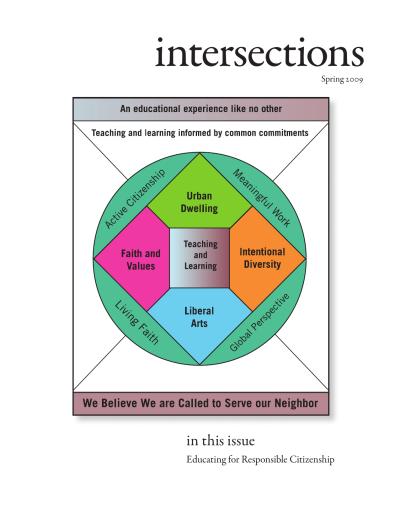 Article
Dual Citizenship: Reflections on Educating Citizens at Augsburg College
Paul C. Pribbenow
No. 29 · Spring 2009
Pribbenow argues that the vocation of Augsburg College is to educate “dual citizens”—those able to live within the messiness of common work rather than resolve every tension once and for all. Drawing on John Courtney Murray on democracy as “the intersection of conspiracies,” Bill Moyers, Jean Bethke Elshtain, Stephen Carter, and the Augsburg vision statement “We believe we are called to serve our neighbor,” he names four common commitments and five principles of civic education that ground Augsburg’s incarnational mission in its city neighborhood.
-
 Editorial
From the Publisher
Mark Wilhelm
No. 34 · Fall 2011
Wilhelm bids farewell to Robert D. Haak, who is leaving the editorship of Intersections and the Augustana College Center for Vocational Reflection for a chief-academic-officer post at Hiram College in Ohio, and welcomes Jason A. Mahn as the incoming editor. He celebrates Haak’s tireless work to integrate the Lutheran concept of vocation into the practices and rhetoric of Augustana and ELCA higher education through six years of Intersections, and frames the journal as a vital tool for sustaining the conversation about education in a Lutheran key—even at colleges and universities where most students, faculty, and staff are not Lutheran themselves.