What it Means to Build the Bridge: Identity and Diversity at ELCA Colleges
Intersections No. 40 · Fall 2014
I’d like to open with the stories of two good friends of mine, women who work at senior levels at Interfaith Youth Core.1 Both were devoted Christians when they went off to Midwestern liberal arts colleges in the 1990s, campuses that have much in common with yours in terms of size and liberal arts ideals, but do not happen to be Lutheran.
Cassie
I’ll begin with Cassie’s story. Cassie grew up in a largely secular household in the Seattle-area and converted to Evangelical Christianity when she was in high school. She loved the closeness of the community and the fervor of the faith. When she got to college in upstate Wisconsin, she discovered that there were only enough active Christians on campus to form a single student group. It included people who grew up speaking in tongues and those more accustomed to smells-and-bells rituals. At first, Cassie had a hard time praying with Catholics; she’d been taught in her church back home that they weren’t really Christian. But soon Catholics were the least of Cassie’s theological worries.
One day in the library, Cassie was approached by a young man she’d been seeing around campus. He carried a notebook in his hand and asked if he could sit down. Cassie said sure, and Ahmed plunged into his purpose. He had to do a project for an Anthropology 101 class on an exotic tribe. He’d been noticing that Cassie’s Christian group had a distinct set of rituals and symbols; they even seemed to speak a special language. He was wondering if he could do the project on her.
This surprised Cassie, especially as it was coming from a dark-skinned man with an accent. From her perspective, if either of them could be described as being a member of an exotic tribe, it wasn’t her. But she agreed to answer Ahmed’s questions. And once she’d explained the purpose of her Wednesday night song circle and the meaning the Bible held for her, she turned the Anthropology 101 assignment on her interlocutor. She learned a little about Islam in the process. Ahmed explained that he was from Bangladesh, that observant Muslims pray five times a day and refrain from alcohol, and that the majority of the world’s Muslims live in South Asia, not the Middle East.
Cassie found herself shook, in the way college ought to shake people. First of all, she was stunned that observant Muslims pray five times a day, including a pre-dawn prayer. She could barely get some of her fellow Christians out of bed by mid-morning on Sundays for church. The more Cassie thought about the encounter, the more challenged she felt. It had been deeply impressed upon Cassie by her home church that people who were not Christian were going to hell and that it was a signal duty of practicing Christians to seek to convert them. Yet she found herself a little uncomfortable with that approach in this particular scenario. It’s not that she didn’t believe in the truth of Christianity, it’s just that she also found herself fascinated by Islam, and she realized that she both liked and admired Ahmed.
In the following weeks, as their friendship grew, Cassie experienced something of a crisis of faith. Was she being a bad Christian if she didn’t view her interaction with Ahmed as primarily an opportunity to evangelize? Was she being a false friend to him if every time they were together she was looking for ways to sneak in the truth of Jesus Christ? Finally, Cassie went to see a pastor about the situation. He listened with great sympathy, but what he offered in return was almost entirely saccharine. He talked about the mystery of faith and the beauty of diversity. The message Cassie came away with was that college was a time to explore new things and that it was important to be a nice person. But honestly, she was looking for more than that. She was looking for a distinct Christian language for building a deep friendship with someone who she admired but who did not hold the same truths that she did.
April
My second story is about April Kunze Mendez. Growing up in Minnesota, April was the poster child for church involvement. She led Bible studies and prayer circles; she participated in church camps and went on mission trips to the other side of the world. She even learned other languages so that she could proselytize more effectively. April went to a selective liberal arts college in Minnesota in the mid-1990s. The same year she was the leader of her campus Christian group, a mosque was burned down in the Twin Cities. There were claims that it was arson, a religiously-motivated hate crime. April was on a state-wide email list of religious leaders, where she received a message from the Imam asking her to attend a candlelight vigil in support of the mosque. She instinctively wrote back “yes.”
The following week, at a meeting of her campus Christian group, April shared the email request and said she’d be organizing a van for people who were able to attend the vigil with her. There was some shifting in seats and some rustling in the back of the room. April asked what was up. A member of the group stood and said, “We think you are supporting devil worship.” He then got out his Bible and started quoting chapter and verse about the wickedness of praying to false Gods and the importance of bringing people to the true path. Other people started speaking in the same vein. Somebody said that this fire, however it might have started, was an act of God, divine punishment for those who followed the wrong religion. Another claimed that true Christian charity at this time would be to use this opportunity to invite the misguided Muslims to their church and evangelize them.
It soon became clear to April that her Christian group was not going to attend the vigil with her. When April insisted she was still going, they declared her unfit for Christian leadership, and deposed her. The people who went to the candlelight vigil with April were called nice; the people who applauded the arson attack on the mosque were called Christian. April started to feel like those were not just distinct responses to this incident, but separate paths altogether. So this once-poster child for the church felt like she had to make a tragic choice—in a world of diversity, she could be nice to people from different religions, or she could be Christian. She chose the former, but not without an awful lot of pain.
Fundamentalism and Relativism
What strikes me about Cassie and April’s respective experiences is that they illustrate what the great social theorist Peter Berger characterized as two especially prominent religious paths today—relativism and fundamentalism. April’s story is, of course, an example of a form of fundamentalism. It’s not violent fundamentalism—we have comparatively little of that in America, thank God—it’s a fundamentalism best characterized as: Being me is based on dominating you. Cassie’s story is one version of relativism—not cognitive relativism or moral relativism, but identity relativism. It can be summarized like this: I no longer know who I am when I encounter you.
We are all well aware of the dangers of fundamentalism. We read about its more violent expressions in the newspaper every day, and likely deal with the dimension that April encountered (the nonviolent though quite vocal domination approach) at least occasionally. In this essay, I want to focus on the challenge posed by Cassie’s experience—relativism. Certainly, relativism is less ugly and less dangerous than fundamentalism. But in my experience working on over a hundred college campuses and speaking with thousands of college students, it is far more prevalent.
“Certainly, relativism is less ugly and less dangerous than fundamentalism. But in my experience working on over a hundred college campuses and speaking with thousands of college students, it is far more prevalent.”
The sociologist of religion Christian Smith has given this form of identity relativism a name: moralistic therapeutic deism. In his book Soul Searching, the product of the most comprehensive survey of young people and religion ever undertaken, Smith talks about how the religious identities of most young Christians basically boil down to this: God exists and wants me to be a good person. Smith comments on how Christian young people are articulate about all sorts of things, from the dangers of drugs to the importance of safe sex, but have little more to say about religion than noted above. Drawing from the philosopher Charles Taylor, Smith emphasizes that “articulacy fosters reality”—in this case, the reality of identity (Smith 268). Simply put, this means if you can’t talk about Christianity, it’s very hard to be Christian.
Why this inarticulacy? Smith posits that it may well be the result of being trained to be polite in a world of diversity. Here, I will quote him at length:
Committed and articulate personal and congregational faith does not have to be sacrificed for the sake of public civility and respect for others who are different. Pluralism does not have to produce thinness and silence. But for it not to, people need to learn to distinguish among…(1) serious, articulate, confident personal and congregational faith, (2) respectful, civil discourse in the pluralistic public sphere, and (3) obnoxious, offensive faith talk that merely turns people off. … In efforts to be civil and accessible, it seems that many youth, and no doubt adults, are getting the wrong message that historical faith traditions do not matter, that religious beliefs are all alike, that no faith tradition possesses anything that anybody particularly needs. (Smith 268)
This is certainly the message Cassie got from the Christian minister that she talked to about her experience with Ahmed. I’ve taught several seminary classes for liberal Protestants and asked them to role play the scene between Cassie and this Christian minister. They play the Cassie character exceptionally well. It’s clear that they have all experienced a profound encounter with diversity that shook their faith along the lines of what happened to Cassie. But these seminarians universally had a difficult time being articulate about Christianity when playing the role of pastor. Like the pastor Cassie talked to when she was in college, they spoke the language of mystery, diversity, love, and friendship. Occasionally, they attached all this to the Holy Spirit, but that was about the limits of their faith vocabulary when it came to giving a young Christian like Cassie advice about what it meant to be both committed to the truth of Jesus and friends with a Muslim.
If there was one thing at the center for these future ministers it was attention to diversity. They cared about it in all its forms—race, ethnicity, gender, sexuality, class, religion. Thinking back to our class discussions through the lens of Christian Smith’s research, I find it entirely plausible that this concern for diversity thinned out their language of Christian identity.
For Peter Berger, while relativism and fundamentalism are at opposite extremes, they are actually closely connected in that they are both “products of the same process of modernization” (Between 2). As he emphasizes in the Introduction to Between Relativism and Fundamentalism, frequent and intense encounters between people with different identities is the signature characteristic of the modern era. In Berger’s pithy phrase: modernity pluralizes. This is a consequence of a variety of technological breakthroughs from mass communications to air travel, resulting in everything from rapid urbanization within nations to easy migration between them to knowledge of the beliefs and actions of people who live on the other side of the world. The bottom line is that more people regularly interact with people different from them today than ever before.
If modernity pluralizes, then, Berger claims, “pluralism relativizes … both institutionally and in the consciousness of individuals” (5). In the pre-modern era, institutions, ideas, and identities had a largely taken-for-granted status. For the vast majority of human history, the vast majority of humankind had little to no choice about which institutions they were going to participate in or what their identities were going to be. Such matters were experienced as fate. In the modern era, institutions become voluntary associations—people choose whether to participate—and identity has moved from “fate to… choice” (6). This puts an awful lot of pressure on moderns like us to constantly make conscious choices about what we participate in and who we are. This is pressure that our ancestors, who simply took for granted the network of institutions they grew up in and the identities they were handed, simply did not have.
One response to this pressure is to float uncomfortably in the mists of modernity, not committing to much of anything. This is the dynamic that produces relativism. But as human beings are hardwired for certainty, and because where there is a demand someone will generate a supply, the explanation for growing fundamentalism is pretty clear as well. So there you have it—a quick explanation for how the phenomenon of modernity pluralizing produces both Cassie’s experience of relativism and April’s encounter with fundamentalism.
From Blasé to Bridge
I believe that some version of Cassie and April’s stories are happening on a regular basis on ELCA college and university campuses. These encounters take place in classrooms and cafeterias, in dormitory conversations and on the quad, in RA training and during freshman orientation. And that is as it should be. Campuses are places where students ought to have intense interactions with deep difference and wrestle with what that means for who they are. But how frequently is the result of such encounters some form of relativism or fundamentalism? And what are the implications for campuses that both seek to be rooted in their Lutheran traditions and welcoming of diversity?
Right now some of you might be thinking about the voices in your communities who grumble about pro-active approaches to diversity. I imagine that among some of your alumni, perhaps even your donors and board, there are those who say, “A Lutheran college is where Lutherans go to become more Lutheran. What are we doing allowing Muslims and Jews and atheists and pagans in, letting them have their own student groups, accommodating their religious practices, even teaching courses about their traditions? What’s up with having a Hindu chair the Department of Religion at St Olaf?”
If Peter Berger and Christian Smith are to be believed, and if my experience with the liberal Christian seminarians above is at all telling, then such critics are far more than just cranks. Diversity does in fact undermine identity—at least it can. To complicate matters even further, the sociologist Robert Putnam has shown that diversity reduces social capital and weakens community bonds. And the political scientist Samuel Huntington famously posited that increased interaction between different identities is a recipe for outright conflict—his infamous clash of civilizations thesis. Simply put, diversity is not an unalloyed good.
“Can campuses be places that do both identity and diversity? I think the answer to that is yes, and I think Lutheran campuses have an especially good shot at it.”
Here’s the fundamental question: Can campuses be places that do both identity and diversity? I think the answer to that is yes, and I think Lutheran campuses have an especially good shot at it.
Let me go back to the scholars for a moment. Peter Berger is not just a describer of “what is,” he is also an articulator of “what ought to be.” He despairs about the growth of both relativism and fundamentalism, claiming that they make a common life together impossible, even as he understands how the dynamics of our times have given rise to both phenomena. Berger hopes to stake out a middle position, what he refers to as “the location of those who want to be religious believers without emigrating from modernity” (Between 13).
Christian Smith holds out this same hope, stating that there is plenty of room for faith traditions to claim and emphasize confidently their own particularities and distinctions without risking religious division or conflict. Youth should be able to hear and embrace (or reject) what are the particularities of their own faith traditions and why they matter, without having to be afraid that this inevitably causes fighting and discomfort (268).
Peter Berger also happens to be a Lutheran layperson, quite conversant both in Lutheran theology and history. He points out that it was the Lutheran tradition that first recognized the possibility “to have faith without laying claim to certainty” (13). Moreover, Lutheran intellectuals were among the first to take the courageous step of putting modern historical scholarship in conversation with elements of faith and scripture. He expands on these notions in an essay in the book Between Relativism and Fundamentalism (152-163). For the purposes of this essay, I want to consider what this heritage means for ELCA college campuses.
Let me begin with a quick typology of religious identity responses to diversity: faith can be a bubble of isolation, a barrier of division, a bomb of destruction, or a bridge of cooperation. A fifth response—the final “b”—is blasé. Faith can be something we neither care too much about nor think too much of. Barriers and bombs—the fundamentalist response—are actively destructive in a diverse democracy. Bubbles are extremely hard to build and maintain (that’s one answer to give your alum who ask why Lutheran colleges are no longer just for Lutherans seeking to be more Lutheran). Blasé seems to be the order of the day, and the question then is how do you help shift the tide from blasé to bridge? I think the answer lies in the metaphor.
A bridge goes from here to there and has to be made of something, preferably something solid. Without a strong anchor “here,” you can’t bridge to “there.” Furthermore, without the materials and the skills to build the bridge, it won’t come into being. For Cassie to continue a Christian conversation with a knowledgeable Muslim like Ahmed, she needs to know an awful lot more about Christianity than the pastor she spoke to was offering. My guess is that Ahmed was hoping for that. After all, he was standing on his “here,” using the materials of his knowledge of Islam to build a bridge to Cassie’s “there.” For the conversation to be enriching for him—to borrow a phrase from a master—there has to be a there there (Stein 289).
“The answer to the problem of nurturing both identity and diversity—of carving out a religious location that does not flee from modernity—is not to weaken either. It is to do more of both.”
The answer to the problem of nurturing both identity and diversity—of carving out a religious location that does not flee from modernity—is not to weaken either. It is to do more of both. Brian McLaren puts this well in his recent book on Christian faith and religious diversity, Why Did Jesus, Moses, the Buddha, and Muhammad Cross the Road?. He points out that strong Christian identity has long been associated with hostility towards others, while positive feelings towards others are connected with weak Christian identity. He wants a third alternative—strong faith identity associated with benevolence towards others. He quotes one of his mentors, “In a pluralistic world, a religion is judged by the benefits it brings to its nonmembers” (40). This is what I have started calling a theology of interfaith cooperation. It means being able to weave from your own religion’s resources—its scripture, doctrines, history, theology, poetry, heroes, etc.—a coherent narrative and fundamental logic for being in positive relation with others, even though you disagree with them on some significant things. This is the substantive material from which we form the bridge that connects here and there, a bridge that can withstand bombs and break through barriers, a bridge that invites people out of their bubbles, and a bridge that provides solid footing for those floating in the blasé.
The Example of Dietrich Bonhoeffer
Many readers will know better than I the finer points of how to use the raw materials of the Lutheran tradition to build a bridge to diversity. What I’d like to do right now is hold up a Lutheran figure who has deeply inspired me as a Muslim, a man who both eloquently articulated and courageously embodied a theology of interfaith cooperation, Dietrich Bonhoeffer. It is not an overstatement to say that his Christian identity was about building a bridge to diversity. Indeed, it was the cause he died for. Consider the following scenes from Bonhoeffer’s life:
Bonhoeffer declaring after the Nuremberg Laws were passed in 1935: “Only he who shouts for the Jews is permitted to sing Gregorian chants” (Nelson 35).
Bonhoeffer preaching at the funeral of his grandmother in 1936. She was a woman who—just days after Hitler ordered Germans to boycott Jewish businesses—walked into a Jewish-owned grocery store right past a group of Nazi stormtroopers, stating that she would do her shopping where she always did her shopping. Bonhoeffer eulogized, “She could not bear to see the rights of a person violated… her last years were darkened by the grief that she bore about the fate of the Jews in our country…This heritage, for which we are grateful to her, puts us under obligation” (Nelson 26).
“Bonhoeffer famously asked, ‘What does Jesus Christ mean for us, today?’ He answered that question with his life, a life rooted in the cement of genuine conviction, a love and mastery that built out of the Lutheran tradition a bridge to everyone.”
Bonhoeffer, returning to the United States in 1939 to teach a summer course at Union Theological Seminary and go on a lecture tour organized by Reinhold Niebuhr, realizes that he made a mistake. He boards the last ocean liner that sails east across the Atlantic during World War II, leaving Niebuhr with a letter that says: “I will have no right to participate in the reconstruction of Christian life in Germany after the war if I do not share the trials of this time with my people” (Nelson 38).
Bonhoeffer in the wan light of Cell 92, Tegel prison, writing to his friend Eberhard Bethge: “The church is only the church when it does for others” (Green 130).
In a school house turned prison near the Nazi extermination camp at Flossenbürg on April 8, 1945, a small group of prisoners who know the inevitable has arrived asks Bonhoeffer to lead a prayer service for them. He offers a meditation on I Peter: “By his great mercy he has given us a new birth into a living hope” (Nelson 44). Dietrich Bonhoeffer was assassinated by the Nazis the next day. Upon hearing of his martyrdom, Niebuhr wrote, “The story of Bonhoeffer…belongs to the modern acts of the apostles” (Nelson 22).
Such a commitment does not emerge from the ether of relativism. In Tegel prison Bonhoeffer famously asked, ‘What does Jesus Christ mean for us, today?’ He answered that question with his life, a life rooted in the cement of genuine conviction, a love and mastery that built out of the Lutheran tradition a bridge to everyone.
The scholar Keith Clements describes how Bonhoeffer’s ecumenism is what connects his pilgrimage from peace-worker to political resister. In 1931, Bonhoeffer accepted an invitation to an ecumenical conference. In the mid-1930s he began making plans to go visit Gandhi (plans that came to an end when he was called to lead the Confessing Church’s illegal seminary at Finkenwalde). He said of the Mahatma, “Christianity in other words and deeds might be discovered…in Gandhi and the East.” Bonhoeffer’s last known words before he was killed were a message for his friend and mentor in the ecumenical movement, Bishop George Bell: “Tell him…with him I believe in the principle of universal Christian brotherhood which rises above all national interests, and that our victory is certain.”
But Bonhoeffer saw problems in the ecumenical movement as well. He said in a speech at an ecumenical youth peace conference in 1932:
Because there is no theology of the ecumenical movement, ecumenical thought has become powerless and meaningless, especially among German youth, because of the political upsurge of nationalism. And the situation is scarcely different in other countries. There is no theological anchorage which holds while the waves dash in vain … Anyone concerned with ecumenical work must suffer the charges of being unconcerned with the Fatherland and unconcerned with the truth, and any attempt at an encounter is quickly cried down. (Clements 160)
As I read this critique today, nearly a century after Bonhoeffer made it, it occurs to me that the development of theology isn’t the primary problem when it comes to bridging identity and diversity. Since Bonhoeffer we have had untold numbers of important figures who have written interfaith and ecumenical theologies—Diana Eck, Abraham Joshua Heschel, Martin Luther King Jr, Fazlur Rahman, Farid Esack, Paul Knitter, Hans Kung, Catherine Cornille, and Jonathan Sacks, to name just a few. The problem is moving this theology from seminar rooms at Harvard Divinity School and Union Theological Seminary to articulacy amongst a critical mass of a rising generation. And that is where your institutions come in.
High Impact Interfaith Practices
A religiously affiliated college is the rare institution with the natural resources to cultivate a strong, benevolent faith, to bridge identity and diversity, to help a critical mass of young people develop articulacy in a theology of interfaith cooperation. Unlike a congregation or most other church bodies, you have religious diversity in interaction. Unlike a public institution, you have a clear and strong faith heritage. Unlike the vast majority of our society, you neither infantilize young people nor treat them primarily as purchasers of your products. Instead, you ask them to inquire into their vocations and empower them to be leaders. Unique amongst all institutions, you have an intense residential community, exceptional intellectual and pastoral resources, and an ethos that prizes respect for identity, relationships between different communities and a commitment to the common good. You are both a laboratory for interesting new ideas and a launching pad for the nation’s future leaders.
“A religiously affiliated college is the rare institution with the natural resources to cultivate a strong, benevolent faith, to bridge identity and diversity, to help a critical mass of young people develop articulacy in a theology of interfaith cooperation.”
So how should you take advantage of your unique environments when relativism and fundamentalism seem woven into the dynamics of the age? I think the answer is to name the challenge and face it head on, to recognize that if you are not proactive about becoming an ecology that nurtures articulacy about religious identity bridging to religious diversity, you forfeit your campus community to the overriding forces of our times.
I remember trying to find language that expressed this urgency at a lunch meeting with President Richard Torgerson of Luther College about five years ago. Luther College had chosen my book Acts of Faith as its common read, and had invited me to give the first-year convocation. I was fumbling around for words when Rick stopped me and said, “Luther recently put into its strategic plan that no student should be able to graduate from our college without wrestling with how their actions will impact the environment. It is one of the principles we have built our curriculum and co-curricular activities around. It seems to me like you are saying that interfaith cooperation ought to be at that level of significance for campuses?”
“That’s exactly what I am saying,” I responded.
So how does a campus do this work? Interfaith Youth Core (IFYC) will soon be putting out a list of high impact interfaith practices for campuses. Let me highlight a handful right now.
Mission
The first high impact practice is to connect interfaith cooperation to the mission and values of your college, and to state this clearly in the strategic documents that guide your campus. Over the past two years, we have partnered with Concordia College in this endeavor, and senior campus officials have recently put together this statement:
Concordia College practices interfaith cooperation because of its Lutheran dedication to prepare thoughtful and informed global citizens who foster wholeness and hope, cultivate peace through understanding, and serve the world together. (see Concordia)
There is a high-level conversation happening at Concordia about how that statement should be connected to the mission statement of the college.
Ecology
The second high impact practice is to not see your interfaith efforts as a single program, but as integrated into your entire campus ecology. At IFYC, we think there are three parts to this:
- Integrate the curricular and co-curricular. One of the advantages of colleges like yours is the barriers between your academic departments and your student affairs programs are relatively low. As interfaith leadership is about scholarly study, vocational discernment, and effective application, campus units that primarily encourage reading and writing (academic departments) and campus units that specialize in personal reflection and applied skill-building (frequently units in student affairs like service-learning, university ministry, and diversity programming) should be working closely together.
- Create a “horizontal.” All of your students should get some robust touch with religious diversity issues (preferably in an integrated fashion, as noted above). Religious identity/diversity themes should be woven into initiatives that touch the majority of your students, such as freshman orientation, large service-learning days, and convocations. Furthermore, texts and modules on interfaith cooperation should be integrated into required general education courses. Other high priority issues like sustainability, racial diversity, and global learning have integrated horizontals that ensure most students substantively engage with them. So should interfaith issues.
- Create a “vertical.” For students who are inspired by their touch with interfaith issues in the horizontal, there ought to be integrated curricular/co-curricular ladders that they can climb to increase their expertise. These verticals can take the form of a course sequence where students can get a minor and/or a certificate in interfaith studies or leadership, or a student group that is large and well-organized enough for students to take leadership in it, to serve as officers, and to organize activities for the broader campus. One concrete benefit of having this ladder is that students in the vertical lead activities in the horizontal.
Staff and Faculty Conversations
Interfaith Youth Core did a consultation with DePaul University and in one of the interviews a staff member commented, “We love religious diversity at DePaul even though we are Catholic.” When I mentioned that to the President, Father Holtschneider, he said, “When we are done with our next five year plan, every faculty and staff person will be able to say, ‘We love religious diversity at DePaul because we are Catholic,’ and will be able to tell you specific Vincentian reasons for why that is the case.” In order for that to happen, the subject of interfaith engagement has to become central to your faculty and staff agenda. This means things like:
- Making it the topic of your faculty convocations;
- Bringing in speakers who would draw a faculty and staff crowd to their talks;
- Sending faculty and staff to relevant conferences; and
- Encouraging and incentivizing your faculty and staff to develop courses and programs in this area.
Measuring
One of the most important developments in the field of interfaith cooperation is the move from “let’s do an interfaith something” to “let’s do an interfaith something that’s effective.” The field is long overdue for an effectiveness discourse, and this means evaluation. Measurement should not feel suffocating and does not have to be entirely quantitative. It does require you to state your goals clearly up front, and to devise evaluations that answer to key questions: How well are our programs achieving our goals? How should we improve these programs to more effectively achieve our goals in the future? In other words, the great gift of evaluation is to encourage your strategy team to set clear goals, to devise programs that you believe will meet those goals, and to create a mechanism for continuous reflection and improvement.
Conclusion: Places Where the Light Falls
I once had a conversation with Martin Marty about Bonhoeffer and Lutheran resources for a theology of interfaith cooperation. What he said to me then applies profoundly to Lutheran colleges and universities. He spoke of Bonhoeffer and the Confessing Church and the seminary at Finkenwalde as archetypes. He pointed out: “We live by examples, and these examples define. They are like a clearing in the wood; it is where the light falls, it is where cultivation occurs.”
At a time when it feels like the only faith options are relativism and fundamentalism, I think ELCA higher education institutions are examples—places that define, places where the light falls. I think this is precisely the purpose of your Lutheran colleges. As I was leaving Marty’s home, he quoted Goethe to me on the task of reaching into the resources of one’s tradition to advance an ethic of interfaith cooperation. I will leave you with the line he left with me: “What you have as heritage, take now as task. For thus you will make it your own.”
Endnote
1. These stories are told in full in Eboo Patel, Sacred Ground, 129-52.
Works Cited
Berger, Peter, ed. Between Relativism and Fundamentalism: Religious Resources for a Middle Position. Grand Rapids: Eerdmans, 2010.
—. The Heretical Imperative: Contemporary Possibilities of Religious Affirmation. Garden City, NY: Anchor/Doubleday, 1980.
Clements, Keith. “Ecumenical Witness for Peace.” The Cambridge Companion to Dietrich Bonhoeffer. Ed. John deGrutchy. Cambridge University Press, 1999. 154-72.
Concordia College, Moorhead, Minnesota. “2014 Annual Report to ELCA Synods and Congregations.” Accessed 1 August, 2014, http://www.swmnelca.org/PDF/2014%20assembly/2014concordia_college.pd
Green, Clifford. “Human Sociality and Christian Community.” The Cambridge Companion to Dietrich Bonhoeffer. Ed. John deGrutchy. Cambridge University Press, 1999. 113-33.
Huntington, Samuel. “The Clash of Civilizations?” Foreign Affairs (Summer 1993): 22-49.
Marty, Martin E. Dietrich Bonhoeffer’s Letters and Papers from Prison: A Biography. Princeton University Press, 2011.
McLaren, Brian. Why Did Jesus, Moses, the Buddha, and Muhammad Cross the Road?: Christian Identity in a Multi-Faith World. New York: Jericho, 2012.
Nelson, F. Burton. “The Life of Dietrich Bonhoeffer.” The Cambridge Companion to Dietrich Bonhoeffer. Ed. John deGrutchy. Cambridge University Press, 1999. 22-49.
Patel, Eboo. Sacred Ground: Pluralism, Prejudice, and the Promise of America. Boston: Beacon, 2012.
Putnam, Robert D. “E Pluribus Unum: Diversity and Community in the Twenty-first Century.” The 2006 Johan Skytte Prize Lecture. Scandinavian Political Studies 30.2 (2007): 137–74.
Smith, Christian with Melinda Lundquist Denton. Soul Searching: The Religious and Spiritual Lives of American Teenagers. New York: Oxford, 2005.
Stein, Gertrude. Everybody’s Autobiography. New York: Random House, 1937.
-
 Editorial
From the Publisher
Mark Wilhelm
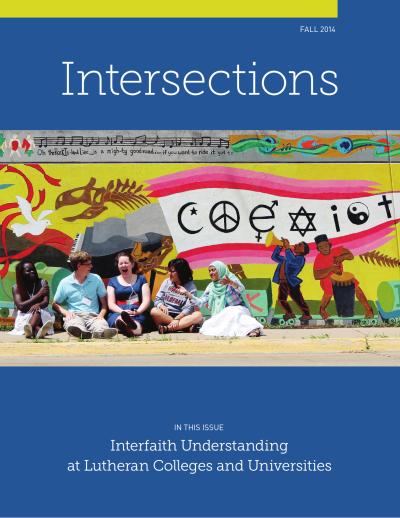
Wilhelm draws a parallel between the rediscovery of vocation and the rediscovery of interfaith understanding in Lutheran higher education, arguing that previously under-emphasized aspects of the Lutheran tradition point us to interfaith work and that an authentic Lutheran college or university will make interfaith understanding a feature of its mission.
-
Editorial
Guest Editorial
Kristen Glass Perez, Richard Priggie
Glass Perez and Priggie introduce the issue by recounting the campus conversations and the June 2014 Interfaith Understanding Conference at Augustana College that gave rise to it, framing the central question, “What does it mean to be Interfaith at a Lutheran College?,” as a living example of the praxis of being a Lutheran college in the twenty-first century.
-
Article
Vocational Re-Formation for a Multi-Religious World
Elizabeth Eaton
ELCA Presiding Bishop Elizabeth Eaton frames vocational formation for a multi-religious world as one of the most significant challenges facing the church and the liberal arts today, calling ELCA colleges and universities to live into Darrell Jodock’s “third path” that is both deeply rooted and dialogical.
-
Article
Why Interfaith Understanding is Integral to the Lutheran Tradition
Jason A. Mahn
Mahn returns to the root of the Lutheran tradition — church, theology, and pedagogy — to argue that interfaith encounter is not the vanishing point of Lutheran identity but central to it, beginning with confession of Luther’s anti-Judaic legacy, working through the typology of exclusivism / inclusivism / pluralism, and showing how the kenotic Christ and the theologian of the cross open Lutherans to authentic encounter with religious others.
-
Reflection
Danya Tazyeen
Danya Tazyeen
Tazyeen, a Pakistani-American Muslim student at Augustana College, reads Qur’an 49:13 — that God made us into peoples and tribes “that you may know one another” — as a charge to break down fear with open dialogue and to see one another as flawed and relatable fellow human beings.
-
Article
Building on a Firm Foundation: ELCA Inter-Religious Relations
Kathryn M. Lohre
Lohre traces the ELCA’s twenty-year arc of inter-religious work — from the 1994 Declaration to the Jewish Community and the Lutheran-Jewish Consultative Panel, through the post-9/11 Lutheran-Muslim Panel and the Shoulder to Shoulder Campaign, to fledgling dialogue with Sikhs and the dharmic traditions — and frames Lutheran inter-religious engagement as the strengthening, not the dilution, of Lutheran vocation.
-
Article
Building an Interfaith Bridge
Belle Michael
Drawing on the holiday of Shavuot, the Book of Ruth, and Martin Buber’s I-Thou, Rabbi Belle Michael picks up Patel’s bridge metaphor and identifies three building blocks for it: experiences with people of different ethnic and religious groups, genuine and long-lasting relationships, and the holy curiosity to ask the questions we are otherwise afraid to ask.
-
Reflection
Gifty Arthur
Gifty Arthur
Reading John 10:3 as a Ghanaian Christian student at Luther College, Arthur reflects on how Luther’s Journey Conversations have deepened her own spirituality precisely by giving room for students to share the personal experiences and beliefs at the center of their own traditions.
-
Article
Journey Toward Pluralism: Reimagining Lutheran Identity in a Changing World
Jacqueline Bussie
Bussie chronicles Concordia College’s Forum on Faith and Life initiative — assessing campus climate, building a President’s Interfaith Advisory Council, and drafting a one-sentence statement that Concordia practices interfaith cooperation “because of” (not “guided by”) its Lutheran identity — to argue that simul justus et peccator thinking equips Lutheran institutions to hold loyalty to tradition and reverence for others together as one piece.
-
Reflection
David Kamins
David Kamins
Kamins, a Jewish student at Muhlenberg College, reads Rabbi Joseph Soloveitchik’s The Lonely Man of Faith alongside his own journey at the Interfaith Understanding conference on the eve of Shavuot, finding in the dual figures of Adam I and Adam II a way to remain firmly grounded in his faith community while going out to learn from those around him.
-
Article
What's in a Name?
Matthew J. Marohl
St. Olaf College Pastor Matt Marohl tells the story of designing The Undercroft’s prayer and meditation room with a campus meditation group whose members began as “Matt” and ended — as their mutual respect grew — calling him “Pastor Matt,” a counterintuitive movement toward a more formal address that signals what intentional Lutheran-Christian hospitality looks like in practice.
-
Reflection
Annie Schone
Annie Schone
Schone, raised in a small conservative Central Illinois congregation, recounts how Augustana’s Interfaith Understanding group and Interfaith Youth Core gave her the first chance to befriend Muslim, Unitarian Universalist, and atheist peers, and how she hopes to bring the joy of those friendships back to her home church through the power of storytelling.
-
Article
Journey Conversations
Amy Zalik Larson, Sheila Radford-Hill
Larson and Radford-Hill describe Luther College’s Journey Conversations Project, a four-phase contemplative practice — quiet, listen, speak, respond — rooted in the Lutheran call to be true to one’s own faith while welcoming all faiths or none, and illustrate its fruit through faith journey stories from Luther students Sukeji Mikaya (South Sudan), Habibullah Rezai (Afghanistan), and Gifty Arthur (Ghana).
-
Reflection
Tom Natalini
Tom Natalini
Natalini, a Susquehanna University senior raised Lutheran, schooled Mennonite, and seasoned by a meditative encounter in India, reflects on his journey through churchgoing, philosophy, near-Jewish conversion, and Buddhist practice to a stance he calls patience — neither Christian, Jew, Buddhist, seeker, nor “none.”
-
Article
Well, Well…Plumbing Our Depths, Telling Our Stories
Ann Boaden
Beginning with a college visit that turned into a grieving mother’s confidence about her daughter’s last moments, Boaden uses John 4’s well of living water to argue that an interfaith education worthy of the name requires Lutherans to plumb the depths of their own tradition’s wells — with rituals, stories, and seasons intact — before they can see, respectfully, into the wells from which others drink.
-
 Editorial
From the Publisher
Mark Wilhelm
No. 45 · Spring 2017
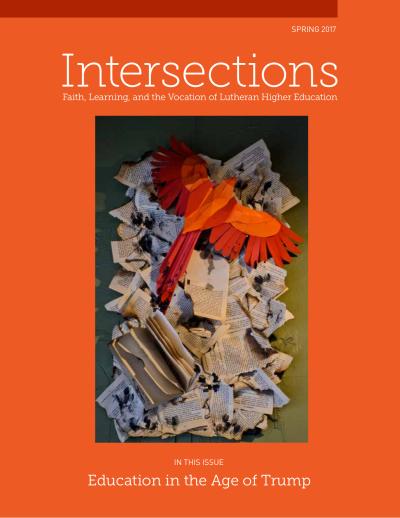
Wilhelm describes how ELCA colleges and universities have shifted the definition of Lutheran higher education away from institutional markers toward alignment with educational values drawn from the Lutheran intellectual tradition — and previews a NECU-convened faculty working group whose recommendations will go to the ELCA college presidents at their June 2017 conference on Lutheran identity.
-
 Article
Women Presidents in Higher Education: How They Experience Their Calling
Aimee Goldschmidt, Gary McLean, Katherine A. Tunheim
No. 42 · Fall 2015
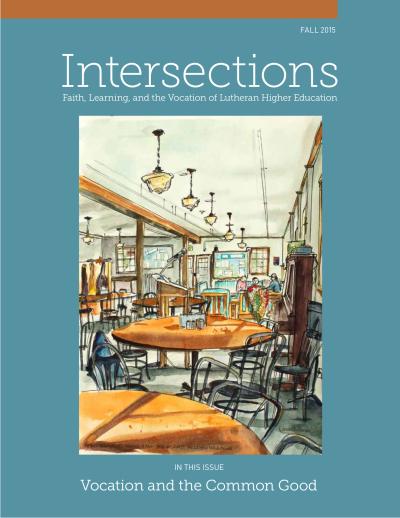
Drawing on in-depth interviews with fifteen women college presidents and a transformative-learning-theory framework, Tunheim, McLean, and Goldschmidt trace a three-stage journey — identifying, interpreting, and pursuing the call — and ask what the language of vocation contributes to the preparation and mentoring of women leaders in higher education.
-
 Article
Why Martin Luther and the Reformation Matter 500 Years Later
Kathryn A. Kleinhans
No. 46 · Fall 2017
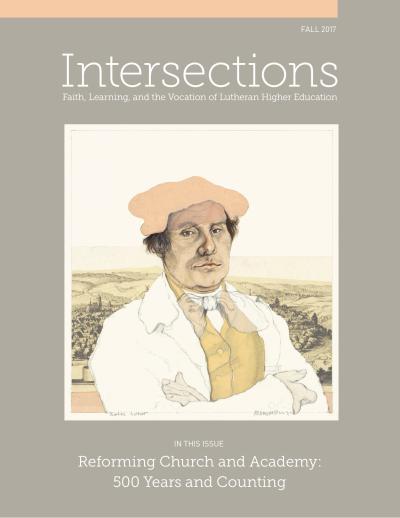
Adapted from a 2017 address to Wartburg College’s entering class, Kleinhans surveys Luther’s lasting impact in vocation, education, social service, and the necessary work of repentance — closing with the Lutheran World Federation’s Windhoek assembly and the Reformation World Exhibition’s call to live reform forward into the next 500 years.
-
 Editorial
From the Editor: So That We, Too, May Flourish
Colleen Windham-Hughes
No. 58 · Fall 2023
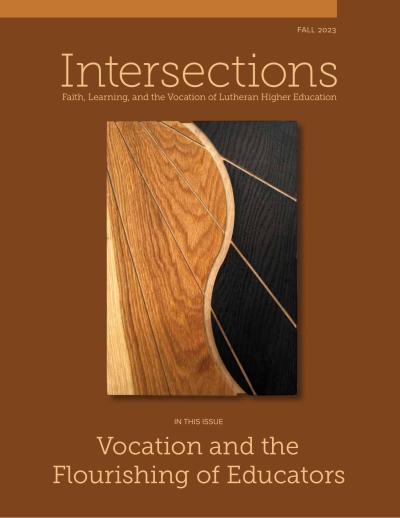
Windham-Hughes introduces the 2023 VLHE conference theme of educator flourishing, drawing on Dr. Monica Smith’s plenary challenge — “How can we flourish if only some are centered and others are at the margins?” — and invites readers to ground themselves in Us/We, the cover art by Augustana graduate William Hatchet, and join the conversation.
-
 Editorial
From the Editor
Robert D. Haak
No. 27 · Spring 2008
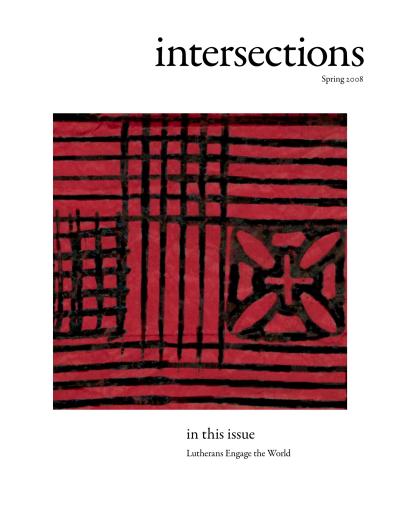
Haak frames the issue around the question of why Lutherans engage the world rather than retreat from it, locating the answer in the doctrines of creation and incarnation, and introduces essays by Erwin on globalism, Carlsen on local community engagement, Marty on multiple callings, and Mattes on the Grundtvigian heritage at Grand View. He also bids farewell to publisher Arne Selbyg, noting the fittingness of the Adinkra (“farewell”) cloth on the cover of this final issue under Selbyg’s leadership.
-
 Article
A Lutheran Learning Paradigm
Paul J. Dovre
No. 34 · Fall 2011
Drawing on Hughes and Adrian’s Models of Christian Higher Education and on Ernest Simmons, Darrell Jodock, Tom Christenson, Robert Benne, and Richard Hughes, Dovre sketches a Lutheran learning paradigm shaped by four deep narratives—the biblical, the confessional, the theological, and the vocational—and traces their implications for curriculum (the study of scripture, theology, and vocation), for the religion faculty’s college-wide responsibility, and for pedagogy (moral deliberation, dialectic, paradox, the engagement of faith and the secular disciplines).