What are we to do in the face of the growing injustice in our world? Communities around the world are being ripped apart by natural disasters fueled by climate change as we with more privilege continue to consume and pollute at an unsustainable rate. In our own country, women are being stripped of their bodily autonomy by overzealous lawmakers eager to use their idea of God to continue the subjugation of the female body. Black and brown people are still routinely being murdered by the police, those who claim to keep us all safe, and are enslaved in a cradle-to-prison pipeline designed to keep their bodies oppressed. Queer folx are assaulted by word and deed, whether as gay people told their queerness is “their cross to bear” or trans people assaulted on their walk home from work, simply as they try to exist as their fullest selves.
Mainstream efforts, such as those made in the Suffrage and Civil Rights movements, would guide us to work within the system; women gained the right to vote largely by working through their male counterparts, and black folks, under a media-promoted, deradicalized ideal of Martin Luther King Jr., are said to have persuaded their white counterparts to gain Civil Rights. Each of these examples is memorialized as completed within the system and is celebrated for starting successful movements in large part through their supplication to those who had power within the system, men and white folks. These both were tremendous steps in the path toward justice, and ones that should not be overlooked; however, the horrendous maltreatment of and violence against the black and brown body, as well as the domination over the female body have not entirely faded into the background to leave a world absent of these forms of oppression. The problem remains in the presence of the systems themselves, systems born and bred to perpetuate harm against those marginalized and to keep those with privilege in power.
So we ask ourselves again, “What are we to do?” In order to address this question, I suggest we revisit how Jesus interacted with unjust systems. In Matthew 21:12-13, it is written:
“12Then Jesus entered the temple and drove out all who were selling and buying in the temple, and he overturned the tables of the money changers and the seats of those who sold doves. 13He said to them, “It is written, ‘My house shall be called a house of prayer,’ but you are making it a den of robbers” (NRSVUE).
The moneychangers and the sellers of goods had formed their own system of oppression, one intended to exploit those who came to worship God and exclude those that couldn’t pay the exorbitant price. The priests of the temple, too, by allowing and gaining from the practice, partook in the creation of this system, profiting off of this exploitation. When Jesus sees this, he flips the tables. Jesus does not sit back and allow for this exploitation, he flips the tables. Jesus does not request the Priests, those with the power to stop the abuse but who chose to profit off of it instead, stop the practice, he flips the tables. Jesus does not bargain over the table, asking the moneychangers and the sellers to provide a more equitable service, he flips the tables. Jesus physically overturns the system.
We are called to follow Jesus, for whoever says, “‘I abide in him,’ ought to walk in the same way as he walked” (1 John 2:6, NRSVUE). So, in following Jesus’s example, we also are called to flip tables, to disrupt systems, like those in the temple, that perpetuate injustice, but we are not called to do this work alone.
Often when faced with injustice, we as human beings are drawn into community with others to process, to find comfort, and, hopefully, to heal. It is also within these communities that we find the support and resources to drive the type of change that we are called to make, to be like Jesus and flip tables. To be in community with others, with shared values and ideas, even in the diversity of reasoning, upbringing, and context in the world, gives us the strength to continue on even when it is hard. Further, it gives us the opportunity to take a break when we need to without losing any progress we may have made. Community in this way also makes the vision of a future in which all are seen, heard, and valued, not in spite of, but because of the color of their skin, the queerness of their bodies, the vastness of the image of God we see in the various shapes of human flesh, possible and within reach. Even if these examples are on a local scale, they give us ideas on how to best move forward creating a system that works for all and not just the few. And whether we see it or not, we all are limited by the continuance of systems that oppress any of God’s wonderful creation, even if we are those that are the most privileged by it. We get caught in these rigid binaries and static boxes, unable to express ourselves beyond these and live out our fullest lives. Equity and justice are not problems for those most explicitly marginalized by the lack of them, they are an everyone problem, and to be like Jesus, to flip tables, we need to make them our problem.
-
 Editorial
From the Publisher: Introduction and Invitation
Lamont Anthony Wells
Wells introduces himself as the new Executive Director of NECU, succeeding Rev. Dr. Mark Wilhelm, and frames this Spring issue as a passionate response to the crises facing higher education amid threats to academic freedom and the well-being of educators.
-
Editorial
From the Editor: Vocation [in] Disruption
Colleen Windham-Hughes
Windham-Hughes introduces the issue’s theme — vocation amidst disruption — previews new features including contributor contact information, a study guide for So That All May Flourish, and invited pieces on reproductive rights, and shares results from the Fall survey of readers.
-
Institutional Focus
So That All May Flourish Study Guide
A chapter-by-chapter study guide to So That All May Flourish (Fortress Press 2023), a new volume by NECU authors that develops the central tenet of “Rooted and Open” and offers discussion questions for use in orientation programs, classes, workshops, task forces, and professional development settings.
-
Reflection
“Miracles are no longer required”—Life Writing as a Healing Tool
Barbara Reul
A music historian and cancer survivor chronicles how a uterine cancer diagnosis in the early months of the COVID-19 pandemic disrupted her vocation as a university professor, and how writing two open-access memoirs became an unexpected tool for healing body, mind, and soul.
-
Article
The Power of Ritual Action and George Floyd Square
Mary Clare Tiede Hottinger
A California Lutheran University senior examines how George Floyd Square in Minneapolis has been transformed into sacred space through ritual action, and considers what this site of remembrance, mourning, and ongoing struggle for justice can teach us about the power of ritual to unify and sustain community.
-
Article
Necessary Disruptions: Centering Vocation in the Common Good
Erin VanLaningham
VanLaningham previews the forthcoming NetVUE volume Called Beyond Our Selves: Vocation and the Common Good, arguing that vocation, common, and good all need to be disrupted and expanded so that students might arrive at a wider sense of individual purpose and collective well-being.
-
Article
Where Disruption and Vocation Meet: One Path Toward Teaching Reproductive Justice in Challenging Times
Lena R. Hann
Hann recounts how a missed math class in her first college term led her into volunteer work at a feminist abortion clinic and ultimately a career in public health, and describes how she designed and taught a Reproductive Justice immersive term course at Augustana College through the disruptions of COVID-19, George Floyd’s murder, and the Dobbs decision.
-
Article
The Duty to Teach and Restore Bodily Autonomy: Reflections from the Classroom
Cynthia Richards
Richards reflects on a Narrative Medicine course she taught at Wittenberg University in the wake of the Dobbs decision, in which students examined cultural “first recognitions” of the reproductive body and discovered that almost none had ever had a way of talking openly about their reproductive selves — an alienation she calls educators to address.
-
Article
Turning to a Reproductive Justice Framework for Inclusive Dialogue across Differences
Jenny M. James
James makes the case that a reproductive justice framework, rooted in the work of black feminist scholars and activists, gives educators tools to overhaul polarized pro-choice/pro-life conversations and to host inclusive dialogues across differences of race, sexuality, gender identity, and faith.
-
Article
A Reconsideration of the Political Approach to Abortion
Sophia Cruz Ponce
Cruz Ponce argues that the pro-life versus pro-choice binary distracts from the underlying social factors that lead to unwanted pregnancies, and proposes a reframed political approach focused on mandated sex education, free contraception, and crisis pregnancy centers that address the social, political, and economic barriers women face.
-
Article
Take Heart: Is Neutrality Really What We Need Right Now?
Abbylynn Helgevold
Helgevold, an ethicist at Wartburg College, argues that calls for faculty neutrality on abortion in the post-Roe classroom stifle the courageous conversations Lutheran higher education is uniquely positioned to host — conversations grounded in “Rooted and Open” and the ELCA’s 1991 Social Statement on Abortion.
-
Article
Views on Flourishing After the Age of Roe
Caryn Riswold, Mary J. Streufert
Riswold and Streufert reflect on the Radcliffe Institute’s January 2023 conference “The Age of Roe” and argue that the ELCA’s 1991 Social Statement on Abortion and its 2019 statement Faith, Sexism, and Justice offer Lutheran higher education a third way to approach reproductive justice grounded in serving the neighbor so that all may flourish.
-
 Article
Liberal Arts and Professional Education: A Call for Philosopher-Servants
Steven C. Bahls
No. 24 · Fall 2006
Bahls, President of Augustana College (Rock Island), calls for a renewed commitment at Lutheran colleges to form “philosopher-servants” — graduates whose grounding in the liberal arts and the liberating gospel equips them for thoughtful service in business, education, nursing, and the other professions. Their impact, he argues, is “a good thing and a fact that we can be proud of as those who labor in Lutheran higher education.”
-
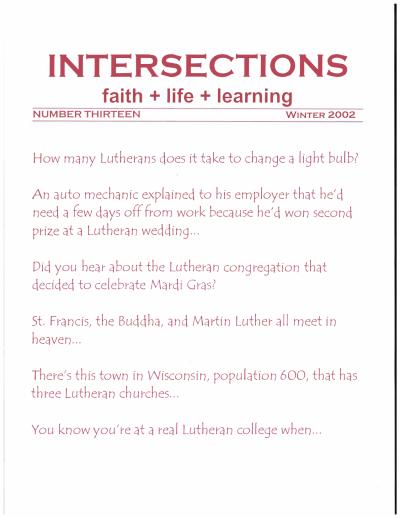 Reflection
Sweet on My Lips
Corin Wesner
No. 13 · Winter 2002
A passage from Wesner’s travel journal during the same South Africa workshop. Walking into a wood-and-tin shack church where raindrops fall on already-soaked carpet and the service is in Xhosa, she remembers her painted, carpeted home church and her adolescent argument with her mother about wearing a dress to worship, and finds herself engulfed in warmth as the few women sing—welcomed by a stranger’s smile and opened up.
-
 Article
Serving Two Masters: Teaching and Writing Between Academy and Church
John Reumann
No. 9 · Summer 2000
Reumann reflects on more than fifty years navigating between academy and church—the Society of Biblical Literature and Exegesis (whose Doktorvater Morton Enslin was unceremoniously dumped at Toronto by “young Turks” Robert Funk and others, while Harry Orlinsky saved the day at the centennial), the 1978–1987 New American Bible Revised New Testament committee with its bishops, the U.S. Lutheran–Roman Catholic dialogue volume on “Righteousness,” and the 1999 Joint Declaration on Justification—and uses his Anchor Bible and Augsburg commentaries on Philippians, Colossians, and Romans to illustrate Krister Stendahl’s judgment that one can no longer master all the literature: epistolary research, rhetorical and discourse analysis, social-world readings, feminist scholarship on Euodia and Syntyche, the koinonia and friendship debates (Sampley, Fitzgerald, Witherington), and the house-church recovery of Filson. The academy is antepenultimate, the church penultimate, God ultimate—professors as “believers, testifiers, witnesses” serving pro bono, pro ecclesia, and pro Deo.
-
 Article
Living at the Intersection of Fear and Hope
Mark S. Hanson
No. 32 · Spring 2010
Hanson draws on his January 2009 ELCA/ELCIC visit to Jordan, Israel, and Palestine—a Hebron Quran that did not burn, fifth graders dancing at the Hope School, a conversation with King Abdullah II—to frame the vocation of Lutheran higher education at the intersection of fear and hope. Engaging Brueggemann, Sittler, Buechner, Auden, Strandjord, Douglas John Hall, W. Robert Connor, Lewis Mudge, and Cynthia Moe-Lobeda, he argues that Lutheran colleges are called to critical inquiry that does not collapse into a hermeneutic of suspicion, to a “thinking faith” that resists religious fundamentalism, and to communities of discernment that work for the common good.
-
Editorial
From the Publisher
Arne Selbyg
No. 24 · Fall 2006
Selbyg situates this issue in the ongoing ELCA conversation about education that began with the 2005 conference and is feeding into the second draft of the ELCA Social Statement on Education, previews the 2007 conference (“The Vocation of a Lutheran College — Engaging the World”) at Augustana College, Rock Island, and lifts up Luther’s insistence that the church and its members contribute to their wider communities rather than retreat into self-centered enclaves.
-
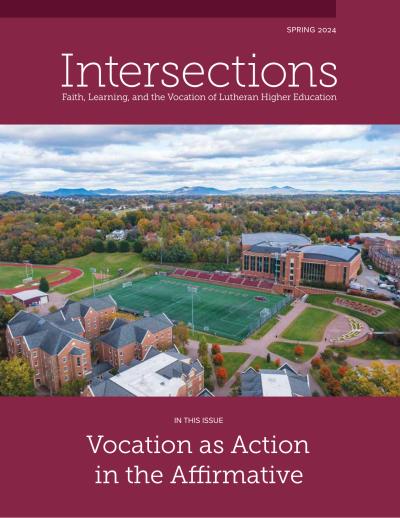 Article
Team Culture is Key to Success: Learning from Student-Athletes
Colleen Windham-Hughes
No. 59 · Spring 2024
On a December weekend in “Championship City” Salem, Virginia, both California Lutheran’s Women’s Soccer Team and St. Olaf College’s Men’s Soccer Team won NCAA Division III national titles. Windham-Hughes talks with coaches, faculty mentors, and student-athletes about how off-the-field team culture — built on trust, relationships, and shared why — translates onto the pitch and into liberal arts and sciences education.