Ethical Deliberation and the Biblical Text—A Lutheran Contribution to Reading the Bible
Intersections No. 22 · Spring 2006
THE GOAL OF THIS PAPER is to articulate a method of ethical deliberation about a particular social issue. Over the last seven and one-half years, I have been asked many times to speak about the issue of the Bible and homosexuality, to lead workshops on the issue, and to facilitate the ELCA study Journeying Together Faithfully. These experiences have led to the realization that there is a great deal of confusion and misunderstanding about the nature of the Bible and the way it functions as scripture. In response I have been working at articulating a Lutheran “critical traditionalist” hermeneutic. My intention in this paper is to test this hermeneutic by using it to critique Robert Gagnon’s reading of Rom. 1:18-32 and to provide an alternative reading of the same text, reflecting briefly on the theological-ethical implications of this method. Before turning to that task, however, it is necessary to explain how and why this has become an issue of importance for me by reflecting briefly on my own social location and agenda.
I am a professor and scholar of the New Testament and Christian origins at Augustana College, an ELCA liberal arts college where I hold tenure and serve as the Chair of the Religion Department. In the eyes of many this makes me an “expert.” In terms of education, income, and other socio-economic indicators my profession places me in the upper middle class, a position I was not born into, but which enables me to enjoy material comforts that sometimes prick at my conscience. My relatively privileged status is further enhanced by the fact that I am a white, heterosexual, Christian wife and mother living in a country where those factors are valued (Holtmann 27-28).1 On the other hand, I am a vertically challenged person in a world where just about every material object that we use in our day-to-day lives appears to have been designed by and for tall, taller, and excessively tall persons. Of necessity, therefore, I see and experience the world from a “different” perspective. As a female I am intensely aware of how under-represented women are in the academy and in the church, especially in leadership positions. Even when we are admitted to the inner circles, all too often we remain the “other” at the table. For me personally, this translates into a sense of liminality, of being poised at a threshold with one foot on either side. The sense of being simultaneously both an insider and an outsider is intensified by the fact that I am an immigrant twice over, having been born in Finland, raised in Canada, and now living and working as a resident alien in the United States. It is natural for me, therefore, to feel a certain affinity and empathy for persons who struggle at the peripheries of society. The combination of those feelings with a Lutheran theology of the cross has convinced me that I am called to stand intentionally in solidarity with the oppressed. Thus, I have come gradually to see my role as an educator as consciousness-raising about and advocacy for those who are marginalized. It is in context of doing just that that questions about the ethics of biblical interpretation have become significant.
A Lutheran Critical Traditionalist Hermeneutic
“Critical traditionalist” is a phrase borrowed from my Hebrew Bible professor, Dr. Robert Polzin. He originally coined the term “critical traditionalism” to label what he saw as the dominant voice within the Deuteronomistic history. He writes, “The ultimate semantic authority of the Book of Deuteronomy […] proclaims an attitude toward the word of God that claims the right to emphasize now one aspect, viz., judgment, now another aspect, viz., mercy, of God’s relationship with Israel, depending on the situation in which they find themselves” (Polzin 68). Polzin asserts that the overriding hermeneutical perspective of the Deuteronomist is that “subsequent revisionary interpretation” is not only necessary, but modeled by Moses himself in such a way that opposing views are nevertheless allowed to have their say (Polzin 205-206). Critical traditionalism, therefore, is a biblically grounded hermeneutical perspective that recognizes the need for constant revision and varying interpretations of core traditions as contexts change through space and over time.
It is my contention that Lutheran biblical hermeneutics have from their inception reflected such a critical traditionalism. For Luther, the Word of God refers in the primary sense to “the eternal Logos, the son of God” who became personally incarnate in the historical person of Jesus of Nazareth, and secondly to the proclaimed Word of God through which creation occurred and salvation was announced. The Bible as the written Word of God is “the definitive documentary on both the incarnation and oral revelation of God’s Word” (Lazareth 33-34). Scripture is thus the word of God in a secondary or derivate sense (Lotz 263). Its authority derives, not so much from what it says literally, but from its ability to re-present and re-embody the life-giving Word. While it is, in Luther’s words, the “queen” that “must rule, and everyone must obey,” Scripture remains the servant of “the Lord who is the King of Scripture” (Lotz 264).2 In other words, “Scripture cannot rightly be interpreted in opposition to Christ’s person and work” (Lotz 263).
Given this understanding of scripture, a Lutheran critical traditionalist hermeneutic must have at least three major components to it. First, it must honor scripture as Queen of the church by taking seriously what biblical texts say, and, even more importantly, what they mean. One way to get at that meaning is to answer the question, “who says what to whom about what under what circumstances for what purposes.” The answer necessitates paying attention, not only to the genre and rhetoric of a passage, but also to the historical, social, and cultural circumstances addressed by, reflected in, and which gave rise to it. Second, a Lutheran critical traditionalist hermeneutic must be ever mindful of Christ, who is the King of scripture, and whose mission is the purpose of the church. The good news about justification by grace through faith in Jesus Christ functions as the primary criteria for deciding whether a biblical passage is relevant to our contemporary circumstances and how it might be used in teaching and preaching.
Finally, a Lutheran critical traditionalist hermeneutic holds us ethically accountable by demanding that we reflect on both the faithfulness and the consequences of our reading. Does our interpretation respect the text as articulated in its originating historical context? Does our reading and application of scripture promote the mission of Christ? What are the consequences of our interpretation with respect to race, ethnicity, economics, gender, sexuality, self-determination, and so forth? Will it be life-giving or death-dealing? For whom? Why? Indeed these may be the most important questions that we need to ask ourselves as we read, interpret, and attempt to apply scripture in our daily lives.
The Use of Romans 1:18-32 by Robert Gagnon
In The Bible and Homosexual Practice: Texts and Hermeneutics, Robert Gagnon sets out to demonstrate that the Bible unequivocally defines same-sex intercourse as sin, and that there are no valid hermeneutical arguments for overriding biblical authority in this matter. His position is that “same-sex intercourse constitutes an inexcusable rebellion against the intentional design of the created order.” It is not only degrading to the participants but is physically, morally, and socially destructive (Gagnon 37). Gagnon’s book is, thus, not about proclaiming the gospel but about laying down the law that will protect the purity and security of the communities with which he identifies.
For Gagnon, the credibility of the Bible’s stance on this subject is rooted in the revelatory authority of scripture, the witness of nature to which the Bible points, and arguments from experience, reason, and science (Gagnon 41). It is not my intention to review the entire book but to focus on Gagnon’s treatment of Rom. 1:24-27, which for him is the central text on which Christians must base their moral doctrine on homosexual conduct (Gagnon 229). As he describes it, this passage is the most substantial and explicit discussion of the subject in the Bible: it is in the New Testament, it explicitly refers to lesbianism, and it occurs within a significant body of material originating from a single writer. Romans 1:24-27 is also in his estimate “the most difficult text for proponents of homosexual behavior to overturn” (Gagnon 230). For Gagnon then, this is the authoritative text because of (a) its location in the Bible specifically in the New Testament (do we detect a supersessionist theology here?), (b) its content, that is, what it says, (c) its apostolic authorship, and (d) its perceived unassailability by proponents of homosexuality.
Gagnon begins by placing the specific passage (Rom. 1:24-27) within its larger literary context (Rom. 1:18-32), which he asserts is Paul’s depiction of “what life used to be like before believing in Christ and receiving the Spirit but which has now been fundamentally transformed for those who are in Christ. It portrays the predicament of all unsaved humanity” (Gagnon 245). Within that larger context, Paul employs a typical Hellenistic-Jewish critique of gentile sin in Rom. 1:18-32 in order to set up an imaginary Jewish dialogue partner who rejects Paul’s law-free gospel for Gentiles and regards Torah observance as excusing himself from God’s judgment. Gagnon argues that Paul’s purpose is to show that God’s verdict is just and right because the Gentiles knowingly act contrary to the knowledge of God’s intentions that is available to them in creation by engaging in idolatry and same-sex intercourse (Gagnon 246-47). Gagnon seeks, thus, to answer the basic exegetical question of who says what to whom about what in what circumstances for what purposes. He correctly identifies the genre of the passage as a typical Hellenistic-Jewish critique of Gentiles, but fails to explore the implications of Paul’s use of such a stereotype and misconstrues Paul’s audience and purpose.
Gagnon’s treatment of Rom. 1:26-27 is based on drawing out the parallels between idolatry and same-sex eroticism. He asserts that just as “idolatry is a deliberate suppression of the truth available to pagans in the world around them…so too is same-sex intercourse” (Gagnon 254). What connects these two for Gagnon is Paul’s use of the phrase “contrary to nature.” His argument is that just as visual perception of the material world should lead to a mental perception of the God who created it, so visual perception of male-female bodily complementarity should lead to an understanding of the rightness of “natural,” that is, heterosexual, intercourse (Gagnon 254-57). Gagnon contends that Paul selects homosexual conduct as “exhibit A” of culpable gentile depravity because it “represents one of the clearest instances of conscious suppression of revelation in nature by gentiles, inasmuch as it involves denying clear anatomical gender differences and functions” (Gagnon 264). While Gagnon clearly sets out the inner logic of these verses with respect to the alleged relationship of idolatry and same-sex intercourse, he fails to recognize that this logic may derive from the original Hellenistic-Jewish critique that Paul recites rather than from the purposes and intentions of Paul. Additionally his entire treatment of natural/unnatural language presupposes modern categories rather than ancient Greco-Roman ones.3
Returning to the larger literary context (Rom. 1:18-32), Gagnon describes Paul’s rhetorical strategy as beginning with “a very clear example of unethical conduct and then…widening the net until it captures all of humanity” (Gagnon 277). According to Gagnon, Paul moves from the discussion of same-sex intercourse to a vice list (1:29-31) that is aimed mainly at Gentiles but which blurs the boundary between Gentile and Jew, and finally to the statement in 2:1-2 which targets the moral person, that is, the Torah-observant Jew. The result is a “sweeping ‘sting operation’” in which the Jew who agrees with the condemnation of Gentiles in 1:18-32 is compelled by the end of chapter 3 to acknowledge that Jews deserve judgment as well (Gagnon 278). According to Gagnon, the trap that Paul sets in 1:18-32 is for those Jews who think that they can be justified in God’s sight through observance of the Mosaic law and apart from faith in Christ (Gagnon 280). Since the letter is clearly addressed to members of the church in Rome, I am not sure why Gagnon thinks that Jews would have been Paul’s target audience. Overall, his reading of Rom. 1:18-32 is governed by his openly avowed agenda of proving that the Bible says that all same-sex intercourse is sin and by a supersessionist theology that contains a latent anti-Judaism.
An Alternative Reading of Romans 1:18-32
I begin by asking who says what to whom about what in what circumstances for what purposes. The letter to the Romans is a communication from the apostle Paul to the church in Rome, a church which consists of both Judean/Jewish and non-Judean/Gentile (specifically Greek) members (Esler 116-119). It is a text that is addressed to Christ-followers (not Jews) of different ethnic backgrounds. It is the beliefs and behaviors of these groups within the church that Paul seeks to alter, in particular the ethnocentrism that each group harbors with respect to the other.4 The effect of Paul’s argumentation from chapters 1 to 11 is to put these two groups on the same footing. Neither Greek nor Judean Christ-followers can portray themselves as inherently superior to the other because both groups are equally in bondage to sin, but in different ways (Esler 144-145).5 The only way out of their common plight is to embrace a new in-group identity, specifically the one arising from baptism into Christ (Esler 152).
It is within this context that Paul recites the information in 1:18-32, a passage that Gagnon describes as a typical Hellenistic-Jewish critique of Gentiles, but which more accurately ought to be identified as an “ethnic caricature” (Stowers 94) or an “extreme type of stereotyping” developed by certain Judeans/Jews (Esler 147). In this stereotype Gentiles, or perhaps more accurately the “heathen,” (Esler 151) are portrayed as idolaters whom God has punished by “causing or allowing their decline into unnatural sexual practices (1:24-27) and antisocial vices (1:28-31)” (Stowers 92). The recognition of the genre of this particular passage should immediately cause the reader to pause. Are ethnic caricatures and stereotypes inspired by God? Does the recitation of an ethnic stereotype by a hero of faith in a biblical text make it a word of God? Can we in the twenty-first century legitimately hold up such an ethnic caricature as the basis for developing a moral doctrine?
In light of Paul’s comments in 2:1-16, I would have to answer unequivocally “No.” Here Paul engages in the rhetorical technique of speech-in-character creating an imaginary interlocutor through whom Paul can criticize his audience without directly accusing anyone of anything (Stowers 103, Witherington 76). Paul’s first-century audience of Greek and Judean Christ-followers would “get it.” Paul’s point seems to be that “whoever you are” (2:1), you are not in a position to judge, condemn, caricature, or stereotype others as if you enjoy some sort of special status. This message applies just as much to the newly saved Greeks who might imagine themselves as superior to their pagan neighbors as it might to the Judean Christ-followers who grew up socialized to view all non-Judeans as inferior.6 Paul insists that God alone can and will judge, repaying “according to each one’s deeds” (2:6). Both ethnic groups will be judged by the same criteria: those who do evil, both Judean and Greek, will experience anguish and distress; while those who do good, both Judean and Greek, will receive glory, honor, and peace (2:9-10). The same criteria applies for the heathen: on the one hand, they may instinctively do what the law requires; on the other, their conflicting thoughts may accuse or excuse them on the day of judgment (2:14-16). What Paul condemns in this passage is precisely the kind of self-righteous presumptuous stereotyping of which 1:18-32 is an example. The word of God in this passage is, thus, to be found in Paul’s pronouncement of the “law,” which in this case might be summarized as “go and do otherwise” (Witherington 77). His proclamation of the gospel will come later (3:21ff).
What Paul is doing in this passage, and indeed throughout much of Romans, is engaging in what might be called a critical traditionalist revision of his audience’s beliefs and behavior. The challenge that Paul faced was how to build or maintain a common in-group identity (as Christ-followers) in a situation where church members were not likely to give up their existing subgroup (ethnic) identities. Was the church to be divided by ethnic distinctions or united in spite of ethnic diversity? Paul’s response was to focus on the different ways both groups were equally enslaved to sin. Their common plight as sinners coram Deo negates any claims of ethnic superiority. The promise that God will justify the Judean “on the ground of faith” and the non-Judean “through that same faith” (Rom. 3:30) unites both groups in a new future where their ethnic identities are recognized but take second place to their shared identity in Christ where their only obligation is to “love one another” (Rom. 13:8).
A Lutheran Reading Romans Today
How might we use this reading in our conversations about sexuality? We need to begin by recognizing that Rom. 1:18-32 is an ethnic stereotype. Since Paul uses this caricature as an example of what not to do, that is, engaging in self-righteous stereotyping, how can we use its contents as the basis for a moral doctrine? How can any conclusion we might draw from it about same-sex intercourse be anything but another caricature? If Paul’s goal was to subsume (not obliterate) ethnic identities under a new overarching identity “in Christ,” could we perhaps find here an analogy to our situation today where the issue is not ethnic identity but gender/sexual identity?
In this paper I believe that I have tried to articulate a method (or at least a set of questions) that might guide an ethically conscious reading of scripture within the Lutheran tradition. I am calling this a “Lutheran critical traditionalist hermeneutic.” It is distinctively Lutheran because it locates the authority of scripture not in the literal content of the Bible, that is, in what it says, but in what it means and in particular how that meaning re-presents and re-embodies the life-giving Word. Another way to say this is that scripture is the word of God that bears in, with, and under its human and earthly elements the Word of God. This may be the most significant difference between my reading of Rom. 1:18-32 and that of Robert Gagnon. He seems to operate out of an assumption that the authority of scripture is in what it says. This leads him to commit the common error identified by Stanley Stowers as “The acceptance of Rom. 1:18-2:29 as an objective, inductive statement of the human condition…” an error rooted in an uncritical assumption that Paul is “stating not only the truth of the gospel, but also the gospel truth” (Stowers 83). So foundational are these assumptions for Gagnon that even when he does his exegetical homework and recognizes the genre and rhetorical moves that Paul makes, he ignores their implications. In doing so, he violates the intention of Paul’s argument. This is one of the great ironies that frequently emerge from an alleged insistence on locating the authority of scripture in what the Bible says. The reader becomes so obsessed with a few particular sentences or words that s/he misses the context entirely. One suspects that in situations like this the real authority actually lies in the reader since it is Gagnon’s agenda that controls both the selection of the text and his reading of it. I am certainly not claiming a “virginal perception” for my own reading. I, too, have an agenda: advocacy for those marginalized by society. This is why I ask “Does my reading faithfully promote the mission of Christ? Is it life-giving or death-dealing? For whom?”
Endnotes
1. Pages 27-28 lists indicators of ascribed status in America as being male, white, able-bodied, heterosexual, Christian, and of the owning class.
2. Quotations are from Luther’s 1535 Lectures on Galatians as cited by Lotz p. 264.
3. It is beyond the scope of this paper to go into the details, but cf. the treatments of this subject in Martti Nissinen, Homoeroticism in the Biblical World (Minneapolis: Augsburg Fortress, 1998) and also in Craig Williams, Roman Homosexuality: Ideologies of Masculinity in Classical Antiquity (New York: Oxford UP, 1999).
4. Esler pp. 40-76 provides a fine treatment of ethnicity and ethnic conflict in the ancient Mediterranean world.
5. See also Witherington 58.
6. Later in Rom. 2:17-34 Paul will redefine genuine Judean status as being rooted inwardly in the heart rather than in the external signs and rites. See Esler p. 153.
Works Cited
Esler, Philip F. Conflict and Identity in Romans: The Social Setting of Paul’s Letter. Minneapolis: Fortress, 2003.
Gagnon, Robert A. J. The Bible and Homosexual Practices: Texts and Hermeneutics. Nashville, TN: Abingdon, 2001.
Holtmann, Linda. Media Messages: What Film, Television, and Popular Music Teach Us about Race, Class, Gender, and Sexual Orientation. London/New York: M. E. Sharpe, 2000.
Lazareth, William H. Christians in Society: Luther, the Bible, and Social Ethics. Minneapolis: Fortress, 2001.
Lotz, David W. “Sola Scriptura: Luther on Biblical Authority.” Interpretation. July 1981: 258-73.
Polzin, Robert. Moses and the Deuteronomist: A Literary Study of the Deuteronomic History. New York: Seabury 1980.
Stowers, Stanley K. Rereading Romans: Justice, Jews, and Gentiles. New Haven: Yale UP, 1994.
Witherington III, Ben. Paul’s Letter to the Romans: A Socio-Rhetorical Commentary. Grand Rapids: William B. Eerdmans, 2004.
-
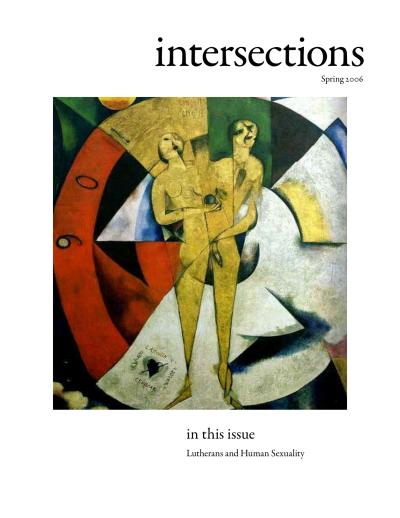 Editorial
From the Publisher
Arne Selbyg
Selbyg notes that both the ELCA and Intersections have undergone major changes this year—the Division for Higher Education and Schools is gone, replaced by the Educational Partnerships and Institutions group within the Vocation and Education unit, and the journal has a new editor (Robert Haak), a new home at Augustana College, a new printer, and a new design. He commends the issue’s focus on human sexuality and points readers to the first draft of Our Calling in Education.
-
Editorial
From the Editor
Robert D. Haak
Haak introduces himself as the new editor inheriting the journal from Tom Christenson and frames the issue around the question of what ELCA colleges might contribute to conversations about human sexuality. He summarizes the contributions of Yeager, Benne, Williams, Bussie, and Nack, and shares previously uncollected National Study of Youth and Religion data on the sexual attitudes and behaviors of Lutheran teens—including that 25% of regularly-attending ELCA teens report the church has done nothing to help them with their sexuality.
-
Article
A Church, the Human Condition, and the Fissured Face of Peace
D. M. Yeager
Yeager, a member of the ELCA Task Force for Studies on Sexuality, reflects on lessons for the church’s educational mission in the wake of the 2005 Churchwide Assembly. Drawing on Macquarrie’s The Concept of Peace, Polanyi on the personal coefficient of knowledge, Hannah Arendt’s The Human Condition, and responses to the task force report from Roy Harrisville III and Larry Rasmussen, she proposes “the fissured face of peace”—peace as the absence of hostility rather than disagreement—and maps how Arendt’s five conditions of human existence (life, earth, natality, mortality, worldliness, plurality) might shape Lutheran colleges’ curricula in history, epistemology, and the sociology of knowledge so that graduates can disagree without hostility and embrace the slow work of reformation.
-
Article
Sexuality over the Lifespan—Social Trends Pose Moral Dilemmas for Communities of Faith
Adina Nack
Nack, a sociologist who presented to the ELCA Task Force for Studies on Sexuality, surveys empirical research on three life-stages flagged by the Task Force as particularly contested—premarital sexuality among adolescents and young adults, sexuality after divorce and within single parenting, and sexuality in late adulthood. Drawing on the Alan Guttmacher Institute, the Office of the Surgeon General, AARP, National Council on the Aging, and the World Health Organization’s 2002 definition of sexual health, she closes each section with questions about the church’s role in education, blessing of committed nonmarital relationships, and dismantling stereotypes about aging and sexuality.
-
Article
Scarred Epistemologies: What a Theology of the Cross Has to Say about the Gay Marriage Ban
Jacqueline Bussie
Responding to Robert Benne’s claim (citing Gilbert Meilander and Wolfhart Pannenberg) that one cannot defend gay marriage on biblical or confessional grounds, Bussie reads three theses of Luther’s Heidelberg Disputation alongside Moltmann’s Crucified God and Martin Luther King Jr.’s Letter from Birmingham Jail to argue that the theologia crucis—with its insistence on calling the thing what it is, its acknowledgment of scarred epistemologies and simul justus et peccator, and its refusal to domesticate God—exposes the Ohio Defense of Marriage Act as scapegoating, selective literalism, and an unjust law that the Christian conscience must reject.
-
Article
What Could the Lutheran Colleges and Universities Contribute to the ELCA Discussion of Sexuality—But What Would They Actually Contribute?
Robert Benne
Benne hopes that Lutheran colleges might model fair moral discourse on sexuality by gathering a balanced mix of what James Davison Hunter calls “orthodox” and “progressive” voices from religion and social-science faculties, with the Great Tradition treated as the default position. He doubts this is what would actually happen: citing Klein, Stern, and Western’s research showing a ten-to-one liberal-to-conservative ratio in social-science and humanities associations, he suspects Lutheran faculties skew further left than other private colleges and would simply reinforce the ELCA’s already-progressive seminary and churchwide leadership.
-
 Editorial
From the Editor
Tom Christenson
No. 3 · Summer 1997
Christenson explains that this issue breaks from the first two issues’ single-focus pattern to feature three principal papers on the environment, the education of desire, and hiring and personnel policies, plus two poems and a piece of reflective bemusement. He then commends George Marsden’s The Outrageous Idea of Christian Scholarship (Oxford, 1997) and challenges Lutheran scholars to articulate how the particulars of their faith inform their scholarship—in conversation with Calvinist work like Nicholas Wolterstorff’s Reason Within the Bounds of Religion and Art in Action—rather than remaining silently complicit in the view that faith has no place in the academy.
-
 Editorial
From the Editor
Tom Christenson
No. 15 · Winter 2002
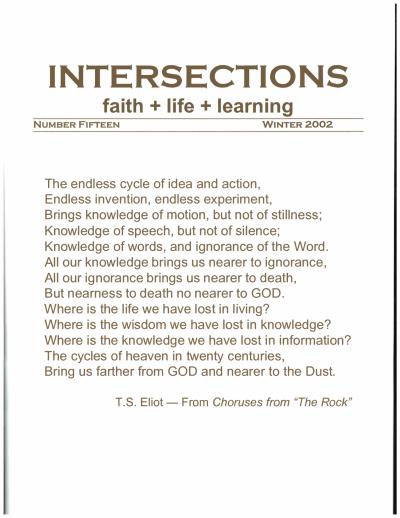
Christenson introduces an issue of varied voices—bishops and university presidents, philosophers and poets, students and their teachers—and defends the T. S. Eliot cover selection (“Where is the wisdom we have lost in knowledge?”) against the charge of being too depressing, arguing with cover artist Ida that Lutherans are realists about human accomplishments and that there is a huge difference between optimism and hope.
-
 Article
A Lutheran Dialectical Model for Higher Education
Ernest L. Simmons
No. 37 · Spring 2013
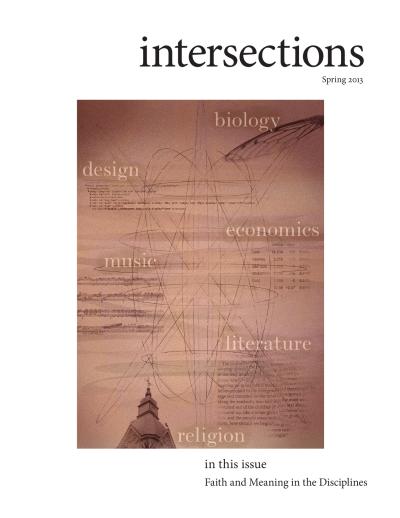
Drawing on “The Freedom of a Christian,” simul justus et peccator, Richard Hughes, Joseph Sittler, Martha Nussbaum, and Tom Christenson, Simmons argues that the Lutheran tradition informs an open, dialectical educational model that holds Christian and academic freedom together. He locates vocation at the intersection of the practical (why are you here?) and the existential (why are you here?) and proposes Lutheran higher education as education for self-transcendence and leadership Soli Deo Gloria.
-
 Article
Both Priest and Beggar: Luther among the Poor
Martha E. Stortz
No. 46 · Fall 2017
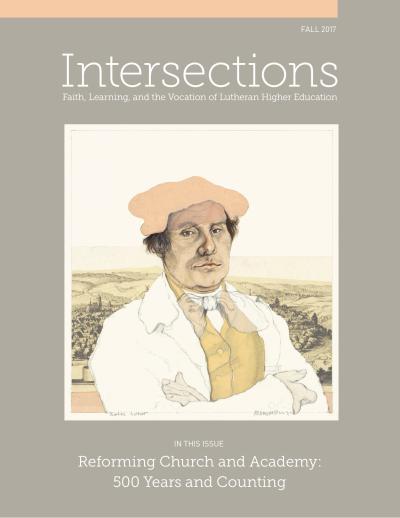
Reading Luther’s deathbed remark “We are all beggars” against his “priesthood of all believers,” Stortz argues that priest and beggar are two sides of a human reality — one that locates civic responsibility for the poor at the heart of the Reformation legacy and that pushes beyond paternalistic service toward the systemic question of justice.
-
 Article
The Church in Education? Education in the Church? Ten Theses on Why These Questions Matter
Leonard G. Schulze
No. 21 · Summer 2005
Writing in the months before the August 2005 Churchwide Assembly that will decommission DHES, Schulze frames his vision for the division as ten Lutheran-style theses, each followed by Luther’s catechetical question “What does this mean?” He argues that critical thinking and moral deliberation are in the Lutheran gene pool; that Luther’s devotion to learning was an expression of Christian vocation; that the rise of the research university and the binary public meaning of “evangelical” have marginalized church-related colleges; that DHES has been wrongly perceived as marginal; and that the reformed concept of vocation must drive the soon-to-be-created program unit for Vocation and Education. An appendix reproduces the 2005 DHES strategic planning overview.
-
Article
The Identity, Mission, Vision, and Goals of a Lutheran College vis a vis Bacon's "Of Studies" and Newman's "The Idea of a University"
Cora Lazor, Mary Theresa Hall
No. 15 · Winter 2002
Hall, an Associate Professor of English at Thiel, and Lazor, a Thiel junior and 2002 ELCA Division for Higher Education summer intern, read Thiel College’s Statements of Identity, Mission, Vision, and Goals alongside Sir Francis Bacon’s “Of Studies” (1625) and John Henry Cardinal Newman’s The Idea of a University (engaging Azade Seyhan’s May 2002 PMLA essay along the way). They argue that Bacon’s “Read…to weigh and consider” and Newman’s defense of liberal over technical training underwrite Thiel’s new Writing-Intensive Course requirement, its ten institutional objectives, and its commitment to “service to society” in the Judeo-Christian tradition.