I am one who still holds to what is perhaps no longer a popular notion, that the liberal arts college has a viable social vocation, that it should attempt to foster what the World Council of Churches has called a just, sustainable, and participatory society, that it is not to be considered an effete afterglow of a now discredited, under constructed academic era. I still believe that the faculty, staff, students, and the constituent supporters of a liberal arts college are in a position to shape the future of our society, for better or for worse, as we together launch students into a variety of social orbits, whether they be first ladies or first social workers or first biology teachers or first lawyers or first nurses or first engineers: and that if we work together, inspired by a common vision of the intellectual and moral relevance of our academic irrelevance, we can indeed influence society, by the character of our students and by the quality of our learning, more nearly to approximate the good, the true, and the beautiful. On the basis of that conviction, with reference now to the theme before us, I want to propose three mandates for your consideration.
First Mandate: Take Responsibility for Your Spiritual Particularity
Everybody comes from somewhere. It is tempting to disregard that historical truism, as the liberal arts community charts its course in this multicultural, pluralistic era. It is tempting to leap prematurely into the heady world of global intellectual commerce, neglecting both the skeletons in our own closets and the riches in our own vaults.
To take responsibility for your particularity as a Lutheran liberal arts college, I believe, must mean at least this much, in light of the topic before us.
A. Confront the Ambiguity of the Classical Christian Tradition toward Nature
Since the publication of a still ubiquitously cited essay by historian Lynn White, Jr. in the late sixties, it has become fashionable in some academic circles to blame Christianity for causing the current global environmental crisis. White argued that the Christian religion has historically been so anthropocentric, so focused on the meaning and value of the human creature alone, and so spiritual, focused on a world-transcending Deity alone, that Christianity bears “a huge burden of guilt” for all the environmental destruction and desecration that has occurred in the modern West. Much of what White argues is historically justified, insofar as one can allow that religious faith can exercise in fact a significant historical causality. As I showed in my study, The Travail of Nature, historic Christianity has exhibited a strong impulse to drive its adherents to rise above nature toward communion with a wholly spiritual Deity and to treat the biophysical world, correspondingly, either as merely a platform for Divine - human interaction or as merely a field to be plowed for the sake of human productivity and prosperity.
But that is only half the truth, and to that degree Lynn White and his many latterday followers in the academy have failed miserably as historians. Pre-modern Christianity produced not only a St. Francis, whom White cites as the towering exception to his historical rule, it also was the seed bed for a rich theological tradition of ecological thinking, from Irenaeus in the Second Century, through Augustine, positioned on the bridge between the ancient church and the medieval world, to Luther and Calvin in the sixteenth century. It is only a slight exaggeration to call this pre-modern ecological tradition in Western theology “Franciscan.”
The ecological tradition in Western theology envisions God as the Creator and Redeemer of all things, as a profoundly immanent Deity indeed who has a cosmic purpose, not merely a human purpose. This tradition, in turn, is deeply rooted in the imaginative projections of biblical faith, which begin with a vision of a God who creates all things with a purpose for all things and end with a vision of a God who will one day bring all things to fulfillment in a new heavens and a new earth, in which righteousness dwells, when all things will be consummated in a New Jerusalem situated in the midst of that new heavens and new earth. The ethos of this vision is one that prompts its citizens to approach the earth in terms of caring and the creatures of the earth in terms of the canon of friendship.
Take responsibility for this particular Christian history. Examine the skeletons in your closet, for sure. But do not fail, either, to contemplate the riches in the vaults. Do not prematurely go running to Zen Buddhism or Native American religions, surely not to the saccharine sweet enticements of New Age religion or to the quick-fix spiritual syncretisms of theological pied pipers like Matthew Fox. Do not prematurely conclude that all historic Christianity has to offer is anthropocentrism and the domination of nature. Learn instead to see with the eyes of ecological visionaries in the Christian tradition among who St. Francis is perhaps the greatest, but still a representative figure. Learn what it means to call the animals brothers and sisters and to hear the glory of the Lord resounding from the galaxies.
As you take responsibility for your Christian particularity, by confronting the ambiguity of the classical Christian tradition toward nature, I now want to encourage you to do more, regarding your Lutheran particularity.
B. Confront the Ambiguity of Classical Lutheran Social Ethics
Whether a Lutheran liberal arts college has only a minority of Lutheran students in its midst or a majority is beside the point. Every member of a Lutheran academic community is associated, for better or for worse, with the ethos, if not self-consciously with the theology, of the Lutheran tradition. It is better to deal with that tradition self-consciously than to be its unconscious captives.
Luther espoused what is usually called a “Two Kingdoms Ethic.” This is the idea. God establishes two realms, which overlap and interpenetrate, but which are fundamentally dissimilar, the Kingdom of creation and the Kingdom of redemption, the world of the Law and the world of the Gospel. God rules by his left hand in the Kingdom of creation, in, with, and under all things, to be sure, but except for certain structures or “orders of creation,” such as the state or the family, God rules in the Kingdom of creation fundamentally in inscrutable and unapproachable ways, according to Luther. In contrast, God reveals Himself by His gracious Word as He rules by His right hand, in the Kingdom of redemption, the church of Jesus Christ.
According to classical Lutheran teaching, these Two kingdoms, creation and redemption, intersect only in the person of the individual believer, who is called by God to be a law-biding citizen in this world and also a witness in this world to the Gospel and to the final Kingdom of Glory that is yet to come, through Jesus Christ. At its best, the Lutheran tradition has sent forth forgiven sinners to be good citizens and witnesses to the Kingdom of God that has arrived in Jesus Christ.
Admirable as this theological construction is as an affirmation and defense of the theology of God’s grace, it leaves much to be desired as an affirmation and defense of the theology of God’s justice. Critics of the Lutheran Two Kingdoms ethic have called it morally quietistic and socially indifferent, and not without good reason. Lutheranism historically speaking was born in the territories of the ruling aristocracy, and, until very recently in places such as South Africa, the protagonists of this historic faith have typically sided with the ruling classes and the status quo, and have been profoundly suspicious, not to say hostile, toward any agents of social change, whether they be rebellious peasants in sixteenth century Germany or unionized workers in twentieth-century U.S.A.
The most sobering Lutheran story, of course, was written by the Lutheran masses in Germany during the Third Reich. Although it is surely historically simplistic to assert the Lutheran ethos was responsible for the monstrosity of Adolf Hitler’s National Socialism in Germany, it is also historically necessary to own up to how that Lutheran ethos made possible the rise of National Socialism and the perpetration of the Holocaust, precisely because its chief social doctrine was rooted in Romans 13: that the powers that be are ordained by God, precisely because it chief spiritual doctrine was rooted in Romans 1: that the singular meaning of the Gospel is the justification of the sinner by grace apart from works of the law.
With the wisdom of hindsight, which still is wisdom, it is sobering to observe that those who adhered to the Lutheran Two Kingdoms ethos in Germany were vulnerable to, even powerless in the face of, a venomous new state-promoted religion of nature: a return to an alleged neolithic spirituality of communion with the wilds, where might makes right, especially where macho might makes right. To be sure, there were some Lutherans in Nazi times like the martyred Dietrich Bonhoeffer, who claimed the world of creation in the name of Christ and did not forsake it to the inscrutable Left hand of God. But those theologians were indeed few in number.
Such is the ambiguity of classical Lutheran social ethics. In light of this history, it is not encouraging to hear more than a few Church leaders in American Lutheranism today being more concerned about whether to hold hands with Episcopalians or with the Reformed or with both, than with responding to the groaning of the earth and its masses in this era of global environmental crisis. Nor is it heartening to read otherwise responsible theologians in American Lutheranism today identifying those Christians who champion environmental concerns with the protagonists of New Age religion.
Fundamental issues of social justice are being obscured in our time, in many Lutheran circles in the U.S. That the greatest number of toxic waste dumps are located near minority and impoverished communities does not appear to be a matter of theological concern for many Lutherans today, while the status of the historic episcopate or the historic teachings about Grace or the best mechanisms for church growth clearly are issues of major concern in the same circles.
Take responsibility for this particular spiritual History. Contemplate the riches in these Lutheran vaults, surely. But also be honest about the skeletons in the closet. Confront the ambiguity of classical Lutheran social ethics.
Second Mandate: Promote Responsible Cultural Criticism
It would be interesting to do a study of the values of typical liberal arts graduates today, especially those who have been nurtured by American churches, to determine how much those values have been shaped by the liberal arts experience itself and how much they have been shaped by earlier formative experiences, above all the ethos of the summer Bible camp: and if not the Bible camp, then surely the ethos of a Henry David Thoreau, which in some watered down form is the still inebriating spiritual potion being served freely by many teachers in secondary education today and by most summer camp counselors.
This is the cultural religion of getting away from civilization by getting back to nature. It would be tempting to blame this sociopathic cultural religion on the advertising media, given their propensity to sell cars by perching them on mountain tops or cigarettes by pinching them in the mouth of the Marlboro man in the wilderness. But in this case, the advertising gurus are mainly addressing a pervasive cultural condition.
Henry David Thoreau, the great American transcendentalist writer of the nineteenth century, is very much a venerable case in point. No student of the liberal arts who is concerned with environmental issues should be unaware of the philosophy of this Concord, Massachusetts sage, given its pervasive influence and exemplary significance. Thoreau’s mythic move to Walden, leaving behind what he considered to be the corruptions and the decadence of urban civilization, to find his true self, alone in the midst of the wilderness, was a primordial act of American culture.
For Thoreau, the wilderness is the source of all human vitality, not the “pomp and parade” of the town. “Our village life,” he writes, “would stagnate if it were not for the unexplored forests and meadows which surround it… We need the tonic of wilderness… We can never have enough of nature. We must be refreshed by the sight of inexhaustible vigor, vast and titanic features…”
This kind of religion of nature was permeated by an elitist social ideology: it promoted contempt for the town and spawned an anti-urban bias in American culture which to this day shows no signs of weakening. Thoreau himself was an ambiguous figure in this respect as is evident in his deep feelings of opposition toward slavery. But upon close examination his passionate moral commitments against slavery do not appear to have flowed from his articulated social ethic. Thoreau’s articulated social ethic is an ethic of withdrawal from social institutions and of striving for individual moral purity. “It is not a man’s duty,” he writes, “as a matter of course, to devote himself to the eradication of any, even the most enormous wrong… but it is his duty, at least, to wash his hands of it, and, if he gives it no thought longer, not to give it practically his support.” This is what his celebrated act of civil disobedience in opposition to slavery was about, to make his life what he called “a counter-friction to stop the machine,” not to make any sustained participatory attempt to change social mores and social institutions.
It is the pure child of nature who speaks here, the one who has found Deity by himself, alone in the light and darkness of vital natural forces, not in any historical call to the human community for moral obedience by a God who struggles for justice in human history. For Thoreau, if society is corrupt, leave it be. Forsake it for the sake of your own moral purity, which can then be undergirded by the original virginity and fecundity of nature.
One might think of Thoreau as the first and most exemplary of American suburbanites. Contemporary suburbia was built and is sustained by a Thoreauvian mythos and a Thoreauvian ethos. Get away from it all. Don’t go into the city. Surround your house with spacious lawns and gracious trees. Get out the barbecue and imagine that you are alone facing the elements in the great wide American wilderness, like the Marlboro Man or Dr. Quinn, Medicine Woman. And, by the way, vote against school levies that would serve urban children. Vote, likewise, against candidates who champion environmental clean-ups in the city and the greening of urban life. Why, after all, have anything to do with the dirty, violent urban wasteland, when you can daily live in a protected natural retreat called suburbia and have regular access during your vacations to majestic ocean vistas in Florida or to ski-lodge mountain panoramas in Colorado. So go surfing or backpacking or white water rafting or mountain climbing. Go back to nature and be surrounded by the awesome wonders of God’s great wilderness in America. But stay away from the city.
On the contrary. Beware of the anti-urban bias of your cultural heritage in America — a cultural legacy in which many liberal arts colleges, founded at the edge of the wilderness rather than in the town, have shared. Thankfully some of our liberal arts colleges, like Capital, are immersed in urban settings. But where are your minds and where are your hearts? Do you begrudgingly study or teach at a liberal arts college located in the city? Do you carry around in your head a picture of the academy that looks like a calendar photo of a New England town green, bedecked with the brilliant colors of the fall? Do you fervently long for the day when the spring semester is going to end and you and a few intimates will be able to escape to God’s great outdoors? Are you perchance tempted to take a different kind of “trip” with the help of so-called consciousness-expanding drugs or by setting out on sexual adventures where you imagine yourself to be living in Tahiti like Gaugin? Yet again, are you what in olden times we used to call a “wonk” or a “grind,” totally devoted to academic achievement twenty-four hours a day, so that you can get into law school and earn the kind of income that will allow you to escape from it all later?
Beware of the sociopathic individualism of your cultural heritage in America, typically justified in the name of getting back to nature and getting away from the city. Is it any accident that the advertising gurus sell you cars with the images of you alone racing out into the wilderness, not with the images of you getting stalled in a commuter traffic jam and getting poisoned by fouled urban air on your way into the city?
Third Mandate: Promote a Holistic Environmental Ethos
A. A Community of Ecological Understanding
Without treading on the prerogatives of departments or reinventing the interdisciplinary wheel that may have been long ago installed in your institution, and surely with no intention of becoming involved in the morass of departmental politics, I now venture where angels fear to tread with this proposal: that there should be a required interdisciplinary core curriculum designed to promote ecological understanding, on the part of both faculty and students, and for the sake of the entire college community and its constituent supporters.
I would further venture to propose that in this case ecology serve as the queen of the sciences. I may be totally mistaken, but it is my impression that many, if not all, of the remaining disciplines are typically afflicted by a mental pathology that might be called hardening of the categories. I would certainly warn against installing theology once again as queen of the sciences, since as far as I can see much of the Church’s public theology today is much more parochial than ecological. If a student learns nothing else, and if a faculty member teaches nothing else, it will be a genuine gain if the core curriculum of a liberal arts college is shaped by the ecological assumption that everything is related to everything else. While it is shocking that many graduating high school students in this country cannot read, it is all the more shocking that many graduating college seniors still think that water comes from the faucet, that bread comes from the supermarket, that heat comes from the furnace, and that when you flush something down the sewer it goes away.
When I attended a meeting at the World Council of Churches in Canberra, Australia a few years ago, I was shocked to learn, and then embarrassed with my own response, that the issue that most troubles the Christians who live around the Pacific rim and on the Pacific islands is what I had thought had been the esoteric issue of global warming. For, if the atmosphere heats up and the polar ice continues to melt, the level of the oceans will rise and their homes will be washed away. Everything is related to everything else. That is a principle of life and death that the people of the Pacific know and understand, however much we may continue to consider it to be a topic that should be of concern only to specialists.
Such topics must be at the forefront in all our disciplines so that all of us can constantly deepen our awareness of the interconnectedness of all things. Overall, the liberal arts education must be predicated on a Declaration of Interdependence, not on a Declaration of Independence.
I can imagine, for example, an introductory sequence of core courses on “The City, Its Bioregion, and the Earth.” These courses could be team-taught by historians, biologists, political scientists, theologians, philosophers, scholars of the arts and literature, and others. The experience of planning this sequence of courses itself, bringing together scholars from many fields, would be worth the sequence’s weight in gold. Hopefully the impact that such a sequence would have on the intellectual and moral life of students and, through them eventually, on others would exponentially heighten the value of that gold.
What, pray tell, is the impact of your KFC chicken on the world in which you live? Is it the case that the fish catch off Peru is being diverted from the people of Peru, many of whom live in poverty, to the chicken ranches of North Carolina in the form of fish flower in order to fatten up mass produced birds which, in turn, are going to fatten you up? What about the fertilizer run-off and the soil erosion from the lands that grow potatoes for your Micky D fries? And what kind of lives, by the way, do the people who serve you the fast food lead? Have you ever contemplated what it might mean to support a family on fast food wages? Your fast food is interconnected with a global economic and environmental network.
Further, what are you going to say to your friends or your neighbors who, as true believers in false prophets like Rush Limbaugh, think that environmentalism is a socialist plot engineered to rob us of our property and our freedom? How will you respond when they tell you that the green tree has red roots? Are you intellectually equipped to define a position that takes both human justice and ecological interconnectedness seriously?
What will you say, likewise, to your significant other, when he or she wants you both to work as hard and as long as you can so that you can buy a house in the suburbs and thereby get away from the city and live in peace with your two-and-one-half kids? Or set aside the thought about moving upscale for a moment. Consider merely the works of art which you will want to take with you into your home, wherever it might be. Will they be romantic escapist prints or paintings of sailboats and mountains, inspired perhaps by the Hudson River School? And if so, will you recognize them for what they are and for what they say about you?
Is this the case? You want to get a liberal arts education so you can get a good job. That’s not an unreasonable aspiration, and your teachers will surely want to help you to achieve it. But to what end? Consider the urgency of ecological understanding on the part of all. Why shouldn’t any liberal arts college worth its name today as a matter of course have a required interdisciplinary core curriculum shaped by ecological thinking? If not, why not?
B. A Community that Liberates the Social Imagination
This thought follows from the preceeding construct, and is predicated on the assumption that normative human life has urban centers, the way the bloodstream has a heart. Can anyone even imagine how a massively growing global population that is now increasingly trapped in gargantuan urban shanty-towns around the world can find a social existence on this planet that is ecologically sustainable, fundamentally just, and genuinely participatory? Is there a dreamer somewhere who can invent and portray new environmentally and socially humane visions of urban life? Can such a dreamer, if he or she exists, survive in our often hyper-specialized academic environments, never mind be considered for tenure? Why is it that intellectual giant such as Lewis Mumford, who in the first half of this century imaginatively assessed economic and social megatrends and issued dire warnings against the human megamachine: and who imaginatively proposed a new kind of communitarian urban existence, green and fair and joyful — why was it that he never “made it” in the American academic environment?
I was involved at the edges of a research project at M.I.T. and Wellesley College many years ago, involving political scientists, philosophers, urban planners, ecologists, and biologists. It focused on the then dramatic challenge of cleaning up the Boston Harbor. After two summers of interdisciplinary study, drawing on all their specializations and expending sizeable grant monies in the process, this elite team of scholars concluded that you cannot clean up the Boston Harbor.
The reason they offered was essentially political. When you ask all the Boston power groups, the Irish, the Brahmins, the Italians, the African-Americans, the Asians, and others whether they want the Boston Harbor to be cleaned up, they all will say Yes. But when you examine their particular political priorities, cleaning up the Harbor for almost all of them ranks fourth or fifth or lower. The team of scholars concluded that politically the city needed a majority of ones and twos if it were ever going to be able to take effective steps to clean up the Harbor. Call it realism, perhaps. But it sounded to me at the time as if it were a colossal failure of social imagination.
To whom, indeed, is this society going to be able to look to dream such dreams if not to that strange collection of irrelevant academics who still cherish the traditions of the liberal arts education and who, by now hopefully, have instituted interdisciplinary core curricula shaped for the sake of ecological understanding?
I am thinking here in terms of what Herbert Marcuse once called the power of negative thinking. This is the idea. If you let your mind be carried away to live in the world of Plato’s Republic, for example, you will have a vantage point — good, bad, or indifferent as it may be — from which you can look back on your own world. You can then say No to your world as the only world. And that rejection can then prompt you to consider alternative social worlds, if not Plato’s republic, then some other. Without the power of negative thinking the liberation of the social imagination is hardly imaginable.
C. A Community that Offers a Cosmic Liturgical Praxis
I am well aware that going to church, or practicing religion of any kind, is not much in fashion on the campuses of many liberal arts colleges today. Nevermind how intellectually indefensible religion sometimes appears to be. Nevermind how morally corrupt it all too often has been. You just do not have time even to explore the matter, since you are too busy either teaching or learning: so that students can get jobs and so that the instructors can keep theirs and so that alumni/ae will support the institution after they have found the jobs they so desperately worked to attain.
Consider your “career” for a moment, or the career to which you aspire. Are you aware that the word career comes from the French for race-track? Is that the world to which you aspire, either in academia or out there in the so-called “real world?” Going around and around in circles, racing at the highest speeds you can imagine so that you can “make it” ahead of everybody else? Maybe you will allow yourself a pit stop now and again, a spring break in Florida or a trip with the family to Disneyworld. But then it is back on to the fast track all over again, is it not?
These days, remarkably, you don’t even have to leave your room if you want to work yourself to death. You may have seen the New York Times story about Blitzmail at Dartmouth College. Thanks now to the worldwide web and your computer connection in your own room, you can race around in the circles of your career twenty-four hours a day, if you want to, and you will never be forced to meet another real human being. Nor will you ever have to venture off campus into the urban jungle that seems to be everywhere around us.
Liturgy is just the opposite. You can’t do it alone. Your computer can never serve you bread and wine. Further, you do have to take the time away from the fast track to do weird things that you will not want to put on your resume, like being immersed in water for a new birth, like lifting up your hands and hearts to give thanks to an invisible Deity as you break bread and drink wine. Not everyone has to worship in such holy array, by any means. But I would hope that at a Lutheran liberal arts college, rooted deeply in the Catholic traditions of the West, some remnant community, if not the many, would still take the time to practice the Liturgy. This, in my experience, is the fountain of the liberated imagination par excellence. This, in my experience, is where you most powerfully learn not just to stand apart from the established order with a prophetic No, a la Marcuse, but to dream dreams and see visions of a totally new order of things, inspired by biblical traditions: where you can learn to say yes to Being as well as No to the world as it is, and claim the Spirit of hope as your own.
In our time of global ecological crisis, universal cosmic pessimism, and popular academic deconstructionism, the theology of hope that is celebrated in the Church’s classical liturgy is perhaps needed as never before, at the heart of the liberal arts experience. Where else is anyone to hear the word of hope these days? Where else is one to participate in a ritual of hope that builds up the habits of hope in one’s soul? To be sure, other religious traditions must have a place in the academy, and their adherents doubtlessly will also seek to address environmental and justice issues in their own terms, some of them resonating with fundamental Christian convictions, some not. But there is reason, I believe, in a church related college, to make a particular effort to foster the cosmic Liturgy of the church itself, in a way that itself is informed by the creative imagination which the academy, at its best, regularly encourages.
I have explored the parameters of a cosmic liturgical praxis in a recent essay “How Does the Liturgy Relate to the Cosmos and Care for the Earth?” This essay represents but one expression of an ecological paradigm shift that has been underway in one tradition in American theology during the last thirty years. For this theological movement, the primary biblical text is no longer the one that was so critical for Luther, Romans 1:17, “the righteous shall live by faith,” although that text is surely and securely presupposed. The primary biblical text in this context is the christological vision of the Pauline author of Colossians and the primary vision of the cosmic Christ who is at once the creative unity and the redeemer of all things in the cosmos:
He is the image of the invisible God, the firstborn of all creation; for in him all things in heaven and on earth were created, things visible and invisible… all things have been created through him and for him. He himself is before all things, and in him all things hold together. He is the head of the body, the church; he is the beginning, the firstborn from the dead, so that he might come to have first place in everything. For in him all the fulness of God was pleased to dwell, and through him God was pleased to dwell, and through him God was pleased to reconcile to himself all things, whether on earth or in heaven, by making peace through the blood of the cross. (Colossians 1:15-20)
Contemplating this cosmic Christology, we see a Christ-figure whose resurrection from the dead is comparable in scope and depth, in power in mystery, only with the creation of the world from nothing. The Resurrection, as the beginning of the ending and the fulfillment of all things, is a new creation, of incomparable glory. What happened before the Big Bang, if that indeed was the temporal beginning of this cosmos, here happens anew and all the more powerfully and gloriously in this particular event which encompasses and unites all things.
The God attested by this theological movement is the God attested also by the Letter to the Ephesians, the God and Father of all, who is above all and in all and through all, who together with the Christ, the cosmic center, in the power of the Spirit Creator, energizes all things, visible and invisible. This is the God to be magnified and adored in the cosmic Liturgy of the Church Catholic, in Baptism and Eucharist and in the hearing and doing of the Word. In communion with this cosmic God of righteous power and gracious love, the faithful are transformed to be participants in the whole life of God, as they, in turn, seek to lead lives that give testimony to, and reflect, the cosmic scope of His Grace. Likewise, since God is the Lord of justice and liberation, who calls all humans, created in His image, to image-forth his eternal life of equality in community and community in equality, the faithful are thereby shaped to be practitioners of justice and ambassadors of mercy, especially for the downtrodden, the meek of the earth, who are one day to be gathered with peoples of every time and every nation in to the embrace of God’s eternal glory and freedom for life in the transcendent City of God, set in the midst of a new heavens and a new earth.
The cosmic Liturgy of the Church Catholic is thus a school for cosmic hope and care for the earth, situated, hopefully, at the heart of the liberal arts experience in Christian colleges. This is the rite that inculcates faith, hope, and love in the hearts of those who participate. This is the rite that builds up an ecological moral character in all who choose to be shaped by it. They, in turn, can serve as ministers of the ecological imagination and servants of the common environmental good, in an exemplary way for the entire academic community.
D. An Academy that Models Ecological Responsibility
Those who practice the cosmic Liturgy of the Church will thus hopefully join with like-minded representatives of other faiths and with a variety of sensitive souls to help transform the liberal arts college into an exemplary environmental community.
Recycling for such a community is not an obligation but an opportunity. The use of environmentally friendly products in the kitchens and the laboratories of the college is not a duty but a down payment on a dream. The clarification of values and the transformation of values in the processes of interdisciplinary ecological learning is not a fad but an investment in the future.
Hands on participation by students and faculty in the study and the betterment of urban ecology is not necessarily an act of patronizing philanthropy. It can readily be an expression of solidarity of the academy and the city for the sake of social justice and environmental integrity. The environmentally sensitive and diversified design of, and care for, the campus buildings and grounds, moreover, is not necessarily a waste of badly needed funds, but hopefully can be an investment in the establishment of a holistic environmental community. The field trips to wilderness areas, perhaps in companionship with classes of urban school children, to experience the interconnectedness and the glories of wild nature first hand need not be a diversion from relevant learning, but a far more illuminating kind of irrelevant learning than the drab careerist exercises that take place in some classrooms and in some laboratories today.
The emphasis on holistic health for all members of the academy, including training in nutrition and self-care and the availability of exercise programs for all and support groups for smokers and other substance abusers, is not a quaint luxury of the affluent, it is rather an essential expression of commitments to human integrity and wholeness in God’s good creation. Physical education is an essential component of the liberal arts experience: and this means physical education for all, not merely support for a surrogate group of quasi-professional athletes.
The promotion of human sexuality in conjunction with interpersonal fidelity and social responsibility likewise goes to the heart of the matter: the development of intellectual and moral character. An institutional bias in favor of sexuality bonded with fidelity and responsibility is not an expression of prudishness, but a rejection of the sexual escapism that is symptomatic of the sociopathic American back to nature spirituality. Can we not ask the Student Services staffs at our colleges not merely to train dorm counselors in the logistics of condom use, the dangers of sexually transmitted diseases, and the definitions of date-rape, but also how to offer support groups that are aimed both at clarifying and transforming values? Are we in fact committed to “education the whole person?”
In addition, the cultivation of alumnae and alumni as people who can participate in this overall academic process of modeling, and who thereby can establish networks that will not only help to undergird the whole process financially but also link graduates with positions that promote a society that is just, sustainable, and participatory is not some pipedream. It is a real possibility. Alumnae and alumni might even support their colleges more enthusiastically with financial gifts if they were allowed to be genuine participants in a modeling process of social transformation and not merely treated as sources of monetary support.
-
 Editorial
From the Publisher
James M. Unglaube
Unglaube opens the journal’s second year by previewing the 1997 Vocation of a Lutheran College conference at Carthage, which will examine the Lutheran tradition from outside (Richard Hughes of Pepperdine on the Lilly Endowment’s Models for Christian Higher Education; David Johnson, President of the University of Minnesota at Morris and Luther College graduate, on the tradition from the public sector) and inside (Ann Pederson of Augustana in Sioux Falls; Timothy Lull of Pacific Lutheran Theological Seminary), and previews Eric Eliason’s emerging proposal for an Academy of Scholars in Lutheran Higher Education modeled on NEH/NSF-style summer seminars.
-
Editorial
From the Editor
Tom Christenson
Christenson explains that this issue breaks from the first two issues’ single-focus pattern to feature three principal papers on the environment, the education of desire, and hiring and personnel policies, plus two poems and a piece of reflective bemusement. He then commends George Marsden’s The Outrageous Idea of Christian Scholarship (Oxford, 1997) and challenges Lutheran scholars to articulate how the particulars of their faith inform their scholarship—in conversation with Calvinist work like Nicholas Wolterstorff’s Reason Within the Bounds of Religion and Art in Action—rather than remaining silently complicit in the view that faith has no place in the academy.
-
Article
An Aristotelian Twist to Faith and Learning
Gregg Muilenberg
Muilenburg, chair of Philosophy at Concordia, surveys the four traditional models for faith and reason—conflict, independence, dialogue, and integration—and argues that the Lutheran dialogical model is insufficient for wholeness. Drawing on the post-foundationalist epistemology of perspective and Aristotle’s account of knowing as desire-driven action, he proposes that faith is an ultimate value (an assessment belief of the form ‘x is better than y’), that learning is desire-directed action, and that the core of Christian education is the education of Christian desire—requiring both reflection and commitment, both integration and diversity.
-
Poem
Two Poems: The Dark Angels / Decorative Cooking
Gary Fincke
Two poems by Gary Fincke of Susquehanna University: “The Dark Angels,” a return to the sidewalk in front of the father’s razed bakery in Etna, the soot-pocked windows, the Saturday trash fire, the last eclair on the work room’s folding chair; and “Decorative Cooking,” the mother’s story of St. Julitta, Betty Crocker’s “New Design for Happiness,” the Sunday dinners of shaped Jellos and anise Magi cookies, the visit of the former pastor returned to Pittsburgh to declaim the death of God, and the father who lays evergreen crosses by the mother’s headstone in the Garden of Dreams.
-
Article
Mission and Hiring in the Christian College
Bruce Reichenbach
Reichenbach of Augsburg argues that the Christian or Church-related college’s mission to educate the whole person from a perspective of Christian faith and values can only succeed through intentional hiring of a “critical mass” of faculty, administrators, and staff committed to that mission (following George Marsden and the 1960s Danforth Commission), supplemented by on-going faculty development. He defends an inclusive community-with-diversity, a freedom-and-commitment tension grounded in Alasdair MacIntyre’s account of tradition, and the legality of preferential religious hiring under Title VII of the Civil Rights Act and the relevant case law (Tilton, Hunt, Roemer, Blanton, Grove City, Amos).
-
Response
A Call for Creative Education
Wendy McCredie
McCredie of Texas Lutheran responds to Reichenbach by reframing the four ideas embedded in his claim that “the entire college community should be knowledgeably committed to the college’s mission”—community, knowledge, commitment, mission—and argues that the Lutheran tradition’s unwillingness to be separate from the world should lead us to educate the public about the Lutheran tradition rather than interrogate prospective employees about their faith. She questions whether agreement on “Christian values” is possible (or even Lutheran), and reads Reichenbach’s “creative education” as the dialectical tension between gospel and law, God’s love and our human limits, that members of communities related to the Lutheran church are uniquely positioned to inhabit.
-
Response
Hitting a Moving Target
Harry Jebsen
Jebsen, former Provost of Capital University, responds to Reichenbach by arguing that the institutions, the ELCA, congregations and pastors, students, and curriculum are all moving targets. Drawing on Alvin Toffler’s Future Shock and his own fifteen years of hiring as Dean and Provost (a candidate who hoped the cross out front didn’t mean anything), he traces the drift from the “Mr. Chips” faculty who personified Dana and Midland Lutheran to a campus culture where “everybody is nice to each other” has replaced theological substance, and where MBA programs, conservatories, law schools, and adult-education programs further dilute the focus of the residential Lutheran college.
-
Reflection
Confessions of a Collaborator
Chuck Huff
Huff of St. Olaf offers a tongue-in-cheek public confession of his lifelong sin of collaboration—from elementary-school reports on dinosaurs and Cliff notes on Faulkner, through high-school algebra and college group projects, to borrowed syllabi, group work imposed on resentful students, tutorials, independent studies on every form of self-reliance, and circulated drafts. Even this confession was collaborated on, and (he confesses) he enjoyed it.
-
 Article
Beyond Deep Gladness: Coming to Terms with Vocations We Don’t Choose
Deanna Thompson
No. 58 · Fall 2023
Thompson, living with incurable cancer, expands Frederick Buechner’s definition of vocation to make room for deep sadness — drawing on Arthur Frank, Shelly Rambo, Beverly Wallace, and Ross Gay to argue that practices of lament, including the public lament of Friday Flowers at St. Olaf, open space for gladness, joy, and even flourishing to emerge.
-
 Article
Civic Engagement and Faith Perspectives
William O'Brochta
No. 63 · Spring 2026
15 min audio
Guest editor William O’Brochta introduces the section by overviewing the ELCA’s call to civic engagement, recapping the Fall 2025 Civic Engagement and Faith Perspectives conference at Texas Lutheran University, and previewing the participant essays that follow.
-
 Editorial
From the Publisher
Mark Wilhelm
No. 43 · Spring 2016
Wilhelm announces the new Network of ELCA Colleges and Universities — established in 2015 and convened for its first Board of Directors meeting in February 2016 — as a missional collaboration between the churchwide organization and the twenty-six ELCA colleges and universities, replacing former churchwide units lost to budget reductions and offering a stronger, more viable vision of Lutheran higher education.
-
 Article
Bringing an Ecumenical Milestone Out of the Shadows
Ronald D. Witherup, S.S.
No. 30 · Fall 2009
Witherup draws attention to the tenth anniversary of the Lutheran-Catholic “Joint Declaration on the Doctrine of Justification” signed on Reformation Day 1999, summarizes the document’s claim that justification is the work of the triune God received by grace alone through faith, surveys the remaining questions raised by Pope John Paul II and the 2006 endorsement by the World Methodist Conference, and proposes a pastoral strategy for bringing this ecumenical milestone out of the shadows in Catholic parishes.
-
 Reflection
Walls: Talk At Gustavus Adolphus College
Elizabeth Baer
No. 5 · Summer 1998
Baer’s September 11, 1997 Gustavus Adolphus chapel homily on Joshua 6 turns from the trumpets to the walls—Robert Frost’s “Mending Walls,” the walls of the Warsaw ghetto in Vladka Meed’s On Both Sides of the Wall and Margaret Zassenhaus’s Walls, the Berlin Wall coming down in 1989—and then to the autobiographical, intertextual discourse of Gustavus chapel itself as a place where misunderstandings come down. An author’s note added after the March 29 F3 tornado reports the closing line (“LET’S MAKE THOSE WALLS COME TUMBLING DOWN”) as eerily prescient: roofs, windows, and 90% of campus trees were lost, but the Chapel walls and the eternal flame in the red glass lantern stood firm.
-
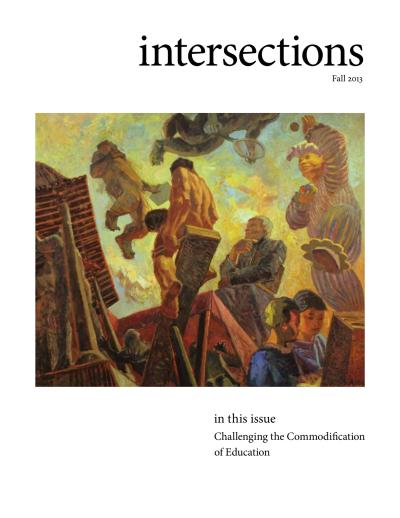 Article
The Value of Evoking Vocation and the Vocation of Evoking Value
Mark Schwehn
No. 38 · Fall 2013
Schwehn answers Michael Staton’s call to “disaggregate” the components of a college degree by insisting that Lutheran education is integral and whole. Working through Bruce Kimball’s history of liberal education, Cardinal Newman, and Leon Kass on Athens and Jerusalem, he argues that Lutherans should defend liberal learning on instrumental grounds and offers the figure of the “local genius”—exemplified by his Valparaiso colleague John Strietelmeier—as the form of human excellence that Lutheran colleges uniquely cultivate.