Freedom of a Christian-College: Looking through the Lens of Vocation
Intersections No. 24 · Fall 2006
Vocation is the fabric of Christian discipleship; it is literally crucial—“at the cross place”—in our life with God. Our vocations are doubly our passions, for the two senses of this word capture two sides of vocational faithfulness: both what we most joyfully “love to do” with God’s gifts but also where we must “suffer” in and with the struggles of our broken world. To get a wide angle on this daunting doubleness we will step far back historically to see how some early Christians helped to shape our heritage on vocation, and come forward, through Luther, to some challenges for our own time.
The joyous side, the search for what most makes us the persons we should be, is captured by contemporary poet Marge Pierce:
The people I love the best
jump into work head first
without dallying in the shallows
and swim off with sure strokes almost out of sight.
They seem to become natives of that element,
the black sleek heads of seals bouncing like half-submerged balls.
I love people who harness themselves, as ox to a heavy cart,
who pull like water buffalo, with massive patience,
who strain in the mud and the muck to move things forward,
who do what has to be done, again and again.I want to be with people who submerge
in the task, who go into the fields to harvest
and work in a row and pass the bags along,
who are not parlor generals and field deserters
but move in a common rhythm
when the food must come in or the fire be put out.The work of the world is common as mud.
Botched, it smears the hands, crumbles to dust.
But the thing worth doing well done
has a shape that satisfies, clean and evident.
Greek amphoras for wine or oil,
Hopi vases that held corn, are put in museums
but you know they were made to be used.
The pitcher cries for water to carry
and a person for work that is real.
(Pierce 157–8)
Christians have no monopoly on this yearning; it is part of our very selves—the persons God created us to be. To work on a college or university campus is to be surrounded by those who know they are hungry for “work that is real,” and to search with those who are seeking it. For those entering teaching in these settings, no better self-description could be claimed than the description of the clerk in Chaucer’s Canterbury Tales: “gladly would he learn and gladly teach.”1 This lovely phrase always comes to me with a memory of my first semester in graduate school. In the midst of all the final flurry of papers and pressures, a more senior student quoted that characterization to remind me—perhaps to remind both of us—why we were meeting one more evening in the library. “Chaucer could be describing me,” she said: “I too would gladly learn and gladly teach.”2 It is truly a privileged and exquisite vocation to teach, whether in classrooms or not, and one which cannot be done except by those who love also to learn. Despite the challenges which we all have experienced and the days we all dread, we are indeed fortunate to work in a field which has at its heart values of relationship—relationships of mutual care, responsibility, and attentiveness; of practices that hone precision and invite creativity; of opportunities for engaging the most serious and unanswerable of questions—and thus of laughing deeply, often, and first of all at ourselves. It is a profession, a vocation, which even on its most vexed days invites us to become more nearly the persons we would want and hope to be. We cannot wish for our students better than that.
Subjects I most gladly teach come from the first centuries of Christian experience. The Christian communities which most directly link us to our beginnings arose in contexts of ancient Mediterranean cultures, those of classical Greece and Rome, which had already long traditions of the “liberal arts.” As we know from our current polarized political discourse, “the L-word” can carry for some of our intended constituencies some negative connotations. But to speak of “liberal arts” is not, of course, to make a contemporary political statement. Instead, it roots our work in the tradition that reaches back, past Chaucer’s clerk and the rise of western universities, to the civic cultures that used the world literally: the liberal arts were those appropriate for “free men.” They were the studies that prompted mature vision and the sorts of understanding and wisdom which prepared fortunate young men, who were not enslaved and had wealth to provide sufficient leisure, for the roles of civic leadership and patronage which lay ahead for them. The significance of the studies was both for the privileged individuals who undertook them but also for the communities which were to be their spheres of responsible action. To be sure, we cannot miss the elitism—the restriction of liberal arts opportunities to only some, which is rightly a concern in our context, was in these contexts explicitly affirmed. Not every person needed such understandings and practices, it was felt—but a community needed for some of its most fortunate members to have them.
This understanding of liberal arts—directed, in a world of slavery, toward those who were free in order to form them in the outlooks and habits of freedom—was present in the cosmopolitan, multi-continental, multi-cultural, urbanizing world in which the first Christian communities were emerging. What then did Christians make of this learning? It is particularly intriguing to examine responses from the fourth century, a time of enormous change as Christians moved from a status of constant vulnerability and intermittent persecution to positions of legal and social privilege in the Roman Empire. From this time comes the Nicene Creed, still today as over the intervening eighteen centuries the most widely used Christian confession of faith. As we can see even in popular works like the Da Vinci Code, many people today view this period negatively—speaking of the “Constantinian cataclysm,” and seeing this time of transition as the wellspring of our woes as Christians. Without stopping to lament all the regrettable misunderstandings of early Christianity that come from these overdrawn condemnations, let me say only that the rapid acceleration of changes for Christians in the fourth century produced both challenges and opportunities of great complexity. Christian communities faced shifting possibilities not only in their legal status but also their cultural roles, including their relations to the heritages of educational resources and practices.
We find in the fourth century then new flares of mutual suspicion between those who were guarding the traditions of liberal learning and newly prominent Christians. Some followers of the traditional religions, for example, asked how it would be possible for those whose religious positions were at odds with the literature of gods and goddesses to teach that literature with sufficiently loving sympathy and appreciation. This was the basis for policies of the emperor Julian, who tried in his brief reign (361–3 CE) to bar from teaching classical texts those who did not believe in the gods as an effort to reverse the growing cultural influence he saw Christians exert. A prominent response, from those Christians who had been formed by the rhetorical delights of Greek and Roman cultures as well as the texts of scripture, was to claim that they could claim all these riches as their own and profit from wisdom wherever they found it. Authors sometimes expressed this stance with what they might call a “topos” and we would call a sound byte, a colorful, allusive way of speaking about their attitude toward these cultural resources which they found both impossible to repudiate or ignore. They recalled from Exodus that when the people of Israel left Egypt for the promised land, they took with them the most desirable of the goods of their former oppressors—they despoiled them of their most precious metals and most gorgeous fabrics. “Plundering,” or in King James English, “spoiling the Egyptians” became one of those recurrent phrases repeated from author to author that justified by implication “liberating” the liberal arts for use in another—in a better—context.3 We’ll come back to this gold a bit later.
But there were inner tensions and intriguing diversities in these evaluations which suggest that the questions were more difficult and contested. We can see some of the vibrancy of these engagements by looking at a fascinating family of Christian theologians who are customarily named from the name of their province, Cappadocia, in what is now central Turkey. In this remarkable family, the oldest brother Basil was educated at Athens in the best Greek traditions. As an adult he wrote a treatise for young students in the “spoiling the Egyptians” vein, providing “both an example of and an apology for” the view that Christians should listen to all who praised the good, for they shared with them common goals—a widely influential work which had renewed popularity in the world of sixteenth century Europe in which Martin Luther and other reformers lived.4 The family also included a remarkable sister, Macrina. In his eloquent tribute to her life, another brother Gregory of Nyssa characterized her as a philosopher—truly a “lover of wisdom,” and a teacher of Christian wisdom to the community she gathered around her. In describing her home-based education he did not say that an expensive education would have been wasted on a woman—Gregory himself had had to pursue his own education because the family didn’t expend the same resources on him as on Basil. Rather, he says that their mother wanted Macrina to be taught as befitted her abilities—but not from the unworthy and unsettling portrayals of women which she would find in classical literature. Macrina wisely, then, restricted her reading to Christian sources. (Gregory 165) Finally, “the Cappadocians” included the family friend Gregory of Nazianzus, who protested the interlude of renewed Roman imperial hostility to Christians under Julian with two orations, which wove together arguments from scripture and Christian understanding with appeals to the best traditions of Rome herself. I learned of these now-obscure orations from the class project of an international student as the United States prepared for the current war in Iraq. She found in Gregory a model of how her own opposition to the war, rooted in her Christian faith, could be argued more effectively when combined also with appeals American ideals and traditions.5
But to see more fully a Christian who is thoroughly, and for the most part non-triumphalistically, taking in the harvest of learning wherever he found it we will turn to Augustine of Hippo. Augustine, whose life spilled over from the fourth century through the first three decades of the fifth, is the figure without whom we cannot understand the western European middle ages or the churches of the Reformation. This African bishop gave his name to the community of friars to which Luther belonged. His legacy continues to be honored at Midland Lutheran’s Augustine Hall and in Carthage College’s “Augustine Institute.” Augustine’s young life, again the subject of much popular caricature as a time of great dissipation, was more a university experience of being “in love with love,” seeking restlessly for direction, understanding, and friends.6 An upwardly mobile striver from the provinces, he rose as far as the capital cities of the empire on his talent for words—words used for effect, for persuasion, for the commendation of his own abilities. But, after a long moral and intellectual struggle which led to this baptism and then to his active involvement in the church as bishop of the unimpressive city of Hippo back in his home province in Africa, he came gradually to reflect on how he could use words to proclaim the work of the Word, the One incarnate in Jesus Christ. Augustine became a deep student of the scriptures which he had once despised on literary grounds, with perhaps even a special love for the wisdom literature. These writings, he taught, both communicated to the simple enough for their needs, and yet provided to the most advanced student levels of meaning which continued to draw their attention toward deeper understanding.7
What buoyed Augustine’s confidence in seeking understanding was his assurance that wisdom, while found in scripture, does not come not from scripture alone, for all true wisdom, even if humanly articulated, has its origin and its goal in God. Thus he could be impatient with those who claimed that studies in the wide ranges of human learning had nothing to offer Christian proclamation. The bishop explored these possibilities for profitable study in a wonderful book called Teaching Christianity. To be sure, the trick to seeing this as a wonderful book is to read it with a certain humor, for his wide-ranging knowledge and vast curiosity are much in evidence here as he piled up example after example of helpful things to know and how they might be put to use. All the while he was constructing what a recent reader called his “sociology of knowledge,” an understanding of meaning and communication based on love. (Babcock 145–63)
In these arguments Augustine was appealing on a number of levels to the presence and activity of God. First, beginning with Genesis 1, he read that the agent of creation was God’s Word—the same Word, as John 1 declares, by whom all things were made. Put another way, as in Proverbs 8—for scripture delights in multiple expressions—it is the figure of Wisdom who has brought forth the world. Human discovery and delight in seeking wisdom, then, are seeking what God’s own marvelous creative activity has provided. So deeply did Augustine honor this divine Wisdom that he describes in his Confessions a brief moment of self-transcendence when he and his mother Monica were lifted up so closely into God’s presence that they could almost reach Wisdom herself.8
But that longed-for experience was a turning point for Augustine in ways he had not expected, and you can see in his retrospective telling of it in his Confessions that his understandings of God’s ways with the creation were being turned upside down. His moment of spiritual ascent was not a solitary moment of individual accomplishment or purification but a shared moment of being lifted up at the apex of a conversation—not with a learned person as the world counts learned but with his mother.9 They were talking together all the time—except for that brief moment of being beyond words in the presence of the Word. Even more important, however much Augustine might have hoped or even expected that he would grow steadily in spiritual perfection and thus in ascent to God, his experience after that moment in the garden in Italy was that the weights of sin’s habits were more persistent than he had hoped and the ties of responsibility to the nurture of his church were more absorbing than he had imagined.
And so, as he grew older, Augustine’s theology increasingly centered on the Incarnation. The creative Word of God who holds the world together in wisdom is the very same Word who in the humility of God has accommodated the weight of sinfulness that keeps us from rising into God’s presence by coming to where we are in Jesus Christ.10 To preach and counsel and teach in ways that pointed to that gracious work of God came to organize his days in ways he would have found unthinkable as an ambitious young teacher of communication who sought first to communicate his own greatness.
For the next thousand years, and beyond, Augustine was the most influential theologian in western Christianity. I hope I have helped to hint at how his theology was so suggestive for Martin Luther and the communities of the Reformation. But I want us also to see that Augustine’s thirst for God’s wisdom helped to shape through the next centuries a powerful tradition of learning in Christian communities. Luther was not only reacting against the narrowed or corrupted aspects of the Church in his time, which reduced vocation to the “religious” realm and turned the lives of Christians away from the needs of the aching world to a specious “spiritual” realm; he also had significant continuity with and indebtedness to positive aspects of these traditions. Spending much of his life in university settings and eloquently defending the liberal arts, he used all the tools of the reviving classical learning to help open his fresh readings of scripture and Christian traditions. The ELCA appeals to this legacy in the study for its social statement on education, which cites Luther’s praise for the vocation of teachers: “If I could leave the preaching office and my other duties, or had to do so, there is no other office I would rather have than that of schoolmaster or teacher…for I know that next to that of preaching, this is the best, greatest, and most useful office there is.” (Task Force on Education) In these words we see the spirit of one who would gladly learn and gladly teach, with generations of lovers of liberal learning before and after him.
Stan Olson has done an excellent job of reminding us how central vocation was for Luther. I want only to add to his discussion the theme of freedom—Luther’s two-edged freedom of a Christian that he described in his famous double assertion: “A Christian is perfectly free lord of all, subject to none. A Christian is perfectly dutiful servant of all, subject to all.” (Luther 596) When Luther talked about vocation, about calling, he was speaking of Christian lives lived by free people; when Stan used the phrase about filling roles rather than obeying rules, he was expressing that “freedom of a Christian” in vocational terms, in terms of our relationships to God’s willing and working—not as obligation but as grateful, zestful praise. This freedom is both a gifted freedom from being responsible ourselves for what is beyond our capacity, and at the same time a freedom for response to the needs of the world. For Lutheran ears, then, the language of the “liberal” arts cannot but resonate with the “liberation” of our best energies, mixed and messy as they will always be, for the needs of the world.11 Like a key signature which subtly changes the sound of all the music that follows, this re-doubled understanding of “freedom” gives to Lutheran songs praising “liberal arts” a distinctive sound. Just as Christian freedom involves two seemingly opposed sides, so does Christian vocation: it is both a free and joyous celebration of our giftedness and an unavoidable and costly response to the needs of all God calls us to love.
With this two-sided understanding, the mutual relation of liberal learning and professional preparation appears with a new dimension of depth and challenge. From one point of view, the both/and collaboration of liberal learning and professional preparation simply allows each to help the other to be its best self. (See Summer pp. 22–29) Each has vulnerabilities which the other can help address: the elitist potential of the liberal arts to restrict the circle of “free” people and to turn its civic edge to the protection of the powerful, on the one side,12 and, on the side of professional preparation, the reduction of vocation only to the working self. Two examples from the world of St. Olaf College show the potential for this creative complementarity.
First, the alum magazine Saint Olaf for Summer 2006 celebrated the history of the nursing education program at that institution. For students whose desire for what the mission statement used to call “lives of vocational usefulness” as healers was integral to what drew them to the college, the program has provided admirable professional preparation, despite the challenges the program has repeatedly encountered from those uncertain how it belonged in a liberal arts school. Quietly evident from the history were the ways the program had in fact benefited from the challenges—facing the questions had itself helped the nursing education take advantage of the ways in which the liberal arts context could help to produce better nurses.
A second example is a new book, Oath Betrayed, written by Steven Miles, a classmate of mine from 1972. Writing as a “practicing physician” and a teacher of medical ethics, Steven investigates the failures of medical professionals, who should have been the “first line of defense against torture”—but did not assume this role at Abu Ghraib or Guantanamo Bay or other more anonymous places where those who were under conditions of detention have been mistreated.
Obviously the book draws on a doctor’s professional preparation—the ability to read between the lines of autopsy reports and to know the codes of professional ethics. But it is also a book written by a liberally educated person, who could use a passage from Dostoyevsky to help bring home a point or marshal psychological research on the unreliability of evidence extracted by torture to buttress the ethical revulsion at medical collaboration with torturers which is conveyed by codes of ethics. And it was written by someone who since his college days, as a campus leader during resistance to the Viet Nam war, had intentionally combined pre-medical studies with ethical argument, theological curiosity, and community activism. St. Olaf prepared Steven for the intersection of committed professionalism and the liberally educated leadership which has marked his life.
But it is not enough to see our colleges only as places where liberal learning and professional education can enrich and inform one another—for this can happen at many other types of institution as well. And, indeed, that mutual enrichment is not by itself enough to respond to the challenge which Lake Lambert has described (see below pp. 30–35): if a line runs through both liberal arts and professional educational practices, where can we find resources for choosing one side over the other? We need to bring another dimension into this decision.
Now I am not saying that there is only one lens adequate for this task. And I am not saying that the questions can be answered easily or decisively in particular cases. But the lens of Christian faith in the Lutheran tradition has, I believe, powerful focusing power precisely on this point. How can we talk about why so many varieties of work can be vocations—but not all are? about when having a “successful” life is a vocational fulfillment and when perhaps a betrayal? about how to draw lines between contentment and complacency? Freedom of a Christian comes to our assistance here, showing how we can understand our vocational lives to free responses to God’s initiating, loving grace in our particular lives and to the needs of the world.
That world we have vocation “because of,” the world which God creates and loves, is an achingly broken, hurting, unjust world inhabited by very broken, struggling, sinful people: that would be us. And in those contexts we also will—in some ways we must—share in that suffering. It is no accident that Luther’s trenchant description of the theologian of the cross is one who calls a thing “what it actually is.” Such a theologian knows that “God can be found only in suffering and the cross” and that coming to this knowledge is available only to those who themselves also suffer.13 This is no perverse glorification or pursuit of suffering for its own sake or refusal to see the also the tender beauties of our lives and our work. Nor is it a suspicious mean-spirited repudiation of lives that look too contented. But it is a way of receiving from Christ a clear-eyed realism about the ways of the world. What does such realism say? While we cannot give an exhaustive answer, surely each of us can think of concrete affirmations like these:
- It is no one’s vocation to work in a mine carrying defective equipment or entering corridors which have been inadequately sealed;
- It is no one’s vocation to abuse a prisoner or for supervisors of interrogators to collude by inattention in such abuse;
- It is no one’s vocation to speak of “servant leadership” to minimum-wage workers locked into a store to prevent their going home when their shift is finished but the job is not.
Remember that treasure taken from the Egyptians—those liberal arts taken along with the liberated people on their way to a better life? That gold was (at least in part) turned into the idol of the golden calf—it became the false god of a new form of enslavement. But that flirtation with unfaithfulness also was not the last word for Israel: those Exodus people, those who had toiled in slavery and then knew liberation, do have wisdom to offer us about work. When we read the early chapters of Genesis, we are reading a story that helps us understand how things come to be as they are, and they speak more than we often remember about work. Work was, Genesis says, part of God’s intent for human life, something which even God entered into and accomplished. But it could also be toil—oppressive, sweaty, grinding toil whose origin lies in sin. It is important to distinguish the two.
With the scriptures, as we have seen, the Lutheran tradition tells us that there is honor and holiness in all good work—in spreading manure so that the plants that God created may grow or changing diapers so that the life that God has begun may flourish or cobbling shoes so that human creativity can meet the realities of rocks and snow. And there can be honor and holiness also in work more directly occasioned by sin—in the work of the police often and the tasks of teachers and parents sometimes. But Lutherans need not turn our heads even from the costs of actively entering into what is wrong and, as necessary, resisting it. God’s call is to places of passion—but these may turn out to be not the “passions” of our own enthusiastic first loves but of the suffering of Christ.
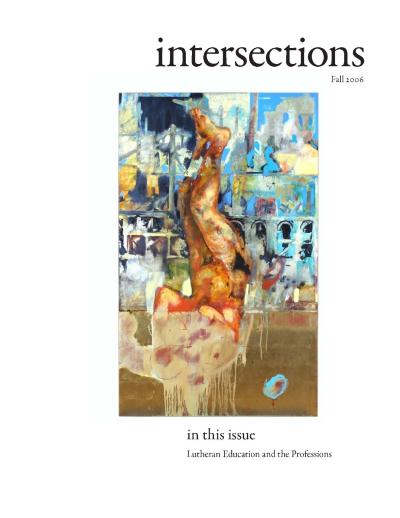
Dietrich Bonhoeffer’s life and death exemplify this cruciform character of Christian vocation, and contemporary artist Bruce Herman helps us to see it. (See cover illustration of this issue.) I am indebted for the image to my colleague Amy Plantinga Pauw, who saw a reproduction of his painting “Elegy for Bonhoeffer” and then sought out the artist for conversation. This is her account:
This painting portrays the death of Dietrich Bonhoeffer, who on April 9, 1945, was stripped of his prison clothes and executed at Flossenbürg concentration camp, along with five other members of his resistance group. In the upper part of the painting you see the glories of Germany’s architectural tradition lying in ruins. The bottom part of the painting is covered in gold leaf to symbolize the realm of God.
Herman’s painting draws on the Christian tradition of memorializing the suffering of martyrs (witnesses) to the faith. This tradition has lent itself to heroic and romanticized understandings of martyrdom. Bonhoeffer, as a young martyr with attractive, well-recognized facial features, has not wholly escaped this romantic heroizing, especially in Protestant circles. But Herman has literally turned this tradition upside down: Bonhoeffer descends, rather than ascends, into God’s presence. The streams of paint at the bottom show his life pouring out as his head and shoulders enter a transcendent realm, obscuring his identifying features. For the theologian who finally “abandoned the attempt to make something of himself,” and who found life “too great and too precious…to romanticize death,” this descent into the arms of divine grace is only fitting.14
Here vocation truly is, as Leonard Schultze likes to say, the “crux” of the matter (Schultze). Bonhoeffer’s costly discipleship was clearly, in his most prayerful and considered judgment, the calling to which he had been called—even when it overturned his hopes and reversed what might have been expected to be the trajectory of his career. His life is inconceivable without his deep appropriation of liberal arts, or without his participation, as a student and for students, in professional preparation for pastoral ministry and teaching. But through the lens of vocation—of christic, cruciform vocation—we can see how it could be that his death by shaming, brutal execution was not failure but faithfulness, even unto death. We know this, of course, first from the story of Bonhoeffer’s life.
But we know it at another level from Herman’s remarkable art, where we see not only Bonhoeffer’s faithfulness to his vocation but also the artist’s own. The overturning of aesthetic expectations in this portrait helps us to know the quality of Bonhoeffer’s death in a new way—to think about and feel it and carry it away with us. Colleges and universities are settings where the challenges raised by a life like Bonhoeffer’s can be appreciated, explored, and received on many levels—in religion and history classes, in art and music and drama, in worship and in social action. These institutions are uniquely placed to help not only students but this church and our wider culture to see what would otherwise be hidden from us by our over-paced lives and over-consuming culture.
Now I don’t for a moment mean to say that only Christians or only Lutherans have some sort of monopoly on seeing the hurts and beauties of the world. It is one of the gifts of Lutheran tradition to be able from its center to seek partnerships and creative collaborations with people who also “seek the good of the cities” in which we live from motives and perspectives different from our own. But I do believe that in Lutheran schools, institutions somehow partners with our Lutheran church, there needs to be a special role—a hosting, inviting, tone-setting, value-articulating role—for perspectives shaped by Lutheran commitments, even though that role may not be the same in every place. I would argue that for this work the presence and collaboration of non-Lutherans, especially faculty members, is not only possible but actively helpful toward the articulation of Lutheran insights for our time. (As a Lutheran who is asked in the Presbyterian seminary where I work to be conversation partner, critic, appreciator, to lend my efforts to help the Reformed tradition make its best contributions to the church and world, I think I know from the other side something of what this role can be.)
At this moment in our cultural history, the church and the world need the services of institutions like the colleges and universities of his church with particular urgency. For many reasons, which we only partly understand, there has come to be in our cultural context too much muting of the voices of Christian witness which see what we see. These under-spoken perspectives include at least these: a sense of being claimed by the power of God in Jesus Christ that sees God’s wisdom also in other places and trusts that it is at work even where we do not see it; a stance that takes with deadly seriousness and yet with joyful lightness the implications of loving God and our neighbors with heart and soul and mind; a sensibility that celebrates a dizzying range of goods in this creation and thus a wide variety of God-pleasing life forms; a commitment that sees also the tragic and oppressive dimensions of this same world not as car wrecks we hope to be able to steer around ourselves but as the places where, with God’s help, we need most to be.
Again, this is not some claim for exclusivism: I would not want to deny the transforming power of God which many people around the globe are finding in forms of Christianity very different from our own, or for the power of other communities of faith to shape lives of holiness and beauty. But so is God at work in Lutheran tradition and in our communities of faith! And it is a part of the vocation of our institutions of learning to raise the visibility of these gifts. Like Chaucer’s clerk and like each of us, the Lutheran tradition needs to be glad to learn—but also glad to teach. If we believe, as I do, that we also have something to offer that is distinctive and valuable, then we need presentations and presences of Lutheran perspectives that are, to be sure, marked by a spirit of repentance and self-criticism where that is appropriate—but are also winsome and commending, engaging because they are engaged with the needs of the world. And all this by the grace of God.
It is no implication of respecting the faith of others to be hesitant or ashamed or inadequately grounded in our own. Recently I visited the Netherlands, and heard about the struggles of the newly-formed Protestant Church in the Netherlands to find its way in a changing culture that offers decreasing support for Christian commitment. The Domkirk in Amsterdam, for example, the national site of coronations and other royal celebrations, is no longer a church; there are no clergy or congregation, and worship occurs only on royal occasions. The bookshop, however, still bears signs of the religious character of the space. In particular, I noticed a number of Dutch books to help people learn about Islam and the possibilities of interfaith relations. But, apart from Bibles, there was a startling dearth of books on Christian faith, to help Dutch readers to understand with equal depth what was, at least nominally or by tradition, their own faith.
Closer to home, as a seminary teacher I see the urgent need for ministers whose professional preparation includes formation by liberal learning. The contributions of some disciplines are obvious: think how much we learn from literature about character, motivation, the degradations and exaltations of human life—and without needing to have directly experienced all those situations and events. But the example I want to use concerns principally the natural sciences.
If you have not been to Kentucky, I hope that you will come. Every May at Derby time we turn a two-minute horse race into a three-week party. More importantly, there are many sites near my home which have helped shape Christian experience in the United States. It has been an “American Holy Land”15: the revivals begun there at Cane Run helped launch the Second Great Awakening; there was a Roman Catholic diocese established in Bardstown at the same time as those in Boston, New York, and Philadelphia; and in the 1840s within a few dozen miles of one another, Trappist monks were establishing a community at the Abbey of Gethsemani and Shakers were pursuing another form of celibate farming utopia at Pleasant Hill. But soon we will add another attraction for tourists to see—a creationist museum. Its exhibits will buttress what claims to be a literal reading of scriptures, that all forms of life were created within seven days about six thousand years ago. Visitors will see how an ark built to biblical specifications could hold two of every species. (The trick, I’ve been told, is that the dinosaurs must be babies.)
Now I’m not concerned here to take on the beliefs of those Christians who promote this form of reading the scriptures. I’m not taking on the assertions of the influential president of a large seminary in Louisville, who describes himself proudly as a “young-earth creationist.”16 My concern is with the seminarians that we teach in our non-creationist setting and with the resources they have to articulate and defend an alternative understanding of the early chapters of Genesis. If they approach this question as if from nowhere, they are likely to pose it immediately as a “God question” and then find it difficult to avoid an affirmative answer: could God have created the world in this way at that time? My hope for them would that before they propose this question they can summon many other perspectives—from what they know of genetics, geology, archaeology, and a host of other spheres of human inquiry that would render them unpersuaded by creationist claims. But, lacking a liberal arts education from high school on, even very good students can find themselves without the tools to articulate and defend the positions they want to take. Students who prepare for ministry without a liberal arts education can, of course, become excellent pastors—but there is something irreplaceably valuable about the perspectives and capacities sustained by study in schools like our colleges and universities.
I wouldn’t want the creationist museum to have the last word about Christians in Kentucky, however. Among my joys in recent years has been participating in developing an ecumenical Master of Arts in Spirituality, shared between the Presbyterian school where I teach and the local Roman Catholic university. We take the shape of the program—our niche in the spirituality world, one could say—from the Cistercian monk Thomas Merton who lived and is buried just south of Louisville at Gethsemani Abbey. Remembering what Luther thought of the monasticism of his day, it is a wondrous and healing to be able to discover in this twentieth-century Roman Catholic monk views which speak deeply to my Lutheran ways of being Christian. As a young man, Merton went to rural Kentucky to turn from the world, but he found there that his attention to God drew him back to care for the world that God loved. Very simply, he came to see, the meaning of contemplation was to see things as they were and not otherwise,17 and that there is no “spiritual life”—there is life, which is charged with God-given meaning.
Every year the Merton Institute for Contemplative Living in Louisville gives a prize for a poem capturing Merton’s vision, and in 2006 it was awarded to Jeffrey Johnson, a graduate of St. Olaf college, a pastor of the ELCA, an activist for peace, and a poet. His words speak, in despite of all our efforts to bend the world to our own use, of simple openness to God’s world as it is, and thus they fittingly here the last words:
If you can focus your eyes
on that bird on the bench,
the one in the charcoal suit
with the off-white shirt,
see that it’s small and proper
with a formal tail tipping
and a head swiveling socially,
see how it flaps straight up
and lands on the same spot,
with bugs on its breath, see it
smooth and present there
and not as a specimen,
an example, a kind or a type,
as a pet to be held or a carcass
for the altar or the market,
but as a small bird on a bench,
then you will have prayed,
and prayed well I would say,
as if you loved an ordinary
and otherwise unnoticed bird.
Johnson 2006
Endnotes
1. Chaucer 15: “and gladly wolde he lerne, and gladly teche.”
2. This phrase from a medieval Catholic author has become the title of a thoughtful book of essays on the teaching vocation from a conference at Mercer University, a Baptist institution—cf. Dunaway 2005.
3. Two examples will suffice. In the mid-third century Origen of Alexandria’s “Letter to Gregory” enjoins his student toward deep study of scripture, and Augustine also used the topos.
4. Quotation is from Van Dam 184. Basil’s “To Young Men, On How They Might Profit from Pagan Literature” was the first of his many works to be printed, about 1471 CE. (Deferrari and McGuire 373)
5. Rhonda Lee, unpublished class paper on Gregory of Nazianzus, Louisville Presbyterian Theological Seminary, Spring, 2004.
6. All this account, of course, is Augustine’s own, from his Confessions.
7. In the final three books of his Confessions, Augustine wrestled at length with the mysteries suggested by the first chapter of Genesis.
8. Augustine, Confessions, 10.24, pp. 227–8.
9. This point is stressed especially by John Cavadini, who uses Augustine’s phrase, “You pasture Israel for ever with the food of truth,” as the guiding image of his article on teaching as conversation (Cavadini).
10. While remaining indebted to “the Platonists” for some crucial insights, Augustine increasingly saw these philosophers as undone by their pride.
11. A helpful introduction to Luther’s understanding of vocation, beginning from Freedom of a Christian, is Kleinhans 2005.
12. Dunaway expressed this potential weakness of liberal arts education when he asked if it were surprising “that the corporate executives who were responsible for the staggering moral failures of recent years (Enron, WorldCom, Arthur Andersen) were trained at our elite universities, most of which were founded upon ideas such as Lux et veritas (Yale), In Deo speramus (Brown), and Eriditio et religio (Duke).” (“Introduction,” Gladly Learn, xi.)
13. Martin Luther, “Heidelberg Disputation,” in Lull, 44.
14. Amy found the painting reproduced in Prescott 2005; her account is indebted to the book as well as conversation with the author.
15. The phrase is that of Kentucky religious historian Clyde F. Crews.
16. President Albert Mohler of Southern Baptist Theological Seminary, who writes and speaks regularly about social questions, describes himself “a Christian theologian committed to the biblical doctrine of creation, complete with an affirmation of a young earth and the divine creation of all things (and of all species).”
17. A helpful reflection on Merton’s perspective is found in Palmer 22–37. Palmer summarized what he had learned from Merton and from experience this way: “Today my definition of contemplation is quite simple: contemplation is any way one has of penetrating illusion and touching reality.” (30)
Works Cited
Babcock, William S. “Caritas and Signification.” De Doctrina Christiana: A Classic of Western Culture. Ed. Duane W. H. Arnold and Pamela Bright. Notre Dame, IN: University of Notre Dame, 1995. 145–63.
Boulding, Maria. The Confessions. Hyde Park, NY: New City, 1997.
Cavadini, John. “The Food of Truth.” Labors from the Heart, Mission and Ministry in a Catholic University. Ed. Mark L. Poorman. Notre Dame, IN: University of Notre Dame, 1996, 55–66.
Chaucer, Geoffrey. The Canterbury Tales. Ed. Walter W. Skeat. New York, NY: Modern Library, 1957.
Crews, Clyde F. An American Holy Land. Louisville, KY: ikonographics, 1987.
Deferrari, Roy J. and Martin R. P. McGuire. “Prefatory Note.” Saint Basil: The Letters. Vol. IV. Cambridge, MA: Harvard UP, 1934. 365–76.
Dunaway, John Marson, ed. Gladly Learn, Gladly Teach: Living Out One’s Calling in the Twenty-first Century Academy. Macon, GA: Mercer University Press, 2005.
Gregory of Nyssa. “Life of St. Macrina.” Saint Gregory of Nyssa: Ascetical Works. Trans. Virginia Woods Callahan. Washington, D.C.: Catholic University of America Press, 1967.
Hill, Edmund, trans. Teaching Christianity (De Doctrina Christiana). Hyde Park, NY: New City Press, 1996.
Johnson, Jeffrey. “2006 Thomas Merton Prize,” Poetry of the Sacred.
King, C. W., trans. Julian the Emperor: Containing Gregory Nazianzen’s Two Invectives and Libanius’ Monody with Julian’s Extant Theological Works. London: G. Bell and Sons, 1888.
Kleinhans, Kathryn. “The Work of a Christian: Vocation in Lutheran Perspective.” Word & World 25.4 (2005): 394–402.
Luther, Martin. “Freedom of a Christian.” Martin Luther’s Basic Theological Writing. Ed. Timothy F. Lull. Minneapolis, MN: Fortress Press, 1989.
Lull, Timothy F. ed. Martin Luther’s Basic Theological Writing. Minneapolis, MN: Fortress Press, 1989.
Menzies, Allen, ed. and trans. “Letter of Origen to Gregory.” The Ante-Nicene Fathers, vol. 10. Buffalo, NY: Christian Literature Publishing Company, 1896.
Miles, Steven H. Oath Betrayed: Torture, Medical Complicity, and the War on Terror. New York, NY: Random House, 2006.
Palmer, Parker. “Contemplation Reconsidered: The Human Way In.” The Merton Annual 8 (1995): 22–37.
Pierce, Marge. “To Be of Use.” Good Poems. Ed. Garrison Keillor. New York, NY: Viking Penguin, 2002. 157–8.
Prescott, Theodore L., ed. A Broken Beauty. Grand Rapids, MI: Eerdmans, 2005.
Quasten, Johannes. Patrology. Vol. III. Utrecht: Spectrum Publishers, 1975.
Schultze, Leonard. “Vocation: The Crux of the Matter—Notes on an Idea and Why It Matters.” Augustine Institute at Carthage College.
Solberg, Mary. Compelling Knowledge: A Feminist Epistemology of the Cross. Albany, NY: State U of New York P, 1997.
Task Force on Education. Evangelical Lutheran Church in America. “Our Calling in Education: A Lutheran Study.” 2004.
Van Dam, Raymond. Kingdom of Snow: Roman Rule and Greek Culture in Cappadocia. Philadelphia: University of Pennsylvania Press, 2004.
-
 Editorial
From the Publisher
Arne Selbyg
Selbyg situates this issue in the ongoing ELCA conversation about education that began with the 2005 conference and is feeding into the second draft of the ELCA Social Statement on Education, previews the 2007 conference (“The Vocation of a Lutheran College — Engaging the World”) at Augustana College, Rock Island, and lifts up Luther’s insistence that the church and its members contribute to their wider communities rather than retreat into self-centered enclaves.
-
Editorial
From the Editor
Robert D. Haak
Haak introduces the issue’s essays by Stanley N. Olson, Kathryn L. Johnson, Gail Summer, Lake Lambert, and Steven C. Bahls; argues that on Lutheran campuses, professional programs in business, education, and nursing are not “second-class citizens” but integral to the institution’s vocation; cites Olson’s mantra (“Because of Christ, the world; because of the world, vocation; because of vocation, education”); and thanks Matt Marohl for assisting with the editing.
-
Article
Vocation and the Vocation of a Lutheran College (Cows, Colleges and Contentment)
Stanley Olson
Drawing on a childhood image of contented cows on Lutheran-owned farmland in Northfield, Olson—Executive Director of the ELCA Vocation and Education unit—asks whether Lutheran colleges are content because they draw nourishment from the Lutheran tradition, or merely because they happen to be standing on Lutheran soil. He proposes the mantra “Because of Christ, the world; because of the world, vocation; because of vocation, education,” and traces what each clause demands of the colleges and universities of the ELCA.
-
Article
Professional Education/Liberal Arts Education: Not a Case of Either-Or but Both-And
Gail Summer
Summer, Dean of Academic Programs at Lenoir-Rhyne College, traces the historical interweaving of liberal arts and professional education in American higher education (using the rise of engineering as a case study) and argues that the standard “either-or” framing of liberal arts versus professional preparation misreads both. At Lutheran colleges, the “both-and” relationship is shaped by a Lutheran understanding of vocation in which professional programs are integral to, not in tension with, the liberal arts.
-
Article
The Divide Within (Not Between) Liberal Arts and Professional Education
Lake Lambert
Lambert, then Board of Regents Chair in Ethics at Wartburg College and Project Director for the “Discovering and Claiming our Callings Initiative,” argues that the real divide in higher education runs not between the liberal arts and the professions but within each — between teaching that forms students for callings and teaching that merely transmits content or credential. He calls Lutheran colleges to recover, across both liberal arts and professional disciplines, a shared commitment to vocational formation grounded in the Lutheran tradition.
-
Article
Liberal Arts and Professional Education: A Call for Philosopher-Servants
Steven C. Bahls
Bahls, President of Augustana College (Rock Island), calls for a renewed commitment at Lutheran colleges to form “philosopher-servants” — graduates whose grounding in the liberal arts and the liberating gospel equips them for thoughtful service in business, education, nursing, and the other professions. Their impact, he argues, is “a good thing and a fact that we can be proud of as those who labor in Lutheran higher education.”
-
 Article
Resistance in the Age of Trump: An Interview with Ivonne Wallace Fuentes
Jason A. Mahn, M. Ivonne Wallace Fuentes
No. 45 · Spring 2017
In conversation with Jason Mahn, Roanoke College historian Ivonne Wallace Fuentes describes how she launched a local chapter of Indivisible after the 2016 election, how the skills of teaching and historical research carry over into grassroots advocacy, and how her sense of vocation (vocare) has become intertwined with the work of advocacy (advocare).
-
 Editorial
From the Publisher
Arne Selbyg
No. 26 · Fall 2007
Selbyg notes that, while a stated purpose of Intersections over its twelve years and twenty-six issues has been the intersection of faith, learning, and teaching, surprisingly few articles have addressed how Lutheran faculty teach and why — and credits the editor for assembling essays from authors whose teaching has benefited from the ELCA Wittenberg Center, on the eve of the City of Wittenberg’s “Luther Decade” leading up to the 2017 Reformation anniversary.
-
 Article
Ivory Tower or Holy Mountain? Faith and Academic Freedom
Nicholas Wolterstorff
No. 11 · Spring 2001
Wolterstorff defines infringement of academic freedom as impairing a faculty member’s standing on account of the ideological content of her position, argues that academic freedom (like free speech) is “duly qualified” rather than absolute, and offers eight considerations bearing on religiously based institutions: Weber’s differentiation of Wissenschaft, religious pluralism within a liberal polity, the vitality of American civil society, a decentralized educational system, the “holistic” character of much American religion, the post-Kuhnian collapse of classical foundationalism and of the “generically human” academy, the fact that ideas matter, and the personhood violated by infringement (the desecration of an image of God). He concludes that the private sector offers wider academic freedom than the public, that religious qualifications are not inherently inappropriate (any more than St. John’s Great Books commitment), but that religiously based colleges too often apply them unjustly—arbitrarily, secretly, without recourse—and that the AAUP’s best service is model codes of procedure.
-
 Response
Of Imaginary Cows and a White Toy Sheep: The Freedom of a Christian College
Ryan La Hurd
No. 6 · Winter 1999
La Hurd, president of Lenoir-Rhyne and a former Thiel English professor and Augsburg academic dean, responds to Christenson by insisting (with Robert Kegan’s story of Tommy’s imaginary cattle farm) that a college is composed of people but is not itself a person, and so cannot share in Luther’s freedom of the Christian. Drawing on Benedict Anderson’s Imagined Communities, Lewis Hyde’s The Gift, George Marsden, Mark Schwehn, Jacques Barzun, and the Pew Higher Education Roundtable, he distinguishes the “imagined college” (the gift-economy realm of teaching and the alma mater) from the “real college” (the commodity-economy realm of fund-raising, deferred maintenance, and federal aid reconciliation that does not have such freedom)—and ends with Pablo Neruda’s “Childhood and Poetry” and the marvelous white toy sheep offered through a hole in a fence.
-
 Editorial
From the Outgoing Editor
Jason A. Mahn
No. 55 · Spring 2022
Mahn closes out a decade of editing Intersections, passes the duties to Colleen Windham-Hughes, gives thanks to Mark Wilhelm and Augustana College, and introduces an issue largely drawn from comments by Lutheran faculty, staff, and administrators at the 2022 NetVUE national gathering.
-
 Editorial
From the Editor
Jason A. Mahn
No. 42 · Fall 2015
Mahn introduces the “Vocation and the Common Good” issue by asking what is left of “the commons” in an age of privatized goods and education-as-commodity, and frames church-related colleges — with their stubborn vocabulary of “liberal arts,” “collegiate,” and “calling” — as among the least fully-privatized resources left in American life.