A
answer noun 1. A response to a question or the solution to a problem. 2. In our times it has come to be assumed that questions are defined in terms of their answers, but in theology this is not so. In fact this disjunction is one cardinal reason that both theological language and poetry are seen as strange or even empty of content. We educate ourselves and each other to search for answers; and when we encounter a question which does not fit the mould, we have no idea of what to do next. 3. In theology and in poetry the answers are less important than the questions themselves, which are often answered again and again yet never answered. Thus Jesus asks Peter, “Who do you say that I am?” (Matthew 16:15) The dialogue which ensues is important, and Peter’s answers are interesting and informative; but the question stands on its own quite apart from what Peter said. It is a sign, and an unfortunate one at that, that the modern age has spilled tons of blood over differing interpretations of the answers while refusing to live in the mystery of the question. See problem and question.
ark noun 1. An especially unseaworthy boat built by Noah, who was not a seaman at all! (Genesis 9:20) For a time, it is said, this boat contained the whole of the human race and culture. God regretted ever having made this race, but for some reason, never truly explained, he relented and saved this small remnant. 2. The first of several demonstrations in the Bible that God makes very odd choices when calling people to vocations. It would seem that when it comes to reading resumes God is without a clue. 3. The ark may also be seen as a metaphor for the church and the graces which may be obtained by being within it: much better than the alternative even if the stench is ferocious!
B
belief noun 1. The act of thinking that some story or doctrine is true, based either on evidence accessible to all or on some special insight available to only a few. 2. While virtually no one wishes to believe either stories or doctrines that are false, it is odd that belief is seen to be a virtue. It is not, and elevating belief to a virtue generally results in idolatry. “To believe falsely” seems to be an oxymoron in all languages. 3. At its best belief is a bet which hope places against the boxing with reality which passes for thinking in most of the world. At its worst belief comes from the fear which causes the boxing. Most of us struggle with a mixture of the two, and the story of the man with the epileptic son (Mark 9:17–24) brings this into focus. 4. Those who would make belief itself into a virtue ought to compare the demons who knew and believed without doubt that Jesus was the Messiah (Mark 5:1–20 and many other passages) to the apostles who were still in the dark at the end of the story! (Mark 16:11) 5. A common error is confusing belief with faith (which see). This error is not innocent as such belief shades into doctrine then dogma then rigid orthodoxy then inquisition. Belief can and has become a primary defense against newness, possibility, and freedom. Such a defense has led in modern times to both violence and depression, the twentieth century’s diseases of choice. There is little doubt that God prefers atheism to many of these forms of belief. If this were not so, Jesus would not have been as sharp with the demons as he always was. 6. It is thought that it is differences in belief that divide the churches, and theologians of all sorts claim to love the truth and speak it and to hate error. It is not surprising in the least that truth in one tradition will often coincide with error in another. The real truth is that all of our dogmas are wrong to some extent. A great scandal of the church is that differences in belief—especially those that are difficult to understand and explain—are used to divide the church. Since the church is a human institution, these divisions must have more to do with interests and property than with principles of any kind. See faith.
C
church noun 1. On a mystical level the Body of Christ and the company of all faithful people. 2. On the human level a temporary and contingent organization. It is a sign of grace and a sense of humor that God put up with it. The true church may be described by the acronym from computer science WYSIWYG (what you see is what you get). It is a community—often shapeless and goalless—of those who have been grasped by that awe-filled freedom for which Christ has set us free. (Galatians 5:1) 3. It is both sanctuary and refuge, which entries see. At the church’s best it is possible to meet within its body, aware that everyone in it is as much a sinner and is as much saved and healed as everyone else. 4. Eventually the church will be out of business. There was no church in Eden (Genesis 2:15–25), and there will be none in the new heaven either (Revelation 21:22). In the present time however, the church is an institution or collection of them, which own property, has laws and hierarchies, and quarrels with itself. Like all institutions it can not imagine the world without itself, and so it spends much of its energy perpetuating itself all the while vainly imagining that the reign of God depends on itself. It does not, and the Galilean carpenter whose name it takes had no interest in institutions of any kind—except to subvert those which held the people he loved in bondage.
comedy noun 1. A dramatic form designed to entertain by calling on the lighter human emotions. As such, comedy may use wit, buffoonery, ridicule, and satire to amuse—and enlighten. Comedic stories have happy endings except for the villains and butts of the jokes. 2. What a Bob Hope one-liner is not, but what a Robin Williams one-liner is. 3. The human story spiraling upward towards its unfolding and fulfillment. 4. The ‘yes’ within the ‘no,’ the light within the dark, the joy within brokenness. 5. The suddenness and surprise of grace. 6. The holy joke which is sprung whenever one realizes that what is needed is already in hand. 7. The Bible contains a fair amount of comedy; and if pious folk did not read it all so grimly, the book would be enjoyed much more than it is. Examples are the story of Ruth, the story of Gideon (Judges 6–8), several of the parables of Jesus, and the Book of Revelation. See grace, parable, poetry and tragedy.
F
fence noun 1. A barrier designed to separate pieces of God’s creation from his creatures. 2. The poet (R. Frost) said “that good fences make good neighbors,” but he was being ironic, a fact missed by the majority of his readers. Fences offer the illusion of safety as they can for a time effect real separation, but eventually what is being avoided will get in somehow. 3. Several centuries ago churches came to have fences (known as altar or communion rails) inside to protect the altar and the priest from wandering farm animals. Soon the separation was between the clergy and the laity, and to some extent that division persists to this day. To be sure, certain members of the laity have been able to enter the area inside, known as the chancel, but only under carefully prescribed conditions. 5. At the time of the Reformation most Protestant church leaders saw that the division was artificial or worse, and the rails came down in most places. Even in England the Archbishop of Canterbury, Thomas Cranmer, decreed that the faithful surround the communion table. This never caught on; Cranmer was burned at the stake in 1555; and fences persist in Anglican churches to this day. During the 1960’s the Roman Catholic Church radically changed their liturgy and their existing fences are now used only rarely.
H
heaven noun 1. Imagined to be a place of eternal bliss in spite of the fact that no one has sufficient imagination to picture either bliss or eternity. Also thought to be somewhere in the sky or beyond it. With our modern understanding of the structure of the universe, this idea has become very difficult to believe. Some imagine an existence after death for the elect somewhere up, but it has become impossible to see in these images much beyond the making of jokes. Floating above pink clouds in a white gown with wings while playing music on a golden harp does not strike the writers of this dictionary as being interesting. 2. Heaven is often imagined to be part of a system of rewards and punishments in which the just, or the faithful, or the chosen are given the ultimate grand prize while the rest of us go to hell. All such systems are individualistic and narcissistic, but they do appeal to those who imagine themselves either among the elect or among those who run the system. It is difficult to comprehend the amount of fruitless anguish which has consumed those who have worried over what might await them after death. 3. Heaven is better seen as the state of being completely in the sight and care of God while knowing that such is the case. (Hell is being radically apart from God, if such be possible.) Either heaven or hell is best seen as real possibility in the now. 4. It is much more fruitful to use the word and image of paradise. Paradise has no fixed location or time in our witness, and we leave it to God to create such a place and life. See hell and paradise.
hell noun 1. Thought to be a place of torment and the just desserts of the unfaithful. Such requires both an ill-tempered and vengeful God and doubtful manipulations of scripture and sensibility. These things come from imagining extensions of narcissism beyond the grave. Nonetheless, orthodox “keepers of the keys” place great stock in a system of rewards and punishments. 2. In this individualistic age many do imagine that one can be punished eternally for not believing the right thing, for not doing the right thing, or for not belonging to the right group. These views are held chiefly by those who think that they believe the right thing, do the right things, and belong to the one true church. We have no wish to be judgmental, but it does strike us as at least possible that the motives are self-justification and fear. 3. Actually to be in hell is to be forgotten by God and unknown to God. It is not, however, clear that such a state is possible even if that should be a person’s deepest desire. (Psalm 139:7–12) Neither is it clear that any one of us receives his or her just desserts. (Psalm 103:8–14) 4. It is much more likely that those who choose to flee from God will get their wish—for a time. Nonetheless, it seems certain that God will not cease to love them. If we have been admonished to love our enemies (Matthew 5:43–8), will not God do the same for those who choose to be his enemies? 5. It follows that both heaven and hell are vital symbols which are bound neither to a linear sense of time nor to a system of justice but which are ever present and intimate possibilities. If we try to move beyond this simple statement, we would be attempting to change God from immeasurable mystery into that which we can manage. See grace and heaven.
M
miracle noun 1. Describes any phenomenon in the natural world which goes against the laws of nature, which is beneficent, and which is, therefore, caused by a supernatural being. 2. This is a modern definition which came into use with William of Ockham in the fourteenth century, and it is clear that the biblical writers had no such understanding. The distinction between miraculous events and the rest became prominent only after the Enlightenment when, as Laplace remarked to Napoleon, the hypothesis of God was no longer necessary. Miracle then emerged as supernatural diddling with the laws of nature, congenially and apologetically retaining a diminishing preserve for the action of a rational and domesticated God. See gaps. 3. Any event—natural vs. supernatural is not the issue—which opens to and drives home the truth about reality, about the relationship between God and humanity. As such the miraculous is always revelation, the laying bare of truth, and revelation is always decreation. See monotheism. All things are potential bearers of miracle. 4. The occurrences of the word in the English Bible are few, and it is always possible to find another word that is closer to the original, such as sign, wonder, or act of power. 5. The great miracles in the Christian tradition are the creation and the incarnation, which entries see. Neither is plausible, likely, or reasonable, but then neither is the very existence of God or anything else. See metatheology and science.
Q
question noun 1. A sentence or statement which invites or requires a response. 2. There are several varieties, but the ones that are of the most interest to theology are often not even seen as questions at all. 3. The most common types are the ones that either have answers or the presumption of an answer. Most of what passes for education in the modern age consist of learning to state the questions and expound the answers. In this way both students and teachers can be assessed, i.e., judged, and it becomes possible to reform and improve education. Thus students in school will be sure that Boise is the capital of Montana, and students in Sunday School will be sure that Noah’s wife was Joan of Ark, and our educational professionals will know what to do. 4. On another level other professionals will do research and find new answers and perhaps even Joan’s Ark. This will provide new information and larger and larger libraries, and soon the human race will know more stuff than it could ever use. 5. Nonetheless, research in itself is more boon than bane, and it can even be done on the biblical texts. Such is certainly fine, and so it is that people ask questions of the Bible. They expect answers too; for what else have they been educated? At this point the witnesses of religion and history veer far from the culture, and the people who live in that culture find themselves in a strange land indeed. The Bible is filled with questions, and so is the history, but they are of a wholly different order. They may not even have “correct” answers, and the skills of professionals won’t help either. The one who goes to the text in search of answers to questions is very likely to find that the text is asking rather than answering. This is disconcerting to say the least, and the result is often an even more diligent search for answers as if the text were some giant puzzle which can only be solved by great effort. The search is interesting, but ultimately ends where it began, that is where the question from the text was encountered. 6. Some examples will illustrate what happens. “What is truth?” (John 18:38) [No answer is given.] “What is his (God’s) name?” “What shall I say to them (the Israelites)?” (Exodus 3:13–4) [The answer given is beyond human comprehension.] “Who do you say that I am?” (Matthew 16:15) [The answer is open; we may respond as we like. If this were not so we would have no freedom worthy of the term.] Sometimes the question is implied: “If you had faith the size of a mustard seed, you could say to this mulberry tree, ‘Be uprooted and planted in the sea,’ and it would obey you.” (Luke 17:5–6) [Well? Probably not.] “Whoever does not love abides in death.” (1 John 3:14) [Again, well?] 7. These questions are always open and honestly so. This is rarely understood, and many earnest folk believe that all of them are in the same class as “What is the capital of Montana?” Those who are on the right side will, therefore, study and learn the right answer. To be sure, some answers are better than others, and Boise is in Idaho. It is, however, much closer to the truth to say that God’s freedom is a real freedom (Galatians 5:1) and not simply the freedom to choose one’s slave master. If this misunderstood and underappreciated gift of God were truly taken for what it is, the questions that we find, or which find us, could be seen for what they are. See answer and puzzle.
S
saint noun 1. A person who is chosen by God for a life of holiness. 2. This is both paradox and mystery because holiness is a property of God alone and because no person is capable of attaining it. Nonetheless, God does give special gifts to certain sinners that make them markers of God’s holy actions in the world. The saint is given the gift of sight as few of us have. 3. A saint has, therefore, a profound sense of his or her own faults and sinfulness. In the second place he or she refuses to let this condition prevent the action that comes from being faithful, even as it is well understood what the likely outcome will be. A living saint is a sinner who has made significant progress in the transformation from self-centeredness to reality and Being, i.e., God. See martyr. 4. It is hard to imagine that anyone could live a life of being a saint all the time, and it is likewise hard to imagine that anyone goes through life without ever acquiring saintliness, at least for a time. 5. Dividing the human race into saints and sinners makes very little sense. Likewise with imagining that saints are dead sinners, whose lives have been edited by selective memories. See sin and holiness.
secular, the noun 1. The literal meaning is those things that are in time, in the sense of chronos. See time. 2. The antonym is the eternal, which stands for those things outside of chronos but inside kairos (God’s sense of time). 3. The usual understanding is that the sacred is the opposite of the secular, but this is an error. Everything in creation is good and, therefore, sacred (Genesis 1:31), so it can not be that things within time are not good. 4. The distinctions made between sacred and secular times are useful to human beings, who after all have a dreadful time with Genesis 1:31, and God approves us. (Mark 2:23–8) 5. The secular may also refer to things not of the church, and so it is possible to refer to secular government or secular science simply to note that the structure of the visible church, which too is sinful, does not control these things. See profane and sacred.
T
trash noun 1. That which is discarded as being of no use and a chief result of modern commerce. A modern idol, worshiped by nearly everyone, is economic growth, and a clear measure of it is the amount of trash which a society produces. If by some means we could devise an economic system in which only what is needed would be purchased and consumed, a great economic depression would occur. By this logic trash is good. 2. In the logic of the biblical witnesses, trash can not exist. Everything that God made is good, indeed it is very good (Genesis 1:31), and it is only human blindness which causes us to believe that any one thing (or any one) is of no use or function.
-
 Editorial
The Vocation of a Lutheran College: Some Transitional Thoughts
James M. Unglaube
Unglaube offers final reflections on thirty years in Lutheran higher education as he leaves the ELCA Division for Higher Education and Schools to join Carthage College, his alma mater. He recalls colleague Richard Solberg’s influence, the closing of Upsala College in 1995, the Higher Education and Namibia program shared with Naomi Linnell, the growth of endowments from $70 million to $1 billion in 25 years, and the Vocation of a Lutheran College project he credits Paul Dovre with inspiring. He likens the twenty-eight ELCA colleges to flowers on a rose bush—same Lutheran tradition, each blossom different—requiring constant nurture if the partnership between church and college is to thrive.
-
Editorial
From the Editor
Tom Christenson
Christenson thanks the departing Jim Unglaube, recommends Ronald A. Wells’s Keeping Faith: Embracing the Tensions in Christian Higher Education (Eerdmans) as both an interesting collection of essays and a model worth imitating at ELCA institutions, previews the issue’s pieces by Richard Hughes, Carl Skrade and Spencer Porter, Gregory Clark, and Karla Bohmbach, and introduces three new features of the journal: “What I Have Learned” (an essay by a senior or emeritus faculty member, inaugurated by Richard Ylvisaker), “Reviews” (initiated by Karla Bohmbach), and a “Bulletin Board” for cross-campus announcements.
-
Article
Our Place in Church-Related Higher Education in the United States
Richard Hughes
Adapting his 1997 Vocation of a Lutheran College Conference address, Hughes asks how the Lutheran heritage can sustain the life of the mind in church-related higher education. He compares Reformed, Mennonite, and Catholic traditions in turn—the Reformed integration of faith and learning around a Christian worldview, the Mennonite priority of discipleship over cognition, and the Catholic sacramental affirmation of the secular as bridge—before arguing that the Lutheran heritage’s particular gifts (justification by grace, theology of the cross, two kingdoms, paradoxical sensibility, vocation, and openness to ambiguity) uniquely support rigorous inquiry, genuine pluralistic conversation, and critical analysis. Drawing on Arthur Holmes, John Howard Yoder, Mark Schwehn, Alasdair MacIntyre, and Lutheran writers including Bob Benne and Tom Christenson, Hughes contends that Lutheran finitude grounds an unusually open and self-critical academic posture.
-
Article
The University in the City of God: Beyond Dialectics and Rhetoric
Gregory A. Clark
Clark, drawing on Alasdair MacIntyre’s Three Rival Versions of Moral Enquiry, distinguishes the preliberal, liberal, and postliberal university and argues that the liberal university’s pretense of dialectical neutrality has masked a particular rhetoric of its own. Following John Milbank’s Theology and Social Theory, he holds that every philosophy and institution is finally a rhetoric and that the church’s task is not to win on the secular university’s terms but to proclaim and embody an alternative city. The Christian college, then, should give up the apologetic pose of meeting secular reason halfway and instead practice the rhetoric of the gospel: a proclamation of Jesus, an enactment of Christian friendship and peace, and a willingness to be vulnerable to the violence of the world as Jesus was vulnerable to his own. Clark commends this stance to colleges related to the church.
-
Article
A God of Peace and Love? Reflections From a Biblical Scholar
Karla G. Bohmbach
Bohmbach responds to Gregory Clark’s call to proclaim Jesus on Lutheran campuses with biblical-scholar reservations. Israel’s sacred texts also include the herem ban, the conquest narratives, and a God who fights for Israel; the Christian canon includes the apocalyptic violence of Revelation. To proclaim Jesus is therefore to proclaim a particular and contested figure within a tradition that has its own internal violence—not a generic God of peace and love. Bohmbach asks what it would mean for staff, administrators, and teachers on a college campus to take seriously the Jesus who made himself vulnerable to the violence of his world, even to the point of suffering for it, and whether Lutheran colleges are prepared for such a vocation.
-
Article
What I Have Learned: Maybe Plato Was Right
Richard Ylvisaker
Inaugurating the new “What I Have Learned” column, Ylvisaker reflects on a career of teaching philosophy at Luther College and offers four hard-won “preliminary examples” in which Plato turned out to be more right than fashionable criticism allowed: (1) communities are not necessarily better off by becoming more diverse—diversity needs a unity of purpose if it is to enrich rather than fragment; (2) politics, to be more than a struggle for power by competing interests, must rest on a moral basis that transcends those interests; (3) the much-derided body-soul dualism contains a measure of truth about the cognitive and moral limitations of embodied life; and, deepest of all, (4) reason itself depends on a community of discourse in which doctrinaire pronouncement gives way to disciplined inquiry. Athens and Jerusalem, he concludes, should meet at the college of the church.
-
Article
A Response to Paul Santmire: The Lutheran Liberal Arts College and Care for the Earth
Arthur A. Preisinger
Preisinger commends much of Paul Santmire’s earlier essay—the critique of the “back-to-nature” cult, the call for a holistic environmental ethos, the suggestion of a cosmic liturgical praxis—but takes issue with Santmire’s reading of classical Lutheran social ethics. He argues that the two kingdoms doctrine was not a systematic Lutheran treatise (the term itself became common only in the 1930s), that the doctrine’s misuse by some twentieth-century German theologians does not condemn its proper use, and that the South African Council of Churches actually deployed the doctrine (correctly interpreted) against apartheid. Drawing on Karl Hertz, Ulrich Duchrow, Tom Strieter, and F. Edward Cranz, Preisinger defends the doctrine as complementary duality—left hand and right hand of God, governances to be distinguished but never separated—and concludes with Bill Lazareth that the skeletons in the Lutheran closet are not Luther but departures from Luther.
-
Article
A Response to Paul Santmire
Don Braxton
Braxton appreciates the dialectical structure of Santmire’s mandates—“skeletons in our closets and riches in our own vaults”—and reads it as a faithful expression of the Lutheran tradition of Paul, Augustine, and Luther. He argues that Santmire is on target in warning against premature flight to non-Christian traditions for environmental wisdom (theoretical sensitivity does not translate into ecological behavior in practice), and that classical Lutheran social ethics has too often been quietistic. But Lutheran ethics at its best is dialectical, not dualistic—recognizing the interpenetration of church and world, Law and Gospel, eschatological Kingdom and present realities, as in Hegel, Ritschl, Bonhoeffer, Reinhold Niebuhr, and Larry Rasmussen. Braxton commends environmental responsibility, social criticism of unsustainable practices, and a liturgical practice of resistance to instrumentalism as appropriate next steps for Lutheran liberal arts colleges, especially Capital University.
-
Book Review
In Search of a Calling: The College's Role in Shaping Identity
Karla G. Bohmbach
Bohmbach reviews Thomas O. Buford’s In Search of a Calling: The College’s Role in Shaping Identity (Mercer University Press, 1995), which diagnoses a meaning-crisis among college students and traces two historical aspects of “calling”: the biblical, communitarian aspect rooted in the Hebrew Bible and the practical, individualistic aspect rooted in the Renaissance. She praises Buford’s reconstruction of imago dei as imagination rather than copy of God’s rationality, his broad disciplinary range (biblical studies, theology, educational psychology, business management), and his identification of the tension between freedom and limitation as the field of calling. She is sharply critical, however, of his final chapter’s wariness of canon-revisionists and multiculturalists, his caricature of “special-interest groups,” and his presumption of a homogeneous student body—a presumption that, she argues, never matched American college reality and matches it less today.
-
 Poem
Poem
Drunks in a Midnight Choir
Kevin Griffith
No. 15 · Winter 2002
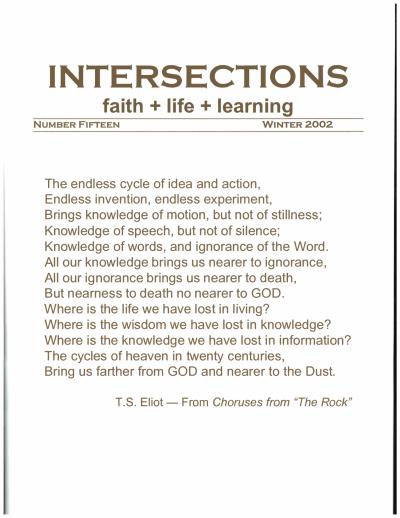
A pantoum-like Christmas-season poem in which red-robed choristers, flasks clinking and hands trembling, mangle the words of carols beneath “the midnight sky, your endless dark coat,” trusting that “it’s the season to forgive what’s vile” and that even wise men praise the humble and make glad.
-
 Article
2024 VHLE Conference: "Rooting Access" Panel Talking Points
Guy Nave
No. 60 · Fall 2024
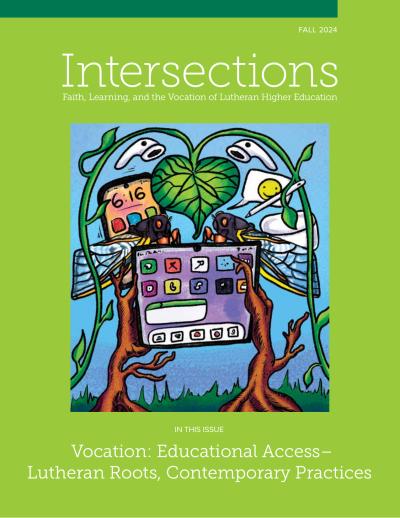
Nave reads “access” across Deuteronomy 23, Ruth, Isaiah 56, Acts 10, and Matthew 15:21-28 as an ongoing biblical conversation that evolves from exclusion to ever-widening welcome — and presses ELCA institutions to shift their focus from “student readiness” to “institutional readiness.”
-
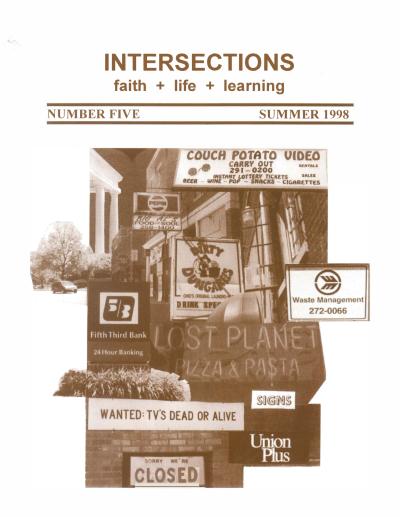 Article
Redemption Through Imperfection
Kyoko Mori
No. 5 · Summer 1998
Mori, drawing on a visit to the Philadelphia Museum of Art with a friend, contrasts Marcel Duchamp’s Étant donnés—a peephole work whose mysterious motion sweeps every viewer into a shared, perpetual performance—with the static, glass-encased Liberty Bell as parody of spiritual experience. She extends the contrast into a meditation on rituals (comfort and consolation) versus art (truth, however painful), and on writing as a redemptive process that moves from orderly first drafts toward chaos and deeper, frightening truth—closing with master potters who skewed each finished vessel slightly so that art and decoration could be told apart. Parts are excerpted from Polite Lies (Holt 1997).
-
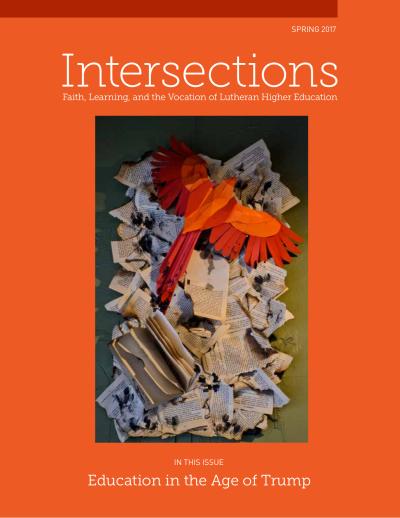 Poem
Poem
Poetry: After Months of Clouds, the Sun; First Bird
Farah Marklevits
No. 45 · Spring 2017
Two poems by Augustana writing instructor Farah Marklevits: “After Months of Clouds, the Sun” calls the reader up from a desk of doom-scrolling addiction and into breeze and light, while “First Bird,” epigraphed by Emily Dickinson, watches a robin flit through mid-January Midwestern loam as a phenological fairy tale of dread and the urge to live.
-
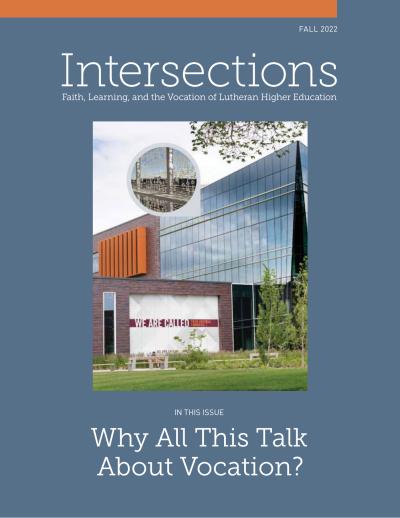 Article
Doing the Work One’s Soul Must Have
Beverly Wallace, Yolanda M. Norton
No. 56 · Fall 2022
Norton and Wallace describe the Womanist Experiential Learning Initiative — including the Beyoncé Mass, study-abroad partnerships in Portugal, Brazil, and Ghana, and the Black Girl Magic Academy for teenage girls — as a way of centering Black women’s voices in theological education and doing, as Katie Geneva Cannon put it, “the work…that one’s soul must have.”
-
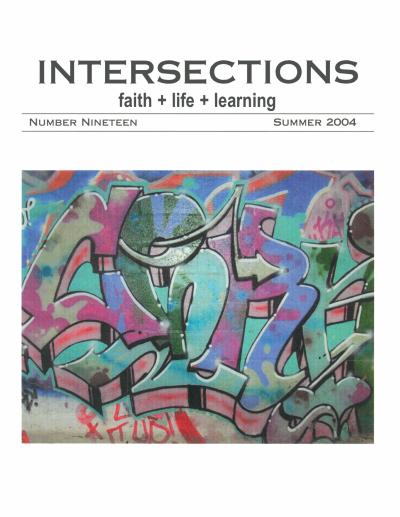 Article
The Ought
Ned Wisnefske
No. 19 · Summer 2004
Wisnefske observes that students and faculty raise contradictory objections to moral education—that students are already morally formed, and that teachers must not form them—and argues that both share the same fear of “the Ought.” He proposes that the Ought is best encountered not in front of us but behind us, nudging us, as we exercise impartiality, sympathy, and free will and discover that the persons participating in moral inquiry deserve respect; the Ought can then reform our past formations and transform our wants, so that it is never too late, or a mistake, to be shaped by it.