What special niche do Lutheran colleges and universities occupy in the world of church-related higher education in the United States? I want to address this question with reference to the primary task of higher education, namely, our obligation to enhance the life of the mind. When we ask, then, about the special niche Lutheran colleges and universities occupy in the world of church-related higher education, we are really asking, "What unique theological resources do Lutherans bring to the task of higher education, and how can those resources sustain the life of the mind?"
Before we begin, we must be clear on what we mean by the phrase, "the life of the mind." Surely, the life of the mind has little to do with rote memorization or the manipulation of data. Instead, it has everything to do with three dimensions of human thought. First, the life of the mind commits us to a rigorous and disciplined search for truth. Second, in the context of that search, the life of the mind entails genuine conversation as we seriously engage a variety of perspectives and worldviews in our radically pluralistic world. And third, the life of the mind involves critical thinking as we seek to discriminate between those worldviews and perspectives. When we ask, therefore, how the Lutheran heritage can sustain the life of the mind, we are asking how the Lutheran heritage can sustain the twin tasks of conversation and critical analysis in the context of the search for truth.
My Introduction to the Lutheran Faith
Before getting into the substance of my remarks, I want to make a few autobiographical observations. In the first place, I am not Lutheran in a formal sense, but I am profoundly Lutheran in a spiritual sense.
I grew up in a religious heritage that, at least in the days of my youth, was fraught with legalism and biblicism. As a result, I had little or no sense of biblical themes like "justification by grace through faith" until I was perhaps 20 years old. A single incident will illustrate this point.
When I was in the fifth grade, growing up in San Angelo, Texas, I always walked to school and had to cross a very busy street before I reached my final destination. I vividly recall reminding myself on many occasions that if per chance I were struck by a car and killed on the way to school, I must remember to ask God for forgiveness for all the sins I had committed since my most recent prayers. Ifl managed to get that prayer in before I expired, I had a chance at going to heaven. If not, I would be doomed to eternal damnation. You might think this a morbid thought for a ten-year old kid, but that's the way it was in my world in those years.
I don't recall hearing the gospel of God's grace until I was a sophomore in a church-related college. In a course on the book of Romans, the professor came to Romans 8: l: "For there is therefore now no condemnation to those who are in Christ Jesus." He explained to us that this text meant precisely what it said-that those of us who were in Christ Jesus had been liberated by the grace of God from the obligation to achieve perfection. I was flabbergasted, but also immensely relieved.
Some four years later, I encountered again the message of God's grace in an extraordinarily powerful way. Once again, the encounter occurred in a university classroom. This time, however, the setting was not a church college but a state university-the University of Iowa where I was working on my doctorate in the field of religion. And the class was not on Romans, but on Martin Luther. The Professor was George Porell. I shall never forget the day when Porell explained Luther's concept of simul ;ustus et peccator (simultaneously justified and a sinner) - a far cry from my earlier childhood understanding that I would have to utter a prayer of contrition before I could possibly be accepted by Almighty God. The truth is, I found Luther incredibly liberating, so much so that Luther's theology of justification by grace through faith has formed the bedrock of my spiritual orientation from that day to this.
And so I speak in this essay not as a Lutheran in a formal, confessional sense, but as a Lutheran in terms of my own spiritual commitments, at least in certain fundamental respects. I also speak as a university professor deeply concerned for the integrity of the academic enterprise. This means that I have asked myself countless times over the past twenty-five years, "How can the Lutheran worldview sustain the life of the mind?" I hope in this paper to share some perspectives on that question.
Some Comparisons
We will grasp those perspectives far better if we begin by comparing the Lutheran heritage with three other Christian traditions. I want to ask first about the theological resources the Reformed tradition brings to the task of higher education, and how that tradition is equipped to sustain the life of the mind. I want to begin with the Reformed model since that model is so widely known and embraced in many Protestant circles of church-related higher education. Then, I want to ask the very same questions regarding Mennonites, on the one hand, and Roman Catholics, on the other. Once we ask and answer these questions, we will be in a good position to ask about the special niche Lutheran colleges and universities occupy in the world of church-related higher education in the United States.
A Reformed Model
If we ask how the Reformed tradition can sustain the life of the mind, the answer has everything to do with the original vision of John Calvin. Simply put, Calvin sought to transform Geneva, Switzerland into a model kingdom of God. To achieve this goal, he sought to place every facet of Genevan life-its religion, its politics, its music and its art-squarely under the sovereignty of God. Ever since those early days, this same vision has motivated Calvinists to bring all human life and culture under the sovereign sway of God's control. Abraham Kuyper, the Dutch statesman and philosopher, expressed this vision well: "There is not a square inch on the whole plain of human existence over which Christ, who is Lord over all, does not proclaim: 'This is Mine!'"1
Clearly, the passion to transform human culture into the Kingdom of God is the driving genius of the Reformed tradition, and it is precisely this vision that sustains the life of the mind in many Reformed institutions of higher learning. Reformed educators seek to place the entire curriculum-and every course within the curriculum-under the sovereignty of God. According to this vision, all learning should be Christian in both purpose and orientation. For this reason, Reformed educators employ three fundamental concepts that underscore these objectives.
The first and most important of those concepts is a notion popularized by Abraham Kuyper, the notion of a Christian worldview. As Albert Wolters points out, Kuyper argued that "Calvinism was not just a theology or a system of ecclesiastical polity but a complete worldview with implications for all of life, implications which must be worked out and applied in such areas as politics, art, and scholarship." With such a worldview, Kuyper believed, Christianity could provide broad cultural leadership in the nineteenth century and compete head to head with other perspectives like socialism or Darwinism or positivism.2
Central to. the notion of a Christian world view stands the second conviction, the notion that all truth is God's truth. By this phrase, Reformed educators mean to say that God is the author not only of our faith, but also of every facet of the world in which we live. If this is true, then there can be no discrepancy between Christian convictions and authentic knowledge regarding other aspects of human life. It is therefore possible to understand every facet of the natural sciences, of the social sciences, and of religion and the humanities in the light of Christian faith without running the risk of intellectual dishonesty.
It is precisely this conviction that breathes life into the third concept employed by Reformed educators: the integration of faith and learning. Because all truth is God's truth, all learning should be integrated into a coherent understanding ofreality, informed by explicitly Christian convictions. No one has expressed the theological rationale for this perspective better than Arthur Holmes in his classic book, The Idea of a Christian College. There Holmes argues: When the apostle writes that in Christ "are hid all the treasures of wisdom and knowledge" (Col. 2:3), he refers ... to [the fact that] Jesus Christ is ... Creator and Lord of every created thing. All our knowledge of anything comes into focus around that fact. We see nature. persons, society, and the arts and sciences in proper relationship to their divine Creator and Lord. . . . The truth is a coherent whole by virtue of the common focus that ties it all into one. 3
It is incumbent, therefore, upon Reformed educators to integrate explicitly Christian convictions into every branch of learning and, more than that, to discover those common, Christocentric threads that transform all fields of learning into one coherent whole.
Finally, this triad of ideas - a Christian worldview, all truth is God's truth, and the integration of faith and learning - this triad of ideas sustains another notion that is critical to at least one version of the Reformed understanding of reality: the notion of secularization. The truth is, one finds in the Reformed tradition two perspectives on this theme. First, Calvin himself argued that "the Spirit of God [is] the sole fountain of truth," whether one finds that truth in the secular sphere or in divine revelation.4 At the same time, following another impulse in Calvin, many contemporary Reformed thinkers view the secular as a hindrance to the Christian presence in the world and therefore seek to overcome it by transforming it into the Kingdom of God. 5
From this latter perspective, secularization occurs when there is even one dimension of human life that escapes the sovereignty of God, or when we fail to bring all of reality under the umbrella of a distinctly Christian worldview. Because the possibility of secularization is so real in this context, the notion of a slippery slope is a metaphor that many in this tradition take very seriously. This means that if one hopes to avoid the slippery slope toward secularization, the integration of faith and learning around a distinctly Christian worldview. becomes absolutely imperative.
This consideration will become important when we compare the Reformed tradition with Lutheranism, on the one hand, and Catholicism, on the other. For if some in the Reformed tradition argue that the slippery slope to secularization is a real and present danger, both the Lutheran and Catholic traditions acknowledge the secular as a legitimate vehicle of the grace of God.
Now we must finally ask, "How can the Reformed tradition sustain the life of the mind?" Clearly, it does so by integrating faith and learning around a distinctly Christian worldview. One can identify at least two great strengths of this perspective, whether one subscribes to the Reformed worldview or not. In the first place, it overcomes fragmentation with its wholistic approach to learning. And in the second place, it provides students with a clearly defined standpoint from which they can discriminate between competing perspectives and worldviews. And if one cares about relating faith to learning at all, one is likely to find the Reformed emphasis on the sovereignty of God over the entire learning process extraordinarily compelling.
But to what extent does the Reformed perspective encourage academic freedom and genuine interaction with pluralism and diversity? There are two answers to that question. First, if a given scholar embraces the Reformed worldview, and is willing to understand all reality from the standpoint of that perspective, she or he will experience substantial academic freedom. Arthur Holmes, among others, has made this point abundantly clear.
Academic freedom is valuable only when there is a prior commitment to the truth. And commitment to the truth is fully worthwhile only when that truth exists in One who transcends both the relativity of human perspectives and the fears of human concern. 6
On the other hand, while the Reformed perspective allows the scholar substantial freedom to search for penultimate truths within the context of an all-embracing Christian worldview, the Reformed perspective is always susceptible to the twin risks of triumphalism and distortion. A hypothetical case in point might be a class in world religions. How, for example, would one study Buddhism from the standpoint of a Christian worldview without either distorting Buddhism into something it is not or debunking Buddhism in favor of a triumphalist Christian perspective?
And yet, the Reformed tradition contains at its core a powerful sentiment that can undermine triumphalism. That sentiment is simply the historic Reformed insistence on the finitude of humankind and of all human thinking and constructions. Arthur Holmes points squarely to that conviction when he writes, "Truth is not yet fully known; every academic discipline is subject to change, correction, and expansion-even theology." Holmes further notes that even worldview construction must take on tentative dimensions. A Christian worldview, he argues, is merely "exploratory, not a closed system worked out once and for all but an endless undertaking. . . . It remains open-ended because the task is so vast that to complete it would require the omniscience of God. "7
And yet, the notion that God has called upon His saints to renovate the world is such an overpowering theme in the Reformed tradition that the profoundly Calvinist theme of human finitude and brokenness sometimes gets lost in the shuffle.
A Mennonite Model
When we tum from the Reformed to the Anabaptist/Mennonite tradition, we quickly discover that we have entered into a frame of reference radically different from the Reformed perspective. The first thing we notice is that the starting point for Mennonites has more to do with wholistic living than with cognition, more to do with ethics than with intellect. One faculty member at Goshen College summarized very nicely the difference between the Reformed and Mennonite models when she observed that if the Reformed model is fundamentally cerebral and transforms living by thinking, the Mennonite model transforms thinking by living.
More precisely, Mennonites begin their task by seeking to implement a vision of discipleship that takes its cue from the radical teachings of Jesus. They take seriously Jesus' words when he counseled his followers to abandon self in the interest of others, or when he charged his disciples to practice humility, simplicity, and non-violence. Their's is a radical vision, to be sure, and one that stands almost entirely out of synch with the values of the larger culture.
One who is unaccustomed to the Mennonite frame of reference might well ask what this perspective has to do with the life of the mind. How can unconventional virtues like these possibly sustain the values we associate with the academy? Put another way, how does one move from Christocentric living to critical and pluralistic thinking?
We can answer that question in three ways. First, we must recall that sixteenth-century Anabaptism originated in the very womb of dissent. In a world that prized lockstep uniformity, Anabaptists dared to question the status quo. It matters little that their dissent began with lifestyle commitments, not with high-level theoretical formulations. Regardless of their starting point, sixteenth-century Anabaptists proved time and again their commitment to independent thinking. If a willingness to question conventional wisdom stands at the heart of the academic enterprise, then surely the Anabaptist heritage offers important resources for sustaining the life of the mind.
Second, Mennonites routinely counsel one another to abandon self in the interest of others and to abandon narrow nationalism in the interest of world citizenship. For this reason, service to other human beings, especially to the poor, the marginalized, and the oppressed throughout the world, stands at the heart of the Mennonite witness. If we ask how a global service commitment like this can sustain the life of the mind, the answer is not hard to find. It is difficult to abandon self for the sake of others in any meaningful sense unless one is prepared to take seriously those "others," their cultural contexts, and their points of view. This means that Mennonite colleges, precisely because of their service orientation, are prepared to take seriously one of the cardinal virtues of the modern academy: the emphasis on pluralism and diversity.
If one wishes to see how this commitment might play itself out in an academic context, one need only consider the international studies program at Goshen College where eighty percent of all students spend one entire semester in a third world culture where they serve, on the one hand, and seek to learn that country's history, cultural traditions, and language, on the other.
Finally, because of its historic emphasis on humility, the Mennonite tradition prepares its scholars to embrace one of the cardinal virtues of the academic guild: the willingness to admit that my understandings may be fragmentary and incomplete and that, indeed, I could be wrong.
For all these reasons, the Mennonite commitment to a life of radical discipleship can contribute in substantial ways to a vigorous life of the mind. Yet, we must also acknowledge that while the Mennonite commitment to stand with a radical Jesus is surely one of their greatest strengths, it can also be a serious liability in the arena of higher education. Ironically, the very commitment that has often inspired humility, dissent, and respect for cultural diversity can also inspire narrowness and sectarian exclusivity. This can happen in several ways, when Mennonites, for example, allow the radical teachings of Jesus to become little more than the substance of ethnic folkways, or when Mennonites take seriously the ethical mandates of Jesus without embracing with equal seriousness the grace of God whereby He forgives us in spite of our failings and shortcomings.
A Roman Catholic Model
When we ask about a Roman Catholic model for higher education, the first thing we notice is the diversity that characterizes Catholic institutions of higher learning. After all, Catholic colleges and universities were established not by the church per se but by a variety of religious orders that bring to the task of higher education a diversity of emphases. Nonetheless, we find in all Catholic colleges and universities certain uniquely Catholic dimensions that sustain the life of the mind.
The first of these dimensions is the sacramental principle which points to the fact that the natural world and even elements of human culture can serve as vehicles by which the grace of God is mediated to human beings. This conviction allows Catholic educators to take the world seriously on its own terms and to interact with the world as it is.
If some Reformed educators argue that the world and the contents of human culture are fundamentally secular if not brought under the sovereign sway of the Lord Jesus Christ, many Catholic educators, affirming the sacramental principle, take sharp issue with that contention. Alice Gallin, former executive director of the Association for Catholic Colleges and Universities, for example, has argued that '"secular' is not simply nor always the opposite of 'sacred,' for in a Christian sacramental view of reality, the secular has a legitimate role and one that is congruent with and not opposed to faith or religion. "8
This is why David O'Brien of the College of the Holy Cross points to one of the documents of Vatican II, The Pastoral Constitution on the Church and the Modern World, as a virtual '"magna charta" for Catholic colleges and universities. It functions in this way, O'Brien argued, since it affirms "the study of the human sciences, respect for nonCatholic, secular culture, dialogue with those beyond the church, and service to society," all in the context of the sacramental principle.9 Two other Catholic educators-Emmanuel Renner and Hilary Thimmesh, writing in Models for Christian Higher Education-argue that "secularization could very well mean sacramentalization to those who recognized the presence of God in the world."10
In a word, the sacramental principle sustains the life of the mind by placing a very great value both on the natural world and on human culture, and by reminding us that these realms are fully legitimate, whether transformed by the· rule of Christ or not. For this reason, the notion of a slippery slope to secularization scarcely makes sense in a Roman Catholic context.
The second characteristic that allows the Catholic tradition to sustain the life of the mind is the universality of the Catholic faith. As a global church, Catholicism embraces believers from every comer of the world, people who hold a variety of political ideologies, who speak a myriad of tongues, who represent virtually every nationality in the world, and who reflect every social and economic class on the planet today. Not only is Catholicism universal in this very tangible sense; it is also intentionally universal from a theological point of view.
The universality of the Catholic tradition should permit the Catholic university to prize pluralism and diversity and to find a legitimate place at the table for every conversation partner. Many have argued this case, but no one has done so more effectively than Fr. Theodore Hesburgh, President Emeritus of the University of Notre Dame. "The Catholic university," Hesburgh writes: must be a bridge across all the chasms that separate modern people from each other: the gaps between young and old, men and women, rich and poor, black and white, believer and unbeliever, potent and weak, east and west, material and spiritual, scientist and humanist, developed and less developed, and all the rest. To be such a mediator, the Catholic university, as universal, must be engaged with, and have an interest in, both edges of every gulf must understand each, encompass each in its total community and build a bridge of understanding and love. 11
This notion of the Catholic university as bridge, rooted in the universality of the Catholic faith, can play itself out in some very concrete ways, most notably in faculty hiring policies. On the one hand, Notre Dame has sought to create that bridge by hiring not only a diversity of faculty from a variety of faith traditions and no tradition at all, but also by insuring "'the continuing presence of a predominant number of Catholic intellectuals"' on the faculty, as the university's president mandated in 1993. 12 On the other hand, many Catholic institutions, grounding themselves in that same concern for universality, demonstrate little or no concern with this issue. David O'Brien reports, for example, that "a Jesuit dean [ at Georgetown] told the faculty that, while wisdom rooted in faith remained central at Georgetown, 'a person's religion plays no part in hiring, tenure, promotion, the awarding of grants or the securing of funds. In fact, most of us don't know each other's religious beliefs.'"13
The final Catholic commitment I wish to consider is one Monika Hellwig describes as the communitarian nature of redemption. At its core, this notion holds that the church is not simply the hierarchical magisterium; instead, the church is comprised of all the people of God, scattered throughout the world, who together form this community of faith. This means that the life of the mind, if understood only in cognitive terms, is less than adequate in a Catholic university. Instead, as Hellwig notes, the life of the mind must translate itself into genuine bonds of friendship and mutual respect and support [which] are envisaged as the core of the educational enterprise, because not only book learning but human formation for leadership and responsibility in all walks of life are sought through the community experience of higher education. 14
Precisely because it takes "seriously the unity of the human race," the communitarian dimension suggests that Catholic colleges and universities should place scholarship and teaching in the service of justice and peace for all the peoples of the world. To a great extent, Catholic institutions-and especially Jesuit institutions-have done just that. As David O'Brien observes, "president after president [in the world of Catholic higher education] has repeated the words of the American bishops insisting that pursuit of justice and human dignity is an essential work of a Catholic institution. "15
It is clear that the Roman Catholic tradition is at home with human reason, with the natural world, with secular human culture, with human history, with human beings who stand both inside and outside of the Catholic faith, and with human beings in every conceivable social circumstance. It is precisely this dimension that renders the Catholic faith, at least in theory, so compatible with the ideals of the modem university.
At the same time, it is entirely possible for the Catholic tradition to stand at odds with the life of the mind. This can happen when dogma displaces inquiry, when orthodoxy undermines the search for truth, or when Catholics absolutize those dimensions of Catholic faith that might otherwise have the potential to break through their own particularity.
A Lutheran Model
Finally, we must ask, "What resources does the Lutheran tradition offer for sustaining the life of the mind?"
The first resource is Luther's insistence on human finitude and the sovereignty of God. To speak of human finitude is to point not only to our frailties, our limitations, and our estrangement from God, from other human beings, and from ourselves; it also points to the depth and breadth of sin that renders us incapable of knowing or doing the good. When Luther argues for God's sovereignty, therefore, his point is not that Christians should impose God's sovereignty on an unbelieving world. That would be an impossible absurdity. Rather, when Luther points to God's sovereignty, he always points at the very same time to human finitude. · The sovereignty of God, therefore, means that I am not God, that my reason is inevitably impaired, and that my knowledge is always fragmentary and incomplete.
In the context of higher education and the life of the mind, this position means that every scholar must always confess that he or she could be wrong. Apart from this confession, there can be no serious life of the mind, for only when we confess that we might be wrong can we engage in the kind of conversation that takes seriously other voices. Further, it is only when we confess that we might be wrong that we are empowered to critically scrutinize our own theories, our own judgments, and our own understandings. Put another way, in the Lutheran tradition, doubt is always the partner of faith. In his marvelous book, Exiles from Eden, Mark Schwehn quotes James Gustafson to the effect that "we believe what we question and question what we believe."16 Or, as the father of the boy with the evil spirit confessed to Jesus in Mark 9, "Lord, I believe; help thou mine unbelief." One who refuses to confess that he or she might be wrong has forfeited the ability to engage in critical scholarship and really has no legitimate place in the academy.
Because of the Lutheran insistence on human finitude, Lutheran theology always has the capacity to break through its own particularity. Authentic Lutherans can never absolutize their own perspectives, even their theological perspectives. They must always be reassessing and rethinking, and they must always be in dialogue with themselves and with others. This is the genius of the Lutheran tradition, and this is the first reason why the Lutheran worldview can sustain the life of the mind.
The second resource the Lutheran tradition offers for sustaining the life of the mind is Luther's notion of paradox, a theme that stands at the heart of Lutheran thought. As we know, Luther gloried in the notion of paradox: the King of the universe born in a manger, God Himself nailed to a Roman cross, the Christian who is both free and servant at one and the same time, or finally, the Christian who is simultaneously justified and a sinner.
But of all these Lutheran paradoxes, there is none more supportive of the life of the mind than Luther's notion of the two kingdoms. In his view, the Christian lives in the world and in the Kingdom of God - or, put another way, in nature and in grace-and does so simultaneously. In fact, in Luther's vision, God employs the finite dimensions of the natural world as vehicles which convey his grace to human beings. As Luther often affinned,finitum capax in.finiti or, the finite is the bearer of the infinite. At this point, the Lutheran tradition greatly resembles Catholic sacramental understandings.
The authentic Lutheran vision, therefore, never calls for Lutherans to transform the secular world into the Kingdom of God as many in the Reformed tradition have advocated over the years. Nor does it call for Lutherans to separate from the world as the heirs of the Anabaptists sometimes seek to do. Instead, the Christian must reside in two worlds at one and the same time: the world of nature and the world of grace. The Christian in Luther's view, therefore, is free to take seriously both the secular world and the Kingdom of God.
This notion carries great implications for the life of the mind, especially if we think of the life of the mind as one which fosters genuine conversation in which all the voices at the table are taken seriously. Clearly, in the Lutheran context, there is a "Christian worldview." But in the light of Luther's two kingdoms, there is no need to impose that worldview on other voices. Nor is it important to "integrate faith and learning" around that perspective. Rather, one seeks to bring the secular world and a Christian perspective into conversation with one another. Luther's notion of the two kingdoms is therefore fully capable of sustaining a commitment to the Christian faith and a serious engagement with the secular world at one and the same time. For this reason, the notion of a slippery slope to secularization makes no more sense in a Lutheran context than it does m a Catholic context, and for very similar reasons.
While the Lutheran tradition possesses extraordinary resources for sustaining the.life of the mind, the strength of the Lutheran tradition is also its weakness. As we have seen, the notion of paradox is central to the Lutheran tradition, but it is all too easy to sacrifice one side of the paradox in the interest of the other. When the paradox dissolves in this way, the risks can be absolutism on the one hand and relativism on the other.
These temptations are especially apparent when one considers Luther's understanding of the two kingdoms. If we accentuate the Kingdom of God at the expense of the secular world, we run the risk of absolutizing our religious vision. Here one thinks, for example, of the scholastic theologians who absolutized the dynamic, paradoxical qualities of Luther's thought into a rigid, airtight system. It is safe to say that this version of Lutheran theology is simply inimical to the life of the mind. Yet, rigid codification of Lutheran thought occurs even within some Lutheran colleges and universities.
On the other hand, if we accentuate the secular world at the expense of the Kingdom of God, we run the risk of relativism since we have diminished our transcendent point of reference.
This means that if Lutheran colleges hope to draw on their Lutheran heritage to sustain the life of the mind, they must find some way to keep alive the heart and soul of Luther's original vision, namely, the paradox of the Gospel and the affirmation of the sovereignty of God and the finitude of humankind.
Conclusion
Finally, I want to make a few observations regarding the dilemmas Lutheran colleges and universities inevitably face as they seek to interpret the Lutheran vision to potential constituents.
In the first place, because the Lutheran tradition thrives on paradox, ambiguity, thoughtfulness, and reflection, it is difficult to explain a Lutheran institution that genuinely lives out of the Lutheran worldview. As the director of development for one Lutheran institution told me a couple of years ago, "It's tough to market ambiguity." This is all the more true in a "sound bite" culture such as ours. How can one possibly explain a Lutheran institution to a potential student or a potential donor in a sound bite?
While in one sense this may seem like a disadvantage for Lutheran institutions, in another sense this may well be a potential asset. Because Lutheran theological resources are unique in the world of church-related higher education, and because those resources can do so much to sustain the life of the mind, Lutheran colleges and universities have the potential to grow into absolutely first class institutions of higher learning. This means that while Lutheran educators may not be able to explain to potential donors or potential students all the intricacies of a Lutheran worldview, they can explain that Lutheran colleges and universities offer a first class education where the life of the mind is nurtured, where all questions are taken seriously, where critical thinking is encouraged, and where a diversity of cultures are valued; and that these virtues all grow from deep and profound commitment to the Christian faith.
In my view, this is the niche-and it is a special niche indeed-that Lutheran colleges and universities occupy in the world of church-related higher education in the United States.
NOTES
Abraham Kuyper, "Souvereiniteit in Eigen Kring" (Amsterdam: Kruyt, 1880), p. 32, cited in James D. Bratt and Ronald A. Wells, "Piety and Progress: A History of Calvin College" in Richard T. Hughes and William B. Adrian, eds., Models for Christian Higher Education: Strategies for Survival and Success in the Twentieth-First Century (Grand Rapids: Eerdmans, 1997), p. 143.
Albert Wolters, "On the Idea of Worldview and Its Relation to Philosophy," in Paul A. Marshall, Sander Griffioen, and Richard J. Mouw, eds., Stained Glass: Worldviews and Social Science (New York: University Press of America, 1989), p. 20.
Arthur Holmes, The Idea of a Christian College, rev. ed. (Grand Rapids: Eerdmans, 1987), p. 17.
John Calvin, Institutes of the Christian Religion, 2.2.15, in John T. McNeill and Ford Lewis Battles, eds., The Library of Christian Classics, vol. 20 (Philadelphia: Westminster, 1960), pp. 273-75.
See Nicholas Wolterstorff's important discussion of the role of the secular in Reformed thought in Until Justice and Peace Embrace (Grand Rapids: Eerdmans, 1983), pp. 12 and 40-41.
Holmes, The Idea of a Christian College, p. 69.
Holmes, The Idea of a Christian College, pp. 58-59 and 66.
Alice Gallin, "American Church Related Higher Education: Comparison and Contrast," ACHE presentation, December 29, 1992, p. 1.
David O'Brien, From the Heart of the American Church: Catholic Higher Education and American Culture (Maryknoll: Orbis, 1994), p. 49.
Emmanuel Renner and Hilary Thimmesh, "Faith and Learning at the College of Saint Benedict and Saint John's University" in Models, p. 37.
Theodore Hesburgh, "The Challenge and Promise of a Catholic University" in Hesburgh, ed., The Challenge and Promise of a Catholic University (Notre Dame, IN: University of Notre Dame Press, 1994), pp. 9-11.
Cited in O'Brien, From the Heart of the American Church, p. 91.
Renner and Thimmesh, "Faith and Learning" in Models, pp. 42-43; and O'Brien, From the Heart of the American Church, p. 90.
Hellwig, ''What Can the Roman Catholic Tradition Contribute?" p. 21.
O'Brien, From the Heart of the American Church, pp. 86-87
Mark Schwehn, Exiles From Eden: Religion and the Academic Vocation in America (New York: Oxford University Press, 1993), p. 49.
-
 Editorial
The Vocation of a Lutheran College: Some Transitional Thoughts
James M. Unglaube
Unglaube offers final reflections on thirty years in Lutheran higher education as he leaves the ELCA Division for Higher Education and Schools to join Carthage College, his alma mater. He recalls colleague Richard Solberg’s influence, the closing of Upsala College in 1995, the Higher Education and Namibia program shared with Naomi Linnell, the growth of endowments from $70 million to $1 billion in 25 years, and the Vocation of a Lutheran College project he credits Paul Dovre with inspiring. He likens the twenty-eight ELCA colleges to flowers on a rose bush—same Lutheran tradition, each blossom different—requiring constant nurture if the partnership between church and college is to thrive.
-
Editorial
From the Editor
Tom Christenson
Christenson thanks the departing Jim Unglaube, recommends Ronald A. Wells’s Keeping Faith: Embracing the Tensions in Christian Higher Education (Eerdmans) as both an interesting collection of essays and a model worth imitating at ELCA institutions, previews the issue’s pieces by Richard Hughes, Carl Skrade and Spencer Porter, Gregory Clark, and Karla Bohmbach, and introduces three new features of the journal: “What I Have Learned” (an essay by a senior or emeritus faculty member, inaugurated by Richard Ylvisaker), “Reviews” (initiated by Karla Bohmbach), and a “Bulletin Board” for cross-campus announcements.
-
Article
The Skeptical Theologian's Dictionary
Carl Skrade, Spencer Porter
Porter and Skrade offer selections from a mock-lexicon of theological terms: answer, church, faith, God, grace, hope, justification, love, prayer, sin, soul, and theology, among others. Each entry begins with a standard definition and then unsettles it—answer reminds the reader that in theology and poetry the questions matter more than their answers; church alternates between “the mystical Body of Christ” and ordinary human gatherings whose machinery often obscures the gospel; God is the One whose name we are told not to take in vain and yet whose name we keep using; prayer is communion with God yet often degenerates into a list of demands. The form’s irony exposes the gap between the language of theology and its lived realities—a sober, witty corrective for Lutheran classrooms and chapels alike.
-
Article
The University in the City of God: Beyond Dialectics and Rhetoric
Gregory A. Clark
Clark, drawing on Alasdair MacIntyre’s Three Rival Versions of Moral Enquiry, distinguishes the preliberal, liberal, and postliberal university and argues that the liberal university’s pretense of dialectical neutrality has masked a particular rhetoric of its own. Following John Milbank’s Theology and Social Theory, he holds that every philosophy and institution is finally a rhetoric and that the church’s task is not to win on the secular university’s terms but to proclaim and embody an alternative city. The Christian college, then, should give up the apologetic pose of meeting secular reason halfway and instead practice the rhetoric of the gospel: a proclamation of Jesus, an enactment of Christian friendship and peace, and a willingness to be vulnerable to the violence of the world as Jesus was vulnerable to his own. Clark commends this stance to colleges related to the church.
-
Article
A God of Peace and Love? Reflections From a Biblical Scholar
Karla G. Bohmbach
Bohmbach responds to Gregory Clark’s call to proclaim Jesus on Lutheran campuses with biblical-scholar reservations. Israel’s sacred texts also include the herem ban, the conquest narratives, and a God who fights for Israel; the Christian canon includes the apocalyptic violence of Revelation. To proclaim Jesus is therefore to proclaim a particular and contested figure within a tradition that has its own internal violence—not a generic God of peace and love. Bohmbach asks what it would mean for staff, administrators, and teachers on a college campus to take seriously the Jesus who made himself vulnerable to the violence of his world, even to the point of suffering for it, and whether Lutheran colleges are prepared for such a vocation.
-
Article
What I Have Learned: Maybe Plato Was Right
Richard Ylvisaker
Inaugurating the new “What I Have Learned” column, Ylvisaker reflects on a career of teaching philosophy at Luther College and offers four hard-won “preliminary examples” in which Plato turned out to be more right than fashionable criticism allowed: (1) communities are not necessarily better off by becoming more diverse—diversity needs a unity of purpose if it is to enrich rather than fragment; (2) politics, to be more than a struggle for power by competing interests, must rest on a moral basis that transcends those interests; (3) the much-derided body-soul dualism contains a measure of truth about the cognitive and moral limitations of embodied life; and, deepest of all, (4) reason itself depends on a community of discourse in which doctrinaire pronouncement gives way to disciplined inquiry. Athens and Jerusalem, he concludes, should meet at the college of the church.
-
Article
A Response to Paul Santmire: The Lutheran Liberal Arts College and Care for the Earth
Arthur A. Preisinger
Preisinger commends much of Paul Santmire’s earlier essay—the critique of the “back-to-nature” cult, the call for a holistic environmental ethos, the suggestion of a cosmic liturgical praxis—but takes issue with Santmire’s reading of classical Lutheran social ethics. He argues that the two kingdoms doctrine was not a systematic Lutheran treatise (the term itself became common only in the 1930s), that the doctrine’s misuse by some twentieth-century German theologians does not condemn its proper use, and that the South African Council of Churches actually deployed the doctrine (correctly interpreted) against apartheid. Drawing on Karl Hertz, Ulrich Duchrow, Tom Strieter, and F. Edward Cranz, Preisinger defends the doctrine as complementary duality—left hand and right hand of God, governances to be distinguished but never separated—and concludes with Bill Lazareth that the skeletons in the Lutheran closet are not Luther but departures from Luther.
-
Article
A Response to Paul Santmire
Don Braxton
Braxton appreciates the dialectical structure of Santmire’s mandates—“skeletons in our closets and riches in our own vaults”—and reads it as a faithful expression of the Lutheran tradition of Paul, Augustine, and Luther. He argues that Santmire is on target in warning against premature flight to non-Christian traditions for environmental wisdom (theoretical sensitivity does not translate into ecological behavior in practice), and that classical Lutheran social ethics has too often been quietistic. But Lutheran ethics at its best is dialectical, not dualistic—recognizing the interpenetration of church and world, Law and Gospel, eschatological Kingdom and present realities, as in Hegel, Ritschl, Bonhoeffer, Reinhold Niebuhr, and Larry Rasmussen. Braxton commends environmental responsibility, social criticism of unsustainable practices, and a liturgical practice of resistance to instrumentalism as appropriate next steps for Lutheran liberal arts colleges, especially Capital University.
-
Book Review
In Search of a Calling: The College's Role in Shaping Identity
Karla G. Bohmbach
Bohmbach reviews Thomas O. Buford’s In Search of a Calling: The College’s Role in Shaping Identity (Mercer University Press, 1995), which diagnoses a meaning-crisis among college students and traces two historical aspects of “calling”: the biblical, communitarian aspect rooted in the Hebrew Bible and the practical, individualistic aspect rooted in the Renaissance. She praises Buford’s reconstruction of imago dei as imagination rather than copy of God’s rationality, his broad disciplinary range (biblical studies, theology, educational psychology, business management), and his identification of the tension between freedom and limitation as the field of calling. She is sharply critical, however, of his final chapter’s wariness of canon-revisionists and multiculturalists, his caricature of “special-interest groups,” and his presumption of a homogeneous student body—a presumption that, she argues, never matched American college reality and matches it less today.
-
 Article
What is Required of You?: Higher Education Leadership in a Moral Key
Paul C. Pribbenow
No. 62 · Fall 2025
15 min audio
Drawing on Micah 6:8 and Stephen Carter’s “etiquette of democracy,” Pribbenow describes the three things Augsburg requires of every incoming student — show up, pay attention, and do the work — as a democratic social ethic that prepares students for engaged citizenship in a fractured public life.
-
 Editorial
From the Publisher
Mark Wilhelm
No. 46 · Fall 2017
Wilhelm reflects on how NECU’s focused work on Lutheran identity in higher education — including the forthcoming document Rooted and Open: Our Common Institutional Calling — turns out to be a fitting commemoration of the five-hundredth anniversary of the Lutheran Reformation, even though it did not arise from anniversary planning.
-
 Editorial
From the Publisher
Arne Selbyg
No. 6 · Winter 1999
Selbyg reports on the work of the Division of Higher Education and Schools to focus what makes Lutheran colleges and universities distinctive, recaps the 1998 Vocation of a Lutheran College conference at Wittenberg, previews the 1999 Susquehanna conference on “Identity and Fragmentation: Can the Lutheran Center hold?” (inspired by Yeats’s vision of the Second Coming), commends Ernest Simmons’s Lutheran Higher Education: An Introduction for Faculty (Augsburg Fortress, 1998), and announces a new NEH/NSF-style initiative called “The Lutheran Academy of Scholars in Higher Education.”
-
 Article
Vocational Discernment: A Comprehensive College Program
Darrell Jodock
No. 14 · Summer 2002
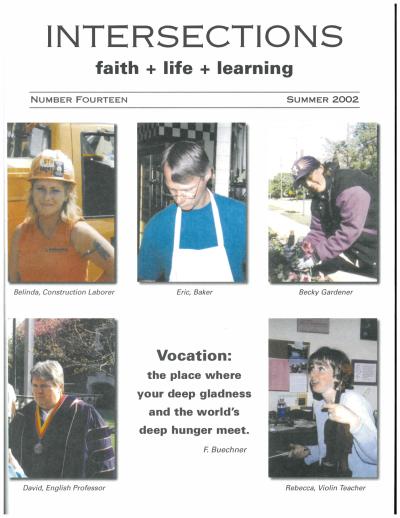
Jodock, whose Gustavus Adolphus was one of twenty colleges to receive a Lilly “Theological Exploration of Vocation” grant in 2000, defines vocation not as occupation but as a self-understanding that nests the self in community. Reading Robert Putnam’s Bowling Alone on the collapse of secondary communities alongside Luther’s ethic of community benefit and five Lutheran principles (graciousness, Christian freedom, community, God active in the world, the theology of the cross), he walks through Gustavus’s three-level design—a definition of vocation open to other faith traditions, “middle principles” drawn from Sharon Parks’s Common Fire, and a long menu of programs coordinated by a new Center for Vocational Reflection—hoping that, in the language of Holocaust studies, graduates will be “resisters” and “rescuers” rather than bystanders.
-
 Article
Professing Religion
John D. Barbour
No. 37 · Spring 2013
Barbour reflects on the vocation of a Professor of Religion at St. Olaf College, asking when and how a teacher should disclose personal faith in the classroom. Drawing on his graduate teachers Anthony C. Yu and Langdon Gilkey, and on Augustine’s Confessions, Dorothy Day, Malcolm X, C. S. Lewis, and Kathleen Norris, he argues that teaching autobiography invites teaching autobiographically—and that professing religion is finally a matter of how one believes, not just what.
-
 Article
“A Decolonizing Conversation”: Indigenous Engagement at Luther College at the University of Regina
Marc Jerry, Sarah Dymund
No. 58 · Fall 2023
Jerry and Dymund describe Luther College at the University of Regina’s response to Canada’s Truth and Reconciliation Commission — Land Acknowledgments, a Starblanket ceremony, the Project of Heart, an Elder in Residence, and the unedited video conversation with Elder Lorna Standingready that anchored their 2023 VLHE keynote.